Moving up from “What is it?” to “What sort of ‘what’ is it?”

Burdock – but is it Greater or Lesser? – Taken on the Panasonic Lumix + Leica macro lens

Coming back from the Two Valleys walk I wrote about on Monday, the new edition of Concise Flora of the British Isles by Clive Stace, was in the post box. I ordered it ages ago but publication day must have slipped a bit. The full edition of Stace 4 weighs in at two and a half pounds and this concise edition is both smaller and lighter at just over one pound. Neither edition has either photographs or paintings apart from some severely technical illustrations which, as you learn to use them, are incredibly helpful.

Stace 4 is a kind of botanists’ bible; the final arbiter on the current state of plant ID in the British Isles, and its austerity is something of a challenge. In a sense, you need to know quite a lot about the plant you’re looking at before you turn to Stace – as someone jokingly remarked, plant keys are only any use when you already know the answer. However, as time goes on, most amateurs like me move beyond Buttercups, Dandelions and Daisies to ask “which buttercup?” – there are around ten lookalikes; and don’t even ask about Dandelions. The gleeful pursuit of a better answer is always the ultimate aim, and once you’re bitten you can turn into the annoying child who exhausts you with an ever regressing set of “why” questions. In Stace, the answer is always couched in quite technical language for good reasons, because any ambiguity in a plant description is likely to lead to a poor ID. Consequently there’s no alternative but to learn the technical language. Luckily I’m the sort of weirdo who positively loves to know the difference between proximal and distal, and is ever willing to describe a trowel as being perfectly trullate.

Stace 4 is too back breakingly heavy to cart around in a bag, not least because I’m not completely weaned off the pictorial plant guides and so I would need to carry around two books rather than one. I still need the security of a set of stabilizer wheels on the botanical bike. “One day” I think to myself, “I’ll step out with just the “Concise Flora”. The book goes to bed with me and I study one plant at a time in the hope that something at least will stick to the empty cavity of my mind, and that one day I’ll be able to engage in learned discussions with all the other propellerheads on a field trip. I’m obviously a very needy person!

Anyway, enough of that flowery stuff. I’ve been mulling over the relative merits of my Pixel 5 phone camera against the Panasonic Lumix + Leica macro lens. This ought to be a no-brainer since obviously the Lumix with a fast, purpose built macro lens is going to be better. The downside is that you have to lug it around and make on the spot notes of the location and ID, not to mention negotiating the plethora of decisions about shutter speed, aperture and ISO. The ultimate downside is the shot that demands a tripod and even additional lighting. The only way to decide is to ask “what’s the ultimate aim here?

If the aim is a perfectly exposed image of gallery quality then the camera wins every time. But as a notebook, to record a plant for future reference or identification it’s hard to beat the phone camera. Control over the shutter speed really helps when you’re photographing a plant that’s waving in the wind, or tracking a butterfly and being able to exploit the macro lens capacity for creating a bokeh effect, blurring out the background and foregrounding the central image, makes for a great close-up. So I guess the answer to my question is both.

Further evidence that the wildflowers on the allotment are really working to attract visitors came with finding a Marbled White butterfly inside the polytunnel yesterday. We also noticed what is probably a Frog Spider setting up its stall on the flower of one of the Achilleas near the pond.

It’s hard to overstate the pleasure that these visitors give us. While I was watering early this morning I realized that probably half our energy now is going into feeding them. That said, the smell of beetroot wafting through the flat as it steams in a pressure cooker is a reminder that the peas, raspberries and beets we picked today are both fresher and far tastier than anything we could buy. Sometimes it seems a sin to cook them at all – who doesn’t pick peas or beans and eat them greedily on the spot? I know that I have some readers with a somewhat unhealthy interest in Borlotti beans, judging by the number of hits those posts attract, and so I’m putting up a photo of some Borlotti in full sensuous bloom. Please use them wisely!

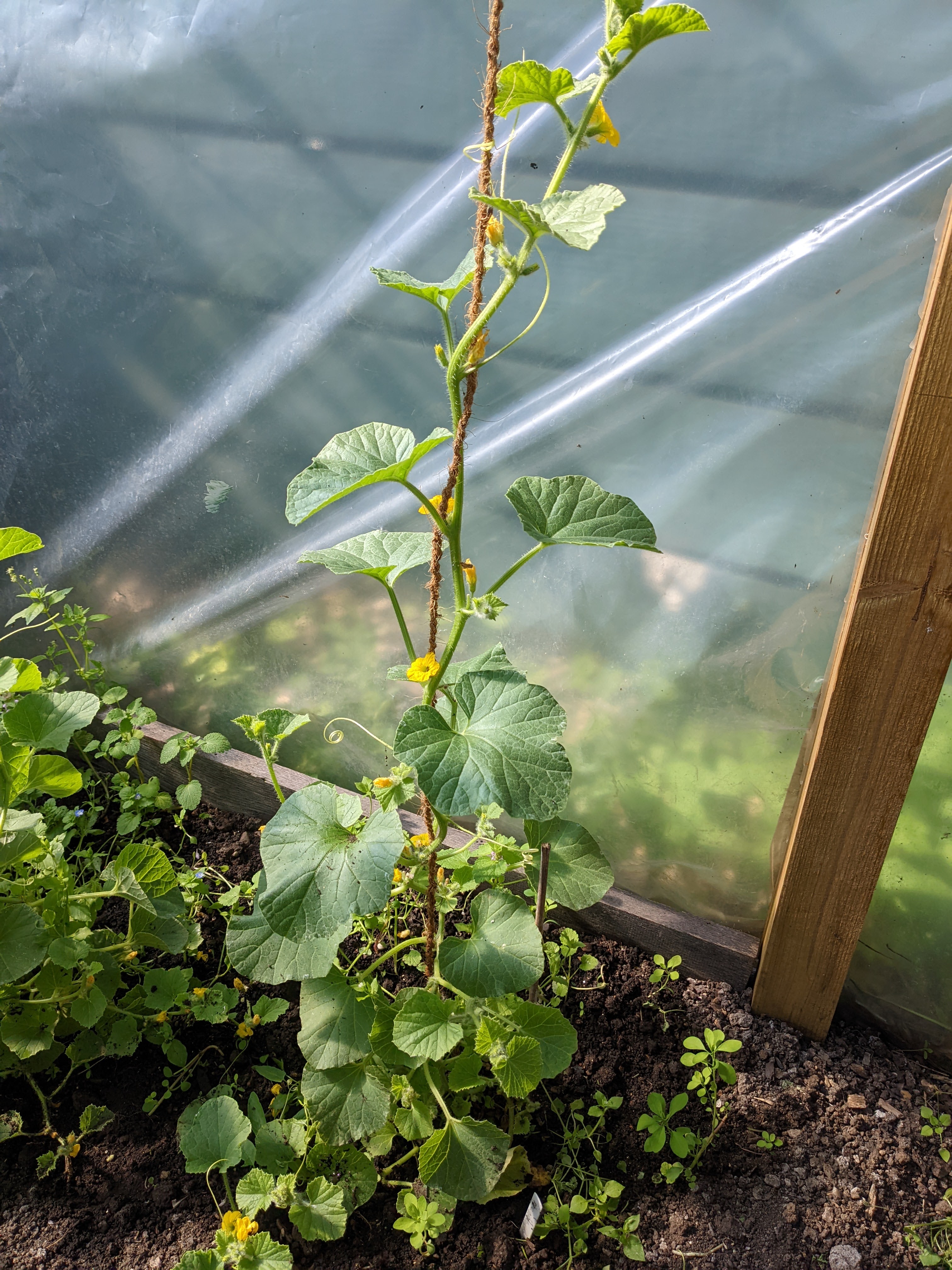
Aside from that, everything’s going full throttle on the Potwell Inn Allotment. This is one of those times in the season when we’re being driven by the plants. The Bindweed (we have to contend with two Bindweed species and last week I identified a third on the walk), – so the Bindweed is ramping through everything. We tear it off as near to the ground as we can and then it dies back and its skeletal remains reproach us until next year. There are also photos of the peppers, runner (string) beans, tomatoes and melons. Here in the UK we’re preparing for a heatwave; further evidence of the approaching climate disaster. With the government in chaos the siren voices of the dirty fuel lobby are rubbing their hands at the thought of yet more easy profits with no coherent opposition.

Not quite Adlestrop – but almost Potwell Inn!

On the day that fuel price protesters were blocking the motorways all over the country, we opted to catch the Weymouth train out of Bath Spa. It’s the small train which leaves the London main line at Bathampton turning right (that’s a technical term) via a set of points and on through the Avon Valley. In these days of diesel trains and welded rails, the characteristic sounds of the steam journey have changed from irregular beat to an even thrumming without interest – except, that is, when the train hits a set of points and clatters off to left or right with a diddley diddley diddley dum and a bit of a wiggle thrown in for good luck. At Bathampton it always feels as if we’re on the Hogwarts Express; veering off to an entirely different kind of countryside where the 1930’s Great Western Railway posters suddenly come to life and men wearing tweed jackets and trilby hats walk their labradors along the riverbank, trailing clouds of Cavendish tobacco smoke from their pipes.

Of course we weren’t going to Weymouth The train stops as often as a country bus; but the fare with our Railcard is cheaper than petrol plus parking; it’s the greener way to travel and we can stop for a pint or two at a country pub and get driven home by someone else. Anyway I love trains so it’s a no brainer. In fact we were only going as far as Avoncliff Halt and planned to do a new circular walk on what’s known as the “Two Valleys Walk” – a clever marketing ploy by the rail company . You follow the River Avon along the riverbank back to its confluence with the River Frome at Freshford. This was an excuse to revisit Friary Wood which we explored for medicinal herbs last Wednesday.

You’d think – with the A36 barely half a mile away and running along the upper half of the valley – that it would be noisy and overcrowded but it’s not. The roads into this stretch of woodland are not much wider than farm tracks and often end with a solitary group of buildings, hardly qualifying even as a hamlet. For once, in this car scorched earth, the best way to arrive is at one of the railway stations, on foot, and take the train. And, should you be lucky enough to alight at Avoncliff Halt, you climb a flight of concrete steps and meet the John Rennie aqueduct which carries the Kennet and Avon canal across the River Avon. It’s along this stretch of the river that road, rail and canal share a contour around the steep sided valley, but here at the lower level, water and peace prevail. There’s even a pub, the Crossed Guns, that does a decent meal and a pint or two; serving walkers, canal-goers and cyclists not to mention those who take the hazardous winding lane by car.

River Avon in quiet mode from the aqueduct.

Looking across the lily pads in the river to the pub it could almost pass for the Potwell Inn, but of course – being imaginary – nothing and nowhere ever lives up to the dream.

Naturally the poem that came to mind as we stood on the platform and watched the train clatter off towards Weymouth was Edward Thomas’s “Adlestrop”. A musing punctured by the cheerful heave ho of the diesel engine’s klaxon.

So off we walked down the southern bank of the Avon. It turned out to be as much a bird day as a plant hunt. Overhead we could hear and then we could see a Red Kite. A song thrush practiced its phrases in the trees where later we heard a Green Woodpecker and a late to bed Tawny owl. At the conjunction of the two rivers at Freshford Mill we turned up the riverside footpath to Friary Wood and on towards the village of Iford. We had never explored the river Frome before and knew very little about it. The village of Iford is so perfect you really feel you’ve stepped back a century and providentially, just as Madame was tackling a stile with a deep drop, the River Bailiff opened the gate for us and later, on the narrow bridge over the river, we had a long conversation about the river, the fishing and a mutual friend called Bob Talbot who ran a tackle shop in my first parish where he and Rene became my firm friends. Bob became my mentor over many an expedition on a Wednesday where I would wear my fishing clothes under a cassock while I took a communion service and scoot through the house discarding the clericals and out through the back gate where Bob would wait behind the high wall in his three wheeler, ready to whisk me away beyond the sharp eye of the Verger who would have grassed me up. The Bailiff – Ed – was a persuasive man and very nearly got me to join his angling club. We peered over the wall and saw multitudes of small Chub congregated there. He reminisced about the times when large Barbel were frequently caught and talked about the voluntary work that members did to maintain the river bank and the fish stocks.

Then a very steep climb to cross back to the Avon Valley and return to Avoncliff and the Crossed Guns – about five miles in all. Later – after lunch – we crossed the aqueduct again and waited for the train home. A perfect day, then!

Big Deal – Small Skipper

I hate the term nectaring, mostly because it’s an in-house term that distances the experts from (the) hoi polloi, and so I’ll say that this Small Skipper was feeding on one of the the Potwell Inn Lavender bushes and it was a delight to see it there. One of the claims of gardening in the way that we do is that by planting flowers to attract pollinators, they will just turn up in their thousands. That’s the theory and it’s always good to accrue some evidence. The photo, by the way, was just taken on my phone – a Pixel 5. The phone has become a marvellous tool for natural history, but insects and especially bees and butterflies pick up the least movement. Flies, with their big compound eyes, have almost no blind spots and are able to scarper even before your shadow falls on them. This, then, was a lucky shot.

The perfect way to observe and record very small creatures and plants without frightening them off comes down to a choice between a heavy long focus camera or a pair of binoculars that can focus at close range. I first saw such a pair being used to scout for liverworts on a wall on a Bath Nats walk. Later I saw them being used to scan the ground for interesting lichens. On Wednesday, maybe three years after first seeing them, we went on another event searching for medicinal herbs in Friary Woods near Bath and I spent much of my time talking to a lovely bloke who was an expert on all things insect. We had a County Botanical Recorder leading the walk and a keen birdwatcher with us as well, and so it was an opportunity for some serious learning to happen. By the end of the walk I’d resolved to get a pair of these binoculars for Madame.

It’s not difficult to feel completely intimidated by experts. I never leave home for one of these field trips without being filled with trepidation, and yet as time’s gone on I’ve realized that very few of them are professionally qualified – we’re all mostly self-taught – and I’ve yet to meet an expert (a real one that is), that isn’t willing and usually eager to share their knowledge. If you’ve ever felt too shy to join a group and go on a natural history walk, I’d urge you to give it a try. It’s dangerously addictive! So much so that that Professor Insects and me had a great laugh over one of his friends asking his wife – “has he always been like this?”

Another conversation ranged around the odd name of the Nipplewort. To me at least the flower looks nothing like a human nipple, but rather resembles the grease nipple on an old machine like a steam engine. One of the women on the walk asked me if I was also a steam enthusiast. I’m not really, but I do get very emotional around steam trains so perhaps I’ve yet to engage with that one. Anyway she told me that she’d been dragged around every engine shed in Scotland by her dad who was obsessed with steam and so she knew immediately what I was talking about. Nipple isn’t a word that gets used much in natural history.

So the photo of the Small Skipper at the top of this piece isn’t really where the rubber hits the road when it comes to field botany. The really exciting photos for me were these:

I found this plant while I was scouting around in a patch of rough woodland field edge and I thought I recognised it. I didn’t even manage to get the little clip-on macro lens straight on my phone on the left hand picture. “It’s Rough Chervil” I thought, even though I knew in the back of my mind that wasn’t right. So I trotted up to the Recorder with my trophy and asked her. “It’s Upright Hedge Parsley” she said – without a second glance. “But why?” my mind silently grumbled even as I was thrilled by actually finding one of them after looking – in a more or less blind way – for several years. “Torilis japonica” – what more poetic name could there be? So there’s the learning point; not getting it right but getting it wrong in the company of someone who knew what she was talking about.

Rough Chervil

I went back to the picture library on my phone where I had a photo of Rough Chervil that had been verified by the East Cornwall Recorder in May. It’s a tiny difference but you’ll notice that the stem joint is slightly swollen in the Chervil whereas in the Hedge Parsley it isn’t. I should say that I was only able to do this because I stuck to my guns and I’ve been laboriously working through all my photos and tagging them properly. Have your eyes glazed over yet? Anyway, joy of joys, not an hour later I found some Rough Chervil and successfully identified it properly. With field botany making a mistake in the right company can get you a two-for-one offer. The plants of the Carrot family – the Apiaceae, or Umbellifers can be very confusing because they can occasionally only be identified by examining a ripe seed with a magnifying glass; but by the end of the walk we’d found Wild Angelica and Fools Parsley too.

So far as finding remnants of a 13th century friary medicinal herb garden goes, we didn’t find anything that couldn’t be found in a dozen other places with no religious associations, but that simply demonstrates how widespread herbal medicine was, even up until the early 20th century. Coincidentally, Madame has been reading “A Midwife’s Tale” the diaries of Martha Ballard, an 18th century American midwife and healer; reading me great chunks of it to whet my appetite. I’ve got half a dozen herbals and what strikes me as I read Gerard or Culpeper is not so much the complexity of herbal medicine as the limited range of complaints it was able to address. 18th century suffering is familiar to all of us; toothaches, boils, broken bones and rheumatic complaints, “womens courses” gets mentioned a lot as do many of the complaints now controlled by antibiotics. The biggest worry is that would-be practitioners and foragers too, really need a solid background in botany unless they want to risk muddling two superficially similar plants with potentially fatal consequences; and I can vouch for the fact that it’s a steep hill to climb.

Rewilding the pavement

North Somerset is a very wildlife rich county. We can easily walk to half a dozen outstandingly diverse habitats which – because we have both a river and a canal – reach like green fingers to the centre of the city. Otters are often seen within a quarter of a mile of our flat, and in summer we can lean over the riverside and see Dace swimming in the shallows. It’s a joy. The tourist guide writers love to swoon over the honey coloured stone at sunset and we not only have parks but also a botanical garden, riverside walks and a cycle path linking us with Bristol and into the National Network that could take you to London on a bike or in a kayak. I don’t want to oversell the beauties because we’re already stuffed with tourists but living in a beautiful city with a local authority which has declared the environmental emergency feels like a step in the right direction.

This year – finally – the City Council took the brave decision to stop spraying our streets and pavements with Glyphosate. The policy seems to have met with less resistance than the clean air zone – or CAZ -which has provoked venomous opposition from those who think parking their SUV’s outside on the pavement next to their favourite shop is some kind of human right. The pollution here has not only been persistent, it’s been illegal and the Council have struggled to impose a policy that would actually work. Exempting all private cars including the Range Rovers and Discoveries was a sop to the most vocal opponents but the policy is working – although much more slowly than it might have done. The providential closure of a major HGV route through the centre of Bath during bridge repairs may have had a lot to do with the results so far.

The routine spraying of pavements was a different issue. Through traffic has been a problem for more than fifty years, but the removal of any plants from the pavements seems to be a hangover from another age; an age in which weeds were treated as an enemy that needed to be vanquished every year – as if the pavements were a war zone. The consequences of weeds were never clearly specified but unknown horrors such as pensioners tripping over were gravely hinted at. In truth, generations of municipal grounds people (I was one of them) were raised within the ancient hostilities and killing weeds gave a kind of atavistic pleasure.

So this is the first year of the new policy and we’re just beginning to see the results. Truth to tell, Glyphosate is a rubbish weedkiller in any case because more and more so-called weeds are developing resistance to it. The plants just died back and played possum for a month or two and then sprang into new life as if nothing had happened. The consequences for the rest of us were less benign, and rivers and their associated water tables have been saturated with poison which has been finding its way into our water supplies and into us. Bayer/Monsanto will claim it’s all a myth but then – they would, wouldn’t they?

The photos at the top could not have been taken on the same day and month in any year within the last decades because by now they would have gone. So it’s a complete joy to report all of these modest beauties growing within fifteen paces of our front door. There are many more, but the street is lined with Mexican Fleabane – that’s the pretty daisy looking plant. Then there’s Canadian Fleabane growing rapidly, Ivy Leaved Toadflax, Broad Leaved Plantain, Cat’s Ear, Smooth Sows’ Ear, Prickly Sows’ Ear, Dandelion, Wall Lettuce, Nipplewort, and Pineapple Weed. There’s Annual Meadow Grass and Wall Barley. At the back there’s Herb Robert, Great Lettuce and many other species. I suppose it was a matter of mindset rather than moral deficiency that kept us killing them off every year – culture eats strategy for breakfast after all and in time, I hope, more and more people will come to appreciate these miniature nature reserves on our doorsteps – after all it’s faintly miraculous that anything can survive in this hot, dry, waterless and polluted hostile environment. It’s a tribute to the persistence and adaptability of nature that these ancient residents and relative newcomers can emerge, seemingly from nowhere, miles from their natural habitats in fields and hedgerows.

The Birds and the Bees – messy gardening.

The Potwell Pond

We were in our bed this morning and Madame was reading the RHS magazine and – over slurps of tea and biscuit dunking – we fell to discussing the merits and failures of the Chelsea Flower Show. She has the advantage over me in this instance because she’s actually worked on a display there. I should say, by the way, that we were in our own bed because our trip to the Cambrian Mountains had to be shortened since the advertised campsite shop was tragically empty, and what few things there were (paralysed longlife milk and potato crisps) could only be bought for cash. Either way round it was a return journey of 20 miles to find an ATM or a pint of fresh milk and some bread.

Anyway it’s not that I’m against flower shows, in fact the old and much missed Bristol Flower Show was an almost spiritual event in my estimation. However, show gardens leave me somewhere between boredom and incandescent rage. The claim that the ludicrous expenditure of time and energy – and here I also mean the sort of energy that flows from oil wells – is somehow justified by the fact that these playthings of the wealthy are subsequently loaded onto lorries and installed as wholly artificial showpieces somewhere else, simply doesn’t add up. Neither does the claim that these chimeras might inspire us to greater gardening heights. At best they are entertainment for those who can afford the tickets, and the recent eruption of rusting water towers and post industrial, angst ridden greenwashing is an insult to those of us who actually put a hand to the plough rather than treat nature as a gawping opportunity.

Abolishing the boundary between Nature and horticulture.

The Potwell Inn allotment raises a finger to beautifully coiffed paths and chemically sterile soil. Notwithstanding the eagle eye of the Head of Allotments we bend every sinew to abolish the boundary between nature and horticulture. We have Dandelions, Common Ramping Fumitory (vanishingly rare in this area), rushes, Nipplewort, Sowthistle, Sorrel, and any other weeds that come for a season and fulfil some useful service to the birds, bees and other insects. The Potwell Inn allotment is the meeting place of all of the pieces I write. The place where gardening, field botany, natural history, birdwatching, herbal medicine, cooking and eating meld into the rather fuzzy concept of being fully human within a community of shared (and occasionally contested) values.

…….. and you can’t put it on a lorry and take it to Chelsea because it wouldn’t work anywhere except in its own unique place.

What this doesn’t mean is that the Potwell Inn allotment is an unkempt wilderness; quite the opposite. What it does mean is that we spend as much time listening to what our patch of earth seems to be saying to us as we do, planning what we would like to eat; and we’re not the only metaphorical mouths that deserve to be fed. This morning, for instance, I was watering when a young dog fox came to within fifteen feet of me and marked his territory on a compost bin. The allotment depends for its functioning upon a breathtakingly complex set of relationships of which we are just one part. Bees, flies including hoverflies, beetles and bugs; fungi and bacteria feed on our plants but provide indispensable service to us as they pollinate and predate on other pests and pass our digested green waste back into the soil . We feed them and they feed us! It’s taken seven years to even begin to crack the code.

Heaven forfend! is that Bindweed there?

There are areas where, for no fathomable reason, nothing ever grows well. The underground hydrology has its own mysterious life with a water table that seems to rise and fall and sometimes even breaks out in the form of a spring beside the cordon apples. We know the track of the sun in winter and high summer and we know where the frost pockets are and from which direction the plants need wind protection. We have discovered that plants have minds of their own and pay no attention to textbooks or common practice. Our vegetable beds are all interplanted with herbs and flowers, many of them self seeded from previous seasons so, for example we don’t actually sow Foxgloves or Borage; Lovage and Angelica. As biennials they might not appear every season but they appear nonetheless. Our fruit trees are surrounded by Garden Mint and Catmint, Marigolds, Borage, Achillia and Nasturtiums. Our only physical pest controls are various grades of netting thrown over hoops. This kind of knowledge isn’t exceptional or mystical – it was the commonplace wisdom of gardeners and farmers for generations until the misbegotten birth of industrial farming turned malignant in the 1950’s, and you can’t put it on a lorry and take it to Chelsea because it wouldn’t work anywhere except in its own unique place.

This kind of gardening doesn’t have a name; doesn’t have an orthodoxy and endures no bishops, experts or high priests. Its sole guiding reference is time, patience and rootedness.

“If we lived here we’d be home now”

The headline, by the way, isn’t mine. I once heard an American writer describing her childhood during which her father – who was a travelling salesman – would take her on interminable road trips which always ended in a more or less seedy motel.

Far be it from me to describe our campervan, which we call Polly – the hero of the Potwell Inn – as seedy. We’d prefer to call Polly “lived in” . Who cares about the odd battle scar or missing wheel trim? It is completely true that when we roll onto a campsite loaded with field guides, binoculars, drawing equipment and wine, we are at home already, surrounded by our familiar objects. After a flurry of hammering to put up the windbreak and then experimenting with the aerial to see if we can get a comms signal, we’re done. The new Netgear router and Ponting omnidirectional aerial have managed to turn a weak or invisible phone signal into a very tolerable 4g+ signal between 10 and 50 Mb/sec.

This time we’re in the Cambrian Mountains in mid Wales – not very far into them because the roads are at best tiny and more likely nonexistent. However we’re parked up next to the River Towy which surrounds us with a comfortable babbling sound overlaid by sheep on the hills- could anything be more restful? It’s one of the least visited wild places in Wales which means it’s really quiet. Typically, as we drove in, I remembered that we’re in yet another quarry/mine. The last campsite which was only ten miles away by road had seen 500,000 tons of shale rock extracted to get at the “dirty” quartz” which, when each 10 tons was pounded, milled and treated with mercury (which necessitated it being taken to Germany for processing), yielded 1g of gold. The mines were first opened in Roman times but then became disused pretty much until a succession of Victorian and early 20th century entrepreneurs lost their shirts on them. The problem seems to be that they needed to pay their miners whereas the Romans used slaves. As you see – nothing much changes. A perfectly viable industry closed down by militants who expected to be paid for risking their lives!

Anyway the trip round the mine was fascinating, especially as we had a professional geologist as a guide. What was equally interesting for us was that we emerged into a path that took us through a lovely wildflower meadow where we clocked several plants I’d never seen before including one relative rarity which necessitated a very friendly exchange of emails with the County Recorder who corrected one and verified another, (whorled Caraway). Yesterday we went back again for a closer look and confirmed that the whole field was full of marsh plants – a highly distinctive habitat known in Wales as Rhos and in Devon as Culm. Who’d have thought of marsh plants on a boiling hot day 600 feet up a hill. Happy days! So, with a couple or three records accepted we wandered back down and found Valerian, Bilberries and these stunning Fox and Cubs – at least three times as tall as I’ve ever seen them before. An ideal photo to accompany a piece about gold mines I think.

Fox and Cubs – Pilosella aurantiaca

The mine workings have mostly been removed, but some authentic pithead gear was brought from another gold mine in North Wales and there were enough industrial artifacts around to give a real sense of what went on there.

So today we drove around to Rhandirmwyn where we found many interesting fungi three autumns ago. The immediate quarry (deliberate pun I’m afraid) is to find Spring Sandwort which I’ve probably missed on Velvet Bottom but may well still be in flower here – if it even grows here. On the map there’s one record somewhere near here but nothing else for many miles. That’s one I’d love to get a record for! – it’s one of those lead loving plants that thrives on polluted slag and there’s an enormous abandoned lead mine within easy walking distance – as long as Madame doesn’t put her foot down; or rather refuses to put it down in search of yet another little white job!

What about the allotment? you may well ask – in the tone of a concerned social worker. Well, allotments are communities and we look out for one another so our neighbours are watering the polytunnel and the rest can look after itself. Meanwhile we’re having a ball in spite of the fact that rain is forecast for the whole of our stay here.

Oh no! not another post industrial site?

Afon (river) Cothi

We were looking for a couple of not too far apart campsites in mid-Wales and decided to combine a third trip to Rhandirmwyn with a few days on the National Trust site in Dolaucothi, where there’s a chance to visit a gold mine that was first opened by the Romans. What we didn’t realise until we read the information boards at the campsite was that the site itself is built on a disused opencast mine. Having said that, there’s not the remotest sign of its previous history – excepting the horrendous difficulty of getting a peg into the ground. I guess potential visitors are put off by the lack of facilities – no showers or loos – and possibly by the apparent absence of even a pub in the village. We did take a look for it but notwithstanding the sign offering a warm welcome for visitors it looked as if it had died in its sleep during the lockdown. We only have three neighbours on the site and they’re all the frantically energetic types, burning off the miles on their bikes in the intense heat.

Last evening we sat entranced by the sounds of Ravens in the midst of a fierce dispute. A Song Thrush dazzled us with his repertoire of short phrases and squeaks from an oak tree just above our heads – I particularly liked the cover version of the Red Kite call worked into the more fruity flutey bits – I bet that’s a great pulling phrase for the females. A buzzard that looked more like an eagle ranged over us in his imperious way and then dived like a stooping peregrine at some unfortunate animal beyond the trees. A robin perched, waiting for careless crumbs; a tree creeper crept up a nearby tree and a Green Woodpecker took off behind the campervan. It’s a post-industrial arcadia. Today we took the official walk alongside the river Cothi and Madame spotted a Pied Wagtail in the stream. Ten minutes later she spotted what she was sure was a red squirrel. This was an unconfirmable sighting because it was so brief and against the light, but the Dolaucothi Estate is a part of the project to protect and restore the Red Squirrel population hereabouts and we’re barely half a mile beyond the boundary. The last time we saw Red Squirrels was on a campsite down in Les Dombes in France.

The trip to the gold mine happens tomorrow and interestingly the acting warden of the campsite also doubles up as a guide there. We chatted for a while and he said they do Victorian tours as well as Roman tours and so it sounded to me as if the mines were re-worked by the Victorians who were often careless about the polluting effects of mine waste. So – there being no cloud without a silver lining – I’ll be looking out for any specialist plants growing amongst the slag. I did a quick check on the species list for this immediate area and it’s surprisingly small when compared with the whole county list.

These sites are marvellous evidence of the capacity of the natural world to heal itself after the grave damage caused by industrialisation. However this has taken a century or more to accomplish and with a looming climate catastrophe we just don’t have that much time.

I had a revelatory moment during the Song Thrush performance when I turned off my new hearing aids (God bless the NHS) and I realized that I couldn’t hear the song at all. At the last test the technician told me I am now moderately to severely hearing impaired. I know that when she fitted the new ones I boasted that I’d just keep them in all the time like I did last time. She gave me one of those undefinable looks and said she thought I’d take quite a while to get used to them. As I left the hospital I was almost overwhelmed by the noise and for a couple of weeks I was absurdly emotional when I heard quite ordinary sounds that I’d not heard for years. Even the sound of a kettle boiling in the kitchen would be unendurable. Now, taking them out at night is a nasty shock.

The photo on the right is of a Lady Fern; markedly softer than the Male Fern or Bracken. I hardly know a thing about the Pteridophytes mainly I suppose because they all look the same until you look at them properly. On the left are three photos of Wood Avens – Geum urbanum, also known as Herb Bennet. Now Bennet is often spelt Benet and is a contraction of Benedict – the founder of the Benedictine order of monks. This made me sit up because next week we’re going on a field trip to woodland on the site of an ancient friary, with the intention of searching out medicinal plants that may have survived the centuries since the dissolution of the monasteries.

The drug companies and the medical profession are outwardly dismissive of herbal medicine, but that doesn’t stop them from trialling the plants used by traditional herbalists in search of useful chemical compounds because, as we all know, plants are little organic chemistry laboratories and many of the most powerful drugs are derived from plants, or synthesised to imitate the work of nature. It’s baking hot here and Madame is snoozing outside under the awning. Later this week we’re moving across to Rhandirmwyn where there’s a tasty abandoned lead mine. It’s also going to rain. I love these post industrial places – they’re so beautiful – honestly. My cup overfloweth!

Where’s Wally?

No – this is a wildflower meadow! (with apologies to Crocodile Dundee)

Below this, at the bottom there are three photos of orchids we found today at Whitefield and one of them is in the wider view above. As I mentioned a couple of days ago, as we approach the summer solstice we’re often awake really early, and so we do as much as we can on the allotment before breakfast and the we have the rest of the day to walk and look for wildflowers. We had spotted the Pyramidal Orchids and another one that I misidentified as Early Purple – they were Common Spotted – for which correction I’m indebted to an impulse buy on Monday when I saw the Wild Guide to orchids and decided I couldn’t live without it. It’s a brilliant guide and it’s already slapped me on the wrist a couple of times. So with those two species under our belts we went back today to see if we could find a third Orchid that we knew was there but which we’d never found. Thanks to the book I now know that they don’t flower every year which may help to explain why we haven’t found it until today. So as Madame scanned the field with binoculars and I looked at the path edges she gave a whoop and pointed to a group of Bee Orchids. Three Orchid species in a field within 100 metres of one another makes for a good morning’s plant hunting; and that’s apart from the multitude of other goodies. So without further ado .. from left to right the Pyramidal Orchid, the Bee Orchid, and the common Spotted Orchid. But which one is it in the picture at the top? Go find!

Watering, weeding, watching and witnessing!

Up at Priddy last week we went for a long walk, introducing our youngest son to some of the sheep droves that make wonderful (and sometimes very lengthy) wildlife walks. We stopped off at the pub – naturally – and feasted on some delicious and very high carb old style pub cooking; but on our way towards it we noticed the field in the photo above that had a recently cut border of something that looked like a red-leaved grain. None of us had any idea what it might be, but there’s a notice up there with the farmer’s phone number on it so next time I’ll make a note of it and ask what it is: desperately hoping that it won’t be some sort of chemical spray.

The soil up there is thin and better suited to sheep farming, so any exposed soil on arable fields always looks impoverished and stony. Several times we’ve spotted small herds of wild deer browsing there. Crossing the fields back from Eastwater Drove to the village green, passing Swildon’s Hole on the way, we encountered a solitary caver walking back along the same path. Many of the fields, although they lack the sheer density of White Field at Dyrham Park, are very rich in wildflowers. What’s interesting is that different species seem to dominate each different environment. As we walked along the Green past the thatched piles of hurdles that are brought out for Priddy Fair every year, we spotted some eggs for sale and bought half a dozen mixed. The next morning I cracked a couple open for breakfast and they sat up beautifully – in perfect condition for poaching.

After this prolonged dry spell our rapidly growing plants need a lot of water, and today we were up at six before the heat got too much for us. This time of year it’s all weeding, watering and waiting on the allotment. We’ll have our first feed of new potatoes and broad beans tonight – that’s one wait I’m glad to end! Weeding is a constant job because we don’t want any of them to set seed or develop stolons or rhizomes. As I was watering I drenched the borders of the pond and a fully grown frog shuffled out of the way. I can’t begin to express how pleased we were to see it. This year none of us have had frog spawn and we were afraid that the disease that’s rampaging through a lot of amphibians had taken them all – but this one looked absolutely fine to me. Yesterday I spotted a hoverfly, one of the handful I can name; Helophilus trivittatus – it doesn’t have an English name. I remember it because its larvae are rat tailed maggots – weird looking creatures with long snorkels.

The best thing about early starts is that we can take longer walks during the day. Yesterday was a ten miler along the river and back down the canal. As we came back into Bath I noticed some Figwort growing at the edge of the path and so I took photos because I don’t recall seeing it there before, and did my best to ID it before emailing the photos to the Vice County Recorder with my suggestion of its identity. I was almost right, but I’d failed to notice two very small details that made it Water Figwort rather than the (less common here) Common Figwort. Anyway, I provided so much detail she was happy to make it a record and I get the credit for noticing it while she gets it for knowing exactly what it was.

Does it matter at all? Is all the voluntary effort to record what most people would regard as weeds actually worthwhile? That’s where the witnessing part of the title comes in. When you walk through a field of chemically supercharged and weed killed Ryegrass it still looks like a field – until you get down on your hands and knees and look more closely and discover there’s nothing there but grass. Yesterday we passed one of our local homeless people with an obvious addiction problem. He was emaciated – bent over and looked as if he might not last a fortnight. I think of these intensively farmed fields as an exact parallel. Whether you’re addicted to crack cocaine or chemical weed and bug killers, you get sicker and sicker and then you die. I try not to dwell on this because it makes me sad; but if we don’t record what’s left now after fifty and more years of intensive farming, then these wonders will slip away and the whole earth will suffer before we wake up one morning and wonder when the last cuckoo was heard, or when the pollinators all died. That’s the witnessing bit. I can’t say whether we’ll succeed but we won’t let up in our mission to record what may one day be lost.

Sometimes I share the mess with an aphid

If you like, you might see this as (probably the only) candid photograph of the Potwell Inn. As you see, it’s not glamorous and – as a friend once pointed out – the stack of interconnected six way sockets under the desk are dangerous and possibly illegal; but it’s where I go to skulk, ponder, remember, puzzle, dream, study, read, write and occasionally paint. The shutters are half closed because that way I can avoid looking at the car park and enjoy the roofs of a Georgian terrace and a couple of trees sunning themselves under the blue sky and summer clouds. Skies, like railway lines, link places together in the imagination. Sometimes I wonder how it’s possible to be homesick when you’re at home and I don’t know the answer, except that the Potwell Inn is the closest to the home I pine for, and like any self-build project it seems to be taking an eternity to create.

Last night a group of travellers pulled onto the green – there were something like ten trailers and an assortment of people from burly men who looked faintly terrifying, a big gang of children who wrestled, tumbled and played on the green with full hearted enthusiasm while their parents stood, arms folded, defying the twitching curtains. A policeman turned up on a bicycle and some negotiations took place – he seemed to be on first name terms with them. When I spoke to him later he said that he was surprised to see them because they usually parked up on Lansdown. I said that at least it would force the drug users and their dealers to find somewhere else. He ignored my remark resolutely and said that the Council would get the paperwork to evict them first thing in the morning. We stood and watched the children playing joyously and felt almost envious of their freedom. Then suddenly they all packed up and left, like a circus leaving town and the green felt empty once again.

The Potwell Inn is a bit like that. It can appear and disappear like the mirage of an oasis; a fugitive dream when you’re lost somewhere between the Favella and the Steppes; and I’m always searching for that sweet spot in between.