“Run the economy like a business” – are you completely batshit crazy? we need to run it like a garden!

Another night of strange dreams led to a sleepless night for Madame as I tossed and turned and made (as she described them) weird noises. I dream a lot, and years of work – hard work too – with a psychoanalytic psychotherapist, have taught me to treat them with the utmost seriousness. So here’s the deal – my dream was about cutting metre square sections of rough grass full of weeds, and setting them out in the usual unspecified way, to conduct an experiment concerned with watching weeds grow. I even dreamed of setting the trailcam to time lapse mode in order to get a continuous film of them growing. Principal among them was our old garden enemy – Bindweed.

Then this morning I was reading Robin Wall Kimmerer marvellous book – “Braiding Sweetgrass” when a connection dropped into place and I was able to see a very small part of a remedy for the crisis we’ve now created for ourselves.

The hot seat!

Allow me a small diversion to help explain the background. I was a school governor for over forty years and in that time we interviewed at least six head teachers. In spite of endless pains we still managed to appoint one complete dud but otherwise they were great human beings with a passion for making children into moral grownups. We interviewed them over two days, handed them heaps of data and gave them an hour to read and digest it then come up with a viable step by step plan. We tested their management and leadership skills by asking them to debate the difficult data with other candidates. We watched and noted those who could embrace challenges thoughtfully and without becoming defensive. It was exhausting for us and even worse for the candidates, but slowly the best candidate for our particular school – with its own unique history and challenges – would emerge.

If you compare that level of diligence with the present election for Prime Minister you will understand immediately how our political system makes such terrible decisions. As I once heard on a bus on the way home from Southmead – “That Jack B …….. he can’t tell shit from pudding!” I have a whole collection of those kinds of remarks, overheard from people who stretch the colloquial into Shakespearean beauty. We have a parliament full of people who share Jack B’s incapacity.

So back to dreams and weeds and revelations, and the connection is this. When we plan the next season on the Potwell Inn allotment we pay attention to the space we have, the nature of the local climate and its variabilities; the soil and its state and – in particular – we pay attention to our own needs. Do we need fifty purple sprouting plants? How many pounds of tomatoes do we really need?

And we also know that our land isn’t just for us – it’s for the thousands of species that – while we can’t eat them – play a vital role in the ecology of the plot. Some of the pests who predate upon the pests who damage our crops are visible – frogs, toads, parasitic wasps and so forth. Some are microorganisms. Some are mixed blessings – badgers for instance; and foxes, cats and even rats play complicated roles of fleas and smaller fleas in the terms of the old rhyme.

Weeds and pests and their many interactions play such a huge and poorly understood role in the overall health of the plot that we leave them alone. So to chase down an analogy – we either draw a binary distinction between friend and foe, and then bomb the foe out of existence in the manner of intensive chemically driven agriculture, or we nurture the richest possible mix of living creatures and edible plants and allow nature to find the kind of balance that allows us a crop, reduces pest damage and leaves the soil in good heart. And it really works!

Running the economy – and especially the ecology – of the earth as if it were a business completely focused on financial profit and loss is a form of ideological madness. Public goods are very hard to monetize, and yet we know that climate destruction brings tremendous costs. We know that farming practices which lead to wholesale species destruction will result in food shortages. We know that viruses can cross over between animals and humans and cause pandemics, and we suspect that the destruction of animal habitat through forest clearance makes this possibility greater. We also know that intensive farming of any kind causes pollution; carbon release and therefore global heating. The point of this line of argument is to emphasise that running the earth as a business so often ignores the cost of adverse consequences. If the full long-term costs of maintenance and disposal of radioactive waste are added to the business plan no investor in their right mind would take the risk. Sadly our government is able to use our money to make us compulsory investors in this dangerous industry.

Running the economy – basing our governance on its impact on the whole earth would make big business howl. Just as an example – the current price of all electricity is based on the inflated price of fossil fuels. This represents the mad economics of subsidising the oil companies by penalising renewables. In a genuine – that’s to say not rigged – market. The renewables would outcompete the fossils on price and the oil and gas producers would have to invest their ill gotten gains in renewables in order to stay in business at all. This is not fantasy economics.

Why weeds then? Why embrace pests and predators? Because any unstable ecosystem will be made more stable if a natural balance is reached. Climate catastrophe is the end point of ignoring the instability made worse by politicians who make stupid policies such as running the economy like a business – and then facilitate the predatory activities of corporate behemoths.

James Lovelock died this week. His Gaia theory gives us the best possible tool for understanding the harm we’ve done to ourselves and future people. The key is going to be diversity. The binary world of bad science and dangerous politics needs to be swept away so we can learn to tend the whole earth – in all its inspiring diversity – as a garden.

Barm pots in high summer

A very happy sourdough starter

There are two pieces of kitchen ware I’d dearly love to own but I’ve never found at a price I could contemplate. They were utterly commonplace until the end of the 19th century but fashions change and these days you’re more likely to see them adorning a high-end gastro pub, or in a museum. Both of them are associated with baking; they are the barm pot – used for keeping a (mostly) yeast starter alive, and a combined mixing/proving bowl. The bowl I have used forever is a very scratched Pyrex bowl – it’s been a familiar friend for over fifty years and the barm pot, sadly, is a cylindrical 500ml Lock and Lock plastic container which just happens to be the one I created the first sourdough starter in years ago. It’s the one in the picture.

Being a potter by (long neglected) trade, I could easily have made both objects in brown and cream slipware, but for all their artlessness they’re fiendishly difficult to make a good job of. The second reason is that many of the most delightful examples of traditional slipware are lead glazed – it’s what gives the glossy melted honey finish that’s not easily replicated, and so I’ve carried on baking with same pair of less glamorous but perfectly serviceable containers that I do own. Of course it doesn’t matter what you make bread in – it’ll still tastes the same. Lead glazes are no longer used because they were so dangerous both to the potters and to anyone who was silly enough to store acidic foods in them. Village baker Bryan English – a truly delightful man – still used wooden proving chests until he retired. His wife Jenny was always known to our boys as “Mrs Bun”.

Anyway, this long chain of associations came about because having neglected the sourdough starter for ages in favour of quicker yeast bread, it had grown sulky and sad; so much so that I was rather afraid I’d killed it. But long experience shows that these sourdough starters are far more resilient than the people who write books and sell bakery supplies would have you believe. After all, it only takes a few cells of the wild yeast to fall into your initial starter to get the whole thing going, and so I guessed that among the casualties there would be thousands of still alive cells that just needed a feed; and so it proved to be. After a week of intensive care and feeding up the result is a barmy, fizzing mass of eager starter and the first batter is sitting in its Pyrex bowl on the side. There’s no reason to be paralysed by the mysterious process, these wild yeasts are as tough as old boots. If you can dry them out and send them around the world by post then why would they expire so easily in the container?

2 Kg batch of tomatoes on the way to becoming 4 X 500ml jars of roasted tomato passata.

Meanwhile, we’ve started harvesting ripe tomatoes from the polytunnel. Most of these early crops will be turned into sauces and different recipes of passata for storage. We’re completely self-sufficient in these base sauces, and along with drying them and eating them fresh they’re probably the most valuable crop we grow. What with the blackberries yesterday, and now the Mediterranean aromas of tomatoes shallots and fresh herbs, roasting in the oven, this marks a change of seasonal gear change on the allotment. High summer means more time in the kitchen, and more time spent in frantic searching for clean jars and lids.

It’s relentless work in the kitchen but that’s where the focus needs to be if we’re to make the most of our hard work on the allotment. We did manage to find an hour so go to an exhibition of Mary Fedden’s work in Bath and I felt utterly at home in her lovely paintings, any one of which I’d love to have – but hey! we did at least see them and they perfectly displayed – in two dimensions – the tricky business of being human; an unfashionably domestic kind of life.

Early this morning we went to the market and whilst I was standing in a queue for the farm milk dispenser a casually (but perfectly judged casually) dressed woman passed me to stand beside the man at the machine, who had his back to me. She immediately apologised and said “I’m with him”. I replied – hoping to make a joke of it “I wasn’t planning on hitting anyone!” She flinched a bit, which seemed odd and the man at the machine turned around and they went off together. I had the strange feeling that I knew him from somewhere and Madame (who’s brilliant with faces) said – “you know who that was?” “No” I said. ….. “it was X” – a well known minister in the Thatcher government. The flinch suddenly made sense. Ah well, welcome to the hostile and divided Malthusian world you helped to create my friend. What goes around comes around.

Just the most utterly delicious roasted tomato passata.

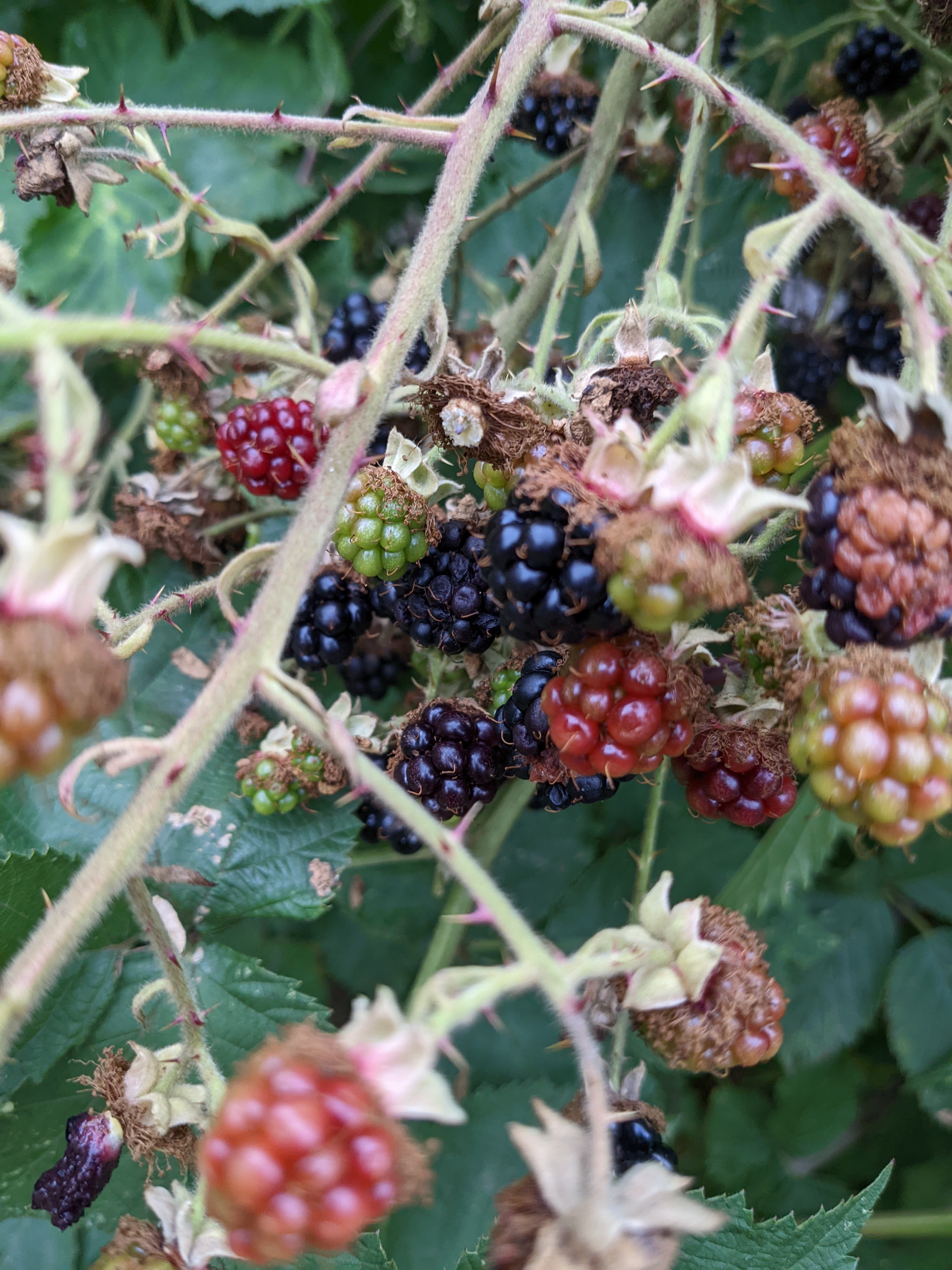
Runaway season brings early blackberries.

I was going to write about our polytunnel tomatoes which have done very well this year – just loving the hot weather. So a piece I was thinking about on the making of panzanella will have to step aside because we were totally gazumped by the blackberries yesterday.

Given the number of privateers who like to climb over the fence and nick our produce without the bother of paying for it or growing it; we’ve capitalized on two of the most useful properties of the blackberry, that’s to say its murderous thorns and its ability to put down roots whenever one of the shoots touches the ground. The third property never really entered our heads, that’s to say the marvellous eating qualities of some wild blackberries. That italicised “some” comes from the fact that the blackberry hybridizes like nothing else, and whilst they all look pretty much the same they vary in palatability from heavenly to a mouthful of sour grit. So what are the chances of choosing a random blackberry to make a fence impregnable and hitting on a bigger, sweeter and more fragrant variety than any of the professionally bred hybrids we’ve all been planting at no little expense.

The downside of this horticultural magic trick, is that word gets around and a polite but steely middle class battle to harvest the fruit is conducted. There are no rules, but the winner takes all. This year we won! And after a dawn raid we came home with a carrier bag and four pounds of sweet blackberries plus a few assorted spiders and grubs.

It was an early encounter with blackberries that introduced me to the spiritual conundrum – that the profound gratitude I was feeling had no home to go to. Who to thank for this outrageous generosity? It’s a question I’m still working on – so please, no easy answers! I’m ashamed to say that we repaid the generosity by making forty pounds of the most disgusting chutney ever, and giving it away to friends. That’s probably why we haven’t got many friends.

Good blackberry bushes, like good spots for harvesting field mushrooms and other fungi are family secrets and never divulged to strangers. Just as when asking farmers how they’re doing you expect nothing more than noncommittal shrug and a mournful shake of the head so too, the passing stranger – asking if the blackberries are any good – will likely be told that they’re very poor indeed, but the rabbit seems to like them; but in the secrecy of the kitchen where the ripe berries have a perfume as fugitive and erotic as truffles, we hug one another and celebrate our great good fortune. In the midst of bad news we’ve pulled a rabbit out of the miserly hat. My uncles were pretty good poachers apparently and doubtless shared the same feelings.

Of course, harvesting them is one thing and locking that exquisite floral perfume into food is another. Blackberry and apple pie never really floats my boat and blackberry jam shares the same pippy texture even when the perfume is there; and so my very favorite way is to make bramble jelly. It’s tricky to make because it needs a bit of pectin to set it and if you add apples you tend to lose the glossy burgundian transparency and so we use proprietary jam sugar which seems to give a better finish.

The other challenge is that the fragrance is really very fugitive and so gentle cooking followed by the shortest possible boil to setting point is the only way to lock in the perfume of the blackberries; but when you bring it off, it’s worth all the faff. Jelly making always seems a bit wasteful but I usually let the initial ingredients drip for at least 12 hours. Our blackberries yielded just under a litre of juice (another reason for finding the best bushes) and with under a couple of pounds of jam sugar it made four and a half small 14oz pots which will only be brought out for special occasions. I remember my grandmother dropping a spoonful of bramble jelly on a rice pudding as a special treat.

And so an intimation of the harvest came early in this season of drought and heat – but it sent us singing into the kitchen where Madame cooked while I assembled the first panzanella of summer. If the Government Scrooges knew how good it felt they’d make it illegal!

Wildflower? Weed? Herb?

In the foreground Creeping Thistle, and in the background Ragwort

Allotments very quickly get out of hand, such is the vitality of nature, and so the photograph of this neighbouring allotment isn’t the product of idleness or long abandonment but simply because the allotmenteers were unable to tend their plot for a couple of months due to circumstances beyond their control. Most interesting to me is the fact that the shot shows two of only seven UK plants which are legally notifiable. They must be removed by law. If Ragwort is incorporated into hay and dried it’s capable of killing livestock – whereas whilst growing in the ground – livestock avoid it. Creeping thistle is a menace because its rhizomes spread aggressively – rather like bindweed – so from an allotmenteers’ point of view it’s the more pernicious of the two. I won’t bother to illustrate the bindweed because anyone who’s ever gardened will instantly recognise those white underground rhizomes. But the Creeping Thistle is tricky because most ordinary gardeners are less likely to recognise it. Here are some more photographs :

It’s all too easy to uproot one of these thistles and, finding something that looks very like a tap root, conclude it’s one of the other less pernicious ones. Unfortunately you have to dig deep – really deep – to find the thick white rhizome that spreads like wildfire. Those plants that grow from seed – and it produces a great number – grow a tap root in the first year and then develop the rhizomes in the second. Fortunately the seeds aren’t that successful, but even a tiny percentage of many thousands can soon turn into a problem. The best way of dealing with them is to uproot them before they flower – as in the left hand picture – when much of their energy has gone into making seeds. The four roots in the middle picture were loosened with a fork and pulled firmly to extract as much as possible, but even so they snapped off leaving much of the rhizome intact and ready to produce more plants. All we can do is hope to weaken it by frequently pulling them up. Madame and I were talking about this yesterday and we thought that the only domestic animal capable of eating thistles is probably a goat. We kept one back in the seventies and she would eat absolutely anything. Brilliant for clearing scrub!

Ragwort is a biennial and, once again, needs careful pulling to reduce numbers; but neither plant will ever be eradicated entirely because they have developed resistance to farm chemicals. Organic control (there’s a good leaflet on the Garden Organic website) is the only option for those of us who opt out of using chemicals.

Of course there’s a downside to controlling these plants because they are both highly attractive to pollinators and they make a lot of nectar ; so removing a weed also removes an important nectar or pollen source as well as a food plant for some of the butterflies and moths we most treasure. Our attitude towards so-called weeds exposes the mindset that places our human needs above the needs of all the other creatures. I’m not suggesting for a moment that we should let these weeds take over our plots, but I am suggesting that many of the small decisions we make on the allotment have an ethical and philosophical component that make our lives that bit more complicated; more morally responsible.

I’ve spent fifty or so years working with people who’ve got themselves into terrible trouble, because they came to a tipping point through countless tiny steps. Nobody sets out to kill all the bees, but they die anyway because a lot of people making little bad decisions can add up to a crime against the earth. These days we’re all creating wildflower gardens, but we shouldn’t neglect the contribution of less popular weeds. Even couch grass offers a particular niche for the Gatekeeper butterfly, and stinging nettles are vitally important for the Comma. Ragwort too is the foodplant for caterpillar of the Cinnabar Moth. While I was taking the photos for this piece I noticed that our Buddleia was devoid of butterflies, whereas I spotted five separate fly/insect/beetle species on the Ragwort. So what I’m suggesting is probably enough to give many gardeners apoplexy, but what is the real danger to an allotment site that would result from a few neglected patches around the edges? Another of our neighbours had an allotment that was truly out of control and, when she got a rude letter from the council, she sprayed it with glyphosate. The grasses and “weeds” all dutifully turned brown and keeled over which, in the present drought, presented a distinct fire hazard. But now after a couple of thundery downpours, they’re nearly all growing again.

So here’s a thought that dropped into my mind yesterday. Many of us enjoy watching gardening programmes on TV. We also love watching celebrity chefs promoting regional foods from across the world and cooking perfectly irresistible dishes. We watch nature via the TV screen and could almost come to believe that all’s well in the world. My challenging thought is this – do television, newspapers and magazines present a falsely rosy view of our situation within global ecological and climate breakdown? And if that’s the case are they functioning as a Panglossian ideological tool which, by presenting a false picture, allows us to think that things aren’t that bad after all?

I spend much of my life in a kind of enervating despair when I look at the present crop of politicians in the UK; the overwhelming majority of them unwilling to act effectively to address the challenges that face us. News bulletins recycle the dangerously stupid ideas dreamed up by politicians so morally corrupt you wouldn’t let them look after your pet dog for an hour. They cry “peace! peace! when there is no peace”.

I even worry that the Potwell Inn, when I write about the way we try to live in the midst of a collapsing culture, might feed the impression that at least some bits of the world are working optimally. They’re really not. We’re lucky enough to live in the centre of a World Heritage City and on some days as we look out over a green space lined with trees we could almost believe that we’re in the grounds of a Georgian stately home. But more often than not we look out on a public space where addicts gather to buy drugs from dealers on bikes (easier to escape on). The air we breathe is dangerously polluted by the constant traffic and the river is polluted to the extent that great rafts of foam float down it during flood conditions. While hundreds of dwellings have been taken out as AirBnb rentals, the waiting list for decent affordable housing in the City grows longer and longer. GP appointments are almost impossible to get; the waiting list for NHS dentistry is a minimum of three years and the local hospital is frequently overwhelmed. Meanwhile the more photogenic parts of the City are regularly closed off to facilitate the filming of endless TV series that draw ever greater crowds to see the places where invented characters do imaginary things. We live in a hallucinogenic haze of Jane Austin, TV soaps and Roman centurions suffused by fast food and the aroma of chip fat.

It’s the political roots of the present crisis that need to be dug out. We’re all too ready to ignore the roots of the pernicious weeds that thread through our political culture, choking out anything that might feed and sustain us. We don’t live the good life. The most we can hope for is to live the best possible life within a broken culture. Our tomatoes are just a tiny skirmish in the battle against climate collapse.

It seems perverse to call a drought followed by a heatwave a watershed moment, but let’s hope it is!

This year’s first giant Sunflower – bird food!

Another day of extreme heat here in Bath keeps us confined to the flat with the shutters and windows closed. We go to the allotment early to water and then sit in the gloom reading and writing. Yesterday – which broke temperature records we tested the “closed windows and shutters” regime with some thermometers and consistently managed the indoor temperature to 10 degrees below the outside.

I hear a lot about our alleged feebleness in confronting temperatures that are quite familiar in, say, Southeast France. These inadequate arguments almost always fail to address the fact that our infrastructure is geared to a temperate climate; so in continental Europe, transport doesn’t grind to a halt because it’s designed not to. And it’s not for lack of warnings. Our privatised utilities have known what’s coming for years but ignored the scientists in favour of dividends to the shareholders. In Southern France, for instance, it’s normal to have very thick insulating tile roofs, thick stone walls and external shutters and the traditional working day embraced a long break at midday. Crops are harvested earlier in the year and the village fêtes occupy much of August. Here, in the UK, farmers and gardeners struggle with the unpredictability of climate change and many homes are not insulated against temperature extremes. Allotmenteering – and also farming- becomes a constant gamble against the unexpected turns of the climate.

The other argument – which is an offshoot of the first – claims that we happily take holidays in hot climates and manage perfectly well. I saw this argument advanced recently by Jeremy Clarkson, the moron’s philosopher. This is a half truth dressed up as a clincher because although it’s true we seek out hot places, we do so to relax, not to work; we often stay in hotels with air conditioning and swimming pools and we have absolute freedom to seek out shady places and cold beers whenever it suits us. Working in impossible conditions is no fun at all. I once unwisely asked a retired South Wales coal miner if he missed it and he said “no I bloody hated every minute of it!”

We’ve been warned for decades about the imminence of global heating and yet our politicians and planners have been pushing back at the kind of changes that we know will need to be made. With a four year electoral cycle there’s always an incentive to avoid climbing the mountain by taking a more pleasant and scenic diversion. So let’s think a bit about the word watershed, as we’re inclined to see those moments when the consultant leans over sympathetically and announces that all those years of overeating, smoking or drinking are demanding their payback.

If sitting in a UK room at 26C (80F) in high summer with the windows and shutters closed and with the electric lights turned on because it’s too hot to venture outside – if that’s not a watershed moment then there’s nothing to do except sit and wait for the end. Among the many things the politicians have remained silent about, there’s been a drought since the beginning of the year and suddenly we’re being told to be careful with our water use because the river levels have fallen too low to replenish the reservoirs.

I’m indebted to the Mashed Radish website for a proper explanation of the term watershed. If, for instance, you drive South through the central spine of France you will reach a signposted point where the rivers which had been flowing Northwards throughout the first part of your journey, suddenly reverse direction somewhere on the Massif Centrale, and shed their water in a southerly direction. A watershed is a place, or an instance of profound and significant change – a paradigm shift if you prefer. “Go with the flow” for too long, and there will be a point at which the direction will, of necessity, change. At the heart of any discussion of watershed moments is an acceptance that resistance is futile. The change, however unpleasant or costly is going to happen and our only path is to adapt. A watershed moment is a non-negotiable fact on the ground. Voila! welcome to the climate crisis – our bridges are well and truly burnt and there ain’t no return to the Promised Land.

If there’s any good news in all this, it’s that no amount of fiddling with the great ship of state is going to help. The media, the corporate lobbyists, the industrial behemoths and above all their plaything politicians have failed comprehensively. Endless growth was a Ponzi scheme heading for disaster, and the bad news for capitalism is that climate disaster is nothing if not democratic. No one can relocate to a more favourable earth. Relying on uninvented technology to save us is like waiting for the Seventh Cavalry to ride over the hill – it only works out well in films. In real life we are left standing to confront the folly of our behaviour. My entirely provocative personal opinion is that not a single drop of oil should be pumped from a new well until the last Range Rover or similarly wasteful SUV has been consigned to a giant scrapheap along with all the products of the weapons industry.

Do I sound a bit cross? I generally try to avoid getting too excited about politics on this blog so you can be thankful I’m not the least bit interested in getting into politics. Complete cultural change, on the other hand, is a different matter.

I’m sick of being told by journalists that because I’m both old, male and white I must, perforce, be a gammon faced right wing climate-denier. It’s not true for me and it isn’t for huge numbers of older people. The Potwell Inn – understood properly – is a provocation; an act of defiance against the politics of the status quo, and a shout-out for a deeply fulfilled humanity, lived in all the huge potential for diverse expression within the earthliness of the “at hand”; the other life forms upon which we depend for food and (dare I say) spiritual growth. Alternatively allotments usually do the trick.

Meet some more Potwell Inn visitors.

The foxes have been regular visitors all along. We’re wondering if this one has found the pond for a drink?
Badger passing through very quickly – probably jinxed by the sound of the camera.
Too tall for a Muntjac – so probably a Roe Deer eating the strawberry runners!!

We’re still experimenting with the best position to set the trailcam to get the best shots of passing animal traffic. Obviously the best location is the crossroad through which all visitors have to pass, but these videos suggest that we should create a slightly longer shot by setting the camera about 3 metres further away and looking west rather than east to avoid the morning sun burning out the picture. That would allow us to set the camera a tad higher without losing the smaller creatures.

There have been rumours about deer on the site for years, but no-one’s ever come up with any proof. The circumstantial evidence is there, with sweetcorn being eaten at cob height without breaking the plant off as badgers tend to do. Rats climb up the stalks but leave half the cobs untouched – same as squirrels.

There’s a real dilemma here for us. We’ve worked hard to create a wildlife garden that’s still productive. We think we’ve succeeded in the butterfly/insect/moth/bee/fly/ amphibian department. As I’ve previously written, the competition between prey and predators seems to have reduced insect damage to the food crops; but although it’s delightful to see these larger mammals on the plot, they can wreak havoc there. It’s likely the deer was disturbed by a tremendously loud Michael Bublé concert in front of Royal Crescent on Friday and Saturday, although that’s a pure guess. Roe deer are brilliant as concealing themselves – we once photographed half a dozen of them clearing up windfall apples in our previous garden.

Roe Deer photographed in our previous garden on New Years Eve 2013

Badgers, of course, are a major predator of hedgehogs which makes it impossible to know whether the reason we’ve never seen hedgehogs on the site is down to predation or the excessive use of slug pellets and rat poison. It’s the age old problem that always occurs when we interfere in an ecosystem. There’s no doubt that hedgehogs would be a tremendous asset in controlling slugs. The blackbirds do a great job hunting the path edges; and robins also help control soil pests as well as worms. We see Buzzards overhead and it’s only a matter of time before the introduced Eastern and Welsh populations of Red Kite meet and become frequent flyers. What with Peregrines nesting on St John’s Church, we’re potentially well ahead with avian predators to hunt our rats – a truly joyful prospect. Pigeons are a major problem on the allotment and any brassicas that aren’t securely netted are likely to be eaten back to the ribs. The thing about animal predation is that animals kill to meet their immediate needs. Even foxes, when they kill a dozen or so hens – which has happened to us at least three times – would come back, drag them away and bury them; especially when they’ve got cubs.

As ever we just have to get out of the way and stop pretending that the earth exists purely for our benefit and give up shooting, poisoning and trapping these creatures. I sometimes have to pinch myself to think that all these wild beings are living in the centre of a busy city like Bath; probably because we have so many parks and gardens, along with significant wildlife corridors along the river and reaching out in other directions, north and south.

Just as an aside, I was astounded to see a BBC report this week that up in the pine forests of Scotland, the foxes eat significant quantities of dog poo. Who knows what cleaning up they do on the green outside the flat! Apparently it has the same calorific value as the usual prey species and it doesn’t run away. Who’d have thought it?

So what do we do about the deer and the badgers? It seems perfectly reasonable to fence our vulnerable crops because neither species is going to disappear as long as there are so many alternative sources of food. I daresay they’ll still come down and mooch about a bit, then hopefully wander off somewhere else having posed for the trailcam. On the other hand I remember watching a badger completely demolish a fence we’d just installed around the Head Groundsman’s garden. In this case there was nothing to eat – he just resented having his customary route blocked . A 24lb male badger repeatedly throwing himself against a fence until it broke was a memorable and chastening sight. The best laid plans of mice and men ….. etc

Corn Salad!

Corn Salad – Valerianella locusta

The monks’ gardens or herbularii contained beds in which were separately grown rosemary, mint, sage, lilies, iris, rue, gladiolus, roses, fenugreek, fennel, cumin etc. [ ……. ] What is significant is the survival of this ‘knowledge’ in seasonal culinary practices, among Greeks, Italians, Catalans, in a tradition unsupported by literacy. The ‘knowledge’ is handed down, chiefly from mother to child, while stooping to gather the plants. (Fallow deer behave in the same way, the mother showing the fawn which plants to eat.) The question now is – without Greek village ladies, Etruscan Dirce,and little girls like Eugenia, how are people to begin to recognize and identify plants? The answer is, I suppose, to consult good books on the subject, although this will be a slower and more uncertain method than those described above. One book to consult is Roger Phillips’ Wild Food. In it you will find a warning. The subject – edible weeds – has aroused an interest just when its pursuit is threatened by the use of pesticides and weed-killers. One has now to acquire an acute awareness in any locality of the use of chemicals. In the Salento the user of these commodities hangs up a bottle or tin from a tree at the entrance to his terrain as a warning sign.

But there is another problem: in Britain, for example, certain wild plants are ‘protected’, and one must know which they are. Ignorance of the law can lead to heavy penalties.

So, quite apart from the ability to discern the edible plants, and awareness of their seasonal apparition, exact knowledge on two counts is required – the Law and the application of pesticides.

It is unfortunate that many modern plant books, relying on colour photographs, ignore the nature of the roots of plants, often vital to the identification of edible weeds by amateurs. The entire plant is to be considered, not just its visible parts.

Nor are botanists particularly interested in edible properties of plants today, with a very lively exception in Geoffrey Grigson (The Englishman’s Flora). His considered opinion of particular edible English weeds, even when prepared by a Queen of Cooks, is not always encouraging.

Patience Gray – “Honey From a Weed

This long section from “Honey From a Weed” is taken from the chapter on edible weeds. Just by way of explanation, Patience Gray was a contemporary of Elizabeth David (I don’t think they cared for one another very much) but each followed very different lives, as did Jane Grigson whose husband Geoffrey is referenced at the end of the quoted section. Very different though they are, for me they are the Holy Trinity of mid 20th century food writers. Between them they did so much more than give me some favourite recipes, because they articulated the foundational truth that cooking is a cultural activity. It’s rooted in the everyday lives of human beings who live in vastly different settings. When I open Patience Gray I can smell the wild oregano and hear Puglian olive trees as their leaves rustle in the hot sun. Patience Gray gave me one of our favourite courgette recipes – Zucchini al forno – but also taught us about human lives, lived out of difficult unforgiving soil and embracing both fasting and feasting. Lives full of seasonal rhythms and texture which led to a book stuffed with insight. I’d urge you to get a copy and embrace it, because I know that if we carry on in the crazy way we’re going and when the climate suddenly switches into something far less temperate – then we’re going to have to live very different lives.

Anyway, this merry thought came to mind as we were watering the allotment early in the morning, trying to beat the suffocating heat. Just recently I’ve spent a lot of time looking at little white numbers, rather like the picture at the top. Many of them are known as Crucifers because they have four petals, symmetrically arranged in a cross shape. Easy peasy. However if you count the petals on the flowers in the photo at the top they all have five petals, which means they’re something else. I had a little chew – don’t try this if you’re not familiar with a plant, but it was pretty sweet and salad-like. It’s Corn Salad, also known as Lamb’s Lettuce probably self seeded from a neighbour’s allotment. But regardless of whether it came via a seed packet or a stray wild seed, it brought Patience Gray immediately to mind. She was a great one for the spring purgative of wild weeds to clear the blood.

To return to a theme that’s been occupying my mind recently, it seems completely random to divide plants into binary groups; edible/inedible, food plant/ medicinal herb. We are both fed and healed by the food we eat, if we choose wisely; and as Gray points out, that leaves the onus on us to choose wisely.

In the kingdom of the blind

So with these thoughts in mind, I set off on a Bath Nats field trip yesterday and found myself being the only person with a modicum of botanical knowledge. Normally I coast along at the back, content to leave the ID’s to a real expert; but in the kingdom of the blind the one eyed man is king and so it fell to me to rummage around in my disorderly memory to try to assist the other members with even less experience than me. I think I blagged my way through it pretty well simply because nearly all the plants that came my way were ones I’d recently struggled with and identified; and I have to say it was terrific fun – I really enjoyed it.

The walk took us in a long four and a bit miles loop around the village of Newton St Loe, which is pretty much owned by the Duchy of Cornwall and shared between several farms, a stunningly beautiful village and one of the Bath Spa University campuses that contains a couple of fishing lakes. The wildlife was, as you might imagine, very rich and varied – lots of birds, insects, dragonflies and the kind of plants you expect to find in mixed woodland and open grassland. The species list will emerge in due course, I’m sure, but I wanted to focus on just two fields which we passed through as we climbed towards the Wilmington Ridge with spectacular views across some archetypal countryside. The first field had a mixed crop of field peas and barley that really threw me, because when I first looked at it I thought it was a complete mess. However a bit of research when I got home, suggests that we’re going to see more and more of this kind of crop as landowners turn to regenerative farming. The peas are grown to augment the protein content of the conventional grain and as a substitute for imported soybeans. Being legumes, the peas also fix nitrogen in the soil and store carbon – so it’s a win win. Obviously there’s a question to be addressed about growing these mixtures to fatten cattle but this is a relatively small mixed organic farm doing its best to adapt to climate change. I’m sure George Monobiome wouldn’t approve but I’m not clear he approves of anything these days (except forests and nuclear power stations ????)

The other field showed a long term result of increasingly intensive cereal farming. A crop of wheat was completely infested with Black Grass – Slender Foxtail, Alopecurus myosuroides. This is a weed of arable crops that has become a massive problem for farmers because it’s easily infected by ergot fungus which it passes on to the host crop – possibly even making it unsaleable. The refined extract of Ergot, Ergotamine, is used by midwives to induce labour. In historical times when it infected rye, it caused a disease known as St Anthony’s Fire which killed around a million people at the end of the first millennium and caused immense suffering through boils and hallucinations. This is not a road you want to go down! This didn’t used to be a problem when crops were mostly spring sown, but these days cereals are sown earlier and earlier in the autumn; germinating at exactly the same time as Black Grass. This challenge converged with another one – the overuse of chemical herbicides – and the Black Grass began to develop immunity to almost all the herbicides that had been used to keep it under control. A small problem suddenly became a really big one. The good news (if there’s any good news in this sorry tale of industrialisation) is that farmers are now having to cope with astronomical rises in the costs of diesel fuel, nitrogen fertilizers, herbicides and insecticides, and so, suddenly the organic, regenerative and – dare I say – traditional mixed farming skills are getting a lot of attention.

So to go back to Patience Gray, we’ve fallen for the great lie that we can have feasting, feasting and more feasting if we follow the path of industrialisation. There’s nothing preventing us from moving towards a far more sustainable future so long as we can accept that every day can’t be Christmas Day without destroying the earth. There can be no more feasting unless we accept that a full and sustainable life has to embrace fasting as well.

Taking a step backwards to go forwards – and another new visitor to the allotment.

Madame hard at work

Ernest Hemingway wrote a letter to his daughter in which he said something to the effect that the only point of an education is to recognize bullshit! I very much agree with that, and over the past few years my own bullshit detector has almost worn out under the onslaught of vintage crap. I want to scream when politicians claim that they are following the evidence – when it’s evidence that they only just finished dreaming up on the back of an envelope. Science, of course, is supposed to be free of those kinds of bias – except it’s not. Too much science is bought and paid for, or suppressed by huge conglomerate industries who want you to believe that there’s nothing new or troubling about having glyphosate in your urine.

Of course it’s always been a bit like this. An old friend – a scientist with a mission to debunk dodgy claims – once showed me the catalogue of a local supplier of herbal remedies. It was full of testimonials to the fact that after only two days the correspondent had coughed, passed or otherwise voided tumours of considerable size and been returned to perfect health. Herbal medicine has always suffered from charlatans who prey on the desperate – which is a shame because in genuinely scientific trials, thousands of herbal remedies have been shown to have some merit. Drug companies have played a dirty double game making vast fortunes by identifying and synthesizing useful components of herbal medicine whilst lobbying to make sure that small scale herbalism is hamstrung by regulations preventing any claims of efficacy.

Madame and I have been reading the same book – “A Midwife’s Tale” by Laurel Thatcher Ulrich, which unravels the 27 years covered in the diary of Martha Ballard; an American midwife and local healer. For her, the plants she harvested in the neighbourhood and those she bought from the local doctor were the mainstay of her work, and although sometimes it takes a little research into local names, many of them find a place in Culpeper’s Herbal. What’s fascinating is the way that over the period the Harvard trained – therefore male – doctors began to dominate and push the women to one side.

Reading some of the entries you quickly realize that Martha Ballard’s herbal treatments didn’t – weren’t intended – to cure the multitude of injuries and illnesses that presented themselves, but to relieve symptoms; to bring comfort and some hope where there was none. This kindly battle against ordinary everyday suffering took place in a society without the means to heal many of the diseases modern medicine has almost vanquished. The drift into scientific medicine has immeasurably improved our life expectancy, but not without the loss of a huge resource to deal with the everyday complaints.

I was so intrigued by the diary that I began to think about the Potwell Inn allotment. Over the years we’ve planted a few things that we were aware have some healing properties. We make Calendula ointment every year, for instance because it’s tremendously useful for minor skin problems and costs a fortune to buy. The upshot was that I had a quick search through a modern translation of Culpeper edited by Steven Foster and discovered that we presently have forty two plants, mentioned and used by Culpeper, growing on the allotment – and it’s only 150 square metres. There are at least twenty more growing on the whole site, and I could find another twenty or thirty growing in the immediate vicinity – up and down the river and the canal. The canal is an especially useful resource because the narrowboat community would have sown patches of useful herbs along the length of their route to London. Essentially, these aren’t rare plants at all, but they’re potentially very useful – if not miracle cures – for the everyday ills we all know.

Fennel

I’d argue that the loss of the traditional knowledge of these remedies is a factor in the overloading and breakdown of the primary care system. The doctors won the monopoly to treat all our ills, but now that the funding has shrunk, they’re completely overwhelmed – often by precisely the kind of ordinary and non life-threatening problems the old remedies were best at dealing with.

The other point worth mentioning is that the list of useful plants on the allotment seems to sit somewhere in the middle between food and medicine. I suppose it’s blindingly obvious, but the distinction between the two categories is entirely arbitrary. Eating well keeps us well – is that so hard to understand? Let’s be clear, I’m not suggesting for a moment that we all become amateur herbalists, but that knowing that a plantain leaf is even better than a dock leaf for soothing nettle stings is one to pass on to the children, and the commercial herbal remedy we use for coughs is more effective and less dangerous than some of the heavily advertised alternatives. There are dozens of potentially effective remedies for minor ailments that would help to keep us out of the doctor’s waiting room – that’s if you can find one anyway!

So that’s a third arm to my argument in favour of gardening – it keeps us fed, it keeps us fit and healthy and it keeps us mindful. Someone should write a book about it – maybe it’s me?

Anyway the excellent news is that we now have a common frog living in the little pond. Here’s a photo – we think it’s beautiful.

Mindful gardening.

Honeybee feeding on Marjoram

We were eating lunch today whilst listening to the Food Programme on BBC radio. We’d missed the beginning but it didn’t take long to realize that the theme of mindfulness was everywhere apparent but nowhere expressed directly. Among the contributors was Tom Calver, a local cheesemaker who turns up every two weeks at the local farmers’ market. His stall couldn’t be less ostentatious – a trestle table with a large round of Westcombe Cheddar, another of Duckett’s Caerphilly – also made by him – and some ricotta. You’d have to ask just to find out the maker’s name, because there’s not even a sign. The first time I tasted Westcombe Cheddar I was transported back to my childhood, where we’d never set eyes on industrial cheese because my mother hated the flavour. Our cheese came with cotton scrim still clinging to the rind. Of course there are other fine handmade and raw milk Cheddars around, but Westcombe remains my absolute favourite. Naturally it costs much more than Cathedral City but over the months we’ve discovered it goes much further because it’s not a food that you snack on whilst passing the fridge. It’s definitely a sit down to savour kind of cheese – down to the last scrap of rind.

Many months ago we resolved to buy locally wherever possible and all our milk now comes from Tytherington Farm in Frome which offers a delicious low temperature pasteurised milk from a vending machine in Green Park Station – where the Saturday market takes place. We’ve also found (at last) a butcher there who sells high welfare organic meat from off the farm. Kimbers sell the best Gloucester Old Spot pork you’ve ever tasted and their lamb is produced by their son in law. You can buy fungi of every delightful variety; organic vegetables and so it goes on. The list is impressive. Combined with the vegetables we grow on the allotment we eat better and healthier food than you could buy in most restaurants; and so long as we’re careful we can live within our budget. It just means reducing the amounts of these expensive foods, principally by eating meat much less often.

Of course there’s an argument to be had for cutting out meat, dairy and eggs altogether; an argument that I don’t want to get into here except to say that to claim that all milk, eggs and meat production are equally polluting is to fly in the face of the evidence. How food is produced is crucially important to any discussion about the impact of farming on the environment so we need to move away from false arguments that treat the impact of small mixed farms as being identical to that of enormous industrial feedlots.

Tom Calver made the really interesting comment that cheesemaking can be quite boring if you don’t relish paying minute attention to each part of the process from pasture and herd management through the natural processes of cheesemaking right through to promoting and distributing the finished product. In fact every single contributor to the programme was making the same point. It’s complete dedication to every part of the process that makes the difference between food as a commodity and food as a joyful cultural celebration.

So to get back to today’s lunch at the Potwell Inn, there were new potatoes, peas and French beans all picked or dug this morning ; and beetroot harvested yesterday. None of them had travelled more than a quarter of a mile. We also had cold breast of lamb, rolled and stuffed that has lasted us a week, which was driven up to the market from Frome – all of 20 miles away. If you’ve never eaten peas harvested and then steamed for a couple of minutes, then you’ve never eaten peas. We grow a tall variety called “Show Perfection” by Robinsons and also a better known variety called “Alderman”. They’re big, fat and incredibly sweet.

In previous years our peas have been badly afflicted by Pea Moth but this year, although we’ve lost a few pods, has been quite different. In fact so far as pests are concerned we’ve had one of the best seasons ever. With all deference to the impossibility of any valid controlled trial, our hunch is that the transformation of the allotment from straight rows and bare earth to messy and a bit wild has brought in a host of insects – they’re everywhere. All the agonised discussions about pollinators ignore another huge advantage of getting the insects in. Many of them aren’t much use for pollinating but they’re ferocious predators. Some of the tiny wasp-like hoverflies and their kind like nothing more than to lay their eggs inside their hosts; eggs which hatch into maggots and ….. well I leave the rest to your imagination. So perhaps one of the advantages of our kind of organic messy wildlife gardening is that prey and predators are locked in a grisly battle that keeps us all happy. Even the Blackbirds join in the fun by eating the slug eggs around the path edges. When plants get attacked we leave them in the ground so the attack is confined – one lettuce in a group, for instance.

The borders are all planted with herbs and known pollinator attractors, and where herbs like Lovage and Fennel have flowered and set seed, we leave them in place. The sunflowers perform the same function and so the birds soon figure out where the food is. A rough and unscientific survey conducted from a deckchair suggests that wild Marjoram is one of our most popular nectar plants. This year we’ve seen the largest variety of insects, butterflies and moths, spiders, hoverflies, damselflies and dragonflies ever. But the key question is – “does all this attention on wildlife diminish the overall yield from the allotment?” and the answer is an unequivocal no!

There’s no scorched earth and no bare earth anywhere to be seen on the allotment. The 100% ground cover shades the earth and helps keep it moist, even in a heatwave such as we’re experiencing at the moment. It provides food and cover for a toad, and any number of small mammals from mice, through rats, to foxes, badgers and a ginger cat. We know this because there’s a trail cam that we move around the allotment to see what’s happening at night. The mindfulness demanded of cheese makers and brewers applies equally to us on the allotment. It might look a bit messy but we’re constantly monitoring the crops and the pests to see how things are going along. Some of our allotment neighbours might think that our obsessive attention to detail is a bit much and whilst we respect their right to take a fortnight off now and again, each and every setback through – for instance – too much or too little water accumulates and produces smaller weaker plants, smaller crops and higher pest attacks.

So let’s add the notion of mindful gardening to the equally important idea of messy gardening. My mother used to say “Sometimes I sits and thinks, and sometimes I just sits”. That’s a lovely way to describe gardening. Like music, the beauty is inescapably created by alternation of sound with silence, of mindfulness with activity, and – at the end – a profound sense of gratitude for the thing created. It’s very hard to experience that gratitude for a lump of industrial processed cheese or a packet of frozen peas. It’s always worth the wait for the real thing!