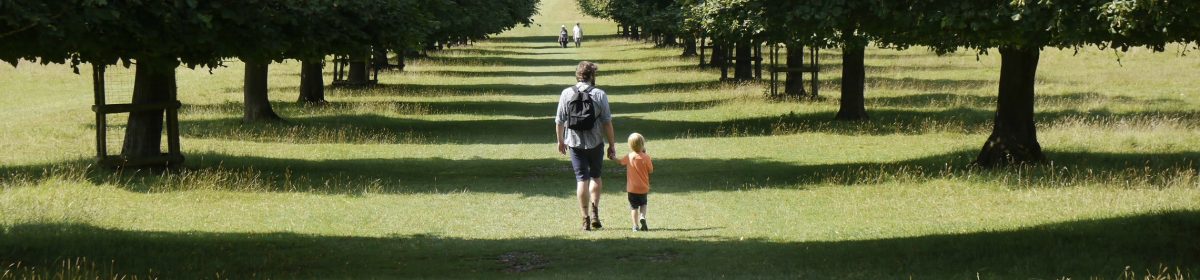
An oasis of peace behind the car park.

Marbled White butterfly sipping nectar from Red Clover in White Field today

Dyrham Park can get very busy – especially in the school holidays – I took a picture of the car park before lunchtime today just to give some idea of how crowded it can be with hundreds of visitors walking down the steep approach towards the house. But there’s one part of the grounds where you can pretty well guarantee a bit of peace and quiet. Today we spent over an hour there plant hunting and we didn’t see a soul.

White Field is a wildflower meadow where, in the late spring and early summer, you can find three species of orchid growing without leaving the mown paths. To be fair, it’s not particularly easy to find, tucked away behind the car park and technically outside the grounds behind a high deer fence, but it’s a lovely spot in which to learn to identify many of our most attractive wildflowers. But don’t leave your visit much beyond mid July because it’s mown off and the hay baled and taken away as part of a management programme. These wildflowers actually prefer poor soil and a single dose of artificial fertilizer could cause irreparable harm allowing rank weeds and grasses to choke out their more delicate cousins.

This was the first place we saw Marbled White butterflies and they really are very beautiful; but why here and not, for example on any old grass verge? The food plant – the one which the caterpillars feed on – is a group of grass species collectively called Red Fescue – which is common across the whole country but there are several other food plants as well. So it’s not the food plant alone but some other factor too. The butterflies display a preference for purple flowers and the distribution maps suggest that unimproved grassland is one important factor. So White Field fits the bill perfectly; unimproved grassland on Cotswold limestone with masses of purple flowers; not least Knapweed, Clover, Meadow Cranesbill, Selfheal and lots of orchids. The sad truth is that the butterfly is as rare as unimproved grassland and we’ve ploughed up and poisoned over 90% of our wildflower meadows in the last fifty years. Anyway, they were there on White Field in abundance today and they were a joy to find.

The field which on our last visit was golden and white with Rough Hawksbeard and Oxeye Daisies looked more brown and shriveled today, but if you looked between the straw coloured mature grasses there were hundreds of Pyramidal Orchids, Oxeye daisies, a few Rough Hawksbeard clinging on, Knapweed, Selfheal and Meadow Cranesbill plants at the edges as well as Birdsfoot, Clovers, Hogweed and Ragwort. Lots to look at and enjoy including Ribwort Plantain, Red Fescues, Timothy grass, Cocksfoot and loads of other grasses I’ve never got to grips with. Altogether a rewarding end of season walk with fabulous views out towards the River Severn and down as far as the Mendip hills.

Rain starts play!

Freed from watering the outside allotment by some decent rain last night we lingered in bed reading, watered the greenhouse and polytunnel, shot down to the supermarket to get canned food for the campervan stores and then off to Dyrham Park in search of orchids. It’s been a difficult drought season, demanding all our effort to keep the young plants alive. Apparently the tomatoes don’t set fruit when the temperature rises above 27C, although we’ve not found a big difference so far. It’s a mad year when we have almost ready aubergines and courgettes in the tunnel but the outdoor broad beans have been decimated by blackfly due to the unaccountable absence of their usual predators – almost certainly down to heavy mortality among them in the cold wet early spring. In particular, ladybirds have been noticeably absent. We’ve been spraying with a neem oil and soap mix with limited success on the broad beans, but with a slightly better result on the asparagus which is being attacked by asparagus beetles. Neem oil is certified for organic use but it really stinks and is unpleasant to spray. It also tends to clog the sprayer so it’s far from ideal. Our conclusion is to revert to sowing Aquadulce Claudia beans in October, plant them out in early November and then protect them from strong winds and prolonged frosts. They usually look a mess in early spring but they tiller freely and give a good early crop when there’s almost nothing else to eat.

So once we arrived in the park we very slowly searched all the familiar places for orchids. We didn’t have to look far for Pyramidal orchids – Anacamptis pyramidalis – there were hundreds of them, smaller but substantial numbers of Common Spotted – Dactylorhiza fuchsii , some of them very pale, and just a single Bee orchid – Ophryis apifera – far fewer than last year.

Orchids are lovely of course but with a dozen or so Marbled White butterflies moving about the meadow with several other species it was a close thing which was more exciting.

Madame took this photo

But I’m not afraid to say that I was enchanted by finding some Cock’s-foot grass in full flower and looking like a beauty at the prom, decked in white. On this poor limestone rich meadow, this bully of a grass had been reduced to playing second fiddle to the wildflowers. The whole meadow was alive with Oxeye Daisies, which looked tremendous; but the absolute star of the show was the seed head of Tragopogon pratensis – Goats Beard – whose mind blowing architecture made me shout out for joy.

Where’s Wally?

No – this is a wildflower meadow! (with apologies to Crocodile Dundee)

Below this, at the bottom there are three photos of orchids we found today at Whitefield and one of them is in the wider view above. As I mentioned a couple of days ago, as we approach the summer solstice we’re often awake really early, and so we do as much as we can on the allotment before breakfast and the we have the rest of the day to walk and look for wildflowers. We had spotted the Pyramidal Orchids and another one that I misidentified as Early Purple – they were Common Spotted – for which correction I’m indebted to an impulse buy on Monday when I saw the Wild Guide to orchids and decided I couldn’t live without it. It’s a brilliant guide and it’s already slapped me on the wrist a couple of times. So with those two species under our belts we went back today to see if we could find a third Orchid that we knew was there but which we’d never found. Thanks to the book I now know that they don’t flower every year which may help to explain why we haven’t found it until today. So as Madame scanned the field with binoculars and I looked at the path edges she gave a whoop and pointed to a group of Bee Orchids. Three Orchid species in a field within 100 metres of one another makes for a good morning’s plant hunting; and that’s apart from the multitude of other goodies. So without further ado .. from left to right the Pyramidal Orchid, the Bee Orchid, and the common Spotted Orchid. But which one is it in the picture at the top? Go find!

Once again, walking down to Percuil, our hearts are lifted.

Potwell Inn regulars will know that I get a bit grumpy when people take the therapeutic powers of nature as the fixed and immutable reward for stepping outside the door. Hand on heart I suspect I’m a victim of the protestant work ethic that guarantees there’s no gain without plenty of pain. I lay the blame for that disposition squarely on the Primitive Methodists who were rather keen on rewards but much more on punishments. Then, like today, we occasionally go for a gentle stroll with no particular quarry in mind, and we return almost breathless with joy.

Cornish lanes are never lovelier than they are in Spring and the footpath down to Percuil from Gerrans was as lovely as any lane ever has been.

We walked this way six weeks ago and the change has been astonishing. One of the most intriguing features of our walks is to see the successional drifts of flowers following one after another. You can no more hold back the emergence of the next wave of plants than you can hold an eel in your bare hands. I took this photograph because the combination of colours: the pink of the Campions, the white of the Stitchworts and the blue of the bluebells looked so beautiful in the sunshine against the green vegetation. You don’t even have to know the names of the plants to appreciate their beauty. Looking more closely you can spot Navelwort, Dock, Herb Robert and Hogweed. Further down the path we spotted a patch of Early Purple orchids – some with spotted leaves and others without; plants don’t read textbooks.

As we went down the path we could see the successions working out. Six weeks ago there was a mass of Winter Heliotrope, mostly finished flowering. with Alexanders emerging through them. Today the Alexanders were almost finished and the Cow Parsley has thrust through them, closely followed by Hogweed. Already the Cleavers (Goosegrass if you prefer) is threading up through the competition and even showing some tiny white flowers. There’s something wildly, needlessly extravagant about nature – like a Sufi dance – that can lead, (I say grudgingly), into direct awareness of the Power, the Spirit, the Tao; whatever you want to call it.

Percuil harbour

Down at the harbour we perched on the concrete wall of the chandlery come boatyard and laughed about the time we got beaten by the tide and the wind as we paddled back in our kayak and had to be towed in by the instructor. One of the boatyard workers drove past us on a tractor and as he walked back I asked if they were busy. “Yes,” he said, “The season always takes you by surprise”, and he graced us with a friendly smile. Behind the wall an invisible woman was having a loud conversation on a mobile and a hundred yards away the sound of a conversation on the verandah of a holiday let, skimmed across the hard sand towards us. We’d hoped for the sounds of Curlew or Cuckoo but today we were content to listen to a whole choir of other species. Upstream on the creek, a Heron and an Egret eyed each other cautiously over a patch of territory.

We walked back up the road with Madame’s rucksack stuffed with Corsican Pine cones for her to draw. I think she’d scaled the fence of a rather grand house to snaffle them under the gaze of a dog walker who she’d confused with me. That’s the joy of a meandering stroll with no particular purpose in mind.

On the other hand there’s serious work to be done and I’d spotted a couple of plants of what I think is Smith’s Pepperwort – Lepidium heterophyllum on a footpath. I checked on the BSBI database and although it’s been recorded all around us on the map, it’s not been seen here. Distribution maps can sometimes tell you more about the distribution of field botanists than they can about the private life of plants. Anyway, with the prospect of filling the last missing square in the jigsaw I was like a dog with a bone and sent a preliminary enquiry with a couple of poor photos to the local Vice County Recorder. That cost me £35 because in all conscience I couldn’t continue relying on the BSBI, (Botanical Society of Britain and Ireland), for help without at least joining. And so I proudly present the evidence below with very little expectation that anyone else will be interested. Little things please little minds.

This little lot cost me four visits, one of which was to sniff a crushed leaf. The fact that it didn’t smell foetid or of garlic turned out to be important. So were the hairy leaves and the tough old perennial rhizome, not forgetting the purple stamens.