The Potwell Inn prepares for the winter solstice

From one of my old notebooks that I found in the garage when we moved to Bath.

According to the meteorologists winter started almost three weeks ago but here at the Potwell Inn we pay no attention to these unnatural dates. It’s always been the solstice for us because instead of simply looking backwards at the autumn and summer – always a bit depressing, especially this year, the solstice marks the shortest day. In fact it celebrates a particular moment because at 10.00am tomorrow the North Pole is tilted as far away from the sun as it will be this year. Mid morning tomorrow the earth slowly begins tilting the other way until mid march when (and I know earth coordinates are a bit meaningless in space terms) it’s ‘upright’ – and we celebrate the vernal equinox and, as the tilt continues, exposing more of the northern hemisphere to the direct rays of the sun we hit midsummer in mid June. And then the earth starts to tilt back again and the cycle begins anew. So the good news is that tomorrow marks both a beginning and an end.

In a more nature orientated culture than ours we’d be eagerly awaiting this moment. Historically, farm work slowed down during the winter because the soil was too heavy and cold for seed sowing. The farm year kicked off with the Epiphany celebrations around 6th January and often included Plough Monday celebrations where a plough would be brought into churches along with seed corn (usually wheat, rye and barley in the UK and not maize in those days). By Plough Monday it’s usually possible to see the lengthening days and the winter pursuits like hedging and ditching gave way on the farm to sowing once more.

But grass seems to grow more or less throughout the year. In fact I remember giving our vicarage lawn a light mow one Christmas Eve, and I was reminded yesterday that grass is by no means as simple as you might at first think. I was re-reading Michael Pollan’s 2006 book “The Omnivore’s Dilemma”. It’s an excellent read and today I noticed a 2016 piece in the Washington Times by Pollan that celebrated the fact that the US has seen a significant growth in food awareness accompanied by increasing numbers of artisanal food producers, organic and post-organic farms and farmers markets. But it wasn’t all good news because the dominance of corn had increased in the national diet.

However it was grass that caught my eye last night, because when I first read the book I knew next to nothing about it in spite of living and working in the countryside for 25 years. Then, when we moved here and joined the Bath Natural History Society we were on a field trip one day when I told one of the leading lights that I found grass identification hard. “Oh she said” pointedly, “grasses are easy” – which challenge was more than I could resist and so I’ve spent three or four years improving my grass skills. Then, earlier this year a friend lent me a microscope and a whole new world opened up and began a new romance for me.

Why is this important? Well, in his book Michael Pollan draws attention to one central criticism of intensive farming in a way that I found irresistible. Grass, he says, harnesses and stores the power of the sun and because of its properties of self regeneration and the sheer density of its coverage and capacity to photosynthesise even during autumn and winter, it represents the nearest thing to a free lunch in the natural world. When we see a meadow, especially a traditional meadow with all its wildflowers – we’re looking at a far more efficient solar energy store than any field covered in solar panels.

Intensive farming, on the other hand, replaces all that sustainable solar energy with unsustainable oil – for driving farm machinery, transporting animals and crops over huge distances, and for manufacturing the fertilizers and chemicals which then go on to promote global heating and cause pollution environmental damage and health problems. The problem is that we humans lack a rumen, the part of a grazing animal’s stomach than can digest grass. So the only way we can access all that stored solar energy for food is by feeding the grass to a ruminant animal like a cow, and then eating it. If you add in the concept of buying locally, he food and the consumer are in the same place.

Grass fed cattle do well although they fatten slower than cattle stuffed with corn and antibiotics, The grass and its herbs provide a still unknown number of micronutrients and healing properties to the cattle’s diet and so they are better able to thrive without the panoply of wormers, drenches and other chemicals that are essential in the feedlots which, incidentally, are becoming more and more common in the UK – this isn’t an American problem. Grass fed beef is lower in health damaging cholesterol and it’s said that it tastes better too. It’s very expensive because it’s slower and less intensively farmed, and the food – that’s to say the grass -doesn’t attract the same level of subsidy. The inescapable logic is that traditional mixed farms are better than intensive farms for a host of environmental reasons but we will have to eat far less meat because the low price of meat in the supermarkets reflects an unsustainable and environmentally destructive food culture.

The question of methane is always the first thing to come up and it’s true that cows produce methane. But intensive farming produces far more methane because cowpats dropped on a low intensity pasture generate far less methane than the lakes of cattle slurry that accumulate on intensive farms and, all too frequently leak into the surrounding watercourses. A second benefit of grassland is that grass is a prodigious carbon store. No dig and low tillage systems don’t release carbon dioxide back into the atmosphere at anything like the same rate. So, as Wendell Berry memorably said, by abandoning mixed farming and grass pasturage, intensive farming has taken a solution (mixed farming) and turned it into two problems: soil erosion and nutrient depletion on the one hand and massive pollution on the other, The manure that cattle leave on the pasture and which improves both soil structure and fertility becomes a lethal poison when concentrated in slurry. The land taken from pasture to grow feed grain releases carbon back into the atmosphere and can only remain productive through the use of chemicals.

And so grass is perhaps as important as are trees when it comes to carbon sequestration – and that’s great because the one thing we can grow here in the southwest of the UK is grass. Anyway I woke up the morning with my botanical whiskers all of a quiver and as we did our customary walk along the river and the canal I did a very rough and ready count of the plants we could see in flower. It’s been an odd autumn and early winter and although we’ve had a couple of frosts they’ve not amounted to much. The rain has been a much bigger problem for us. I didn’t have a pen with me so I couldn’t write them all down but from memory there were Canadian and Mexican Fleabane, a single dead nettle, groundsel, yarrow,common ragwort, one dandelion, red valerian, nipplewort, perennial sowthistle, ivy and some ivy leaved toadflax, plus (and this is a long shot) on the flood prevention scheme on North Quays where there was a lot of inappropriate wildflower re-seeding and I’m pretty sure there was a single corn marigold flowering on the spot where a very out of place clump of them grew last summer. As ever, plants don’t read the textbooks and to reverse the ethical aphorism, in field botany you can’t make an is into an ought. There were also new shoots breaking through on an old man’s beard vine, and a clump of very lush green prickly lettuce leave emerging on the river bank. Fourteen plants in flower on December 20th isn’t bad, and you could smell the strange almond perfume of the winter heliotrope all up the canal. Spring is hiding behind the bushes!

Tomorrow we’ll celebrate the solstice with a roastie and I’m wondering whether I can risk embarrassing Madame with a little candle-lit ceremony at 10.00am and then we can enjoy a solitary Christmas with a mexican meal that the children would never have let us get away with: they’re far greater traditionalists than we are! Then we’ll go for a walk amidst the hordes of similarly stranded grandparents.

Happy solstice!

Is there a cunning plan?

It’s utterly depressing, but the answer is going to be no. At the present moment living in the UK feels as if we’ve strayed into an episode of Blackadder, except there are no jokes. I’d like to be writing warm, lyrical and encouraging posts about how wonderful life is at the Potwell Inn – except it’s not – and I don’t mean that I’m lying here on the floor with an axe embedded in my head, although the thought may have entered Madame’s mind. The reason it’s not wonderful is that we’ve spent eleven months in a suspended state; very largely on our own and separated in any meaningful sense from our family and friends. During the first lockdown and the first easing we enjoyed the fine weather on the allotment, where we almost lived for months; but now in the winter there’s hardly anything to do there because we used the autumn to prepare for next season. So we’re deprived of the exercise and the sense of engagement that kept us sane for the first five or six months. Hence the renewed interest in long distance walks and the renewed exploration of the Mendip Hills, of which a little more later.

Of course there are always books. Madame reads novels and biographies, and pretty much anything else she can lay her hands on but I’m firmly in the grip of the protestant work ethic and my reading tends to be highly directional and (dare I say) improving stuff with footnotes and references and centred on the green new deal, environment, natural history, food and that kind of thing. I wish I felt more improved than I do but for the most part it leaves me feeling sad, utterly depressed or screaming at the TV in anger at the incapacity of either interviewers or politicians to ask or answer the simplest (but most diligent) question – more Blackadder. I remember once talking to a depressed consultant oncologist who confessed he was so overworked his first thought on meeting a new patient was how am I going to get this person out of the room? I always felt that any culpability for his reaction was far more due to the distant political choices that put him in that terrible position, than to any deficiency in him.

I probably shouldn’t unload any of these personal anxieties except that I know that it can break through the isolation that leaves so many of us wondering if we’re the only ones who feel this way. Isn’t the first aim of gaslighting always to isolate your critics and convince them that it’s all their fault. But it’s not our fault that covid and brexit have been so badly managed. I look down the list of countries in which Potwell Inn readers live and I can see that many of us have been let down – in different ways – but still let down.

Not feeling safe; not knowing what to believe and what not to believe; not understanding what it is we’re meant to do; missing the everyday pleasures of chance encounters with neighbours and friends; missing the lectures and meetings that cement us as a cohort of like-minded individuals; missing the hugs and the smell of our grandchildren’s hair (OK that’s a bit out there, but you know what I mean). All these etch into us like frost and rain etch their way into rock, and leave us feeling empty and exhausted. I read too many articles about the benefits of nature for mental health, but the principal benefit may be to writers writing books about the benefits. I reckon I’m a pretty resilient person, and I know that Madame is too; and yet we both feel hollowed out by this experience, and sometimes the walking and even the cooking and gardening seem more like displacement activity than wholesome activity should. Staying sane seems to be an immense effort of will.

One question has been bothering me in particular because, in the light of the constellation of crises we’re facing, the issue of food security must surely come near the top. Do we really want to get back to normal if that involves the pollution, the destructive farming and the sickness that associates with bad economics, poverty and junk food. So I’ve spent quite a lot of time reading around the question of food security, trying to see if there’s an answer to the question – could the UK be more self sufficient in food without going deeper into the abyss of intensive chemical dependent farming; and the answer – I’m pleased to say – is “Yes – But”.

If there are any vegans and vegetarians out there who think we can save the world by eating processed non-animal gloop, then the answer is no. If there are intensive farmers who think the way forward is more of the same, the answer is no as well. It’s no to industrial organic farms and no if you think we can feed ourselves on mediterranean delights grown on the allotment or purchased in the supermarket. If there are any people sitting in 3 litre SUV’s prepared to embrace anything except changing the way they drive, it’s also no. And it’s no to airlines, and no to food miles and criminal waste. In fact the answer can only be yes if we’re all prepared to change – quite a bit. This isn’t just a personal view, it’s a summary of all the scientific evidence I’ve managed to get my hands on.

Number one – (two three and four as well!) – is we need to eat less meat, much less meat; preferably chicken because it has a much more efficient conversion ratio. We need to embrace a plainer more sustainable diet sourced as locally as possible – to quote Michael Pollan – ‘eat food, not too much, mostly veg‘. The over embracing plan is summarised by Tim Lang in his book “Feeding Britain – our food problems and how to fix them” * – and he describes it as “a great food transformation”. Crucially this isn’t a book about organic farming or vegetarian diet, it’s an important book about farming, diet, public health, social policy, politics and food culture. You would profit from reading it wherever you stand on the food and farming spectrum. Of course, the cynics will say that the population will never embrace such far reaching change, to which he would respond that in a crisis – let’s say the onset of war in 1939, for instance, there won’t be any alternative but to change. The storm clouds that are gathering on the horizon right now are coming our way and our political system is proving itself unfit to deal even with one challenge, let alone three or four existential crises at once.

They would say that wouldn’t they?

Mandy Rice Davies

But this is good news. We are categorically not all doomed – we can make the changes we need to make and what’s more important, we can create a far better, far less divided and infinitely safer world as we do it. We mustn’t allow the powerful to claim that nothing can be done except more of the same. They would say that wouldn’t they?

Well there we are, and just to prove it’s not all been eye strain these past couple of days, the long Mendip Way walk is being chipped off a few miles at a time. On Monday we walked from Tynings Farm down to Shipham; back through Rowberrow Warren and across Blackdown. Why would I bother with these obscure place names when many people who read this will never see them? and the answer is that place names are beautiful in and of themselves, like tiny topographical markers that set up home in your mind and remind you that the earth is made of places which, just like us, have names and histories and are often very beautiful. The walk took us down the most lovely valley, following a stream most of the way, and then back through a forestry plantation and out on to the open moorland of Blackdown. Barely five miles but offering three quite distinct landscapes. Best of all we found hazel catkins flowering in profusion in the sheltered valley. The photograph shows one such catkin, coated in melting ice formed in the overnight frost but demonstrating that spring will come – and it can’t come too soon.

  • I’ll make a proper booklist soon – most of the books have been mentioned but I’ll assemble a proper list in case anyone is interested.

The Potwell Inn dispensary

Well, it was a rainy day so there was nothing for it but to spend it at the stove, catching up on the list of to-do’s, the first of which was to turn the calendula flowers, harvested from the allotment in the autumn and infused in sweet almond oil – into a most useful cream to use at home. Among herbal remedies, calendula is a reliable go-to for eczema and itchy dry skin. Bought from commercial suppliers it’s pretty expensive – the best brands cost around ÂŁ6 a tube, and so we decided that this year we’d make our own. There is, however, something of a dilemma to be addressed in making it because almond oil is way beyond the resources of our allotment so we have to buy it. But there’s a choice to be made that turns out to be quite an expensive one. Our usual supplier lists two types of sweet almond oil – the organic and non organic, and the standard non organic oil costs ÂŁ12.59 a litre. The organic oil, on the other hand, costs ÂŁ52.85. So on price alone, the non organic wins hands down – but wait – because if you look up the source country you discover that the organic oil is produced in Spain and processed in Germany. The country of origin of non organic oil is not listed so it’s probably a blended generic oil from many places ……… including California?

So what’s the problem with California? you might ask and the answer is that according to Tom Philpott’s excellent new book “Perilous Bounty” it’s not just the fires that have brought disaster to California. In the Central Valley there is a massive industrial scale almond farming enterprise. The valley has always been fed by the meltwaters of the Sierra Nevada snows until, that is, drought and global warming began to take their toll and so the farmers started to pump groundwater at an increasing rate – it takes a gallon of water to produce a single almond. The result has been fairly catastrophic. As the wells deepen, the water becomes more saline. The aquifers are emptying rapidly because they are being drawn on far more quickly than they can be refilled by the melting snow and so the land is literally sinking – up to two feet a year; causing havoc with the local infrastructure – roads, pipes aqueducts and canals. A second problem has affected the industry because the margins are so tight, it can only make a profit by employing migrant labour at the lowest possible wages. Before the long drought began in 2011, this area produced $20.7 billion worth of fruit, vegetables and nuts – 53% of the US total (all these figures are from Tom Philpott’s book).

So it turns out that the cheaper almond oil comes at a cost that is simply not reflected in the price. Cheap almond oil depends upon cheap labour and the overuse of cheap water – and it’s destroying the environment. For all we know, precisely the same slow destruction is taking place in Spain. One of the great unspoken problems with the organic movement is the way in which it is being slowly industrialised. However, that’s why we bought the expensive organic oil which, of course, will be much more expensive again after brexit if (when) tariffs are applied. That’s how politics, economics and ethics are hanging together when we think about a Green New Deal. There’s no way of building a greener future without changing our political, economic and ethical assumptions. As I wrote yesterday, it amounts to such a profound change it will feel like a bereavement as long as we refuse to embrace the evidence that’s before our eyes.

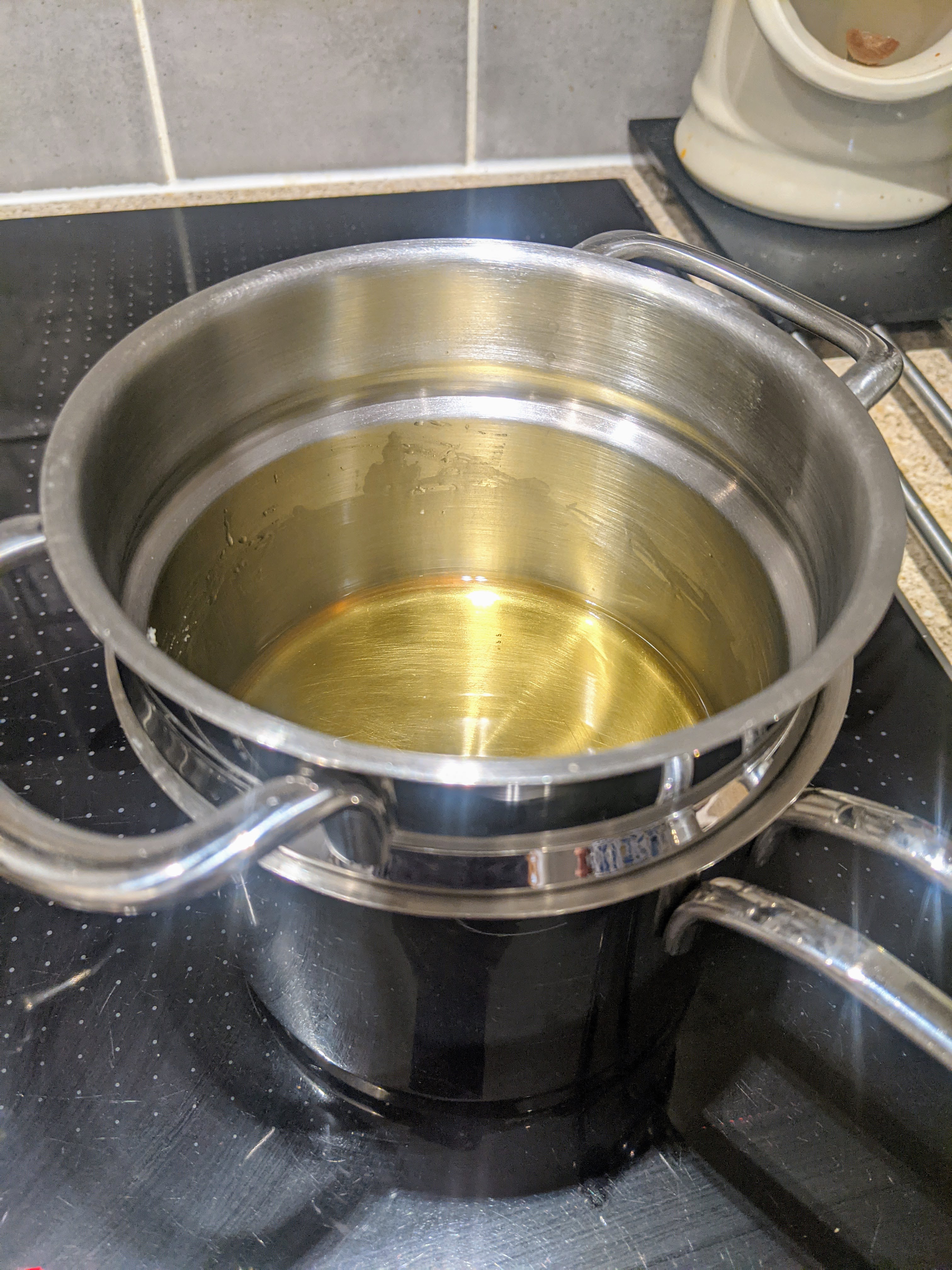
Anyway, the home produced organic calendula cream still came in at 50% of the price of the commercial products and there was nothing whatever added; just the flowers extracted into the oil, and some beeswax. As for the method, you simply melt the beeswax slowly in a double boiler and stir in the strained oil. It’s best to check that the cooled ointment is the right density, so we tested it like jam – on a cold plate. Then we bottled and labelled it …. ta da!

But that’s not enough to keep us out of mischief for a whole day, so I made a favourite old stager from the Potwell Inn book of borrowed delights. This one came initially via a friend (and occasional diner) at the Walnut Tree in Abergavenny – just one of the huge list of marvellous restaurants we could never afford to eat in – but who needs a restaurant when you’ve got a recipe? – after all I can do my own washing up. This dish comes up all over the place so it’s hardly a scarce and exotic signature dish; just plain Italian cooking whose flavour is like the brass section in a Brahms symphony.

Then there was stock to be finished. This time it was a proper pot au feu with a whole chicken and a small piece of beef plus all the usual herbs and vegetables. The beef gets turned into Salade Parisienne with a spicy salsa verde of gherkins, capers, shallots, parsley and oil. The chicken is picked and will make at least three meals and a soup, with stock to spare. We always freeze surplus meat rather than leave it in the fridge until it has to be wasted. On a cooking day it seems like a lot but this batch will last us the whole week if not longer, served in as many ways as we can think of. But there is just as much of an ethical and economic challenge with our diet as there was with the almond oil. I’m also re-reading Michael Pollan’s brilliant book “The Omnivore’s Dilemma”. Pollan is one of the best writers around on food and its constellation of issues and I’d happily recommend this book as an excellent starting point for a big think on living responsibly. Dieter Helm, Simon Fairlie, Tim Laing and James Rebanks have all written about the ethical issues surrounding food and food production and they’re worth the effort as well.

So, (lecture over), finally I baked a wholemeal sourdough loaf – our everyday bread. Let’s be honest, it’s never going to win any prizes against a bloomingly adolescent loaf made with white flour but if flavour counts at all, this loaf is a constant pleasure. You can look in vain for a 100% wholemeal recipe for sourdough bread, and there’s a reason. It can never compete in the crisp crust and open texture competition. It won’t rise to the same degree without adding a significant (say 50%) amount of white flour – which we’re not eating at the moment. But it’s not a competition, silly. Cooking at home means you can eat exactly what you want at a fraction of the price – it’s a no-brainer. Happy days!

Four hundred and fifty three thousand, seven hundred and forty four

No it’s not a telephone number, that’s how many words I’ve written on this blog – I mean, it’s a lot, even spread across 585 posts, and I’m aware that it’s a bit intimidating too. I suppose you could read it every day, in which case it would be like a sequential diary, but most people don’t, and only pick up on a particular search term that they’re especially interested in. I’m not sure what you’d call it because the bigger it gets the harder it is to search. So in the midst of a somewhat sleepless night it occurred to me to make a kind of pot luck offer in a tag cloud. You can click on any of the tags and see what’s behind it; pick a favourite topic or just have a random meander around the inside of my head – there’s plenty of social distancing space there; and search for your particular silver threepenny bit in the plum pudding.

autumn blogging Camino campervan repairs climate change climate emergency composting covid 19 deep ecology economic collapse environment environmental catastrophe environmental crisis field botany foraging Fungi global climate crisis global heating green spirituality herbal medicine intensive farming locally sourcing lockdown macro photography meditation no-dig pickling and preserving pilgrimage polytunnels preserving raised beds rats regenerative farming rewilding Sourdough species extinctions spring technology urban ecology urban wildlife walking water storage weeds wildflower meadows William Cobbett

Walking with a purpose

I have some dim idea why I love these little characters so much because they were the first gulls I learned to distinguish out of the group which I had always just seen as “seagulls”. I was puzzled enough by their red legs and beaks with black tips to get a bird book and find out what they were called. That was years ago and so now I know they’re black headed gulls – which caused a many a problem because it turned out they were only truly black headed in the summer. But they turn up here most winters; sometimes they stay and sometimes they go on somewhere else, and since I first noticed them I’ve learned a good deal more about them, but I love their delicate flight; the way they make the herring gulls and lesser black backed gulls who also live here look a bit lumpy – and, they’re here at the moment. These two were on the river bank immediately below the church where we often see peregrines – there was one there today. This isn’t unusual, we also saw wagtails, robins, blackbirds, pigeons, moorhen, mute swans and a lone Canada goose. The heron has been missing for a couple of days but he’ll show up again in one of his favourite haunts.

It was here on this walk that I learned to separate the ragworts; to find pellitory of the wall and half a dozen other medicinal herbs growing wild; here I noticed winter heliotrope and not – as I first thought – coltsfoot. Here too the wild lettuce that doesn’t look the least bit like the stuff on your plate. We do the same walk pretty well every day; come rain or shine. It’s about 8 Km which gets us over the 10,000 step line and passes a couple of local shops that we use. That means that we walk around 10 kilometers most days and it’s not in the least boring because it’s never the same two days running.

If I was trying to make it sound a bit posh I’d call it a transect – an ecological technique that helps us to understand an environment by walking the same path as regularly as possible and recording what you find there. It takes a while but eventually you kind of make friends with it, to recognise the old stagers and the newcomers and to rehearse their names so often that they stick in your mind. Depending on the season we could focus on birds or plants; insects (not too sharp on those) or butterflies and if anything the walk becomes more interesting each time we do it. Naturally there are other walks in much sexier places where we can marvel (gawp?) at five star rarities but there’s nothing in the world to beat finding one of them in a dark corner of a familiar place. We know the proper names of some of the fishes that congregate near the surface of the water in the summer, we watch the river in spate and at its lowest time in a dry summer. There are things we’d love to see – like otters – and I’m sure one day we will. The local natural history society – there’s a link on this page – runs a great facebook group where we can see things we’ve never seen ourselves and check out an identification with some hardcore experts if need be.

Walking is the most tremendous activity when you want to think. Our days are pretty standard; two hours of walking, three quarters of an hour of weights, two or three hours of writing and the rest on the allotment, cooking, eating and reading. When I write it down it looks almost monastic and yet it doesn’t feel that way. Walking grounds us, gives us a couple of hours when we can talk or be quiet and where we can find a perspective on the troubles and worries of life, and it provides me with an endless source of reflection – much of which finds its way on to the blog.

Nietzsche, Rousseau, Thoreau, Santayana and a host of deep ecologists, poets, writers and pilgrims have all found comfort and inspiration in walking, so I reckon the evidence is in. I’ve always kept notebooks and sometimes the notebooks became journals and they’ve been the most important source of inspiration for me. So often, reading back on an everyday, common experience can suddenly flood it with light – “oh so that’s what was going on”. A walk can be an almost symphonic experience that might one moment be prayer, or contemplation, or remembering, or just filled with wonder and delight or perhaps a simmering grouse, or an anger that’s needing to be dealt with. Let them come, and let them go. And that’s not to mention the fresh air, occasional sunshine and the natural history waiting to be recorded.

It’s November, almost official winter and yet today we saw herb Robert in flower, winter heliotrope with its odd perfume, so difficult to describe; nipplewort; a couple of vagrant marigolds on the canal bank and the initial rosettes of a dozen pathside herbs that look lovely even as they are. It’s so easy to be sniffy about ragwort but really, its leaves are lovely in their prime condition.

Sitting on my desk at the moment is a piece of lichen that I picked up last year. If I sprayed it with water it would come back to life, and under the microscope it becomes a miniature world; a kelp forest an inch across. There are bits of dried grass and a pencil sharpener; with all the books and apparatus I need to continue the walk in my head later. It’s so much bigger and richer than just boring old exercise; making up the 10,000 steps. Oh yes, walking is good – good for the legs, good for the mind, good for the spirit too. It takes some ordinary – you might say thin – time of course, but renders it thick, rich and deep like good soil. Sure you might add the biochemical changes and dismiss it all as so much dopamine and you’re free to do just that; but I prefer to think of each walk as another voyage of the Potwell Inn Beagle.

*If you want to explore the philosophy and history of walking rather than read books about routes you might like to look at Rebecca Solnit’s “Wanderlust”. I thought it was a superb book when I first read it and I’d recommend it without hesitation.

Britannia lures the waves!

And – as the great ship of state sinks gently to the seabed of reality …….

Sometimes a photo is a ready-made metaphor for something you can’t quite explain! But then, it was such a nice day today for a reflective walk that even the provocations made me laugh. I’ve written before about the way each season carries intimations of the next to cheer us on, and today there was a tremendous sense that spring will come because time and tide bow to no-one, however powerful our inglorious leaders might like us to think they are. There were signs of occasional occupation in this boat until a month or two ago, but now it’s about to join the shopping trolleys and stolen bikes at the bottom of the river. Meanwhile the prophets of Baal (you can look it up, it’s a very funny story) whip themselves up into a froth of evangelical fervour as we stand alone against Johnny Foreigner – ready to show what we’re really made of. Sadly, there’s absolutely no sign of Elijah anywhere on the horizon – I certainly don’t think Keir Starmer cuts the prophetic mustard. Anyway as a sign of our preparedness for the coming troubles I thought the poor old wreck was a fitting tribute. Johnson’s new ÂŁ10 billion navy – “Just needs a lick of battleship grey and a union flag and she’ll look as good as she did in the 1930’s”. And we all know how well that went.

So by way of a bit of diversion this two part graffiti on the river bank made me laugh out loud:

I thought the waggish “why?” completely demolished the rather earnest philosophical tone of the original comment. Elsewhere I thought you might like to see this 20th century brutalist response to the foppish grandeur of Georgian Bath.

Yes it’s the Avon Street multi story car park which is about to be demolished – but still much loved by skateboarders. Needless to say the offending building – like most of the truly ugly modern buildings in Bath was erected in Kingsmead – where we now live. This was the area that was most damaged during the Baedeker air raids during the war – the bombers missed the real target back in the day – but instead of grasping the opportunity to restore what was always a poor but vibrant mixed community they built lots of horrors like this and demolished even more small, historic houses across on the London Road on the spurious grounds that they were unfit. The tragedy, of course, is not so much the failure of architectural imagination – I’m not arguing here for mock Georgian multi-story carriage stables – it’s the shocking fact that someone, in an office somewhere, thought this was all we were worth. George Steiner wrote memorably of a critical test for literature – “What measure of [hu]man does this propose?” The architect Richard Rogers has written that buildings embody our idea of human worth, what we’re about and what we’re capable of. We’re not there yet by any means – the Western Riverside Development in Bath, done by Crest Nicholson resembles nothing more than a bonded warehouse or an architectural tribute to a Chernobyl housing project.

There are, however, grounds for hope. The lockdown has created economic havoc among some of the larger companies, but many of the smaller shops and businesses have proved themselves more adaptable; working collectively and capitalising on what feels like a real longing for a new order. The butchers and bakers and for all I know the candlestick makers too have tapped into something significant, exploring the meaning of local and community; and all it could take to demolish the supermarket myth for good will be another food supply crisis – like the one so heedlessly being put together at the moment. It used to be a raise in bread prices that caused riots – maybe this will be the first civil unrest ever caused by a shortage of jackfruit and avocados, but more plausibly – given the middle class aversion to any action bar gentle hand wringing – it will be provoked by the absence of the everyday things; the foodstuffs that (like it or not), most of us have learned to depend upon.

So back to my book of the year (so far). Here’s a section that caught my eye this morning:

We’ve now discussed, however briefly,the human ecology of field crops, gardens, livestock and wood crops with a view to constructing more sustainable farm systems for the future out of this raw material. Earlier I mentioned the idea of people re-wilding themselves in the context of that future – spreading themselves out across the landscape like other organisms to to skim its flows sustainably rather than concentrating so as to mine its stocks, practising the arts of self-reliance, knowing how to fill the larder, and knowing how to stop when the larder is full rather than pursuing an economy of endless accumulation.

Chris Smage – “A Small Farm Future” p 144

Well, Amen to that. The economy doesn’t just need the tyres pumping up or an oil change it needs to be exposed for what it has become, the means of extracting wealth, leisure and humanity from millions of people and throwing millions more into dependency, sickness and poverty. The etymology of the word crisis comes from the Greek crino – to choose – and so we have to ask who gets to choose when we reach the crossroads? – when the multiple crises facing us come to fruition at the same time because, in essence they are one massive connected crisis.

So to round off a pleasurable walk today, photographs of the two repurposed bridges from the ‘glory days’ of steam. The first the line from the old Somerset and Dorset, which brought coal (remember that) in from Midsomer Norton and the North Somerset coalfield into Green Park Station. The second, the old Midland Railway line. A third one comes in from the West and goes to London and is the only surviving working line. And of course there’s the lovely iron pedestrian bridge over the Kennet and Avon canal which no longer carries coal but pleasure boaters onwards towards London. The latest bridge across the river is for pedestrians and cyclists only. Steam has gone; coal has gone and the old station now houses market stalls, a butchers shop, food outlets and the local farmers market on a Saturday. The owner says he could let another six units today if there was space. Is this a sign of collapse or is it the foretaste of a new future, the first buds of spring that actually appear in late autumn when the leaves fall from the trees? If you look now you’ll see the buds there waiting. Only time will tell what fruits they will bear.

Trench warfare at the Potwell Inn allotment

The sticky end of the unwanted grape vine

Regular readers of this blog may remember our ongoing struggle with underground streams on the allotment. In many ways we’re very fortunate to have a stream percolating somewhere beneath our feet that is able to supply water to the roots of any our plants with the means to access it. But it cuts both ways when we get very wet weather and the water table rises to about a foot beneath the surface; the clay/loam soil is desperately liable to poach and so many plants hate having wet feet.

The grape vine was on the allotment when we arrived. In fact the whole site is populated by genetically identical black grapes, all of them planted in the heyday of the Italian restaurants when a team of waiters and chefs took over plots and grew food to remind them of home. The very last of them died just this year and well into old age he still browsed our allotments as if he and his friends were still running them. I once saw him take two carrier bags of ripe figs off an allotment that used to be theirs. They would also pick many buckets of grapes to make wine which is, or was, reputed to be pretty good. We’ve got a vine on each side of our plot and one of them looks after itself with a bit of pruning in the winter, and gives us a good crop of small, sweet black grapes rather spoiled by over large pips. The other vine has always functioned better as a windbreak and screen, producing copious growth of leaves and shoots but never setting a decent crop of grapes. We made 25 litres of wine from the other vine a couple of years ago, but there wasn’t enough sugar in the grapes so it was very ‘thin’, lacking in flavour, and in the end we poured it away. When we decided to stop drinking alcohol 18 months ago it removed one of the reasons for growing these small grapes. Ironically our present allotments are on a site thought to have been a vineyard in Roman times.

So when we rationalised the fruit cage this autumn we decided to dig up the less successful vine to make space for a redcurrant, and today I attempted to dig it out. After a nominal first foot it was clear that the reason for unsuccessful growth was that it’s had its feet in water every winter. In the end I had to give up because the hole was filling with water within minutes and the stump appeared to be sucking itself deeper and deeper into the soil as I squelched around it with a spade and crowbar. I was experiencing the legacy of the wettest October on record – which leaves a question mark over replanting a redcurrant bush there. At the very least the patch will need a lot of grit incorporating to improve drainage. I might be able to redeem it a bit by diverting rainwater from the adjacent row of compost bins into more water butts. The council turned off the water supply today so I’m glad we’ve got about 1000 litres stored already. Over recent years we’ve experienced problems early in the year before the site supply is restored, because we’ve been blessed with fine dry weather.

While I was getting hot and muddy, Madame planted another two rows of broad beans to stand over winter. She was planting them in a bed that we’d augmented with some bought-in topsoil that had an even larger clay component than our own ground and which I had to dig a whole bag of grit into today before she planted it up. In the fruit cage the winter pruning is almost done now, and on the veg plots the garlic is growing steadily as are the peas which are always a bit of a gamble. If they survive the weather and the mice we’ll have an early crop next year. The brassicas were mostly planted on a bed that was well fed with our own compost and now the early purple sprouting broccoli are almost as tall as me. Let’s hope they’re as productive of shoots as they are with leaves.

The rats have returned to the compost heap since I drove them out by turning it repeatedly; so today I had to set one of the powerful spring traps baited with crunchy peanut butter. Hopefully greed will overwhelm their caution and I can get rid of them before they breed. We do have a lovely but rather wild cat on the site but even he can’t eradicate them all on his own. I say a quiet prayer to bring on the hungry peregrines, buzzards and kestrels and multiply the stoats and the owls!

I was thinking during all these labours about the strange way we misrepresent the allotment as if it were a haven of peace, tranquility and rest. An organic allotment may not have anything like as high an energy footprint as a non organic one, but only if you discount the gigacalories of human toil that goes into replacing the chemicals, pesticides and nitrate fertilisers and the very considerable financial expenditure on bringing the soil back into condition. One survey I read claimed that an allotment can be ten times as productive as an equivalent sized plot of farmland – which can only be true of a very intensively managed allotment. Once a plot becomes a significant contributor to the household food supply, it becomes a place of work – good creative, skilled and satisfying work but work nonetheless. I’ve been reading Chris Smaje’s book “A small Farm Future”c Chelsea Green Publishing and I was interested to see (Page 106) a chart that placed gardening in the same category – high labour input + high productivity – as the conventional arable farm. The difference is that the energy input is mostly human toil rather than fuel, fertilizer and chemicals. It’s a great book, well worth reading and presenting a well argued case for small farms and locally sourced food chains. So while I’m in the mood, here are three books I’ve learned a great deal from:

  • Chris Smaje “A small Farm Future” – Chelsea Green Publishing
  • Dieter Helm ” Green and Prosperous Land” – Collins (an economist’s view)
  • Simon Fairlie “Meat – A Benign Extravagance” – Chelsea Green

I could add many more, but these three are extremely practical, albeit quite polemical contributions to the debate about the future of food production. One thing’s for sure; this is a debate we’re going to have to engage with whether we like it or not.

And finally we’re off to the flour mill tomorrow to get 25Kg of stoneground wholemeal flour. I was expecting to be turned away but lockdown part deux hasn’t had the same impact on flour supplies as the first round. It’s an excuse to drive 20 miles along the Cotswolds in the most beautiful scenery, so Alleluia – life feels good. This morning after our saintly breakfast of home made muesli, I had a slice of the first loaf of everyday bread and the first teaspoon of marmalade (also home made) in four months. Oh joy!

Busy bee

OK its probably a hoverfly, but cherry blossom on the riverside in November is a lovely sight!

By 5.00am I was wide awake and in the kitchen today. Yesterday I resumed breadmaking after a break since August when we put ourselves on a low carb diet; and, notwithstanding all my protests that it’s impossible to make a really satisfying 100% wholemeal sourdough loaf, I went ahead and started one anyway.

We survived the first lockdown by cooking (not so bad) but also eating far too many portions of comfort food; bread, cakes, biscuits and preserves and thus it came to pass that we were becoming more generously proportioned than is good for us; in fact we were as fat as Christmas hogs. The last three months of frugality have worked well, we’ve both lost approaching a couple of stone and the threat of nameless but horrible consequences has receded – no doubt like the devil seeking an opportune moment. I won’t bore you with the self glorifying details but there were two particular milestones – rediscovering my waist, and then a joyful reconciliation with a load of clothes that had been folded up and stored with a sigh years ago when it all started. Hilariously, I also discovered that when my old jeans were properly installed around my waist rather than clinging precariously under my belly I no longer needed the shortest leg length. Toulouse Lautrec eat your heart out!

The challenge with wholemeal sourdough is to get it to rise without the sharp edged bran damaging the structure by puncturing the bubbles of carbon dioxide. Those of us of a certain age will remember the Grant loaf – often as hard and dense as it was possible for a dough to be. But Doris Grant had one thing absolutely right; wholemeals don’t need as much kneading, and they ferment quickly, so leaving them for too long is more likely to lead to a collapsed dough than a life-changing loaf. My idea was to cut out the second rise altogether and see what happened; I just had my illumination at exactly the wrong moment and so I started the batter at a time which ensured I would be awake at 4.00am worrying about the dough overflowing the banneton. The idea is to catch the dough when a poke with a finger creates an indentation that feels springy and mends itself immediately. This morning I missed the optimal moment by a couple of hours and a dangerous looking muffin top was just overhanging the banneton (reminding me of my old jeans) , but mercifully the loaf forgave me and with a good sprinkle of rice flour as lubricant it slid from the peel into the hot oven without collapsing.

Yesterday the sun shone and so we took ourselves for a long walk along the canal and back – about eight miles in all. Aside from the cherry blossom I also spotted winter heliotrope in flower on the canalside. In fact there were intimations of life and growth everywhere, if you took the time to search them out. But the other thing we noticed was how much larger the population of permanent narrow boat residents has become. At a time when decent housing in Bath is beyond reach for so many young people, quite a few have taken to the water in a range of boats from the spick and span to the downright messy. In fact one of the floating homes we saw yesterday isn’t a narrow boat at all but an improvised raft.

Noah’s Ark?

A little further on was another boat stacked so high with stored artifacts and second hand timber it seemed to be anticipating a siege –

Are we supposed to get annoyed about this? To me it shows resilience and, after all, people have to live somewhere and if we allow a housing crisis to develop we have no right to criticise the improvised methods of survival that desperate people are obliged to adopt.

The highlight of our walk was a conversation with a young man who is developing an organic smallholding on an unpromising strip of land between the canal and the railway line. There are several such allotments dotted along the canal and this one was well stocked with pigs, goats, chickens, geese, ducks and one or two exotics in the background. A strip of land that would otherwise be producing nothing but brambles is coming to life and producing food in a largely self-sufficient way. What was so nice about our conversation was that notwithstanding maybe fifty years of difference in our ages, we shared the same experiences and enthusiasm for low impact and sustainable agriculture. I’ve just started reading the recently published “A small farm future” by Chris Smaje – you should check it out – it’s a closely argued book that repays slow and careful reading, but if our conversation with the young smallholder yesterday is anything to go by; the ideas that inspired and motivated us in the seventies and which have been so diminished and derided within this grim era of neoliberal economics, have been slowly gathering momentum and heft in the background. There’s a whole community down on the canal and it’s functioning with its own distinct (and distinctly more sustainable) culture. In my darker moments I’ve sometimes feared that everything we believed in and worked for over the past fifty years has been crushed, and that there’s no-one left to pass all the accumulated experience on to. After our long walk we came back to the flat with more of a spring in our step because there are signs of hope along the canal and in many other places. Goodness only knows how this will play out over the coming decades, but yesterday it felt as if the cultural tectonic plates really are moving – too slowly for some, no doubt – but that’s the way of the paradigm shift. For decades there is nothing but almost inaudible questioning of the status quo, the way we do things round here – and then suddenly one day it all clicks. Like sourdough, the best things are worth waiting for – and I think I’m about to have to eat my own words about the impossibility of creating good 100% wholemeal sourdough. Let’s have a taste!

I’ll tell you what it tastes like tomorrow ….

Buttering parsnips

I’ve never quite understood how fine words could fail to butter at least a couple of parsnips – as long, that is, as someone is paying you to write them. Sadly, though in my case nobody pays me to write anything and so the Potwell Inn parsnips are only ever buttered thanks to our extremely modest pensions. Still; what’s the price of a pat of butter against the pleasure of eating our own organic parsnips straight off the allotment.

Yes it’s parsnip time again; having seen off the last of the summer vegetables. Parsnips and all the other roots shuffle modestly to the front of the queue and surprise us as they do every year. I imagine you could (just about) eat them boiled with a knob of butter; or mashed with the aforementioned and a bit of pepper but for me the glory of the parsnips is roasted until they’re golden – in olive oil rather than butter which burns too easily. For even greater transports of delight (so long as you’re not a vegetarian) I’d roast them with carrots, squash, and possibly beetroot in the meat juices left in the pan while the joint is resting, but that, for us these days, is a very occasional extravagance (and all the more enjoyable for it). But really any which way is good, and with care and attention you can even achieve the chef’s holy grail and possibly mythical quality – balance. Balance, I think, is how you describe a perfect culinary chord in which (to carry on the musical analogy) neither the first violins or the horns are getting all their own way.

Parsnip soup is one of those dishes beloved of pub chefs with a limited budget, who want to honour local sourcing without lashing out on salt marsh lamb. But that doesn’t mean it can’t be improved by a bit of TLC. I’ve tasted some truly grim versions. Don’t rush it; get the best fresh ingredients and give it time. Parsnips, especially shop bought ones, can be a bit woody towards the end of the season; so preparation should include cutting out the woody cores, because however long you blitz the resulting soup for, it will still taste as if you dropped a corner of the kitchen table into the pan. Your guests will not be impressed as they pick the splinters from their teeth if you extol the rustic virtues of their lunch. And finally, don’t over season it – let it speak for itself – and give it a swirl of sage oil and a dollop of crème fraiche. There isn’t a better way of marking an otherwise dull day.

It’s mid October and the daylight hours are shortening dramatically. When the sun shines, the autumn colours of the leaves are wonderful; but on a day like today when it’s drizzling; the allotment stares back at us like an estranged teenager and the earth is cold. It’s hard to see beyond the moment if the rain’s running down your neck and even the grass has taken on the blue green hue that’s an autumn speciality. Any pause in the traffic and you can almost hear the slugs munching. So we drifted off to a garden centre to get supplies of potting compost, sand and fine grit for a new garlic bed which needs to be well drained. We could make our own potting compost, but if the lockdown goes on we’ll have run out by the busiest time in March.

If you think that my occasional forays into philosophy or poetry, environmental politics, or spirituality are unexpected or random, I’d have to push back a bit and say that being human – I mean really human – can’t be boiled down to cooking and eating parsnips (thank goodness) or, for that matter, growing them. The allotment and the kitchen are two of the most important spaces in the (imaginary) Potwell Inn; but only two of them. Neither the natural history of Bath nor the contents of the bookshelves or the paintings on the walls, finish crossing the t’s and dotting the i’s. I couldn’t even begin to make a list of my favourite marks of humanness and neither would I dare to suggest that my list enjoyed any kind of privilege in the great order of things. But the unique and glorious bird’s nest of borrowings and learnings that furnish my/your/anyone’s inner life is a symphony, a work of art.

And on the wet days and the ones where nothing seems to go right, it helps to have that precious bird’s nest. Goodness knows I was fed up today – so fed up I started reading Rilke! What I wanted to say is that full humanity needs its stories and poems and pictures and perhaps above all, its spiritualities, songs and music. It’s only through these shared arts that good and bad can be held together in hope. So although fine words may butter no economic parsnips, they can raise two fingers to the gods of chaos, war and destruction. And without those internal resources, there’s no symphony, no texture; just a solitary busker with a hat full of rain.

Silence comes in many shapes

So instead of spending Wednesday hanging around in a secure campervan compound, we were able to charge the batteries properly while driving the round trip of about 100 miles to Hay on Wye and back again. I have no idea why we’re so passionately attached to Hay – we don’t attend the festival or even camp there very often, but it’s very close to some of our favourite places like Hay Bluff, Capel y Ffin and Kilvert’s parishes, not to mention Offa’s dyke and some of the best (and longest) hill walks in Wales; and it does have a very good ironmonger – so good we once drove there to buy a crowbar. They didn’t have one.

I don’t do endorsements, but our journey was only made possible by an extraordinary piece of technology. LIke most of us, the campervan had developed a flat battery this summer during the lockdown when we weren’t able to go anywhere; and our usual way of dealing with this problem would be to drive 20 miles with our genny to where it’s stored, and spend hours charging it up – sometimes meaning we had to make two journeys and waste most of a day. I’ve always avoided the idea of getting a battery booster set because in my memory they were extremely cumbersome, and lugging one of them up and down three flights of stairs at the flat is a bit of a pain. However, after a lucky online search, I found the most wonderful lithium ion booster which weighs just over 500 grammes (one and a quarter pounds), fits in your pocket and will deliver 1000A; enough to crank up a 3 litre diesel or 6 litre petrol engine. No – I didn’t believe it either – but I charged it overnight via a USB socket and this morning we went down to the van and after a couple of minutes getting it attached,started the engine without so much as a hint of battery problems.

But this post isn’t a touristy piece on the Brecon Beacons; it’s about something rather different – more psychogeographical than topographical, and more literary than I’d expected: think Kilvert’s Diary, Bruce Chatwin’s ‘On The Black Hill’ and …… forgive me …. JRR Tolkien’s ‘Lord of the Rings’. But first, Adlestrop.

So …. sunny autumn day; the leaves turning golden on the trees and as we crested the top of the hill leading down to Raglan we could see Hay Bluff in the far distance, the atmosphere was so clear. We always go by the the back roads, eschewing the motorway and sticking to the quieter and shorter route which, notwithstanding the continual nagging of the satnav, takes exactly the same length of time – give or take the occasional tractor. The car park at Hay was only a third full and visitors were pretty thin on the ground by the looks of it, so we drove down to the bottom and parked up in the sunshine to brew tea.

Silences are difficult to describe because they can often be defined by sounds. As I sat on the van step, soaking up the warmth and listening to a robin singing in its birdish minor key, I suddenly thought of Adlestrop in Edward Thomas’ poem. There the silence is defined by the sound of escaping steam. In my parents’ garden the silence was always defined by house sparrows. We were once walking in Clun where there was the most lovely silence I think I’ve ever experienced, it was so warm and embracing. Tawny owls do good night silences here in Bath and once in Corsica we were kept awake by the silences, bookended by the sound of the Scops owls. Urban silences are always brief and punctuated at each end by the sound of traffic and aeroplanes, or perhaps ambulances. You have to snatch them out of the still air as if you were attempting to catch a butterfly in your hands. The silence you can find in the Brecon Beacons is different again, accompanied by wind and grass but yesterday in Hay on Wye, the silence was modulated by the sound and smell of a petrol mower somewhere close by, and by the quarreling jackdaws in the trees. It was a silence pregnant with all the other lost silences of my life. Robin, my last therapist, was good at silences. He could create a silence like a rich medium in which my hidden thoughts could germinate and grow and, once established, would follow me up the lanes and steps as I walked back to Clifton with my ghosts.

This silence, once evoked, stayed with me even above the noise of the van as we drove back. Pen y Fan never looked lovelier or more challenging as we drove towards Bwlch and then, on the right, there was Buckland Hill and Tolkien joined my thoughts. Despite his protestations that the Lord of the Rings had nothing to do with the war, he had started the writing Hobbit in 1939, and it’s infused with melancholy for a lost and comfortable world that’s always made me feel that when push comes to shove, I’m a hobbit too. Utterly attached to my own place and all too fond of a good meal and a gossip. The Tolkien obsessives have often associated the Buckland of the book with the Buckland hill overlooking the River Usk near Bwlch. There have always been rumours that Tolkien stayed at Buckland Hall as a child, although no-one has absolutely nailed it, but the c0-location of fictional Buckland with the fictional ‘Crickhollow’ is hard to ignore when you’re about to drive through the entirely real Crickhowell with the ‘old forest’ of the beacons looming above.

And in this thoughtful mood we drove on in the noisy, roaring and rattling silence of the van, and I thought about Louis MacNeice’s marvellous ‘Autumn Journal’ and the ominous sense that its lines, written in 1939, are like the leaves of a tree suddenly illuminated by the intense light that sometimes precedes a storm.

Something has broken. Was it Mircea Eliade that said we ‘live in a story shaped universe’? Yesterday it seemed as if ‘losing the plot’ might be a trivial way of expressing the fact that we’ve lost the story. Goodness knows I’m not a fan of all those dwarves and elves in Tolkien but the fact that Lord of the Rings became almost canonical for several generations of us, does suggest that some kind of story can be a better guide to being human than the predigested idiocy of the politicians who suggest that the way forward is, in fact, the way back. I remember being very struck by something George Steiner wrote more than 50 years ago in relation to literature. He suggested that we should ask the question “what measure of man [sic] does this propose?”.

Buckland Hill, for all its powerful imagery, both exists in the mind as a fictional landmark and also in its geographical embodiment overlooking the River Usk. Of course the two are not separable, and who in their right mind would wish to do so? Perhaps that’s what Philip Pullman was pointing at in ‘His Dark Materials’. The destruction of stories is an act of barbarity and violence.

The silence followed me home and back in the flat, I took down the Lord of the Rings and my maps from the bookshelves; just in case I could find a way out of this plague somewhere within them.