Old man’s beard, Traveller’s joy, Clematis vitalba.
This new database of mine is already driving me crazy. I’ve got thousands of photos of unidentified plants and hundreds of plant records – the ones I know I’ve seen in the past – easy ones like Elderberry – without any photographs. I try to keep a list of the photos I need to take in my head, but in reality I spot something I might need to photograph for the database and then go back to the laptop to check. It’s never too soon to get organised!
The love of nature is very peculiar. I’ve been vocal in my suspicion of the endlessly asserted factoid that nature is good for you and cures more human ills than the finest snake oil – but that’s just my sceptical nature. When I stop to think I can recall the first time I experienced what I later discovered was called an oceanic experience. The phrase was coined by Romain Rolland in a letter to Sigmund Freud.
“a sensation of ‘eternity’, a feeling as of something limitless, unbounded”, a “feeling of an indissoluble bond, of being one with the external world as a whole”
Harebells on Rodway Hill
Which is a bit grand for my unforgettable experience but it was real enough for me – aged maybe 11 – lying in the grass on Rodway hill, listening to the wind fingering the fine grass while I watched a group of Harebells swaying in unison. These days I understand the geology of the Old Red Sandstone and the acidity of the thin soil, but none of that grown-up knowledge comes close to explaining the experience. I’d just want to say that it’s the memory that sustains and inspires me and it’s vanishingly rare in my experience – it doesn’t happen every time I go out botanizing and it doesn’t cure my anxieties but rests there in my mind as a permanent reminder that it’s not all confusing and bad. There’s something indescribable but good under the chaos of events.
Two weeks in Cornwall with an average internet speed of around forty kilobits per second – really! – has tested my saintly patience! Anyway, I took the Old Man’s Beard photo on our last holiday walk and it suited my wicked purposes very well today as I started to write this, because the two words -“traveller” and “joy” were never more inappropriately joined together as we drove back from Cornwall. Our holiday had to be curtailed by two days because one of the components of the campervan water system had failed and we needed to stop off at MURVI headquarters in Ivybridge where it could be repaired. That entailed a considerable detour across-country from Roseland to the edge of Dartmoor via Plymouth; a pleasant drive avoiding any rush hour towns. We arrived on time and the job was done in half an hour by a brilliant fitter called (I think) Chris, who made it all look easy. Thereafter we were on the A38 and later the M5 travelling at about 20 mph all the way. This wasn’t due to flooding, accidents or even roadworks but sheer traffic overload. There was a long queue beyond every single slip road and we chugged along in a pall of pollution and bad tempered driving. It’s my proud boast that we kept up with a Ferrari all the way. Not bad for a 2009 campervan eh? By Saturday the motorway was flooded and the road surface of the new Severn Bridge had lifted so the bridge was closed. More huge queues. Is anyone planning for the impact of a global climate catastrophe? Peaceful demonstrators can get 5 years for protests which may be annoying, while children develop lung disease from pollution.
Comma butterfly in the lane
There are a number of familiar walks from the campsite we’ve been staying at for years. But our familiarity with the resident plants is always challenged by new finds – I wrote about some of them in the most recent post – and so we walk with our eyes wide, scanning the verges waiting for something to stand out. These lanes have plants you’d never see anywhere else and some of them are so shy and retiring we’ve walked past them for years without spotting them. Luckily in the past couple of weeks we’ve spotted something new almost every day. Alongside the Percuil river where we found orchids in spring, we stood and listened to the heartbreakingly lovely call of the Curlews.
We live in Bath which is also continually choked with traffic. Not only that but the size of cars (and therefore engines) seems to be increasing exponentially; driving behaviour is moving close to fairground dodgems – and speed limits? – don’t even ask. All this whilst lobby groups supported by deluded “locals” (they’re often not) are fighting tooth and nail for the human right to drive down narrow residential streets at whatever speed pleases them. It seems to have escaped their tiny thinking parts that the outcome of unrestricted and unregulated traffic is – wait for it – traffic jams. I once took this up with a campaigner waving a placard near to our flat and he admitted that he didn’t even live in Bath. And don’t come back at me about our campervan because it’s only done 52,000 miles in the past 15 years and we keep it in a compound way outside the Bath LTZ which is a price we’re prepared to pay for not clogging the streets or the air.
Sea Carrots – Daucus carota ssp gummifer
Of course autumn has its own unique pleasures, not least to look at plants that are more easily identified by their seeds and seed heads – this applies particularly to the large and confusing carrot family. I don’t know how you could distinguish wild carrots from sea carrots if it weren’t for the fact that senescent wild carrot flowers shrink and bend into tiny old fashioned wicker lobster pots or perhaps bird cages, whereas sea carrots remain fairly open. Then the scarlet fruits in the hedgerows could be Black Bryony, or Woody Nightshade, or Honeysuckle – it’s fun to know the difference.
Coming back home to the crowds and the drug dealers outside on the green was a painful reminder that all is not well in our country. Part of the A36 has fallen down the hill in Limpley Stoke and is closed and on Saturday the students all moved back into their accommodation which effectively closed the lower Bristol road all day. The new Labour government is already weakening environmental regulations and abandoning their election manifesto commitments at the behest of lobbyists and shady donors. Am I cross? Hell yes!!
Blue Moon over the sea
But I’m desperately sad for the young woman and two young men who sat on the bench outside on the green, smoking crack, slumped over; their hopes of better lives draining slowly away.
Cadgwith is by no means one of the Lizard peninsula’s most threatened communities as long as you consider it as part of a larger area including Ruan Minor, Lizard Village and perhaps Poltesco. Between them they can offer an excellent pub almost on the shoreline (great Sunday lunch) and another in Lizard; both Methodist and Anglican churches, two schools; two post offices with a general store and café, a farm shop, a GP surgery which was still open this spring, a lifeboat station and a coastguard lookout run by volunteers; hotels, cafes and pasty shop, local arts and crafts galleries, probably the last serpentine turner in the county and some wonderful walks through a botanical wonderland. The small inshore fishing fleet is mainly run by part timers and – here’s the rub – there’s a superabundance of holiday lets. If you’re a plumber, or an electrician or builder; or if you’re happy to do a bit of cleaning you can earn a sensible living but as far as buying a house locally is concerned, you might as well resign yourself to a long commute from St Awful (that’s a local judgement, not mine) – or Camborne which is one of Cornwall’s most deprived towns. We tend to think of levelling up as a northern phenomenon but Cornwall has some of the poorest communities in the UK and like some parts of Wales, the only way up for many ambitious young people is also the way out.
If you’re a regular visitor to the Potwell Inn you’ll know that this part of South Cornwall is one of my favourite places on earth, most years we visit two or three times to hunt for plants; but you also need to know that simply liking the place, buying a Guernsey sweater and a hat with an embroidered anchor will not; will never make you a local. Upcountry is an unsettling and wicked place which necessitates passing through Devon and nothing good ever comes through Devon.
However, turning to Cadgwith once again, the tin tabernacle in the photo which is on the steep footpath from near the Todden and leading up to the car park is inaccessible except on foot. I took this photo in January 2022 – I’ve always loved these remnants of mission churches. We had one of them in Oldbury on Severn in the next-door parish to mine. There’s much more information about the Cadgwith chapel in the linked Guardian article published last week. The protesting cottage, also at the top of this piece is just a few steps further down the lane and reflects the majority view of the locals. When we grow old and forgetful it’s regarded as a personal tragedy but the mass influx of outsiders can just as surely drive out the community memories which are the glue that holds people together in shared experiences, and which is one reason why we were both so delighted to see that the little blue corrugated iron chapel has been given a grade 2 listing. Go inside and sit quietly on one of the blue pews and reflect on the courage of the volunteer lifeboat crew who, in 1907, went out to rescue 456 people from the stricken liner “Suevic” – and the vicar was a member of that crew.
Earlier this year we were having a pint in the pub on the Lizard and I noticed that one of the bar staff was wearing an RNLI pager. In Pembrokeshire last week we were on the Puffin shuttle bus going towards St Justinian when we had to stop to allow a car to pass and the bus driver stopped for a chat with the other driver – it’s that kind of bus route – and turned around to tell us that the man was, in fact, a member of the St David’s lifeboat crew; cue for a big cheer from the passengers! These things matter greatly. Community memories are hardwired into the whole landscape in these isolated places. Sustainable tourism demands a thoughtful attitude from those of us who are just visiting to ensure that we are not responsible for eroding and diluting those memories.
We’ll soon be back for another month in paradise – the campervan may be a bit cramped, but it’s like a holiday cottage on wheels once you’ve learned how to live like a submariner and put things away in the right place every time.
Read on for the full story of accidental good luck
So we’re back in one piece from St David’s after two weeks of sun, biblical rain and gales. This souvenir photo is of a big moment when I finally found a plant I’ve been looking for, misidentifying and hunting for years. As you see, it’s on the side of a road – freshly surfaced with very sticky tar and gravel which got into my shoes and on my trousers – and regularly traversed at speed by eager tourists hunting for somewhere to park 20mm closer to the sea. Whilst I was on my knees and elbows trying to photograph the plant the farmer whose house I was outside drove out and asked if I was alright. Two carloads of eager puffin hunters paused and wound down their windows to see if I was alive – all in a day’s work for a plant hunter – but I was sustained by my excitement at finding a not particularly rare plant that over the past two weeks we’d walked miles looking for. I’d even been told that it was there by the local County Recorder but three holidays later I’d still never seen it.
Not being a mild natured and placid sort of person I’d taken the previous knockbacks to heart, gracelessly cross with myself but more determined than ever to nail it and on the very last day of the trip I was crossing the road next to the campsite to empty a heavy cassette of – you don’t need to know – when in the midst of the hedgerow chaos I spotted a single white flower clinging on within inches of the traffic, the tarmac and the predation of strimming. Here it is:
It’s a Dwarf Mallow – not a Common Mallow or a Tree Mallow or a Musk Mallow or any of the several closely related Mallows – including the Marsh Mallow (yes really!) that I’ve found in the past. But Malva neglecta. Who says field botany isn’t exciting! I reckon getting the pictures, closing the ID and cataloguing the plant was a lot more rewarding than hunting for seabirds that aren’t there and getting seasick for £25 a pop. I may be wrong but apart from the obvious dangers of getting run over and ruining a decent pair of trousers, that single chance encounter whilst holding an over-full cludger was one of those unforgettable moments. In fact I can remember the exact places where I found its cousins; the Musk Mallow in July 2016 on the canal side, the Tree mallows on the clifftops in Wales and Cornwall, the Common Mallows which gave me so much grief, on the coast path down to Whitesands beach, because they vary so much in height and general jizz according to their situation. So after miles and miles of walking, it turned out to be 100 yards from where we’d parked the campervan. I’m reminded of Robert Frost’s little couplet:
Forgive, O Lord, my little jokes on Thee, and I’ll forgive Thy great big joke on me.
Anyway, here – spread over at least ten years are some family photos
It wasn’t meant to be like this – the first proper campervan trip of the year with everything working properly; batteries charging, the gleaming new sink a stranger to leaks and the fridge roaring away on gas. However we hadn’t factored in the altitude difference or the gloomy weather forecast before we set off to High Mendip for a couple of days and last night we were freezing cold on account of forgetting to bring the duvet. On the plus side we had a surfeit of pillows that looked exactly like a duvet until we took them out of the bag. Back down in Bath the trees were leafing up nicely but up here with a scything WNW wind barrelling up the Bristol Channel they’re still stuck in November. Spring comes later when you’re almost 1000 ft up. As ever the dandelions and daisies were risking the weather and covering the grass, but all the same a solitary Cuckoo flower greeted us when we pulled on to our pitch. If ever you needed an example of the importance of environment, this was it. A lover of marshy ground setting up shop under the water tap.
After a week of pretty perfect camping weather with the high temperatures setting records- and during which we were sweating it out on the allotment – winter has regained the initiative and up here, the wind batters the van in gusts of almost 50 mph, howling in every less than perfect window seal. As the temperature falls to 3C. the buds are clenched tight on the trees, like coldwater swimmers’ naughty bits and we’re sitting in bed planning the best time to walk down to the village where the Queen Victoria pub does a life threateningly good old-style lunch; pies and chips and stuff like that. The route we take will depend on how much mud there is down the lane to Priddy Pool where there are some ferns I failed to identify last year. This time I’ve brought a list of possibilities – fifteen of them, because this is a place they love. No news yet on any improved access to the more detailed locations on the database – I hope I haven’t panicked them by asking!
Before we left we had a discussion about whether to bring my super heavy Welsh Black raw sheep’s wool jumper which weighs about 2 Kg and even smells like a sheep. At that moment it seemed ridiculous but today I’m sitting in bed wearing it, along with its hideously itchy companion beanie and listening to the other van dwellers abandoning their holidays, mainly due to disgruntled teenage children. The wifi signal dropped to 0.50 megabits last night as family resentments boiled over, mobile phones went silent and televisions spurted out their entertainment in ten second packets. How we treasure our little Tardis of a campervan.
I first started coming up here when I was a teenager and spent a lot of time exploring the multitude of caves in the area with the help and guidance of the Bristol Exploration Club. I was never going to be an intrepid or even particularly courageous caver, but I loved the sensual and hard natural beauty of the underground, and the smell of the surrounding fields as we emerged from the dark and wetness has imprinted itself in my imagination. Today we will walk the fields above the underground passages, rough tracing their torturous progress from 400 feet above. Swildon’s stream will be roaring after the night of rain and we will be pausing to find early risers among the plants. Slow is also beautiful.
No – we were looking forward to a more Wordsworthian sort of Spring
Much to our surprise we woke this morning to a couple of inches of snow. You might describe our present weather as topsy turvy, but that would trivialise it. We were chatting the other day and what seems clear is that one of the early warnings of climate catastrophe is the sheer unpredictability of the weather. On the allotment the old certainties are falling one by one. Good Friday, for instance, is the traditional day for planting potatoes (in the UK) and that gives it six weeks to wander over the calendar in any case, due to the synchronisation (or lack of it) between the solar and the lunar calendars. But today after February broke all records for warmth and rainfall, the snow came as a complete surprise. Madame and I sat in bed this morning feeling just a bit smug because we’d spent much of the week preparing the campervan for just such an event; draining the water tank and such like. Since we came back from Dartmoor – or more precisely from a workshop on an industrial estate outside Ivybridge – we’ve been preparing the van so we can get away and start enjoying the luxury of having everything now working properly. Only four years ago the electrics failed completely one January night and we had to huddle in the sleeping bag with only head torches for light.
I don’t know why we haven’t walked on Dartmoor for so long. We’re blessed for high country here in the Southwest, with Dartmoor, Exmoor and Bodmin Moor to the south and across the Severn and westwards we’ve got the Bannau Brycheiniog (Brecon Beacons), the Cambrian Mountains and then mighty Eryri (Snowdonia). I’m not one of those people who grumble about the change of names from English to Welsh. Years ago I did a lot of bus journeys running writers’ groups in South Wales and I simply had to learn how to pronounce Welsh place names. Ystrad Mynach was a particular struggle, but Welsh is a phonetic language and once you know a few simple rules, like the fact that “y” is a vowel in Welsh, it’s painfully easy to sound as if you know where you’re going.
But crossing Dartmoor a couple of times last week – we had to commute between the campsite and the workshop – we felt very drawn towards it. Our first visit was more than forty years ago when we stayed near Burrator and found the Devonshire Leat, a quite wonderful piece of industrial archaeology, and one which – given my attachment to abandoned industrial landscapes – resonated within me. It’s not even that I search for them, they just seem to find me. I can almost hear the voices from the past in them; miners and quarrymen; shepherds and packhorse drivers; tinkers and overseers. Safe paths across the peat bogs mark their passage across the centuries and standing stones celebrate or warn of ancient beliefs and untimely deaths.
Part, I think, of the Grimstone and Sortridge leat on Whitchurch Common, Dartmoor
This photograph was taken in March 2016 and it took a bit of finding because there was no location amongst the EXIF data – those were the days! We were staying in the campervan near Tavistock and we’d come down from the northern area of the moor – just mooching about really, enjoying the early months of retirement and going through that long process of asking – if not work, what are we for? I’d asked an old friend whose partner had retired before me, how long it took her to embrace the freedom. Much to my consternation she replied “five years?”. Looking back, I’d say for me closer to eight. Here are a few more photographs from one of our very first journeys in October 2016.
Knowing next to nothing about fungi I photographed the waxcap among dozens of brightly coloured neighbours and then discovered years later that their presence is a sign of unimproved land. Patently obvious, I now know, but that’s how understanding happens.
This time in Ivybridge we went to the local bookshop and I bought a couple of books. One of them – Guy Shrubsole’s “The Lost Rainforests of Britain” is so good I read it – or rather devoured it -in two days. It’s a marvellous and accessible account of an almost unknown and rapidly disappearing habitat – and before long I’d gathered together all the resources on my bookshelves that would help me to understand these sites better. If that sounds a bit worthy it’s really not. For years I’ve been a bit obsessed with ferns, fungi, mosses, lichens and all the other woodland species that characterise this rare habitat; but my obsession has focused on their appearance – they can be very beautiful. Now I’m going to dig into the science and identification of them. Suddenly the new season has gifted me a project. The second book, Karen Armstrong’s “Sacred Nature” is altogether different and although she raises all kinds of ideas I’m familiar with, there’s no dirt under its fingernails.
The workshop removed the twisted wreck of a satellite aerial from the roof of the campervan and installed a much neater and lower profile miFi outfit. It seems a bit extravagant but I always need internet access on our travels to the public natural history databases which are so full of expertise and advice. We’re off very soon for some time in Eryri (Snowdonia) to spark up the botanical appetite, grease our creaking knees and get our eyes working.
This photograph doesn’t nearly capture the drama and force of the river Erme just as it passed beneath the old bridge at the top of Fore street in Ivybridge. We turned around and crossed the bridge and looked down into something resembling a maelstrom; an unsurvivable torrent of peat-stained moor water shouldering down the narrow and deep river bed, past shops and houses and old mill buildings and out beyond the town, heading towards its seafall below Holbeton. Forty years ago we swam in the river at Mothecombe as I was recovering from a bout of viral pneumonia. Swimming upstream was hard work, but the return journey made us feel like Olympic athletes.
How to describe the indescribable power of floodwater haunts my mind. I dream about it and think about it constantly because it always carries a wealth of meaning, a hierarchy of suggestion. So far in one paragraph I’ve ventured –maelstrom; unsurvivable torrent; shouldering; drama and force. I see the water as if it were a flayed body on an anatomist’s slab, the knotted musculature speaking of movement; but poorly because that’s too static altogether because its days of carousing are over. Another image that came to me last night in the dark, was the sound of an invading army of infantry, advancing silently in the dark; but again the murmuring, even of an imaginary crowd of football fans bent on mischief has the menace but nowhere near the vocal range, the musicality of the water as it twists and turns over boulders. Then I thought of the twisting of the flooding river as a cable, and later as a rope (more flexible). I thought of a rope walk where the separate fibres are spun and drawn together creating strength and flexibility out of shorter fibres. But finally two steps came to my aid at once in my thoughts. Why not wool? Imagine that sheep are now the principal inhabitants of the moor and even the longest fleece must be spun into woollen yarn. The history of the moor, now that the mines have closed, is written in wool. The farmer shears; the fuller cleans; the spinner spins; a skein of wool draws together every corner of the moor and finally the sleins are woven or knitted. I like to think of the streams and tributaries contributing their ten pennyworth into the great yarn of water flowing towards the sea. And what could be woven from that yarn? Is there a place for the lady in the Sally Army? a place for the dodgy taxi driver, the ten firms of solicitors that cluster in the town, the psychotic man shouting at no-one, the local ladies of a certain age drawing raffle tickets in the Italian cafe, the bookshop owner and the cafe proprietor, the despondent landlord? The customers of the innumerable charity shops and the fast food outlets. The history of the moor isn’t written as much in the big events as in bus tickets, receipts and whispered adulteries in the bar. It’s Llareggub, the yarn of poets, woven from the water that has seen it all and washed it all away.
Anyway, enough lyrical stuff! The reason we were in Ivybridge at all was nothing to do with having memories recalled, but because the campervan was needing some repairs done about three miles up the road. In the past we’ve sat in the waiting room but we knew that this was going to be at least a day’s work and there’s a limit to the amount of sitting around I can tolerate. The principal repair – or at least it was when we first arranged the appointment – was to replace the badly degraded and cracked vac-formed sink. But then the mission creep crept in, and we added investigation of the non-functioning leisure battery charger, the removal of the old satellite dish that detached itself noisily one day when we were driving back from the Brecon Beacons – now known as Bannau Brycheiniog and getting the gas jet on the 3 way fridge working after three years. This time we decided to skip the 4.00 am alarm call to get us there in time for the workshop to open and we booked a couple of nights at the campsite just outside Tavistock so we could take a more relaxed approach with a night in the van either side of the appointment.
In view of the appalling weather we delayed leaving until lunchtime when the driving rain eased off; but just as we parked up at the campsite we noticed an old fault – a busted fuel filter – pouring diesel on to the gravel. I didn’t need to think twice about the cause, but the cure – at nearly 5.00pm was more problematic. Suddenly the early start at the workshop was in peril. Anyway I rang the AA and explained the fault and, wonderfully an AA van pulled in 20 minutes later carrying a spare. This man really knew his stuff and we were repaired inside fifteen minutes.
The next morning we resolved not to drive over the moor on account of the weather, but the satnav paid no attention and before long we found ourselves on roads, but especially bridges which were all too close to the width of the van. We soldiered on in the driving rain with Madame in brace position most of the way and eventually we arrived twenty minutes later than planned at the workshop; dropped the van off and called a taxi (I’m not going to name the company). The driver was a bit of a shock. An old friend of ours, a scientist, told us how he and his student friends had invented a new unit of measurement – the millihelen – which was the amount of beauty required to launch one ship. Our driver was somewhere down in the microhelen range, with a prominent hooked nose, deeply lined skin and what can only have been an expensive Beatle wig, improbably auburn and shining like spun plastic. He was also very difficult to engage in conversation but that wasn’t a problem because he was the most erratic driver I’ve met in years. We took the longest possible route on the way there which cost us £14 – and not the guide price of £10 – but in fairness it was further because he used the A38 and we were glad to be alive. On the way home he took the back roads for reasons which became obvious because he had obviously been using cocaine and carried on snorting noisily on nothing as we careered around the edge of Dartmoor at a cost of £10 and possibly a couple of counselling sessions. On the bright side he recommended an Italian place and dropped us off outside it.
It was absolutely freezing on Thursday. Ivybridge under black skies looked like the kind of place that sheep gather in shop doorways to shelter and then die of exposure anyway. The cafe – Marco’s Trattoria in Fore street was wonderful; lovely food; warm and functioning as a real social hub. The owners, we discovered when we spoke to one of them, were both professional engineers and huge fans of Italian cooking. We had a revealing conversation about her engineer’s take on making pizzas which involved the strictest time and temperature protocols.
The bookshop about two doors away was just what you’d expect with a decent local collection, loads of maps and natural history. I couldn’t resist buying a couple of books – local bookshops struggle to survive, and so desperate were we to stay out of the freezing weather that we even went into the bank and spent twenty minutes in a warm queue in order to make a cash transfer that I could have done in one minute on the laptop. Then a couple of turns around the centre of town before my fingers went white and I couldn’t feel them any more. On our way around we discovered a microbrewery being run as a social enterprise, and Madame was overwhelmed by the kindness of a Salvation Army volunteer who she asked where the toilets could be found and took her inside to their day centre. I was outside in the rain, and one of their customers passed me shouting at no-one in particular with the most appalling racist threats which, given his nationality, was rather surprising. With two and a half hours still to fill we sat in the better looking of the pubs for a couple of hours over a pint of Guinness until it was time for the taxi driver to put his razor blade away and fetch us. The Landlord had moved down from Northampton in October and he reckoned it had rained every day since then. When I told the taxi drive story to our youngest son he said that people always think that city centres are where it all happens, but he reckoned the real crazies live out in the sticks. Our oldest son said – “how do you think taxi drivers survive the hours without the coke”. That’s me put in my place then!
When we got back to the workshop, one look at the boss’s professionally mournful face told us that the job could not be finished in a day and so we arranged to come back the following morning. We drove to the campsite through Plymouth to avoid the roads across the moor but it turned out to be a totally stupid decision because the centre of the city was utterly clogged – possibly by the discovery of a 500lb wartime bomb and a recently changed traffic layout that foxed the sat nav completely and sent us around Derriford Hospital in an endless traffic jam. In the end we turned off the A386 on to the moor again.
On Friday morning – we didn’t need to discuss it – we set out across the moor and loved it. It was still raining and the bridges hadn’t been miraculously widened during the night; we even saw a few flurries of powdery snow but yesterday’s nightmare journey was vindicated by the scenery and the 40mph speed limit which was a very safe speed with sheep and horses everywhere. As we passed over the 12 century bridge at Horrabridge, Madame had an inspired moment as she recognised the Spar shop and the cottage we’d stayed at when our first baby was only 6 months old. He had screamed for hours and Madame had convinced herself that it was because he “didn’t like the wallpaper”. I went up to the Spar shop and bought a tub of Ski yoghurt which he downed hungrily and quickly, promptly falling asleep after eating possibly the most corrupting food I could possibly have given him. Later I stood in the garden and wondered whether I could cope with fatherhood at all.
In a couple of hours the job was finished and we drove home with a new sink, a functioning miFi system with a new smart TV, a fridge that worked on gas once more and a functional charging unit. We even found a garage that sold LPG on the A38, although the wheelie I did to get into it may have perplexed a few people and so – as they say – all our ducks were in a row. The smile on the mechanic’s face as we left the workshop suggested that we may have paid for his summer holiday too!
As a small postscript to this, I should say that a couple of weeks ago I bought a polo necked sweater knitted from raw Welsh Black sheeps’ wool to the same pattern worn by Ernest Shackleton. It cost an arm and a leg, and it smells like a sheep (lovely!) but it’s just the toughest and warmest garment you could imagine. I also bought the matching beanie but I think I may already have mislaid it somewhere. So although I can’t boast of weaving a history I can at least lay claim to wearing a bit of it, although confusingly it’s not black but brown; beautiful, warm, smelly brown.
I was just adding up and I’m pretty sure our first visit to the Lizard would have been in 1969 while we were at Falmouth Art School. It must have made an impression because when we moved to Bath Academy of Art in Corsham we went back for three weeks, camping in a heavy cotton tent on a farm for 50p a night with access to an outdoor toilet and a cold tap in the corner of the farm garden for washing. The farmer was an amazingly good looking young man with blond curls who was experimenting with milking three times a day. We quickly got through the small amount of money I’d earned as a temporary groundsman and I had to phone my sister for some additional funds. The journey down began with a car drive to Penryn with a friend who was visiting her brother and then after an overnight stay we caught a series of buses beginning outside the Methodist Chapel where they were singing in tongues so loudly you could hear it through the three foot granite walls. We finally arrived in Lizard hours later, just in time for a snack in the Regent Cafe on the green (still there). For some reason I’d brought my little portable Remington and a coffee percolator (I didn’t type a word the whole time we were there!), and everything we needed was packed into two rucksacks; mine was so tall I could barely lean to one side without toppling.
I was determined to walk across to Kynance Cove to camp, but I was equally determined to navigate across the most direct route rather than follow the coast path. On sober reflection and more than fifty years later I understand that every mark on an OS map has a meaning. Not least the little wavy blue lines that signify some very rough and waterlogged ground. I had no idea then what botanical treasures we were stumbling across. We finally made it across Lizard Down in the dark having scrambled down and up the precipitous sides of a valley quite unnecessarily and erected the little yellow tent on the first bit of flattish and dryish ground we could find. In the morning Madame went for a wee behind a rock, having barely slept a wink for fear of being inundated by the sea which – although it was noisy, was 100 feet below us – only to be approached by a phalanx of bemused walkers. We’d pitched the tent in the middle of the coast path. Words were spoken and we packed up and walked the coast path back to Lizard.
The three weeks were blissfully hot and we walked and sunbathed all day, discovering the small villages, eating at the cafe when we got back from our explorations and drinking at the pub in the evening. On one occasion I tried to drink every whisky on the bar while Madame had her first taste of brandy and Babycham. It didn’t end well and I banged my head on a farm shed lintel so hard that I saw stars. On other evenings we really did see stars; millions of them.
This was the holiday we discovered Cadgwith. We stopped off in Ruan Minor and found a little pop up cafe doing cream teas in the garden, and then we walked on down to the Cove and – although I couldn’t swear to it – I think we probably bought fresh crab. Cornwall had been a revelation to us; both of us born and brought up in Bristol and, for the first time, seeing Dracaenas, (which were Palm Trees as far as we were concerned), growing everywhere. The sea there, after the familiar mud soaked grey brown of the Bristol Channel, was a miraculous blue. It was there I discovered the name of the exotic looking clifftop weed called Kaffir Fig. It was there too that we saw the last few Choughs eking out a living before becoming extinct for several decades. Intensive farming and chemical cattle drenches finally did for them and almost did for the Ravens too. It was there that two intertwining threads were born in us; a passion for natural history and a passion for this extraordinary part of Cornwall.
When we go back anywhere along that coast, the first thing I do is take in a great draught of the air; of the sea, the grass, the cowpats in the fields – not the ammoniac stench of huge silos but crusting there on the grass for flies to lay eggs which hatch into maggots which in turn feed the Choughs. The second thing I do is to pause and listen to the sea, the wind and then the birds. Jackdaws, Choughs, Rooks, Crows, Magpies and even Ravens if you’re lucky – they’re all such voluble chatterboxes. The Lizard is known as a botanical hotspot which, translated, means there are so many plants I don’t recognize and can’t name, that I exist with a permanently cricked neck and spend the evenings poring over books and photos. I’m a slow learner.
Then for some reason we stopped going there. It felt overrun with tourists not like us, and the ambivalence of the Cornish towards us was occasionally hard to bear. Too many Tarquins and Cressidas; too many labradors; too many wannabe sailors and posh wetsuits; too much Guinea Fowl and too many places we could no longer afford to eat; too many times being ignored in the bar whilst the barking classes sharp elbowed their way to the front.
We eventually had three boys and for most of the time life was a struggle but we found a wonderful and cheap campsite in the extreme west of Wales with amazing beaches that you could only access on foot after a long walk; and where we could go skinny dipping if we felt like it and build driftwood bonfires on the sand. The boys were happy there and soon found friends among the AT (alternative type) campers. It was like Totnes by the sea. On one occasion one of the other parents asked us if it was really true that we cleaned our teeth with twigs – the boys had rather exaggerated our commitment to low impact living.
I was learning plants more quickly by this time – making long lists of them as we walked down the lanes, whilst barely keeping my head above water at work. There were several occasions when I drove back home – a 300 mile round trip – to take a funeral in the middle of a holiday. I always felt responsible, but we survived the worst that a few of the church congregation felt entitled to throw at us and gradually they left to attend other churches where the vicar was more malleable and would do as they were told. Pastoral care for us was a joke, because the bishops felt threatened by therapeutic groups that might reveal abuse and bullying in the Church of England.
One lovely summer we took three weeks off and went camping in West Wales and by the end I felt like a wildly excited dog, charging around the field. I think that was when I realized that some jobs will crush the life out of you if you let them. There was me preaching about life in all its fullness and slowly fading away myself. That summer I let my beard grow and when we got back one of the congregation told me I looked frightening. I felt that was a good start.
But what about Cornwall? One summer after the boys had left home and we were both working full time we’d arranged and paid for a holiday in the South of France and needed to hire a car which you can’t do without a credit card. That’s so the hire company can remove hundreds of pounds from your account without asking you, on the spurious grounds that you didn’t refill the tank until the fuel ran over your shoes. Anyway, the credit card never arrived, the holiday and our money were lost and three weeks later the bank rang to say that they’d found the card in a drawer in the office. No word of apology or any offer of compensation. Madame was devastated and I felt responsible but she immediately started searching for a new holiday. Needless to say looking for a campsite in August is tricky but she stumbled on a long established campsite in Cornwall that had just changed hands, which had led to a bit of a boycott by the longstanding patrons. So we were in, and found our Cornish heaven again. We’d had a couple of damp squibs in the intervening years. One cottage near St Ives, owned by another vicar, turned out to have walls running with damp and squatting in a sea of mud. The tenants on the farm looked terrifyingly inbred and we drove straight home again before the banjos and shotguns came out.
The new campsite on the Roseland Peninsula was everything we needed and had its own microclimate with its own flora. But working eighty hours a week precludes any serious botanising apart from a few short holidays and so we had to wait until we both retired and moved to Bath before we could settle to some serious plant hunting. Nowadays we alternate between the Lizard, Portscatho and the Llyn peninsula for longer breaks and do local field trips with the Bath Nats where there are abundantly qualified members to help us identify plants and fungi, even insects sometimes.
Cornwall is a difficult place to get your head around. I’ve often written about my attraction to post-industrial landscapes, which the county offers in abundance. There’s barely a square mile that hasn’t been dug up, turned over and mined. A century later it all looks like a film set; ferns growing tastefully from the crumbling pitheads against the pyramid backdrop of china clay spoil heaps; footpaths glistening with mica flakes; cliffs stained blue and green with copper and arsenic leaking from flooded mine adits.
And then there are the fishing villages. Hardly anyone outside the big ports like Newlyn and Penzance goes fishing any more, apart from a few small day boats after mackerel, crab and lobster to sell through the back door – but the fishing myth persists in a miasma of half remembered better days. It’s kept alive because we all need it to be kept alive. What cottage or pub connects better with the imaginary past than the one with a few coloured glass floats and a brass barometer on the wall? In the winter the pretty villages empty out and go dark. Village schools, churches and shops close every year as the locals move to damp and poorly maintained rentals inland.
But we go back like lemmings to the edge of the sea every summer because we need to feed some remote part of the soul that can’t be fed anywhere else. We take our own soul food; a few folk songs, remembered paintings, some Leach pottery maybe – because the essence of twenty first century life; the high wall that keep us chained to neoliberal stupidity is the constant erosion of historical memory. Memories of the real past, like languages don’t just wither away, they’re deliberately suppressed and the resulting holes are filled with the polystyrene foam of costume drama on TV. Cornwall is Poldark; Poldark is Cornwall. Believe what you like! Truth is so last year! A bit of wrecking or piracy or smuggling is OK, after all it’s only a film!
I suppose for a botanist, even a very amateur one like me, it would be simpler to ignore all that stuff and just enjoy the plant life. But there is a live interface between, for instance, unemployment and a dirty industry like lithium mining. Polluted land might provide a niche interest for people like me, but it’s polluted all the same. In West Penwith there’s a battle raging between Natural England and some of the local farmers. There are about 3000 hectares of moor and downland that constitute one of the largest semi natural sites in the country. We’ve walked the footpaths there for years. But nutrient enrichment and changed land use towards intensive farming is slowly destroying the habitat. There’s more heat than light in the debate because the farmers will be compensated for any effect on their income, but there’s no doubt that the way of life they’ve become accustomed to for – say – fifty years, will have to change. That’s a toughie because a fifth generation farmer didn’t sign up to become a nature warden and very properly wants a bit more flesh on the bones of how it’s all going to work. The problem is, organic change is very slow and incremental but the environmental crisis is more akin to a tsunami. There’s no time for a generational change and some farmers there find it threatening and oppressive to be told their traditional way of life is less important than a tiny plant or a spider.
The Cornish, like most threatened communities, have become defensive and suspicious of the government. The fishing industry has been hammered by brexit whilst simultaneously overfishing because you have to make hay while the sun’s shining. Lack of housing is a huge source of anger – it goes on. Tourism is a constant irritant; there are too many buy to lets and airBnb’s and, just as with the tin mining, much of the money is exported to the wealthier parts of the UK.
And yet ……. and yet, when the beach side building that houses fishing gear in Cadgwith came onto the market, threatening the livelihood of the last few fishing boats, the local community launched an appeal which was supported by people all over the country and the building was saved.
When we are there my greatest joy is to stand at the kitchen door of our rented National Trust cottage – in truth an otherwise derelict cattle shed – and absorb the smell and plangent sound of the sea against the rocks below. I don’t need to own it, or control it in any way. The thought of it just being there is a sustaining one when the going gets tough in Bath. A week is all it takes to fill the tank, and we’ll come home with dozens of photographs and maybe identify some never seen before (by us) plants, oh and we’ll eat fresh fish from the fishmonger in Porthleven, drink wine, sleep like innocents and feel the life running through our veins.
If there is a solution to the conundrum to the disconnect between real Cornwall and the competing fantasy versions, it will surely include tourists like us; but let’s make it sustainable tourism, buying locally to support small businesses, parking thoughtfully without blocking the lanes and respecting those who live there the year round. Let’s support any initiatives to bring sustainable non-polluting green jobs to the county and behave like ethical grownups!
Getting used to the routine now. Campsites tend to be at the bottoms of valleys – next to the river – so the first task of the day is invariably a long climb uphill to the ridge – which we follow to the next destination (sometimes crossing several valleys on the way).
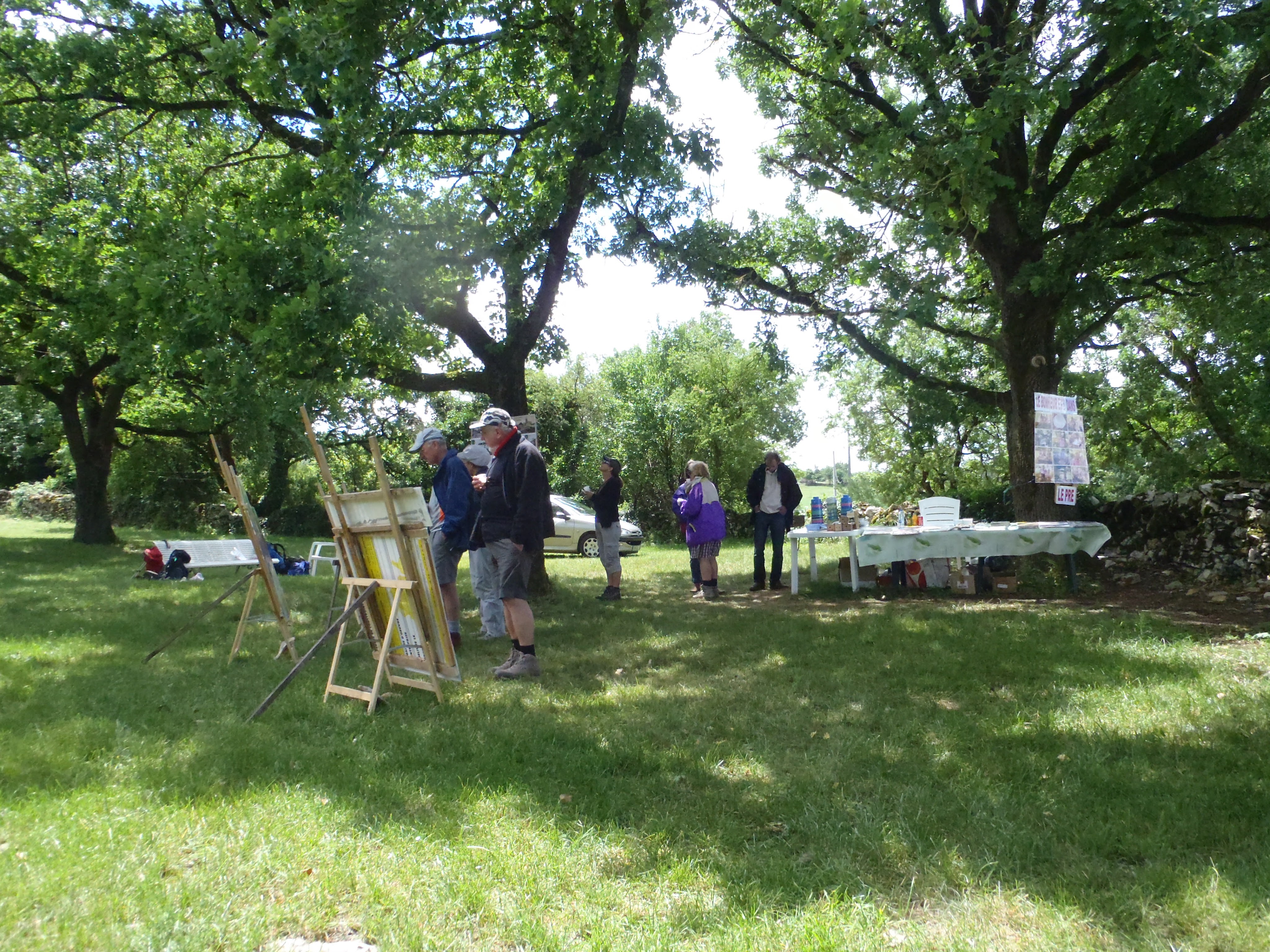
Raining when we woke up but sky soon cleared for a lovely sunny day. Up on to the Causse – mostly shaded with small trees. Lovely walking and only 18K so we were very relaxed about reaching Limogne en Quercy. Once again stumbled on improvised refreshments and an improvised exhibition about the area hilariously translated into English using Google, we thought. Arrived at Limogne to find campsite not only closed but almost derelict. Back to Tourist Office who suggested we might be able to pitch our tent at the Stade (town football pitch) where there was at least a water supply. Sent us to the Mairie and hinted we might even get them to lend us a key to the toilets. You must be joking. Much Gallic shrugging of shoulders so in the end we just stuck the tent up without permission, much to the agitation of a group of teenage boys whom we considered bribing to look after our stuff while we went to find food. The only food shop in town was closed for an annual stocktake so we had no alternative but the local pizza takeaway – which deserved a chapter all to itself. The owner had managed to integrate his social life (drinking) with his business.
Found a lovely local café with a clientele who all seemed to know each other. Beautiful and very aloof young (30’s) woman dressed in black in charge. Two east London wide-boy builders having a coded conversation about some deal or other. We sat there for a couple of hours with Alain and his wife going through all the books and maps we had. There seemed to be a complete absence of campsites/food/water on the next 40K stretch – bit of a pattern emerging – so we decided the only alternative was to catch a bus down to Cahors.
Journal
Des Causses du Quercy, in any other circumstances might have been the very best part of our walk; high limestone plateau – like the Mendip hills but ten times as large – and all the wildlife, all the caves and potholes; everything I love about limestone. Forget the lovely waiter, I called her Sophie but that was just a fantasy name and I wouldn’t have been worthy of a second glance in any case. After nearly 3 weeks on the path my blistered feet stank. There was a moment when I would have sold my soul for a single breath of her – infused (I assumed) with something other than M’s cigarettes and yesterday’s wine, mixed up with sweaty T shirts and socks. Our tent sometimes seemed oppressively small. But I also knew that the sole cause of my sudden horniness was that I was missing Madame.
But today as I pore over the map with a bright orange highlighter line following the GR65 I realize that this 40 Km stretch of impossible terrain for an overloaded pilgrim was the biggest experience I didn’t know I was missing. Two years later Madame and I drove back following most of the route in reverse, but we drove north of the GR65 towards Albi. I’d dearly love to go back there to the Causses with Madame and wander the paths and tracks in Spring. It would probably rival the Aubrac Plateau for wildlife.
It’s strange how sometimes you entirely miss or fail to notice something that under other circumstances might have changed your life. A couple of seasons ago we were down on the Lizard, walking towards Kynance cove and looking for plants. It was fun and we had some success, but in the back of my mind was the possibility that we might find something a bit rarer – Isoetes histrix, Land Quillwort – which, I’d read somewhere, was in the area and likely to be found in one of the pools which dot the landscape. It was prime yomping terrain and I found a pool that was strewn with what looked like the debris from a strimmer, floating on the surface. It occurred to me that it was the oddest place to use a strimmer – especially since I couldn’t see any part of the surrounding vegetation that had actually been strimmed. So without taking a single blade of floating whatever for reference, or even taking a photo for the album I struggled back to the track and we went on our way. Much later I discovered that the mysterious floating material could easily have been the fronds of Isoetes histrix, complete with their spore carrying bases, disturbed and detached by the recent stormy weather.
I’m sure there’s a lesson there about jumping to conclusions. Des Causses – the day we sat in the cafe in Limogne en Quercy – had become a frightening place of deprivation; hot; featureless and dangerous. We just didn’t know enough about it to make a better decision – maybe we could have just dipped a toe in the water with a circular walk. And equally I was expecting a rare plant to announce itself with at least a small fanfare and so because it didn’t assert itself I didn’t bother to take enough notice. I am a ram stamped idiot! It’s known as eisegesis: reading your ignorance and prejudices into a situation; rather than exegesis which is soberly examining the facts/maps/text or whatever and making your mind up only when the evidence comes together.
This revisiting of the Camino walk has frequently suggested that there are times when doggedly refusing to change the plan is plain stupid. For the sake of an extra day’s walking – out and back – we might have ended our Camino with a greater sense of achievement. Who knows? The next morning, with Alain and Daniele, we caught the bus down to Cahors. From memory it took about 40 minutes rather than 2 days. We arrived safely.
Well [the school party] didn’t quite stay up all night but the DJ had them singing all their favourite pop songs at the tops of their voices until quite late. I’d gone to bed at about 8.00pm leaving M to finish off his (2nd) bottle of wine. I always feel very anxious when he starts drinking. Slept all but 11 hours with a few interruptions. M unzipped the tent several times and told me he’d spent £40 on a [phone] call …… in the night. That’ll teach him!
Woke in the morning to the sound of 50 suitcases and accompanying children being herded right past the tent. Daren’t get up for a piss even, as they were overrunning all the facilities. When calm was restored 2 hours later I went to the toilets only to have myself photographed several times by children on the coach which I hadn’t noticed was overlooking me. Left M sleeping and went for breakfast – better than last nights dreadful pizza and chips. 2 coffees, fruit juice, pain au chocolat bread and preserves. Did all the washing in the morning and left it to dry in the sun. Dozed by the swimming pool. After minimal lunch – picnic – went to Conques.
All very picturesque but the abbey was cold and, for me, spiritually meaningless. The town itself is overwhelming but ultimately a gift shop. If you came here looking for faith I’ve no idea how you would find it. Resting again now. Meal booked at the auberge along the road for 7.30. Owner looks just like the one of the *Two Fat Ladies who died. As the days go past we just walk, sleep, eat and search for toilets. That’s about it really. What a strange way to spend a summer. Not very religious and not remotely what most people imagine we’re doing.
* well known TV chefs of the time
Journal
Thirteen years is a long time; long enough to change perspectives, long enough to be led out of Europe by a bunch of liars; long enough to see poisonous and cruel ideologies strip away our security and dignity; long enough to see our civil rights taken away; long enough to see the poisonous fruits of environmental degradation set fire to the atmosphere forcing the thought that my memories of a pristine landscape and historic culture may have already been erased; long enough to know that I’d never be able to undertake such a long walk again. In truth it’s likely me who’s disappearing and I’m finding it hard to adjust to the loss. The sense of morbidity grips like winter – grips my joints; grips my hearing and my eyes; grips my heart which is always liable to go off on a cadenza of its own devising.
This week, on the television we watched “Partygate” – the horrifying documentary that chronicles the carousing and lawbreaking in Downing Street, going on while thousands of people died of Covid. We watched Tory Party conference speeches that were psychotically detached from reality, and we watched the David Olusoga documentary “Union” which dealt with the bloodshed, greed and corruption that fuelled the union of England, Wales, Ireland and Scotland. Any residual faith I once had in our human capacity for compassion, generosity and communal life is being slowly crushed. I was born in Bristol and raised on the horror stories told by my father and grandfathers of the Bristol riots; how the middle classes allowed the miners of Kingswood and South Bristol to fight for the reform acts knowing that their sacrifice would only benefit a couple of thousand wealthy property owners. I was fascinated by Rolinda Sharples’ painting of the trial of Colonel Brereton which still hangs in the Museum. Brereton was court martialed for losing control of the riots, but had been made a scapegoat and committed suicide before his trial ended. Nobody knows how many rioters were killed by the Dragoon Guards.
History and its relics makes fools of us all. I wonder if the only way to conduct a real pilgrimage today is to start with the pot of fools’ gold bought in the cathedral gift shop and then walk away with it into the reality of twenty first century suffering. Who knows? the alchemical work of walking might transmute it into real gold; spiritual gold.
In my twenties I went into a prolonged period of anxiety and depression and so I curse this mood as if it were an estranged acquaintance turning up out of the blue. The doctor diagnosed morbid anxiety and assured me that I would get better with a bit of human company. “Go down to the pub!” he advised. “Pills are no good”. I took him at his word, and months later I met him at a party. I was standing at the top of a rather ornate Georgian staircase. He climbed towards me clutching a large glass of wine. “Ah, I see you took my advice” – he said – and then toppled drunkenly backwards down the stairs in a well practiced cartwheel. Months later it suddenly dawned on me that – of course – I was going to die; but not yet!” Those few imagined words were what you might call a performative utterance and I got better. Ever since, but mercifully rarely, winter trees take on the appearance of blackened lungs and the feeling returns but I’m reasonably hopeful it won’t last
So possibly this wasn’t the best time of year to start remembering the Camino. On the allotment, autumn is my least favourite season because the crops are harvested and all our energy is directed towards clearing up weeds and dead plants. The Camino has always felt like a comprehensive personal failure – so much so that I can only manage writing about it for a couple of days at a time. And yet I go on writing because there’s a tiny part of me that knows the only way to move on is to turn and face the black dog. When faith becomes fetid and blocked with the debris of false belief, the clearing out has to begin. I have to drag the bindweed out of my heart.
My photographs of Conques were enough to set me off on this gloomy excursus. We came down from the Aubrac Plateau exhausted but buoyed up by the landscape we’d been walking through, and were then thrown into Disneyland; the relic of a town, dusted with cobblestones, and rolled into a preserved, boned, rolled and stuffed religious experience.
If you’ll allow me a small biblical moment, some may be familiar with the Gospel story of the Transfiguration – when Jesus goes up the mountain with Peter James and John they see him transfigured – glowing – and talking to Moses and Elijah ( a heap of theology there!). Peter, as always, gets over excited and offers to build three shelters so that (presumably) later pilgrims can return to the place. Jesus (and I’m translating roughly from the Aramaic) shouts at Peter and says don’t you effing well dare you moron – that would be an epochal piece of misdirection. Sadly, ever since then, generations of Peters have been throwing up more and more effigies, buildings and reliquaries in complete defiance of the instruction to remain silent. Now I realize that this is a very loose interpretation of some greatly loved and important verses and that some will think it’s heretical but the central idea is that God can’t be trapped in a location or a building or relic. The Tao that can be spoken is not the Tao.
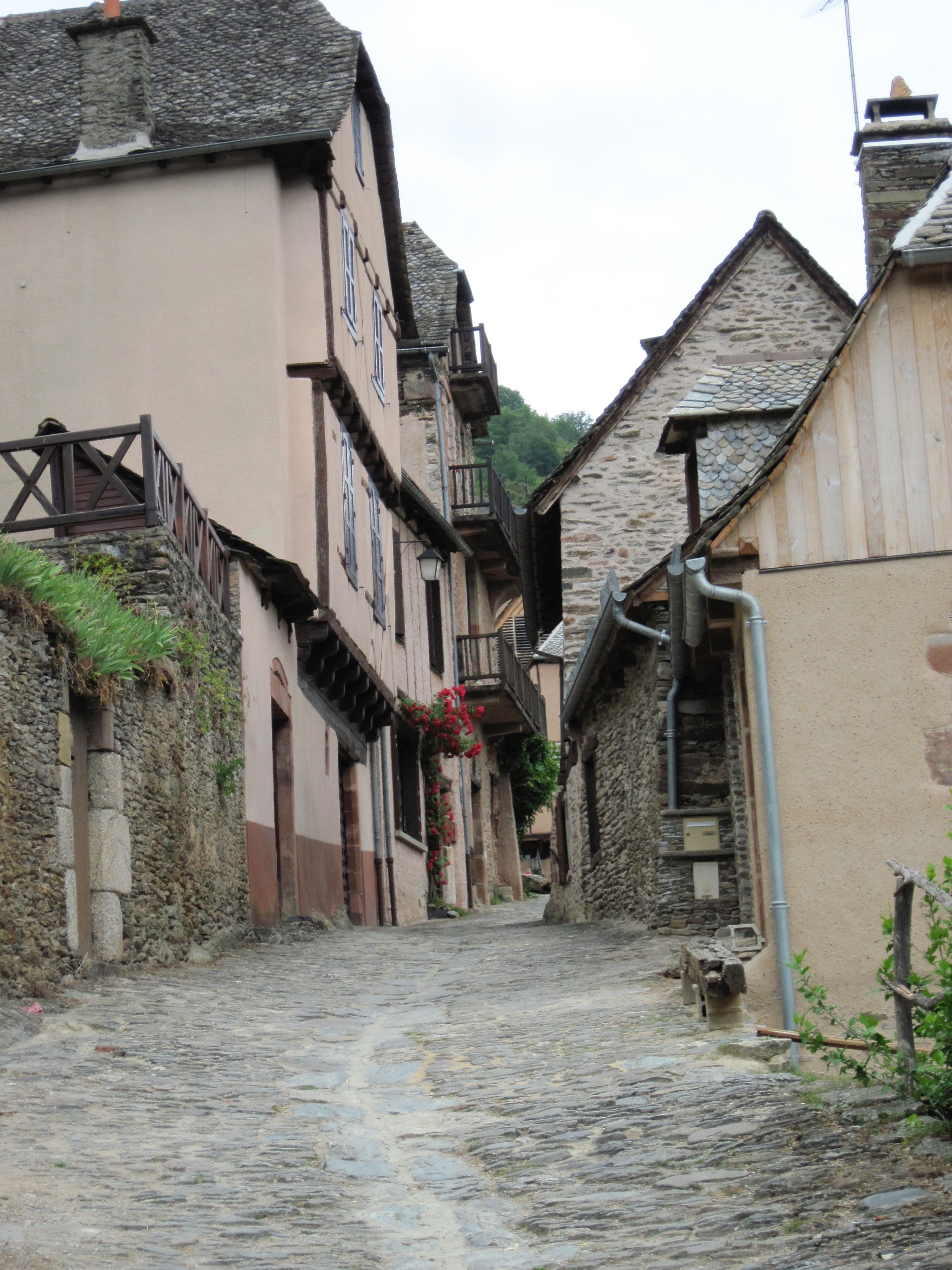
So there’s a sense in which Conques was a kind of turning point for me. The coldness and emptiness of the Abbey exactly mirrored my feelings of coldness and emptiness. The rest was gift shops, bars and bakeries specializing in sweet treats baked with chestnut flour. We got our pilgrim passports stamped and wandered down to the bottom of the valley, knowing that we’d have to sweat it out up the other side in the morning – see the photograph at the top. The untouched beauty of the small town was rather undermined by its chocolate box alleyways and streets and oddly (to most people who don’t know me) I became fascinated by the leadwork gutters and downpipes and took any number of photographs – which I’ll spare you.
This was where the idea of walking away from the iconic place was born. Next time I’ll write about the phone call that changed everything.
Postscript
My friend Rose reproaches me mildly by sending some photographs of Fontenay Abbey which she says is “scoured free of crap” – and I agree entirely. Getting rid of the clutter, the explanatory material and all the accumulated cultus at least allows the buildings to speak. But it still seems to me that occasionally the still small voice can speak through the carnival of distraction – however I think those occasions are determined by grace and not design. So here are a couple of pieces from the past that – I hope – paint a more nuanced picture.
Celtic wayside cross – now outside the door of Gerrans church
This Celtic cross in Gerrans churchyard, (in Cornwall where we are at the moment) spent at least a part of its life on its side as a coping stone on the wall; which is a fairly ignominious fate for what must be the oldest Christian relic in the village. I have to remind myself that although we like to think that artistic, spiritual or historical value is intrinsic to the objects we treasure, it’s clear that what it’s worth is what we think it’s worth. So there were obviously times when this cross was valued more highly than it is today – and what’s more, by the 19th century it was no more than a handy lump of stone.
But hold on; what goes around comes around. What if objects, like words, accumulate meaning, and like words, also shed them. For instance while we were walking the Camino we found several enormous stone frames standing outside old farm buildings. One of them had an immensely strong looking set of straps, but I had to read some history to discover that these frames were used to restrain oxen while they were being shod by the local blacksmith. I’m perfectly content for the frames to be both redundant for practical use – because there’s not much call for oxen with shoes these days (perhaps there should be but that’s another argument); but now they are charged with meaning and resonate as object metaphors for a lost age.
Looked at in this way, the Celtic cross still resonates meanings from the past and still, if we choose to allow it, carries a kind of accumulated spiritual meaning for us. But it’s important to stress that whatever that meaning is, it will take the form of a dialogue. We take questions to these powerful objects; questions such as “what is your name?” “what was in the mind of your maker?” “what kind of world did they live in? and what were their beliefs? “What is your purpose?” Happily we know the answers to some of those questions; this stone began its life as a wayside cross, perhaps in the so-called Dark Ages after the Romans had left, taking their form of Christianity with them – whilst the Celtic church of an earlier – perhaps 3rd century – period which had been most powerful in the westernmost fringes, continued as before. The two spiritualities were very different and so too were the forms of organisation. The reason I think the wayside cross is significant is because the Celtic church was monastic and its monks were great travellers; setting up cells and monasteries wherever they could. In an age where people travelled on foot or by horse on more or less unmarked tracks and footpaths, waymarkers were vital, and continue to be so on pilgrimage routes.
So much then for their accumulated meanings, but could it be possible that the questioning I just mentioned is, in fact, a two way conversation? Would, or could the stone and other treasured artifacts speak back to us? I don’t think that’s a step too far towards some kind of wooly, ill defined spirituality. It would depend on the quality of the question of course, and the intensity of any meditation on the reply. This can sound a bit religious, but for me, the answers to good questions are almost never concrete but – let’s say – Delphic. The symbolism of the crossroads is crucial, because it involves choosing – the ultimate derivation of the word crisis is the Greek crino – to choose. So instead of answering the question where now? the function of the Celtic waymarking cross is to ask it – where now? All I know is that once I’d seen the 7′ high stone I felt compelled to go close to it and see. The stone called me.
Inside Gerrans church there are other speaking objects. A 14th century font carved from granite – Cornish stone; 15th century pew ends bearing the pineapple crest of Katherine of Aragon; the remains of candleholders from the early 20th century, Victorian floor tiles – and so it goes on. But the church is on its knees. The systematic withdrawal of support from these little parishes towards the centre exactly mirrors the social depredations of successive governments. Oblivious to the cultural and social significance of village churches they are being allowed to close.
As we went into the church I read the notices and after we left, I googled up their web page and it was enough to break your heart. These parishes with their 1500+ years of history are being abandoned. Here there are three voluntary churchwardens, but no licensed lay minister and no priest helping to keep them alive. You might think it seems as if the Romans are leaving all over again – which could, just could, lead to a rediscovery of Celtic spirituality. Wouldn’t it be wonderful if our tired and bankrupt churches gave up trailing thirty years behind secular fashions and arguing about challenges long-since settled by the rest of us; gay marriage stops being a “problem” when marriage stops being a property relation; women as priests and bishops stop being a “problem” when women stop being a problem.
So there’s a huge opportunity to rediscover the hospitality, the creativity and the profound love of nature exemplified by a Celtic spirituality that’s open to all and most importantly refuses to define itself in a series of attempts to imprison God into a linguistic cage. There is no theology beyond poetry, song and music.
So where does this all lead me?
18th March 2017 – the Wye in flood at Hay on Wye
This is going to be a hard one to explain ..
I had to give up my futile search for some kind of overarching meaning on 18th March 2017. I know it was that moment because I’d taken this photograph and I just knew it was over. We turned our backs to the river and then I turned back for a moment and said goodbye to God. Then I waited for some kind of catastrophic reaction – the full Kübler Ross experience; anger, denial, bargaining and depression followed at a decent interval by acceptance. No such thing happened because I went straight to acceptance, feeling nothing but a sense of relief that at last I could stop trying to hold the tectonic plates together. What I didn’t realize until this week was that the flooding river wasn’t moving away from me; it was offering me an object metaphor which I could return to six years later with a second piece of the jigsaw – the Celtic wayside cross – with which I could continue the journey in the right direction. The river flows, which is the state of everything in nature. I could go on for ever embellishing and working up the idea but that won’t do because it’s the dreary job of theology to explain, when what the river demands is wonder, that’s all. I filled the ensuing years with the allotment and with learning the plants, and intellectually as well as physically it was absorbing and rewarding – but there was no music in my life; I wasn’t singing any more. My sense of wonder couldn’t tolerate being spread so thinly.
Which was certainly why, on walking into Gerrans church I felt the most extraordinary sense of peace. How strange and how unexpected?
The wayinclines but never compels. (To steal a phrase from the astrologers)
Writing up my notes on the Camino we walked in 2010 has led to some provisional insights among which is the understanding that the full Damascus Road experience isn’t really what it’s about, and also that that once you’ve signed up and set foot on the path, you’ll always be on it whatever happens on the way and however far you ranged in search of an easier route.
The initial landscape on the Aubrac plateau before it morphed into woods.
For a long while I’ve had a set of photographs taken in Estaing that I couldn’t place anywhere in the walk, and so finally I’ve gone back to the map and figured out that it’s a fairly short walk beyond Espalion, and so we didn’t hang around apart from a coffee, I think, somewhere down near the bridge and the river. Then we pushed on. So having finally got this piece into the jigsaw I could see that – far from leaving the hill country behind we were still in the thick of it. Unlike the Aubrac Mountains, this landscape was heavily wooded and the footpath – marked all the way, I’ve never mentioned before, by white and red posts- balises was mostly easy to follow.
And there we are – I’ve probably tried to say everything and actually said nothing.
27th May 2010 ctd:
Bed at 9.00pm. It rained at night and it was raining when we set off so M was pissed of with the extra weight [the tent weighs half as much again when it’s wet]. Turned out to be a monster day again. Following the River Lot but crossing 3 tributary valleys so climbing maybe 1000 metres. 27K in all. M a bit hypo and cross. Found campsite in Golinhac (650m) very good. Pitched tent and had a couple of coffees before walking down to the shop to buy picnic tea. Sadly I’m too tired to eat so we’ll have to make up in Conques tomorrow. Easier day I very much hope.