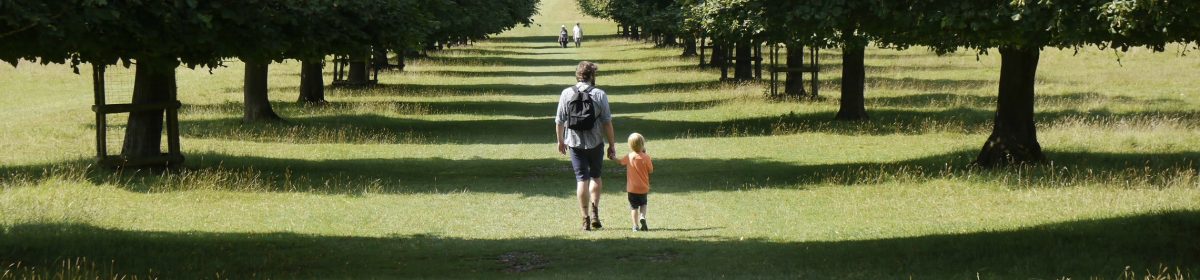
We both love this place – any time outside the holidays, when it gets impossibly crowded. After the weather we’ve been having there wasn’t much chance of seeing anyone beyond a few walkers but for once, apart from one brief heavy shower the sun even came out, the café was open and everyone was very happy. There were no more than a dozen or so cars in the car park, and it was blowing a hoolie as we set out, knowing that once we dropped into the valley we’d be a bit sheltered.
As we were packing the rucksack I thought I’d give myself a rest from plant hunting. Neither of us had slept well, in my case because I’d had an unexpected phone call from a very old friend with whom I thought I’d lost touch and heard some unexpected news about three others who’d died recently. I didn’t sleep beyond 3.00am as thoughts of mortality circled around my mind. So we travelled light even though I knew that the likelihood was that we’d find some rare plants, because the Lizard is an absolute hotspot, and true to form we found some lovely plants including two national rarities and two more flowering exceptionally early. Here are the rare ones – I won’t say exactly where they are growing because they could so easily disappear from too much contact with boots. I don’t know if there’s any research on these particular plants, but certainly orchids plus many other species, growing wild, absolutely depend on mycorrhizal relationships with fungi and if they’re dug up by hunters they’ll just die without the extensive fungal network that keeps them alive. That’s quite apart from a potential fine of up to £20,000 pounds because this is a site of national importance. The Lizard is an enormous lump of serpentine rock, which is rich in magnesium and poor in calcium. The soil lacks nitrogen and is very thin in places so without help from the fungi, the plants would starve to death. Anyway here are the rare two – there are others but they haven’t flowered yet so left to right – Cornish Heath and Land Quillwort which is tiny and I’ve been looking for it down here for maybe 4 years!
The best way of finding these plants as always, is to join a natural history society and get someone to show you. The Quillwort is almost identical to several other common plants that also grow in the area and as a relative beginner I’ve spent many hours trying to learn about them. Anyway, it was almost just as much fun to spot a couple of relatively common plants – Three-cornered Garlic and Kidney Vetch in flower rather early. It’s always difficult to blame global heating, but even after the wet winter we’ve suffered, there are a few more early risers each year
There were Dandelions, Daisies, Gorse and Hairy bittercress also in flower. All the other locals are there in leaf, and we spotted Sea Beet, Buck’s-horn Plantain, Sea Plantain, Thrift and Wild Madder amid the heather and plentiful blackthorn. Here are some of them:
So yes it was a lovely walk, and we sat on a bench outside the cafe where, nearly 60 years ago we’d emptied our pockets to see if we had enough money for a shared cucumber sandwich. We spent the first night of our first ever camping trip together that year with our tent pitched up on the headland. It’s a very special place which – just look at the photos – has remained pretty much unspoiled – helped by the long walk from the car park and the steep footpath you have to take.
But as well as the sunshine, the massive waves crashing on the rocks and rebounding with a wild roar; as well as the fine mist of sea spray that fell on us like a veil from the wavetops and rocks; as well as the glimpses of deep green water through the curling white horses; we heard first and then watched two Choughs playing in the wind above the steep sided valley. That and the hot chocolate so sweet it almost burnt our throats helped down with a toasted tea bun. It’s the very essence of being in nature
If you look carefully above the familiar Beech hangar known as the Nearly Home Trees, or more properly Cookworthy Knapp you’ll see the glimmer of a wind turbine propeller blade just peeping above the trees. I don’t know whose bright idea it was to allow it to be built there but it does little to enhance a view that always lifts our spirits when we return to Cornwall. In fact it’s not actually in Cornwall at all but still in Devon – providing a useful, if overworked, scapegoat to blame for the indignity. I feel slightly guilty about calling them “Nearly Home” because we don’t live here, but we’ve both loved coming down here for over fifty years since we lived in Falmouth for a year and fell in love with the place.
Since the first time we discovered the Lizard it’s been our go-to destination. We’ve camped here, stayed in cottages when funds permitted and brought the campervan down on many occasions. Writing and drawing have always been a part of the agenda, but photographing and recording some of the amazing plants have been added to the list so we bring a faintly ridiculous amount of kit here, up to and including the portable WiFi gear that weighs far less than the portable Remington typewriter I insisted on stuffing into my rucksack on our first visit. A second and equally eccentric corner of the bag was filled by an Italian aluminium coffee percolator. The last time we stacked our kit up in the hall our neighbour asked us if we were moving out.
Storm Chandra – the latest of three named storms has changed our idea of what’s possible while we’re here. In fact I don’t remember us having a “storm season” at all until quite recently but now it’s a thing, like the monsoon season and the hurricane season. No doubt Keir Starmer will be bending every sinew to discuss the climate crisis with the Chinese government; just after he’s signed off on buying a few more nuclear power stations and secured some juicy weapons contracts. How blessed we are to have such Nelsons at the head of the ship of state, (Sorry; that sentence was auto-corrected from ” such Nellies at the head of the shit of state”).
Anyway, our journey down was largely unaffected by the storm apart from fierce rain as we drove through Devon and a 30 minute delay on the A30 when traffic was funnelled into a single lane so that four blokes could dig out a blocked drain. We were so glad of the new windscreen wiper blades! There were flooded fields to the left and right of us almost all the way, but we managed to load the car in a dry spell and once we got beyond Helston it cleared up beautifully. Chatting to a lost delivery driver this morning he told me that the side roads hereabouts are still blocked by floodwater and fallen trees, and on the television news we learned that the Environment Agency hadn’t even begun to assemble their array of mighty pumps on the Somerset Levels until storm Chandra had made landfall. There was a worrying moment as we drove through Redruth, when we heard an awful noise and smelt something like burning rubber which thankfully turned out to be outside the car and leaking in. It looks and feels like a town where whole industries go to die. They voted against the EU down here but the new A30 improvements are a stark reminder of what a few billion pounds worth of help from the neighbours can do. So now there’s fantastic roads infrastructure for the bailiffs to haul the machinery and the jobs out of the county.
Anyway we’re here and in, and after the usual hour of curses and hand-to-hand combat with the mobile router we even have the internet. It didn’t take long to Google up what’s on locally and we’ve already signed up for a talk at the village hall on Monday about the Lizard Flora. There are two rare plants that we’ve been seeking for years – one of them – Spring Sandwort – also occurs on the Mendips and although we know roughly where they ought to be we’ve never found them. But they also occur down here on the Lizard and the reason is that it’s a plant that’s tolerant of the post-industrial mine waste that occurs from lead mining on Mendip and Serpentine on the Lizard which has large surface areas of the mineral. The other plant we’d love to find is Land Quillwort which, being not much larger than a 1p coin and also not producing flowers but spores is loosely associated with ferns and is one of the plants we have in danger of becoming extinct. The Lizard is the only place it grows. So – as my Mum would have said Hope springs eternal in the hearts of the faithful (actually Alexander Pope said that first but I prefer my Mum’s identical version.
Spring Squill (I think!)
One of the problems of identifying the Quillwort is that it bears a strong resemblance to the emerging leaves of the Spring Squill which also grows here – it’s just much smaller. We were wandering on the clifftop some years ago before we got quite so interested in plants and we met a woman who was scanning the grass as only botanists do. “What are you looking for?” I asked. You probably need to know that this was before I discovered how deaf I’d become. I was sure she’d replied “squirrels” and so not wishing to display my ignorance I asked “what sort? grey or red?” – “Spring”- she answered” and then the penny dropped. I hope you’ll also be pleased to know that just before we came away I got my third set of NHS hearing aids which are absolute game changers. Apart from being able to hold a lucid conversation with Madame (my mishearings were becoming hilarious), I can now receive phone calls, listen to music and even connect them to the satnav. Madame finds this bit troubling because now I shout at thin air and have conversations with people who aren’t there.
While I was waiting to intercept the lost delivery driver at the top of the lane I chatted to a ninety year old local man who was born here and still lives in his grandfather’s house. He looked as fit as a flea, and told me how he still gets pleasure from pushing open the door knowing that his grandfather’s hand had touched the same ironwork. The air must be pretty good around here.
But in answer to a question I was asked during the week– “What was the actual millionth word?” – well you may think it was a bit of a disappointment because it was “much”. Feel free to develop any metaphorical significance you like; it’s Freedom Hall here at the Potwell Inn. The oldest existing version of St Mark’s gospel ends mysteriously with the Greek word “gar” – ‘because‘ and scholars have had a field day inventing possible reasons and even helpfully completing the book to their own tastes. In the case of the Potwell Inn, I like the word ‘much’ as much as any other but I finished the sentence in any case and after a short rest, here we are again.
Last Monday was alleged to be some novelty, named (by the media) “Blue Monday. We were all supposed to be fed-up by the endlessness of winter, the short hours of daylight and our January bank statements. I’m sorry to buck the trend but I had a lovely day which included feeling very pleased with myself for completing last year’s resolutions but also submitting 420 completed botanical records to the Vice County Recorder which, thinking about it, probably spoiled her day. But maybe the crowning moment was finding a Lesser Celandine in flower on one of the two main roads into Bath. Notwithstanding the pouring rain and wind it brought a touch of spring into our hearts. It was in a half-starved looking garden just opposite the derelict hotel where the police were busy removing 700 cannabis plants from an illegal factory. You see, in Bath there’s no need for a writer to make stuff up – it just comes along, barely 50m from where we live. The smell of cannabis was so strong nearby that we called the spot “Skunk Corner” and wondered how the residents managed to survive their habits. It may well turn out that they lived blameless lives, living next door to the extractor fans, which would be a great example of blaming the victim.
The Celandine wasn’t the first exciting plant of the year. That was the Greater Dodder that was found climbing up a riverside nettle on the New Year plant hunt by the same Vice County Recorder whose Monday I may have turned blue. Sorry about that. The Dodder was – if not rare, certainly very unusual which bears out my belief that the place to look for rarities begins as you step out of the door. The VCR, Helena, was kind enough to email back and say that some of my records were interesting. Chatting to our friend Charlie yesterday – he’s South African – he said that was a classic example of British understatement. On the other hand, they might be 90% wrong which is why we all have to hand in our homework for review. We don’t overdo praise here in the UK.
But if you were to ask me to say which find was the most important, then I’d say the Celandine was most important and exciting to me and the Greater Dodder was more important to science, with the rider that whilst Celandines may be ubiquitous, like House Sparrows, Starlings and Turtle Doves once were – if we don’t record them they might begin to disappear too. But the most important reason for my ranking the Celandine highest is that it’s one of the most noticeable markers for Spring. Ever reliable, easy to find and bright in colour so they show themselves in hedgerows, they always gladden the heart. However grey, cold and wet the weather the Celandines will announce the turbo-charged arrival of the new plant hunting season.
We’re off to the Lizard peninsula in Cornwall for a break but the weather outlook is pretty awful. Nonetheless we’ve been checking our plant hunting equipment – hand lenses, GPS unit, charging batteries, testing cameras and SD cards, packing bags and running tests on the new moth trap, choosing books and waterproofs. So we don’t expect too much from the weather and probably the moths will be hard to find but whatever happens we’ll have fun and if the worst comes to the worst I’ll finish reading three big books, two on fungi and a new one on hedgerows. The allotment is tucked up for the winter and the trail cam is busy with visits from fox, badger, squirrel, domestic cat and – of course – rats. We’ve filmed the fox predating rats which was a heartening sight and the soil is taking a well-earned rest, although from reading my fungus books I’m discovering just how busy it is just below the surface.
I’ve also been testing Googl Gemini AI to see if it can help with my work – mostly playing with it and asking difficult questions to see what happens. It’s immensely powerful – it digested ten years of my writing in a minute and came up with a summary that was more right than wrong but still needs a pile of editing. There seems to be an algorithm that favours the more recent over the older stuff and there are one or two WTF? moments including a word I’ve never used and had to look up. I’d like to teach it to do routine and boring jobs on the spreadsheets so that I can get on with the more interesting bits.
We seem to be living in what the Chinese call “interesting times” – with what used to be regarded as responsible politicians behaving like hooligans outside the pub on a summer Friday night. Madame has suggested that we don’t watch TV or read newspapers while we’re away. It’s an attractive proposition. When I was very young my friend Eddy and I used to go occasionally to a night club in Yate. We were almost always refused admission because we were deemed too scruffy. Every Friday the bouncers would clear the club at closing time as soon as the inevitable fight broke out, and if it didn’t they would start it anyway. I tried once to point out to the bouncers that the fights were always started by young men wearing suits and not looking scruffy. Like so many occasions in my life I got into trouble for pointing out the evidence. I was thinking about this last night and I realized that this is a pattern that’s been repeated since I was about twelve. Among my many talents is a capacity to enrage people who dislike being challenged. Ah well, I’m not apologising!
Books mentioned – I recommend them all:
Fungi – Collins New Naturalist series: Brian Spooner and Peter Roberts
The Fifth Kingdom -An introduction to Mycology Brice Kendrick
Hedges – Robert Wolton, Bloomsbury British Wildlife Collection.
You’ve no idea how lovely it is to feel well again; to wake up in the morning full of ideas; relishing each day and going out on our walks once more; a bit further each time. I still don’t know with any certainty what was wrong with me but in the end – and by default because they’d looked at every other possibility – I think it all boiled down to iron deficiency anaemia caused by polyps in my colon which were removed by a lovely team at the RUH and then, after a troubled start on iron tablets which initially made me sicker than ever, they were changed for another type and apart from the bother of waking myself up to take them at 5.00am, I feel better than I’ve felt for around 18 months. Hooray for the NHS and the Royal United Hospital ….. and for our GP who started the ball rolling on what must have been a hunch.
So last year didn’t go too well on the travel front – rescued twice by the AA and ignominiously towed home on a trailer; the engine blew up once, cambelt, water pump, clutch and alternator needed replacing and two trips were cancelled before they even began. But that was then and this is now and the van, Madame and me are ready for (amost) anything but especially for a trip to the Lizard which was just ravaged by storm Goretti and lost both water, electricity and internet for a couple of days. We’re staying in a rented clifftop cottage and the photos at the top were all taken through the half-door; the one on the bottom left taken early on the morning of our last departure. Every time we leave it feels like a small bereavement – there’s a bit of my soul living there permanently.
Having spent several years on the neighbourhood plants – Lizard is a botanical hotspot – I’ve just finished fixing up a moth trap. It’s very early in the year and we don’t expect more than a handful of visitors, but in many ways a slow start is the best way for beginners like us. The more projects we embark on, the more the planning resembles a military campaign – laptops, mobile wiFi router and aerial, books, maps, food; cameras, lenses, tripods, kitchen sink. You get the picture. I’ve even bought a new, clonking great monograph on hedgerows to keep me happy if it rains non-stop, and that’s happened on several previous trips.
Eskdale 2019
Taking photographs is only a fraction of the battle, though. Identifying the plant in question is three quarters of the fun. For instance the little darling below was – so far as I was concerned – a white form of death cap that we found on the edge of a wood in Cumbria a few years ago. It’s been labelled and sitting in the photos folder for years until yesterday when I was reading a brilliant monograph on fungi in the New Naturalist series – when I discovered that it also looked very like another fungus known as Destroying Angel which really is white. In the intervening years I’ve learned how to access the massive power of databases and so I checked on the largest I could find and discovered that neither of the fungi is even recorded close to the place we found it, but that even so my initial identification was more likely to be correct. There is a test to distinguish them but of course the subject of the photo is long gone and so it will always remain an unanswerable question.
That’s the thing about nature, it seems far more malleable than we would wish. It would be fairer to say that short of a full DNA profile almost all our identifications are provisional. Like weather forecasts ID’s are correct on the basis of percentages. 100% certainty is rarer than we’d like. Of course that merely means that we should be more modest about our certainties. A couple of days ago we were on a plant hunt and I overheard someone airily identifying a Feverfew with a lot more conviction than I would dare to offer. In fact, the more I learn about fungi the less likely I am ever to forage for them. Both the Death Cap and the Destroying Angel are regularly and fatally confused with edible fungi. No thanks, then, I’ll have the fish fingers!
So, the packing lists are all made and the kit is all checked over, charged up and wrapped. You would think we were off up the Amazon but you need to remember that as a list addict, planning is almost as much fun as getting there. It doesn’t always work of course, we once drove up to Pembrokeshire for a camping holiday only to discover I’d left all the tent poles behind. On another occasion I forgot the air mattresses, and after a trip to the local supermarket we bought a couple of air beds that were so thick and luxurious our noses were almost touching the flysheet.
But at this moment I can hardly contain my excitement at the prospect of waking up to the sound of the sea and walking between fields and hedgerows which – being much further south – are just beginning to wake up. Bring it on! – we say.
I was just adding up and I’m pretty sure our first visit to the Lizard would have been in 1969 while we were at Falmouth Art School. It must have made an impression because when we moved to Bath Academy of Art in Corsham we went back for three weeks, camping in a heavy cotton tent on a farm for 50p a night with access to an outdoor toilet and a cold tap in the corner of the farm garden for washing. The farmer was an amazingly good looking young man with blond curls who was experimenting with milking three times a day. We quickly got through the small amount of money I’d earned as a temporary groundsman and I had to phone my sister for some additional funds. The journey down began with a car drive to Penryn with a friend who was visiting her brother and then after an overnight stay we caught a series of buses beginning outside the Methodist Chapel where they were singing in tongues so loudly you could hear it through the three foot granite walls. We finally arrived in Lizard hours later, just in time for a snack in the Regent Cafe on the green (still there). For some reason I’d brought my little portable Remington and a coffee percolator (I didn’t type a word the whole time we were there!), and everything we needed was packed into two rucksacks; mine was so tall I could barely lean to one side without toppling.
I was determined to walk across to Kynance Cove to camp, but I was equally determined to navigate across the most direct route rather than follow the coast path. On sober reflection and more than fifty years later I understand that every mark on an OS map has a meaning. Not least the little wavy blue lines that signify some very rough and waterlogged ground. I had no idea then what botanical treasures we were stumbling across. We finally made it across Lizard Down in the dark having scrambled down and up the precipitous sides of a valley quite unnecessarily and erected the little yellow tent on the first bit of flattish and dryish ground we could find. In the morning Madame went for a wee behind a rock, having barely slept a wink for fear of being inundated by the sea which – although it was noisy, was 100 feet below us – only to be approached by a phalanx of bemused walkers. We’d pitched the tent in the middle of the coast path. Words were spoken and we packed up and walked the coast path back to Lizard.
The three weeks were blissfully hot and we walked and sunbathed all day, discovering the small villages, eating at the cafe when we got back from our explorations and drinking at the pub in the evening. On one occasion I tried to drink every whisky on the bar while Madame had her first taste of brandy and Babycham. It didn’t end well and I banged my head on a farm shed lintel so hard that I saw stars. On other evenings we really did see stars; millions of them.
This was the holiday we discovered Cadgwith. We stopped off in Ruan Minor and found a little pop up cafe doing cream teas in the garden, and then we walked on down to the Cove and – although I couldn’t swear to it – I think we probably bought fresh crab. Cornwall had been a revelation to us; both of us born and brought up in Bristol and, for the first time, seeing Dracaenas, (which were Palm Trees as far as we were concerned), growing everywhere. The sea there, after the familiar mud soaked grey brown of the Bristol Channel, was a miraculous blue. It was there I discovered the name of the exotic looking clifftop weed called Kaffir Fig. It was there too that we saw the last few Choughs eking out a living before becoming extinct for several decades. Intensive farming and chemical cattle drenches finally did for them and almost did for the Ravens too. It was there that two intertwining threads were born in us; a passion for natural history and a passion for this extraordinary part of Cornwall.
When we go back anywhere along that coast, the first thing I do is take in a great draught of the air; of the sea, the grass, the cowpats in the fields – not the ammoniac stench of huge silos but crusting there on the grass for flies to lay eggs which hatch into maggots which in turn feed the Choughs. The second thing I do is to pause and listen to the sea, the wind and then the birds. Jackdaws, Choughs, Rooks, Crows, Magpies and even Ravens if you’re lucky – they’re all such voluble chatterboxes. The Lizard is known as a botanical hotspot which, translated, means there are so many plants I don’t recognize and can’t name, that I exist with a permanently cricked neck and spend the evenings poring over books and photos. I’m a slow learner.
Then for some reason we stopped going there. It felt overrun with tourists not like us, and the ambivalence of the Cornish towards us was occasionally hard to bear. Too many Tarquins and Cressidas; too many labradors; too many wannabe sailors and posh wetsuits; too much Guinea Fowl and too many places we could no longer afford to eat; too many times being ignored in the bar whilst the barking classes sharp elbowed their way to the front.
We eventually had three boys and for most of the time life was a struggle but we found a wonderful and cheap campsite in the extreme west of Wales with amazing beaches that you could only access on foot after a long walk; and where we could go skinny dipping if we felt like it and build driftwood bonfires on the sand. The boys were happy there and soon found friends among the AT (alternative type) campers. It was like Totnes by the sea. On one occasion one of the other parents asked us if it was really true that we cleaned our teeth with twigs – the boys had rather exaggerated our commitment to low impact living.
I was learning plants more quickly by this time – making long lists of them as we walked down the lanes, whilst barely keeping my head above water at work. There were several occasions when I drove back home – a 300 mile round trip – to take a funeral in the middle of a holiday. I always felt responsible, but we survived the worst that a few of the church congregation felt entitled to throw at us and gradually they left to attend other churches where the vicar was more malleable and would do as they were told. Pastoral care for us was a joke, because the bishops felt threatened by therapeutic groups that might reveal abuse and bullying in the Church of England.
One lovely summer we took three weeks off and went camping in West Wales and by the end I felt like a wildly excited dog, charging around the field. I think that was when I realized that some jobs will crush the life out of you if you let them. There was me preaching about life in all its fullness and slowly fading away myself. That summer I let my beard grow and when we got back one of the congregation told me I looked frightening. I felt that was a good start.
But what about Cornwall? One summer after the boys had left home and we were both working full time we’d arranged and paid for a holiday in the South of France and needed to hire a car which you can’t do without a credit card. That’s so the hire company can remove hundreds of pounds from your account without asking you, on the spurious grounds that you didn’t refill the tank until the fuel ran over your shoes. Anyway, the credit card never arrived, the holiday and our money were lost and three weeks later the bank rang to say that they’d found the card in a drawer in the office. No word of apology or any offer of compensation. Madame was devastated and I felt responsible but she immediately started searching for a new holiday. Needless to say looking for a campsite in August is tricky but she stumbled on a long established campsite in Cornwall that had just changed hands, which had led to a bit of a boycott by the longstanding patrons. So we were in, and found our Cornish heaven again. We’d had a couple of damp squibs in the intervening years. One cottage near St Ives, owned by another vicar, turned out to have walls running with damp and squatting in a sea of mud. The tenants on the farm looked terrifyingly inbred and we drove straight home again before the banjos and shotguns came out.
The new campsite on the Roseland Peninsula was everything we needed and had its own microclimate with its own flora. But working eighty hours a week precludes any serious botanising apart from a few short holidays and so we had to wait until we both retired and moved to Bath before we could settle to some serious plant hunting. Nowadays we alternate between the Lizard, Portscatho and the Llyn peninsula for longer breaks and do local field trips with the Bath Nats where there are abundantly qualified members to help us identify plants and fungi, even insects sometimes.
Cornwall is a difficult place to get your head around. I’ve often written about my attraction to post-industrial landscapes, which the county offers in abundance. There’s barely a square mile that hasn’t been dug up, turned over and mined. A century later it all looks like a film set; ferns growing tastefully from the crumbling pitheads against the pyramid backdrop of china clay spoil heaps; footpaths glistening with mica flakes; cliffs stained blue and green with copper and arsenic leaking from flooded mine adits.
And then there are the fishing villages. Hardly anyone outside the big ports like Newlyn and Penzance goes fishing any more, apart from a few small day boats after mackerel, crab and lobster to sell through the back door – but the fishing myth persists in a miasma of half remembered better days. It’s kept alive because we all need it to be kept alive. What cottage or pub connects better with the imaginary past than the one with a few coloured glass floats and a brass barometer on the wall? In the winter the pretty villages empty out and go dark. Village schools, churches and shops close every year as the locals move to damp and poorly maintained rentals inland.
But we go back like lemmings to the edge of the sea every summer because we need to feed some remote part of the soul that can’t be fed anywhere else. We take our own soul food; a few folk songs, remembered paintings, some Leach pottery maybe – because the essence of twenty first century life; the high wall that keep us chained to neoliberal stupidity is the constant erosion of historical memory. Memories of the real past, like languages don’t just wither away, they’re deliberately suppressed and the resulting holes are filled with the polystyrene foam of costume drama on TV. Cornwall is Poldark; Poldark is Cornwall. Believe what you like! Truth is so last year! A bit of wrecking or piracy or smuggling is OK, after all it’s only a film!
I suppose for a botanist, even a very amateur one like me, it would be simpler to ignore all that stuff and just enjoy the plant life. But there is a live interface between, for instance, unemployment and a dirty industry like lithium mining. Polluted land might provide a niche interest for people like me, but it’s polluted all the same. In West Penwith there’s a battle raging between Natural England and some of the local farmers. There are about 3000 hectares of moor and downland that constitute one of the largest semi natural sites in the country. We’ve walked the footpaths there for years. But nutrient enrichment and changed land use towards intensive farming is slowly destroying the habitat. There’s more heat than light in the debate because the farmers will be compensated for any effect on their income, but there’s no doubt that the way of life they’ve become accustomed to for – say – fifty years, will have to change. That’s a toughie because a fifth generation farmer didn’t sign up to become a nature warden and very properly wants a bit more flesh on the bones of how it’s all going to work. The problem is, organic change is very slow and incremental but the environmental crisis is more akin to a tsunami. There’s no time for a generational change and some farmers there find it threatening and oppressive to be told their traditional way of life is less important than a tiny plant or a spider.
The Cornish, like most threatened communities, have become defensive and suspicious of the government. The fishing industry has been hammered by brexit whilst simultaneously overfishing because you have to make hay while the sun’s shining. Lack of housing is a huge source of anger – it goes on. Tourism is a constant irritant; there are too many buy to lets and airBnb’s and, just as with the tin mining, much of the money is exported to the wealthier parts of the UK.
And yet ……. and yet, when the beach side building that houses fishing gear in Cadgwith came onto the market, threatening the livelihood of the last few fishing boats, the local community launched an appeal which was supported by people all over the country and the building was saved.
When we are there my greatest joy is to stand at the kitchen door of our rented National Trust cottage – in truth an otherwise derelict cattle shed – and absorb the smell and plangent sound of the sea against the rocks below. I don’t need to own it, or control it in any way. The thought of it just being there is a sustaining one when the going gets tough in Bath. A week is all it takes to fill the tank, and we’ll come home with dozens of photographs and maybe identify some never seen before (by us) plants, oh and we’ll eat fresh fish from the fishmonger in Porthleven, drink wine, sleep like innocents and feel the life running through our veins.
If there is a solution to the conundrum to the disconnect between real Cornwall and the competing fantasy versions, it will surely include tourists like us; but let’s make it sustainable tourism, buying locally to support small businesses, parking thoughtfully without blocking the lanes and respecting those who live there the year round. Let’s support any initiatives to bring sustainable non-polluting green jobs to the county and behave like ethical grownups!
We set out to double check and photograph a patch of wild leeks that we found a couple of days ago and which I’ve never seen before so we needed to document them properly with grid references and detailed photos in order to get them double checked by the local County Recorder. There is a kind of trainspotter sickness that can grip you when you get into plants but fortunately it’s a sickness whose symptoms are air punching for no apparent reason and feeling absurdly happy even on a cold grey day in winter.
Glistening Inkcap, Coprinellus micaceus
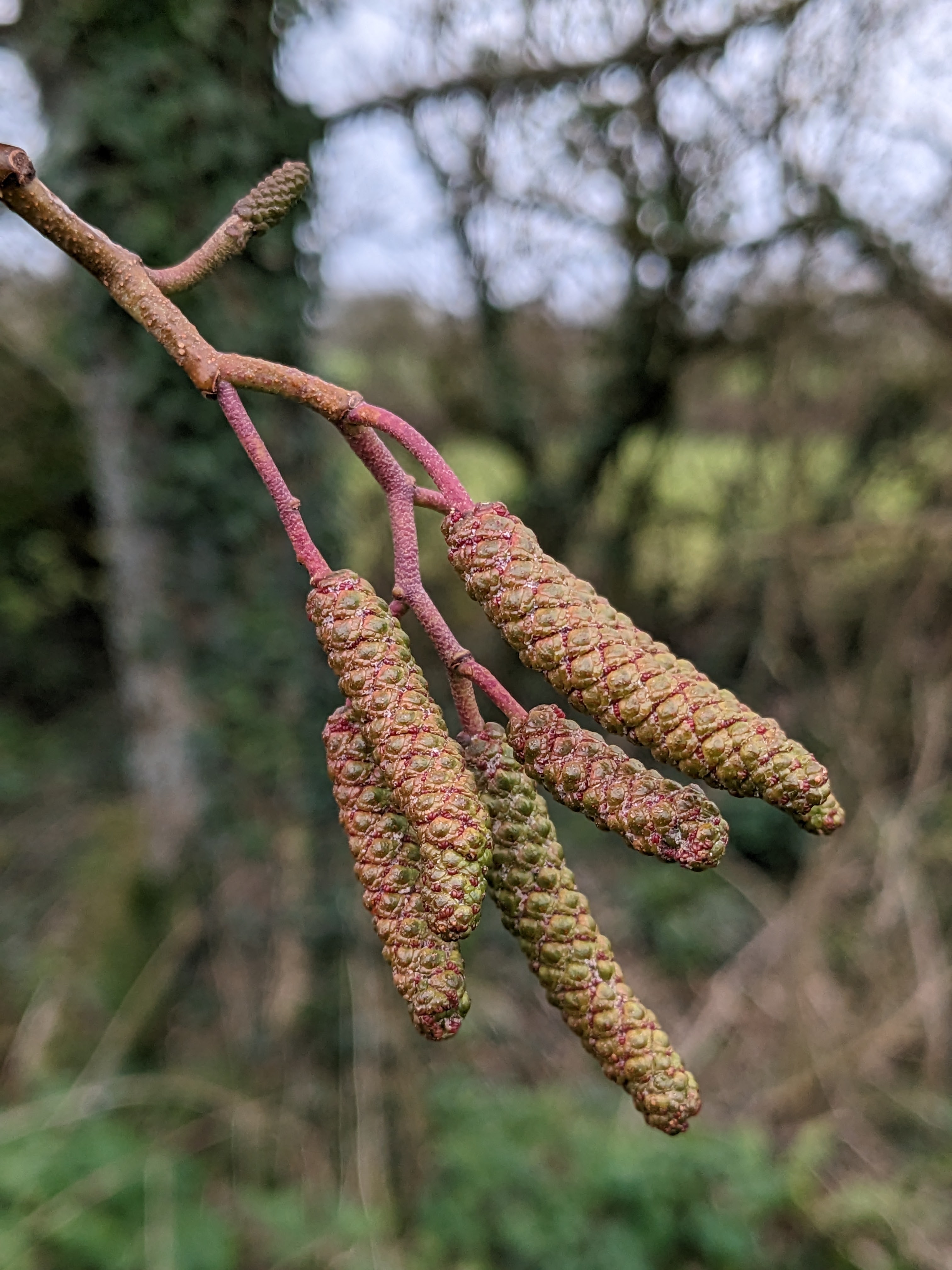
The secondary reason was the competitive urge to find a Celandine in flower. The results of the New Years plant hunt, organised by the Botanical Society of Britain and Ireland are coming in and the general impression is that this is a rather late season. Last winter we photographed them in flower down here on 17th January and by the look of the leaves today we’re running a fortnight late this year following the continuing bitterly cold weather. We did however find a lonely violet – not my strongest subject but Sweet Violets, Viola odorata are the earliest to flower. Winter Heliotrope were in flower too and a solitary Cyclamen was hiding at the top of a hedge bank which – while photographing it – provoked the strong perfume of wild garlic under my feet. There were abundant purple catkins on an alder tree. In the fungus department we spotted a Glistening Inkcap on a moss covered log.
More than anything, seeing the growing leaves of a multitude of other flowering plants made me wonder how many terawatts of sheer green energy are sitting there underground waiting for a daylength and temperature signal to let them burst forth. Hemlock Water Dropwort doesn’t look half as dangerous when it’s vibrant green and only a few inches tall.
As for the very local Wild Leek, we await the verdict from the County Recorder but here are the photos we sent to him. Cocoa and toasted saffron cake were consumed.
Rainbow at the entrance to Cadgwith Cove – seen from the kitchen door
Rather impulsively, perhaps, as soon as new year was over we decided to rent a cottage on the Lizard in Cornwall for some R & R after a very challenging few months. It’s significant that over the last 50 odd years we’ve always gone as far west as we could manage, whether it’s down in Cornwall, or in West Wales and more recently on the Lleyn peninsula. So we arrived on the 10th January after deliberately taking the motorway free route which is slower but much more more scenic, crossing, the Blackdown Hills – even if it does amount to around 200 miles. Interestingly we swapped the hills for the motorway on the way home and used 30% more petrol! We were staying in a National Trust converted cattle byre which was a perfect fit for us – perched, as it is, on top of a cliff with the South West Coast Path virtually running through the garden. I won’t bore you by rambling on about the magical landscape; you’ll just have to take it from me that even in the dead of winter but with the benefit of six consecutive days of full sunshine this is a very special place indeed.
For a start it’s around three or four weeks ahead of Bath for signs of the beginning of spring. The Alexanders are forging ahead; we’ve seen primroses, Red Campions, jonquils and today even a solitary hogweed beginning to flower. Down at the beach I found a thriving community of Butchers Broom – (Ruscus aculeatus) which I’ve never seen before. While we were wandering along we saw a group of people, noses to the beach, hunting for tiny pieces of amethyst which apparently washes out of the mineral rich rock. Eschewing semi precious stones, Madame concentrated on finding beautifully marked dog cockle shells. In a month or so this place will be a botanist’s paradise with Spring Squill and all sorts of rare flowering plants. This week we’ve watched common seals in the sea, and a kestrel hovering, hunting over the cliff path today.
Clockwise from the top left, Lesser Celandine, Bladder Campion, Thrift, Butchers Broom, Alexanders, Red Campion and Gorse – known locally as Furze.
But this is also a post industrial landscape. Further up the coast beyond Lands End are the remains of many tin mines. North of Lizard there are huge quartz pyramids left by the China clay works. Here on the Lizard there were two principal industries, fishing and the quarrying and finishing of Serpentine rock. In fact down at Poltesco the two industries coexisted on the beach side by side. The serpentine works, now ruined but still visible was situated alongside a vigorous stream that fed an overshot wheel via an overhead aquaduct and powered huge toothless circular saws that utilised sand and water to cut the slabs of rock. Next door to it is a circular building that housed a human powered windlass which enabled the fishermen to haul in their huge seine nets containing (on a good day) many thousands of pilchard. Cheap imports of Italian marble, a change in Italian fasting habits and the disappearance of the pilchard shoals put a sudden end to both industries leaving nothing but ruins and unemployment. We sat on the boulder strewn beach, soaking up the sun beneath the abandoned buildings. The whole scene had a mournful air. In the strong onshore wind, each withdrawing wave turned even the largest boulders making a sound that could have been the rattling of bones or occasionally like rapid small arms fire. Part of the magic of these Cornish landscapes is the way they seem to contain memories of a disappeared culture – and I’m using the word as an active verb. It was an extractive and greedy culture that was able to suck the marrow out of Cornwall and turn it into huge fortunes and stately homes – a culture that, as David Fleming would have argued, is about to collapse. Who knows? Perhaps the extraordinary price of oil and gas at the moment are the beginning of what he terms “the climacteric”; the brutal end of a brutal system.
When the tin mines finally closed at the end of the twentieth century it marked the end of the industrial revolution in Cornwall and this is now a shamefully impoverished county, depending absolutely on tourism. Second homes have become a major political issue. There may be some new jobs if the experimental lithium mines become profitable but then again, I’m not sure whether the effluent from the process will cause more pollution problems than the tin mines did. There are still old mine workings holding lethal levels of arsenic. But who will dare to say to the unemployed that the possibility of well paid work must be withdrawn for fear of environmental damage. There are no easy answers here. What they need is some plan – any plan – to reinvigorate the local economy. For the moment it seems to be sustained by small builders who, at this time of the year can be seen everywhere maintaining and improving empty second homes. There’s a large RAF station that has enough workers to generate a very small traffic jam outside Helston when they leave in the evening and the usual cluster of industrial units around the towns. It ain’t beautiful! Meanwhile, up on the north coast of Cornwall two European registered supertrawlers have been spotted. These leviathans can scrape every living thing out of the sea, making a mockery of the promises that convinced the local fishermen to vote for brexit. The sense of betrayal here is palpable.
All of which glum observations lead me into something more positive. I’ve mentioned these books in a couple of previous postings. The full title of the condensed edition is important – it’s “Surviving the future – culture, carnival and capital in the aftermath of the market economy – A story from Lean Logic”. Selected and edited by Shaun Chamberlain from David Fleming’s much larger book “Lean Logic”.
My mother, who was a dressmaker, had a small tea chest that we called the button box which (unsurprisingly) contained hundreds of buttons that were endlessly fascinating to me and my sister. There were a dozen ways we could play with it; treating the buttons as toy money, sorting them by size or colour; stringing them on thread. We could create an almost infinite number of “narratives” from the same box. Rather like the buttons, the original creation of “Lean Logic” was the never quite finished work of many years, comprising hundreds of short and longer entries on the topics that exercised David Fleming’s mind. All attempts by friends and admirers of the unpublished text to get them published were met with the argument that it wasn’t quite ready. LIke Penelope, Odysseus’ wife, his woven cloth it was endlessly unravelled, revised and improved but never finished. Finally, just as he was beginning to prepare the manuscript, he died unexpectedly leaving his great work unpublished. It takes the form of a dictionary, or encyclopaedia of terms relating to the central concept of “Lean Logic” and it’s rather like my mother’s button box because it’s so well cross referenced you can drop in on any one of the articles and then follow several alternative threads according to your particular line of enquiry. What the smaller book does is develop one possible thread – a story – from the larger. I bought both the complete and the concise versions (available from Chelsea Green Publishing) before coming down to Cornwall, relishing the prospect of some serious reading.
You will know if you follow this blog sequentially – (does anyone do that? I’ve no way of telling) – that I was extremely put-out by the use of a quotation from Roger Scruton that read like the sub racist, dog whistle nonsense that he was so good at. I just couldn’t see the point of using it – especially next to a far wiser quotation from Wendell Berry. This was in the context of a section on the dangers of “mass immigration” – so you’ll see the danger of publishing material that will inevitably be twisted into the service of a dangerous cause. I mused on this in the blog and resolved to finish reading the shorter book with my critical faculties dialled up to nine!
Chatting with Madame about this on one of our coastal walks, the conversation (as conversations do) took on its own momentum, and a new dimension to the offending words appeared. My instinctive reaction to Scruton’s remarks was to focus on the terrible human cost of racism, and that alone would have made me excise those words had I been editing the book. However there’s no doubt that the environmental breakdown we’re causing, added to the wars being fought over oil and energy, not to mention rare minerals; will lead to huge numbers of displaced refugees moving towards a safer future. That’s not a phenomenon that can be avoided by building walls and weaponised borders.
But at a far more local level, what about the effects of second homers and ‘upcountry’ incomers on the lives and cultures of settled communities like the inshore fishermen of Cadgwith where we were staying? The village itself is almost empty in the winter in spite of the fact that it’s so beautiful, almost every fisherman in the cove has appeared on television. The fishing culture is being held together by a handful of mostly older men while the threatened sale of the building in which their gear is stored was met with an appeal that raised thousands of pounds from both locals and supporters across the UK. The building was saved but the cafe, the local fish shop and the pub are all closed until spring. Aside from the small number of active boats, the place is deserted apart from walkers like us – very much of a certain age. It’s the same problem in Pembrokeshire, and in the Welsh speaking areas of North Wales there’s the added problem of a disappearing language. Schools are closed, local services depleted and ways of life that could fairly qualify as ancient are slowly lost as young people move away, unable to borrow the prices of houses inflated by London prices; and these communities could be beacons of truly resilient ways of life in a collapsed economy.
And just to join that thought to the concept of lean logic, we were walking the coast path towards Lizard Point a couple of days ago and we passed a volunteer lookout post. Some years ago the national Coastguard service decided to close all of its coastal lookout posts and withdraw to centralised offices run on information gathered by radar, VHF radio and all the other sources of electronic information, and it probably works pretty well as long as you’re in a large vessel, or at worst a lone individual spotted by a passer by with a mobile phone that has a signal – that’s to say, not me. My phone hasn’t worked at all .
That’s what I call a foghorn!
So I was reading the poster below the station and the figures are jaw dropping. The lookout is run throughout the year by thirty trained volunteers and costs five thousand pounds a year to run. That’s right – £5000 a year, less than the wages of a part time cleaner. The window opened and a cheerful man hailed us with a “good morning”. We chatted for a bit about the need for the lookout – he was on first name terms with all the local fishermen and was even able to tell us that one of the boats ‘Scorpio’, photographed above, was line-fishing pretty well in front of us. Clearly the skipper of Scorpio was a friend. The volunteers keep a lookout for anything that’s passing through this dangerous spot, from tankers and container ships to kayaks and including walkers on the coast path. Invaluable eyes-on information being fed back free of charge to a windowless office somewhere in Cornwall and all for £5000 a year none of which came from state money. But there was more. Madame asked “so where can we buy fresh fish here?” – he laughed and pointed us in the direction of a local farm, Treleague Farm, where the fishermen sold some of their catch in the winter months. So off we went to the farm shop where we discovered that apart from fresh local fish, the dairy business has started several milk rounds, bypassing the piratical pricing of the supermarkets. They make their own cream too, and stock any number of locally produced foods. This is lean logic in action – simple, sustainable and local solutions to local challenges. And the landscape with its magnificent flora is an endless series of delights. On Sunday, walking the coast path between Porthleven and Loe Bar, we saw a couple of brave thrift plants in flower and stopped to admire a fabulously aggressive devil’s coach horse beetle crossing the footpath. As we bent to look it raised its tail and looked very like a scorpion. I decided not to to take a close up photograph as I didn’t want to get within squirting range – they also bite! When we got back to the cottage we discovered – from a local newspaper – that there had been an all night rave near the bar the previous evening – yet more wild life!
The entrance to Frenchman’s Creek looking left from the Helford river.
On our 8th day on the Lizard we had a literary walk up the length of Frenchman’s Creek near Helford. The tide was fully out so the creek looked as muddy as the footpath we followed, but we spotted a little egret fishing on the edge of Helford River; Madame saw from a distance what looked very like a Peregrine, and we listened to the call of tawny owls somewhere out of sight. There was a crazy and joyful group of schoolchildren playing in the woods under the supervision of their teacher and a couple of volunteer parents. We diverted through St Keverne on the way back and saw that the local fire station is run by volunteers. If you ask me if we’re ready to embrace the idea of a lean economy I’d say that this part of Cornwall – largely through government neglect – is halfway there already.
So, would I recommend shelling out for the larger book? I absolutely love it and it’s so well referenced you can follow up almost any topic. the author admits when the evidence is lacking or based on a single source as he does when accounting the overall energy costs of nuclear power. What you won’t find there – because he specifically excludes the topic on the grounds that anything he could write in, say, 2009 would be rapidly overtaken by new developments – is much about renewable energy. Go find out for yourself – he says. But as a resource for anyone wanting to consider the challenges facing us it’s unique – as you would expect from someone who was largely responsible for the first manifesto of the Green Party, known at the time as the Ecology Party. That is in itself one of the contradictions of a avowed Tory voter who kept his support up even through the Thatcher years but offered his heft to a rival green vision. It’s full of insights; often laugh out loud funny, and not afraid to take on the more Cromwellian wing of the Green Movement with a few sharp barbs. If I have a reservation at all, it’s about the occasional breakthrough of an almost hobbit like vision of the local. I recommend reading the shorter book first. It’s a really good plan because it presents the central ideas of lean thinking in a far more concise way, and it will enable a new reader to embrace the implicit overarching ethic. It’s not a manifesto in itself rather in the same way that Patrick Whitefield’s “The Earth Care Manual” is not a step by step guide to permaculture. Both books are about new and challenging ways of re-visioning a sustainable life after the coming crisis without resorting to magical thinking about yet to be invented technology.
After a week of glum silence, suddenly my phone sparked into life this morning when the clouds rolled in. Who knows whether there’s a link? It’s probably nature’s way of telling me to get out there, rather than waste a week of exceptional sunshine brooding over a laptop. We’ve been staying at the very end of the Lizard peninsula in Cornwall and we’ve been walking and photographing around the coast every day.
Of course I’ve also been reading, writing and doing stuff offline and I’ll post at greater length and with some of the photos when we’re back on broadband. Meanwhile this picture was taken a couple of nights ago from the kitchen door!