Bird’s foot truffle oil and other disasters

Close-up of a small flower with orange and yellow petals surrounded by green grass.
Lotus corniculatus

These past two days have been a revelation – although not a good one. and I’ve been left with just the embers of my project and on my knees, eyes streaming, trying to blow some life into them. The bright new day is yet to dawn.

Just to recap, I’ve been designing and now testing a new workflow for my botanical recording – attempting to make it faster, more accurate and less of a square peg when it comes to uploading into the round holed national databases; but rather like the time I rebuilt the engine of our Morris 1000 and left out the rotor in the oil pump, the flaws soon made themselves apparent when I road tested my bright new idea down here in Cornwall.

There’s a lane outside the campsite which begins as the metalled road down to a large house, presumably once part of a home farm at the centre of the big estate. It then continues as a footpath above what’s now a hay meadow for a couple of hundred yards, across a stile into a patch of scrubby woodland for a little way until it joins a very pretty deep sided sunken track which leads to the beach via another track heavily decorated with dog poo bags making the exploration of its botanical residents a bit hazardous. The fact that it’s Madame’s favourite walk makes it easier to smuggle in a bit of road resting. Sometimes. Although I’ve never formally surveyed the plants along with its several micro-environments, it’s the perfect place to learn. So here it is; the method …..

Step one attach the microphone and receiver ready to record all the details for later, and when the plant is spotted, record them in one continuous packet of data – Problem – I talk too much and instead of recording just the details, the recording features too many oohs aahs and miscellaneous grunts and strange noises. Worse still comes later when I load the recording into the transcription software.

Step two – take a quick photo on Flora Incognita to get a reference picture with a provisional name. Problem – no internet signal. But I do get a time and unreliable location so as to link the data together later

Step three – take any measurements that I might need later and note them for the audio

Step four – take reference photos on the Olympus camera which can do macro and has better resolution. Problem – stiff winds make focusing on grasses a complete nightmare. I either need to take a small piece of board as a background or uproot specimens to photograph later – not ideal and sometimes illegal.

Step four– take GPS reading and photograph it on the phone or note it. This ties it all together. Problem – remember to figure out how to reset the GPS to gather the current location and write it down (data separation hazard) or record it. Need to write a short script and stick to it.

Step five – record all the data; names, grid reference and measurements etc in a standardised form that AI can understand.

Step six– back at the ranch, run the audio through the transcription software and edit if necessary. This is where the system totally collapsed because I was using the free Google Record app which handles ordinary conversation pretty well, but went to bed with a headache at the sound of plant names and just fainted at Latin binomials. I tried to edit the result but it was terribly time consuming so I recorded a page from John Wright’s “Grass Lands” to give it another chance. This was a great laugh, with Bird’s foot Trefoil being rendered as Bird’s foot truffle oil, and the blameless little Eyebright – “Euphrasia nemorosa, the commonest form” unaccountably branded as the communist form. Obviously this level of inaccuracy is beyond the editing powers of any AI programme. The plan was to feed these pre-digested dollops of data into Notebook LM and ask it to sort them into a spreadsheet in correct order to pass through the pearly gates of head office; every single entry checked against the great canonical parchments.

Step seven – this was meant to be the bit where I closed the reference books and where I modestly admitted that the new workflow was a triumph, instead of which there was much wailing and gnashing of teeth. When I remonstrated with Google Gemini it almost cracked a robotic joke and said the bird’s foot truffle oil sounded like the salad dressing from hell! (now that is scary – it’s cracking jokes already).

However – I’m an eternal optimist – there are some tweaks I can see which fall short of carrying a mobile router around with an aerial tied to my bandana. It’s helped me see how to improve my photographs to get better results – especially with grasses and I’ve learned a lot about identifying grasses – which was one of my targets. I’m pleased to say that I’ve added five more grass species to my total. We also met a Swedish woman and talked about the yellow flowered strawberries that grow down the lane. We thought they were probably poisonous but she said they used to eat them in Sweden but they were insipid and not that sweet. She doesn’t eat them here because of the dog poo that gets everywhere. After a few days of wind and rain the sun has now come out and Madame is cooking a dish of ratatouille as a punishment for my distraction. Over the twenty years we’ve been coming here the village has become more and more gentrified. The local spar shop now sells curated wines, amalfi lemons and “pain de campagne” and an ice cream next door sells for ÂŁ4.50 a scoop. Here are a few pictures from the entirely un-gentrified lane. They’re all weeds, but nonetheless rather charming in their blunt honesty. It’s a very under-recorded little paradise and one day I’ll bite the bullet and do a proper survey.

Cornish Tin Tabernacle makes the news.

Cadgwith is by no means one of the Lizard peninsula’s most threatened communities as long as you consider it as part of a larger area including Ruan Minor, Lizard Village and perhaps Poltesco. Between them they can offer an excellent pub almost on the shoreline (great Sunday lunch) and another in Lizard; both Methodist and Anglican churches, two schools; two post offices with a general store and cafĂ©, a farm shop, a GP surgery which was still open this spring, a lifeboat station and a coastguard lookout run by volunteers; hotels, cafes and pasty shop, local arts and crafts galleries, probably the last serpentine turner in the county and some wonderful walks through a botanical wonderland. The small inshore fishing fleet is mainly run by part timers and – here’s the rub – there’s a superabundance of holiday lets. If you’re a plumber, or an electrician or builder; or if you’re happy to do a bit of cleaning you can earn a sensible living but as far as buying a house locally is concerned, you might as well resign yourself to a long commute from St Awful (that’s a local judgement, not mine) – or Camborne which is one of Cornwall’s most deprived towns. We tend to think of levelling up as a northern phenomenon but Cornwall has some of the poorest communities in the UK and like some parts of Wales, the only way up for many ambitious young people is also the way out.

If you’re a regular visitor to the Potwell Inn you’ll know that this part of South Cornwall is one of my favourite places on earth, most years we visit two or three times to hunt for plants; but you also need to know that simply liking the place, buying a Guernsey sweater and a hat with an embroidered anchor will not; will never make you a local. Upcountry is an unsettling and wicked place which necessitates passing through Devon and nothing good ever comes through Devon.

However, turning to Cadgwith once again, the tin tabernacle in the photo which is on the steep footpath from near the Todden and leading up to the car park is inaccessible except on foot. I took this photo in January 2022 – I’ve always loved these remnants of mission churches. We had one of them in Oldbury on Severn in the next-door parish to mine. There’s much more information about the Cadgwith chapel in the linked Guardian article published last week. The protesting cottage, also at the top of this piece is just a few steps further down the lane and reflects the majority view of the locals. When we grow old and forgetful it’s regarded as a personal tragedy but the mass influx of outsiders can just as surely drive out the community memories which are the glue that holds people together in shared experiences, and which is one reason why we were both so delighted to see that the little blue corrugated iron chapel has been given a grade 2 listing. Go inside and sit quietly on one of the blue pews and reflect on the courage of the volunteer lifeboat crew who, in 1907, went out to rescue 456 people from the stricken liner “Suevic” – and the vicar was a member of that crew.

Earlier this year we were having a pint in the pub on the Lizard and I noticed that one of the bar staff was wearing an RNLI pager. In Pembrokeshire last week we were on the Puffin shuttle bus going towards St Justinian when we had to stop to allow a car to pass and the bus driver stopped for a chat with the other driver – it’s that kind of bus route – and turned around to tell us that the man was, in fact, a member of the St David’s lifeboat crew; cue for a big cheer from the passengers! These things matter greatly. Community memories are hardwired into the whole landscape in these isolated places. Sustainable tourism demands a thoughtful attitude from those of us who are just visiting to ensure that we are not responsible for eroding and diluting those memories.

We’ll soon be back for another month in paradise – the campervan may be a bit cramped, but it’s like a holiday cottage on wheels once you’ve learned how to live like a submariner and put things away in the right place every time.

Looking over Cadgwith Cove from Inglewidden

Bah humbug! Madame saves the day

Christmas is done. The dread gap between the Winter Solstice and New Year has not been fractured (yet) by family disputes, old rivalries or half-buried resentments. No tremendous hangovers; no mountains of leftover food – which was all boxed up and distributed to those who couldn’t eat it on the day and no incriminating photos posted online. Let’s call it a tremendous success which always comes at the price of relentlessly patrolling the ramparts. Like wartime firewatchers we attempt to locate the incendiary remarks before they ignite, and we lob them over the wall avoiding my sherry trifle whose pendulum had swung to the deadly end of the spectrum. Everything except the gammon stock was good but unfortunately I forgot to turn the heat down whilst reducing it and didn’t notice until three fire alarms went off. The resulting charred mess took three days to remove but the pan is now gleaming. So – as my old boss used to say – when he had no idea what to say – well there we are.

I suppose I should mention that our celebrations were compromised by the fact that we were both recovering from COVID. Second time this year and ameliorated if not prevented by our jabs. So there was a good deal of coughing and spluttering going on although we were not – according to the test – actually infectious. A bit snippy maybe!

Christmas – I think we’re supposed to say – is a family time; a time of celebration. Well yes, but it’s still exhausting and emotionally draining. Most of the time we don’t waste that much energy on expecting the best of everyone, we just accept that things will probably be a bit shit but we’ll muddle through like we always do. Sharing loos and showers; negotiating the choice of TV programmes and getting the washing up done are the banana skins of family life. You can’t wish a personality change on another human being and even middle aged ‘boys’ seem to revert to an early teen mindset. Last night after the last wave of the last hand with rictus damaged smiles we fell into bed only for me to wake again an hour later with battery acid reflux. It was dark, overcast and raining by morning and even the trees outside were wrapped in a coat of shining slime. Something had to be done.

Thanks to the global climate catastrophe – the named storms are coming three at a time and the high temperature record was once again being broken over the festival season and the weather feels ugly and depressing. The allotment, being at the bottom of a hilly site with a stream running underground through our apple trees, is all but inaccessible. There are daylight, temperature and weather processes that are essential to the wellbeing of perennial plants like apples; but disrupted as they are, the growing of crops is becoming more like a lottery.

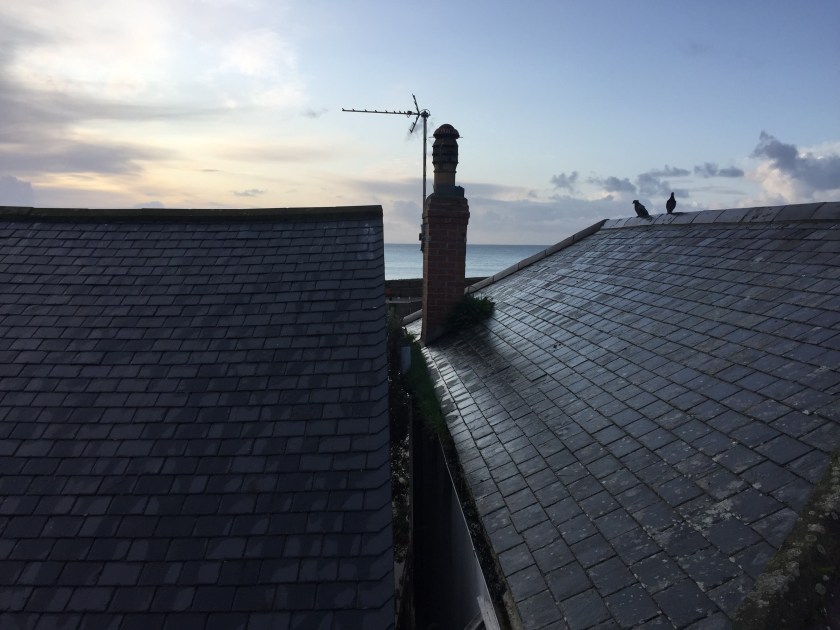
So while I cleaned the oven and descaled the steam function; then put the dishwasher on a cleaning cycle and made strong coffee; Madame went back to bed and worked silently on her tablet for half an hour while I cleaned up the crime scene. When she eventually shouted “Come here” in her most imperious voice I responded immediately and she said “the cottage in Cadgwith is free” – (but still not cheap, I thought), while my heart leapt for joy and my soul sang in their hearty and soulful fashion. With ÂŁ150 discount it still wasn’t really cheap but it was below the inexcusably extravagant line, so after ten seconds deliberation we booked it for a week. Photos from the kitchen door at the top of this post.

Our most extravagant moment almost escaped our attention entirely. One of the boys brought a bottle of wine and I could tell it was a good one just by looking at the label. I said it looked good and he said “It should be at that price!” All unknowing I opened it and took a sip and it was wonderful – I mean symphonic. Madame was having a dry night so I managed to drink about three quarters of the bottle before caution and generosity compelled me to stop. Only then, after I had a sneaky look online did I discover just how good it was. Oh and expensive too. It may well turn out to be the most expensive wine I’ll ever drink. Madame finished it up the next day and agreed that it was very good. I’m glad I didn’t know its value before I tried it. I’ve often wondered whether the whole wine connoisseur thing was a snobbish affectation but on the basis of a blind tasting there was no doubt.

And so, back to my favourite place on earth to look for plants and ferns and especially a Quillwort that I managed to walk past without recognising last year. It will be a tremendous place for a bit of spiritual renewal – it always is!

At last, a signal

Full moon over Cadgwith – maybe a wolf moon?

After a week of glum silence, suddenly my phone sparked into life this morning when the clouds rolled in. Who knows whether there’s a link? It’s probably nature’s way of telling me to get out there, rather than waste a week of exceptional sunshine brooding over a laptop. We’ve been staying at the very end of the Lizard peninsula in Cornwall and we’ve been walking and photographing around the coast every day.

Of course I’ve also been reading, writing and doing stuff offline and I’ll post at greater length and with some of the photos when we’re back on broadband. Meanwhile this picture was taken a couple of nights ago from the kitchen door!

Anyone for angelica?

IMG_6215

IMG_6212Sometimes the success or failure of a day out hinges on something essentially random – like finding a shop that sells crystallised angelica.  We last bought it in Penzance at least three years ago, and so as we set off up Causeway Head I had little hope of finding the shop, which even then had the air of a pop-up, still in business. But there it was, very much in business and pleased to sell me enough for three Christmas sherry trifles at least.  I’d despaired of ever finding it again but somewhere there’s a person with the energy to simmer angelica stalks in increasingly strong sugar solution for days, until the tender stalks are preserved ready to add a touch of green to contrast with the morello cherries floating on whipped cream atop the trifle.  The Potwell Inn always produces Christmas puddings as well, but we rarely eat them until well into the year because sherry trifle made according to a recipe given to us by an old friend has become a Christmas fixture.  As you can see my thoughts have turned instinctively to Christmas for no better reason that the preserving and pickling are all but finished.  Once upon a time, Gill made us the trifle as a gift every year, but when she became too old I took on the task as a tribute.  No Christmas could be complete without it, and because she always aded angelica it never looks right without it.
When I think about it, most of the canonical tasks of Christmas involve quite inexplicable feats of endurance. We know perfectly well that the puddings, cakes and treats are ridiculously rich and life-threateningly full of fat and sugar but a good life deserves a bit of occasional feasting as well as fasting. We are far from the mindset of a couple known to Madame whose idea of the perfect Christmas lunch was to warm up an Iceland frozen turkey dinner and eat it on their laps. Somehow the angelica is even worth a trip to Cornwall, and  always tastes better as a happy accident.  IMG_5459

We grow it on the allotment – it’s a magnificent sight in the summer as it grows to six feet tall – each plant producing enough of the leaf stems to decorate a hundred trifles – but once again this year, we didn’t find time to create our own store in the kitchen. The little shop is, in itself, a model. There is virtually no packaging to be found in it, you could bring your own containers and buy a huge range of ingredients from bulk.  How strange that even in cosmopolitan foodie Bath there isn’t an equivalent shop – I’m sure it would do well.

We walked up and down the pedestrianised street and found an excellent bookshop (Barton Books) the contents of whose bookshelves closely resembled our own at home.  I think I’d read about a third of the stock, and would happily have read the rest.  I joshed the owner a little and asked him if he’d only stocked his favourite books and he responded that good booksops always reflected their owners’ tastes. I couldn’t agree more, and I came out with John Wright’s latest book on foraging which I’ve already started reading.

Penzance is a place of contrasts  – three years ago I’d have been glad never to visit again after we watched an unhinged young woman pouring abuse and beating her dog in the street.  Today we were in Newlyn buying some fresh fish and the fishmonger said he lived in Penzance but it had become “a hole” over the years. Exactly as if we were at home, we watched a couple selling drugs on the street – both obviously addicts themselves, both hollowed out by drugs and life in general and with no provision for any help out of their mess.

Mousehole, where we’re staying, is stuffed with ludicrously pretty cottages which are all that remains of a once thriving fishing community.  Next door in Newlyn there is still a big fishing fleet but Moushole, with its tiny harbour, confines itself to selling souvenirs and doing a bit of occasional crabbing. The purpose has gone out of the place. In Newlyn the fishmonger said he’d voted for Brexit.  I sincerely hope for the town’s sake that he doesn’t get his wish. Virtually all the fish we eat as a nation we buy in, and virtually all that’s caught here is sold abroad, overwhelmingly in Europe. If tariffs were applied to the catch, the fishing would become as unprofitable as the tin mining and that would leave tourism – which only really pays for a third of the year – as the principle industry, bringing even more poorly paid jobs, homelessness and unemployment, helplessness, anger, drugs and alcohol abuse.

But the incomers seem to be taking up at least some of the slack by driving up house prices and providing work for an army of builders, painters and plumbers. The landscape and its wonderful light are largely untouched by change and the granite landscape of West Penwith is as magical as ever it was.  Am I too hard on this place?  We lived in Falmouth for a year as students and were both captivated by it whilst, at the same time, being wary.  You’re always an ’emmet’ here, one of the teeming hordes of ant-like tourists who come, as if to a left-luggage office, looking for something you’ve lost but can’t quite describe. The little battery lit serpentine lighthouse you used to be able to buy from the turners’ shacks on the Lizard has come to stand as a lament for that loss.

We walked to Newlyn today and passed the memorial on the original site of the Penlee Lifeboat station from which the Solomon Browne set out in 1981 in a hurricane force storm to try to rescue the crew of the Union Star coaster. Both crews were lost in the 60 foot waves, and the tradition of Christmas lights here must surely reflect and bring to mind that terrible tragedy as the lights shine out across the sea as if to welcome back the men who will never come.

IMG_6206There’s nowhere to park here: the village was fully formed before the car was invented and the old fishermen’s cottages form a maze of narrow alleyways but there’s an excellent bus service back and forth to Penzance and from there onwards to anywhere in the county. On the roadside facing the sea there are allotment gardens, with some sculptural and whimsical scarecrows.

So, as always we celebrate a few days in Cornwall with mixed feelings. Loss and tragedy are never far below the surface and yet there are few places quite so likely to get the creative sap rising. The railway line to Penzance brought with it not just the tourists, but the painters of the Newlyn School, and later the St Ives artists who, for a while, changed the course of art history.  It’s a culture that’s never quite at ease with itself, often feeling isolated and angry with the ‘upcountry’ politicians who have served it so badly.  If ever a place needed strong regional government this is it. There’s an uncanny resemblance to Wales where the mineral wealth was extracted by a semi colonial economics leaving the place sucked dry.  Love it?  Hate it? It’ll still be here long after we’re all dead!