Black Gold

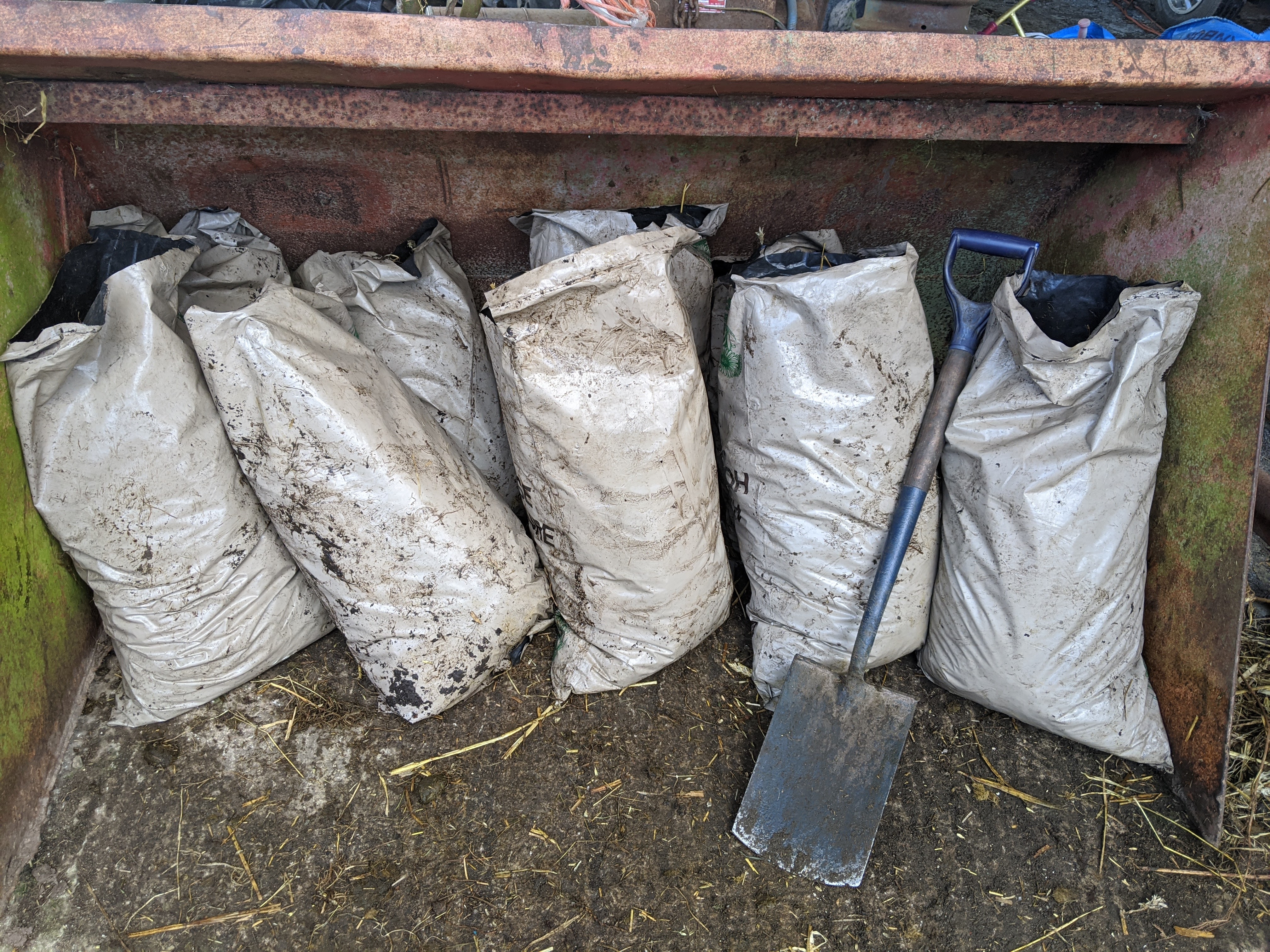
Well, after a two long sessions at the compost bin we finally achieved somewhere around 350 litres (ten largish tree containers) full of pure, screened compost and, with the bay empty, I could then turn the newest heap into the vacant space and start a fresh batch. Composting can be pretty slow – especially in the winter months – but (like narrow boats) as long as you can keep the loads moving through the system, they can emerge ready for use in surprisingly large quantities. If there’s a trick to it it’s no more complicated than watching the mixture of green and brown elements, turning regularly, keeping an eye on the temperature and paying attention to the moisture levels. Dry heaps stand still; wet heaps stink and the best compost just smells earthy – as if you’d scooped up a handful of woodland soil.

Of course it’s not necessarily a good idea to use the best compost neat. At the end of the row of four bins is one that’s just filled with leaves each autumn (fall). During the following summer we cap the leaves with a bit of fertile soil and grow cucumbers and squashes on the top of the leaves, and they do very well indeed. When the plants come out in September we have a bin full of leaf mould that can be partnered with the compost – plus some sand, grit and/or vermiculite to make a perfect seed compost (hardly any compost) potting on medium (a bit more fertility from the black gold) or use the home grown compost as a top dressing for the beds – possibly mixed with some leaf mould which, even on its own, is a marvellous soil treatment.

What we’ve discovered (everyone gets there in the end!) is that too much nitrogen can make the plants somewhat sappy, leafy and vulnerable to aphids. A little bit of hardship does most plants no harm and, according to James Wong is positively good for chillies.

The addition of the polytunnel this year has meant that we are doing work now that we would normally do in September and October. The tomatoes, for instance, are loving the warm environment and are several weeks ahead. We need to get all the plants in the tunnel harvested in the next few weeks to re-sow and plant up for the protected winter crops. That’s why the compost is being stored inside the tunnel where a good deal of it will be used to top dress the beds.

Turning compost is hard work, but today’s work revealed at least half a bin – possibly another ten containers of compost that will be ready to screen in a few weeks time. Good news all round, then.

Today we ate the first of the sweetcorn – rescued from the resident badgers with a double fence of netting. One of our neighbours is protecting her cobs with sleeves cut from bottled water bottles – but since we don’t buy bottled water (I think I read that it’s about 1300(!) times more polluting than tap water) – the double fence will have to do. Anyway the corn was absolutely delicious – far better than anything you could ever buy in a store. I’m tired of hearing myself say that it’s been a strange season but the proof of the pudding is in the eating and planning for next year feels more like a lottery than ever before. Madame provided us with a meal largely comprising our own home grown food tonight and it was lovely. But tonight we’re going to sit down and veg out – pun intentional! A bunch of books just arrived with translations of Basho’s haiku. The plum chutney can wait. The beetroot relish is bottled up, along with the piccalilli all of them placed under wraps until Christmas. It’s nice to have stores of preserves but January can’t come quick enough in the marmalade department as we’re down to our last half a dozen jars. Life is good – but then even in a cold and wet August we’d expect nothing less.

Riddling out the twenty first century dross

One leaf fluttering,

tells of autumn

0ver all the country.

From “A Zen Forest” Translated by Soiku Shigematsu – White Pine Press, Buffalo
Working at the riddle

There’s a certain mindlessness about riddling compost. I sit in front of the open bay with a large bin between my knees and the riddle resting on two short lengths of wood. When the riddle has passed all the friable compost I throw the dross into a bucket and reach again with a spade to take another spit and repeat the process – over and over. Whatever escapes the bucket gets into my boots and over the path. The bits that don’t pass both the sieve and my close inspection after each load give me pause for thought. You might think the dross comprises mainly sticks and stones too large to pass through the half inch mesh, but that’s not quite true. Most of the riddled out waste is bits of plastic from old pots, the remains of so-called biodegradable teabags, old compostable sacks and metal pegs. Of course there are intractable pieces of wood in there; smooth pebbles that come from who knows where? – maybe the beach on Lleyn where we harvested seaweed for the asparagus bed two years ago. Oh and the inevitable cabbage stumps which, however hard you smash them with the back of an axe seem to resist the great carbon cycle.

Next door to the bay I’m clearing is one that’s now full to the brim and badly needing a thorough turn. On the surface are the barely wilted remains of plants we’ve only just placed there; but as I turn the heap and dig down further, things get darker and less recognisable. There’s no great smell but an abundance of slugs and snails near the top, along with wood lice, and minor league chompers in their thousands. Then as we go further we find worms in glorious writhing abundance. Very occasionally a startled rat jumps over my shoulder and scuttles off, low to the ground. I used to try to kill them with the yard fork but the very act of angrily striking at their sleek bodies seemed sacrilegious.

After a couple of months undisturbed in the next bin – the one I was clearing yesterday – and minus the twenty first century rubbish there is something that looks and smells just like earth which, of course, it is. But not just ordinary earth because in its return journey from the harvest it’s gone through the insides of a dozen little animals; been processed by fungi and finally passed through a worm – maybe two worms – richer from its passage than anything you could buy from a garden centre. Not just compost, but our compost; primed with all the fungi, bacteria, colloids and nutrients that belong in this tiny patch of the earth’s surface. Our allotment and our compost. No wonder the plants love it!

So the act of riddling, because it’s so repetitive, has a meditative quality as I participate in the alchemical process that renders green plant material mixed with cardboard and wood chip into soil. I watch each large bucket filling – as much as I can comfortably carry into the polytunnel – pondering on the process that yields such a wonderful substance and rehearsing in my mind where it should go. When I built the four bay composting setup two years ago I had no idea whether we would ever be able to fill it. I just knew the quantity of compost we would need to spread a couple of inches over the whole plot and hoped for the best. Last autumn we were in a hurry and so we just spread our first batches unsieved and picked out the plastic as it rose to the surface. It was so rich in nitrogen we experienced an explosion of leaves, often at the expense of fruit. Better prepared this year, we’ll treat it like the expensive luxury it is and sieve it all properly. Riddling is hard on the back and you definitely value the things you’ve worked hardest on, and so we intend to mix it with topsoil and a little sand for drainage.

The little quotation from “A Zen Forest” reminded me of the way we read the seasonal signs on the allotment. I guess it’s easy to feel you’ve done something when you use a strimmer or a powerful machine to shorten the hours it takes, but the din of the machinery blots out every natural sound as well as filling your nose with petrol fumes. These simple, repetitive manual jobs can be done in thoughtful silence and while you reflect, the allotment gets the chance to speak as well. It’s even better when the silence is filled with gratitude. The zen sayings caution against trying to explain or describe what is essentially beyond words. One of the sharper ones reminds that words are the hitching posts that you tie doneys to! Nonetheless, even if words can only get you to the foothills of the mountain they have some worth so long as you know when to stop.

Mindless tasks aren’t remotely mindless it transpires. They can be mindful beyond the mind’s capacity to explain. As the seasons progress we move from winter through spring and summer and then approach autumn once more. Each season brings love and loss; generosity beyond our dreams and hardship as well. It seems corny and defeated to embrace them all equally as teachers; but the machine has yet to be invented that can control the way of things – for which we can thank whatever higher beings we might follow, and be thankful for those challenging riddles in every historical culture that force us to abandon the fierce consciousness of the machine.

Our twenty first century culture is destroying the earth – we’re quite sure of it now; and so each moment of contemplative silence feeds us as the compost will feed the ground. We shall grow together; minds and compost alike sifted by riddles.

Whereof one cannot speak, thereof one must be silent.

Well yes, Captain Kipper (OK actually Ludwig Wittgenstein) – but what if there’s something you’re trying to articulate that’s so liminal, so at the boundary of a concept, yet to be properly mastered, that words and their meanings need to be forged anew? Surely that’s the work of the poet? and can’t be shirked in favour of silence. Language is endlessly adaptive; always finding ways to speak the previously unsaid, and one of those ideas that’s slowly being forged into speech is the curious relationship we have with nature.

We arrived back from our family get-together in Cornwall and went straight to the allotment, as you might expect. Then we prowled around to see the state of things; set up the trail camera and made plans for today – and today it rained; so we put on our waterproofs and got on with picking out the courgettes that had swollen to blimp size during the week; harvesting tomatoes, aubergines, runner (pole) beans, potatoes, peppers, summer squashes and masses of herbs. As you will know there are only two of us so this season of plenty has to be matched with a positive frenzy of pickling, preserving, boiling, reducing, freezing and fermenting. It’s been a crazy weather year and right now with the jetstream moored south of the UK we’re stuck in a series of lows, bringing cold winds and rain in off the Atlantic – it feels like autumn already.

So today we got wet and yet we both felt completely content just to be there. After finishing harvesting, Madame got on with summer pruning the fruit trees while I wheelbarrowed down enough woodchip to level the path in the polytunnel. There’s a reason for this because our plan is to clear the tunnel completely by the end of August and then we’ll need easy access with a wheelbarrow to bring compost in to feed the beds ready for the winter crops. Later in the kitchen I made stock and prepped a dozen half litre jars ready for tomorrow’s new batch of roasted tomato passata while Madame prepared to cook a bulk batch of ratatouille which freezes very well. All the while I was making sourdough bread and attending to the starters after their week in the fridge.

Perhaps one reason for the rather philosophical opening paragraph was some marvellous video footage of our friend the badger failing to find the sweetcorn beyond two layers of soft net and a maginot line of tagetes and mint – which we make portable by growing it in pots. Badgers hunt by smell and we aim to confuse them as much as possible. The three sisters experiment is exceeding our expectations and we have corn ten feet tall with borlotti plants climbing to the very top, whilst below some fat winter squashes are developing nicely in the shade. It looks a mess but it also looks like a success. The only predator likely to get to them before us is the badger; but since we invested in the trail cam we’ve grown to love the nocturnal intruders. We want to deter them of course but we wish them – with the foxes, squirrels, magpies and even the rats – no harm and the reason for that is that we have begun to see them as having their own inalienable rights over the land. The thought that they’re out prowling during the night gives us as much pleasure as the sound of a tawny owl calling does. We share their taste for the vegetables we grow, but perhaps value them more in their appetite for the slugs, snails and rodents that trouble us. The old binary division between crop and pest is dissolving and it’s that disappearance which demands a new language. The actors haven’t changed at all – badgers love corn and that’s unavoidable. What’s changed is that we are beginning to accept that if we want to save the earth; all those binary distinctions will have to be overcome through an unprecedented change in the way we understand, and therefore speak of our place in nature .

Wheelbarrowing woodchip with the rain running down our necks; stacking the compost heap with a mixture of green waste and wood chip and feeling its rising heat the next day; summer pruning, rooting strawberry runners and sowing chard for the autumn is done not though the domination of nature with powerful tools and chemicals but by attempting to think like a fox or a badger or – more oddly still – to think like a compost heap, or like the earth in a raised bed. It demands that we learn to think like a tomato or a potato; to ask what ails you? as we did today when we were examining what might have been tomato blight but turned out to be (in all probability) didymella stem rot, caused by stress – in turn caused by a poor watering regime. Failure often brings knowledge. Yes we talk to our plants; but more mysteriously – and only when we listen with complete attention – they speak to us in a language we have barely begun to understand, and which stands on its head, centuries of binary thinking through which we believe ourselves to be independent, separate subjects moving through a sea of resource objects. In this new state of being we are (imperfectly) in what Gary Snyder described thirty years ago as a “trans species erotic relationship” with nature; which sounds clumsier today than it did when it was written – but the word erotic captures the sense that this relationship transcends the instrumentality of the old ways and enables powerful feelings for nature which offer a pathway out of imminent destruction. Talking to the trees – it turns out – is a two way conversation as long as we are willing to get over ourselves and listen.

Composting – is it just a load of old rot?

Just to my left, as I’m writing this, is a bookshelf filled with books about composting. If you’ve followed this blog for any length of time you’ll know that we’ve tried almost every way there is of making good compost; and each of them has advantages and disadvantages. The one thing I can say with absolute certainty is that the heap in the picture above is a rubbish heap and not a compost heap. The computer software saying – “garbage in, garbage out” applies every bit was strongly to compost. I’ve even seen an abandoned bike rusting away on a compost heap.

The favourite starting point for most of us is the one you make from wooden pallets. The advantage is that it’s pretty much free to make and it will produce compost. The downside is that the open slats allow cold air and rats to get in, and if there’s any trace of food waste they’ll come hunting for it. Rats are an ever present nuisance and we just have to accept that. You can line them with chicken wire but rats often dig in by tunnelling underneath and you’ll soon discover when turning the heap that the tines of your fork will constantly hit the netting. Our neighbour bought himself a fabulously expensive hot-bin made from expanded polystyrene and the rats simply ate through it. As for the conical polythene ones that you buy at garden centres or from the council – I can’t say because we’ve never had one – but I hear the rats still get in from underneath.

On the far left above is my version of the California Cylinder which, – when there’s plenty of green waste around – will go like a train. It’s made by forming two concentric cylinders of sheep wire and then inserting thick cardboard into the gap between them. You can also build in a chimney to pull heat through. In one of our gardens, when we cleared it of weeds, we had four in a line steaming away merrily and turning out fabulous compost. The next year we had far less green waste and they were not so successful. The other disadvantage is that it’s all but impossible to turn the heap – it’s better to pull the wire and cardboard off, set it up again somewhere close and refill it with the turned compost.

The simplest composting method of all is the leaf mould heap, like the one in the right hand photo, which is a single cylinder of sheep wire filled with as many leaves as you can press down into it. It takes a year or two but it always works. We find that we can grow a great crop of cucumbers on the heap during the summer while it rots. Even open heaps will work eventually, but then you really have to turn them very frequently and they’ll grind to a halt as soon as the weather gets cold. In the end I built a large four bay composting arrangement with removable fronts which works well for us and makes turning easy -still hard work, though!

Composting is a seasonal cycle

The big challenge is that composting works best when you control the ingredients – mixing green and brown waste and turning regularly. So during the winter months there’s nothing much going in except for veg peelings and the like. Winter heaps don’t often heat up very much, and unless they’re well laced with torn up cardboard and paper, they tend to get anaerobic, wet and smelly. Even in a well managed winter heap, you’ll find that it’s worms doing most of the work. Worms are wonderful. They appear out of nowhere, chew up your waste and turn it into gold – very slowly. In the spring if the heap or the ambient temperature gets warmer they’ll move off somewhere more comfortable without any intervention on our part.

There are two peak green waste seasons – early summer when the remains of winter crops like broad beans go in; and autumn when bean vines and all the rest are cleared away. We move the winter heap with its worms to the next bin and then layer the abundant green waste with any sort of carbon we can get our hands on – cardboard so long as it’s not plastic coated, any sort of dried or dead grass, leaves and – interestingly – wood chip. Just this week our bin reached almost 60C with several 2″ layers of wood chip incorporated. We were confident in adding wood chip because we noticed that we get through around 25 barrow loads every year just topping up the paths. It rots down much quicker than you’d think. We’re lucky because the local council bring wood chip and leaves on to the site during the autumn.

But there are other additives that are invaluable in a compost heap. We use horse manure and even seaweed when we can get it. The last load of seaweed we brought down from the Lleyn Peninsula in North Wales where we’d been on holiday. It stank to high heaven and was full of flies and sandhoppers so it was an uncomfortable 200 mile journey with the windows open; just as it always is with the still warm horse manure that we use in the hot bed. If there’s any spare we add that to the compost as well because it’s so rich in nitrogen and carbon – already mixed.

We also occasionally use chicken manure pellets to steam things up a bit, and drench the heap with liquid seaweed feed now and again if it feels too dry. Control of the moisture level is crucial to success and one of this year’s jobs on the to-do list is to roof over the whole line of bins so we can harvest the rain falling on them and control the temperature and moisture level more accurately.

Of course the finest additive of all is human urine which combines bioavailable nitrogen and moisture at the same time – but don’t overdo it and make sure you’ve agreed with your partner that it’s OK to clutter up the bathroom with a jug and a five litre ex vinegar container marked clearly “Bio-hazard” . We tell everyone we talk to that we’re doing it because it’s an amazingly effective preventative against crop larceny – because they never know which ones we’ve just anointed!

What not to add

Obviously any cooked food and or meat – although I’ve occasionally left a dead rat to compost down because it seemed only fair. Winter heaps should not contain noxious weeds like bindweed because they don’t get hot enough to kill seeds and roots . a very hot summer heap – if it reaches, say, 60C would kill pretty much anything – but you never know. We err on the side of caution always, having introduced creeping buttercup into one of our past gardens via horse manure.

More particularly after wasting many hours picking bits of so-called compostable material out of an old heap; we no longer add those green caddy liners nor any teabags. We open teabags to extract the tea leaves and the compostable bags which seem never to rot, go to landfill. Even worse are the big ticket tea temples that are part of the USP of Teapigs brand. Sorry guys – without a commercial (very hot) process they appear to be invincible; clogging up the beds and any rake you might use. I actually ran an experiment on the little coir disks wrapped in mesh which purport to be green – and they don’t rot either. When it comes to greening up horticulture it pays to be careful – not everything it says on the packet comes to pass! And don’t ever put in a thick layer of grass mowings unless you’ve allowed it to wilt first in the sun.

That’s it really – the sad sum of my composting experience in a thousand or so words out of the fruits of which we can make maybe three cubic metres of compost and one and a half of leaf mould every year. Marvellous stuff ‘though – and so much better than anything you could buy in a shop.

Growing, cooking, eating

Of course, however much we’d like to boast how skilled, clever or green fingered we are the truth is that it’s more likely that the allotment is growing us rather than the other way round. However well planned and executed the season is, our plans are at the mercy of the weather and a thousand other unpredictable variables any of which can trip us up. For instance when we arrived back from Wales we checked on the garlic and pulled a single bulb to see how things were going on. It looked fine – it just needed another couple of weeks to plump up. I think I mentioned this when I wrote on Friday or Saturday,

Anyway, yesterday I got down to some serious weeding in the garlic bed and discovered that one or two plants were soft where the stalk met the bulb. A quick survey of the whole bed revealed about half a dozen badly affected plants and so we decided to pull the lot in case there was an outbreak of something really nasty like white rot. There were two varieties in the bed – one was much more affected than the other, and after a long consultation of the text books it looks 90% sure that the plants had been infected by basal plate rot, a fusarium fungus. This is caused by a multitude of stresses; weather, water and over fertilization for instance and so regretfully we’re putting it down to yet another instance of the collateral damage caused by the exceptional weather this spring,which has broken records in alternating between continuous rain and drought, coolest and warmest consecutive months and persistent episodes of cold wind from the northeast and northwest. Plants don’t like stress and that’s when they get diseased or attacked by pests.

The upshot is that we have lost about half of the crop and we’re presently drying the (apparently) unaffected plants. At least fusarium can be controlled by rotation, whereas white rot persists for decades. I don’t think over fertilisation is the problem because we use no fertilisers, just compost. Ah well; life’s rich tapestry we say; but it’s another piece of evidence that maybe we have to change the way we grow things. It’s almost a given that it’s a good thing to sow some crops – like garlic, broad beans and even peas in November/December to get them off to a rapid start in the spring with the promise of an early crop. But for several years we’ve been wrongfooted by the weather and now we’re wondering whether to abandon the technique of overwintering our plants (except perhaps in the polytunnel) and getting everything in much later than we’ve been used to.

We talk a lot about the pleasures of gardening – and they are many – but we tend not to stress the disappointments, perhaps for fear of putting people off or of simply showing what terrible gardeners we really are. Organic gardening deliberately eschews all the chemical shortcuts and remedies so it’s more like hand-to-hand combat in amongst the rows. We embrace and encourage coalitions of friendly forces by inviting in the trillions of soil friends, insect predators, companion plants and physical barriers; leaning on nature rather than technology to even the scales in our favour.

The payback, of course, is on the plate. I love the surveys that purport to show that there’s no difference in flavour between organic and intensively grown vegetables. What they don’t mention is the fact that all supermarket veg, whether organic or not, are stale if not close to death before the tasting takes place. If you ran a bowl of our fresh allotment peas, straight off the vine, with even the best brands of frozen peas – you’d wonder of they were the same vegetable; and “fresh” peas from the supermarket are fit only for soup. Cooking times (usually steaming for us) are shorter the fresher the vegetable is and so their nutritional value is greater. Better flavour, shorter cooking times and higher nutritional values make cooking more rewarding than ever.

Today, apart from a greedy bucket of peas, we picked a large bag of elderflowers from which we’ll make cordial tonight. The only two food items we seem to be completely self-sufficient in are elderflower cordial and tomatoes as puree, passata, dried and as various sauces. The elderflowers are free, of course, and greatly undervalued as a flavouring. We often use the cordial to sweeten rhubarb; but at the moment it’s perfuming the whole block with its strange combination of nectar and cat’s pee. The neighbours must be wondering what on earth we’re cooking now. The variety we picked today is a decorative purple cultivar that makes the loveliest pink syrup.

I said at the beginning that the allotment is growing us as much as we grow it and by that I mean firstly that most of the traditional varieties we grow have been selected and preserved for many years – so in a sense we’re part of their reproductive process. But in another way, we grow because in spite of the occasional disappointments nature is generous beyond all our deserving. We learn fast that our hard work is as nothing in the great cycles of seasonal change. We try to dispose but we cannot compel and can never forget that even half a crop of garlic is at least ten times what we planted – and in the case of our foraged treats we did no work and invested nothing. Cordial is ÂŁ3.50 a bottle and we make it for about 50p so our carrier bag full of flowers today was a free gift from Mother Earth. The insect life seems to be increasing every day as the season progresses and more and more allotmenteers are growing wildflowers and digging ponds. The site is close to becoming a 4 acre nature reserve. Learning to embrace the occasional failure is another kind of gift too. Sometimes we get despondent, but it’s not personal because there’s more strength in yielding than attacking with fire and chemicals. Today it’s one nil to the fusarium, but hey – it’s got to make a living too!

At home with the fungi

Well, not really – but I found the tiny Coprinus (bottom right) growing down in the dark in the compost heap today. I don’t know why but it surprised me because the heap, being full of green waste, was rather hot and the reason I was scratching around in there was to add a barrow load of dead leaves to bump up the brown waste proportion. I’ve learned that if I can smell the heap it’s going (or gone) anaerobic and needs turning along with more brown waste. The effect of the two actions is often surprisingly quick as the heap heats up so quickly.

It was whilst looking for a photo of fully grown member of the species (Lawyers Wig in old money) I randomly typed “fungus” into the Google Photos search line and after a brief interval, hundreds – and I mean hundreds of my photos of fungi going back over a decade suddenly appeared. I’d heard that the search engine had been improved, but this was wonderful because I usually spend ages searching manually through the thumbnails to get the picture I need. It’s a blogger’s dream because I almost always use the photos I’ve just taken because the prospect of searching is so long winded.

Anyway, this is yet another serendipitous moment (synchronistic if you’re a Jungian) because I’m halfway through reading Merlin Sheldrake’s book “Entangled Life” and it falls neatly within a current line of science that’s rewriting our whole view of ecology. For me the most impressive learning point is how well it supports the view that all life is – at its most fruitful – collaborative and cooperative. If ever an idea needed to be born today it’s that one!

After a day working on the allotment in the rain we were glad to get back home. Complete with a meal of the first tiny potatoes and a bag of broad bean tops. There’s tomorrow’s food sorted,

Monika’s dacha

I’m constantly amazed at the way in which our neighbours personalize their plots on the allotments . This one’s really beautiful because it combines really well maintained growing spaces with the most inviting shed on the entire site. The cast iron stove outside used to be on the inside but I think it was somewhat hazardous and so it’s been moved – although come winter it might find its way back. Monika started off with very little experience of gardening but she’s learning fast. The shed, and the greenhouse at the other end are both made from recycled materials. The greenhouse seems to be constructed entirely from discarded shower doors; fruits of a friendship with a Polish builder on furlough.

Quiet space, private space – call it what you will – are one of the most significant benefits of allotment life, and we see it expressed in dozens of different ways across the site. On one plot a sawn down tree stump serves to secure one end of a hammock which is shared by the couple whose allotment it is. One digs and the the other snoozes, and then they swap over. Another couple have a barn door on their shed and a lean-to greenhouse up against it. Our three buildings (shed, greenhouse and polytunnel) are so full of plants and their associated clutter, that we put up our folding chairs between two buildings and if it rains we retreat to the tunnel which is also full so we stand and look at one another and listen to the rain drumming on the polythene.

Yesterday a long delayed consignment of rhubarb (Fulton’s strawberry surprise); a tayberry and a blackberry all arrived and while Madame watered inside the tunnel I planted the fruit. Something of a change of mood has come this year because at last the final position of the beds is fixed and all the major structures are in place. There’s more civil engineering to do, like putting a roof on the compost bins and building a shelter for us; but they’ll have to wait until the autumn because we’re fully occupied in sowing, propagating, pricking out, repotting and all the day-to-day things that make springtime gardening feel like a full time job. We’ve organised a bigger than ever group of perennial herbs, bushes and small trees so we know exactly how much space there is for the rotating crops.

Which brings us to pottering – or is it puttering? For me, puttering is always the sound of a small boat with an inboard diesel engine so when we garden it’s pottering: one of the most pleasant meditative exercises ever. Instead of being grimly focused on raising the ziggurat of Ur or putting up the trellis for the hanging gardens of Babylon, we alight on the multitude of small tasks like browsing bees; removing a weed here and there; replacing a tree tie; doing a minute examination of a plant for signs of insects; talking to the worms in the compost heap and sniffing emergent leaves to try to guess which plant they belong to. Or it might be dozing in the sun, listening to the birds above the constant noise of the traffic. Even a small plot like ours generates a huge number of little tasks that individually don’t amount to much but collectively make the difference between a well run allotment and a thuggish wilderness. You may have heard the story of Brother Lawrence who, as a young monk, chafed at the mundane tasks he was given and longed for something with a bit more status. He eventually discovered the great satisfaction to be got from throwing himself into the everyday as if it were the most important job in the world. [This story was naturally appropriated by the church hierarchy whenever it felt threatened by anyone with a new idea and wanted to put them in their place – but it still stands]. There is no greater reward in gardening than the emergent qualities of a plot that seem vastly to outstrip the insignificance of the means of tending it – or to put it another way; hedge laying is cold, windy, wet and repetitive but just about the best job in town on a winter morning.

Away from the mundane, I had a fun five minutes after the memory of a chart in Bernard Leach’s “A Potters Book” wandered into my mind uninvited in the middle of the night. Bernard Leach was one of the key figures in 20th century studio pottery and one of the areas he was interested in was the use of wood ash in glazes. So …… stay with me here …. we use wood ash on our compost heap because it contains useful elements like potash and phosphorous and on page 162 of my almost worn out 1940 first edition there’s a table of chemical analyses of various ashes. I bet you didn’t know that unwashed apple pulp ash has the highest phosphorous content of any of the ones he tried. There’s a bit of a clue there for composters I think. What comes from this middle of the war book though is a charming lists of the available substances for burning that can be harnessed as fluxes in ceramic glazes, and it’s not science as much as anthropology. Who’d have thought that among the freely available substances were Japanese rice straw (he lived in Japan when he was young), thatching reed, autumn weeds,apple pulp, lawn mowings,bracken ash, box (Buxus) ash and apple wood. I can’t make up my mind if the poetry of the list doesn’t outweigh its usefulness to potters and gardeners.

A rather fun (and very personal) garden in Mousehole where we stayed a couple of years ago.

If looks could kill …

A thousand words on poo!

As we turned into the allotment yesterday a light tipper lorry pulled away at great speed and off down the hill. “He was in a hurry” I said to Madame as we pulled over next to a newly dumped pile of manure whose new owner stood regarding it whilst trying to keep her two children out of it. Obviously I couldn’t just ignore the chance to see whether it was as good as, or better than, our usual supplier. It certainly looked alright, but when I took a handful and smelt it, there was a powerful whiff of ammonia. Without getting too nerdy about it, ammonia (NH3) is one of the principal greenhouse gas emissions from cattle farming. It’s generated when ammonium – which is a normal component of fresh manure – breaks down in a double chemical whammy that deprives the resulting manure of nitrogen, reducing its fertilizer value; and at the same time releasing ammonia into the atmosphere as a greenhouse gas. Farmers know about this (I hope) and manage their manure carefully to minimise losses.

We allotmenteers are mostly neither chemists nor farmers but our belief in manure is almost parallel to membership of the local church – we think it’s a terrific thing but we’d rather not get too involved in the theology. On the other hand, cattle produce mountains of the stuff and it can be quite a disposal problem and so combining the excess of poo on the farm with the excess of zeal among the faithful means that there’s a considerable temptation for entrepreneurial tipper lorry owners to solve the farmer’s problem and make a considerable amount of money in the process.

“How old is this?” I asked the allotmenteer who was still getting over the shock of my sticking my bare hands and nose into the pile. “He said it had been stacked for two years”. “Hm” I thought. “How much did he charge you?” “ÂŁ100 – cash”, she said. There was not much over a cubic yard, around half a ton, which meant it cost roughly the same as my present source which was looking better by the minute.

Years ago I was given the honour of digging out about a four foot layer of horse dung from a stable. I imagine it must have been necessary to sell the thoroughbreds and buy some Shetland ponies, the filthy floor was so close to the rafters. If you want to know what a four foot layer of anaerobic, methane emitting manure smells like please put down your knife and fork now. This is not for the faint hearted; but straw being expensive and occasionally in short supply, there’s a temptation to put as little as possible down and my goodness it shows, or rather smells – acridly, stomach churningly, eye wateringly vile .

On the other hand a friend who runs a stable and lets me have a load of fresh horse manure for the hotbed every year (although not this one because of travel restrictions), is generous to a fault with her straw, and it shows in the horses gleaming state of health as well as in the healthy “countryside” aroma of their poo. In a nutshell, not all manure is equal and it pays to choose your source personally rather than rely on the A4 advert flapping on the entrance gate of the allotments. Try before you buy if it’s all possible and remember that among species there’s a hierarchy of value. My grandfather valued sheeps truckles above all else, but they’re better left on the land. I can’t imagine that he would feel the same about sheep muck from intensive farms where the sheep are fed on concentrates and never see a field.

Next comes the horse, but even then as I’ve already described, there’s a vast gulf between good and bad. If you’ve got loads of space it might be best to get it fresh, keep it covered and turn it yourself until it’s ready. Oh and check that they’re not worming the horses with some persistent vermifuge that will kill all your hard won worms. Cow’s manure comes last in the list and don’t ever use pig’s manure which is full of pathogens, and – if I haven’t already put you off – remember that e coli often comes as a freebie with manure, especially the fresh stuff, so keep it well away from salad crops and wash your hand carefully, perhaps with gel – like I did.

Good manure needs to be turned frequently to complete its decomposition and this obviously involves the farmer or stable in a lot of work which will be reflected in the price. Cheap is not always a bargain. So this pile of rather young manure which smelt strongly of ammonia was not all it was cracked up to be. But on the other hand we’ve had a tremendously wet winter and heaven knows how much nitrogen has been leached out of our soil during the past few months – so we’ll all be looking at organic ways of feeding it back.

What to do …?

Our allotmenteer has several choices to make. She could stack it and turn it regularly until it’s properly finished – which is extremely hard work. Leaving it as an uncovered pile will just mean more ammonia (nitrogen) escaping into the atmosphere as the weather warms up, while more will be washed away by the rain and could land up polluting the river. She can’t spread it among salad crops, tender plants or dig it into beds where she intends to grow root veg because they’re all adversely affected by fresh manure.

The one place I can think of where it would probably be OK is a good deep bean trench covered with soil. Another possible use is to use it in layers as a compost activator. She could mix it in layers with the free wood chip we have on the site which would reduce to compost reasonably quickly – the same would happen with dead autumn leaves because what this concentrated source of nitrogen needs is lots of carbon – even cardboard – to assist its decomposition and breakdown into “black gold“; odourless friable compost. Ideally she’d nurse it and turn it regularly and then spread it in the autumn and let the worms take it down.

There isn’t a 100% ram stamped ecologically pure way of composting – whether it’s manure or garden waste. The challenge isn’t to reduce wastage and greenhouse gases to zero – which I don’t believe is achievable – but to minimise it as far as possible. As Wendell Berry memorably said of intensive farming where manure is kept as slurry and cattle are kept in squalour, – they’ve taken a solution and turned it into two problems. Remember that in a small mixed farm where livestock are kept on grass, there isn’t – or shouldn’t be – any manure for sale at all because it’s just too valuable. Home compost made from vegetable material and activated with comfrey is as good as any animal manure you could get, unless it’s from your own livestock. The problem for small allotment holders is that we just don’t have space to grow comfrey and we don’t generate enough vegetable waste to compost our couple of hundred square yards sufficiently to compensate for what we take out. We too are intensive farmers! So beware of manure if it looks and smells like waste, because it probably is; and find a good source of safe horse manure and be prepared to put the work in. .

Tomorrow is spring – except it’s not.

Bright sunshine, frogspawn, daisies and a small tortoiseshell butterfly bathing in the sun. We’re out on the allotment every day and the flat is full of seedlings as the propagators encourage them into dangerously precocious growth under artificial lights. That’s the easy bit. Keeping them all alive and thriving for the next few weeks is a harder job altogether.

Every year we suffer from traffic jams for the simple reason that plants get bigger and we’re left trying to find space near a warm window to compensate for the move out of the ITU. The slow procession from the propagators to the ground on the allotment is one of the absorbing challenges of gardening. We’re always trying to steal a march on nature by persuading our late January chilli seeds that it’s really May in the tropics – i.e. warm, humid and with a constant 12 hours of sun – which, being a first floor flat in Bath requires a degree of cunning coupled with a few bits of kit. But once the plantlets move from their snug beginnings into our living room. the only thing they’ve got going for them is the fact that we have three large south facing windows; the spring equinox is only three weeks away and as long as we keep the room temperature at around 21C they seem to do well. We, on the other hand. soon reach the point where for two months we can’t close the shutters because they’re behind a wall of green.

However, with the polytunnel up and running (I put up a large suspended shelf yesterday), the progression will be propagator – living room – unheated hallway – greenhouse – polytunnel – and then wherever they’re intended to grow. It’s hardening off at a glacial timescale but happily it works for us.

I was pondering all this in the week when we happened to watch a TV programme on Cornish fishermen and I realized that, just like them, 90% of our skill (if we have any) is in obsessively reading weather forecasts, looking at the sky, feeling the temperature of the earth, flaring our nostrils in the late winter air and being willing to venture it all on a kind of informed hunch that this is the moment. We like to pretend that we’re flowing with the Tao, but our unspoken purpose is to beat the Tao at its own game. One year in four we win some; but then a late frost or an unexpected snowstorm gives us a massive reproachful slap and our humility knows no bounds. Winter and spring are locked in a battle over custody of the weather and they can both be spiteful. The balmy protective warmth of the greenhouse can become both freezer or furnace in the few hours snatched to go for a walk without opening/closing the doors. The tunnel is an unknown quantity in terms of its response to the weather, but we already know that the protection offered by warmer nights as the soil radiates back its stored heat can be followed by a temperature rise to 25 C in the morning sun – even with a cool wind blowing.

We’re so busy at the moment that it’s hard to find an hour to write, and I’m writing this with one ear on the sounds from the kitchen where Madame is potting out tomato seedlings. Later I’ll be turning the compost bins again, ready for a new start in a couple of months. We’re not yet self-sufficient in compost and neither do we have the amount of land we’d need to grow crops just for composting. I think John Jeavons, living in a country where space is plentiful, underestimates the challenge. So we buy in composted horse manure and also hot fresh manure in normal times – so not this year. But with anything bought-in there’s a risk of chemical residues than can harm tender plants or soil life like worms – and so we’re careful but we have to accept that we don’t garden in a perfect world.

With the big civil engineering projects on the allotment all finished – pond, irrigation and water storage and the tunnel are complete – we’re back to delightful pottering. More later – as my old friend Joan Williams would have said – God willing and a fair wind!

The thrills and spills of seasonal work on the allotment

Our neighbouring allotmenteers went on a gardening course with Sarah Raven last week and among the multitude of new ideas they were buzzing about afterwards, one in particular stuck in my mind. The soil is all important – the beginning and the end of any attempt to grow things. Of course that’s right, but it was only as I was turning the compost heaps again today that I remembered how much I enjoyed this time of year when I was working as a groundsman, and we began all the routine maintenance jobs; repairing the wickets, hedging and draining and looking after the machinery. Of course we had to maintain the football and rugby pitches and mark out the white lines every week., but it was the time when all the foundations for the next season were laid.

And on our plot today we were already setting things out for next season. Peas and broad beans are all ready, in fact the first batch of broad beans is already growing in the ground. The fruit trees are ready for their winter pruning and we’ve prepped ready for five new trees. The tall perennial herbs have been divided and moved to their new spot near the pond; the asparagus bed has been cleared, weeded, given a supplement of calcined seaweed , then composted and sheeted. All the beds have been manured or mulched with leaf mould and sheeted even though some of them will be planted up before Christmas. We’ve had rain and then a few days of early morning frost which will help the garlic; the new batch of leaves is stored for next year – there should be about two cubic metres of finished leaf mould.

Then the paths have all been topped up with new wood chips which rot down surprisingly quickly so they swallow up to thirty wheelbarrow loads every autumn to bring them level with the path edging. That’s a lot of trudging up and down the steep site, but when it’s done the plot looks somehow more purposeful if that makes any sense.

Sadly, today I dug out all of the leeks for burning, because they were attacked again by allium leaf miner and were beginning to rot where they stood. That’s the third year we’ve lost them all and so I think we’ll give them a miss now for a few years. although I’m sure the plant breeders will be looking for more resistant varieties. We don’t put the affected leeks into the compost because especially at this time of year we’re unlikely to reach high enough temperatures to kill the pupae, and today I found a cluster of eggs laid near the base of one plant. These obviously need to be destroyed or we’ll just perpetuate the infestations, but the insect now seems to be everywhere in the UK. Our best hope of control is the same as it is for any other pest – physical barriers, good soil, strong plants and masses of predators at the right time. That’s why we overwinter the broad beans – it toughens them up enough to resist the aphid attacks until the ladybirds arrive.

There really is a correlation between abundant insect attractors and improved predation on garden pests, and one of the principal deficiencies of spraying with chemicals is that it often kills the predators as well as the target pest; thus making yet more applications of spray necessary. Modern apple production requires quite staggering numbers of spray applications; every one of which can make the situation worse.

The compost heap still heats up obediently every time it’s turned, and the more often it’s turned the quicker it does its job. One indicator of how well it’s doing is what’s happening to the bean vines which are often quite slow to rot. This year the vines were taken down in mid September and a couple of months later they’ve all but disappeared in the the heap. the worms don’t like it too hot and so they move up and down in the bin until they find a congenial spot – many thousands of them can congregate of a single bin. You just need to keep the heap at the right level of moisture – not too wet and not too dry but just right.

The same goes for plants which prefer their moisture in modest amounts; so this time of year too, when we get heavy rain, we can see which parts of the plot need additional grit to help with drainage. With the exception of bog plants I can’t think of any normal garden vegetables that don’t absolutely hate standing in waterlogged ground. Plants can die from lack of oxyen – they can easily ‘drown’ if they’re left too long.

It would be quite wrong to think that allotments can be ‘put to bed’ in late September and not tended again until spring. These quieter growing months are a marvellous opportunity for planning, remedial work transplanting and new planting of trees, and the odd bit of civil engineering. I wish I could add digging to the list because I absolutely loved doing it and miss it terribly now we’ve given it up; but I honestly can’t think that, aside from keeping me warm and fit, it does anything for the soil at all – and if you miss the exercise, get a bigger wheelbarrow and fill it up – or, if you must, drag a tractor tyre up a hill with chains.

And there we are – a whole posting without a single apocalyptic rant about the environment, but I think our chat with the young smallholder yesterday reminded me that while, as the astrologers might say, our economic and political systems might dispose us towards destructive practices, they really can’t compel us. We can resist and go our own way, knowing that although we may not be saving the planet on our own, we’re at least not making it any worse.

And finally yesterday’s 100% wholemeal sourdough loaf. I’ve eaten my words and unreservedly recant all my previous statements on the impossibility of making a decent 100% loaf. Thinking back, during the first lockdown I changed a large part of the time and temperature settings during baking, none of which changes I’d ever applied to a wholemeal loaf. So the combination of leaving out the second rise – cutting the overall proving time down to 18 hours instead of 26; and shortening the bake by 30%, the first ‘new method’ loaf emerged pretty triumphantly with a soft crumb, open texture and a good crust, not an impenetrable barnacle hard carapace. The flavour was intense – as you’d expect – but with none of the bitterness you sometimes get with a fast, yeast driven wholemeal loaf. And best of all, it tasted of wheat: really wheaty with a rich taste of the granary floor (if that makes any sense). As children my sister and I used to love feeding the chickens at my grandparents’ smallholding in the Chilterns. The grain was kept in a shed, and we would go and fetch an old pot, fill it with grain and go out to feed the hens. The loaf reminded me of, and tasted as good as that experience.