Stale yeast – bad news!

This could be a bit of a shaggy dog story so I’ll keep it short. On Thursday last the steam oven packed up; not just no steam but no oven at all. The engineer can’t make it until Monday afternoon, but that’s just the beginning because he’ll have to order the parts and we could be without our main oven for ten days. But all’s not lost because we have a combination oven/grill/microwave and we also have a very elderly bread machine. Over the years I’ve tried every idea in the book for ways of making steam including saucers of water and wet bricks but none come close to the real thing.

So no sourdough for maybe ten days and yesterday I fetched out the jar of dried yeast and made a quick machine loaf – the resultant brick on the right was the clearest sign that the yeast had effectively died – it doesn’t last forever and I bought a kilo of the only yeast available in the panic days of the first lockdown. This morning I bought new yeast and the difference is clear – which doesn’t mean the bread machine is anything other than a quick work around in an emergency. I know without even cutting a slice that it will be fluffy and tasteless, but it makes half decent toast. The shame is that we’re right in the middle of processing tomatoes and this will limit our capacity.

Our neighbour on the allotment has just lost much of her tomato crop to blight. When we get a wet spell like the one we’ve been enduring here, it’s only a matter of days before blight appears and it’s a tragedy. This has been a truly weird season and it’s impossible to believe that the cause is anything but the oncoming climate catastrophe. Food security is one aspect of the crisis that’s not mentioned nearly enough.

But I’m also more directly affected by air pollution than most because I’m asthmatic. It was never a problem until we moved to Bath, but the air here can be so poor that I could barely walk to the surgery. One of the health factors that is affected particularly by microscopic particles is atrial fibrillation which, for me has intensified from occasional to continuous, and the polluting particles aren’t just from the burning of diesel fuel. Very heavy vehicles like diesel SUV’s obviously emit copious amounts, but it’s also been demonstrated that because electric vehicles are so much heavier they emit more particles from tyres and brakes. Children are ten times more likely to be killed or seriously injured if struck by SUV’s as opposed to smaller cars. When children – more often poor children are exposed to pollution their lungs never grow properly. I mention this because Bath is infested with these giant vehicles, often carrying just one driver. So the argument that ULEZ and 20mph speed limits are restricting some kind of human right is so obviously wrong that continuing to advance it is the exact equivalent to promoting cigarette smoking among children. Who stands to gain from this? Big oil, and car manufacturers, that’s who.

I remember the headline from a column in the Daily Mirror when I was a child, written by William Connor whose ferocious articles appeared under his pen name Cassandra. It was “This Septic Isle”. What goes around comes around!

For want of a nail the shoe was lost ..

The beginnings of the container garden

Today we started to make a container garden outside our block of flats. We’ve been talking about doing it for months and then our neighbour, Wes, plonked a couple of containers down and the blank wall just came to life. After that it was a no-brainer and we bought and borrowed some pots and brought things down from the allotment to make a start. This is a community project that just seems to have spread right down the street. The majority of front entrances now have displays outside – some of them really beautiful. I put this photo up on the residents’ app a few minutes ago and got 5 likes within minutes so maybe others will want to join in.

We’re massively lucky to live right in the centre of Bath, but this is also an area of great deprivation with a lot of social housing and – as I’ve written before – big problems caused by drugs and alcohol, with ambulances being called almost daily. On the plus side we have a big patch of green outside which, in hot weather, becomes a favourite venue for parties and barbecues. I have an entirely personal theory that the nicer we make the area look, the better people will behave, so this is our street campaign to make this area family friendly and welcoming. There are no rules, no committee, no chief executive and no competitions. Occasionally we organize, but more often than not some kind of street party just happens spontaneously. One of our neighbours will sit out on the broad Georgian pavement with a bottle of wine and before you know it there are half a dozen of us. Most of us live in some kind of social housing and we have a tremendous mix of musicians, teachers, nurses and even a couple of retired professors along with the retired and unemployed all with different and interesting backstories.

I titled this piece “For want of a nail … ” because this traditional rhyme brings home one of the most critical issues in our society. The neglect of tiny things can often have catastrophic consequences. Loneliness and isolation are endemic, especially among older and poorer people and the cost of neglecting it is prodigious. In the current environmental crisis we are losing species every day and we have absolutely no idea which of those losses will prove critical, so every little wildlife garden we create, every journey we make using public transport, every action we take to build stronger communities, every small act of kindness could just make the difference.

Covid had a terrible effect on community life and just about every voluntary organisation has suffered. Many people are still scared of crowded places and it will take a long time to mend the damage. These small instances of community action are also acts of resistance against the ideology that preaches that there’s no alternative to the neoliberal economic orthodoxy that loads the burden on to the poorest and most vulnerable families. The mere existence of functioning neighbourhoods and communities that are maintained by the people who live in them and share their experience and good fortune freely are anathema to our Gradgrind government.

In many ways living here feels like a return to the sixties and seventies. There are very few advantages in being old, but one of them is the experience of communal living at its best and worst, and understanding that if something needs doing you can just do it. It’s amazing what can be achieved without grant support and official recognition. But if we wait for the politicians to change things it’s all over for human life on earth.

A redemptive bus ride to the supermarket

This campsite in Pembrokeshire has the huge advantage of being about a quarter of a mile from a bus stop that’s part of a circular route around the local coastline. It’s called the Celtic Coaster and for £4 you can buy a day ticket that allows you to get on and off as many times as you like and at any of the stops. It’s ideal for walking and also ideal for shopping in St Davids because it runs every half an hour so if you get your skates on you can catch the bus to the centre, do a lively run around the shops and be back on the City Hall bus stop in time to catch the same bus back to the campsite. The lanes here are really narrow and often congested and parking in St Davids is as far from the shops as we are from the bus stop so it’s an environmental no-brainer to leave the campervan behind. Another plus is that the drivers are so cheerful and obliging that we usually get dropped off at the campsite entrance and yesterday we were such a merry bunch of passengers I thought we might even start singing. To be honest, the thought of that kind of atmosphere on one of our local city buses is a faraway dream; but a sense of community, shared values and belonging will have to be a part of any emergent culture to replace the hostile and suspicious communities of one that constitute the smouldering remains of culture wars.

But aside from that little redemptive challenge to the status quo, there was something else on my mind as we cut through Gospel Lane and down New Street towards the supermarket, because this wasn’t just about shopping but is also the scene of my ecological idiocy in 2019 when I uprooted a chunk of the plant which I subsequently discovered was the second of only two previous sightings. I’ve never shared the photos I took back in the van because I knew that the obvious question would be “why did you take this away to photograph it?” But I think I dare show one of them today because I found redemption on the car park wall! It’s not even a very good photograph – the lighting’s rubbish and it really doesn’t show enough of the key features, but that’s something you learn as you go along. Any way, if you scroll up to the top of this piece you’ll find what we found yesterday. That little solitary plant has now grown into the handsome stand we found yesterday. I could have done a celebratory jig but I lacked the nerve.

Rough Chervil seeds

Photographing plants is a skill that takes a while to develop and I’m only just getting a grip on it. The Catch 22 is that you never know what the important features are until you know what the plant is. As some wag once said – the keys in the floras are only any use if you already know what you’ve got. So not being an expert I just take lots of photos from different angles, using a macro lens to capture fine detail and using a small ruler to measure some of the parts that I know will be important. With the Carrot family, for instance, the exact shape and dimensions of the seeds are crucial to getting an ID. The payback is that the closer you look, the more intensely beautiful the seeds become. You could spend a lifetime making handbuilt pots based on them and you’d never run out of inspiration. This is the point where science and art overlap. Here, for example, are the seeds of Rough Chervil that I photographed this week on the campsite. These days all my photos are taken on a Pixel 6a phone with an add on macro lens that costs less than £50. It’s a joy not having to lug a huge bag of kit around and all my stuff for an excursion fits into a small shoulder bag.

As we walked down to the bus stop I also caught sight of what turned out (after a lot of head scratching) to be Black Spleenwort. I really wanted it to be Lanceolate Spleenwort which would be a first record, but my selfish desires were trumped by good science. With ferns you really need to look at the shapes but also in microscopic detail at the way the spores are carried at the back of the leaves. If you’re at all interested in ferns – and I think they’re addictive – the little green swellings called “indusia” contain the “sori” the almost microscopic bundles of spores called sporangia, and which contain the spores themselves – millions of them! Here’s a selection of photos I took near the bus stop. It’s not all about glamorous adventures in the jungle!

After a drought we shouldn’t complain – but secretly we do

The view through the windscreen when we woke up today

We know exactly where they are – Ramsey Island, St David’s Head and the dragon backed hills beyond, but they’re invisible; crouched under a blanket of cloud and rain. The van shudders and rocks now and again in the blustery wind and it seems that everyone else has left the campsite. The big group of young people left, bedraggled, this morning. They tried their very best to party last night, circling their cars like covered wagons in the mist. The music started quietly and worked to a climax as one of the lads demonstrated his car’s special trick of flashing the headlights to the rhythm- but the light show only lasted ten minutes at most and the music soon died down to the point where we could hear them talking quietly. I was sad for them because there was no heartbreakingly beautiful sunset to watch and it was cold, damp and hostile to youthful dreams that so often come apart in the cold light of reality. Friendships and relationships strong, fragile or merely desired were untouched by lightning bolts and revelations and the lecking ground that the boys had created was more often deserted by the girls who preferred their own company. I remember it all so well; the temptation to settle for less and let go of the dreams.

Or maybe that’s all just part of my personal psychogeography – the sadness I sense seeping from shores and strandlines, especially out of season. Maybe it’s to do with the sound of the waves which taunt us and say – “no; ‘eternal’ is the wrong word. Times and seasons, rise and fall, spring and neap – this is what ‘forever’ really feels like. Eternity is a suburban religious concept born out of the fear of change.

A confession

Anyway, there are bigger fish to fry this holiday, well botanical fish anyway, because in an email exchange with the local Vice County Recorder a couple of years ago – (they’re the first line volunteers who make sure that beginners and idiots like me don’t submit wrongly identified records) – he verified a record I’d sent and then wished me well; suggesting that I might have a look for three modestly unusual plants, growing right next to the campsite. I never properly thanked him for his encouragement because I knew that I’d committed a grave sin out of sheer ignorance. We were in a hurry to catch the bus back to the campsite and I spotted something I’d never seen before and carelessly ripped a lump away so I could identify it later. This is the shadow sin to the more normal one of thinking that every plant I don’t recognise must be vanishingly rare. Anyway, after a bit of a struggle I managed to photograph the bit of the plant I’d taken and key it out and – to my great embarrassment – it really was very unusual. Only one previous record of it growing wild in St Davids city. The karmic punishment for this is that every time we go to the supermarket to stock up I search the wall fiercely in search of survivors and cry inwardly “out damned spot.” If that kindly VC Recorder ever reads this story – I’m truly sorry and I’ve never removed so much as a leaf since that day. I just take photos of all the parts of the plants that clinch the identity.

So these three plants, then – Wormwood, Dwarf Mallow and Corn Parsley – well the Wormwood seems just the ticket for an act of atonement if I can find it, but I’ll excuse myself the gall. Corn Parsley is one of those declining plants that once thrived in the different world that we’ve hubristically destroyed and Dwarf Mallow will be a doddle to identify if I can but find it. I shall send the three records as compensation, wash my feet in St Non’s Well and then do a jig.

Every time we come here I’m struck by how very different the mix of plants is. For the first few days I feel utterly incompetent until I get my eye in. Climate, geology, wind, rain and salt shape the coastal plant life in a unique way and I’m always awestruck by nature’s capacity to adapt and change. By the way, I’m well aware that calling nature some kind of thing is a kind of category error. The other day I photographed a Ribwort Plantain on the allotment site. It just shouted at me – “Look at me; I’m different!”

Would it be impolite to say to the plant – “My goodness, those are the longest flower stalks I’ve ever seen on a Plantain!” – Again I sent the photo off to the North Somerset Vice County Recorder and she was quite sure it was both unusual but also no more than a genetic variation; an intellectual bridge too far for me. The thought that plants and other organisms merrily go through life as if they were at a car boot sale picking up bits of DNA that – as my grandfather would say – “might come in useful one day”. I can imagine Madame balking at me trying to smuggle an electron scanning microscope on to the van – and as for DNA I discovered that hand DNA scanning devices really exist at fabulous expense so I’m afraid it’s back to the Book of Stace for me.

So here we are in West Wales but strangely my mobile phone thinks for the purposes of weather reports we’re in County Wexford in Ireland. I’m hoping that doesn’t mean they’re imposing roaming charges on the data SIM. It’s raining almost continually after weeks of punishing sunshine so we’re in no position to grumble, but naturally we lament the fact that after all the watering and nurturing of our infant crops; and after assisting with watering on eight other allotments whose owners were sunbathing languidly on holiday; and after packing almost no cold-weather clothes we’re confined to the campervan; and I’m writing rather than pottering around in the sunshine. “Never mind” – we say “Life’s an ever flowing well of interesting events”, and it’s true but as I wrote earlier in this post, it sometimes refuses to live up to our expectations.

Sunset – last September

You don’t know what you’ve got ’till it’s gone.

The lake at Upper Treginnis today. It looks as if somewhere between 300 and 500 cubic meters of water have been pumped.
The same lake in September 2022
Musk Thistle

There’s a walk we do when we’re in St Davids and it takes us past a small lake – almost certainly dug for irrigation years ago. Since we’ve been coming here it’s been one of those dead cert places for all sorts of wildlife, with a large population of dragonflies, damselflies, birds, insects and marsh plants. It is (or perhaps was) surrounded by several organic farms. Today as we walked past we saw one farmer tilling two fields of old pasture. Our favourite mushroom gathering place was tilled and planted up with rye and another field, badly infested with Musk Thistle had been sprayed with some kind of weedkiller. Worse again, the pond had been drained of 2/3 of its water and apart from some insect hunting reed warblers and a few Wagtails had become a ghastly eutrophic puddle, thick with blanket weed; and what had been the point of all this water being pumped out? – as we continued our walk down to the beach we spotted the reason; several fields planted up with thirsty potatoes. Elsewhere other once-thriving pasture fields were dried out and worthless.

I think this is Chicory sown in the herbal ley mix at Upper Treginnis last year – no longer to be seen in the drought afflicted meadow

I can see the dilemma for the farmers here. This is a very small area with a rich flora and fauna and difficult soil most suited to pasture used mainly in the past for sheep. The government have been completely hopeless in supporting these marginal farms which could, and should, be kept as biodiversity hotspots, and I’m not sure that many farmers either understand the new ELMS environmental subsidy scheme, or indeed trust the government to put enough money into it. Let’s be clear; supporting the environment isn’t a plan for entertaining wildlife enthusiasts it’s essential for food production – for pollination for instance but also to support the incredibly complex food chains where, if one link fails, the consequences can be dire. Nobody is arguing that all agricultural land should be returned to the so-called wild – it’s more like saying if you polish your car every week but never service it or maintain it properly it will break down. Farmers land up trying to pay off the bank with dodgy cash crops; gambling against the system to save their land.

Anyway, that’s enough – there are many interlinking problems here. Farmers are forced into growing the wrong crops because doing the right things would lead them inevitably into bankruptcy; the climate is changing so rapidly that extreme events are becoming almost commonplace; and when food is treated as a commodity, prices are driven down by supermarkets and farmers suffer. I remember an alarming conversation with a retired grain dealer who explained how it was possible to make fantastic returns by harvesting subsidies as a crop was loaded onto a train and passed through several countries without ever being unloaded. Producers and consumers are the innocent victims of this profiteering.

The net result is a rather depressing walk through a once favourite wildlife hotspot. Happily we still managed to find a lovely little Marsh Bedstraw – Galium palustre and the Musk Thistles rising from their chemically damaged rosettes; but the drying out of the pool has allowed hordes of Hemlock Water Dropwort to germinate which, if they continue to thrive, will be a menace to cattle. All this is a part of the rapid march of global heating and environmental breakdown coupled with an inexcusable profiteering food chain. Broken politics makes everything so much worse. Anyway here’s a photo of the Marsh Bedstraw – nature abhors a vacuum! Last night we celebrated our arrival with several bottles of wine and listened to all our favourite music as the sun set and the moon became visible high in the darkening sky. We slept well!

Rain starts play!

Freed from watering the outside allotment by some decent rain last night we lingered in bed reading, watered the greenhouse and polytunnel, shot down to the supermarket to get canned food for the campervan stores and then off to Dyrham Park in search of orchids. It’s been a difficult drought season, demanding all our effort to keep the young plants alive. Apparently the tomatoes don’t set fruit when the temperature rises above 27C, although we’ve not found a big difference so far. It’s a mad year when we have almost ready aubergines and courgettes in the tunnel but the outdoor broad beans have been decimated by blackfly due to the unaccountable absence of their usual predators – almost certainly down to heavy mortality among them in the cold wet early spring. In particular, ladybirds have been noticeably absent. We’ve been spraying with a neem oil and soap mix with limited success on the broad beans, but with a slightly better result on the asparagus which is being attacked by asparagus beetles. Neem oil is certified for organic use but it really stinks and is unpleasant to spray. It also tends to clog the sprayer so it’s far from ideal. Our conclusion is to revert to sowing Aquadulce Claudia beans in October, plant them out in early November and then protect them from strong winds and prolonged frosts. They usually look a mess in early spring but they tiller freely and give a good early crop when there’s almost nothing else to eat.

So once we arrived in the park we very slowly searched all the familiar places for orchids. We didn’t have to look far for Pyramidal orchids – Anacamptis pyramidalis – there were hundreds of them, smaller but substantial numbers of Common Spotted – Dactylorhiza fuchsii , some of them very pale, and just a single Bee orchid – Ophryis apifera – far fewer than last year.

Orchids are lovely of course but with a dozen or so Marbled White butterflies moving about the meadow with several other species it was a close thing which was more exciting.

Madame took this photo

But I’m not afraid to say that I was enchanted by finding some Cock’s-foot grass in full flower and looking like a beauty at the prom, decked in white. On this poor limestone rich meadow, this bully of a grass had been reduced to playing second fiddle to the wildflowers. The whole meadow was alive with Oxeye Daisies, which looked tremendous; but the absolute star of the show was the seed head of Tragopogon pratensis – Goats Beard – whose mind blowing architecture made me shout out for joy.

On the allotment today

To dig or not to dig?

Madame and I are definitely no-diggers, but not in a religious sense and so there are some occasions when we resort to the fork because we share a thirty yard border with several untended plots which constantly test our defences with daring raids. Sometimes they’re aerial – dandelions and sow-thistles are regulars, but also underground – particularly bindweed (hiss) and couch grass. Both of them, especially bindweed, spread underground rapidly; I think I read somewhere that they can grow a metre a week. Anyway, every two or three years we have to dig it out and dispose of it. There’s no point in composting it and we’re all much more circumspect about garden bonfires now we know how dangerous the smoke is. In the intervening years when it’s not a problem, it’s usually enough to run a three tined cultivator hoe, or a sharp draw hoe across the beds and slice them off at ground level. What’s particularly irritating is that our then neighbour allowed us to grow potatoes on a part of one of the plots. We could still keep the ground clear and even improve it but the Council wouldn’t hear of it. However often the plots are offered, there are no takers, it seems, and meanwhile we listen to the bindweed growling at the gate!

It’s been a difficult year for growing so far. We were late getting on to the ground with spells of very wet and very cold weather so we decided to go with the flow, sowing and planting whenever we could. Many of our veg will be later than usual, but fellow allotmenteers who stuck to the textbook timetable have been caught out. We lost some old friends during the winter; the Achillea, the Calendula and Salvias all gave up and a quick trip to a garden centre showed a huge increase in prices so we’ll have to do without for the time being. However the always reliable angelica and some second year parsnips are flying the flag for the insects. We also lost two rosemary bushes down at the cold end of the allotment, so we’ll have to replace them with cuttings somewhere out of the frosts.

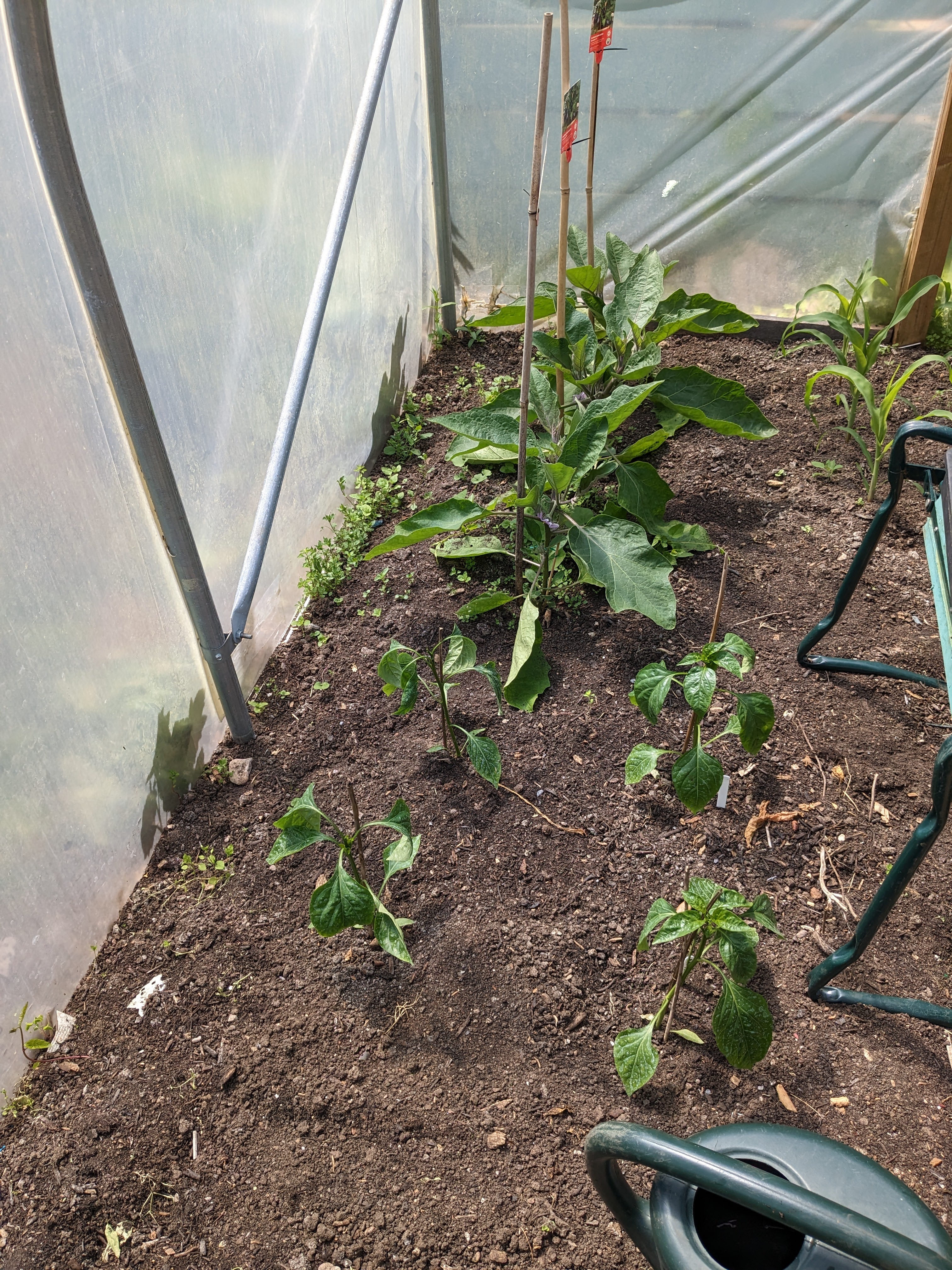
The polytunnel has given us great fun and tomatoes, peppers, aubergines and a long row of basil are all thriving. This year – purely as an experiment – we’re growing a patch of sweet corn in the tunnel, hopefully out of reach of the badgers. So notwithstanding a fortnight’s camping in Cornwall; between the kindness of neighbours and the lateness of the season the plot came through for us.

A bit of a post-covid tree planting binge has shown its first fruits in the shape of ten victoria plums while the others all flowered for the first time. We bought them just after the lockdown eased and they were pretty poor, but loads of TLC has helped them along. A Tayberry has grown tremendously fast and looks like it will be providing a good crop later on. All in all, our resolution to cut back last autumn has been comprehensively trashed, so maybe next year. We both ache in every muscle after having to water the vulnerable plants so much in this mini-summer. On the other hand, seven years of regular composting and leaf-mould spreading have left the soil in good condition with decent amounts of moisture at about four inches down.

The asparagus bed is under a final warning because it’s not really producing nearly as well as we’d hoped. Our immediate neighbour grows Connover’s Colossal and he gets great crops, so maybe it’s another example of the old saying – “Right plant, right place”. After a rather lonely winter, the site is finally buzzing again. A few of the newcomers who started during Covid have discovered that Liz Leendertz’s book about a “one hour allotment” doesn’t stand up well to the reality of jobs, children and all the other distractions. Hopefully they’ll return to gardening later in life.

Look we actually found a maypole!

We discovered this Maypole rather hidden away in a glade above the terraces at Dyrham Park

On tuesday our grandchildren’s school was shut for a teachers strike, and it was the tail end of a NHS nurses strike. As it happens, our grand daughter was booked in for some reconstructive orthopaedic surgery on her foot; notwithstanding any strikes (which incidentally we fully support). Her operation was carried out without delay or problems and she was home again by tea time, grumpy but hopefully fixed. As we drove past their school with the other two I tooted at the pickets who waved back cheerfully at the sight of two of their young students out for a day trip with granny and grandad.

Dyrham Park is close and (for National Trust members) cheap and the children love the freedom to race about and build dams in the streams. No-one has ever objected to them so we let them get on with it. Of course they also get a free natural history lesson – here are a couple of St Mark’s flies we photographed while they were mating. They’re the dozy black flies with dangly legs that seem not to mind flying into you – which makes them faintly scary to some people. They’re called St Mark’s because they emerge from their burrows in the grass in their tens of thousands in late April around the feast of St Mark; who – if you’re not a Christian and a full-on churchgoer – probably means nothing at all. On Tuesday they were present in many hundreds of thousands. We also hunted for St George’s mushrooms without luck (I’ve already made the point about saints days!) and enjoyed the peak dandelion period. We saw Cuckoo flowers, Maidenhair ferns and Harts Tongues. We talked about everything we saw and taught them to listen for birdsong and how to use a mobile phone app called “Merlin” to help identify them. Oh and we talked about the way barley straw is used to clear murky ponds and found some tadpoles and enjoyed the huge views out towards the Severn and the Mendip Hills. I absolutely defy anyone to say that a family day out is no substitute for a day in school.

Then, wandering around we came across a lonely maypole (this being the day after May Day) but you’ll see that the grass surrounding the pole looks pretty untroubled by even little feet. Clearly we haven’t yet embraced paganism with any enthusiasm in spite of the dark forebodings expressed by the Strict and Particular Brethren.

When we got back the children taught us how to order a Deliveroo from a mobile and then ordered all their favourite things. The oldest said afterwards “We love coming to you because you spoil us!”. So we all learned something new although ours was by far the more expensive lesson.

On Wednesday we were walking back from the allotment when we came across a bunch of people on the A4 protesting about the 20mph speed restrictions, the clean air zone and all things associated with wokery, 5G telephones, vaccinations and communism. Passing motorists tooted their horns enthusiastically without the tiniest thought illuminating their bewildering prejudices. I’m glad to say that the local elections 24 hours later saw the eviction of a raft of councillors who’d campaigned against the clean air zone and the new speed limits. Overwhelmingly the voters of Bath see the virtue of slowing down and breathing unpolluted air. Of course that won’t stop the campaigners (who are associated with all manner of far right causes), from telling us that they know better than we do – what we believe.

Mayday

This photograph of the allotment was taken on May Day 2016, two months after we took it on.

There was me, writing here a few days ago lamenting the absence of what I chose to call cultus; call it what you will really but it’s about moments of communal celebration – and then today it’s May Day.

Not that anything very discernable happened. No maypole to be seen on the allotments; no May Queen, no carousing and drunkenness; no dangerous and profligate behaviour. All you could say was that the allotments today were busier than they’ve been since last autumn. We’ve endured long periods of solitary allotmenteering as winter extended its grip to a full six months and we wondered whether we would ever see the sun again. Now we have two consecutive bank holidays and a coronation and aside from a meet the street gathering here next Sunday it seems that big and boozy community events were dealt something of a death blow by Covid. Somehow we’ve got out of the habit – out of the habit of harvest festivals, Christmas carols, plough mondays, Whitsun; and beating the parish bounds; other flavours are available if you can remember them.

There are probably many who wish good riddance to the lot of them – Christian festivals are a bit passé now – except for the fact that most of the meaningful festivals that still exist were pinched from the pagans centuries ago. Oliver Cromwell did his level best to ban the lot of them but the moment the Restoration happened they emerged from their brief hibernation as full of energy as before.

When St Augustine of Canterbury arrived in Britain in around 597 he discovered that a fully functioning pagan religion had returned in the period since the Romans left. He sent a desperate email – (OK letter!) – asking the Pope what he should do and in one of the few sensible decisions in the history of Christian evangelism; some months later the Pope replied that it was better to take on the pagan buildings and traditions and give them a Christian backstory. Welcome to Plough Monday, the first Monday after the (Christian) feast of the Epiphany – OK then, Twelfth Night – when traditionally the sowing of crops began after the Christmas lockdown. Plough Monday was the pagan festival celebrating the beginning of the agricultural year. In fact there’s an uncanny tie-in between the surviving Christian festivals and the old pagan calendar; and some, like Wassailing, that were never successfully co-opted at all.

All of which is a rather long winded approach to the fact that today, May Day, is also celebrated as Beltane; the traditional festival celebrating the beginning of summer. Fires, singing and a bit of carousing would once have taken place all over the country. I’ve got a photo of my mother as a child (born in 1918) dressed in white, with a garland of flowers round her head and standing next to a ribbon decked maypole on an Oxfordshire village green. Sadly since the triumph of the Evangelicals – Cromwell’s withered soulmates – most of the Christian Churches see these entirely innocent reminders of the earth cycle as heretical if not as devil worship. If you really want to see devil worship go and stand outside the chemical works in Huddersfield that still produces Paraquat and sells it to poor farmers in India.

The point here is that the earth cycles – the solstices, Winter (Christmas); Summer (Midsummer Day); equinoxes; Spring (Easter); Autumn; (Michaelmas) and the intervening quarters; Imbolc (Candlemas); Beltane (May Day); Lughnasadh (Lammas) and Samhain (Halloween) need to be detached from their captivity within institutional Christianity not because I would like to damage what became my own spiritual dialect but because the context has changed; history has moved on and – in the story shaped universe that we created and now inhabit – the earth cycle has (once again) become the story we desperately need to move us away from the dominant narrative – neoliberal economics and politics – towards an earth centred spirituality, not because it feels like a nice idea, but because our lives depend upon it.

So today we were on the allotment. Madame was mulching our fruit bushes with sheep fleeces given to us by our friends NIck and Kate who live in Bannau Brycheiniog – the old and original Welsh name for the Brecon Beacons. We’re expecting a plot inspection any day now and, to be honest, it looks as if a small flock of Jacobs Sheep has died in the fruit cage, under the blackcurrants and gooseberries. Fleece, which is almost valueless these days, makes an excellent mulch and slug repellent and it’s very good as an additive to the compost heap. Anyway we hope we don’t give our neighbours palpitations.

While Madame was engaged with the fruit cage, I was earthing up the potatoes. Years ago I bought a ridging tool which I only ever use once a year but it’s exactly right for earthing up spuds. The soil is black and friable and smells lovely with a bit of sun on it. It’s worth ridging up this time of year because it protects the emerging leaves from a late frost better than fleece, which allows Jack Frost to do his destructive work wherever it touches the leaf.

Everywhere there are signs of growth. The immense energy of spring drives the plants upwards into our realm and as I hoed the soil, I touched, for a moment that sense of sacredness that occasionally visits a gardener in quiet thought. This moment of inspiration was accompanied by a speaking; not at all an auditory hallucination but the clearest intimation that the soil itself is the mother of all life. We might imagine for a moment that those Buddhist monks who rake gravel temple gardens have, somehow, a higher form of spirituality. It’s not true of course. The sacred is always ordinary; the ordinary seeking us out.

But I can’t leave this thought with any suggestion that the paganism which I have referred to here is in any sense inferior, heretical or dangerous. My point in using it is to suggest that its connection with the earth cycle may be an insight whose time has come again. In 1966 First Nation Canadian, Buffy Sainte Marie, released a song called “Little Wheel Spin and Spin” and it just wouldn’t leave me yesterday. You might like to listen to it – it’s on YouTube music. Fifty seven years on it’s as powerful and prophetic as it was when I first heard it.

Christianity has been a rather poor guardian of the ancient traditions it once co-opted. Maybe it’s time to ask for our ball back? Happy Beltane.

A gentle reproach from Wales

October 2022. An absolute whopper from the Marcher Apple Network orchard in Cwmdu – no idea what it’s called.

I should open my Severnsider mailbox more often, I know, but mostly it’s full of technical stuff that I don’t understand – which is why I only found a polite note concerning the proper Welsh spelling of an author I’d written about – it ran – “Not a massive typo – you have Carwyn down as ‘Carwen’ on this post which is the female rendition of the name.” The post, from many months ago was titled “This is beginning to look like my mother’s siege larder” – and I’ve just amended the spelling by placing Carwyn in the correct gender.

Blog posts are ephemeral of course, but books last forever so I thought I’d give Carwyn Graves another plug for his two books; the first was (I think) published in both Welsh and English and it was called “The Apples of Wales”. If you’re at all interested in the innumerable local varieties of apple which result from its promiscuous cross pollinations, then this is a really interesting book offering marvellous insights into the local histories of some of these varieties. And if you’re really interested there’s a whole orchard of Welsh apple varieties behind Plan yn Rhiw on the Lleyn peninsula, and we were also able to visit an orchard at Cwmdu in the Brecon Beacons which was planted by the Marcher Apple Network – a society for reviving old varieties of apples and pears. We’ve planted a number of traditional varieties on the allotment, and our friends in the Beacons have planted many more.

Carwyn Graves’ excellent new book “Welsh Food Stories” is equally engaging and informative, so much so that I was tempted into following up on some of the books he mentions and I’ve managed to buy two or three of them secondhand. So I hope this mention makes up for my inadequate knowledge of the Welsh language; long may it prosper!

Anyway, while I’m in the mood I’ll also mention a piece I stumbled on yesterday called “Failing nature on Dartmoor – why its protected areas are in such poor condition and what needs to be done” by Tony Whitehead, analysing the heated debate on successes and failures in preserving Sites of Special Scientific Interest on farmed land on Dartmoor. It’s a subject that I’ve written about before and it’s been much clouded by misreporting and exaggerated accusations. I won’t attempt to paraphrase it but if you’re interested in getting a better grasp of what’s at stake it’s a really useful summary.

Back on the allotment an instinctive starting pistol was fired over the Easter holiday and the site was swarming with allotmenteers. For once it seemed sensible to be planting the potatoes on Good Friday, and the intoxicating smell of the wet but warming earth – known as petrichor – carried the subliminal message of the season. Is there some kind of spirituality here? – something to do with being held by an embracing framework? Nonetheless, not everyone is as engaged with nature as we are. We were expecting a delivery of plants which eventually turned up yesterday, three parts dead, after sitting in a courier’s warehouse for six days. The boxes were festooned with notices that warned they contained live material.

Now we’re sitting indoors waiting for Storm Noa to pass over while Madame sorts the wheat from the chaff in the seed box. This is such typical spring weather. Southwesterlies laden with moist air bring pulse after pulse of rain and sunshine to us in the west country, gifted by the Atlantic. The warmer the sea gets the more extreme the weather gets.