 One of my earliest memories is of potato planting on Easter weekend. Traditionally, in the UK potatoes would be planted on Good Friday and, as I remember it, the intoxicating smell of freshly dug earth would follow me all the way as I walked a couple of miles down to my mate Eddy’s house. Bear in mind, of course, that I’m thinking of a time 60 years ago when growing vegetables was an almost universal preoccupation among what Channel Four News likes to describe as “ordinary people” – I prefer a less patronising way of describing the vast majority of us. There are – or were- things that were done with no real idea why, apart from the fact that they needed to be done and they’d always been done. I think that’s a pretty good definition of culture – the way we do things round here – that’s to say right here in the West Country and not the way someone who lives in a flat in central London might see it. And so horiculture is a subset of culture as a whole and concerns the growing of things where we are.
But memories fade and cultures evolve away from the old preoccupations with putting food on the table and so we’re left with the urge to sow seed but not the accompanying local knowledge inherited from parents and grandparents. Which is a very wordy way of addressing the fact that crowds of allotmenteers on our site have been enjoying the unprecedented sunshine and warm weather this week. Last Easter the garden centres were facing bankruptcy and were only saved by the equally unprecedented hot summer. I wonder if we shouldn’t rather be worried than celebrating this latest evidence of climate change.
The earliest date for Easter – which is the only Christian festival tied to phases of the moon – is March 22nd, and the latest is April 25th. That’s almost 5 weeks, which is a very long time in the spring. Last season we had our last frost at the beginning of May and we would have lost all our tender runner bean plants if we hadn’t kept a large number in reserve. It was a gamble we lost decisively! So our response to the tradition of planting potatoes on Good Friday would need to be “it depends when Good Friday falls”, but the takeaway point is that in this part of the UK the answer has to be not yet! They’re safer being chitted.
It’s so distressing for new allotmenteers to experience the way that after all the winter digging and preparation the weeds appear to come back with renewed vigour, and it’s even worse to lose an entire crop to a late frost. Every year we see newly fledged allotmenteers losing heart and walking away from their plots. You can almost hear the bindweed laughing. I don’t want to make it sound more daunting than it is, but the best gardeners have patience and resilience built in to their DNA. Forget the ‘magical’ chemicals that do more harm than good. There are certain weeds that are desperately hard to eliminate, but resilience, patience and low cunning will see the back of all of them. Find out what they like most and deprive them of it – that’s the way. Often a winter under plastic sheeting or weed control mat will weaken them, but then if we pile on the pressure by hoeing and hand weeding and especially mulching, we can tip the balance in our favour. Better wait a year than waste a crop, and no-one will criticise you for it, in fact your neighbours will probably share their surplus with you in grateful thanks that your plot is no longer exporting noxious weeds on to theirs.
So for all those who are starting out on the adventure – good luck, and if enough of us share our accumulated knowledge, who knows? Maybe our children and grandchildren will know when to plant potatoes.
 If there’s a downside to allotmenteering (or gardening for that matter) it’s how to get a break during the growing season. I suppose our allotment has the additional problem that all the water is turned off between late October and mid-March, and so we early starters need to make our own provision. Back at the Potwell Inn, we have just under fifty tender capsicum seedlings in the two propagators. Normally I water them once a day with a fine spray of very dilute seaweed growth stimulator, but I thought I’d do an experiment to see if I could use capillary matting attached to a large water source. In its first iteration I passed a wide strip of matting from a small bucket, through the ventilator of the propagator and under the matting inside. A rapid flood occurred because evidently too much water was flowing from the source. So I wondered if the flow rate correlated with the width of the connecting strip, and I halved the width, but that also wicked too much water into the propagator. Quick rumble of the little grey cells and so next I wondered if the amount of wicking that was submerged in the source bucket was the problem. The solution was to shorten the wick and attach it to a wine bottle cork with two drawing pins – as per photo – a very cheap cistern arrangement. That’s been running all day and it’s certainly slowed down the transfer of water to the propagator. If that still proves too much I’ll halve the wick width once again and carry on with the cork cistern – total cost about a pound. The next stage is to work out how large the cistern needs to be for us to have a week away. I should say that the lights are timer controlled to give 12 hours of fairly intense daylight at 24C.
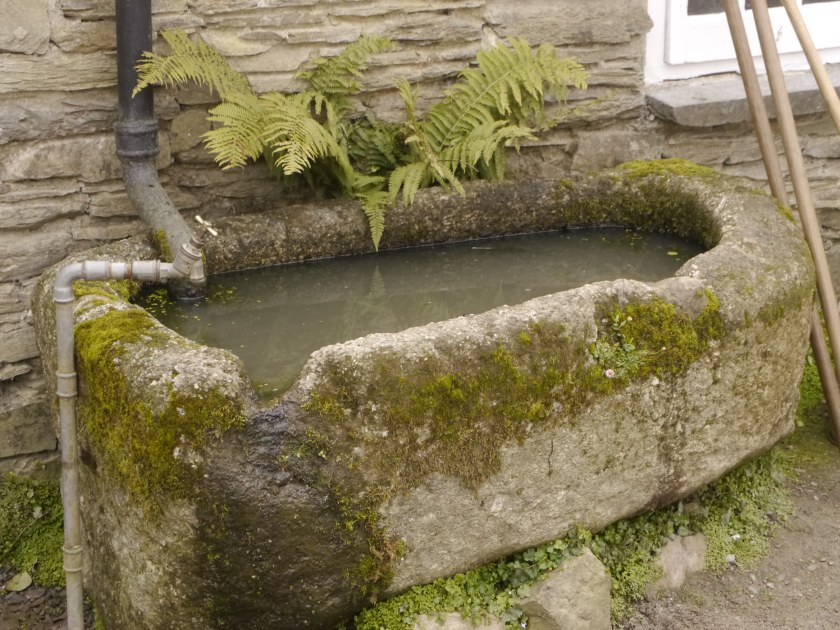
 Up at the allotment I spent a couple of hours yesterday reinstating the timed dripper system to water the seedlings in the greenhouse. It took some time last year, researching the available gadgets, to make sure the one we bought would function at the very low pressure provided by the water butts. This battery operated model has been reliable for a whole season, and works on a reasonably small head of water. Given that there’s no clean water available on the site for some weeks yet, I was so pleased when I rigged up a temporary tap from the water butts to find fresh clean rainwater – 1000 litres of it – flowing reliably through the system. Madame had taken a look at the rainwater in the trough but someone appeared to have washed a paintrush in it so it had a nasty blueish hue and was almost certainly contaminated with anti-fungal chemicals.
 The other independent watering system we’ve used is soaker hose which we installed under the tomatoes last season and which worked very effectively over the first 2/3 of its length. That’s a point worth noticing, the hose we used was years old and had become kinked. It would probably have worked under mains pressure, but trickle fed from a water butt wasn’t working at all.


 I think these must be the happiest cows I’ve ever seen. I took the photo in May 2010 when I walked 200 miles of the Camino between Le Puy en Velay and Cahors with my son Andrew. Purely by chance we were crossing the Aubrac hills just as the transhumance was going on. Cattle were being walked back up to the high pastures with real ceremony and all the surounding villages were decked out for a party that seemed to go on for days. This was “La France profonde” and we were pitching our tiny tent wherever we could because we couldn’t afford even the hostels. But these cattle had just arrived and they were so happy I swear they were smiling. We were too. The local cheese was wonderful and made a change from our terrible diet – we had no means of cooking with us and so we plumbed the depths of cold cassoulet eaten straight out of the tin. Most character forming.

 So back then to Aubrac and those wonderful smiling cows. We didn’t see any rich farmers on the whole walk, but we saw a lot of farms and villages doing their best to preserve a way of life that hasn’t changed in centuries. and so it seems we can have happy cattle and wonderful cheeses, and we can have wonderful meadows too, decked in spring with every kind of orchid and alive with insects. But if we get rid of the farmers we won’t have any of those things, and if we want them badly enough the change we shall have to embrace will be to live more simply. If we really insist on eating Big Macs and smoked ribs every day for next to nothing, then we can’t expect to have anything except a degraded environment and a legacy of debt to the land that our grandchildren will have to pay.
 I guess we’ve all got a list of writers we know we ought to read but somehow never get round to it. For me, it’s all too often someone I’m slightly frightened to read because I’m a bit afraid I’ll be overwhelmed, and Wendell Berry fell firmly into that category. Some of the most influential books I’ve read came to me accidentally, before I’d been able to think of a reason not to read them. Wendell Berry was one of those slightly terrifying characters who wore dungarees and represented all the stuff I felt most uneasy about in America and so I steered a wide course around him whilst all the while trying to find a way of living that he could have helped me with if only I’d not been so stubborn.
