Each one of these photographs has a share in today’s post. The first two on the top line are celebrating the fact that we finally finished harvesting our summer seasonal crops on the allotment. So Borlotti and the last of the tomatoes are in the photograph, but outside the flat we’ve got old and new potatoes, and squashes while still on the allotment are peppers, cucumber, beetroot and chard, runner beans and seven varieties of apple; so all in all not a bad year and the stores are full for the winter and hungry gap. It was hard work getting everything ready to come away, especially in the midst of a heatwave but we got it all finished and ready so we could come down here and do some end of season botanizing.
Sadly the campervan had other ideas and so I’ve spent hours crawling around in impossibly small spaces attempting to diagnose three distinct problems – ghost drain on the leisure batteries, bad contacts on the fridge supply and an apparently non functioning battery charger. Apart from the lethal possibilities of poking around in the circuitry hidden behind the wardrobe, I tend to get cramps and my arms are covered in bruises. I found that the grey plastic distribution board had a big boys section (live mains) and a child’s play area for the 12 v circuits. Luckily there was no temptation to do anything other than housekeeping because the fine weather broke this morning with such vengeful and remorseless storms that we spent the rest of the day trying to get two sets of wet clothes dry again. On the plus side I’ve found fuses where I didn’t even know there were places and I’ve thanked Harold Wilson for inventing the Technical School which gave me the confidence to approach these problems rationally and without fainting. Classical education is all very well but it doesn’t understand circuits. I feel uniquely fortunate that in addition to the technical stuff I learned Chaucer, 2 modern languages, 20th century American poets and discovered singing before I discovered hormones.
There’s another day’s Camino lined up and I may try and finish it tomorrow but there’s one place I need to go back to again. It’s our absolute favourite walk down the bridleway from Gerrans to Percuil harbour. On Thursday we sat on the bank of the creek and listened to the Curlew and all the other seabirds and it felt as if I was floating halfway between earth and heaven. These liminal places, on the edges of sea, sky and land belong to no-one and are in constant motion. It’s possible, here, to imagine an earth without me and not feel sad about it.
Looking down Percuil River towards St Mawes and the English Channel.
Left Aumont Aubrac early. We set the alarms for 4.45 and it was dark when we woke. I had an extremely restless night – hardly slept. We were right next to a main road and the transhumance festival parties didn’t begin until 11.30pm so all night there were drunks outside the campsite shouting and banging the railings. I was praying they wouldn’t see our 2 little tents. We didn’t want to wake Alain and his wife so we breakfasted at the camp gate on dried apricots and yesterday’s apricot pasties + water. When we left – way before sunrise – there was a thick mist over the valley bottom. We climbed and climbed for several hours knowing that this was the last day we would have the heavy (35lb) loads because we had agreed (long haggling session) to shed lots of stuff the previous night.
Big dream during my restless night. I dreamed I was at Severn Bridge railway station* except it looked exactly like an SNCF station like the ones you see in French films (and in France of course). Suddenly this strange and sinister man dressed like the Sandeman sherry label logo comes towards me. He’s all grey, very large with no face. I start to tear at his clothes and in a kind of fast-forward sequence I tear all these clothes, disguises and appearances off one after another – he’s everyone, everything, and all these flash past in front of me until at last I’m left holding a plucked chicken!
After a stiff climb we reached Les Quatre Chemins which was just a bare road junction such as you might find on High Mendip. Gloriously there was a café (Chez Regine) perched on the corner. It was a proper French bar/café with Regine – if it was her – looking as if she had been hot smoked with tobacco.
Previously in Lasbros we’d fond an immaculately clean toilet complete with paper, which made up for the lack of overnight facilities.
Due to the early start we crossed the Aubrac Plateau before the sun got too hot. Unbelievably beautiful wildflowers – including [this is a misidentification I now realize] gentians which I’d never seen before. Untouched pasture and some of the healthiest and happiest cattle I’ve ever seen. In Lasbros we saw a foal that could only have been born an hour before – just standing up all knock-kneed. It was a hard and hilly day and very very hot. Even I drank 3 litres of water but fortunately there were many taps. Finally staggered into Nasbinals mid-afternoon. Andrew had pulled a muscle and was getting grumpy. Found campsite at other end of town, as always, so probably walked 27K. Put up tent, slept , had a shower and walked back into town at 6.00pm passing a restaurant on the way in. So we booked a table or 7.00 and had a couple of panachés in the local bar. Meal was excellent and shared with 2 Germans and 2 French. Young Frenchman reminded us it was Pentecost.
Journal
*Incidentally, although the Severn Tunnel (not the bridge) does have a railway station, on the Welsh side, I’ve never set foot on it – so its role in my dream is just one of life’s imponderables.
This afternoon I realized that I’d already mentioned, out of sequence, an evening shared with a nightjar as well as the worst meal ever. Having laboriously checked the previous seven posts on the Camino I thankfully discovered that neither incident was claimed as a component of the walk we’d already done and so I’ll continue gracefully along the Way but very aware of the fact that even with the aid of exif data from photos, a handwritten journal and a pretty reasonable memory it’s incredibly easy to slip up and transpose experiences from one day to another. Why it should be so important to me to get it exactly right is a question I can’t answer except for the fact that as I write this I’m constantly trying to answer a crop of my own questions. I hesitate to describe this exercise as therapeutic but I would love to think that when I press the last publish button on this group of posts, I might be just a touch wiser. Of course, 30 years as a parish priest taught me that life is irredeemably complicated and is very rarely understood by the people having to put up with it, and even less so by the people trying to explain it. That’s why psychoanalysis is so expensive. Not many caring professionals can resist explanations and keep quiet for as long as it takes for the client to hack their own way through the undergrowth.
The day was, as I’ve described it previously, full of wonders. Watching a transhumance take place is like watching a thousand years of history roll back. On a more mundane level, my mention of the newly born foal took me back to the day and the place so vividly I was able to revisit Lasbros in my mind as if it were yesterday.
No energy today. Every step (all uphill) a struggle. Jacqueline caught up with us and gossiped us over the first huge pass. Stopped at a farm and had café au lait + fresh bread and a small cheese made on the farm. Wonderful!
Ctd next day:- No room at Les Sauvages so we decided to press on to St Alban sur Limagnoles – 35K and nearly killed us. Arrived at the church at St Roch and unexpectedly burst into tears. On and on – it seemed even walking downhill was hard. Arrived at campsite exhausted and on the verge of quarreling. Mercifully the campsite manager cooked us a toasted sandwich and some chips. Slept 10 hours and breakfasted on two bowls each of hot strong and sweet black coffee. Left at 11.00am thinking we had an easy (17K) walk but it was 25°C and uphill (2 big hills and their corresponding valleys. [M] had to help carry my stuff as I was about to collapse. Arrived at Aumont Aubrac to find the campsite closed. Broke in and picnicked on sardines and apricot tart + UHT milk. Still tasted heavenly. We were both feeling demoralized as all the campsites we hoped to stay in were closed for the next three days. Discussed sending some stuff home to save weight. Bed at 7.30pm as we want to leave between 5.00 and 6.00am to miss some of the heat. 25K tomorrow. Can’t get fuel for our cooker anywhere in France. Sharing our vagrant experience with Alain and his wife – he’s made a cooker from the end of a beer can! Crazy as a coot!
Journal
Well we didn’t exactly break in but we did clamber over a locked gate. It was a weird experience because the facilities were all locked up with the entrances full of leaves – a sight we were beginning to be all too used to. We’d met Alain and his wife a little while earlier. They were sitting at a table outside a cafe and being mercilessly teased by some of the locals. The village was heaving with visitors partly there for the Pentecost holiday – which we’d failed to factor in; and also because the annual transhumance was beginning and locally it’s a big deal as the cattle, decorated with flags and garlands, are driven up to the plateau to graze the wildflower rich meadows. The French are among the most secular of people, but they don’t appear to have given up on the holy days, and there’s a deep sense of tradition surrounding the transhumance. I found it very moving to watch the cattle being driven up the drove roads, but the downside was a good deal of drinking which left us feeling a bit unsafe at times. That was the evening when Alain – a retired tax inspector – showed us the tiny spirit stove he’d made from the bottom of a lager can. Later on in the walk by which time we’d all got blisters, we found him walking in pink plastic sandals with plastic bags on his feet.
The church of St Roche was almost the only church I actually entered on the walk. Inside was the obligatory elderly woman in black and with rheumatic chesterfield legs hobbling around and completely ignoring me. My mother had died two months previously, but as she’d died with Alzheimer’s and hadn’t recognized either me or my sister for several years, any acute sense of mourning had been dissipated over a long period of what we called pre-mourning– or so I thought. So in a rather blokeish way I went into the church, saw the old lady, came out and completely fell apart; howling all the tears I’d had locked away for a very long time. M looked at me and said – “that was a bit unexpected” and the subject was never mentioned again. I didn’t need a therapist to help me see what was going on there, but a long time later exactly the same thing happened in a psychoanalytic psychotherapy therapy session. I was trying to describe how moved I was by the way that Odysseus’ nurse had recognized him by the scar on his thigh and once again I exploded with what felt like a volcano of grief. Grief seems always to be a work in progress.
The way down to St Alban was steep, narrow and rocky, and with our heavy rucksacks much more of a struggle than grinding uphill. It would have made our journey easier if we’d realized how wonderful it would be crossing the Aubrac plateau the next day, but that’s the way of pilgrimage – everyday is a surprise.
The view down the valley last Tuesday morning. Sometimes the whole valley fills with clouds below us.
Fascinating though it may be to revisit the Camino journal after 13 years – (in fact I’m finding it pretty painful going) – life goes on at the Potwell Inn with the last of the tomatoes to be processed into two sorts of passata; one roasted and the other simply simmered with onion and indecent amounts of butter. It’s been an odd year, but we’ve now pretty well replenished our stores with a big crop of tomatoes from the polytunnel and our biggest ever crop of aubergines. Our only real failure was the broad beans early on and we’ve resolved to sow next year’s crop in November rather than wait until the spring reveals its hand. The asparagus bed failed yet again to rise to the occasion and so I’m afraid it’s going to come out in the autumn. It’s in the coldest part of the allotment and that may have something to do with it; but for the last three years we’ve spent out more on saving the crop than the value of the harvest and we can’t afford the indulgence. The surprise crop of the year was the Tayberry vine which gave a lovely crop of berries; and the apple trees which all fruited for the first time since they were planted.
The trip to our friends’ smallholding on the Bannau Brycheiniog (Brecon Beacons) was partly to celebrate Madame’s birthday and partly because it’s a joy to spend a few days there with our friends. There’s always work to do on a smallholding – fencing, feeding animals and suchlike – but this time we helped to butcher a couple of two year old sheep (AKA mutton) which had just come back from the slaughterhouse. Vegetarians may prefer to look away now but as a meat eater on a modest scale, I have no moral difficulty with eating organic, free range sheep whose lives are entirely natural and whose lifetime travel takes them just ten miles to a local slaughterhouse.
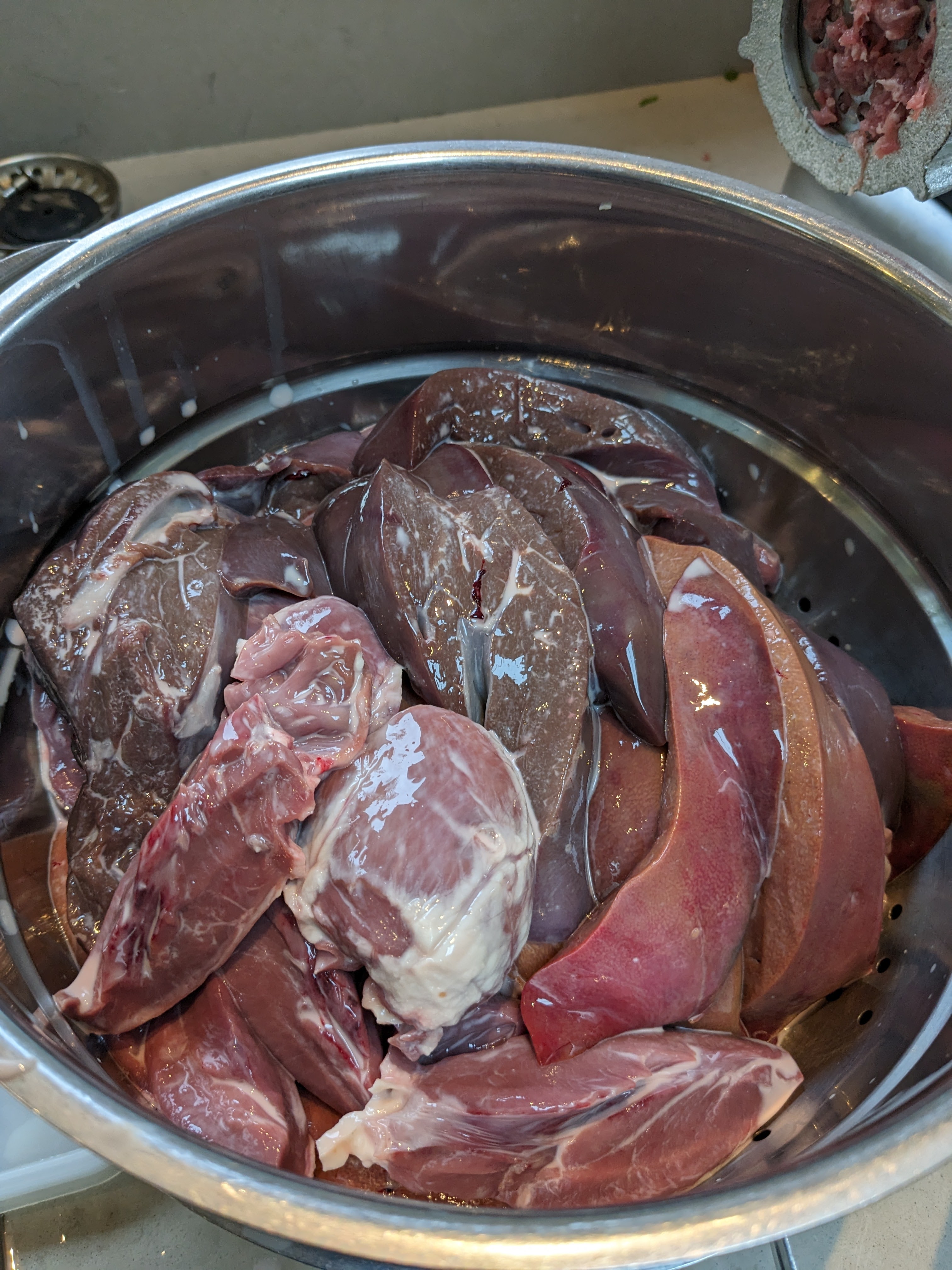
Butchers – I mean real butchers – are highly skilled at what they do. As for me, confronted by a quartered carcass, it was a matter of trying to remember where all the joints come from and what they are supposed to look like. Three of us worked as a team in the kitchen and reduced the carcasses to joints, cuts and mince and enjoyed playing silly games whilst avoiding chopping our fingers off. Then we made a vast pot of stock and boiled all the bones down while Nick and me made trays of faggots – that may need translating for some readers – basically meat patties made from all sorts of offal; we only used the liver and hearts. By the time we’d finished we had four leg joints, four shoulder joints, 15Kg mince, 4Kg diced, 4 hocks, fillets for stir fries, leg steaks, racks, whole loins, 32 faggots in gravy, a gallon of stock and 36 blocks of dog food using every left-over scrap of meat from the bones.
I always feel, when I’m writing like this, that I should explain or defend hill farming and the killing and eating of animals. There’s no denying that intensive farming is the source of terrible cruelty and much avoidable pollution; but to equate what goes on in a 20 acre hill farm with what happens when two million chickens are crammed into sheds is a bit of a debater’s cheap shot. I go back to Michael Pollan’s wise motto – eat food, not too much, mostly vegetables. The consumption of ultra processed foods has been shown to be the cause all manner of illnesses and, if we all took to eating ultra processed vegetarian and vegan food we’d soon be totally enslaved by the gathering disaster of the food industry’s war on healthy eating, quite apart from swelling the profits of the industrial grain giants and the growers of palm oil and soya beans. Of course the killing and eating of animals raises all manner of ethical issues but we’re far too prone to exporting the hard questions as far away as possible. Buying your meat shrink wrapped and trimmed doesn’t detract from the big moral question of killing it in the first place. The taking of life is a big deal and so we should try never to eat more than we need, and endeavour not to waste any part of it.
We came home to the Potwell Inn with meat for the winter; we had dined on the freshest eggs you’ll ever see and we also brought a fleece back. Kate has used them for weed control, composting and also for lining hanging baskets. Nothing ever goes to waste on the smallholding. We’ve known them for over thirty years and from day one we treasured our fellow inner peasants. It takes a certain kind of personality to get so much pleasure from shaking plums out of a tree. I also fell in love with their Welsh terrier Dilys and proposed to her secretly but she rejected me, saying she was already suited.
Anyway, that was a long day and the following day we gathered plums, identified moths from the overnight trap and baked bara brith. Moths are attracted to a strong light and then they drop down into the depths of the box where they find egg boxes to spend the night before being identified and released in a manner that minimises the risk of them being eaten by birds. The wall outside the kitchen is used for feeding birds throughout the year and it’s fascinating to see the variety – most of the tits, nuthatches, robins, yellowhammers (increasingly rare) and finches too. At night we listen to the tawny owls and in the early spring there are cuckoos – it’s the last place I heard one, four or five years ago; pure joy. A family of field mice live in the crevices of the wall and pop out nervously from time to time to grab some grains.
Then finally, before driving home, we had a dip in the pool; filled with rainwater and warm from the combination of sun and solar panels. Paradise indeed!
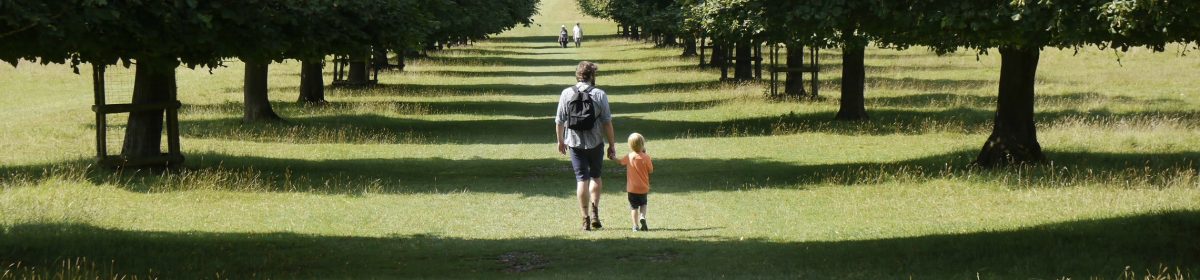
A lovely day at Dyrham Park with the Grandchildren and their mum. We’ve pretty much got used to the absence of the deer since it was culled due to so many animals being infected with TB. But the knock on effect of their absence is obvious when you compare the photo in the header with the one below. Firstly, of course we notice the much more ragged look of the avenue of Lime trees today. The header shows how closely cropped the lower branches used to be, and the avenue had a formal, clipped quality that led the eye forward. Elsewhere, the change in grazing has allowed the coarser grasses to take over because, sadly, mowing cannot replicate grazing as a means of improving grassland diversity. Let’s be fair, if you know where to look the variety of grass species is (so far) about the same but it’s consigned to smaller areas.
July 2019
Today the two figures are the mothers of the figures in the header – Madame on the left and our lovely daughter in law on the right. But there’s good news too. It’s been hard to get any official information about the return of the deer herd; but today we discovered – by talking to a couple of friendly volunteers – that there are plans to restore the herd some time next year. We’d noticed that there’s been a continuing programme of installing high fences around the park. In our helpful conversation we discovered that the fencing is not so much about keeping the Dyrham Park deer in but keeping the wild (possibly infected) deer out. The badgers in the park have all been trapped vaccinated and released, and soon – we know not when – a new herd will be brought in. Hooray!
Common grasshopper
For today our grandkids hunted grasshoppers, spotted buzzards and we were able to talk to them about wildlife.
Back home we’re up to our necks in produce; processing tomatoes for the winter, for instance. I’m completely knackered!
We were watching Stanley Tucci’s cookery series on TV last night and at the very end of his visit to Sardinia and after sharing a rather grisly starter of cooked sheep’s blood and mint with a group of shepherds they barbecued the lamb- basted with the bitter honey of the Strawberry Tree – and began singing the traditional shepherd songs of the island. We’d heard that sound before on Corsica; every bit as lovely in its rather chilling way. It’s called polyphonic music; a highly textured interweaving of voices. This kind of music appears all over the world in different registers between high culture and folk song- we were in Barcelona some years ago and next door to the Museum of Contemporary Art there was a sound installation where the forty parts of Tallis’ motet Spem in alium were each given a loudspeaker, the whole arranged on stands in a circle which we were free to move inside. We were transfixed with tearful joy. At a less exalted level, there are many traditions of circle singing around the world; some, but by no means all, associated with Psalms. What these traditions all share is the complex interweaving of a single phrase being sung in something like a round by singers following different intervals.
Shepherd music, though, is less associated with loosely organised religion than it is with various forms of independence struggle. We were on Corsica on Bastille Day, for instance and not a single firework was let off. Most Corsicans don’t give a toss for the French government. Similar song forms exist in Finnish and – closer to my heart – in Wales.
But this isn’t going to be a technical discussion. The point of it, for me, is that polyphonic song is powerfully spiritual, visceral in its intensity. One of the things the lower voices do in Sardinia seems to be very similar to Tibetan throat singing; the bass sings a very rich fundamental along with its harmonics. Even the single note at the bottom would be incredibly difficult for most singers to reach; but to allow the overtones and harmonics to develop around it takes the song to a different level.
I often talk about the absolute necessity of shared community values if we are to flourish, because the whole purpose of this blog is to find ways of being fully human while living in a culture that strips us of any vestige of humanity if we aren’t careful. Singing, we are encouraged to believe from infancy onwards, is (like art) a difficult and rare skill that few of us possess – which is a pernicious lie because it cuts us off from a turbo charged source of spiritual food. Look at a shepherd choir, a folk band, a string quartet, a circle of singers and watch them as they watch each other while they make music. There’s a wild and passionate engagement with one another as we make music, which breaks down the barriers between us and allows us to experience our own wholeness in, and with others. As I often said in my old day job; “if they knew what was going on here they’d tax it or ban it altogether”. When you join music with a shared culture, a shared memory or aspiration then it takes on a scary power.
What’s the first thing a colonial power does to subdue a culture? It takes away its language, its shared memories, its art, its poetry and its songs – and so singing, remembering and celebrating become a countercultural act. I’ve never forgotten a retreat I went on at Emmaus House in Clifton. There we were, a bunch of complete strangers, and we were invited to take both hands of the person next to us and behold them. You simply wouldn’t believe what a deep experience that was because it involved a profound letting go of boundaries. Singing does that too, but on steroids!
But I wouldn’t want to forget that these humanising experiences are additive. Add singing to a shared meal, a bit of drama, (carrying in the haggis, beating saucepans around an apple tree, a bawdy mummer’s play – you get the picture) and invisible threads are woven like cat’s cradles around the participants. So in answer to the question –how can I feel more alive? more human? get down off your solitary dung heap, stop crowing like a preacher, get your head out of your arse, lose all those inhibitions, eat your dinner together and sing as if your life depended on it – because it does!
A week of rain has given me lots of time to work in the kitchen and I’ve employed (and enjoyed) every moment of it. I’ve written before about my aversion to ratatouille – (which Madame loves) and so one of my aims has been to work up some alternative ways of dealing with the aubergines, courgettes and tomatoes that I genuinely enjoy. The problem is always that they tend to ripen in numbers at roughly the same time, so being frugal means eating them up or finding a way of storing them.
Of the three vegetables, tomatoes are by far the easiest because they have high acidity and we can bottle them and keep them for a whole year. I’m ultra careful with bottled fruit and veg and I usually give them a decent time in the oven – say 40 minutes at 110C – before I screw the lids down. I mentioned a couple of days ago that we produce 3 kinds – straight passata, roasted passata and Hazan no 1. They’re all marvellous standbys to have in the kitchen and all taste quite different so they suit different dishes. Today I made a second batch of roasted passata using mainly plum tomatoes from the polytunnel. I was surprised just how different the final flavour and texture was – really delicious and a perfect accompaniment to the Hake we bought from the mobile fishmonger at Newton Park Farm Shop this morning. The fish will only need a tablespoon of the passata as a dressing, with some brown butter and a scattering of fried capers and served with some of our own new potatoes and a bed of spinach, all from the allotment. I’ve fallen in love with Hake over the last few weeks, but it usually turns up at the supermarket fish counter looking a bit sorry for itself. Today’s fish came up from Brixham after being landed at 4.00am. Trust me, super fresh fish is lovely!
So what about courgettes – which can grow from six inches to a seedy blimp overnight. Aside from the dreadful rat it usually gets used in some kind of bake with tomato sauce and almost always mozzarella cheese. I got my original recipe from Patience Gray’s “Honey from a Weed” – in my view one of the great cookbooks but also filled with a tantalising account of life in Puglia. Patience Gray was not one to send off to Fortnum and Mason for exotic or unobtainable ingredients; she always cooked from what was to hand. The recipe for Zucchini al forno – can as easily be used for aubergines. I think from memory that she used mozzarella cheese, torn into shreds between the slices of vegetable with tomato sauce, all cooked in the oven. I’ve cooked it dozens of times, but the cheese is always a disappointment – the supermarket versions are too rubbery and bland so you rarely find it soft and smelling of buffalo. Yesterday I worked up a new version using Taleggio cheese and home-made straight passata with slices of courgette fried quickly in very hot oil to give them colour and finished with a squeeze of fresh lemon juice. The cheese turned the topping brown in the oven and it was delicious and full of intense flavour.
My other favourite way of cooking courgettes comes from Elizabeth David who pre-boiled them before dicing them. I don’t bother with that any more because they tend to get rather soggy, so I dice them and fry them in hot butter with a dash of olive oil and then chuck a bit of finely chopped parsley and some lemon juice into the pan to finish them. It’s lovely with fish. My next adventure will be to slice one of the fat ones – marrows really – laterally into thick discs and then stuff them with a risotto and bake them in the oven. We’ll see how that one shapes up.
So finally to the aubergine. Aside from rat we do stuffed aubergines to a Middle Eastern recipe from Rick Stein’s Spanish book – always good. They’re good in slices on a barbecue but they seem to respond best to some fairly strong spices. Our youngest cooked for a season in Greece and he brought back a recipe for baba ganoush which was very good. But here, marooned in a flat with no access to a gas stove or barbecue unless we cook outside, and festooned with smoke and fire detectors it’s hard to get the smoky flavour. Yesterday I prepped some aubergines halving and scoring them through to the skin and then smoked them over hickory chips in our middle sized Cameron’s Smoker for 15 mins before finishing them in the oven (still inside the smoker) for around 40 mins at 180C. The resultant puree with the usual spices and tahini and a bit of good olive oil was a revelation. There was a huge difference between burnt and smoked and although Madame doesn’t really like smoked food she said nice things about this one – so I need to scale it up a bit and learn to make flatbreads.
When I say it rained today I mean real heavy stuff; but nothing daunted we added another three pots to the little container garden outside on the pavement and got very wet in the process. There’s still work to do but we’re getting close. While we were out there it suddenly occurred to me that we should call it Gwen’s Garden after my mum. She loved flowers and was an inveterate thief of cuttings and seed heads wherever she visited. I don’t suppose her little old lady act would fool anyone, but flowers gave her, and us, such pleasure. You may find it shocking, but we’ve still got her ashes in the wardrobe at the Potwell Inn and I’ve met any number of other people who do the same thing. Can’t bring ourselves to part with them. Anyway, I haven’t asked my sister yet if she minds calling it Gwen’s Garden but she reads this blog from time to time so I’m sure she’ll tell me! I washed the trowel off in the flooded gutter when we’d finished. The water was warm. This weather is deeply troubling!
As I look at this now I’m thinking that it would be lovely to have a Banksy portrait of my mum on the wall behind.
This photograph of Stoke Row hangs over my desk partly as a reminder of another era, but also as a reminder of my grandfather who, apart from a spell working as a carpenter in London, was born and lived there for almost the whole of his life. He was probably the biggest influence in my life; very short and equally short tempered with a creative gift for cursing that I’m fortunate to have inherited. He was a vernacular builder which meant his drawings were almost always on the back of a fag packet and securely in his head. Most importantly he was a natural radical and he had a collection of books that opened my mind to a world of possibilities, and several huge long sheds in which he stored everything he’d ever wanted to repair but never got round to; for instance a couple of penny in the slot pianolas which he would let my sister and me play with. He could make rainbows with a stirrup pump; give us rides in his wheelbarrow and let us feed the hens or look for Charlie the toad in the greenhouse. He also grew and cured his own tobacco which was so smelly he was chucked out of the pub for smoking it. He made carpenter style furniture – he was no Chippendale -hand built the first wireless set in the village and owned the first television. He also helped me to build my first transistor radio and erected a long wave aerial in the garden for me. He was almost entirely self educated and taught me logarithms before he gave me my first slide-rule (a kind of manual calculator for working with big numbers). He introduced me to Dickens and H G Wells and although he was a devout atheist, would secretly repair the benches in a local churchyard.
Much later, long after he died, I discovered the radical writer and pamphleteer William Cobbett; thorn in the side of everyone who annoyed him and whose two books “Rural Rides” and “Cottage Economy” inspired me and reminded me of my grandfather. I think this website owes a great deal to William Cobbett’s writing. In “”Rural Rides” he took up the cudgels on behalf of starving farm workers after undertaking a series of rides on horseback to see for himself the terrible poverty that followed the systematic impoverishment of land workers during the Industrial Revolution. He fought government corruption and campaigned for a more just electoral system – and when I say campaigned – his writings were fierce enough to have him thrown into prison several times. He fled from justice to France in the middle of the revolution; thought better of it and sailed on to America only to find that as a conservative he sat uneasily within the radical movements of the day, I would probably have hated him if I’d ever met him because he was really a backward looking old style conservative but the fire that flows through every sentence of Rural Rides is a model of righteous anger.
Most historians dismiss Cobbett because he advocated a return to the old rural ways. He was a ruralist and farmer himself and although he spent the last years of his life as an elected MP he never gave up campaigning. He wrote at the beginning of the industrial capitalist society and already he could see the cruelty and contradictions inherent in its exploitative and extractive philosophy. Today; as we suffer in the dog days of the same ideology, radical thinkers are again persecuted and imprisoned by powerful interests who can’t tell the difference between criticism and insurrection; and national politics once more is stained by corruption; industrial strength lying and greed.
Cobbett’s other book – “Cottage Economy” is, or should be required reading for anyone interested in 19th century traditional farming and any form of self-sufficiency. In a haze of what might seem to be sentimental idealisation of rural life due to Cobbett’s lifelong conservatism, Cobbett explains brewing, bread baking, building an ice house, the keeping and killing of farm animals and the preserving of them by smoking. He thought that the potato was the work of the devil and that the drinking of tea and the consumption of potatoes made men effeminate(?). Bread and beer were the culinary gods in his canon, and at a time when much water was unsafe to drink, the consumption of “small beer” – brewed from the remaining malted grains after they’d been once sparged – or washed for the making of stronger ale – was much safer having been boiled. Above all the book is a fascinating social history of village life before the industrial revolution. It’s hilariously funny at times – Cobbett was an old fashioned Church of England member and addressed some of his funniest and most excoriating prose to the Methodist Ministers who – in his fertile imagination – would always turn up to visit the poor cottager on the day that the pig was killed. No-one could possibly try to run a 21st century life on the pattern of a 19th century polemic, but his memorable style can make you wish it could still be possible; indeed some survivalists really do try it.
But Cobbett understood and called out injustice and its perpetrators in a fearless way that scared them. He was utterly incorruptible in a way that I would love to see once again. His pen name was Peter Porcupine – you get the joke at his own expense and he never stopped writing, pamphleteering and campaigning on behalf of the poor. Most critics focus on what he was wrong about. I prefer to attend to the things he was absolutely right about.
I wonder what my Grandfather – who was a member of the Independent Labour Party – and my Father who was also a lifelong Labour Party member would think about the present state of British Politics which is so corrupted by the lust for power that we can only look forward to choosing between a wealthy liar and a spineless liar because the electoral system is purpose built to crush radical dissent.
But although I get very sad at times I’m essentially an optimist, and the Potwell Inn and the way we do things around here are essentially my personal project to dig a pollution free well; think as clearly as I can; grow some healthy food to cook and keep us out of the hands of the merchants of sickness; oh and find every occasion to provoke and challenge the knuckle draggers and drool mongers who are driving all life on earth into a wall in the hope of enriching themselves at our expense.
There are, as the saying goes, no pockets in a shroud!
Suddenly we have surpluses to deal with – possibly due to the fact that we invested in grafted aubergine and tomato plants this year and they are strikingly vigorous and are both producing fruit at speed. I know that many gardeners avoid spending money on F1 hybrids and grow all their crops from seed, but seeds often decline in their ability to germinate quite quickly and some saved seed may be infected with diseases. Is it worth spending the extra on grafted plants and F1 hybrids? In my opinion, the blight resistant varieties of tomato and potato are worth their weight in gold – they really work. Every year on the allotment site there are gardeners who lose their entire crop when blight strikes. There’s no more depressing sight in the world. Our grafted plants are far more productive than the ones we grow from seed ourselves so we’ll continue to buy them. However they can arrive in a very sorry state when we’ve ordered online and sat for days in a warehouse, and so we prefer to buy them at a garden centre where we can see what we’re getting.
So this weekend it’s been raining and therefore a perfect time for batch cooking. I’ve made bramble jelly with the wild fruit we picked, and a couple of kilos of ripe tomatoes into the first batch of roasted tomato passata. This batch was so powerfully flavoured I bottled it in 250g jars – plenty for a pasta dish for two. The last job was to stuff eight aubergines with a middle-eastern flavoured lamb mixture. We’ll freeze them and get them out for a quick meal on a busy day.
I’ve written before about the pleasures of a full store cupboard; pleasures which are just as flavourful when delayed as they are the day they are made. Some things, of course, don’t store or freeze well and they’re the heart of the seasonal contribution to our meals. Tomatoes are so important that we produce three different sauces – unflavoured straight passata; Hazan number one – a beautifully flavoured passata/sauce with mild onion and indecent amounts of butter; and finally the roasted sauce which is a standby for any dish that needs a tablespoon of rocket fuel – umami on steroids. Most seasons we make enough to feed us throughout the year.
It’s been an uphill struggle to second guess the weather this year. The seasons have been badly affected by climate change and the unwillingness of politicians to address the coming crisis is a shameful betrayal. I was particularly struck by a droll remark by an ex Labour party supporter who adapted one of Blair’s catchphrases to: “Tough on hope; tough on the causes of hope”. Someone needs to show them that sticking your fingers in your ears and shouting la la la la la doesn’t amount to a strategy. Lowest common denominator politics is low and common and I can’t understand why anyone with more than ten brain cells would want to indulge in it in the face of the suffering that economic, climate and ecological destruction is causing already. Shame on them!
The title, “Well tempered household” is a steal from a gardening classic by Christopher Lloyd called “The Well Tempered Garden” – well worth reading even though he seems to think of a small garden being anything less than three acres. “Tempered” in the sense that he’s using it has nothing to do with bad tempers or good manners because it’s drawing on a process familiar to sword makers when steel is heated and cooled in order to make it less fragile, more ductile and altogether stronger. A well tempered garden in this sense is a garden that’s capable of withstanding the kinds of climatic surprises and shocks that we’re becoming all too familiar with.
So extending the metaphor to a whole household – like the Potwell Inn – seems not to be too far a stretch, at least to me. We’re not tidy, we’re frequently bad tempered but the Potwell Inn is a well tempered household because in amongst the joyful moments we’ve seen a few shocks and many stresses; we’ve endured scary times and sad times; we’ve frequently been hard up, and to borrow another idea from Nietzsche – what doesn’t kill you makes you stronger. I like to think that layer after layer of experience has been forged into the steel of our being, such that our resilience has made us strong.
Of course there are some shocks that experience can’t overcome. Yesterday we went to visit an old friend with Motor Neurone Disease and against all the odds we had a really lovely afternoon together. Any difficulties in listening to his failing voice were overcome, and – not for the first time – I felt the presence of a kind of luminosity which is not unusual among those who are approaching death. We left and drove back to Bath on a warm and sunny evening and I was overwhelmed by a sense of fullness as all my summer evenings were forged into one. It was an unexpected and extraordinary moment.
Back in the kitchen there were jobs to do, and so I kneaded the new batch of dough for the morning and set it into a banneton that I’ve only used a few times before. I don’t think I could ever write a full account of baking bread. It’s so embedded in my memory and my hands that hundreds of micro decisions contribute to the final loaf. There is a recipe stuck to the fridge, but it’s overwritten with so many amendments I rarely even look at it. But when the stars align and the starter, the batter and then the dough come right there’s a feeling that it’s going to be good. But there’s another feeling too because having the starter right, having the flour and then the loaf right are tokens of stability. Well tempered baking is a fundamental part of a well tempered household and so too is the allotment which brings us healthy food. Today we harvested tomatoes, potatoes, aubergines, green beans and sweetcorn and Madame picked 2Kg of blackberries from the footpath. Today we’re winning the sweetcorn battle with the badgers six nil. Lunch was good.
The Pyrex bowl in which I’ve proved every loaf I’ve ever baked is so precious and replete with memories that it’s only ever hand-washed. I’m not sure I could cope with losing it. The sourdough starter is more than ten years old and always sulks when we go away and don’t feed it. Recently a couple of American neighbours were in the process of moving away and they entrusted a three generations old sourdough pancake batter to our care.
So yesterday evening we ate late, watched television far too late – binging on “Bear” series two – and then listened to some of the music again while we drank too much wine. The sound track is amazing. A short night, then, and up early with a thick head to bake the loaf.
As the produce floods in, I spend more and more time in the kitchen. Today there were the blackberries to be cooked and strained through a cotton twill bag to make jelly. Bramble jelly is one of the most fragrant of all the jellies, and it always feels like we’re eating summer when we have it. Then today I also made the first batch of roasted tomato passata which we use as a base for many meals throughout the year. I suppose all this is another instance of resilience; of the tempering process that keeps the household on track even during the toughest of times. Without our sack of flour, the bakers yeast and the sourdough starter and a cupboard full of preserved produce from the allotment we’d have felt very exposed, but as it was, our principal enemy was isolation.
Are we self-sufficient? Absolutely not; but are we well tempered and resilient? without doubt!