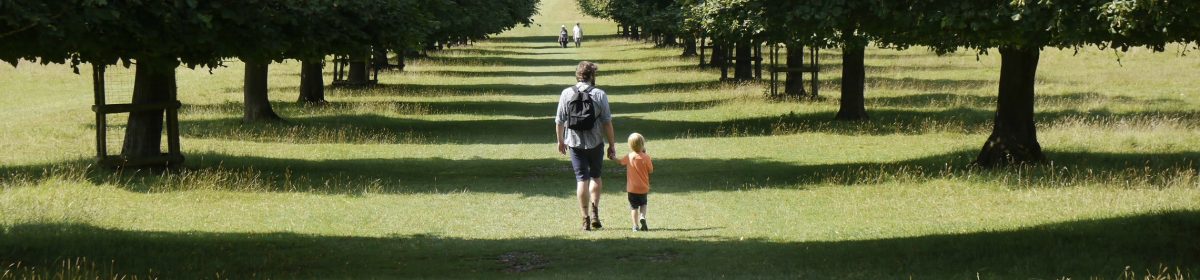
We’re back in Cornwall; this time on the Roseland Peninsula and in the campervan. We were pretty knackered when we arrived but after an excellent 9 hours and 44 minutes sleep we felt rested and ready for Madame’s favourite walk ever. This is a campsite we’ve stayed in for years and between the site and the sea there’s a bridle way about 2.5Km long lined on both sides for the majority of the way by Cornish hedges. It’s a very special environment – partly at least because you rarely see anyone on it apart from the occasional walker or horse rider.
Today we saw Red Admiral, Small Blue, Small White and Orange Tip butterflies; we saw a buzzard hunting at a little distance and later we saw a Kestrel no more than 25 m away. It was a wonderful and inspiring sight with its capacity to keep its eyes completely still over the prey, whilst fluttering and gyring in the sky.
On the way down to the sea I kept on seeing such a variety of wildflowers I decided to record them whilst walking back up the hill. There were way more than I recorded, but I made a list of forty species in the gathering rain. I was never more grateful for the waterproof pen and notebook. Many of them require further exploration but that’s half the fun. For instance I caught sight of a single Geum urbanum, that’s to say Wood Avens or Herb Bennet in the UK. The word “Bennet” caught my eye because Benedict was often shortened to Benet. So Herb Benet has a history in herbalism – probably because this ‘Blessed Herb’ found a use in herbal medicine, probably because of its aromatic root. There were also large numbers of Pellitory of the Wall – Parietaria judaica – used to treat urinary infections. Of my forty plants, twelve were either traditionally used as foods or medicines – excluding the Foxglove which will damage your heart!
They’re all common enough plants; for instance the Broadleaf Plantain travelled to the US in migrants’ boots and spread wherever they went – hence the First Nation name “White Man’s Foot”. It’s apparently a remedy for foot pain – you just wear a fat leaf inside your socks. I really should try it some time. A guide at the Lost Gardens of Heligan once showed us how you could peel off the outer skin of Navelwort – Umbilicus rupestris -with your thumbnail, and apply the sticky side of the leaf to your skin as a kind of natural plaster. I’ve often wondered whether Stitchwort is a cure for the kind of stitches you get when you run?
Anyway, on our return to the van, and when the real work began, I began to wonder whether my Fumaria could possibly be F. capreolata but, like the Polypody, that ID might demand a microscope.
I was especially pleased that my list of forty species was as long as my previous best but which took a fortnight to complete, but the price you pay for speed is a bent back and a compulsive swivelling of the eyes; not a good look.
This is going to be a very short post but I think it’s important to think aloud occasionally, if only to begin to set out some kind of a stall. My aim here is to tease out a couple of missing threads in the environmental movement; threads that – if we could fill them with life – might release enough energy to get this heavy stone to the top of the mountain.
The only data I really understand is myself and my feelings which seem constantly to suck the life out of any hope. Despair is utterly destructive. I’ve mentioned before (often) that any kind of earth spirituality needs a structure, a framework in which to function, to act, to think and to conduct our daily lives. This doesn’t seem to me to require the invention of any supernatural entities; there’s more than enough awe in nature to inspire the biggest of thoughts and responses and even to drive to our knees from time to time. That’s the first missing link – a structure or framework which will need to be maintained and expanded by our best thinkers.
This would be the first task of what I’ll call the geologians – the earth philosophers who know how to ask good questions and frame good answers. Theologians do God which is a good deal easier since “because I say so” is a circular argument which I’ll come to with the next missing link. Geologians will help us to think sensibly, coherently and truthfully without waving big sticks like damnation and purgatory.
The second missing link after the framework begins to take shape will be to form a canon – a collection of writings that can command general acceptance. This wouldn’t be too hard, there are loads of books on my shelves that call themselves “readers”- selections of writings that seem to demand our attention because they help us to think more clearly. I’m certainly not proposing we turn our geologians into a high priesthood. A canon is a collection of trustworthy writings that come with the assurance that they won’t lead us into the wilderness – and I’m sorry for the occasional reference to more biblical notions but they’re handy shortcuts sometimes. However, as I hinted before, even canonical literature needs to be constantly examined and revised if it’s not going to die and become putrid. That’s why “because I say so” ican never be on the agenda.
The third, and possibly the trickiest component will be what we have to describe as the cultus – without for a moment implying a derived cult. The cultus might involve – for instance – thanking a plant for meeting some of our needs before we dig it up; community harvest or planting festivals and so forth.
These three threads already exist extensively within native, first nation and ancient cultures. They have elders and wise people who maintain the culture and guide actions, they have highly refined structures of belief and they abound in ceremonies and rituals which enfold communities and hold them together. However this can’t mean that we could just take a system off the shelf and apply it to ourselves. Many of the existing systems are highly localized – to plains communities; herding communities or forest communities. We in the overdeveloped and greedy west have obliterated the concepts of theology, cultus and canon in order to remove any opposition to neoliberal capitalism. The vision I’m talking about refers more to a possible post apocalyptic future. The driving force is the hope that the most thoughtful and creative minds of our generation; artists, poets, scientists engineers and philosophers (well not my generation perhaps; I’m pretty ancient!) – may forge a new vision that can act as a bridge towards a new sustainable future.
Most revolutions are fought without much of a vision of what happens afterwards and this is what leads to populism and dictatorship; easy to fall into and hard to dispense with. Lashing out might feel good for a moment but the bad actors have all the power and they won’t hesitate to use it. What they don’t have is the power to eradicate a contagious vision. Faith – as the evangelists often say – is caught and not taught. Belonging is far more powerful than believing. We’ve got local elections in the UK in a few days time and I’m immensely disheartened by the fact that the Greens have the right policies expressed in the style of a university seminar reading. To borrow and adapt an idea from Monica Furlong; feminist theologian “anger is hope overwhelmed by despair”. Only visions can express theories with sufficient power to change “the way we do things round here”.
Yesterday was just one of those days that left me almost breathless with pleasure. We were five old friends whose various relationships reach back way over fifty years; five old friendships that have seen and survived all manner of triumphs and tragedies and five human beings sharing a walk (well, more of an amble) on a stunning spring day, while we followed the course of the remains of the Somerset Coal Canal which was built to carry coal from the North Somerset coalfield to the junction with the Kennet and Avon canal, near Dundas aqueduct. For me, a light bulb went on when I realized how much of the old stone structure had survived, but Madame also had it written down as a place to return to – a lot!
It wasn’t a long walk by any stretch but we gave it several hours anyway, soaking up the sun and exploring off the path from time to time, looking at plants and rusting iron lock gate nails with equal interest; catching glimpses of the equally abandoned railway line that forced the demise of the canal. For me it’s a paradise of post industrial relics and possible sites for interesting wildflowers, and by all accounts it has some very interesting geology, which is always good news for plant hunters. But it wasn’t all green wellies and Tilley hats. C and I had a friendly bird app competition with our phones and I realized that the absence of an in-phone database meant that hers identified a Black Cap Warbler much faster than mine which was still looking for a signal. Just for interest I was using Birdnerd and C had Merlin – hers was clearly better for off-grid id’s – mine’s always worked perfectly well but perhaps I’ve just been lucky with phone masts.
Weld – Reseda luteola
There were no rarities spotted, but it was just as reassuring and pleasurable to see Dandelions, Cuckoo Flowers, Cowslips, White Nettles and Ground Ivy all flowering in profusion. The only oddity was what I think must have been Weld – Reseda luteola, AKA Dyers Weed, Dyers Rocket or Yellow Weed. No prizes, then, for guessing what it was once used for. If it was Weld I suppose that would make it a post industrial plant relic from a much earlier historical moment. Lurking up and down these beautiful valleys are the ruins and remains of monastic communities with their medicinal herb gardens and watermills, grinding grain from local farms. Far from being enjoyable just for its remoteness and quietness, you could almost feel the presence of innumerable farm labourers, fishermen, monks, boaters, miners, navvies and railwaymen, all those faint echoes flowing towards the river Avon. The horizons are punctuated by the silhouettes of grand mansions and farms such that we were obliged to consider the source of all that wealth. One of our party had long dead ancestors who were in the cloth trade and who may have furnished the backs of navvies, slaves and workhouse inhabitants. with fustian – rough but hard wearing cloth that combined cotton weft on linen warps.
We finished up – as all good walks do – in the pub where I photographed the hauntingly lovely sign at the top of this post; something I’ll come back to in a moment.
I’ve been struggling for a long time to find a way of expressing what seems to me to be a fundamental difficulty in this post-religious age. A few days ago I wrote this:
the intoxicating smell of the wet but warming earth – known as petrichor – carried the subliminal message of the season. Is there some kind of spirituality here? – something to do with being held by an embracing framework?
The trouble with words like Spirituality and Love is that they’ve been so trampled upon by blowhards, bishops and pornographers they no longer have any meaning at all except for a vaguely felt inflammation of the imagination which could be anything from a vision to a mild virus, and so writing about such things becomes an exercise in frustration; altogether lacking the tools for the job.
For me, best and most creative ideas come when the parts of a solution finally come together for no discernable reason except the relaxed mindfulness of a walk. These ideas, quite often, are not the lofty analytics of a Holmesean three pipe problem. They can seem vulgar, irreverent and occupy worlds so different it’s almost like harvesting the energy of colliding comets.
So here’s the problem – how can we find a contemporary way of expressing the content of words like spirituality and love. What kind of love, from all of the available flavours, would best express our love for the Earth in this age of catastrophe? and secondly, what form of spirituality could provide a language accessible to the religious, the determinedly non-religious and that huge population in the middle who long for a structure, a framework for understanding a way of being human that isn’t part of what’s destroying us all?
And so what about these three components?
Chef’s Ass
Calendula officinalis
The marriage service
These three rather disparate ideas have at least one thing going for them because they include a painful (but not fatal) human condition, a plant that provides a useful remedy, and a form of words that might just provide the beginnings of a framework.
Let’s take Chef’s Ass first. If you’re working in very hot and humid sweaty conditions – for instance in a restaurant kitchen, polytunnel or just walking for long distances in inappropriate clothes you may contract a very uncomfortable form of abrasion rash known colloquially as chef’s ass in the trade. I consulted our son – who’s a chef – on a possible cure, and he said he’d once tried alcoholic hand gel which turned out to be effective but screamingly painful. I hoped I could find a less extreme cure for my similar gardening related problem and turned to our home made Calendula Cream which, to my great surprise and relief worked miraculously well. It’s so cheap and easy to make I wonder why anyone would pay £15 for a tube, or resort to potentially dangerous remedies like hydrocortisones.
Calendula flowers drying in August 2020
Forget God for a moment because there’s absolutely no reason to invoke any kind of higher level supernatural powers here. The earth provides us with a multitude of effective remedies for many unpleasant, painful but non-malignant diseases. Calendula is just one example. Now the application of the cream did the trick for me, but that left me with the odd sense that I should be able to say thank-you for that help. I get exactly the same feeling harvesting our produce, eating it and sharing it with friends. That unchannelled, unfocused gratitude needs somewhere to land but all too often, like a boomerang, it circles back on itself and manifests itself as pride.
I know I’m using a religious term here but bear with me just for a moment while I explain. Pride is a very dangerous thing not least because it blinds us to our own fallibility. But collective pride – for instance in our ability to solve every challenge, even catastrophic climate change, through our own cleverness is a form of idolatry. Our thank-you’s desperately need to be channelled into something less destructive than pride.
So with that in mind I’ll turn to to some words from the marriage service which once seized me so powerfully in the course of a wedding service I was taking, that I had to stop in my tracks and recover my wits before I could continue. Each of the couple (and I’m using this example in a completely secular and non gendered way) say to one another – “All that I am, I give to you, and all that I have I share with you”. From that moment onwards I almost invariably reminded my couples that the second half of the promise was the easy bit. “All that I have I share with you” is the kind of arrangement that any half witted solicitor could organise. It’s a kind of prenuptial clause. But the second half of the promise- “All that I am I give to you” is on a different plane. How many of us have even the faintest clue what “all that I am” means for ourselves, let alone our prospective partner?
And yet the point here is that the earth has made precisely that promise to us. The earth says – “all that I am I give to you” and means it utterly, to the end. But we, in our infinite pride, forget that in this imagined marriage relationship with the earth we secretly and covetously hope to get our hands on the money and say that sentence with our fingers crossed behind our backs. There’s no more destructive relationship than a one sided and selfish marriage. This is not a religious point!
So at last I come back to the pub sign. I’m a sucker for naive paintings and a complete fool for the ones that express in paint something that the painter could never have articulated in words. Our angel, with a look of considerable doubt on her face is taking an anchor from the heavenly (that’s the hope bit) to the earthly ( that’s the anchor). When the rope breaks there’s no guide to the way back and we are lost. So to recap from the top; all those ancient voices flowing down to the river and onward to the sea were the hopes of our ancestors, lived out in the world of nature that provided food and health as best the earth could offer. It was greed and selfishness that fouled things up and because of that idolatrous worship of our own powers we now face an existential crisis.
Ironically (or maybe not), we five walkers all agreed that it wasn’t just the complete ineptitude of our politicians or the continuing impact of lockdown; the war in Ukraine, or even the cost of living that was making us depressed and unhappy. There is something deeper that wrecks our sleep and furnishes our worst dreams. Without finding a new relationship with the earth and all living things we’ll remain delusional, lonely and ultimately doomed.
We know you can buy asparagus at almost any time of the year, but our own asparagus bed is only just beginning to throw up a few spears and we don’t – on principle – buy it from other parts of the world with all its attached air miles. So today our eyes lit up when we saw some bunches of Hereford grown (Chinns – praise where it’s due) and although it was expensive it’s as iconic a sign of spring as Easter, or Oestre which gives a better clue as to what it’s all about.
You can look up the recipe (which comes from Simon Hopkinson – one of our finest cookery writers) – it’s freely available if you Google it. From my point of view it combines four of my favourite elements; pancakes, asparagus, air dried ham and hollandaise sauce. All in all our special treat supper cost just over £10 which compares favourably with any takeaway and tastes ten times better. I know this because we always eat them in silence -like Montalbano on the television.
Years ago, hollandaise took me several tries to make at first – mainly because I didn’t read the precise instructions closely enough. Our son Jo used to make it by the gallon in one of the restaurants he worked in – he said it was easier in bulk. It’s like mayonnaise and all those other emulsion sauces; a bit of practice makes perfect.
Spring is sprung, the grass is riz …
So today we completed the last of the infrastructure work on the allotment and soaked the polytunnel with 250 litres of our stored rainwater. The paths are all topped up with wood chip; every bed is now ready or already planted up and this morning I unscrewed the retaining boards to give us easier access to about 1.5 cubic metres of leaf mould and the same of compost. At last the compost production line is beginning to deliver as we planned.
Now, with broad beans and potatoes in the ground we can ease back on the hard work as the seedlings get stronger and we wait for the last chance of frost. Our ever obliging French Sorrel has reached its prime so I think a French soup is called for. We are content, replete and celebrating with a bottle of Provenĉal rosé (don’t knock it if you haven’t tried it). The Potwell Inn is ready for the season!
October 2022. An absolute whopper from the Marcher Apple Network orchard in Cwmdu – no idea what it’s called.
I should open my Severnsider mailbox more often, I know, but mostly it’s full of technical stuff that I don’t understand – which is why I only found a polite note concerning the proper Welsh spelling of an author I’d written about – it ran – “Not a massive typo – you have Carwyn down as ‘Carwen’ on this post which is the female rendition of the name.” The post, from many months ago was titled “This is beginning to look like my mother’s siege larder” – and I’ve just amended the spelling by placing Carwyn in the correct gender.
Blog posts are ephemeral of course, but books last forever so I thought I’d give Carwyn Graves another plug for his two books; the first was (I think) published in both Welsh and English and it was called “The Apples of Wales”. If you’re at all interested in the innumerable local varieties of apple which result from its promiscuous cross pollinations, then this is a really interesting book offering marvellous insights into the local histories of some of these varieties. And if you’re really interested there’s a whole orchard of Welsh apple varieties behind Plan yn Rhiw on the Lleyn peninsula, and we were also able to visit an orchard at Cwmdu in the Brecon Beacons which was planted by the Marcher Apple Network – a society for reviving old varieties of apples and pears. We’ve planted a number of traditional varieties on the allotment, and our friends in the Beacons have planted many more.
Carwyn Graves’ excellent new book “Welsh Food Stories” is equally engaging and informative, so much so that I was tempted into following up on some of the books he mentions and I’ve managed to buy two or three of them secondhand. So I hope this mention makes up for my inadequate knowledge of the Welsh language; long may it prosper!
Anyway, while I’m in the mood I’ll also mention a piece I stumbled on yesterday called “Failing nature on Dartmoor – why its protected areas are in such poor condition and what needs to be done” by Tony Whitehead, analysing the heated debate on successes and failures in preserving Sites of Special Scientific Interest on farmed land on Dartmoor. It’s a subject that I’ve written about before and it’s been much clouded by misreporting and exaggerated accusations. I won’t attempt to paraphrase it but if you’re interested in getting a better grasp of what’s at stake it’s a really useful summary.
Back on the allotment an instinctive starting pistol was fired over the Easter holiday and the site was swarming with allotmenteers. For once it seemed sensible to be planting the potatoes on Good Friday, and the intoxicating smell of the wet but warming earth – known as petrichor – carried the subliminal message of the season. Is there some kind of spirituality here? – something to do with being held by an embracing framework? Nonetheless, not everyone is as engaged with nature as we are. We were expecting a delivery of plants which eventually turned up yesterday, three parts dead, after sitting in a courier’s warehouse for six days. The boxes were festooned with notices that warned they contained live material.
Now we’re sitting indoors waiting for Storm Noa to pass over while Madame sorts the wheat from the chaff in the seed box. This is such typical spring weather. Southwesterlies laden with moist air bring pulse after pulse of rain and sunshine to us in the west country, gifted by the Atlantic. The warmer the sea gets the more extreme the weather gets.
I rather enjoyed dating the damson vodka “April Fools’ Day”. As spring advances, we feel the urgent need to do something useful with the produce which we abandoned to the freezers last autumn because we were tired and wanted a break. That’s the biggest danger with freezers. We chronically overproduce on the allotment and then use the freezers to hold the surpluses until we can think what to do with them. Consequently the 5 kilos of damsons were removed from cryogenic storage last week and were turned into 2 litres of damson vodka and 11 lbs of damson jam. The last couple of kilos will become damson ketchup early next week. They were a gift from a friend on Severnside who didn’t know what to do with them either. His tree is old and marvellously productive and ours is just two years old and may take 15 years to bear any serious quantities of fruit – by which time I’ll be 91 and possibly too wobbly to climb ladders! I seemed to have inherited from my mother some kind of Jungian shared trauma which impels me/us to bottle, pickle and jam at the mere sniff of a plum, ‘because we might need them one day’ .
Of course there is an upside to this. I curl my lip at recipes for instant pickles in the glossy supplements because they just taste like raw veg with vinegar on them. If you enjoy the feeling of your taste buds doing a Mexican wave inside your mouth then be my guest. I prefer to make chutneys and pickles, label them and pack them away somewhere so hidden they come as a complete and marvellous surprise 2 years later when we find them just coming into their prime. Plums, green tomatoes, mixed vegetables and damsons all make lovely chutney but our absolute favourite is a Delia Smith plum chutney called “Dower House Chutney”. Immediately after it’s made it tastes like paintstripper with chilli sauce, but after a couple of years at the back of a cupboard it’s the go-to for anything with cheese – dark, rounded and perfectly blended. The same goes for the ketchups ( we make all our own).
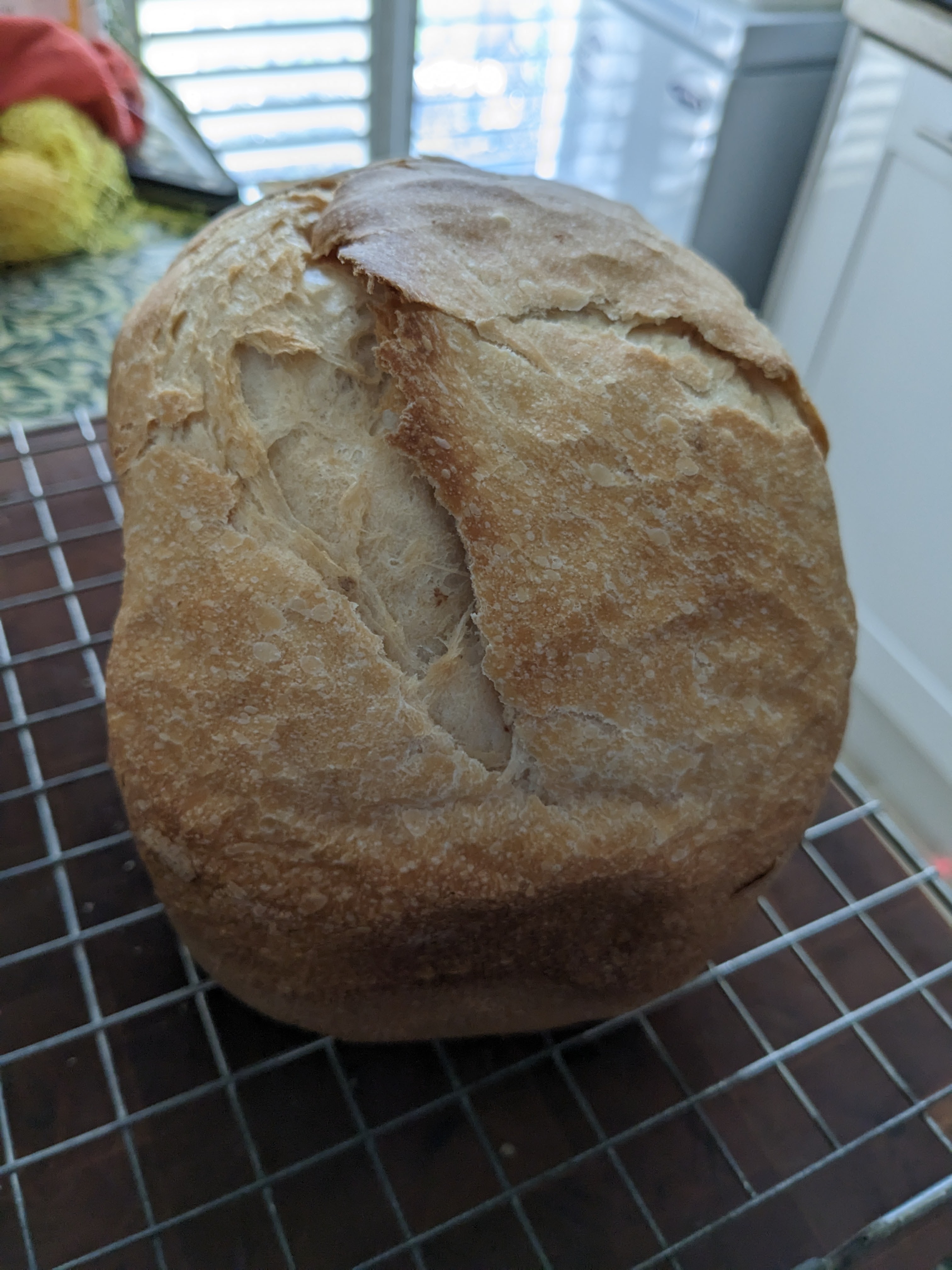
Damson jam is my favourite breakfast treat after marmalade. I don’t think we made any last year – at least we haven’t found it if we did! – and so it was a joy to have some again. Unlike pickles and chutneys, jam is ready to eat as soon as it’s cool. The vodka is blissful after dinner. The books say to strain the fruit off the vodka and sugar after six months, but once again we’ve sometimes left it for well over a year and extracted some of the almond flavour of the stones – giving a much more nuanced and darker taste. Sloe Gin, which we also make, needs a couple or three years to reach its state of grace so the vodka is an easy standby. The other couple of photos are of some bread and a lemon meringue pie that I was practicing for a family meal on Easter Sunday – (I’ve never made it before).
I haven’t written much about the allotment recently simply because the wettest March since records began was a bit of a deterrent. But a few brighter days have made it possible to almost complete the spring preparations whilst we eat spinach from the polytunnel and parsnips, leeks and parsley out of the ground. The potatoes are chitted ready to go in on Good Friday – that’s tomorrow – as per long British tradition. It’s a bit of a daft tradition because Good Friday – as does Easter Day – wanders around all over the calendar simply because solar and lunar calendars can never quite sync; so for the church festival and for allotmenteers we revert to the lunar calendar for planting potatoes. Kind of Steiner lite, you might say.
The broad beans are in, the asparagus is just shooting and the damson (our damson) is in flower. Gratifyingly, the fruiting buds on the apples are looking hearty and – this is down to Madame – beautifully pruned. So it’s all looking good for another season. As I finished bottling the jam the other day, Madame was musing whether we might be that last generation to have learned these skills. On the other hand, our middle son and his partner are keen cooks and gardeners (well he’s a chef, like number three). And post lockdown there are far more young people on the site – which is marvellous too.
The first Cowslip this year, in Alveston Churchyard.
There’s nothing like a day on the allotment, with the sun on your back. It can lift the heaviest gloom. For some fine weather gardeners being tempted out for the first time this year, the plots may look a bit overgrown and neglected but that’s just nature doing what nature always does – healing its wounds. Although most of the time we don’t dig but just cultivate the surface; some infestations like Couch, Bindweed or Creeping Thistle really do need to be dug out carefully. That can be hard work, but the robins will come and keep you company and a host of birds will visit the turned earth and eat some pests (so long as it’s an occasional digging and not an annual religious ritual). We think too highly of ourselves if we come to believe that the Earth depends upon us for her vitality. Quite the reverse is, in fact, true. It’s we who depend absolutely on the incredible generosity and healing power of the Earth.
Another week on the Lleyn peninsula, at the feet of the Snowdon range and jutting out into the Irish sea. The drive home was an idyllic spring journey through three mountain ranges, Snowdonia, the Cambrians and then the Brecon Beacons. I suppose we could have driven home the quick way via the motorway network but then we’d have missed the superb clear views of the mountains. On one occasion a couple of years ago we took a wrong turn and drove up beside the Arenigs and Lake Bala. It cost us a couple of hours finding our way through the Welsh Marches but it felt as if we were following in George Borrow’s footsteps as he researched for his book “Wild Wales”.
The weather was iffy to say the least, but then it usually is in North Wales, and we found sunshine and time for walking every day – which led to a surprise discovery. Coltsfoot (bottom left) isn’t rare by any means but I haven’t seen it for over a decade. The last occasion was on a bike ride along the Severn estuary when the verges were thinly covered by melting snow. It’s one of those plants which flowers before the leaves emerge and I suspect the contrast of golden yellow against the mud spattered roadside snow caught my eye. I’ve been back to the same place often at this time of the year to see it again, if only because it cheers me up to see it defying the last of winter, rather like Celandines do. It’s possible, though that I haven’t found it because it just wasn’t there – because it’s fussy about its environment, but only in the sense that (like the Twits) it relishes disturbed and unpromising environments like landslides, mudslides disturbed ground and generally mashed up land. Last week there were so many Coltsfoot plants punctuating the wind and sea-lashed mud cliffs of Porthor beach, I thought I’d gone to heaven.
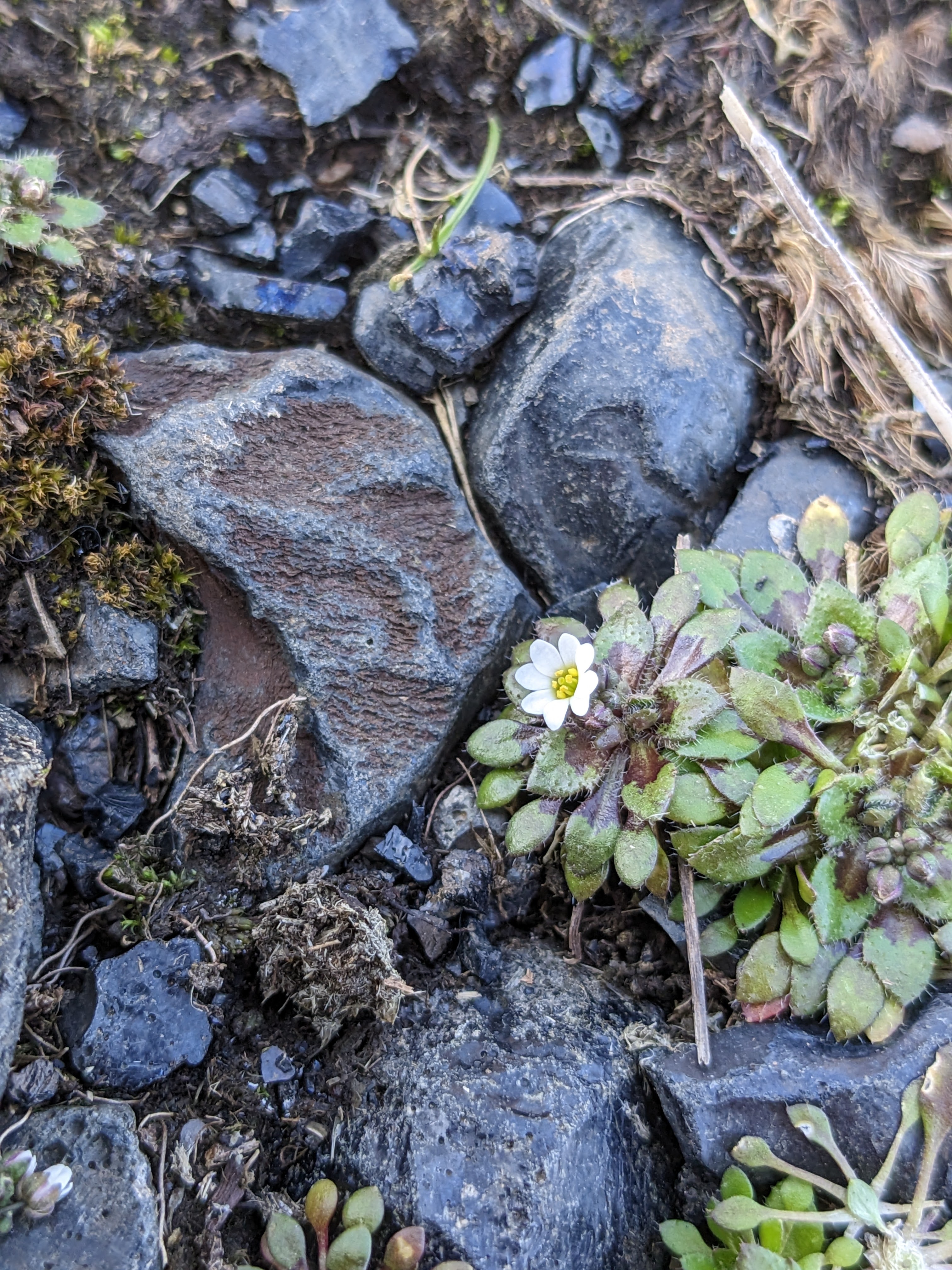
And I really like these places. Madame rolls her eyes and laughs at me when I run rapturously towards a slag heap, but here you can find some of the great survivors of the plant world. Often absolutely tiny, they make a scant living in the most unpromising places; for instance those lumps of dark rock in the bottom right hand photo are actually lead slag and in early spring, Common Whitlowgrass is among the few plants that can tolerate the concentrations of heavy metals like lead. The top right photo is of Danish Scurvygrass growing in pure sand. It’s common all around the coast, and I once chewed some (picked out of dog range) and it tasted pretty horrible – like gone off horseradish with mustard. For sailors however it was once a lifesaver due to its concentration of Vitamin C. Foragers like it for reasons best known to themselves and for them the good news is that salt gritting the roads has created Scurvygrass highways, reaching inland on verges.
Many ferns too can scratch a living on drystone walls and almost bare rocks, and so the list goes on. The adaptations to allow these precarious lives are as varied as the species themselves, and that’s the thing about evolution – it’s got time and sheer weight of numbers on its side; so many combinations and mutations to select from. One seaside favourite is the thickening and toughening of the skin – the description succulent kind of misses the emphasis that should rather lie with the plant’s capacity to resist drought, salt and all the other indignities of marginal life. Some ferns rely on what’s called apomixis – they’re self fertilised and so the minute spores can set up shop almost anywhere without fertilization by another plant – and my goodness they can travel in a favourable wind.
I get bored by formal gardens mainly because their glorious arrays are almost always the result of intensive breeding and human effort. They’re the well bred six footers who always get noticed first at the bar whilst the rest of us poorly bred peasants have to wait.
The most misused concept in farming is the idea of “improved pasture” because it’s not improved in any conceivable way- it’s just more productive in the single sense that it makes cattle fatter quicker. But the fact is that unimproved grassland yields better, stronger, far more biodiverse, health promoting and nutritious food; not just for meat production but also capturing and sequestering more carbon whilst sustaining the intricate web of wildlife – birds, flowers, pollinating insects in balance. Improved grassland is just a wasteful and expensive way of turning soil into dirt!
I don’t blame the farmers for this impasse. Decades of government policy and propaganda from supermarkets and agrochemical businesses have promoted the gods of economy, “progress” and yield, but just as the Canaanite god Moloch demanded child sacrifice, the gods of intensive agriculture have sacrificed the soil; offering only dwindling returns and throwing countless small farmers into bankruptcy and poverty.
Of course, picking up my initial thread, some plants will succeed in the most impoverished and polluted situations – which may be of comfort to those foragers who haven’t yet tried salad leaves contaminated with heavy metals. But there will be no botanists there to record and admire them. You see, to return to the idea of evolution, we have to remind ourselves that evolution carries on whether or not there are any humans around. After the barren earth and the inevitable famines, there will be plants and every other kind of wildlife, doing what my favourite plants have always done; adapting surviving and flourishing. This is the point we’re missing. If we want to survive as a species we need to follow their example and adapt the way we live until balance is restored once again.
There will always be snake oil sellers who offer fossil fuelled shares in going back to the good old days. Laugh at them. Laugh in their faces at their risible stupidity, because if there’s one thing we’ve forgotten in this scientific age it’s encapsulated in this adapted quip.
Heavily polluted runoff from an abandoned tin mine
Just before we left Cornwall the week before last, and after we’d loaded the car and returned the key, I had a quiet couple of minutes leaning on the gate looking out to sea while the birds were singing their hearts out in anticipation of spring. A Mistle Thrush rehearsed his repetitive chorus; Robins sang their plaintive songs, Great Tits, Blue Tits and gulls of several persuasions added their descant; crows and Magpies rattled on about nothing much – all adding to the rhythm of waves beating on the pebble beach below; and I realized how little I wanted to leave. I struggle to quantify or even understand the healing power of nature, but I completely and gratefully accept it.
However, there were things to do back in Bath, not least a Bath Natural History Society lecture on regenerative farming given by local farmer, Jeremy Padfield. It was an excellent talk on a subject I’ve often explored in the Potwell Inn and I made so many notes that I felt inspired to write an account for the Bath Nats website and the annual report. A quick enquiry about length solicited a noncommittal response and so I set to and wrote just over 1000 words just as an email from the editor of the annual report arrived to suggest 350 words. So a postcard then! Much anguished editing and sacrifice of my little darlings boiled the stock down to a thick jus and off it went.
Simultaneously a report in the Falmouth Packet, (local Cornish newspaper which I like to keep an eye on), printed a story about the lovely strip of coastal land running up from St Just to St Ives. It’s a place we know well and have often walked, and the newspaper was working itself up into a froth because the area has just been designated a SSSI (Site of Special Scientific Interest) due to the rich biodiversity of the land which has a tremendously wide variety of habitats rare flora and fauna and even a breeding colony of Dartford Warblers. Sadly and predictably one or two farmers were describing the move as a “land grab” – comparable to Putin’s invasion of Ukraine – well Natural England weren’t exactly bombing the area in order to protect it, and at first sight this seemed like a bit of a Luddite knee jerk reaction. Nonetheless I was interested to see whether their fear of being driven off their land was justified.
The outcome was that I was reading the (54 page) Natural England report on the West Penwith SSSI at the same time as I was reading about the new ELMS scheme for Farming subsidies; trying to discover what actual subsidies would be available to Cornish farmers in the SSSI, whilst writing my piece on Regenerative Agriculture.
The lecture itself was illuminating . Since 2009 when two Duchy farms reached an agreement to work together it seems that tremendous progress has been made: here’s my shortened report.
Regenerative Farming has become a bit of a buzzword recently but it’s an idea whose time has come, not least because of the new Government policy – the ELMS scheme – which aims to move farm subsidies completely from the old system based on farm acreage to “public funding for public goods” – rewarding farmers for carrying out important environmental work. Compensation for lost output will now be based on income foregone. LEAF has two functions, firstly as a charity promoting Integrated Farm Management and secondly as a marque for food produced under LEAF standards.
Jeremy Padfield and his business partner Rob Addicott, farm about 1000 acres of the land under Higher Level Stewardship Agreements of which 80 acres are specifically conservation managed for wildlife. Their combined Duchy farms became LEAF demonstration farms in 2006. Over subsequent years soil organic matter averages out at around 5%; no insecticides have been used within the last 5 years; weed killing is targeted only reactively; antibiotic use has been reduced by 58% and plastic use is down by 60%. Minimum tillage leads to a 68% drop in fuel consumption; water is intensively managed and stored, and solar energy meets much of the needs of the farm buildings. As well as wider wildlife field margins, Stratton Farms have been experimenting with skylark plots and wide strips of wildflowers and companion plants through the crops. Additionally, 20 acres of trees and 2000 metres of hedgerow have been planted.
This may sound like a revival of traditional farming, but what makes it profitable is the use of very hi-tech equipment like drones with three yearly intensive soil testing and highly technical GPS delivery systems which have dramatically reduced the amount of artificial fertilizer applied to the soil.
The most memorable illustration of the evening was when he took an apple to represent the earth and then cut successive slices away to represent otherwise unprofitable land. The proportion left on which food crops could be grown turned out to be breathtakingly tiny. A well attended talk which drew together the threads of shared interest that unite farmers, environmentalists and consumers.
Dave Pole – report to Bath Natural History Society.
Impressive stuff, we thought – as seemingly most of the members present agreed. However when I checked on the DEFRA website, some of the subsidies looked pretty minimal – the best example being the skylark nesting patches for which they would receive just £10. Lapwings come in quite a bit higher. Just how much admin time it would take to replicate the old EU subsidies, or whether it’s even possible is a moot point. If these measures are not properly funded then the government will be expecting farmers to fund environmental improvement of the land from their own pockets. That would be a good deal easier for a farmer on 2000 hectares of prime land than for a small mixed farmer with just a couple of hectares of grassland in the middle of a SSSI.
Then, shockingly, the Observer this weekend featured a piece on the present state of the replacement farm subsidies being managed by DEFRA. It’s almost unbelievable, but only .44% – less than half a percent of the sum set aside has actually been paid! There was no detail on which farms and farmers had actually received their payments, but one regenerative farmer reported a 48% fall in government payments.
I’m beginning to wonder whether the undeclared policy of the government is to do precisely what those West Penwith Farmers fear most – drive them off their land in order to achieve heaven knows what objectives. After a recent edition of Countryfile on the BBC featuring the mining of lithium and selecting Cornwall as a prime area for reviving the (all kneel please) economy , I wrote to the BBC complaining that there had been no spokesperson opposing the extension of this wasteful and polluting process. If joining the dots is the only way to figure out what this government actually wants to do with the countryside I’d say that on present evidence their policy amounts to greenwashing the continuation of an extractive economy which has brought the environment to the brink of destruction.
“‘Let them eat lentils’ won’t save us from animal farming – we must embrace meat substitute”.
From the very first sentence – “Our insatiable appetite for meat is laying waste to the planet. But the alternative is looking (and tasting) better by the day” – I can hear the voice of my one time sociology lecturer Sid Harris demanding “It all sounds very nice David, but where’s the evidence?” and this piece by George Monbiot is all too characteristic of some of his recent writing. It’s peppered with hot links most of which are references to scientific papers, some of them hidden behind paywalls so we get the headline but none of the supporting evidence. In fact they create the illusion of hard facts without letting us judge for ourselves. The hotlinks and the somewhat breathless style suggest an overuse of green ink and handwritten capitals. The most tendentious statements – like the one above – “Our insatiable appetite for meat is laying waste to the planet ……” is plain silly. I’m pretty hard up but I’d still bet a tenner that Monbiot couldn’t stand that one up without being allowed to empty the shelves of available prejudices and heavily redacted papers. I’ve linked to the whole article, not because I want to promote his fundamentalist views but because they’re an example of the evacuation of analytical thinking from too many mainstream media opinion columns.
Clearly we have an environmental crisis bearing down upon us, and clearly there is some evidence that some farming practices – like intensive feedlots and so-forth make a substantial contribution to that, but to pretend that there is any equivalence between small mixed farms, peasant and subsistence farms and intensive farms with thousands of cattle being fed intensively farmed soya is a deliberate distortion of the statistics. To suggest that meat farming is the principal engine of global climate change is pure vegan wishful thinking. In fact the continuing burning of fossil fuels in every part of the so-called developed world – some of which is used to drive farm machinery and make chemicals and fertilizers – but much of which is used by aviation, private car use, and the transport of foodstuffs over hundreds if not thousands of miles; this is what’s driving the crisis.
Do we eat too much meat? – undoubtedly the answer is yes. We eat too much of it and especially we eat too much of the wrong kind of it; the kind that’s fattened in conditions of appalling cruelty and fattened on food that makes cows sick. They’re ruminants, they evolved to eat grass not grain and soya meal. Should we ignore ethical questions surrounding farming and troll people who elect not to eat meat? Of course not, and I wish they’d stop the trolling in the opposite direction. Does referring to milk as an “animal secretion” encourage sensible debate? Do I really need to answer that? Is there any doubt among scientists that the way in which Co2 equivalent is calculated is at least questionable? – here’s a link to a paper in Nature that you can actually read!
As long as we allow this critical debate to be dominated by cherry picked evidence and hyperbolic statements on all sides, the battle to save the earth will be stalled. We don’t have the leisure of all the time we need to sort this out – successive COP meetings have seen time and energy wasted by bad faith and bad data.
The wildlife and plants that are so important to me and to millions of us have value in their own right, although they have no seat at the table to make their case. They are the canaries in the mine and they are disappearing by their hundreds and thousands while this sterile debate goes on.
If only it was true that we could save the earth by doing just one thing – ban farming; ban big cars, blah blah blah – but we can’t because it’s a hugely complex problem with more tentacles than the Hydra in Greek mythology. The simplest explanation – but it’s not that much help – is that the age of extraction, burning, waste and neoliberal economics has run its course. We need to find an alternative, but much as I admire some of George Monbiot’s work, columns like this one are not going to be part of the solution because they’re part of the problem.
Photographs taken in the Lost Gardens of Heligan farm in October 2018
Walking, reading, thinking and writing just about sums up my idea of a good holiday. Mercifully Madame feels much the same and so on our trips away anyone keeping a close eye on us might conclude that we’ve nothing to say to each other; but they don’t see the subsequent conversations in which we read aloud extracts from the books we’re reading and share ideas. It’s just that when we’re out and about we don’t always need to talk because that’s when my eyes are on the hedgerows looking for plants and hers are focused in the trees looking for birds, butterflies and all the rest.
Anyway, this week amongst all the other things we’ve done I’ve been reading Simon Fairlie’s autobiographical book “Going to Seed”. I may as well get the unsolicited plug out of the way by recommending it wholeheartedly for many reasons – not least if you’re around the same age as me it will evoke warm memories of what turned out to be a brief and largely unsuccessful rebellion against the status quo, but also if you’re the same age as our children and grandchildren it will fill in the embarrassing details of how we lived our lives to the full in the 70’s and 80’s. Far from impoverishing their inheritance we (some of us) were actually trying to create a sustainable and more fulfilled future for them, but we were no match for the suits who were better practiced at creating the narratives of pure hokum which were the real cause of the current crisis. Those times were good and bad in equal measure, but we set up cooperatives, lived in a couple of communes and earned peanuts from insecure part time jobs. The book is a thoroughly good read and Fairlie never lets his self critical gifts slip. We got things wrong and underestimated the sheer inertia of the status quo. On the other hand, if ever there was a time to revisit some of those visionary ideas it’s now in the face of the global systemic failure of economics, species extinctions and environmental catastrophe.
Simon Fairlie has also written “Meat, a Benign Extravagance” – a carefully argued case for small scale sustainable mixed farming that takes on some of the shriller and sillier notions of fundamentalist veganism as well as demolishing the arguments of the agrochemical giants. It’s a joy to see the supporting evidence for all of his arguments – “go check for yourself” he invites us, rather than following the probably apocryphal story of the preacher whose sermon was annotated with the words “argument weak here – shout loudly!”
There’s a third book “Low Impact Development” that I haven’t managed to read yet but is available secondhand. But there’s another reason why I find an instinctive kindred spirit in him. Starting from opposite ends of the social spectrum we were both difficult, argumentative and occasionally reckless teenagers; both ultimately thrown out of school and both on a journey – me towards a proper education and he in pursuit of the practical skills of a social class from which he’d been excluded by birth and culture. Neither of us – and I’ve never met him – were apparently prepared to swallow the predigested bird food that passed for an education – the question “why?” was so burned into our souls.
You may have gathered that I’m a binge reader and so a modest amount of research threw up two excellent magazines, the first of which – The Land Magazine – he is co-editor, and another – Resilience – to which he is a regular contributor. One article that caught my eye can be found on this link to Resilience which lists all of his contributions. If you search for the article “A convenient Unruth” you will find a forensic takedown of the current debate about the methane emissions of ruminants. He makes a convincing argument that the widespread obsession with cattle emissions is based on bad reporting which is not the fault of the scientists who came up with an initial estimate of the global warming effects of methane which has been falsely used to imply that methane emissions are, in simple terms, 32 times more dangerous than carbon dioxide. This false claim is possible only by ignoring the fact that methane degrades relatively quickly (a half-life of ten years) whereas carbon dioxide never degrades. I’m simplifying greatly here, but given that the size of the national UK herd has declined over the past 30 years whereas car ownership and Co2 emissions have grown enormously, the arguments pursued by George Monbiot – whilst they may have real ethical weight – are scientific nonsense. Fairlie is as firmly against intensive agrochemical farming as is Monbiot; but again the reason is the prodigious cost in Co2 emissions of fertilizers, agrochemicals, gigantic farm machinery and grotesque transport footprint. No amount of cherry picked evidence is forgivable if the net result is to send agriculture to oblivion and force feed the rest of us with junk food gloop produced by the multinational food corporations using huge quantities of green energy that would be better applied to new mass transport systems or ending the scandal of old people freezing in their homes.
So yes – hats off to Simon Fairlie, and if I ever buy a scythe it will be from him. Prophets are rarely appreciated in their own country.