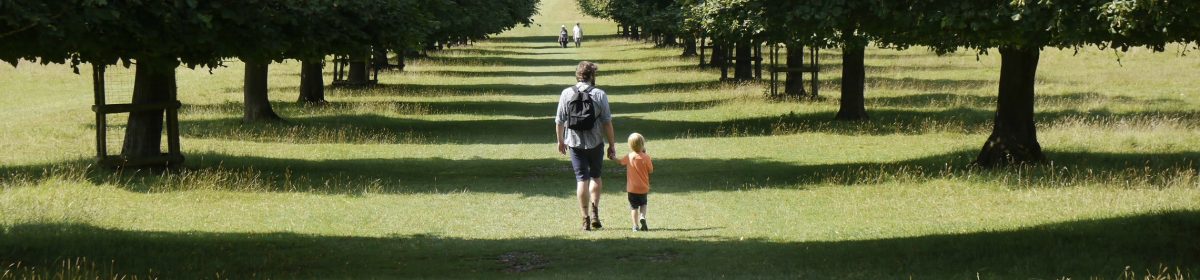
A walk on the wild side?

Luckily the threatened rain held off all day yesterday so our time with the grandchildren, while their mum was at work, was at least dry enough to go over to Dyrham Park for a bit of fresh air and subtle natural history. I’ve been going there for over sixty years – when I was young and before the National Trust acquired it I was a bit of a trespasser. I used to cycle ten miles or so culminating in a fearfully steep hill on my old gearless Raleigh bike, and climb over the wall into a different world. Much later on Madame and I would hire horses at the stables and ride through the park only more or less in control of their ill-tempered behaviour. I remember one particularly evil horse called Copper who knew every low branch in the park and took off at a full gallop hoping to unseat me. I was never a natural rider!

The field now called Whitefield was directly adjacent to the hill and the wall and so, although this is just a faint memory, I must have laid on my back there and watched the clouds passing overhead; one of my first experiences of what came to be known as oceanic feelings, although at the time I was too young to have known anything at all about Rolland and Freud – but as a result the place has always been very special to me.

Back, though, to Dyrham Park in 2023 and the creeping sense that the 21st century hunger for what the copywriters call “experience” as they tack it uneasily to any old event; has infected even the National Trust . What might once have been going to look at a garden is inflated to “Having A Garden Experience”, as if somehow the having of an experience adds a new layer of gravity and depth to it. This shift of emphasis also leads to the awful domain of the curator whose superior understanding of almost everything from art to gardens and Egyptian mummified remains compels them to lead us by the hand through the world and – where there’s not quite enough interest to it – to put the missing bits in. We buy our tickets at the entrance and get our biodegradable bag of ooohs and aaaahs to spend on the way around.

Wild Carrot

This is especially troubling in relation to nature and wildlife because being driven around a wildlife reserve behind a tractor with a rather loud commentary is in no sense a substitute for lying on your back and watching the clouds, listening to the birds and getting a Cider With Rosie view of the lowest level of plants; in amongst the roots and stalks. To be clear, there are no tractors or commentaries at Dyrham Park but some of the most lovely footpaths have been winter proofed with intensely white crushed limestone in order to direct the visitors around the park without getting their shoes muddy and – what’s worse – the edges of the paths have – in some of the busiest areas – been sown with wildflowers mixes that feature plants which would not normally be seen there. In high summer they’re extremely pretty but there’s no signage to assist visitors in understanding that this is a thoroughly unnatural display. In fact these wildflower displays might even nudge visitors into thinking that ecological destruction is not really happening because they’ve seen fields that are absolutely full of life. Yesterday we even spotted Cornflowers, alongside Poppies and other all-but-extinct pests of arable land; virtually poisoned out of existence by intensive agriculture in their natural habitat. There were huge drifts of Wild Carrot looking rather out of place but stunningly beautiful architectural plants in their more usual setting. This was a trick that the planners tried to use to greenwash the development of the riverside in Bath. Sadly, but inevitably the wildflower mix only lasted for one season and then were outgrown by the usual thuggish natives.

The awful truth is that there is just one area of genuine wildflower meadow in Dyrham Park and that’s Whitefield now fringed on two sides by a road and an expanded car park, and yesterday – after a lovely display of wildflowers and orchids in early spring – now bone dry and looking all but dead because the truth is – beyond the fences – the curated scenery of the pay to view park mocks the climate destruction and extreme weather conditions that are causing increasing extinctions of some of our most rare plants. Worse still, it’s outside the boundary of the park and is used as a dog walking area. This was brought home to us yesterday when – as we always do – we took the grandchildren to their favourite part of every trip there; playing in the stream that flows down from a spring below Whitefield, following the road down to the big house. But it wasn’t there; it had dried up completely. Whitefield looked more like the South of France in August. Notwithstanding the rain running down the windows as I write this, we’re in drought and we’ve been in drought for months.

Roesel’s Bush Cricket plus youngest grandson.

But nothing dampened the enthusiasm of the grandkids for hunting grasshoppers and crickets, and I even managed to work in a brief lesson on grass ID with the oldest. We play natural history games constantly in the hope that some of this invaluable knowledge will rub off on them. I was blessed by a Grandfather and a Mother who did the same with me and it enriched my life. I wonder if we’re not our own worst enemies when it comes to understanding and teaching about climate change. Dyrham Park, beyond the gaudy displays and formal gardens has got some really good plantlife. With three children to look after it’s hard to spend time riffling through the grass; but yesterday offered a feast of grasses apart from the usual suspects like Cocksfoot, Perennial Rye and False Oat grass. There were Timothy, and different Fescues, and some very fine grass – probably clinging on after the departure of the deer. There was Yorkshire Fog … oh and I could go on, but my point is that if we want to encourage people really to treasure the environment we need to encourage them to give the time and energy to move into a deeper slower and more personal experience of the natural world.

I used to have an inspiring teacher who taught us how to read literature better by way of what he called CAT sessions. CAT stood for close attention to text. We could spend an hour unpacking a single sentence. Natural History deserves its own CAT sessions. Yesterday I noticed something about the Wild Carrot flower that I’d never seen before. I’ll put the photo below, but if you look carefully you’ll see a red flower in the centre of the umbel. I’d never before given it the close attention it needed and when I checked it got even more interesting because no-one really knows what it’s there for. I think I must have assumed it was one of those bright red beetles sometimes known as bonking beetles. Some suggest it may be to attract pollinating insects but who really knows; but simply noticing it reminded me how poorly I often attend to the smallest details of wildflowers.

Back home we fed the children with hot dogs and afterwards the oldest told us that they’d had hot dogs the day before, and then when we delivered them back home they asked what was for tea and their Mum said – Hot Dogs. Three days running – poor souls, they must love us!

Wild Carrot – Daucus carota – plus mysterious red flower.

Here come the rogues!

Including two distinct types

So the first bunch are entirely harmless in most ways but just as a weed is a flower in the wrong place these are mostly weeds in the wrong place – that’s to say the North Quay in the centre of Bath isn’t the place you’d expect to see clifftop and ancient meadow specialists. But walking along the river just now is a continuous surprise, for instance I’ve never seen a corncockle in its natural habitat – there’s a clue in the name – and as for ragged robin, one of my favourite wildflowers I associate it with boggy ground in West Wales and on Mendip but not next to the bus station.

Now I know that there are many purists who think that these artificial wildflower mixes somehow ruin the ‘purity’ of the local environment – and you can see their point – except that short of seeing them in the wrong place you’d be pretty unlikely to see them at all. Why not a bus station? – if it keeps the species going surely that’s better than letting it become extinct because they’ve turned its favourite habitat into a car park. I’ve been fascinated to see what’s survived and what’s passed into oblivion over the last three years, and the sheer diversity of plant-life on the river bank makes a glorious picture in the sunshine. Sadly I think some will not thrive in this turned over soil and the nettles and docks are not going to give way to their more fragrant and colourful new neighbours. Perhaps this would be a good time to put up signage to introduce walkers to some of the newcomers. I was honestly flummoxed by the corncockle, for example, because I’ve never seen it before and it was just as beautiful as an unexpected non-native introduction because it’s virtually extinct in the wild. So rogues, but the kind you can develop some affection for.

Walking through Bath today we could see that, notwithstanding all the scientific advice, the streets are slowly coming back to life; and you have to wonder why this is being allowed? My own darkest fear is that the Covid 19 pandemic is being used as a kind of distraction burglary and what’s being stolen is the environment, the air we breathe, the water we drink and the food we eat. What’s being stolen is job security, education, care in the community and a hundred and one other supremely important things that are regarded as profit sapping extravagances by the powerful, and if they get their way we can wave goodbye to any chance of dragging the earth back from destruction.

That corncockle is almost extinct because of what’s been done to its natural habitat. In fact you could say that the wildflower seed mix so beloved of architects and town planners is- ‘though it might be keeping the species just about alive – no more than a bit of idle greenwashing. Playing the fiddle while the earth burns. The same could be said of so many artisan extravagances and consumer distractions.

the more dangerous kind of rogue wears a suit and tells you what you want to hear while he’s draining away your hopes and selling them off to the highest bidder

There’s a very well thumbed copy of Naomi Klein’s book “This changes everything”. It’s so well thumbed, it looks as if I’ve had it for years, but it’s almost new. The truth is it’s so alarming that I can only manage a paragraph at a time and so it’s aged prematurely while it fuelled my anger and despair. And that’s the problem. Despair is their tool! It’s really not impossible to imagine a world in which we made things we needed for real, and made them so they’d last. I’ve got a large Pyrex bowl in the kitchen in which I’ve been proving bread dough for over fifty years. It’s scratched and dull from continual use and yet I’m so fond of it I treat it like an old friend. I’d be heartbroken if anything ever happened to it. I don’t feel poor; I don’t feel ashamed that I wear a pair of shoes until they pretty much fall apart; I don’t feel ashamed that I can sew a button on, or that we buy quality clothes because they last for years and pass through from ‘best’ to ‘OK for the allotment’. I don’t need a big car to prop up my fragile ego.

While I was writing this I wandered into the kitchen and saw a drug deal being conducted right in front of me on the street below. Both dealer and customer looked like rogues, but the more dangerous kind of rogue wears a suit and tells you what you want to hear while he’s draining away your hopes and selling them off to the highest bidder. Farmers and fishermen alike have been conned into thinking that leaving the EU would allow us to protect our own. It can’t do that because the World Trade Organisation is set up to make it illegal to protect our own.

Covid has taken our attention away from the environment – the hottest, sunniest and driest spring for many decades has been taking place. Levels of pollution have dropped – this isn’t rocket science! – but if we go back to the way things were they will rise inexorably again as they have in China. Covid has taken our attention away from an economic system that has served the wealthy for so long, but is now collapsing under the weight of its own contradictions. We haven’t got one big problem we’ve got several and time is running out.

Some silver linings

Well we’d better make a start with these early risers – just a dozen of the wildflowers – don’t say weeds – flowering this morning on the riverbank footpath.  We took ourselves out for an hour in the fresh air today, fairly certain that we were maintaining our social distances in the required fashion.  The only downside seems to be an increasing tendency for young people to look rather suspiciously at us as if we were causing the problem rather than being the principle victims.  You can’t blame them I suppose, they’ve been repeatedly told that we stole their pensions – a bit of larceny I don’t remember at all – someone else must have taken my share! On the other hand the sight of a man crouching amongst the weeds may have led them to conclude I was about to expire and reminded them of the admirable advice in the parable of the good Samaritan, that’s to say – to pass by on the other side.

So this year I fear my botanising will be largely confined to these local wild and weedy thugs – aside from a trip to Whitefield meadow at Dyrham Park where with a bit of luck we’ll find the elusive orchid whose name I’m not even going to mention. The riverbank was reseeded with wildflower mix a couple of seasons ago, following flood prevention works, and although it looked quite pretty for a while is just didn’t look right.  It was a jumble of wildflowers from quite different habitats including a few poppies. As I’ve mentioned several times I’m reading George Peterken’s marvellous book “Meadows”, (£35.00 and worth every penny), anyway he mentions in passing something that demonstrates exactly why the wildflower mix looked so wrong – there were poppies in it and poppies are arable weeds.  In fact he says that there are no red flowers in flower meadows at all. I’m in no position to verify that nugget, but it sounds exactly right and completely underlined why the riverbank attempt at flower meadow flora was a bit – well, out of tune.

What’s more to the point, though, is that these expensive usurpers didn’t, probably couldn’t, last the course.  They arrived in an alien environment; out came whatever passes for banjos and shotguns in the plant world, and the locals simply shouldered them out of the way as if they were old people in the queue for toilet rolls. The burdock that I was so sad to lose to the bulldozers and excavators has reasserted itself in its old home and the whole stretch of the river bank is restored to pretty much the way it used to be. Weeds!  How long, I wonder, before public pressure is brought to bear on the council to get the strimmers out?

More silver linings for the family.  The almost complete disappearance of tourists has led to a crisis in the holiday rental market and so suddenly, overnight, there are flats available for short term rent and our youngest son has found somewhere to live. Our middle son has just heard that the government is subsidising wages up to 80% – which will be a lifesaver in the catering industry where thousands have been laid off already.

But yesterday I spoke to our oldest, who is a teacher, and he was able to tell me about the traumas that students and teachers are experiencing when relationships that have taken years to nurture are suddenly ruptured. Young people have no idea how they will cope with the postponement of public examinations and they are quite properly distraught at being cut adrift at this crucial time in their lives, not knowing what lies before them.  So he’s going to be working harder than ever to make sure they’re safe, properly fed and cared for. When you read about the schools being closed, remember that teachers aren’t going to be enjoying ‘garden leave’ but struggling to keep the show on the road. My advice is not to crack jokes about the ‘long holiday’ if you want to continue to enjoy your own!

There were crowds up at the allotment today. We were too emotionally exhausted to do much but the weather looks fine for tomorrow so we’ll have a day with as little stress as possible. To adapt a quote from Churchill, who seems to be on everyone’s’ lips at the moment –

The government can always be relied upon to do the right thing – after they’ve tried everything else!

Records played, updated and broken.

It was always going to be the hottest day of the summer so far, and so we agreed to give the (shelterless) allotment a miss.  The thunderstorm on Monday night had given the ground a real soaking, in fact we went to bed and then got up again at around half past midnight as the first growls of thunder got underway. It was the oddest storm I’ve ever watched – there were no lightning bolts to be seen and yet the sky was as bright as day each time there was a flash.  When I was a child I took part in a survey where I had to count the time between the flash and the thunderclap and send off other bits of information on a postcard, but if I’d been doing the same survey on Monday night I’d have had nothing to write.  The thunder was – well – thundrous and almost continuous, and when the rain eventually got underway it was very very intense.  People were out on the Green whooping and running around and at the back we could hear cheers breaking out. The sheer oddity of the storm had turned it into a comunity event.

IMG_2163So no need for watering and far too hot to be doing any jobs on the allotment we elected to walk up the river and along the Kennet and Avon Canal to Bathampton. We’re very fortunate to be able to walk right across Bath without leaving the footpath (bar crossing a couple of main roads). We got to a point opposite the railway station where the heights of the many floods that have affected the river are engraved on the plinth of the footbridge.  Some of the floods were way above our heads, and if you’ve ever seen the Avon in flood you’ll know what a scary prospect that would be. The canalisation of the river has always been a main source of the floods and in the last couple of years an artificial flood plain has been built in the most affected area.  Sadly (as per normal) the native bankside flora was stripped out by the diggers and a pre-seeded carpet of so-called wildflowers was put there to replace them. Do architects and civil engineers ever actually look at wildflowers?  `The resulting mess that extends along the length of the ‘improvements’ comprises plants from every corner of Europe except this one and it looks either stupid or downright ugly – depending on your mood. A much loved and reliable crop of Burdock near the road bridge has been replaced by a chocolate box mix of intense reds and blues that don’t belong, and the saddest thing of all is that the majority of passers-by probably don’t even notice. Flooding, environmental destruction and heatwaves are all part of the same massive challenge and the mainstream political parties here just don’t get it. Enough!

By the time we got to the station we realized that a walk up the canal was going to be far too uncomfortable and so we took the short cut through town, opened the windows and pulled the shutters across and while Madame dozed I wrote for a couple of hours.

In the evening a workshop on Polygonaceae (that’s Docks, Sorrels Knotweeds etc in plain English).  Sadly , and probably due to the 32C temperature, the attendance was a bit disappointing  – well there were two of us.  I was slightly outgunned by the workshop leader and the only other participant who was a County Recorder and who could easily speak a sentence where I could only understand the conjunctions. However I quite enjoyed it and while they argued about promiscuous hybridizing I got on with it and looked at the samples.  After a mind-numbing two hours I’d successfully identified three easy plants and learned two new terms, which I count as a great night out. I’ll never look at a Dockweed the same way again.

IMG_5846

Mercifully, this morning it’s cooler and we’re off to do a great deal of weeding.  We have a rule on the allotments that says we can’t have a “bonfire” between March and the end of September – which happens to be the time we most need to burn weeds like couch. We’ve argued the toss about whether a small incinerator – burning at low temperature and creating very little smoke except when first lit – is the same thing as a bonfire. But rules, apparently are rules and so we must bag up  our noxious weeds in plastic sacks (obviously we compost almost everything), and drive them to the tip, engine idling while we advance a metre at a time in the queue. There they will be bulldozed around the bays and loaded into huge lorries when they can be driven either to landfill somewhere miles away, or to Avonmouth where they can be – wait for it – burned in a brand new incinerator.  Ah yes – that’s going to save the world!