The weather in Cornwall has been pretty terrible since we’ve been here, but we’ve managed to get out for a walk on most days. So far it’s always culminated in rain, and most of the time it’s been blown in by storm winds. Last night it was so strong I could make out the somewhat orchestral sounds of the timpani as waves crashed into the cliffs and the shingle harbour below us, then there was what Matthew Arnold called “the melancholy soft withdrawing roar” of the waves retreating from the shingle beach; clattering and sharp, more brassy than soft last night, like a chorus of a thousand stonechats – and then the woodwinds battering and flickering around the windows searching for gaps to whistle in. There are times when we miss being in the campervan, but not last night. Yesterday morning we tried to walk across to the Caerthillian valley to do a botanical reconnaissance in preparation for another visit in spring, but we were beaten by the cold wind and retreated to the pub for fish and chips. Then I spent the rest of the day researching how so many rare plants manage to survive the soil round here, with high levels of magnesium (poisonous to most plants) low levels of nitrogen, and low levels of calcium. It turns out that the magic trick is to grow in conjunction with invisible underground fungal networks which have almost magical powers to search out water and convert the dodgy soil into food for the plants while blocking the baddies in return for a share of the plants’ photosynthesized sugars. It was an afternoon well spent I think, leaving me excited that at the very core of nature lies millennia of cooperation. The rarities simply couldn’t exist without each other.
Naturally the Lizard, beautiful though it is, is not the center of the universe and elsewhere, politicians are busily trying to reverse that process of mutuality and convert our once rich culture into serpentine dust. You should treat that last sentence as a metaphor. The current news is as depressing and disturbing as it could possibly be. I’m very used to seeing the degradation of Cornwall through neglect, but that attitude which was so apparent in the past where it was said that at the bottom of any hole you could find a Cornishman, but it was rarely mentioned that at the top there was almost always an Englishman stuffing the money into his pockets. Now the contagion is spreading through the whole country as decades of neglect through profiteering are too obvious to be covered up by corporate or government doublespeak. There’s an ugly mood afoot and it’s growing so quickly that even a quiet stroll down a quiet seaside lane is compromised and diminished by fearful thoughts of the coming storm.
A little list
Montbretia (Crocosmia), Winter Heliotrope, Hart’s Tongue fern, Tree Mallow, Pellitory of the wall, Common Gorse, Foxglove, Sea Beet, Nettle, Black Spleenwort, Alexanders, Sea Radish, Purple Dewplant, Sea Carrot, Hottentot Fig, Bramble, English Stonecrop (17 species)
When we say that the Lizard is one of the most biodiverse places in the country, that little (and very incomplete) list is only the beginning. I’ve seen many of them in the centre of Bath, and the seaside specialists pop up along the whole of the west coast. But this was just a brisk fifteen minute walk in the rain alongside a lovely Cornish hedge. If we had time and a great deal of patience we could find over 900 in just this small area. You can rightly feel as if you’re touching a great beauty here.
How to flourish and live beautiful lives in a hostile world should concern us more than it often does. As nature struggles from extractive farming, chemical desolation , carbon dioxide, global heating and polluted rivers we’re neither winners or beneficiaries of all that bogus productivity. We’re the victims. We need to demand more than lowlife chicanery from our politicians, the so-called tech titans and the client media who feed us poisonous lies. Across the green from us there’s a man who’s probably got severe mental health issues and regularly bellows “The earth is burning“, sometimes for an hour at a time. He’s not wrong.
We walk into the supermarket or log on to Amazon and it’s all there; the cornucopia, the works – everything the contented human being could possibly want. Except in times of scarcity, after snow or flood or during an epidemic when the shelves are empty and then we’re angry.
Yesterday we had a light frost. We walked down the steep slope to the allotment and the sun – we are almost at the winter solstice – transits behind a row of trees low in the sky – was unable to warm the soil on any of our plot. The overnight temperature according to the trailcam was 2C.
Our culture directs our instincts to want to take control. We have come to believe that each of us – apart from losers who don’t count – is some kind of tabula rasa on which we are free to inscribe whatever we want; fulfillment, creativity, success; even new and more attractive silicone lips. If you can be bothered you can easily test my hypothesis by counting how many times the word control crops up in an evening’s TV ads. Without adequate control, we are all smelly, leaky and horribly unattractive, betrayed by our unforgivable lack of the Big C which is always available – at a price – from a retailer near you.
The sad truth of course is that by the time you’ve been programmed to aspire harder and show the world who you really are it’s too late. You’ve already lost who you really are to the expensively curated simulacrum who gloats back at you in the mirror and demands more, more, and yet more.
If allotmenteering is even remotely therapeutic, as is universally claimed but rarely actually tested; it’s closer to psychoanalytic psychotherapy than that it is to happy days in the sunshine. We are not blank canvases and neither is the earth. Just as we have no retrospective agency with our appearance or with our childhood and past history, neither has the earth. The question we have to take to each session is – “why am I as I am?” “Why do I need to take control all the time?” and for any allotmenteer, and I know this may sound ridiculous, “why do I have such a complicated relationship with this patch of earth?” Why do weeds upset me so much? Why do I have this boundless fear of rats but not – let’s say – hedgehogs? Why did I feel I had to destroy anything that occupied my [?] allotment when I moved on to it. Why am I so obsessively protective of its boundaries? Why do I want so much to kill pests. What is it about badgers that I like most of the time, until they eat my sweetcorn?
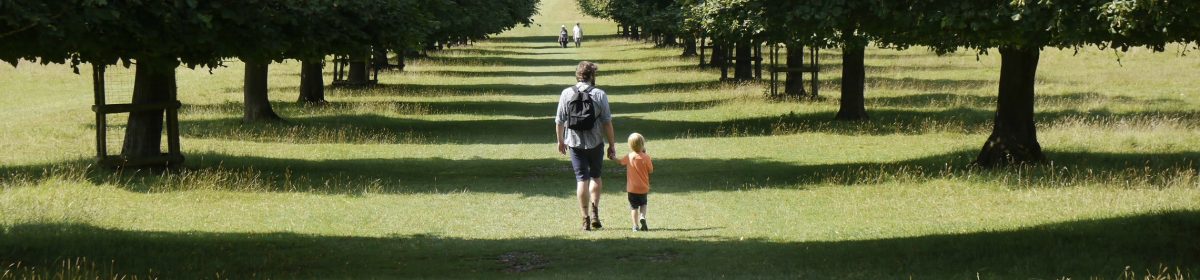
If you look at the photograph at the top of this post, you may recognise one of the the tracks up the Blackdown ridge on Mendip. If by some mischance you were to inherit this lovely patch of earth you could decide to grow almost anything. You could decide but you wouldn’t succeed because this land has history; millions of years of it. Once upon a time it was at the bottom of the sea but now it’s at the top of a range of hills. The point where I stood when I took the photograph is above a deep layer of carboniferous limestone, and likely way under your feet there are still undiscovered cave systems. Rod’s pot, Read’s cavern are entered just beyond and below the horizon. Walk on half a mile and (unless you know your plants) you’d never know that you are standing on a cap of acidic sandstone. What will grow on one substrate won’t grow on the other so none of your controlling instincts will prevail. You’ll just have to go with the soil.
Our allotment is on the kind of soil called “clay loam” – we easily checked that with open source maps. This soil – when it’s in its natural state – will bind together in a ball due to its clay content. It’s naturally quite fertile but it can be hard to work when it’s dried out and you shouldn’t trample all over it when it’s wet. This immediately suggests working the allotment in beds, sufficiently narrow to reach from both sides. We also built deep paths filled with wood chip to drain away surplus water. We even tested the soil for pH – it was somewhere near the middle between acid and alkaline. Vegetables have strong preferences regarding soil types and where they prefer to grow. It sounds complicated but the point is that you can’t raze it flat and then flip through the seed catalogues hoping to grow anything you fancy. You have to negotiate if you don’t want to fail. We’re in a frost pocket at the bottom of a steep slope; that’s a problem. On the other hand we’re sheltered from the prevailing South-westerly winds by a row of trees. The plots at the top get a lot more sunshine but their sheds regularly blow down. We have to carry everything down a narrow path to our plot, but we’re pretty well out of sight from the main track which makes it so much easier for compost deliveries and thieves. Control is a fantasy when it comes to growing on an allotment. We can’t order the weather, put up notices to forbid allium leaf miner or asparagus beetle, or plan surpluses of apples which might, like this season, bless us and in others fail to appear or suffer from codling moth.
What goes on invisibly and under the surface of the soil is almost miraculous. Some thuggish plants will even resort to subterranean poisoning to get their own way while tiny nematodes and the smallest slugs can chomp away at the roots of your vegetables: …. “And little fleas have lesser fleas and so ad infinitum!” 95% of plants apparently have fungal relationships; none of these are visible to us, but their invisibility can’t make them invulnerable to the onslaught of chemicals we use to assert our control over pests and diseases, and I saw in the newspaper today that climate change and global heating are dramatically increasing the spread of pests and diseases, not to mention extreme weather events; storms and heatwaves. Fungicides and pesticides with artificial fertilisers have wrought havoc with the soil structure and depth. The earth is not a blank canvas and we can’t do as we please to it without compromising our own existence.
I recall a couple of farming proverbs that we’d do well to pay attention to:
Live as if you’re going to die tomorrow, farm as if you’re going to live forever
The farmer’s boot is the best fertilizer
If allotmenteering is therapeutic at all it’s in the way that it teaches us a kind of humility – the root of the word refers to humus the condition of the earth, the soil. Don’t try to control; accept, even embrace failure and success as two sides of the same coin. The urge to subdue, to dominate and to control isn’t new, it goes back to the creation myths of the Old Testament as does the subjugation of Eve to Adam. We reject the second of those myths and we should equally turn away from the first.
Have you ever noticed that gardeners are often really nice people? Is it the therapy of crumbling the earth between your fingers, watching a robin feed on grubs you’ve just exposed and watching the clouds for rain ? or is it perhaps the botox injections? Hmm – that’s a tough one!
We’re back next to the Monmouth and Brecon canal in the campervan and today, walking towards Brecon we noticed that the canal is a tad shallower than usual; so much so that boats passing in opposite directions need to take especial care not to ground themselves as they move to the side. This is the place where I saw my very first Kingfisher in the 1970’s and since then we’ve camped here, paddled up and down the canal in our kayak and walked the towpath in winter frost and summer heat. Spring is the most exciting time when the banks of the canal are alive with emerging wildflowers. It’s a truly inspiring landscape – rich and still diverse with flora and fauna. Last night, over the hedge, we heard a man exclaiming to his child “look up at the tree, there’s an eagle sitting there!” In all probably it was the Osprey that’s taken up residence nearby. Hearing the man’s excitement was almost as good as seeing it for myself.
There’s a reason for the low water level and it’s a dispute about water abstraction from the river Usk which runs almost alongside the canal, and it’s between four principal parties; Welsh Water, the custodians of the river Usk, and the Canals and Rivers Trust who are now obliged to pay £1 million a year in what you might call ransom money to Natural Resources Wales whose explanation of what they actually do with the money boils down to “because we can – it’s really expensive collecting all these tithes!”.
The other litigants are the multitude of smaller environmental groups who love the river, love the canal, and the businesses which bring millions of pounds from tourism in the area and the farmers who can’t grow our food without either rain or irrigation. It isn’t a surprise that there’s a shortage of water; well not at least if you’ve read a newspaper since the middle of the last century or stepped outside your front door in the last three or four years. Droughts, heatwaves and then fierce storms are the symptoms of global heating and we’ve known for decades that this time was coming. Decades during which we could have prepared for an entirely new kind of climate.
It’s widely thought that much of the Usk water being abstracted from the river Usk is now being diverted to depleted reservoirs in order to maintain the water supply in South Wales. I did a quick Gemini search and came up with this answer about pollution incidents involving Welsh Water and here it is:
Natural Resources Wales (NRW) has recently reported that Dŵr Cymru Welsh Water was responsible for 155 pollution incidents in 2024.
This figure represents a significant increase, being the highest number of sewage pollution incidents in a decade, and a 42% increase in incidents over the last ten years. Of the total, 132 incidents were from sewerage assets and 23 related to water supply. Six of these were classified as serious (category one or two) incidents.
NRW has expressed serious concerns about the deterioration in Welsh Water’s performance since 2020 and is demanding urgent and fundamental changes to their operations. They have also pursued a number of prosecutions against the company for various pollution offences.
So the canal is being held to ransom and the river Usk is still being depleted by Welsh Water which – astonishingly – isn’t run by greedy venture capitalists but as a non-profit distributing community asset which is supposed to apply all of its surpluses to improving the environment and resources. Needless to say Welsh Water hasn’t done very well, not having built any reservoirs or, evidently improved its sewerage processing plants. The great and good appear to be standing around wringing their hands and whining that they’d like to get their hands on the people who did this. If they’d like to email me or any of the millions of fuming customers I think we could point them in the right direction. “We have seen the enemy; it is us!”
So inevitably someone will argue – it’s not the fault of the water companies if demand outstrips supply or if, as in the case of sewage supply exceeds capacity. Let’s be frank, there are a multitude of government agencies whose whole raison d’être is to plan, to supervise, to administer, to anticipate demand and to sanction the organisations under its supervision when they fall short. We, the great British public (I could have said unwashed), pay these agencies to do those jobs that can only be done at all at a large – macro – scale.
Any public body that fails to anticipate that increasing housing will require more schools, more water, more sewerage disposal, more doctors and schools whilst planning for thousands of new houses is a few sheep short in the top paddock. Any government that abolishes environmental regulations and then goes to all expenses paid conferences to boast its green credentials is asking for its collective dismissal.
Meanwhile we saw a large dead fish floating on its side in the canal today. If the water level drops too far the oxygen level will fall to the point where it doesn’t support life; the clay lining will dry out and when it’s wetted again it will break up and allow the water out. We saw it happen on the Sharpness canal several decades ago. The writing isn’t just on the wall like a piece of graffiti; it’s eaten into the mortar and the whole edifice is crumbling before our eyes. Parts of it have already collapsed on innocent victims. We grieve for the earth and feel utterly powerless whilst the politicians are still in the denial phase and we’ll be well into anger while they’re asking us all to go straight to acceptance and, by the way, would be kindly stop using so much toilet paper to save the earth. Some time. One day.
There are no winners, only losers in this sterile dispute. Large organisations cost money to run, but in return they really must do what they’re paid to do. We all need clean, unpolluted water and we all need to share in the solution even if it means making do with less. Our attitude to water is pretty depressing, wasting it without thinking and treating our sinks as somewhere which is directly joined to another world so it doesn’t matter what drug residues and chemicals go down them. We love rivers and canals and want to use them for leisure and renewal, we love wildlife, we like eating locally grown food and we like taking a shower and we can’t achieve any of these goods by setting one charity to bankrupt another.
I started this piece intending to write about some of the lesser known and interesting plants we found today. I’ll write that tomorrow – it’s predicted to be raining! Here’s a taster.
While we didn’t exactly come down to Cornwall to search for spring – after all it’s barely January – what you certainly notice is that everything’s at least a couple of weeks ahead of Bath. I listed a few early starters yesterday; none of them in flower but all putting in an appearance. So, in the depths of this grey and dreary weather I thought it would be nice to show a couple of plants from today that cheered me up no end. On the left Allium triquetrum, three cornered garlic, and on the right Poa annua annual meadow grass; both cheap as chips, common as muck and mutton dressed as lamb if you like, but lovely. I must have a slut’s eye for the local weeds.
Sea Spleenwort in Bath city centre!
My mind was actually set on higher things because I set out with a grid reference that I hoped would lead me to some Sea Spleenwort. We’ve walked miles along this bit of coastline looking for it but if it’s there it’s no more than a millimetre tall (which I know isn’t true because I’ve seen it growing in Bath). I know it was here years ago because it was recorded by an impeccably qualified botanist, so I guess it may just have died out – like so many species in these times of climate and wildlife destruction.
It’s been freezing cold and wet here since we arrived and I was thinking that if the Atlantic Meridional Overturning Circulation (AMOC) should change direction (which is a real possibility with global climate change) we shall have to stop pretending we live in a warm and temperate climate and put up with living at the same latitude as St Petersburg. At the moment we’re in denial about the effects of climate change. We dream of uninvented, uninventable technologies coming over the hill to save us, like the Seventh Cavalry in an old cowboy movie but the bad news is that they’re not there.
Maybe we focus too much on the loss to science with species destruction. OK there are a million reasons why we might need to learn from life-forms we haven’t yet even discovered; powerful drugs to be discovered and so forth, but the sheer loss of beauty that comes with species destruction is a loss to our souls (and don’t ask what I mean by “soul” because even though I couldn’t say what it is, it’s still an important intangible something which raises our humanity above the instrumental.
The weather here, even in the far South West, has been pretty awful, although not as bad as it’s been further north, but those flowers (even grasses have flowers) are a kind of token that we know will be redeemed as February turns to March and our hearts begin to thaw.
I’ve already written about our hasty decision to rent a cottage on The Lizard because we were both suffering from post COVID tristesse. We calculated – as we always do – what was the cheapest week we could get before the price doubles at Easter, and a phone call sealed the deal. After weeks and weeks of continuous rain and three weeks of COVID symptoms we were desperate to take advantage of what promised to be a dry week with occasional sunshine. Both of those qualities were abundant here but sadly we also had wickedly strong north-easterly winds which kept the temperature down to 4C but felt more like freezing. Cold enough to take your face off even with three layers of clothes, beanies and mittens. I don’t think we’ve ever known it colder here – as far South as it’s possible to be on mainland Britain. Still lovely as ever but the usually reliable signs of spring seem to have been stopped in their tracks.
My initial aim was to check out a pond. Here it is. Last year I’d come to believe that I’d failed to spot a little plant called Spring Quillwort – Isoetes echinospora – which sheds its fronds in the winter. It turned out I was wrong because if I’d taken the trouble to check I’d have seen that it’s never been recorded on the Lizard. Anyway one thing led to another and I discovered that there is another, even rarer, member of the same family which does grow here and attracts visiting botanists from all over the world. It’s an odd plant that grows in impoverished soil in temporary puddles during the winter and, in order to survive the constant drought, dies back in early summer. Our first expedition was compromised by sheer driving wind, but I managed to narrow our find down to one of two species and then decided to send a photo to the local Vice County Recorder for his opinion. He was right – I was wrong and it was Spring Squill but he’s a very encouraging kind of man and sent me a detailed map of where I could find the real deal. Short of coming and holding my hand he couldn’t have been more helpful.
So on Tuesday afternoon we set out once again, map in hand in the fierce wind to a place close to the car park to search again. They weren’t there but it’s a bit early in the year anyway. What we did notice was an enormous gorse fire running apparently out of control and very close to another potential group of plants. Cue for a strong email to the National Trust asking why on earth they were burning gorse so close to a nationally important site. To their credit the project manager emailed me back within the hour explaining what they were doing and describing “controlled burning” as one among many controls that were being trialled on the Lizard, to improve the life chances of around 20 nationally important species. “That’s great” – I thought, but the word controlled is a bit of a tricky one. You can control everything up to the point where you apply the match to the tinder but thereafter the wind will take over and from where we were standing it looked as if the flames were twenty feet into the air and travelling at speed in the direction of the footpath where the rare plants had a foothold. They wouldn’t have had the ghost of a chance of stopping it, if it got sufficiently close to the path to cause damage. Fire and flood are two of nature’s gifts that do not allow negotiation.
The project manager said that he had been present and he didn’t think it was out of control, but conceded that we might have had a better view of it. He also said that the burning had been carried out by contractors. From a contractor’s point of view a strong northeasterly, driving the fire towards the cliff would have done the job quickly and efficiently – which would have been fine if the purpose of the burning was merely to clear the ground of gorse. But the true purpose of the burn was to create a better environment for the rare plants and therefore speed and efficiency were – or should have been – subsidiary to their preservation!
My other objection would be the sheer amount of particulate (PM 2.5) matter released into the atmosphere along with Co2 and all the other noxious substances that bonfires emit, plus the release of phosphate and potash from ash into what needs to remain impoverished soil. Against that you might argue that if the contractors had waited for a southwesterly which would have taken the direction of travel of the fire away from the cliffs; Lizard village would have been inundated with choking smoke – so maybe cutting the gorse back would have been a more expensive, slower but greener alternative.
So after smoke – which we know to be a component of climate heating and lung disease – there comes ash, which is quite alkaline, quite mobile, and known to be fairly soluble in some cases; plus all of the the accumulated trace elements which – depending on the heat of the fire – can also be released. There’s an abundance of science on all this and it seems wise to err on the side of caution when it comes to these highly vulnerable sites. It’s never a good idea to let the perfect drive out the good but sometimes we need to look for a better kind of good.
Obviously, fire and overwintering insects aren’t a good mix. In a world of reliable abundance maybe the loss of a population of insects would be soon repaired. Eggs and pupae can’t get out of the way. The Project Manager wrote that expert surveys had been carried out before the policy had been adopted, but there is no denying the impact on insects and many species of bee overwintering in the earth beneath the gorse; and finally, Gorse, which flowers the year round, is a useful source of nectar at a time when there’s nothing much else around.
Now I have the greatest of respect for the National Trust and for Natural England and I’m quite sure that a good deal of discussion was expended on the variables in all this, but “The best laid plans of mice and men” …… etc are always liable to be upended by the facts on the ground, and a little humility, when the plan literally turns to dust and ashes, goes a long way. Nature conservation demands a fleet footed and occasionally improvisational approach and the problems come thick and fast when institutional inertia gets in the way. If this is an experimental project this may be a time when one part of it should be abandoned in the light of events.
First list of the year
We come down here most years for a break – usually around three weeks later than this year so we can look for spring plants.As the years go by it’s more like checking out on old friends; but there’s more than an element of looking for signs of spring – like fields of flowering daffodils near Culdrose, as they are this year. But the weeks of rain followed by this extreme cold snap has certainly held things back. I’ve come to appreciate the exuberant beauty of plants as they burst through the soil. The rosettes of Wild Radish leaves are probably as lovely as the plant gets, for instance. In particular we were looking for some small populations of Babington’s Leek that we’d recorded for the first time last year, and a wireplant that must have travelled from New Zealand via the isles of Scilly; both of which were in or near the ruined serpentine works at Poltesco. So we parked the car at Ruan Minor and set off down the steep valley, past a restored but apparently abandoned water mill and on to the ruined mill on the sea shore. What’s not to like? industrial ruins and rare plants – paradise.
So with the two boxes ticked we also looked for plants in flower and found twelve.
Celandine
Winter Heliotrope
Hogweed (unexpectedly)
Perennial Sowthistle
Dandelion
Ivy Leaved Toadflax (white form)
Primrose
Snowdrop
Violet
Red Campion
Gorse
Daisy
Admittedly we’re talking about single specimens in some cases, but that’ll do for a harbinger of better times, we need some good news. I’m not sleeping well and tormented by dreams of violence. Last night I dreamed about children in a war zone. I won’t bother you with the details. Here are some pictures of the mill and some of the plants, taken by Madame.
Postscript
The gorse burning has continued for several days, with the Fire Brigade called out at least once. Photographs on social media on Sunday showed that the plume of smoke could be seen from Penzance. It seems to me that in an age when we’re thinking twice about wood burning stoves and garden bonfires, it’s a bit rich when a state sponsored organisation (Natural England) is burning acres of gorse for any reason at all. It may be perfectly legal, but that doesn’t mean it’s sensible or ethical. One obvious possible solution is to cut the gorse back, shred it on site to reduce the volume and then compost it and/or use it for mulch. More expensive? Well who’s paying the bill for the environmental cost of the fires?
After a certain amount of unsubtle lobbying, Madame bought the final two volumes of Geoffrey Kibby’s magnum opus for my birthday but wouldn’t let me open the package until Sunday morning. She is a strict traditionalist in such matters, but then we were swept away to a family gathering before I had time to settle down and look at them. The gathering was fun but only highlighted the growing generational gulf between those who play computer games and the rest of us who treat mobiles and laptops as useful tools and prefer talking to each other. It was early evening before I was alone with the books and they are very good indeed. All I need now is a good microscope and some dangerous chemicals.
However I should point out that Geoffrey Kibby took four years to produce volume one because all the illustrations were hand drawn and painted. The subsequent three volumes were illustrated with the help of an iPad and a very good computer programme in less than two years. Sadly I left the Apple ecosystem some years ago after a contemptuous young sales assistant held up my old Macbook by one corner and declared it not repairable because it was too old. At least I think it was the laptop he was talking about! With a good deal of help from my son I moved over to a Chromebook at half the price and rather quicker to begin work.
The revelation that the illustrations were done on a tablet came as a bit of a shock because they’re so good, so I’ve bought a stylus and downloaded a free programme on to Madame’s Pixel Tablet. Work has now ground to a halt because the allegedly intuitive programme looks as if it needs a degree in computer illustration before I find it remotely intuitive. Madame thinks it would be better to keep on with pencils and watercolours.
Over the last few weeks I’ve fallen in with a bunch of Natural History desperados for whom spiders are the most beautiful creatures on earth. Their Facebook group which I was invited to join outpaces the British Mycological Society postings by two to one. So a decently obscure specimen can flatten the battery on my phone in half a day. Madame suspects me either of having an affair in code or being completely mad.
I find that the fierce concentration on identifying specimens creates a wonderful quiet space in my head at a time when what’s going on all around is feeling like living in a psychotic vision. We’ve reached the point where I have to leave the room during news bulletins and I’ve come to think that COP 28 – in fact most of the ideas being circulated about heading off a climate catastrophe is nothing more that the usual hubristic nonsense that sees us as owners of the Earth. The Earth doesn’t need us and we can’t own it -we’re just noisy, wicked and destructive tenants and although I came to understand that – generally – the bereaved don’t follow Elizabeth Kubler Ross’s stages of grieving to the letter, I can see elements of denial, anger, bargaining, depression and acceptance in abundance at the COP meetings and in most of the planning for our (very short) future. The good news – if there is any – is that all parties could be on the same trajectory; just at different places on it. In all my experience of bereavement – and there’s a lot of it – the worst thing you could say to anyone is “time to move on”. However; that doesn’t excuse wilful and deliberately destructive bad behaviour. If the Earth is our parent – and I can’t see it any other way – then the plagues we are enduring are admonitions for our bad behaviour. I’m not turning this into a religious argument because so far as I’m concerned any chatter about God is heretical because it’s (by definition) inadequate. What’s wrong with reverential silence?
The view down the valley last Tuesday morning. Sometimes the whole valley fills with clouds below us.
Fascinating though it may be to revisit the Camino journal after 13 years – (in fact I’m finding it pretty painful going) – life goes on at the Potwell Inn with the last of the tomatoes to be processed into two sorts of passata; one roasted and the other simply simmered with onion and indecent amounts of butter. It’s been an odd year, but we’ve now pretty well replenished our stores with a big crop of tomatoes from the polytunnel and our biggest ever crop of aubergines. Our only real failure was the broad beans early on and we’ve resolved to sow next year’s crop in November rather than wait until the spring reveals its hand. The asparagus bed failed yet again to rise to the occasion and so I’m afraid it’s going to come out in the autumn. It’s in the coldest part of the allotment and that may have something to do with it; but for the last three years we’ve spent out more on saving the crop than the value of the harvest and we can’t afford the indulgence. The surprise crop of the year was the Tayberry vine which gave a lovely crop of berries; and the apple trees which all fruited for the first time since they were planted.
The trip to our friends’ smallholding on the Bannau Brycheiniog (Brecon Beacons) was partly to celebrate Madame’s birthday and partly because it’s a joy to spend a few days there with our friends. There’s always work to do on a smallholding – fencing, feeding animals and suchlike – but this time we helped to butcher a couple of two year old sheep (AKA mutton) which had just come back from the slaughterhouse. Vegetarians may prefer to look away now but as a meat eater on a modest scale, I have no moral difficulty with eating organic, free range sheep whose lives are entirely natural and whose lifetime travel takes them just ten miles to a local slaughterhouse.
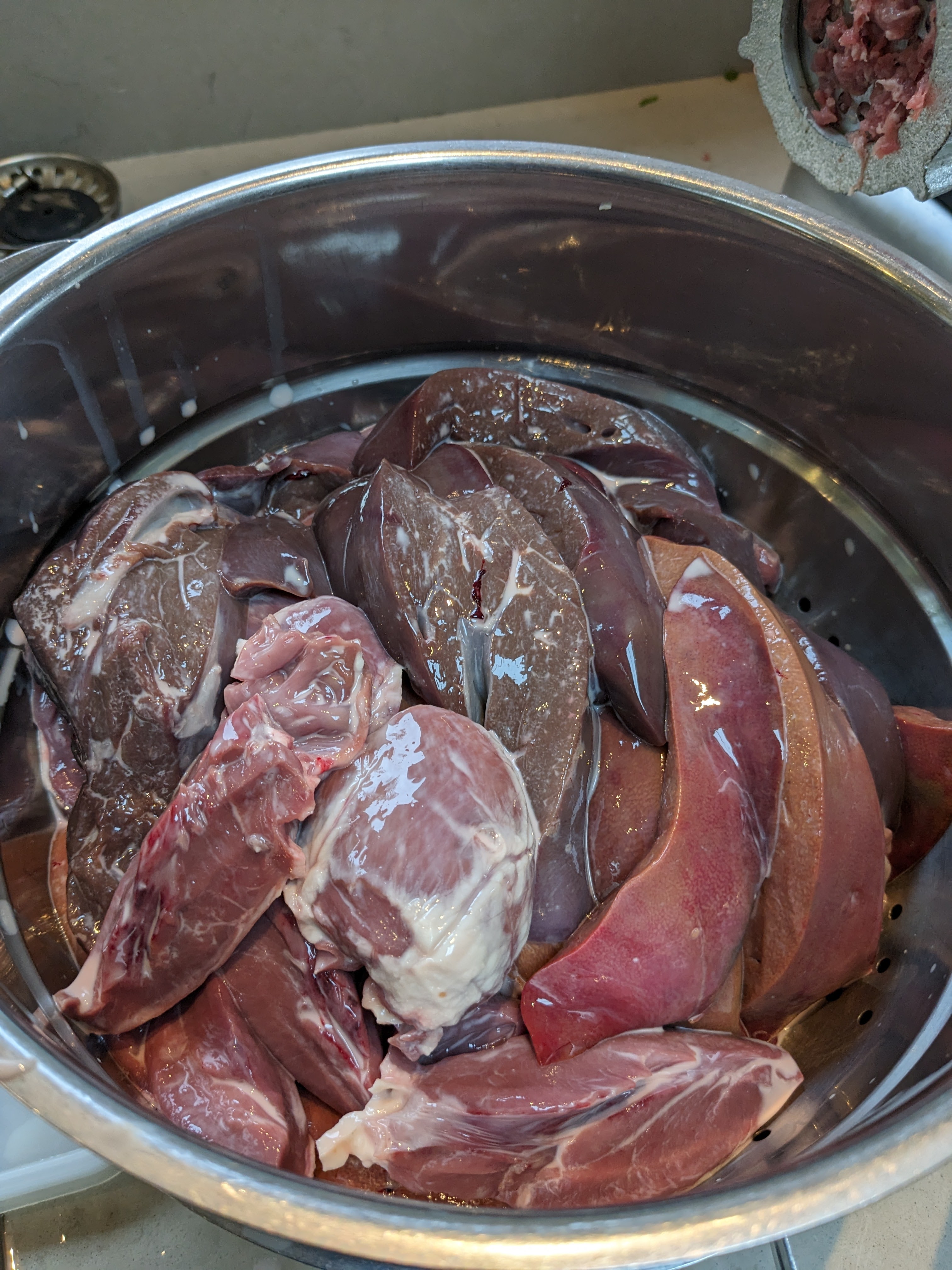
Butchers – I mean real butchers – are highly skilled at what they do. As for me, confronted by a quartered carcass, it was a matter of trying to remember where all the joints come from and what they are supposed to look like. Three of us worked as a team in the kitchen and reduced the carcasses to joints, cuts and mince and enjoyed playing silly games whilst avoiding chopping our fingers off. Then we made a vast pot of stock and boiled all the bones down while Nick and me made trays of faggots – that may need translating for some readers – basically meat patties made from all sorts of offal; we only used the liver and hearts. By the time we’d finished we had four leg joints, four shoulder joints, 15Kg mince, 4Kg diced, 4 hocks, fillets for stir fries, leg steaks, racks, whole loins, 32 faggots in gravy, a gallon of stock and 36 blocks of dog food using every left-over scrap of meat from the bones.
I always feel, when I’m writing like this, that I should explain or defend hill farming and the killing and eating of animals. There’s no denying that intensive farming is the source of terrible cruelty and much avoidable pollution; but to equate what goes on in a 20 acre hill farm with what happens when two million chickens are crammed into sheds is a bit of a debater’s cheap shot. I go back to Michael Pollan’s wise motto – eat food, not too much, mostly vegetables. The consumption of ultra processed foods has been shown to be the cause all manner of illnesses and, if we all took to eating ultra processed vegetarian and vegan food we’d soon be totally enslaved by the gathering disaster of the food industry’s war on healthy eating, quite apart from swelling the profits of the industrial grain giants and the growers of palm oil and soya beans. Of course the killing and eating of animals raises all manner of ethical issues but we’re far too prone to exporting the hard questions as far away as possible. Buying your meat shrink wrapped and trimmed doesn’t detract from the big moral question of killing it in the first place. The taking of life is a big deal and so we should try never to eat more than we need, and endeavour not to waste any part of it.
We came home to the Potwell Inn with meat for the winter; we had dined on the freshest eggs you’ll ever see and we also brought a fleece back. Kate has used them for weed control, composting and also for lining hanging baskets. Nothing ever goes to waste on the smallholding. We’ve known them for over thirty years and from day one we treasured our fellow inner peasants. It takes a certain kind of personality to get so much pleasure from shaking plums out of a tree. I also fell in love with their Welsh terrier Dilys and proposed to her secretly but she rejected me, saying she was already suited.
Anyway, that was a long day and the following day we gathered plums, identified moths from the overnight trap and baked bara brith. Moths are attracted to a strong light and then they drop down into the depths of the box where they find egg boxes to spend the night before being identified and released in a manner that minimises the risk of them being eaten by birds. The wall outside the kitchen is used for feeding birds throughout the year and it’s fascinating to see the variety – most of the tits, nuthatches, robins, yellowhammers (increasingly rare) and finches too. At night we listen to the tawny owls and in the early spring there are cuckoos – it’s the last place I heard one, four or five years ago; pure joy. A family of field mice live in the crevices of the wall and pop out nervously from time to time to grab some grains.
Then finally, before driving home, we had a dip in the pool; filled with rainwater and warm from the combination of sun and solar panels. Paradise indeed!
You may disagree, but for me this gall, growing on an old enemy to any farmer or gardener – Creeping thistle – is exceptionally beautiful. It suggests a tiny Baobab tree. If you were interested to Google up the fly itself – named on the caption – you’d see that flies too can be very pretty; these are called Picture Wing flies and I’ve never seen one, so there’s still plenty of wildlife for me to look out for.
I wrote a few weeks ago about the sowing of wildflowers along the edges of several paths in the grounds of Dyrham Park. I have to question my reasons for disliking out-of-place wildflowers because I’m quite sure that a kind of covert “wild-ism” can establish itself and become a brake on wildlife conservation. With global and disastrous heating of the climate; we’re certain to see many of our native species disappear and be replaced by migrating plants moving north to escape from the heat. We’re going to have to learn to welcome all sorts of human and non human strangers here and we’re going to have to learn to say sad farewells to old friends if we’re going to regain the earth as a friend. We’re also going to have to accept that when every news bulletin features the latest out of control fires across the world it’s we who are responsible. There’s no future (really!) in treating climate disaster as an abstract concept – we have seen the enemy – it is us!
I said at the time I wrote about this, that I thought many of the artificially seeded wildflowers would look lovely for a season and then fail to thrive and for once I’m sorry that I’m right, because it’s happening already and the thugs are reasserting themselves in a big way, and chief among them is the Creeping thistle. Yesterday in Dyrham Park the National Trust was deploying volunteers to cut them down. Truth to tell, the only way to control them properly is to pull the young plants out by hand, roots and all. The game volunteers were working with strimmers and sickles in a snowstorm of thistledown and undoubtedly this pernicious weed spreads viable seeds; but it gains control of large tracts of ground by spreading by rapidly growing roots which, like Bindweed, can regenerate from small fragments. Alongside the newly laid paths which, a couple of months ago were covered with wildflowers, the Creeping thistles already reign supreme in the overly rich and recently overturned soil. Re-establishing wildflower meadows is the work of decades. Meanwhile the Hogweed is showing the door to the Wild Carrot and a few poppies struggle to flower. Our son’s partner muttered that “they’re all weeds as far as I can see” and she’s right.
But aside from grumbling about missed opportunities; something else has been on my mind. A couple of days ago I mentioned Geoffrey Hill, the poet and writer of a poem sequence entitled “Mercian Hymns”. I was musing on what a strong sense of rootedness in a landscape means whilst reading “On the Black Hill” by Bruce Chatwin. I first read Geoffrey Hill maybe fifty years ago and although I loved Mercian Hymns I didn’t really understand the poem. This brought back to my mind one of those turning point memories from decades back. I was having real problems with the choir in one of my churches. There’s no getting away from it, they hated me with the kind of hatred that thrives like the creeping thistle in the virtuous people of the church when they’re not getting all their own way. So in a last ditch attempt to get them to cooperate, I enlisted a friend – a great musician and conductor who was struggling to teach me to play the piano – to come and run a rehearsal for me. The choirmaster had, by this time, walked out. Imagine this choir as a group of surly sixteen year olds in detention on a hot Friday afternoon. They were not going to cooperate even if the roof fell in. So we struggled on for a while and my friend suddenly marched across the chancel; tore the hymn book from the hands of one of the ringleaders of the rebellion; threw it violently on the floor and shouted in her face – “For goodness sake forget the notes and look for the music!” That was pretty much the end of the choir, but soon I recruited musicians and singers; learned to conduct and passed my music theory exams so I could engage with them on more like equal terms.
It was a thrilling intervention that, this week, suddenly helped me to understand what I was doing wrong with Mercian Hymns. I had been struggling to understand the words but failing to find the music. So I immediately searched and found a second hand copy of the poems for £8.00. It arrived on Wednesday and I found that it was speaking to me in a language I could inexplicably understand. When the book arrived I tore open the package and at once saw the cover. It was Paul Gauguin’s painting “The Vision after the Sermon”.
I have to pause here and take a deep breath because this Old Testament story about Jacob crossing the Jabbok brook is immensely important. You can read it in Genesis chapter 32 if you wish, but you don’t need any faith at all to learn from it. Jacob is making a life-changing journey into a new life; leaving his family and everything familiar behind. He crosses the river and spends the night wrestling with an angel, demanding a blessing from this mysterious being. The angel gives him the blessing, but injures his hip at the same time. Psychoanalytically, this is about as important a story as they get. Carl Jung spoke often of our wounds as being integral to our creativity. We work from them; we grow from them. But the story goes further because it tells us that creativity and generativity are a relentless struggle with forces we barely understand. If you’re a writer or an artist; if you’re a farmer or an allotmenteer or a parent or if you wish to live a virtuous life seeking justice or compassion, you are going to have to wrestle with the angel, sometimes all night, and even at the cost of getting hurt – demand that blessing and live with the consequences.
So where does that leave us with the Creeping thistle with its very own gall? Where does it leave us with weeds and disappointments and failed crops? Where does it leave us when we confront injustice and inhuman behaviour? Where does it leave us with loss and gain?
Well, it leaves us exactly where we are already but suggests that the only way forward will – almost always – come at a cost. We need the kind of honesty that tells us – this is going to hurt – but it’ll be worth it in the end.
The lake at Upper Treginnis today. It looks as if somewhere between 300 and 500 cubic meters of water have been pumped.
The same lake in September 2022
Musk Thistle
There’s a walk we do when we’re in St Davids and it takes us past a small lake – almost certainly dug for irrigation years ago. Since we’ve been coming here it’s been one of those dead cert places for all sorts of wildlife, with a large population of dragonflies, damselflies, birds, insects and marsh plants. It is (or perhaps was) surrounded by several organic farms. Today as we walked past we saw one farmer tilling two fields of old pasture. Our favourite mushroom gathering place was tilled and planted up with rye and another field, badly infested with Musk Thistle had been sprayed with some kind of weedkiller. Worse again, the pond had been drained of 2/3 of its water and apart from some insect hunting reed warblers and a few Wagtails had become a ghastly eutrophic puddle, thick with blanket weed; and what had been the point of all this water being pumped out? – as we continued our walk down to the beach we spotted the reason; several fields planted up with thirsty potatoes. Elsewhere other once-thriving pasture fields were dried out and worthless.
I think this is Chicory sown in the herbal ley mix at Upper Treginnis last year – no longer to be seen in the drought afflicted meadow
I can see the dilemma for the farmers here. This is a very small area with a rich flora and fauna and difficult soil most suited to pasture used mainly in the past for sheep. The government have been completely hopeless in supporting these marginal farms which could, and should, be kept as biodiversity hotspots, and I’m not sure that many farmers either understand the new ELMS environmental subsidy scheme, or indeed trust the government to put enough money into it. Let’s be clear; supporting the environment isn’t a plan for entertaining wildlife enthusiasts it’s essential for food production – for pollination for instance but also to support the incredibly complex food chains where, if one link fails, the consequences can be dire. Nobody is arguing that all agricultural land should be returned to the so-called wild – it’s more like saying if you polish your car every week but never service it or maintain it properly it will break down. Farmers land up trying to pay off the bank with dodgy cash crops; gambling against the system to save their land.
Anyway, that’s enough – there are many interlinking problems here. Farmers are forced into growing the wrong crops because doing the right things would lead them inevitably into bankruptcy; the climate is changing so rapidly that extreme events are becoming almost commonplace; and when food is treated as a commodity, prices are driven down by supermarkets and farmers suffer. I remember an alarming conversation with a retired grain dealer who explained how it was possible to make fantastic returns by harvesting subsidies as a crop was loaded onto a train and passed through several countries without ever being unloaded. Producers and consumers are the innocent victims of this profiteering.
The net result is a rather depressing walk through a once favourite wildlife hotspot. Happily we still managed to find a lovely little Marsh Bedstraw – Galium palustre and the Musk Thistles rising from their chemically damaged rosettes; but the drying out of the pool has allowed hordes of Hemlock Water Dropwort to germinate which, if they continue to thrive, will be a menace to cattle. All this is a part of the rapid march of global heating and environmental breakdown coupled with an inexcusable profiteering food chain. Broken politics makes everything so much worse. Anyway here’s a photo of the Marsh Bedstraw – nature abhors a vacuum! Last night we celebrated our arrival with several bottles of wine and listened to all our favourite music as the sun set and the moon became visible high in the darkening sky. We slept well!
The endlessly adaptable Mexican Fleabane – Erigeron karvinskianus spreading along our street year by year
Phew what a scorcher! – says the sub editor for the 10,000th time
The Met Office defines a heatwave as a period of three days or more when the temperature rises above the expected. So no argument then! we’re in a heatwave; something I guess most of us in the UK would have known without the benefit of the definition. However, definitions sometimes throw up potential problems such as this one. In a time of global heating what’s expected? Upon what form of statistical calculation is that decision made. Is it the average temperature? the mean temperature? – and what happens when the temperature is rising year on year? Even if the mean June temperature is calculated over the past five, ten or even fifty years, it will surely rise; and at what point will the media be dutifully reporting a cold snap because the mean June temperature falls below a level that we’ve become wearily accustomed to. Maybe we need an alternative way of expressing the impact of temperature rises – for example excess deaths; the effect on crops; the price and availability of food; the water levels in the reservoirs; pollution in rivers as the reduced dilution effect of dry weather gives the game away ?
Of course, what we usually do in the real world is lament the idiocy of politicians who are too cowardly to address the crisis, and get on with it as best we can. Here at the Potwell Inn we’re getting up early and going to the allotment soon after seven o’clock so we can get three or four hours in before it’s too hot to work any more. Some jobs are much harder – for instance setting out young plants when temperatures are likely to rise to 30 C (86 F). They need intensive care from day one. The simplest manual jobs like tilling a bed or raking in compost or fertilizer can be exhausting, and watering becomes a test of stamina. At its worst I can walk 10000 steps between the water troughs and the allotment.
But there’s an upside too. After a seemingly endless winter in our flat we both felt thoroughly seedy and out of condition, but now we’re suntanned and as fit as fleas. Allotmenteering is both a physical and also an intellectual challenge – trying to predict what might happen next. I suppose you could say it resembles sailing, inasmuch as reading the weather almost becomes an obsession. We look to see where the wind is coming from. South westerlies can be warm but they also bring rain in from the Atlantic. A cold easterly can decimate fruit blossom and kill tender plants – we lost our Tarragon and Rosemary as well as an established Clematis during the winter and any heavy rain or snow can be destructive of plants or netting. It’s no use thinking “I’m not going out in this” because staying in might cost you your crop or your nets.
So we don’t feel in the least downhearted about this heatwave because, like the Mexican Fleabane in the photo, we can – if we work at it – adapt to all manner of changes. Don’t for a minute imagine that I’m saying we can adapt ourselves out of catastrophic climate change without changing our whole lifestyle. What I am saying is that being hard-up for most of our lives, being prepared to keep the household just about going by earning a living wherever it’s possible is a great training in resilience – I’ve washed up in a hotel, driven buses, been a rather poor welder, a groundsman, a night cleaner in a factory, worked nights on my own in a rat infested factory sawing large blocks of polystyrene foam into sheets, and worked in a prison and a couple of old style mental hospitals. I can cook, clean and grow stuff and of course I worked as a parish priest for 30 years and I think I learned a great deal about being human or how not to be human. Madame has a very similar skill set and so we muddle along contentedly together, knowing that a good life doesn’t depend on having a Range Rover.
I’ve been reading a short article by Prof Massimo Pigliucci in “Philosophy Now” which I picked up from a newspaper stand before I looked at the price. Anyway the article lists six ethical ideals shared by almost all the world’s faiths. This is a long way from religion in the commonly understood sense. These values are:
Practical wisdom
Justice / morality
temperance / moderation
fortitude / courage
Humanity
Transcendence (gratitude, hope, spirituality
This group of dispositions broadly represents what’s usually called Virtue Ethics. To risk simplifying the idea so much it becomes a parody, these kind of dispositions, when internalised and lived out in everyday life, are the most effective guidance we have for flourishing – not for getting rich, or amassing honours and power but simply flourishing, being / becoming human. When you think about it it would be hard to express a better wish list for gardeners, nurses, or so-called captains of industry.
There’s a kind of grim satisfaction in knowing that when the climate catastrophe finally strikes us, the wealthy can only hope to buy a few more years of absolution from the bletted fruits of their behaviour before they realise they’ve got no talent for being human and no skills to change themselves. The snake oil salesmen and the invisible Seventh Technological Cavalry will have fled, and their last moments will be spent howling at a blackened sky like Violet Elizabeth Bot “I’ll thcweam and I’ll thcweam and I’ll make mythelf thick!”