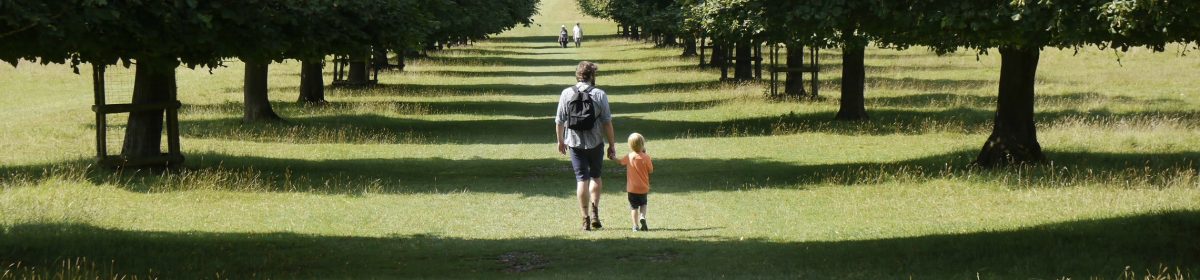


Last summer we made our first trip to Cumbria, driving from East to West across the country, very roughly following the route of the Coast to Coast Path. We stayed for a week in Ravenseat in a cottage that was actually on the path and then we moved on West, picking up on the A5086 at Cockermouth, through Frizington, Cleaton Moor, Egremont, Calder Bridge, Gosforth and finally Ravenglass, within sight of Seascale nuclear reprocessing plant. Although we’d never been to the area before, somehow the names of these villages seemed familiar and after a while I remembered why. They were, or rather had been, mining villages. Both coal and iron were mined there – the perfect combination for driving the industrial revolution. But not any more. It was quite depressing, in truth; there was a terrible air of dereliction hanging over the villages. They looked sad, run down and depressed. There were many posters demanding brexit, St George flags – big ones – mounted on aluminium flagpoles at no little expense. Even a large sign outside Seascale announcing that we were on the “Energy Coast” seemed more ironic than triumphant.
If ever there was a living example of the coming crisis it was here, and I haven’t been able to shake it out of my mind since the summer. The results of the general election have only brought it back more strongly because this is where the paradoxes that caused the collapse of our present economics are obvious to anyone who comes. Just as William Cobbett witnessed in his (1822 – 1826) Rural Rides –
The stack-yards down this valley are beautiful to behold. They contain from five to fifteen banging wheat-ricks, besides barley-ricks and hay-ricks, and also besides the contents of the barns, many of which exceed a hundred, some two hundred, and I saw one at Pewsey another at Fittleton, each of which exceeded two hundred and fifty feet in length. At a farm which, in the old maps; is called Chissenbury Priory, I think I counted twenty-seven ricks of one sort and another, and sixteen or eighteen of them wheat-ricks. I could not conveniently get to the yard without longer delay than I wished to make; but I could not be much out in my counting. A very fine sight this was, and it could not meet the eye without making one look round (and in vain) to see the people who were to eat all this food ; and without making one reflect on the horrible, the unnatural, the base and infamous state in which we must be, when projects are on foot, and are openly avowed, for transporting those who raise this food, because they want to eat enough of it to keep them alive; and when no project is on foot for transporting the idlers who live in luxury upon this same food; when no project is on foot for transporting pensioners, parsons, or dead-weight people!
The ‘pensioners’ that Cobbett mentions, by the way, are not senior citizens but recipients of government generosity for indefinable contributions to their continuance in power.
I was reading today that there is a proposal for a new deep mine in Whitehaven producing 2.5 million tonnes of coking coal a year and offering 500 new jobs. The proposal was supported by Conservative, Labour and Liberal Democrat politicians in the face of strong criticism from environmental groups.
So there’s the paradox. How can we deny these post industrial areas of high poverty the jobs that could put them back on their feet? “The coal is in the ground, why not take it out and sell it?” they say. Are you weeping and gnashing your teeth yet? Are there no other less destructive occupations than releasing carbon into the atmosphere that could be encouraged? The challenge before us is to change a whole culture, and it’s no use coming up with endless strategies because – as any business consultant will tell you for a large fee – culture eats strategy for breakfast! The culture in question has centuries of entrenchment under its belt – so much so that it’s become commonsensical to regard the earth’s resources as if they were created entirely for the enrichment of humans, and without any value intrinsic to itself. To suggest that we might have to treat the earth as a partner smacks of tree hugging madness.
For years the evidence has piled up, and no-one took much notice, but now it’s the experience we’re getting. The rainwater that floods into valley towns and flood plains, ruining land and houses is not a theory. The forest fires aren’t theories and the extreme weather isn’t a theory either. It’s not an academic exercise to encounter the diminishment of the soil and the declining yields that can only be propped up by more and more of the very chemicals that are causing the problem. Massive increases in stress and diet related diseases aren’t theoretical and asthma resulting from atmospheric pollution isn’t a figment of some doom-monger’s imagination, neither is the mass extinction of insects, and it breaks my heart to see mainstream politicians waving through policies that will make things worse for the sake of a few votes in a run-down area. They should hang their heads in shame.
Meanwhile the very same interests who have conceived, promoted and benefited from the violation and destruction of the earth have taken complete control by driving their juggernaut through the ranks of the opposition because the opposition had no plans for anything except managing the destruction a little more ‘fairly’. There was no teaching, no vision, no genuine conversation with these depressed areas, just the odd hospital and road thrown their way in the hope it would be enough to stave off change. Our politics has shown itself to be no longer fit for purpose. Workington men and women, and millions of other disillusioned people voted from despair because no-one ever listened, nothing ever happened and no-one was offering a coherent picture of a way forward, the only show in town was a regression to the imaginary glory days. I can’t get that line of mining towns out of my head. I took a school trip down Big Pit once, and I got chatting to a retired mine electrician at the pithead. “you must miss it” – I said. “Miss it?” he snorted – “I hated every bloody minute of it!”
Driving across Yorkshire to Cumbria we passed some of the prettiest and some of the most derelict areas in the UK. It’s collapsing, the whole political and economic structure is falling apart and the earth on which we depend utterly is screaming its distress at us. The threads of a new culture are there. They lack all sorts of detail, but I think we now understand that our relationship with the earth has to be understood as a spiritual “I -Thou” relationship and not the “I- it” relationship of modernism. I think we understand that people really matter, and that strong human community is as essential to us as air and water. I think we understand too that our politicians need to stop speaking and start listening more. I’m not the only person who gets exasperated by being told what I believe by a person who’s never spoken to me. And I think that we understand that the fruits of the earth and of our labours must be more equitably shared. It would be a crime of the highest order to export the crisis to the poorest people on earth in order to preserve our wasteful way of life. And finally we have to change ‘the way we do things round here’ – the way we grow and harvest, the way we eat and the way we enjoy our leisure. The people of Whitehaven deserve better – just not that kind of better.
So I’ll finish with some words from Roger Gottlieb from an essay entitled “Spiritual deep ecology and the Left: an attempt at reconciliation” – I found it in the first edition of “This Sacred Earth” and I’m quoting it because I think we need to talk.
“A fruitful exchange between deep ecology and the left, however, requires that adherents of both perspectives suspend some entrenched prejudices. Leftists need to open themselves to the possibility that a spiritually oriented perspective might actually have something to teach them: in this case, something about the ultimate source of value in our lives and about limitations in our conventional sense of self. Deep ecologists, on the other hand, would do well to suspend their ahistorical arrogance about their own wisdom, their pretensions to being above or beyond political struggles and their too facile dismissal of left movements as unremitting agents of the exploitation of nature.
***********
Although committed to ending unjust systems and ending oppression, leftist or progressive political movements have often reproduced, rather than opposed, the conventional ego. Classic liberalism emphasised personal rights, enshrined individual economic activity at the heart of its system, and believed the central purpose of society was to protect and further ownership and consumption. Surely this will not help us face the environmental crisis.
Sadly, more “radical” political movements of the West – despite their emphasis on community, class or racial experience, and their attempt to generate an ethic of collective solidarity and struggle – have also too often presupposed an individualistic consumerist ego. The practical politics of the left have frequently aimed to provide more things, money, and prestige. They have too often represented the interests of one segment of the oppressed while claiming to represent all, and they have repeatedly failed to challenge the individualist premise that a higher standard of living will make for greater happiness. It has been a rare progressive party that called for less, not more, consumption – at least until the Green Parties of Europe came into being; and there has been little assertion that human fulfillment may be directly opposed to high -consumption lifestyles.”
 I’m a little younger than Richard Mabey – I checked – and the courses of our respective lives have been very different, but there are bits that coincided too. I was reading the first of the short pieces in his book – “A Brush with Nature” last night. Yesterday we were feeling a bit stir crazy after a morning in the flat so we went around to Toppings to check out their natural history section and then, because there was nothing that caught my eye, we wandered down to Waterstones where I found the book amongst an entire case of ‘nature writing’. I bought it because he’s never written a dud book.


 All this, of course is displacement activity because what I ought to be doing is reminding you how important the latest “State of Nature” report is and explaining why it might be that these peaches were rotten before they were ripe, but that would involve an elaborate reconstruction of their immersion in gases, their interminable journey at low temperatures in large ship-borne containers or giant lorries. The fact is, they’re on the compost heap right now along with a big pile of cardboard that took ages to tear up into small pieces. It’s essential to add plenty of carbon to a compost heap and that’s a bit of luck because one of our neighbouring flats has been refurbished and we’ve been able to recycle heaps of cardboard from the newly delivered white goods. The downside is that the old and probably functional items were simply stacked in the basement and when we kicked up a fuss with the management company, the guilty party just dumped the rest in the road outside.

 We know the whole environmental culture has to change, and so let’s take the example of tree planting. Should we plant a million trees, say? Well yes, but where should we plant them? – and what trees should we plant? whose land shall we plant them on? who will pay for them, maintain them and keep them healthy? Can we tackle the climate crisis and the extinction crisis at the same time with the same plan – or will the two sides of the larger crisis require a plan modulated to meet both? This is where I part company with some of Monbiot’s comments because one obvious solution is to use the presently indefensible agricultural subsidy system to change the farming culture. To say to farmers “you can do what you like (within the law) with your own land, but we won’t pay you to do it if it doesn’t bring about any public good.” I’m pretty sure that most farmers would be only too pleased to stop damaging their land so long as it didn’t bankrupt them in the process. Most hill-farms get 80% of their income from subsidies. Monbiot is quite right to say that the hill-country landscape has been turned into a wildlife desert by overgrazing sheep, but whose fault is that when, until recent years, farmers were paid according to the size of their flocks so, of course, they overstocked the sheep. Millions, if not hundreds of millions of trees could be planted on some of that unproductive land but the best possible workforce and custodians of the new forests would be the farmers who presently farm sheep. They’re in place already and they know their land as only farmers do. Calling for an end to sheep farming only makes a dangerous situation worse. Do we even know what numbers of sheep might constitute a sustainable national flock? Aren’t there economic and ecological benefits to maintainin a much smaller national flock thereby retaining the best of the hill farming culture and reducing overproduction to the point where the market for sheep and wool improves. Would a revival in woollen cloth be a sustainable alternative to more plastics? I don’t see the point in alienating and threatening farmers with the expropriation of their livelihoods when we know we’re going to need them onside. The grouse moors are much harder to defend, especially when the cost of shooting is so great that only the wealthy can participate, and amid the costs to wildlife by heather burning are the sinister statistics around the shooting and poisoning of birds of prey by gamekeepers who know when to keep their mouths shut.


 It was always going to be the hottest day of the summer so far, and so we agreed to give the (shelterless) allotment a miss. The thunderstorm on Monday night had given the ground a real soaking, in fact we went to bed and then got up again at around half past midnight as the first growls of thunder got underway. It was the oddest storm I’ve ever watched – there were no lightning bolts to be seen and yet the sky was as bright as day each time there was a flash. When I was a child I took part in a survey where I had to count the time between the flash and the thunderclap and send off other bits of information on a postcard, but if I’d been doing the same survey on Monday night I’d have had nothing to write. The thunder was – well – thundrous and almost continuous, and when the rain eventually got underway it was very very intense. People were out on the Green whooping and running around and at the back we could hear cheers breaking out. The sheer oddity of the storm had turned it into a comunity event.
 So no need for watering and far too hot to be doing any jobs on the allotment we elected to walk up the river and along the Kennet and Avon Canal to Bathampton. We’re very fortunate to be able to walk right across Bath without leaving the footpath (bar crossing a couple of main roads). We got to a point opposite the railway station where the heights of the many floods that have affected the river are engraved on the plinth of the footbridge. Some of the floods were way above our heads, and if you’ve ever seen the Avon in flood you’ll know what a scary prospect that would be.

 Happily all was well in the tomato department but while Madame was picking some peas she found that the Pea Moth was cranking into gear – that’s why getting them sown and picked as early as possible is always a good idea.
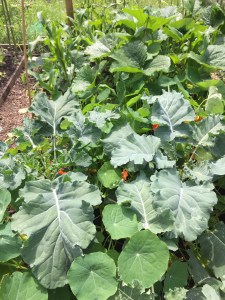 The only way to mitigate our water use is to increase the water capacity of the soil by increasing the amount of organic matter and making use of mulches to reduce surface evaporation. It’s clear from our experiments with mixed plantings, that covering the ground completely (courgettes, for instance under sweetcorn) lashings of leafmould and so-on really increase the moisture holding capacity. The Potwell Inn allotment needs most watering on the areas where the soil is exposed – it’s obvious really. Another approach – one which I’m sure the seed merchants will soon be all over – is to develop drought resistant varieties, but we could also start to develop extremely locally adapted plants through seed saving.