
It’s difficult to overstate how beautiful this cauliflower is. I wondered for a moment whether I should add “beautiful to me” to that statement, but I think not. The beauty of grown things is not a whimsical fancy but one of the facets of nature that presents itself to us as a fait accompli. This exquisite formation of leaves and curds doesn’t demand my admiration – in fact, being a vegetable, it has no view on me or my opinions but comes as a gift.
I took the photograph yesterday when Madame unfurled the leaves which had mantled the head because she wanted to see whether this longstanding occupant of the allotment had finally come through. A full year after being sown, this cauliflower – one of four – was showing signs of its age; chewed by slugs with the outer leaves pecked by pigeons until we netted it, and the stalk turned to wood. These long standing biennials occupy a lot of ground for a very long time but, like the purple sprouting broccoli, they ripen at times of peak need – the hungry gap. The old growing year produces its Rembrandts just as the bright young things are putting on their first shows.
Most amazing of all is the fact that the food we grow and eat is made by turning sunshine, water and earth into vegetables. It’s a difficult balance because just a little too much or too little of any of the three can lead to disaster. For instance we’ve just emerged from one of the wettest winters since records began, followed by the driest spring and the coldest sequence of frosty April nights for sixty years. The plants are all at sixes and sevens and we allotmenteers are juggling seedlings, watering cans, propagators, south facing (UK) windows and fleece whilst obsessively consulting the weather apps on our phones. Sunshine, water and earth – the elemental gifts of nature – are outwith our area of dominion.
The watering can, the heated propagator, the polytunnel, fleece and greenhouse are our puny attempts to skew the odds in our favour. However, skewing the odds presupposes we’ve cracked the secret and what’s actually happened is that growers and farmers believed the bookies and started shovelling cash into the agrochemical fruit machine in the misplaced certainty that they were bound to win the jackpot eventually.
But slowly we’ve come to realize that rain, sunshine and earth are not strangers but the deeply related holy trinity of all growing things – ourselves included. Seawater and sun make clouds and clouds make rain. But when the clouds obscure the sun then the sun and the earth are estranged. When the earth is eroded no amount of sun can restore it. When it heats up, the weather becomes confused and extreme. The dark side of forcing the last drop of profit from the earth is drought, storm, flood, pestilence and famine – and if that sounds a bit Old Testament it’s maybe because this temptation to game the system isn’t something that got invented in the modern world.
But to get back to my cauliflower; when I look at it – rather perhaps when I behold it, I understand that all the while I thought I was the agent through whose efforts it could grow – I was, in fact its servant. Fussing over the seedlings, pricking them out and then in time planting them in a bed we’d already prepared; netting them last summer to keep the cabbage white butterflies out; hand picking slugs and snails out of the crown; spraying the white fly with soap and water and wrapping them against pigeons. We were in it together the whole while; with me in the expectation of the food it would provide and the cauliflower presumably committed to continuing its genetic inheritance to a future generation – all of which makes seed saving a kind of moral imperative!
We haven’t done a great deal of seed saving on the allotment except for the Calendulas and sunflowers (harvested one drunken night in Provence, with a full moon and fireflies!) – which seem to grow better from saved seed. This year we’re leaving a single parsnip in the ground to flower and we’ll save seed from that too; but the main motivation was to take advantage of its power as an attractor for insects. Is this some kind of religious attitude creeping in? It would hardly be surprising if there weren’t some traces of harvest festival, rogation days, Plough Monday and Wassailing at the White Hart jiggling around with the Old Testament stories in the back of the old lorry that constitutes my memory. But it’s not organised religion in any sense – not the kind that gives licence to so much mayhem and destruction.
What I love about allotmenteering is the chance to engage with nature much more practically. Going on a walk through the woods is like sitting there alone on the edge at the school prom. It’s much more engaging to grow a wallflower than to be one. When I approach a plant I often ask it (silently) what would be the right thing to do for you right now? Sometimes plants say ‘give me some space‘, or ‘give me some water‘. Sometimes they say – “I don’t like it here – can you put me over there in a bit more shade or sunshine?” The end result of the dialogue is a better plant. My cauliflower is the product of a long conversation between the seed, the earth, the sun and the rain and me. That’s the point of it. When we finally pick and harvest our produce we often say thank you out loud as we shall when I cut the first cauliflower at the weekend.
Of course there’s all the stuff about road miles, industrial food production and intensive farming with all its chemicals and heavy machinery; but ultimately we grow food at the Potwell Inn, because the only way to become fully human is to join the dance; to embrace feast and failure as a joyful participant rather than a passive consumer fuming at the absence of your favourite brand of tomato in the supermarket.
There is something splendid about a vegetable – even a cauliflower -wrought in this elemental process of earth, water and sun. The fact that generations of seed savers and plant breeders have selected for what we like to describe as desirable qualities might equally be seen as the resilient plant’s embrace of mutuality as the best way of getting along well. As Michael Pollan points out, corn and potatoes have done pretty well out of the deal.
So let’s not get too despondent about the way things are. Environmental degradation really is reversible. My phone – an ever reliable cause of pondering – came up with this photo of the Potwell Inn allotment exactly five years ago to the day. I rest my case.


 But today the farmers were out baling the straw, and with a couple of days left before the rain returns, they’ll be ready for the winter. The last peaks of the Snowdon range that form a natural boundary to the Lleyn peninsula were standing clear in the blue skies. We walked along the clifftop and below us an abundance of birds were sunning themselves on the rocks – it’s a little paradise here when the wind drops and the sun shines. Much of the time it can be pretty rough. Near to where we’re staying there are a number of coves you can climb down to, all empty of humans apart from us.


 Happily all was well in the tomato department but while Madame was picking some peas she found that the Pea Moth was cranking into gear – that’s why getting them sown and picked as early as possible is always a good idea.
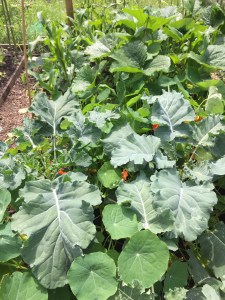 The only way to mitigate our water use is to increase the water capacity of the soil by increasing the amount of organic matter and making use of mulches to reduce surface evaporation. It’s clear from our experiments with mixed plantings, that covering the ground completely (courgettes, for instance under sweetcorn) lashings of leafmould and so-on really increase the moisture holding capacity. The Potwell Inn allotment needs most watering on the areas where the soil is exposed – it’s obvious really. Another approach – one which I’m sure the seed merchants will soon be all over – is to develop drought resistant varieties, but we could also start to develop extremely locally adapted plants through seed saving.

 Here’s a photo I took when we stayed up in the hills on Cap Corse at the northern end of Corsica a few years ago. I suddenly thought of it during the night as I listened to the relentless sound of the wind outside. Of course, here in the South West we’re used to winds, but the Atlantic fronts usually rattle through for a few hours or maybe a day or two. However we’ve had this particular group of storms for two weeks now and the experience on the ground – as opposed to the weather charts – suggests that this is a bit of an outlier.