Computer says no!

Having gone on – perhaps a little too lyrically – about the joys of big data in yesterday’s post; I came up against one of its limitations today. It was nothing; or it was something …… who knows, but it was a wonderful example of the way that – re-using the phrase I used yesterday – absence of evidence is not evidence of absence. Or to put it in more immediate terms – there is little to no evidence that the plant in the photo has ever been found in, or anywhere near, the Lost Gardens of Heligan – or even in East Cornwall. This may of course be because the gardens – being lost – cannot be invaded by this plant because it can’t find them. On the other hand, there it was in front of me on Wednesday, and all I knew for sure was that I’d never seen one before …… but it was almost certainly a form of comfrey.

So I spent quite a few painful hours checking and then double checking but, as an amateur, you have to hang your hat somewhere and so I decided it was probably but not certainly Symphytum bulbosa. The haunting possibility is that it’s something entirely different; so much so that any halfwit would have known its real name. Common as muck! Where have you been living, you botanical imposter. And there’s the crux of the problem. There are two possible outcomes to the conundrum and one of them is to submit the record to the scrutiny of someone who actually knows what they’re talking about, but who may dismiss me scornfully they may also be looking at the same maps, records and data as me and go on to say that tuberous comfrey simply doesn’t grow where I saw it and so, QED I was wrong.

Now this isn’t that big a deal – it would hardly be a hardly a paradigm shift if I turned out to be right; but the sheer inertia of the system resists change and for a learner like me, taking on a system is a really big deal. Nobody dies either way, whether I’m right or wrong; but if I don’t submit the record because I don’t want to rock the boat, everybody loses. I miss an important lesson, and the maps and data are just that little bit less accurate than they could be.

So I bit the bullet and filled in the online form; emphasising my lack of experience and humility (I wish!) in the company of experts and all that blah blah, and then spent twenty minutes trying to change a GPS reading from my phone to British National grid without realising that the programme accepted it either way. The only thing I forgot to fill in was the species name which by this time I had forgotten. So once I’d found the name again I filled in the form and immediately a red triangular warning sign appeared against the entry; I’d been flushed out before I’d even pressed the send button!

So there we are. My contribution to citizen science is out there, somewhere in cyberspace, awaiting final judgement by a recorder who may well be knackered and daunted by a stack of 10,000 records that they wished they’d never signed up for.

Today the sun shone. There was a stiff northwesterly wind and so we found a sheltered spot in full sun on the beach and I recorded some celandines and sea beet. At least I know what they are.

Heligan – the return

Crossing the jungle

Last time we camped here at Heligan the campervan leisure batteries – (and therefore almost everything else) -gave up and we spent best part of the week (it was February) freezing cold and huddling in the sleeping bags with only head torches to see by. This time we crossed all the T’s and dotted all the I’s and after a lot of maintenance work the van is restored to its full glory. Sadly the weather has been awful, with almost continuous rain, and so it’s been obligatory wet weather gear. Nothing daunted though, we’ve been out and about to see the spectacular beginnings of the magnolia and camellia blossom. The kitchen garden looks a bit like the allotment at home – all dressed up with nowhere to go. What we need, of course, is a bit of decent weather. It’s all very well the Met Office determining that March 1st is the first day of Spring, but for gardeners and astrologers, not to mention traditionalists, the equinox is the real deal. Someone should tell them that nature doesn’t read books – however well indexed. Those extra three weeks make a world of difference. Today as we walked the perimeter of the Heligan estate we could see all manner of leaves pushing upwards but relatively few flowers.

Gunnera plants.

For sheer horror you could do worse than film these Gunneras unfolding in time lapse mode. They might well have been part of the background research for Aliens and if we had the gift of standing completely still and watching for a month we’d probably need psychotherapy! So just to balance things out a little, here’s a Magnolia bloom representing the acceptable face of gardening.

Magnolia

Still it’s true that sometimes the most memorable finds are not the show stoppers, but the ones that nearly got away. I brought a new field guide down with me to try and I was anxious to give it a test run. Weather being weather it would have been hazardous to give it a first run in the rain – the Collins Wild Flower Guide is not for the faint hearted. Before we set out I weighed copies of the Rose “Wildflower Key” which came in at around 800 grammes. The Book of Stace was about 1500 grammes and the mighty Collins swaggered it at 1700 Grammes. You really need some thew to carry it around in your bag ……… so I didn’t!

Anyway, as we were wandering alongside the stream in the woods at the southern edge of the estate I spotted something odd, lurking amongst the vegetation, in this case mostly primroses in leaf. At first glance these tiny (3mm) flowers looked as if they belonged to a sickly Veronica; the leaves looked yellowish and chlorotic. But after I’d walked past a couple of clumps I could see that they were in full flower except the flowers seemed to have sepals but no petals – rather like tiny euphorbias. So lacking the book I took a couple of photos and did some research back at the van where I found that they were golden saxifrages – specifically the opposite leaved form – Chrysosplenium oppositifolium. After confirming it in the Collins WFG and checking the distribution on the BSBI online maps I felt brave enough to record it on iRecord. It’s not showy, it’s not in the least rare but I’d never noticed it before. Sitting in the van and uploading the record with the rain beating down on the roof, felt like a vindication of the day. There are very few activities where a complete amateur can make a difference, and when it comes to the destruction of the environment we need witnesses. Witnesses that can put hard, verifiable records up against the magical thinking of the climate change deniers.

And that’s also why it’s worth recording even the humblest and most common of the plants. If I have a beef with natural history films it’s their tendency to stress the spectacular over the mundane and wrap every living creature into a homesy narrative overwhelmed by overblown musical scores. Natural history as folk religion.

When you think about it, rarity and scarcity are not quite synonyms. Living organisms first become scarce and only then do they become rare. How will we know when an old familiar friend is becoming scarce if we don’t record them when they’re plentiful? Ten thousand records for lesser celandines seems about right, against one for the ghost orchid. But if no one ever recorded the ordinary everyday plants we wouldn’t notice until they almost disappeared – like the cuckoo! Today, standing in the woods, we heard a woodpecker drumming. As a child on my grandparents’ smallholding in the Chilterns, such a sound would have been commonplace; but today it made my spirits leap. In the 1950’s my squirrels were all red squirrels. My grandfather was doing his best to shoot the greys, for which he was paid a penny a tail, I think. It didn’t work, though, and now we have to travel afar to see them. After another rainy day here tomorrow, we’re off to a site on the Roseland Peninsula with a more promising weather forecast.

It’s been an additional pleasure to write this post because a couple of weeks ago we decided to lash out on a portable WiFi router that runs on a data SIM. It seems to be working very well with all our laptops and phones networked and able to stream video. I think it’s known as a MiFi system. Anyway it works for us – so no more standing out in the wet trying to get a signal. With campsite WiFi here costing ÂŁ15 for three days and not even functioning very well, it’s goodbye to tethering and hello to happy days.

All tooled up!

Gosh we’ve been busy getting ready for the next trip. I think I’ve finally got the courage to start officially recording some of the plants we hope to find and so it’s been a rush to gather together all the tools and to figure out how to use them. So I hope you’ll forgive me for failing to find a ghost orchid or anything remotely rare but settling on an ubiquitous weed like couch grass simply to check on some ID keys and test out the macro extension lens on the phone; and I’m feeling ever so pleased.

There’s a bit of a knack to taking photographs for plant ID’s because they need to capture as much as possible of the kind of technical information you’ll definitely wish you’d recorded when you get back to base; things like grid references and what kind of soil and light conditions not to mention – in the case of grasses – all manner of obscurities concerning ligules, auricles, lemmas glumes, stolons, rhizomes and spikelets. So while we took a break from planting out broad beans I pulled a lump of the revolting weed out of one of the allotment beds and tried to remember all this stuff as I took the photos. I know it’s all a bit technical but there’s something very lovely about grasses because they hide their differences so completely. Half a millimetre can be important. This reminds me of one of my theology tutors who used to run what he called CAT sessions – close attention to text. We discovered that the really important understandings demanded time, attention and focus. Drill down hard enough and what appears to be a uniform field of grass can become a garden of delights. Don’t knock it if you haven’t tried it!

The other bit of plant recording I’ve had to learn is the software. There’s a mountain of data out there in databases which must have taken millions of voluntary hours of recording and checking. OK I’m a complete nerd but I think I’m happier growing and examining plants than I am frothing at the mouth while I scream at the television. So couch grass became a rehearsal for the really good stuff which I’m so looking forward to finding this season.

Later, just for fun, I dug into the herbals and discovered that however much we gardeners loathe the stuff there are people out their who are prepared to pay ÂŁ10 for 100 grammes of the offending roots. By all accounts (and lacking any scientific proof as far as I could find out) couch roots have some healing properties. By my reckoning there must be many thousands of pounds worth of herbal remedy underground at the allotment site but the sheer agony of digging it up would need the price to go a lot higher than that. It is, however, the most tremendously vigorous plant. I read later about an experiment where 20 week old couch tillers grew 5 metres – 15 feet in a few weeks while throwing up over 200 buds. Oh to think that it’s an incomer brought in centuries ago. My mum was an inveterate smuggler of purloined cuttings from every garden she ever visited – perhaps it was an ancestor of hers that brought the wretched weed here.

Anyway, the kit is assembled, tested – and we’re ready to rock and roll this season. Fortunately while I crawl around in the dirt in lovely places, Madame will be bingeing on drawing with ink and bamboo pens; inspired by David Hockney’s latest book. In the background I can hear our waterproofs taking an interminable time to dry in low heat after being re-proofed. We’re optimistic but not reckless.

What’s your movie?

The heading at the top is the title of a very good Mose Allison song – “What’s your movie?” – which takes the mickey out of people who build their identities out of film characters. Although I love the song and laugh out loud at it, I’m also aware that none of us is able to escape the temptation to weave a narrative around our lives. The problem is that we don’t need to be even remotely out of the ordinary to be able to weave multiple narratives. So with that caveat, please welcome my first ever botany book – Warne’s Wildflowers of the wayside and woodlands”. I think I must have bought it in my late teens and – truth to tell – it was never that much use. The illustrations were miles away from the plants they depicted and the resolution was so poor that at best they gave an impression of the plant; and fatally – there were no keys at all apart from some line drawings sorted by the colour of the flowers. I had no technical knowledge of plant families and so the only means of naming one was to laboriously turn the pages until I found something that looked like – even vaguely like – the plant I had in front of me. Madame will testify that this made for very slow and exquisitely boring walks on her part. Consequently – much as I’d like to – I’m unable to construct a credible narrative around my career as an amateur field botanist. My movie is more like an inconclusive list of rough drafts and false starts that should never have seen the light of day.

However the passion for observing and naming plants never went away and over the years I’ve accumulated an unholy number of books, most of which were totally beyond my comprehension when I bought them. Over fifty years I sort of caught up with most of them whilst simultaneously throwing myself into the pit of incomprehension by buying yet more.

Yesterday I got lucky and found a copy of the out of print New Atlas of the British & Irish Flora, for ÂŁ34 on the Oxfam website and it was while I was pondering where I was going to find a space for it that I found my battered old copy of “Wayside and Woodland” languishing behind a row of more prestigious looking volumes. When I opened it, I noticed the long dead vetch flower – brown and flattened – which I must have stuffed in there pending further investigation. In those days I hand no hand lens and no other way of taking it any further. It took several years longer to buy one, and I borrowed my first microscope only two years ago; and still the flower sits reproachfully in the book like a photo from a holiday romance, wagging its finger and asking what took me so long? I was utterly vexed by veronicas and distracted by dandelions and daisies. Any self-taught botanist will tell you it’s a prolonged agony of blind alleys and mazes.

And so I have passed the three consecutive Atlantic storms that squatted on our horizon and tormented us this past week- by mugging up on grasses, gathering my kit together, re-registering on iRecord and assembling my field guides ready for our first proper plant spotting trip down to Cornwall. Cornwall is early and later we’ll move up the West coat of the UK as far as North Wales hopefully catching the same plants several times. Suddenly I’m energised and better prepared than ever before. I watched three of the brilliant BSBI webinars on grasses and then ploughed through the introduction to the BSBI handbook on grasses, looking up all the terms I still don’t fully understand. This is a bit of a grudge match because during a field trip with the Bath Natural History Society, I mentioned to one of its luminaries that I found grasses difficult. “Oh” she said – “Grasses are easy!” She’s a brilliant and normally patient teacher and I’m pretty sure she’d intuited the fact that I can’t resist a direct challenge. Gradually, after three years – two of which were wrecked by COVID – I’ve made a small start – decades after I should have done.

Ironic isn’t it? Just as I’m beginning to get my act as a field botanist together, the proper botanists have retreated to white painted rooms, DNA analysis and electron microscopes. I can’t tell my haploid from my diploid and neither do I have the faintest idea what a palisade variant of non Kranz (C3) anatomy might be (actually I’ve an idea it’s to do with photosynthesis). My dearest wish is just to walk through a flower meadow and greet each of its inhabitants by name. My biggest fear is that I’ll be among the last people to be able to do so.

Hello Eunice

Lizard Point – in 2014

It’s not so much that we’ve never had weather like this before. The big difference is that severe weather is afflicting us more frequently; and so although I could try to support the ‘argument’ that climate change is fake news by citing this photo taken in 2014 and claiming that the weather has always been like this the only fact that matters is that there are many more extreme weather events than we had in the past, and it’s not down to sunspots, 5G telephone masts or Russian hackers it’s down to our profligate use of fossil fuels.

And so yesterday we were up at the allotment trying to make everything as secure as possible and then we went to the campervan to make sure it is as safe as we can make it. It’s parked within a hundred metres of the Severn Beach sea wall which, today , is the subject of red alert weather and flood warnings. Spring tide + force 10 winds always equals a storm surge so we’re paying constant attention to the mobiles for alerts . We once lived at the tidal end of the river Avon when we had the same combination of events combined with a snow melt and I’ve never seen water rise so rapidly, or menacingly. It was eerily silent as it topped the harbour walls and raced across the road towards us. Mercifully it stopped rising just a few inches below the point at which our basement would have flooded. This morning the only damage so far seems to be a flying fence from the Air BnB opposite the flat; and the scratches and dents were confined to the car which was abandoned by a previous tenant who took care to remove the plates before dumping it. At Green Park Station the glass roof – which was already in a precarious state – is shedding panes on to the ground, so probably no farmers’ market tomorrow. Ah well!

This week we’ve had two named storms; the first, Dudley, affected the north of the country but today’s storm Eunice is all over the South West. It kicked off at about 7.00am and built to crescendo during the morning. Apart from the flying fence the only other casualty looks like a smallish tree across the green. These winds growl and search at the windows with a real malignancy. Opposite my window as I write this, there’s a 20′ extractor chimney above a burger joint that’s become semi-detached at the top and is waving around alarmingly. It’s all very scary.

So the question is – how can we live sane, flourishing and fulfilled lives in this insane society – or should we even try to do so? Years ago we were at the much missed Bristol Flower Show when we encountered a man in a wheelchair who’d had both of his legs amputated. He was being pushed by his son who had lovingly attached an ashtray to the arm of the chair with a jubilee clip so that his dad could carry on smoking, having no feet to stub out his dog-ends. Obviously it’s not sensible to be angry or berate either the man or his son for assisting the habit that was so obviously killing him. My reaction was to feel overwhelmed by a strange kind of hopeless compassion for someone who was being slowly killed, not entirely through his own idiocy but through human weakness and a powerful culture created and funded by the tobacco industry.

I don’t want to spend a moment more than necessary being angry. How much time am I prepared to waste on shouting at the television and frothing with indignation – because that too is a killer! Most of us have a role in the decay of this society. We’re all a mixture; somewhere between the son and the father; and so we’re all both victim of climate change as well as being part of the problem. Nothing suits the fossil fuel lobby better than a situation where we all blame and fight against one another; cyclists against motorists, vegetarians and vegans against omnivores, city dwellers against farmers – and so on ad infinitum. In the end we all have to live in each others’ crap so let’s forget the squabbles and go after the real villains and their stooges in the press and in government. It seems to me that one way of changing things is to make sinning as difficult as possible. We should be hitting the fossil fuel corporations where it hurts them most – in the bottom line. We should go after their lobbyists – naming and shaming them for pandering to their employers. Public scorn – as we are seeing at the moment – can really wound the powerful.

But we needn’t be angry – it saps the soul. With the allotment, the campervan and a hand lens in my pocket; and with a copy of the Tao te Ching somewhere to hand – I can live as sane, as flourishing and as fulfilled a life as is granted to me. Who could ask for more?

Postscript

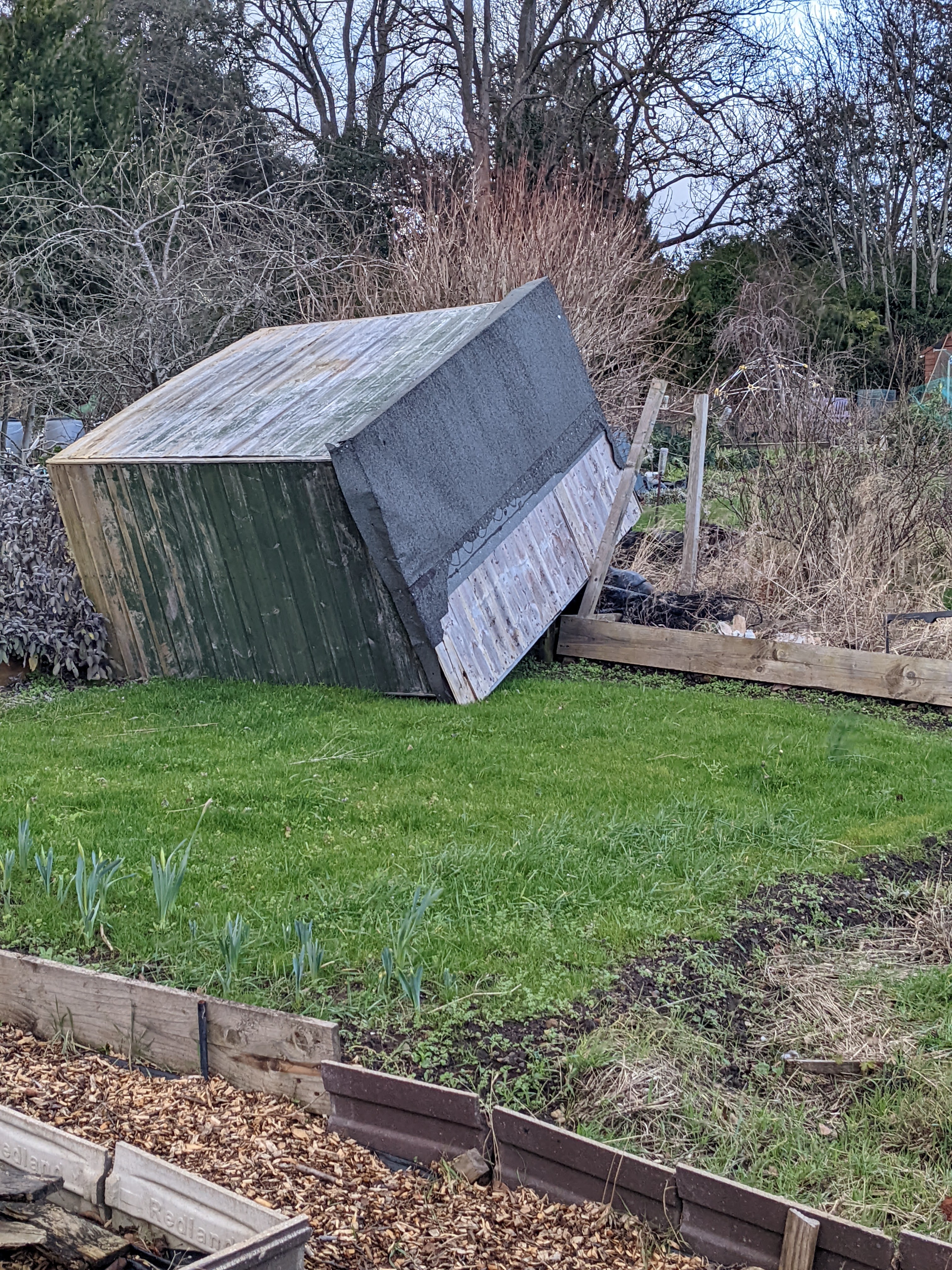
Once the red alert had dropped to amber we went to look at the allotment and noticed a number of roof tiles near the entrance to the back door of the block where we live – any of them would have killed someone walking below. The allotment was completely hammered, with overturned sheds and broken greenhouses. Lots of glass flying about obviously. Our plot was mercifully intact but others were a sorry sight. The flood alert affecting the campervan site continues until tomorrow but we’re hoping with less wind and a smaller tidal surge we’ll be OK.

“Do not go gentle into that good night” – first, clear up the mess in your head!

The vandalizing of the allotment at Christmas knocked the stuffing out of us. Aside from the feelings of vulnerability which are inevitable, I suppose, the replacement toughened glass for the greenhouse has been difficult to source and the whole area inside and out needs clearing of broken shards. The polytunnel – less than a year old – is now patched with tape. In fact we were so knocked off course I mooted the idea of giving up the allotment and working as volunteers in a community garden – it’s fair to say that one didn’t go well with Madame. We discussed whether to step back and grow more perennials and fruit, which need far less attention, so we could spend more time away in the campervan. That was one of the underlying reasons for trial renting the cottage in Cornwall; selling the van would pay for a lot of holidays.

On the other hand, the campervan brings us the freedom to travel as and when we feel like it, without booking months ahead; and it’s bought and paid for – although storage, maintenance, tax and insurance can mount up unpredictably. A van is a very costly bit of kit – especially when it’s sitting outside in the rain rotting away gently at roughly the same speed as we’re getting older. Two years of lockdown had given us plenty of time to reflect on what the van gives us, and it’s clear that it’s become essential to us. When we’re away we sleep better, walk and explore more. I treasure the time and space to turn on my botanical eyes so that plants I’ve never seen before suddenly become visible. We find time to talk and reflect and – if I’m honest – carouse and drink wine and abandon the ghastly effort of acting our age. You can’t do this when your children (and grandchildren) are around because it makes them cringe!

The net result of the holiday was a kind of mixture because we decided that we would keep the van and try to take much more time away in it, as well as carrying on with the allotment and on meeting up with friends we’ve not seen for two years. Last week we lashed out on 4 new tyres and windscreen wiper blades – they hadn’t been replaced in over a decade, and a new (yet to be installed) WiFi aerial and router to get over the constant lack of signal when we’re out in the wilds. In any case the old satellite dish is so enormous we look like a TV outside broadcast van in spite of the fact that – large as it is – it can’t see past a tree with leaves on.

I think any allotmenteer will recognise that feeling when the plot isn’t going well and you almost dread the thought of going to it. As a seasonal (winter) melancholic I often have to force myself to get off my backside and do some work. On the other hand any allotmenteer will recognise that once the work is in progress there’s a tremendous sense of wellbeing: why ever did I make such a fuss? you ask.

Truth to tell, though, I think it was the greenhouse bringing me back to life

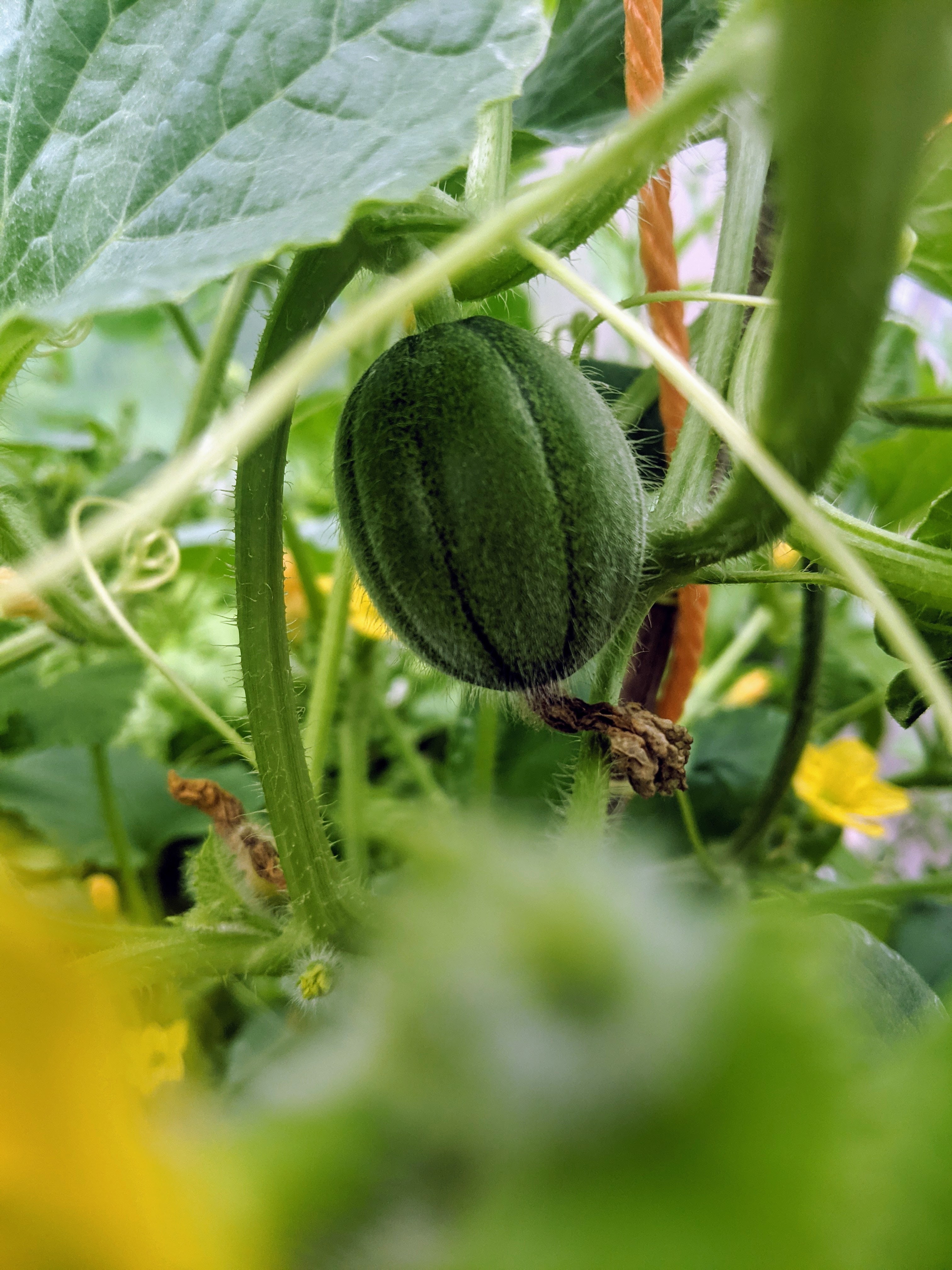
Yesterday the sun shone and we went to the plot where I cleaned up the mess in the greenhouse while Madame weeded and tended the polytunnel. Safety glass shatters into a million fragments and so kneeling in a confined space with so many sharp edges around needed extra care; however after a couple of hours the greenhouse was clean, safe, and relatively tidy and I was surrounded by reminders of past seasons like root trainers – empty and stacked neatly in their containers. Is there a psychological term for that warmth that spread through me as I worked there? Previous notions to replace the glass with polycarbonate sheets seemed to fade and I began to think – ‘let’s replace and restore it properly, otherwise the vandals win. It’s depressing seeing the greenhouse, shrink wrapped in weed control mat, bits of black polythene and duct tape, so let’s bring it fully back to life.’ Truth to tell, though, I think it was the greenhouse bringing me back to life. As we worked there in our usual contemplative silence it was obvious that the allotment was as essential to us as the campervan. Madame had a long conversation with a fellow allotmenteer whose home built polytunnel had also been slashed and he told her that watering for us while we were away in the summer was an especial pleasure because the perfume of the ripening melons, basil and tomatoes filled the tunnel. As soon as we got home I turned to the photos on the laptop and I knew that there’s no way we we can thrive without growing food. Without the allotment we shrink; our souls starve.

We’re growing old, so there’s not so much time left we can afford to waste any of it. We’ve been inseparable since we met when Madame was fifteen and the prospect of our eventual infirmity and even separation hangs over us. The earth, our earth, becomes more precious as we share in her processes and dimly understand her grace and complexity, and although this might sound counterintuitive to a much younger person, it gives us comfort. We can’t win the environmental battle without a revolution fired by collective action. So long as we’re governed by wilfully stupid, squalid, and greedy governments none of the actions we know we need to carry out, will happen. Lying awake at night in a fury because they have just licenced the use of poisonous neonicotinoids to protect sugar beet – and who needs reminding that excess sugar consumption is killing and maiming millions of people? – well, it’s a waste of emotional energy.

So long as we have our wits, and enough physical energy to do it we’ll grow food and travel whenever we can so that we can record and enjoy the natural world in all its ludicrous generosity; write about it, photograph it and draw it. What’s happening to the earth demands witnesses because without witnesses there will be no time of reckoning. So no – we won’t be going anywhere quietly, thanks!

Positively the last post on Cornwall (for now!)

I took these strikingly post-industrial photographs on the beach at Porthoustock on the Lizard Peninsula last week. The beach there is completely dominated by the huge brutalist silo – now disused – that was a part of the St Keverne quarry. The quarry still operates in a small way as you can see from the top left picture of a working excavator, and by the look of the pile of crushed stone, seems to be excavating roadstone. The local granite is apparently coarse grained and often used in sea walls and such like much of it going to South Wales.

While we were there we fell into conversation with a threesome of divers – all retired – who were looking for a suitable clubhouse in the area. The talk ran down familiar tracks; litter, dogshit, tourism, housing crisis and so forth. They mistakenly identified the silo as having to do with tin mining but I think it would have contained thousands of tons of crushed stone waiting to be loaded into the kind of small ships that could pull alongside at high tide. The ports, visible from rust stains at the side, would have discharged stone straight into the boats.

There was a turn when we discussed whether the small quarrying operation was actually removing the whole headland – it is, apparently, in the face of some local opposition – and this conversational thread led to the chronic unemployment in the area, and whether lithium mines would be a boon or an environmental menace. The key moment came when one of them said – “of course we’re all retired and so we don’t have to worry about jobs. Our instincts would be to insist that nothing changes here – it’s why we moved here in the first place.”

I don’t think for a moment that they were being as selfish as that statement implies. What I think was being expressed is the ongoing paradox of living in a wildlife paradise, surrounded by beautiful views when the local people are living in demonstrable poverty caused by inflated house prices and high unemployment mitigated only by seasonal and poorly paid work.

I did a lot of work running writers groups in the Welsh Valleys during and after the miners’ strike. You could taste the anger and depression being caused by the deliberate destruction of their culture. Now, of course, we’re trying to end coal mining altogether – and nobody worth listening to is contesting the significance of climate change; but the move to sustainable, renewable energy could have been, and now must be managed through huge investment in the retraining of local people to take on skilled, well paid jobs in a greener future.

Halfway marker on Porthallow beach

On the beach there, we saw the paradox that must be faced. Simply knocking down all traces of an old and proud culture and filling the empty space with second holiday homes and caravan parks would contribute nothing to the problem. There amidst the ruins, we saw a buzzard feeding on the remains of a dead fish. The place is alive with wildlife, and of course these post industrial sites are often nature’s hotspots. I know I’ve got a bit of a thing about this kind of landscape. It comes from growing up in an exactly similar area in Gloucestershire, where one or two of our neighbours were retired coal miners, and a couple of the pits were still in operation. We had pipeworks, brickworks and – looking much further back – names relating to the woolen industry. I spent days with my friend Eddie, tracing the old dram road that brought coal from Coalpit Heath to the river Avon. I was delighted to discover that Cornwall and Gloucestershire once shared what’s known in linguistics as a soft mutation – tram roads were always spoken of as dram roads. I felt very much at home on that beach! A handful of fishing boats and the small quarry were a sign that the culture is clinging on. Further up the coast towards Falmouth we watched a large fishing boat seine netting in the bay from Porthallow beach.

I took the pictures below in 2009, in the remains of one of the abandoned tin mines on the north coast. The technicolour stains on the cliff are a permanent reminder of the poisonous effluents that accompanied tin and copper mining. The furnaces in which the ores were extracted must have been terrifying; a real-life vision of what may yet turn out to be the end of the world. A group of volunteers have restored the old steam powered beam engine – it was an awesome sight. Naturally – or, in fact, unnaturally – we could erase the buildings and make the area ‘profitable’ by building second homes or industrial estates; but to wander through those derelict acres of ruined land – which are by now being reclaimed by wildlife and specialist plants of real importance – is the best way of telling the story of the industrial revolution in a way that lays bare the downside – the greedy and extractive ruination of a whole county by unfettered capitalism. Beneath the surface of the impoverished soil, even the fungi and bacteria are doing the work of remediating the damage that our ancestors caused.

Is there any way forward so long as Cornwall is mismanaged from London by politicians and civil servants who have no connection or knowledge of its history and culture? Bring on regional government, I say, and for goodness sake don’t even think about creating a regional structure that attempts to join Cornwall with Devon. Bishop Trelawny would rise from his grave! Cornwall is as much a country as Wales.

Port Diddly Eye – according to Mrs Malaprop.

We first came to Porth Dinllaen because we’d seen the place on a TV programme and we thought it looked beautiful – particularly the pub on the beach – Ty Coch Inn (the Cock Inn) once rated the best beach pub in the UK, seemed almost too good to be true; set at the end of a sweeping bay from which on a clear day you can see Holyhead on Anglesey from one end, and the peak of Yr Wyddfa (Snowdon) from the lifeboat station at the other end.

So today we took a walk from the car park in Morfa Nefyn down and along the beach, past the pub and the lifeboat station back to the car park. I haven’t been wearing my field botany hat very much this time, because the weather’s been so awful and we’ve only been able to grab quick walks in the teeth of the gales and rain. However yesterday’s cold and wet northwesterly has disappeared and a ridge of high pressure gave us a couple of hours of sunshine during the morning. And as we walked around the path from the pub to the lifeboat station a little blue flower caught Madame’s eye and she pointed it out to me. It was a bit of a puzzle because it had a borage like flower but the same kind of leaves as a bristly oxtongue. So I stopped and took some photos and brought them back to the cottage to identify. Here’s a photo.

It’s not the least bit rare, but that didn’t diminish the pleasure of finding it at all. It’s an annual bugloss – Anchusa arvensis – the name suggests it’s a field dweller, which it often is. The last one I saw was way down the coast in a field near St Davids; so it also has a taste for seaside and sandy soils. Interestingly I discovered that the French call it oxtongue, langue de boeuf, and the name bugloss comes from a couple of Greek words that mean exactly the same. We’ve already got a bristly ox tongue in the UK so the case for Latin names was never better made!

Anyway I couldn’t have been more pleased if I’d found a ghost orchid. Botanising isn’t just about rarity; for me it’s about getting to know my neighbours by name. Then later I picked up Fred Provenza’s book “Nourishment” which (in chapter 2) talks about the biochemical intelligence of plants and their role in nutrition. Awesome stuff. I began to feel pieces of a puzzle dropping into place in my mind. Field botany, herbal medicine, agriculture, human diet, deficiencies and so much more all in the same mind map for the first time in my experience. Happy daze!

Rainy day thinking

I think this one is Rhodymenia pseudopalmata – rosy fan weed

It’s a rainy day today, although the wind has died back a bit and the temperature has dropped a little further. We managed to get out for a walk down to the beach during a break in the weather and Madame collected seaweeds and pebbles to draw while I dozed in the sun watching a common seal popping its head out of the water from time to time, giving me a thorough inspection. The curiosity was mutual, I’m bound to say but I’m intrigued at our sentimental attitude towards a pretty serious predator. This sentimentalisation of the animals is almost encouraged by the kind of natural history films that present nature as a comforting spectacle full of anthropomorphised animals whose every action reflects the finest human values.

Anyway, rainy days are great for reading challenging books and I haven’t been able to read more than about 20 pages of Jacques Ellul’s “The technological society” at any one time without taking a break. I could say that I wished I’d read it when it was first published in 1957 but, aged eleven, my French was at the la plume de ma tante stage under the merciless eye of Whacker Allan whose Parisian pronunciation constantly got me into trouble, driving around on holidays in Provence.

Perhaps now is the perfect time to take it on, though, because my entire life has been lived since his forensic takedown of the more idealistic post-war twentieth century sociology. The last chapter of his book is a prophetic look at the year 2000 which did not have the ‘benefit’ of living through currency crashes, pandemics, monetarism and economic game theories, mass migration, energy wars, environmental catastrophe and the rise and rise of computing; and it’s been much worse than he predicted. On the plus side, I am learning a great deal about the underlying reasons for our lemming like rush to the cliffs.

Apart from reading and looking at seals – which we always seem to spot accidentally – we’re pretty much on our own here. The sensible walkers, having looked at the weather forecasts – have nearly all gone home and there’s just out of season people like us, and a few birders dragging their giant scopes and cameras along the clifftops. There’s no garden to speak of where we’re staying, just a deep valley lined with impenetrable brambles, blackthorn and hawthorn towards the top and then shrubby willows down towards the stream that flows out across the small beach. At the back we’re surrounded by elderly apples, shriven by the constant gales. It’s a perfect environment for birds and so we can spend hours looking down the valley with binoculars.

On the clifftop, apart from a brain teasing array of gulls; there are carrion crows, rooks, chough and jackdaw as well as the jays in the valley. Most of them are easier to identify by their calls if they’re at a distance; but the choughs seem to have the extraordinary ability to perform 360 degree rolls when they’re showing off. Our quiet clifftop walk yesterday was accompanied by the crashing of waves thrown up by the wind driven swell, punctuated by fighter planes roaring overhead and a single engined plane nearby that was performing similar tricks to the chough – barrel rolls, diving and looping the loop. Three ages of flight charting the unstoppable growth of technology and culminating in the formidable killing machines that can fly from here to Northern Ireland and back in the time it takes us to walk down from the cottage.

Sadly we’re here just that bit later this year and so it looks as if the field mushrooms have either come and gone – or perhaps they’re waiting for more clement weather. The circle of fairy ring mushrooms is there at the end of the footpath. They’re easy to dry and string together to hang in the kitchen and although they’re not in the porcini league they make a decent contribution to a stock. Apart from that there are loads of psilocybin as well – which would probably make an even more interesting stock but I’m a bit of a coward when it comes to hallucinogens.

Time will come, I think, when the war on drugs will finally end and we shall be reading even more breathless articles from the selfsame journalists who were all for banging up recreational drug users for life – singing the praises of the new wonder drugs and printing verbatim the press releases they get from big pharma who’ll want to get in on the act as well. Cynical … moi? I’ve always remembered James Belsey, leading reporter on the local paper in the days when that meant something, saying to me – “Dave you’ve got to remember that journalists are bone idle and if you write their copy for them you’re much more likely to get it in the paper”.

What ails you?

As I was reading today the question popped into my mind whether Amish farmers, who avoid any kind of modern technology, have capitulated to the spirit of the age. From a bit of fairly shallow research it seems that not all Amish farmers are organic and some may even use chemicals. I’ll carry on investigating because it would make an interesting study . But in the course of following that question up I realised that to characterise organic farming, the rewilding movement and the innovative grazing systems now being explored as sentimental and backward looking is precisely to miss the point. One thing about technological society (mechanical mind if you like) is its capacity to sweep up small inventions made across history and amalgamate them into emergent technologies. We can’t save the earth by regressing to an imagined golden age but we have to move into the future with all the challenges and dangers that the technological mind presents, and make it safer and more sustainable for the earth and all its creatures including us and beginning with the grail question – “what ails you?”

Where to start?

Good days and bad ones

But first, an extraordinarily heartwarming conversation with my eight year old grandson. We were in Dyrham Park, walking along the edge of Whitefield – a stunning wildflower meadow which we haven’t managed to see for two years because of Covid. The grandchildren had all been dosed with antihistamine because their mum knew they’d be rolling around in the grass at some point during the day. It happens that their sister is given the drug as a liquid, orally and to save time the other two also got it from a small syringe this time. So oldest grandson and me were chatting about all this and we wandered into the topic of words that sound the same but are spelt differently and have different meanings. Orally and aurally came up of course – and then he said to me quite unexpectedly – “they’re called homophones”. I could have cried with joy at him even knowing the word, and -in the way that children are – he was a bit surprised (but rather pleased) at how thrilled I was. High fives all round. I love going for walks with him because he’s so eager to learn. Each time we go out I teach him the names of different flowers, plants and trees, and tell him their stories. It lights up the day for both of us.

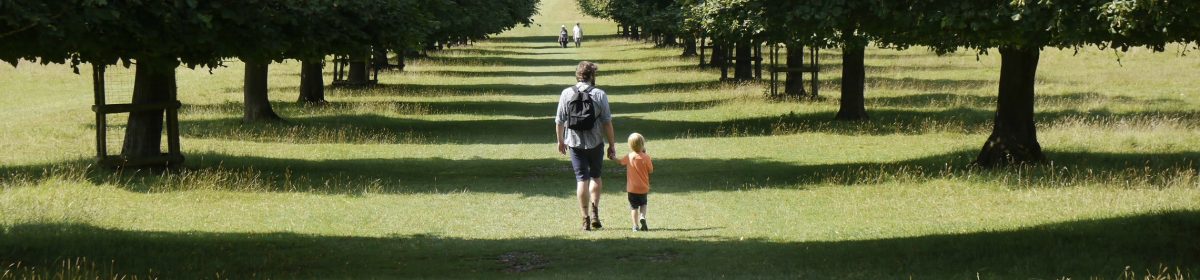
But at the very top of this page – the one that comes up every time – there’s a photo of the same grandson walking down an avenue of limes, holding hands with his uncle Jonah’s hand. Sadly the avenue of trees no longer looks the same – and it’s for the oddest reason.

The aspect of the landscape in that particular shot caught my eye, not so much for its natural beauty, but because in reality it is so artificial. The lower leaves in the regular avenue of limes is – or rather was – clipped to such an even height above the ground it reminded me of the famous Marienbad film setting. But this wasn’t achieved by platoons of gardeners but by a wild herd of roe deer which has lived there for a couple of hundred years. Sadly the herd was all slaughtered during the Covid outbreak because of a persistent outbreak of bovine TB. It was all very hush hush in the way it happened; probably in anticipation of a fiercely negative response from the thousands of visitors who’ve grown to love them. If you live in the UK you’ll already know about the furore that’s arisen over the slaughter of a single llama for the same reason. However it’s done now and we’re promised the deer herd will be replaced as soon as possible. I simply don’t know whether the vaccines that exist for farm cattle would work for deer, but if they do I’d be saddened by the fact they weren’t used. There may be other reasons, though. Some visitors had no idea how to treat the deer as wild animals, and one ranger told me they’d had to intervene when a large group of visitors tried to corral a section of the flock in order to take photos! Deer, like all wild animals, respond badly to stress and I’ve long wondered whether TB isn’t a symptomatic disease of stressed animals.

The upshot of all this is that the grassland character is rapidly altering, with rank grasses taking over; and the lime avenue is looking distinctly ragged now. It’s amazing how quickly this has happened. The countryside as expressed in the great English parks is about as artificial as it gets; and it’s easy to see, particularly at the higher level of the park – the scrub will very soon take over when it’s no longer grazed by the deer. Eco purists and some rewilders might think this is a good idea; but I’m not so sure. All landscapes are artificial in one way or another, depending on the management strategies in place. Wildflower meadows are no more “natural” than municipal parks if by natural you mean left completely to their own devices. Each type of landscape – even (or especially) abandoned industrial sites – develops its own unique ecology. Maintaining peat bogs requires minute attention to water levels, for instance. So diversity is best maintained by deliberate management. I just don’t see how Dyrham Park can be maintained as it was – without its deer herd.

But finally, the bad news is that the badgers on the allotment eventually found a way past our barriers and finished off the sweetcorn. The video at the top was probably the marauder himself leaving the scene of the crime. And so, the fencing will be strengthened even more next year. Luckily we had a least a few feeds, and although we could wish they hadn’t broken in; we wouldn’t want to see them disappear altogether. Once again, maintaining ecological balance has its pluses and minuses. A couple of days ago I lamented the fact that there are no hedgehogs on the site, but of course badgers are one of the main predators of hedgehogs. Whenever we intervene in nature, however worthy our intentions, the results are often full of unintended consequences.

Farming, gardening, house building and transport infrastructure – to name just four of many possibilities – are all loaded with ecological consequences and ethical choices. Even a visit to a National Trust attraction involves ethical choices. The earth is a place for moral grown-ups; or at least it is if we want to save our place in it. Occasionally, on my bleaker days, I wonder if it wouldn’t be better to leave it to the plants and animals who got here first; but usually I just think – better get on with it then.