Looking down the mouth of the Percuil river towards St Mawes and Falmouth
After my exhausting battle with language in the last post I thought, maybe, that I, along with any readers who follow this blog sequentially, needed a bit of a lie-down. Unfortunately most readers clearly don’t read it sequentially and so a very long and slowly unfolding idea will only be found by searching on the tag “green spirituality”.
I just need to add one further dimension to a rather one-sided discussion by suggesting that the aesthetic is, in a peculiar way, another sense to add to the five more commonly accepted ones – sight, hearing, taste, touch and smell. At its most basic, the aesthetic embraces all of the five, and often makes sense where the logical mind fails. I never could understand Madame’s passion for art until (I was nineteen and she was fifteen) I suddenly got it in front of a semi abstract painting of the back of a Georgian terrace in the Bristol Museum and Art Gallery. My conversion felt like a several gigabyte data dump constituting the key, and taught me in an instant the difference between seeing and beholding. That’s all I wanted to add to the previous post. If our unconscious minds really are structured like a language then the language is more likely to be musical, poetic or artistic than logical and scientific. To drag an ancient canard out of the confit, truth is beauty and beauty is truth – ask any mathematician.
Anyway one of the most visible plants around down here at the moment checks in at best part of six feet tall; it’s Charlock and in terms of beauty it’s way down the scale. The Book of Stace describes it as an archaeophyte and denizen. I had to look denizen up and it’s a plant that can compete with native plants and generally act as if it is a native. For goodness sake don’t let the Daily Mail get hold of this information or they’ll be organizing vigilante Charlock squads.
So Charlock is no beauty and yet if you should want to distinguish it from its multitude of close cousins who have been stowing away on grain ships since Roman times in order to pollute our pristine land with foreign genes; one thing you can do is stroke the stem and the leaves and if it’s five or six feet tall, let the sense of touch flush it out. It’s very bristly and rough. You have to look at the sepals – the tiny little leaves poking out directly beneath the flowers (which should be yellow) and if they stick out at right angles you can toss your head in disdain at this wretched jumped up weed. Or alternatively you could say “Good luck mate, I wish I had half your energy” .
I much prefer talking to plants and birds because there’s always the possibility of a silent conversation beginning, and who knows where that will lead? These moments of intense contemplation can be almost erotic in their intensity. I’ve spent days trying to capture the texture and form of a single Hyacinth blossom in watercolour. In the early days of my artistic adventures I remember seeing a drawing of Clevedon Pier by Peter Lanyon; a completely relaxed charcoal line that perfectly expressed the pier in a way that a prissy architect’s drawing could never have achieved.
So never neglect the aesthetic power of plants and flowers. They don’t have to be rare. I suppose there is a bit of the trainspotter in all of us, but the pleasure of finding (top left clockwise) Kidney Vetch and Sea Carrot growing in full spring colours was only marginally less than finding the Spring Squill and the Cut Leaf Cranesbill; or the little pathside explosion of Primrose, Buttercup, Soft Shield Fern and Ivy; the Cuckoo Flowers which I climbed over a fence to photograph and found a couple of hours later had all been mown off. A little bereavement. And then, finally the Pale Flax whose flower is so intense that you could spend an afternoon gazing into its depths and pondering how long it is since it was part of a valuable cloth industry.
So it’s been a wonderful couple of weeks. Yesterday we were sitting outside the campervan drinking a cup of tea and we recorded no less than seven birds strutting their stuff nearby. We heard a Robin, a Blackbird, House Sparrows, a Dunnock, a Wren, a remarkably faint Curlew, and the usual garrulous cries of Crows, Magpies and Jackdaws. During our walk we watched House Martins scooping mud up from a drying puddle to build their nests and saw sparrows having a noisy dust bath on the tinder dry coast path. All this on a day that I completely failed to find a single Sea Spleenwort after thrashing sweatily along every cliff and sea facing Cornish wall I could find – in spite of all my attempts to research it beforehand. That’s the other thing about nature: it’s always surprising.
I’m constantly writing and thinking about the reason the natural world so deeply affects me (and so many of us), in such a way that it’s almost impossible to express in words. Feeling good about the natural world hardly does justice to it when for instance – at the moment of taking this photograph of the Percuil river – I was so filled with inexpressible gratitude and joy. It was an intensely spiritual moment, I might say; except that any half sensible interrogator would ask – “Well what does spiritual actually mean?”
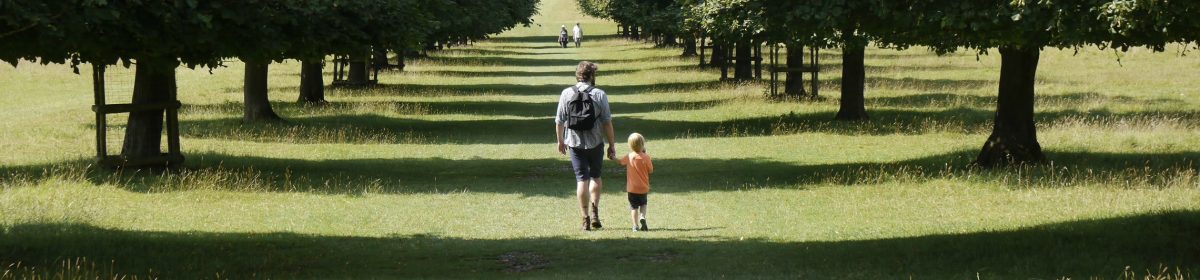
We’d just walked down the path in the photo, through open woodland that was just alive with wildflowers. Now and again we caught glimpses of the river across a gated field entrance but mostly we were concentrating on re-finding the reliable patch of Early Purple orchids we’d found several years running. The dappled woodland was a perfect setting for the yellows, blues and reds of Celandines and Buttercups; Bluebells, Cow Parsley, Herb Robert and Red Campions. Little moments of visual intensity suspended in air above the green background; a silent triumphant chord turning one of the five senses into another.
Plant hunting turns out to be an incredibly sensual experience. With a bit of experience the exploration of any new plant – it needn’t be rare at all -uses all of the senses. The texture, colour, minute details of form, taste, (used with extreme discretion) and smell. The geology underfoot, time of day and time of year, exact setting – mid field, hedgerow, open woodland or dark forest; all these play into a reflection that draws on our memory and previous experience distilled down to a single moment with a single expression of Nature.
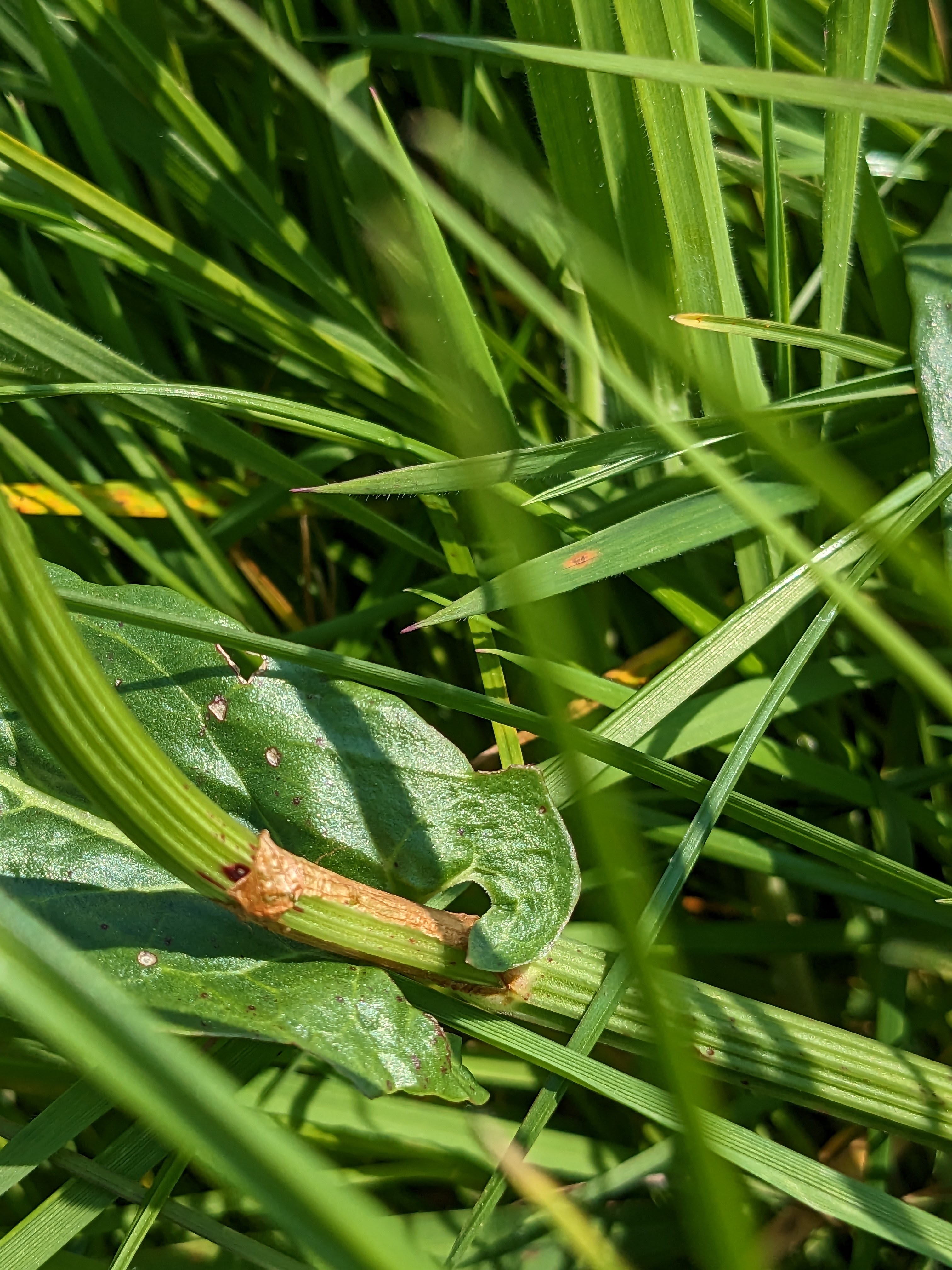
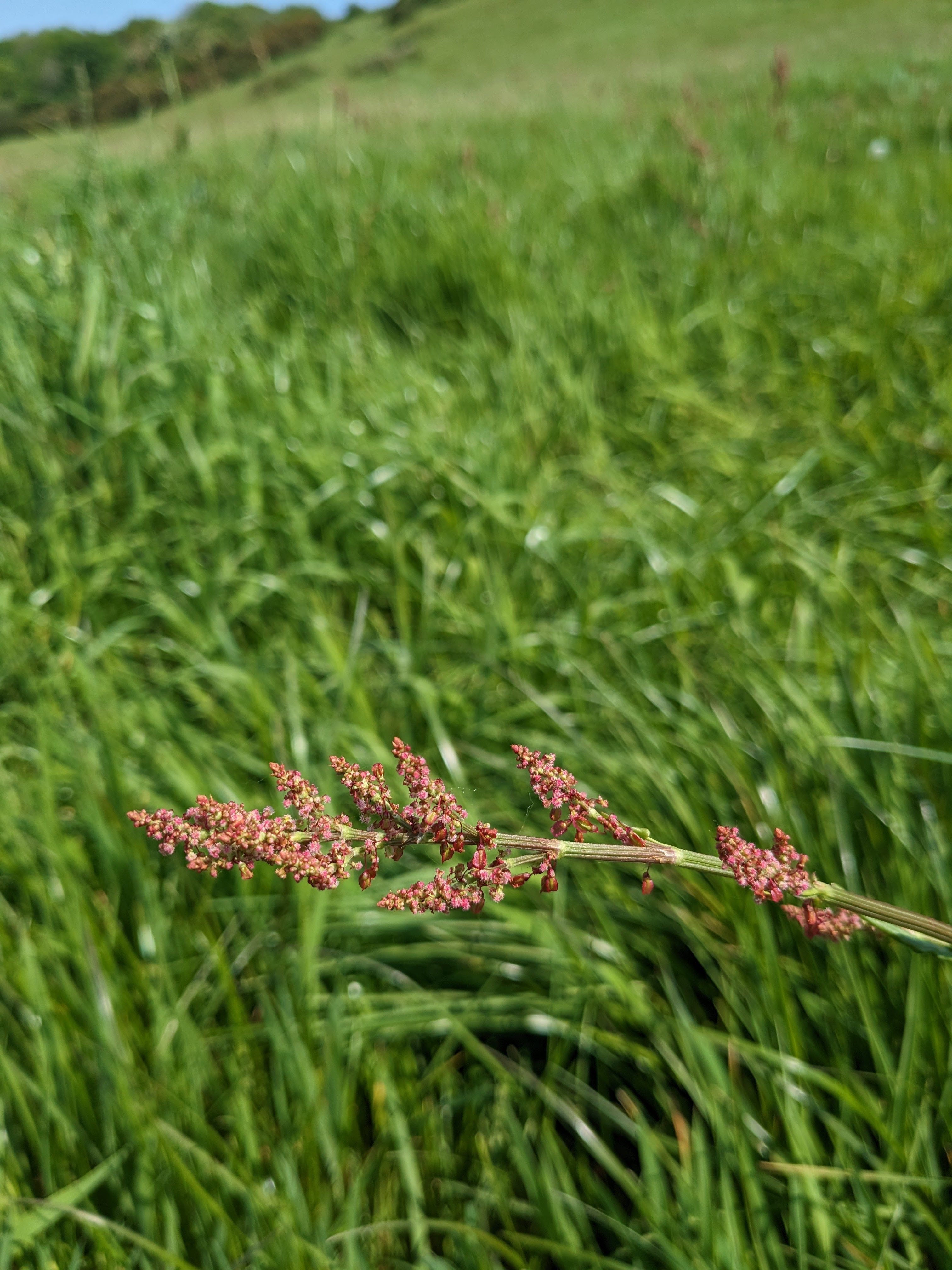
Yesterday I was idling along looking at different kinds of Dock – I was able to comfortably name three – all of them ubiquitous in this country – Broad Leaved, Curled and Common Sorrel. I could have managed a couple more but they weren’t there, but in naming them I used exactly the sensual plus procedure I described above. When I started out I almost always forgot the diagnostic powers of stroking and sniffing, until I encountered Hedge Woundwort whose crushed leaves smell horrible.
When we reached the little boatyard at Percuil we sat on a wall in the sun, looking at the moored boats when Madame caught sight of a familiar plant right in front of us. “Its Fennel” – she said – “Go and look”, and so I did. It wasn’t difficult because we use Fennel and grow it ourselves. So a roll between the fingers and a sniff confirmed beyond any doubt. But at this point the story took another entirely new turn because the BSBI (Botanical Society of Britain and Ireland), have just published an online database of all the plants, their distribution, their increase and decrease in the face of this environmental catastrophe. Thirty odd million records processed and mapped. So out came my mobile phone and with a few taps we discovered that Common Fennel is indeed very common around the coast but hasn’t been recorded in the little four kilometer square in which we were sunbathing. So that’s a new record that sits like the last piece of a jigsaw in a long coastline.
But once you’ve photographed, checked and rechecked and consulted the field guides and satisfied yourself that the name is factually correct, there’s always a remainder. A chunk of the experience that refuses to be reduced to dimensions and probabilities and pays no heed to logic and expertise. It doesn’t even have to be a rare plant – it could as easily be a Dandelion. Maybe some kind of spirituality is where that remainder lives. When all the pub quiz / trainspotter stuff is over and done, something is left that feels as if it’s mostly made from love, wonder and gratitude. A whole other sense above and beneath the tactile, the sensual and the intellectual. Maybe the beginnings of a Green Spirituality lie within this barely explored sense. The earthy, material, exhilarating phenomenon that we call Nature speaks through our senses. Here’s the orchid – still there and below that, some bits and bobs including a stunning bit of walling.
We’re back in Cornwall; this time on the Roseland Peninsula and in the campervan. We were pretty knackered when we arrived but after an excellent 9 hours and 44 minutes sleep we felt rested and ready for Madame’s favourite walk ever. This is a campsite we’ve stayed in for years and between the site and the sea there’s a bridle way about 2.5Km long lined on both sides for the majority of the way by Cornish hedges. It’s a very special environment – partly at least because you rarely see anyone on it apart from the occasional walker or horse rider.
Today we saw Red Admiral, Small Blue, Small White and Orange Tip butterflies; we saw a buzzard hunting at a little distance and later we saw a Kestrel no more than 25 m away. It was a wonderful and inspiring sight with its capacity to keep its eyes completely still over the prey, whilst fluttering and gyring in the sky.
On the way down to the sea I kept on seeing such a variety of wildflowers I decided to record them whilst walking back up the hill. There were way more than I recorded, but I made a list of forty species in the gathering rain. I was never more grateful for the waterproof pen and notebook. Many of them require further exploration but that’s half the fun. For instance I caught sight of a single Geum urbanum, that’s to say Wood Avens or Herb Bennet in the UK. The word “Bennet” caught my eye because Benedict was often shortened to Benet. So Herb Benet has a history in herbalism – probably because this ‘Blessed Herb’ found a use in herbal medicine, probably because of its aromatic root. There were also large numbers of Pellitory of the Wall – Parietaria judaica – used to treat urinary infections. Of my forty plants, twelve were either traditionally used as foods or medicines – excluding the Foxglove which will damage your heart!
They’re all common enough plants; for instance the Broadleaf Plantain travelled to the US in migrants’ boots and spread wherever they went – hence the First Nation name “White Man’s Foot”. It’s apparently a remedy for foot pain – you just wear a fat leaf inside your socks. I really should try it some time. A guide at the Lost Gardens of Heligan once showed us how you could peel off the outer skin of Navelwort – Umbilicus rupestris -with your thumbnail, and apply the sticky side of the leaf to your skin as a kind of natural plaster. I’ve often wondered whether Stitchwort is a cure for the kind of stitches you get when you run?
Anyway, on our return to the van, and when the real work began, I began to wonder whether my Fumaria could possibly be F. capreolata but, like the Polypody, that ID might demand a microscope.
I was especially pleased that my list of forty species was as long as my previous best but which took a fortnight to complete, but the price you pay for speed is a bent back and a compulsive swivelling of the eyes; not a good look.
Yesterday was just one of those days that left me almost breathless with pleasure. We were five old friends whose various relationships reach back way over fifty years; five old friendships that have seen and survived all manner of triumphs and tragedies and five human beings sharing a walk (well, more of an amble) on a stunning spring day, while we followed the course of the remains of the Somerset Coal Canal which was built to carry coal from the North Somerset coalfield to the junction with the Kennet and Avon canal, near Dundas aqueduct. For me, a light bulb went on when I realized how much of the old stone structure had survived, but Madame also had it written down as a place to return to – a lot!
It wasn’t a long walk by any stretch but we gave it several hours anyway, soaking up the sun and exploring off the path from time to time, looking at plants and rusting iron lock gate nails with equal interest; catching glimpses of the equally abandoned railway line that forced the demise of the canal. For me it’s a paradise of post industrial relics and possible sites for interesting wildflowers, and by all accounts it has some very interesting geology, which is always good news for plant hunters. But it wasn’t all green wellies and Tilley hats. C and I had a friendly bird app competition with our phones and I realized that the absence of an in-phone database meant that hers identified a Black Cap Warbler much faster than mine which was still looking for a signal. Just for interest I was using Birdnerd and C had Merlin – hers was clearly better for off-grid id’s – mine’s always worked perfectly well but perhaps I’ve just been lucky with phone masts.
Weld – Reseda luteola
There were no rarities spotted, but it was just as reassuring and pleasurable to see Dandelions, Cuckoo Flowers, Cowslips, White Nettles and Ground Ivy all flowering in profusion. The only oddity was what I think must have been Weld – Reseda luteola, AKA Dyers Weed, Dyers Rocket or Yellow Weed. No prizes, then, for guessing what it was once used for. If it was Weld I suppose that would make it a post industrial plant relic from a much earlier historical moment. Lurking up and down these beautiful valleys are the ruins and remains of monastic communities with their medicinal herb gardens and watermills, grinding grain from local farms. Far from being enjoyable just for its remoteness and quietness, you could almost feel the presence of innumerable farm labourers, fishermen, monks, boaters, miners, navvies and railwaymen, all those faint echoes flowing towards the river Avon. The horizons are punctuated by the silhouettes of grand mansions and farms such that we were obliged to consider the source of all that wealth. One of our party had long dead ancestors who were in the cloth trade and who may have furnished the backs of navvies, slaves and workhouse inhabitants. with fustian – rough but hard wearing cloth that combined cotton weft on linen warps.
We finished up – as all good walks do – in the pub where I photographed the hauntingly lovely sign at the top of this post; something I’ll come back to in a moment.
I’ve been struggling for a long time to find a way of expressing what seems to me to be a fundamental difficulty in this post-religious age. A few days ago I wrote this:
the intoxicating smell of the wet but warming earth – known as petrichor – carried the subliminal message of the season. Is there some kind of spirituality here? – something to do with being held by an embracing framework?
The trouble with words like Spirituality and Love is that they’ve been so trampled upon by blowhards, bishops and pornographers they no longer have any meaning at all except for a vaguely felt inflammation of the imagination which could be anything from a vision to a mild virus, and so writing about such things becomes an exercise in frustration; altogether lacking the tools for the job.
For me, best and most creative ideas come when the parts of a solution finally come together for no discernable reason except the relaxed mindfulness of a walk. These ideas, quite often, are not the lofty analytics of a Holmesean three pipe problem. They can seem vulgar, irreverent and occupy worlds so different it’s almost like harvesting the energy of colliding comets.
So here’s the problem – how can we find a contemporary way of expressing the content of words like spirituality and love. What kind of love, from all of the available flavours, would best express our love for the Earth in this age of catastrophe? and secondly, what form of spirituality could provide a language accessible to the religious, the determinedly non-religious and that huge population in the middle who long for a structure, a framework for understanding a way of being human that isn’t part of what’s destroying us all?
And so what about these three components?
Chef’s Ass
Calendula officinalis
The marriage service
These three rather disparate ideas have at least one thing going for them because they include a painful (but not fatal) human condition, a plant that provides a useful remedy, and a form of words that might just provide the beginnings of a framework.
Let’s take Chef’s Ass first. If you’re working in very hot and humid sweaty conditions – for instance in a restaurant kitchen, polytunnel or just walking for long distances in inappropriate clothes you may contract a very uncomfortable form of abrasion rash known colloquially as chef’s ass in the trade. I consulted our son – who’s a chef – on a possible cure, and he said he’d once tried alcoholic hand gel which turned out to be effective but screamingly painful. I hoped I could find a less extreme cure for my similar gardening related problem and turned to our home made Calendula Cream which, to my great surprise and relief worked miraculously well. It’s so cheap and easy to make I wonder why anyone would pay £15 for a tube, or resort to potentially dangerous remedies like hydrocortisones.
Calendula flowers drying in August 2020
Forget God for a moment because there’s absolutely no reason to invoke any kind of higher level supernatural powers here. The earth provides us with a multitude of effective remedies for many unpleasant, painful but non-malignant diseases. Calendula is just one example. Now the application of the cream did the trick for me, but that left me with the odd sense that I should be able to say thank-you for that help. I get exactly the same feeling harvesting our produce, eating it and sharing it with friends. That unchannelled, unfocused gratitude needs somewhere to land but all too often, like a boomerang, it circles back on itself and manifests itself as pride.
I know I’m using a religious term here but bear with me just for a moment while I explain. Pride is a very dangerous thing not least because it blinds us to our own fallibility. But collective pride – for instance in our ability to solve every challenge, even catastrophic climate change, through our own cleverness is a form of idolatry. Our thank-you’s desperately need to be channelled into something less destructive than pride.
So with that in mind I’ll turn to to some words from the marriage service which once seized me so powerfully in the course of a wedding service I was taking, that I had to stop in my tracks and recover my wits before I could continue. Each of the couple (and I’m using this example in a completely secular and non gendered way) say to one another – “All that I am, I give to you, and all that I have I share with you”. From that moment onwards I almost invariably reminded my couples that the second half of the promise was the easy bit. “All that I have I share with you” is the kind of arrangement that any half witted solicitor could organise. It’s a kind of prenuptial clause. But the second half of the promise- “All that I am I give to you” is on a different plane. How many of us have even the faintest clue what “all that I am” means for ourselves, let alone our prospective partner?
And yet the point here is that the earth has made precisely that promise to us. The earth says – “all that I am I give to you” and means it utterly, to the end. But we, in our infinite pride, forget that in this imagined marriage relationship with the earth we secretly and covetously hope to get our hands on the money and say that sentence with our fingers crossed behind our backs. There’s no more destructive relationship than a one sided and selfish marriage. This is not a religious point!
So at last I come back to the pub sign. I’m a sucker for naive paintings and a complete fool for the ones that express in paint something that the painter could never have articulated in words. Our angel, with a look of considerable doubt on her face is taking an anchor from the heavenly (that’s the hope bit) to the earthly ( that’s the anchor). When the rope breaks there’s no guide to the way back and we are lost. So to recap from the top; all those ancient voices flowing down to the river and onward to the sea were the hopes of our ancestors, lived out in the world of nature that provided food and health as best the earth could offer. It was greed and selfishness that fouled things up and because of that idolatrous worship of our own powers we now face an existential crisis.
Ironically (or maybe not), we five walkers all agreed that it wasn’t just the complete ineptitude of our politicians or the continuing impact of lockdown; the war in Ukraine, or even the cost of living that was making us depressed and unhappy. There is something deeper that wrecks our sleep and furnishes our worst dreams. Without finding a new relationship with the earth and all living things we’ll remain delusional, lonely and ultimately doomed.
Another week on the Lleyn peninsula, at the feet of the Snowdon range and jutting out into the Irish sea. The drive home was an idyllic spring journey through three mountain ranges, Snowdonia, the Cambrians and then the Brecon Beacons. I suppose we could have driven home the quick way via the motorway network but then we’d have missed the superb clear views of the mountains. On one occasion a couple of years ago we took a wrong turn and drove up beside the Arenigs and Lake Bala. It cost us a couple of hours finding our way through the Welsh Marches but it felt as if we were following in George Borrow’s footsteps as he researched for his book “Wild Wales”.
The weather was iffy to say the least, but then it usually is in North Wales, and we found sunshine and time for walking every day – which led to a surprise discovery. Coltsfoot (bottom left) isn’t rare by any means but I haven’t seen it for over a decade. The last occasion was on a bike ride along the Severn estuary when the verges were thinly covered by melting snow. It’s one of those plants which flowers before the leaves emerge and I suspect the contrast of golden yellow against the mud spattered roadside snow caught my eye. I’ve been back to the same place often at this time of the year to see it again, if only because it cheers me up to see it defying the last of winter, rather like Celandines do. It’s possible, though that I haven’t found it because it just wasn’t there – because it’s fussy about its environment, but only in the sense that (like the Twits) it relishes disturbed and unpromising environments like landslides, mudslides disturbed ground and generally mashed up land. Last week there were so many Coltsfoot plants punctuating the wind and sea-lashed mud cliffs of Porthor beach, I thought I’d gone to heaven.
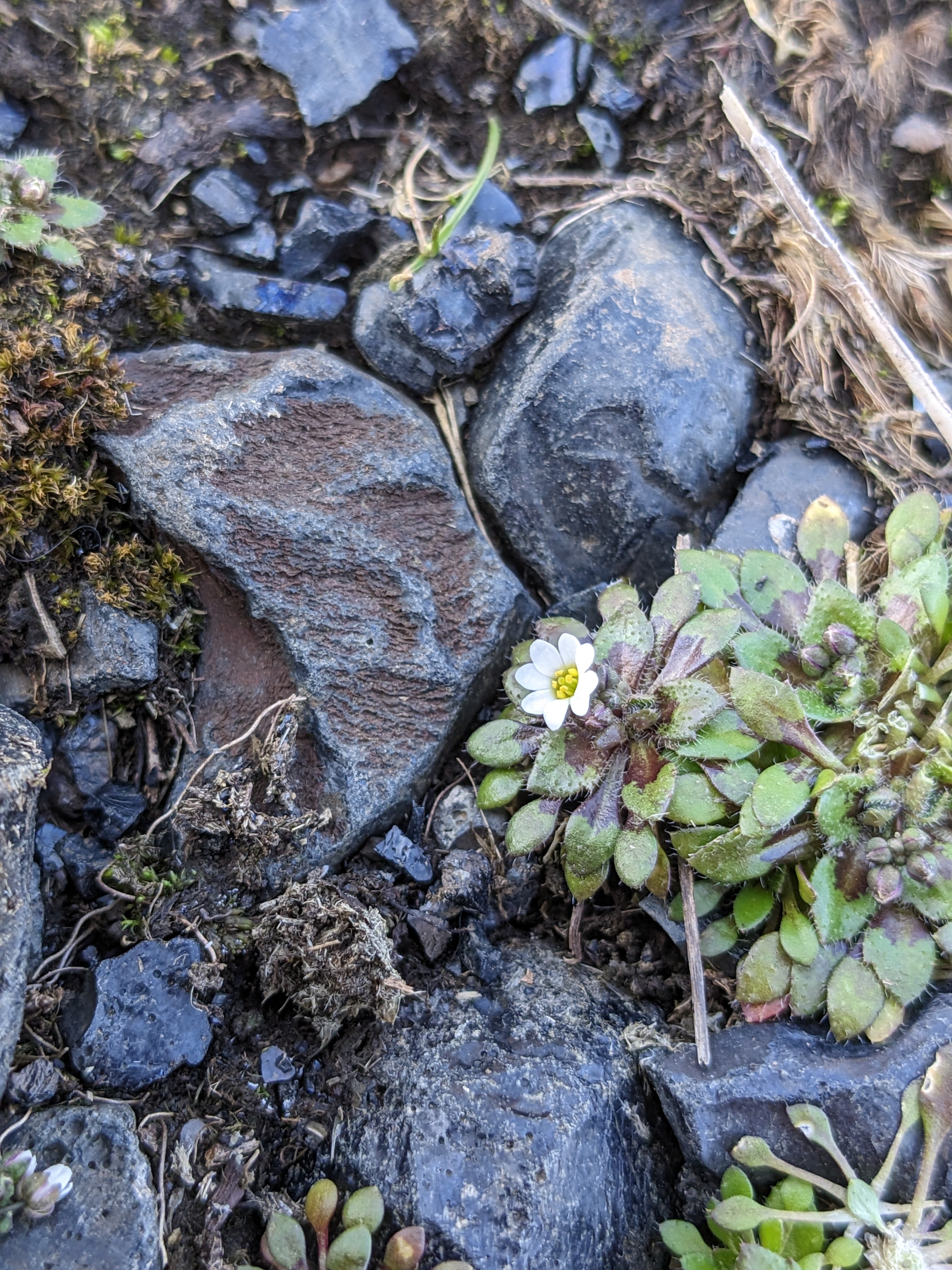
And I really like these places. Madame rolls her eyes and laughs at me when I run rapturously towards a slag heap, but here you can find some of the great survivors of the plant world. Often absolutely tiny, they make a scant living in the most unpromising places; for instance those lumps of dark rock in the bottom right hand photo are actually lead slag and in early spring, Common Whitlowgrass is among the few plants that can tolerate the concentrations of heavy metals like lead. The top right photo is of Danish Scurvygrass growing in pure sand. It’s common all around the coast, and I once chewed some (picked out of dog range) and it tasted pretty horrible – like gone off horseradish with mustard. For sailors however it was once a lifesaver due to its concentration of Vitamin C. Foragers like it for reasons best known to themselves and for them the good news is that salt gritting the roads has created Scurvygrass highways, reaching inland on verges.
Many ferns too can scratch a living on drystone walls and almost bare rocks, and so the list goes on. The adaptations to allow these precarious lives are as varied as the species themselves, and that’s the thing about evolution – it’s got time and sheer weight of numbers on its side; so many combinations and mutations to select from. One seaside favourite is the thickening and toughening of the skin – the description succulent kind of misses the emphasis that should rather lie with the plant’s capacity to resist drought, salt and all the other indignities of marginal life. Some ferns rely on what’s called apomixis – they’re self fertilised and so the minute spores can set up shop almost anywhere without fertilization by another plant – and my goodness they can travel in a favourable wind.
I get bored by formal gardens mainly because their glorious arrays are almost always the result of intensive breeding and human effort. They’re the well bred six footers who always get noticed first at the bar whilst the rest of us poorly bred peasants have to wait.
The most misused concept in farming is the idea of “improved pasture” because it’s not improved in any conceivable way- it’s just more productive in the single sense that it makes cattle fatter quicker. But the fact is that unimproved grassland yields better, stronger, far more biodiverse, health promoting and nutritious food; not just for meat production but also capturing and sequestering more carbon whilst sustaining the intricate web of wildlife – birds, flowers, pollinating insects in balance. Improved grassland is just a wasteful and expensive way of turning soil into dirt!
I don’t blame the farmers for this impasse. Decades of government policy and propaganda from supermarkets and agrochemical businesses have promoted the gods of economy, “progress” and yield, but just as the Canaanite god Moloch demanded child sacrifice, the gods of intensive agriculture have sacrificed the soil; offering only dwindling returns and throwing countless small farmers into bankruptcy and poverty.
Of course, picking up my initial thread, some plants will succeed in the most impoverished and polluted situations – which may be of comfort to those foragers who haven’t yet tried salad leaves contaminated with heavy metals. But there will be no botanists there to record and admire them. You see, to return to the idea of evolution, we have to remind ourselves that evolution carries on whether or not there are any humans around. After the barren earth and the inevitable famines, there will be plants and every other kind of wildlife, doing what my favourite plants have always done; adapting surviving and flourishing. This is the point we’re missing. If we want to survive as a species we need to follow their example and adapt the way we live until balance is restored once again.
There will always be snake oil sellers who offer fossil fuelled shares in going back to the good old days. Laugh at them. Laugh in their faces at their risible stupidity, because if there’s one thing we’ve forgotten in this scientific age it’s encapsulated in this adapted quip.
Porth Neigwl beach in a fierce onshore gale yesterday.
Here on the Lleyn peninsula we’ve had to cut our cloth according to the southwesterly weather systems that (as always) brought periods of blissful sunshine punctuated by rain-bearing fronts that threw everything bar the kitchen sink at us. The gale even found the resonant frequency of the steel chimney and periodically filled the cottage with the sound of a full Brahmsian symphony orchestra tuning up. It was quite unnerving until we worked out what it was.
But it wasn’t the end of the world – or our break – because we both had indoor things to do; sharing the dining table, with me identifying plants from photos and Madame drawing. Just how interesting this is for anyone else is a moot point at the moment because the bill for the next two years of the Potwell Inn blog just arrived and I have been thrown into introspective maunderings as I try to interrogate my own motives.
If raw visitor numbers were the sole criterion the decision would be easy because I know that this is one of those niche blogs that tend to disappear beneath the waves of controversy and narcissism. I’m not, and would never want to be an “influencer” of any sort, neither would I dare to set myself up as an expert in any of the subjects I write about. I’ve covered over the years, for instance, the allotment; cooking – especially baking sourdough bread; growing, harvesting and preserving food; wildlife, especially wildflowers and then a few branches in the road towards art, poetry, philosophy and especially global climate catastrophe and ecological destruction. Not quite in the – “an ill-favoured thing, sir, but mine own” category – I’m rather proud of it in fact – but by no means essential reading for saving the earth. My unspoken aim since I first started this as a private journal nine years ago, was to try to reflect the arduous business of being human at a time when our humanity, our survival is under threat; and lest that sounds too worthy by half I’m bound to say that I just love writing. Three quarters of a million words don’t seem nearly too many to me. I’d like to get up to a million but ………. here’s the thing …….. I wouldn’t want to get there by just focusing on my most popular subjects because – frankly – I’m easily bored. I’m a grown up and I’m sure that my loyal readers are grown-ups as well, and can cope perfectly well with a bit of complexity. I even like to think that my occasional literary or philosophical references are part of the fun. And so my readership increases at the glacial pace that would make a sloth feel pleased with itself, and I’m denied the egotistical pleasures of boasting about my immense popularity.
However, that doesn’t mean that I’m not interested in numbers. The challenge, for me, is to give myself and my interests (OK obsessions!) space to evolve and mature. Right now I’m pretty busy with naming plants, but I’m nowhere near competent enough to set myself up as an expert. I rely on a whole network of fabulously competent people to referee and mentor my efforts. They could easily write their own field botany blogs but my interests are slightly divergent from the mainstream. For instance I’m enchanted by the English common names of plants, and today as we were waving goodbye to our son I caught sight of a ferm I didn’t recognise – a very small thing. So I turned to the books and came up with Black Spleenwort. Isn’t that just beautiful? Just as Vipers Bugloss, or Lungwort and Wolfsbane are beautiful, evocative and poetic words weeping with historical associations. But if I add the Latin names to them is that off putting to non specialists? – or should I press on with them because they add a whole new depth and dimension. As my interest and knowledge deepen I’ve had to learn about huge databases, ecological niches, brownfield and polluted sites – not to mention geology, and so it goes on.
A bellringer once tried to explain method ringing to me. We were in the kind of pub that – back in the day – had nicotine dripping from the ceiling when it got crowded. In order to explain his passion for bellringing, he upturned the ashtray on to the table and drew in the slurry with his finger to illustrate the sinuous complexities of the method. I was utterly lost after the first couple of sentences. That’s just what I don’t want to do! On the other hand I once drove a blind bellringer to a tower in Winford and they rang a method which I probably misremember as Bristol Surprise and which – like the song of a blackbird – almost broke my heart with its beauty.
How far do you go to communicate that intense feeling? Well I think I have half an answer to that question. I’ve never forgotten a “joke” cracked by Canon David Isitt while I was training. We were planning a service soon after our ordination, and he said “I want you each to bring a symbol of your ministry – I’m bringing a condom!” He was so right about all too many people except himself. Too much of any kind of ‘ology’ can shut an audience down in seconds. My (entirely personal) theory is that technique and deep technical understanding are absolutely essential to creative work – BUT they should always remain hidden. No-one needs to be told how clever you are, and showing off is fatal. On the other hand the best teachers draw you into their world and encourage you to try for yourself.
So the future of this blog is under consideration, but meanwhile here are some photos of the Black Spleenwort – Asplenium adiantum-nigrum, but don’t worry too much about that. More to the point is the fact that – with a small magnifier – the world becomes ever more intensely beautiful as you look more closely. British summer time began today. Make the most of every precious moment!
If you asked me to nominate one invention that changed the world irrevocably for the better it would be the lens. My friend Chris Lee uses a telescope lens and some pretty fancy software to make the most thought provoking images of space. Most of us use cameras of one sort or another and they’re dependent on lenses of course, but today I was using nothing more sophisticated than a clip-on macro lens attached to my Pixel 6a to reveal some of the secrets of the Common Polypody fern. Those are the pictures at the top and I ran out of magnifying power at the last one which really needs at least a x100 microscope.
The others are all photos I’ve taken in the last ten days and as we looked at them we were both excited by their capacity to surprise and inspire us – not as botanical specimens at all but as objects of beauty. So the fern makes me think instantly of the Victorian fashion for the terrarium and the wonderful images of ferns made by botanical artists across the centuries. The middle row has an impenetrable blackthorn bush at Kynance Cove today which surely must have influenced Graham Sunderland in his tapestry of the crucifixion in Coventry Cathedral, but equally seems uncannily close to Jackson Pollock. The stonecrops could be models for the roof bosses of a thousand churches and if ever William Morris needed inspiration for his wallpaper designs surely the Buckshorn Plantain and the leaves of Mugwort would have served him well. The little Sea Campion has an uncanny resemblance to Tiffany glass; the rosettes of emerging Hedge Mustard are a glorious reminder of symmetry and the catkins – well I just love the colour. Nature’s palette is incredibly restrained and yet limitless in its applications. Whilst I was learning some botanical illustration, we did an exercise of limiting ourselves to three colours and I never subsequently saw the point of using more.
Almost exactly seven years ago I set myself the challenge of painting a Hyacinth in flower. I took hundreds of photos and practiced drawing the flowers from every angle; above, below and from the side and with light falling on them from different directions. I still have the practice drawings and paintings but I abandoned the painting because it was just too complex.
The take home point for me was that minute attention to the detail of a plant, whether flower or leaf was both meditation and scientific exploration and linked deeply with the creative process. Hard, then, not to attribute natural form to some benign guiding hand. But these days I think that’s a shortcut and a cop-out. I’m happy with not knowing because for me, doubt was always the beginning of faith. The lens takes us to places we never even suspected to exist and that’s why it’s my nomination for the world’s greatest invention.
and a postscript to this piece. As we walked up the valley from Kynance Cove we spotted what looked like a (too) small buzzard sitting high on the crest of the rocks. We tracked up the footpath and came level and behind it and we could see from its beautiful chestnut brown back that it was actually a kestrel as it set off in a zigzag hunting flight across the valley. There was a bitterly cold northwest wind and it must have been puffed out viewed from below, but there was no mistaking its colour as it set out with what Gerard Manley Hopkins described as its “wimpling wing”. Cue “Windhover” – one of his finest poems.
The first Celandine of spring – or at least the first we’ve seen.
A great friend and mentor of mine; a parish priest like me, was leading the graveside prayers at a burial service when he lost his footing and very nearly went down with the coffin. He was held firmly by one of the pall bearers who whispered in his ear “Wait your turn, Sir – wait your turn!”.
It would be comforting to think of nature as a basically static display of plants that come up in the spring and die in the autumn. Except it isn’t like that at all. The emergence of the first spring flowers depends on a whole heap of factors like ambient temperature, day length, amounts of sunshine and space to grow. This year, for example, the first Celandine we saw was here on the Lizard exactly as it was last year, but 13 days later. That was it – the only Celandine in flower in a five mile walk. Look closely at the photograph and you’ll see that there’s another plant there that’s growing fast enough to steal its sunlight in a week or two. Cleavers is an extremely vigorous climber – you’ll know it from the burrs that stick firmly to most clothes by way of the tiny hooks which were the inspiration for Velcro.
Look closely at the hedgerows around this time and you’ll see the first leaves of many plants which follow in strict succession right through to late autumn, and all timed like a glorious firework display to flower and fruit in their unique optimal conditions. Not all buttercups are buttercups and not all dandelions are dandelions (in fact they’re so complicated they can’t even make their own minds up). Some will flower for weeks and with others you can blink and they’re gone. Nothing stands still for a moment in nature and for me the first Celandine is both a joy and a warning that from now on it’s an unstoppable torrent of flowering and fruiting that will change the whole appearance of fields and hedgerows every couple of weeks. The succession of the plants ensures that each one has its own space. Cow Parsley gives way to Hogweed and so forth. It can be exhausting trying to keep up, especially for Madame who will beg me to leave the notebook and hand lens behind and just go for a walk . I note, however that she always takes her binoculars out – “just in case”.
Today we started on the Lizard Green and walked down the lane to Church Cove and then took the coast path as far as Housel Bay and then turned off to avoid a monumental flight of steps and took the easier path to the back of Lizard Lighthouse stopping for some food and then back to the car park. Ten years ago we’d have bounded up those steps without a care, but one of the less talked about advantages of getting quite old is that we walk rather slower and so we see much more. This was a walk we tried to do on Saturday but the coast path was rammed with runners doing a 100 mile ultra marathon. I bet they’ll be walking slowly with ultra knackered knees long before their 70’s.
Anyway, the short cut was marvellous because we caught sight of a very big Buzzard eating his/her kill on a Cornish wall. Within ten feet of the Buzzard there sat a lovely Carrion Crow waiting apparently unafraid until the superior hunter got bored with lunch and flew off – whereupon the crow hopped sideways along the wall and polished off the remains. That was surprising enough, but half a mile later we saw the same two birds repeating exactly the same routine. It was clearly a relationship of more significance to the Crow than the Buzzard but I suppose the crow – Corvids are among the smartest birds – probably reasoned that it was best to keep your friends close and your enemies closer. There was no way that the Buzzard could launch a surprise attack from ten feet. But whatever the rationale it looked as if both birds were in fine health and as fat as butchers’ dogs – which is the closest I could get to an appropriate metaphor.
Ulex europaeus
There was another surprise on the walk because I’ve been spending some time trying to identify a species of Gorse called Western Gorse – Ulex gallii. It’s one of the plants that are plentiful around the Lizard and Kynance Cove but rare everywhere else; but which is very similar to its larger cousin Gorse – Ulex europaeus. The difference between the two comes down to size – ordinary Gorse is bigger; its thorns are longer and deeply grooved, like the one in the picture. But the clincher was (note the past tense) the fact that Gorse ordinaire flowers all year round, but Western Gorse flowers in summer. Or at least that’s what the books say, but unfortunately plants don’t read textbooks and today we found hundreds of Western Gorse plants around the coast path, and many of them were in flower.
Ulex gallii
The Lizard peninsula has two things going for it. One is its unique geology which gives a home to hundreds of wildflowers some of which are only found here. The other thing derives from its geography. It’s the furthest southerly point in the UK and it enjoys a unique climate as well. It’s warm. On first seeing it many years ago it looked completely wild and windswept – and indeed it is, but its warm microclimate means that some wild plants better suited to better to warmer places actually thrive here.
Good news too on the recording front because the County Recorder emailed yesterday and accepted both records I’d submitted. I’ve already posted a picture of the little perennial Leek – Babington’s Leek yesterday. He was kind enough to say that I’d found two sites where it hasn’t previously been seen. The other plant was a real outrider – Wireplant, Muehlenbeckia complexa a New Zealand visitor and that one passed as well. Three more little red squares on the national map.
Approaching retirement I often wondered what I would do to fill my time. The idea of voluntary work often came to mind but I never fancied any of the options because many of them felt like not retiringat all. But this combination of allotmenteering and field botany have turned out to be my happy place. Spring? Bring it on!
Roughly translated that lovely piece of Bristolian rudeness means spin on that one Jack – or in received pronunciation – I think I was right after all, old chap!
So before we came down to Cornwall I had high hopes of finding a few interesting plants because there’s nothing quite as rewarding as getting a tiny square on a species map attributed to you by name (not that anyone except Q or some equivalently highly placed person would be able to access it). I wrote yesterday about the trainspotter infection and today the fix I needed arrived by email confirming my records for two plants that are pretty rare because they only grow here. They are Muehlenbeckia complexa AKA Wireplant, top left going clockwise; which is – in botanical terms – a recent alien from New Zealand but which hasn’t been recorded for 12 years; and then Allium ampeloprasum var. babingtonii – Babington’s Leek which is also known at the site but I found two new previously unrecorded nearby sites for it.
It may be a bit counterintuitive but in the botanical/ecological world, a plant doesn’t exist if it’s not recorded – which can be crucial when designating protected sites. But in January there aren’t many flowers to go by so we have Poland and Clement’s “The Vegetative Key to the British Flora which is basically a book of leaves”, and very good it is.
Records, however can’t be entered before they’ve been verified by a proper botanist and so we humbly present our finds with photos, measurements and all the rest; submit them and wait for the confirmatory email. Luckily the County Recorders are a brilliant bunch and very friendly , especially to beginners, and so being corrected becomes a positive learning experience rather than a crushing humiliation.
And so it came to pass today that I got the confirmations and two little red squares appeared on the national map. A matter of stupefying unimportance to the mentally sound population but in Chris Packham’s terms worth a good thigh rub! Sadly, Babington’s Leek is sold in packets by many seed merchants but for me that doesn’t diminish the pleasure of finding really wild ones.
So a short but jolly post tonight and tomorrow looks sunny so we’ll be out and about seeing what we can find. Madame has a wonderful eye for plants – we make a perfect team.
We set out to double check and photograph a patch of wild leeks that we found a couple of days ago and which I’ve never seen before so we needed to document them properly with grid references and detailed photos in order to get them double checked by the local County Recorder. There is a kind of trainspotter sickness that can grip you when you get into plants but fortunately it’s a sickness whose symptoms are air punching for no apparent reason and feeling absurdly happy even on a cold grey day in winter.
Glistening Inkcap, Coprinellus micaceus
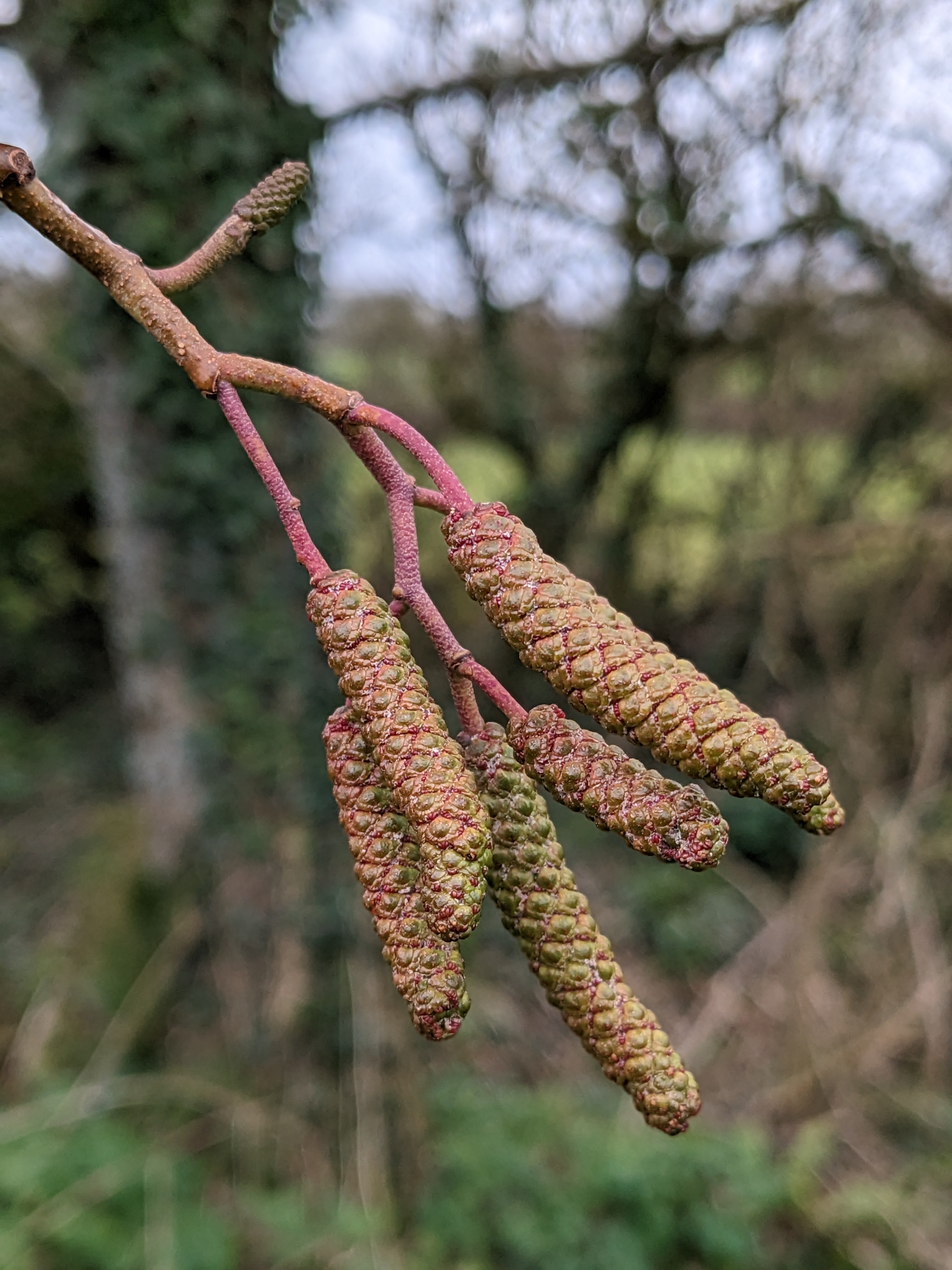
The secondary reason was the competitive urge to find a Celandine in flower. The results of the New Years plant hunt, organised by the Botanical Society of Britain and Ireland are coming in and the general impression is that this is a rather late season. Last winter we photographed them in flower down here on 17th January and by the look of the leaves today we’re running a fortnight late this year following the continuing bitterly cold weather. We did however find a lonely violet – not my strongest subject but Sweet Violets, Viola odorata are the earliest to flower. Winter Heliotrope were in flower too and a solitary Cyclamen was hiding at the top of a hedge bank which – while photographing it – provoked the strong perfume of wild garlic under my feet. There were abundant purple catkins on an alder tree. In the fungus department we spotted a Glistening Inkcap on a moss covered log.
More than anything, seeing the growing leaves of a multitude of other flowering plants made me wonder how many terawatts of sheer green energy are sitting there underground waiting for a daylength and temperature signal to let them burst forth. Hemlock Water Dropwort doesn’t look half as dangerous when it’s vibrant green and only a few inches tall.
As for the very local Wild Leek, we await the verdict from the County Recorder but here are the photos we sent to him. Cocoa and toasted saffron cake were consumed.