Think of your Sole

Fishing boats hauled up on Cadgwith beach – January 2022

A couple of days ago I mentioned the sinking of the Crig-a-Tana off Cadgwith last November and the rescue of the two man crew by the Lizard Lifeboat. Both men were ironically members of the lifeboat crew and even more darkly ironically the boat was named after a pretty vicious looking reef off Kuggar called Crig-a-tana rocks. The sinking of the boat had nothing whatever to do with the rocks because she went down 6 mile southeast of Bass Rock and they are waiting for a report from the Marine Accident Investigation Branch to discover what happened. Fishing and farming remain two of the most dangerous industries in the country.

Anyway, all best wishes to the crew who have been through a horrendous experience, but this raises once again the insecurities and dangers that the inshore fishing fleet have to contend with, and lends support to the idea that unless we support these industries by buying their produce they may not survive for the future. Interestingly the Government published their proposals for the ELMS scheme today – this is a payment support scheme that offers farmers subsidies in return for public goods – like environmental schemes. Once again the big arable farms will be able to claim most of the subsidies while small farms and hill farms will be competing for the scraps. I needn’t mention again the betrayal of the inshore fleet by the brexit debacle.

And that’s why we at the Potwell Inn try to buy as much as possible of our food from local sources, preferably direct from the producers and bypassing the supermarkets. With that in mind we trogged off to Porthleven yesterday for a walk and to buy some fish. Who knew that fish are seasonal? I sort of knew it in the recesses of my mind but when we got to the fishmonger she had some Lemon Sole on display, as well as Haddock – not a major fish around here, and of course crabmeat. Lemon Sole are bang in season at the moment and I think I must have cooked them badly at some time in the past and never bothered again. Madame on the other hand absolutely loves them so we bought a couple of fillets each of Haddock and Lemon Sole (more expensive!) plus a tub of mixed white crab meat with the brown splodgy bit). The brown meat is much cheaper and yet it’s full of flavour. So we’ve been gorging ourselves on fish, which in Cornwall has sometimes been tricky in the past – because apart from supermarkets you never see it fresh. Unlike the Continent, the local fisherman don’t sell their catch off the boat as a matter of course.

So ÂŁ23 for three meals seems a lot, except fish prices have escalated; but think that we paid ÂŁ6.00 for the crab meat and made three rounds of crab sandwiches which would have cost something like ÂŁ30 in a cafe. We also lashed out on a ÂŁ10 bottle of Muscadet which would have been marked up to ÂŁ25 or ÂŁ30. That looks like value for money to me. The haddock, which we had for supper cost about ÂŁ8 – compared with ÂŁ15 a portion for fish and chips. Then we had the Lemon Sole today – dusted with seasoned flour – and simply fried in butter and olive oil. The trick is to hammer the skin side until it’s crisp and then turn the heat down and turn the fish for a minute – it cooks quickly. Once again delicious with 1/2 bottle of cheap Albariño. Learn to cook – it’ll save you a fortune and you’ll eat like a Russian oligarch!

Seasonal fish isn’t always to everyone’s taste – I love Cod Roe – which is almost unobtainable now due to the complete absence of any other customers. You can buy smoked roe for taramasalata at almost any time but the raw roe probably looks too much like a pair of giant testicles to attract the faint hearted. These were the last I ate, seven years ago.

But the take home point is that fish have their seasons and like every other food it’s best to eat them while they’re ‘in‘ and when they’re local because they’re that much fresher and come without a contrail of air miles.

But we haven’t just spent the past few days eating. I finally got to scrambling up a cliff path to a patch of promising looking gorse and managed to identify the two most common gorse species in this part of the world. Growing next to each other made it relatively easy tpo see the differences and I’m reasonably sure of my ID because the larger Gorse/ Furze Ulex europaeus was in flower and the smaller Ulex Gallii – Western Gorse wan’t, and it fitted most of the other descriptors. Clive Stace – who must be obeyed in all matters botanical – demands the mean of ten measurements of certain flower parts before identification is made – but since one of them wasn’t in flower and wasn’t expected to be in flower until June I decided not to wait. It is quite absurd, the amount of pleasure to be gained from nailing the names of two plants so similar you need a magnifying glass to distinguish them but honestly it’s the best fun you can have while keeping your clothes on. Naked botanising among gorse plants in a brisk offshore wind is an overrated pastime. Finally, just to complete my joy I noticed a Cornish Heath nestling among its taller neighbours. I believe some vulgar botanists refer to this as a slam dunk. Here they are.

The biblical “Last Trump” probably sounds (and looks) a bit like this.

The Lizard lighthouse foghorns
Is Cornish culture on its last legs?

I can’t find a single photograph I’ve ever taken of the Lizard Village. We’ve visited it many times and, in the past camped there; in fact yesterday we saw a decommissioned helicopter parked incongruously in the paddock of a farm where we once washed ourselves in with nothing more than a cold tap and an outside privy. The post office where we waited for an emergency bailout from my sister has closed; the pub where I tried to sample every whisky and ended up knocking myself half senseless (the other half had already gone), on a low beam – closed. The little restaurant where we spent the last of our money and I tasted guinea fowl for the first time, closed. The only supermarket has gone and the last of the serpentine turners appears to have turned his last lighthouse ornament and then turned up his toes. The trippers still arrive like locusts in the summer and strip any green shoots of the old culture bare, so everything is distorted and could ultimately be destroyed by tourism. There’s barely a pig shed in Cornwall that’s not been converted into a holiday let or an airBnb, and hardly a spoil heap that’s not been turned into an “experience” by a small time entrepreneur.

Years ago John Betjeman described the Lizard as depressingly full of buildings like army married quarters, and it hasn’t improved over the past 50 years. The only remnant of our first ever visit is the Regent Cafe on the green where, a few summers ago we saw a poster advertising the ancient Cornish sport of whippet racing.

All that said, we still love the knackered old place and come back year after year because a short walk beyond the village takes us to the coast path and the lighthouse whose fog horn is a thing of wonder. I’m sure I permanently damaged my hearing, sitting as close as I dared when it was working and listening to the fan starting up and build steadily until an almighty blast straight from hell poured into the air and echoed all around the surrounding bays. It hit you in the belly and rattled your teeth; the tinnitus lasted for hours afterwards then there was silence. For a while.

Why so, then? As politicians often say “I’m glad you asked me that” and then go on to talk about the new cycle lanes they’ve personally fought for in their constituencies. Cornwall’s a mess but nobody could argue it’s all the fault of the English or the tourists. The road improvements to the A30 and the A38, and many other important infrastructure and cultural projects were paid for by the EU which the Cornish voted in force to leave. The fishermen who were especially keen to regain our sovereignty soon found that they could no longer afford to sell their fish in a Europe from which we’d separated ourselves. Some skippers known locally as slipper skippers sold their boats to the scrapyard and their quotas to the Spanish who repaid their naivety by dredging the sea empty. The NHS failed to receive the promised ÂŁ350 million a week and the GP surgery in Lizard is now in a single tiny prefab building, and in spite of the enormous success of the lost gardens of Heligan and the Eden Project which have brought money and good jobs to the poorest part of Cornwall, when Tim Smit tried to open an education centre in Lostwithiel the objections from the locals poured in and the project looks like being scrapped. It seems that finding a future for Cornwall other than hospitality and seasonal homelessness is rather like the kind of hopeless task presented by what Michael Balint the psychoanalyst called “heart sinkers”.

All of which mournful thoughts floated around in my mind during what I thought was a terrible night but which my Withings watch scored at 100%. Re -reading Fred Pearce’s “The New Wild” recently I began to wonder whether our negative attitudes towards invasive plant, insect and animal species didn’t find an exact parallel in some of our instinctive responses to tourism. These attitudes in humans draw from deep wells. Apparently just as the English tell jokes about the Welsh and the Irish and never fail to wonder at the meanness of the Scots – none of which stereotypes have any foundation in fact; the Russians make fun of the Ukrainians, and we all know where that leads to; so the Cornish refer to out of county visitors as “grockles” who, given a moment’s reflection, are the one reliable source of income in a county which has lost virtually all of its traditional employment. The tin and the copper mines are gone. Fibre optics will probably mean that the copper market will never really gain strength. Fishing is largely gone due to overfishing which wasn’t all down to Spanish supertrawlers. The quota system is the bastard child of overfishing in the face of all the evidence.

Looking around there are no obvious replacements apart from tourism – I’ll probably get hate mail for this – so right now, any attempt to go back to some imagined past by legislating against the one reliable source of income is doomed to fail. The lithium mine being proposed is about the last thing Cornwall needs at the moment. The specialist workers may well be brought in from beyond the Tamar and in any case if you add in the principle that the polluter pays the environmental damage and the excessive use of water ought to scupper the project on the drawing board. The world needs what Cornwall needs – better mass transport systems and less cars on the road and a new vision of fulfilled life.

Living in Bath can feel a bit like living in a theme park at times but without the tourists (and the students) the local economy would collapse. We have become inured to the shock of crossing Royal Crescent in front of a battalion of portly Roman re-enactors, or weaving a course down Milsom Street between 100 variations of a Jane Austin character. I don’t suppose the Cornish are any more pleased at seeing people queuing on a beach to take Poldark selfies.

The Lizard is a real botanical hotspot as well as a half legendary miasma of once upon a time gallimaufry. In two days I’ve found a couple of real rarities and one local newspaper recently latched on to the possibilities of enticing visitors here with a different quarry than ice cream, pasties and fish and chips. Writers like Fred Pearce are arguing that alien species often bring new and vital energy to an ageing or damaged ecosystem and simply eradicating them is an expensive way of doing even more damage.

Changing the profile of visitors would be slow work and the massive problem of housing shortages would need a great deal of new affordable building alongside restrictions or (as in Wales) financial disincentives to second homes. Schemes like Tim Smits proposed Lostwithiel education centre need to be encouraged whilst perhaps steering them away from the NIMBY strongholds. There will need to be a huge emphasis on secondary and tertiary education because farming and fishing will remain profoundly important to the local economy, but embracing ecologically sustainable methods would pay a premium. Of course this would cost money, but the UK government seems to have ÂŁbillions at their disposal for lining their rich mates’ pockets.

And let it never be said that the village communities are now broken beyond repair. We were chatting to a woman in a local Farm shop who told us that a local fishing boat had sunk just before Christmas. Luckily the crew of two were members of the lifeboat crew and did all the right things but spent 20 minutes in freezing water before they were rescued by their mates in the lifeboat. Within days the community had rallied round and raised thousands of pounds to support the two men who now had no means of earning a living. A few years ago the same village crowd funded the purchase of a vital building on the seafront that had been used by the fishermen for generations. What these threatened communities need more than anything else is a long term plan and the long term funding to bring it off.

Old Watermill in Poltesco.

It’s tuppence for the plant and a tenner for knowing where to find it.

Cadgwith in winter

Back again in a very special place but with little expectation of finding many of the wildflowers that make the Lizard peninsula one of Britain’s botanical hotspots. We come here in the winter because it’s much cheaper and not crowded – it’s as simple as that – but in a month or two the great explosion of wildflowers will begin; some of them quite unique to this area. For now we were hoping to spot the earliest Celandines and perhaps one or two other bits and bobs that sometimes defy the season. John Wright; writer and forager doesn’t really rate this time of the year. We saw young shoots of Sea Beet and there are Jelly Ear fungi on some of the Elders but for foragers (I’m not one of them) he says January is a poor month and February is “much the same only worse” . For a while the Facebook site of the British Mycological Society has specialized in readers’ photographs of mouldy rice puddings and cakes. Most of the time it’s an amazingly useful resource for learning fungi. Yesterday we spotted lots of emerging young leaves – Cow Parsley was one, and one or two plants were even in flower; Gorse flowers in every month as does the Red Campion, if it can find a sheltered spot. Alexanders are in early leaf, seven or eight inches high and we spotted some lovely Narcissi, escaped from a garden. Not much need for the flower guide at this time of the year but if you like that kind of thing Poland and Clements have produced a very useful “Vegetative Key to the British Flora.” which – if you like quizzes will keep you amused for hours in the winter. We were just happy to be out in the cold wind and the sunshine.

As we walked down to Kynance Cove where the cafe was unexpectedly open I shared a lump of fruit cake with a Rock Pipit that was very nearly hand tame – so tame in fact that I wondered what bird it could be that looked so much like a Rock Pipit but which behaved more like a Robin.

Walking down I also caught sight of an unfamiliar plant that looked like Heather but just wasn’t right. I ignored it and we carried on down to the Cove’ but on the way back I paused and looked again and realized that perhaps I knew what it was – in one of those ways that you sometimes just know something without knowing how.

I think this is probably Cornish Heath, Erica vagans

I’m taking a risk but I’ll say it’s probably Cornish Heath, Erica vagans; but I’ll readily concede to a better botanist. What’s exciting – if I’m right – is that it only really thrives here on the Serpentine rock of the Lizard. Checking on another website I see it can be found occasionally further up-country but it’s plentiful here on the Lizard and it’s one of Stace’s two star rarities. So (again, if I’m right,) we did manage to spot at least one local hero.

Which prompts a thought. We’re constantly reading about what a good thing it is to be out in nature. Now I know nature lights me up but I’m all too aware that a lot of people pass through it in search of an ice cream without noticing a thing. I don’t blame them because our whole culture teaches us from childhood that nature is lovely to look at, but not that we are a part of it. Naming other beings is far more important than cataloguing them. Each old plant friend we meet provokes a moment of recognition and reflection. Each greeting is a moment of meditation on the sheer diversity and beauty of the plant world. Could it be that the much written about benefits of nature are somehow related to the release of endorphins that comes with a meeting – “Hi I’m Dave, and I think you must be Erica vagans”. Cue warm surge! There must be a PhD that’s looked at this surely? Here are some more photos. The Alexanders on the top left has a kind of gall I don’t think I’ve ever seen before but I think it might be some kind of Phyllocoptes.

Pristine? Virgin? – is it time to give these concepts a break?

Mine rake on the Mendip Hills

Reading Fred Pearce’s book “The New Wild” again this week I felt uncomfortable. As he listed some of the less glorious attempts of some conservationists to turn back the clock in the hope of recovering the pristine environment, a voice in my head was shouting – what about Whitefield in Dyrham Park? what about those glorious wildflower meadows in North Yorkshire or – closer to home the hills surrounding Bath? The main thrust of his book is to say – look here, nature is fast, adaptive and highly dynamic. Trying to hold back change by micromanaging nature reserves and SSSI’s is an expensive path to nowhere, so we should maybe step back and give evolution a chance.

But then, as I pondered my instinctively hostile reaction, I thought of Eddie Cox – my first and best childhood friend – and our adventures and exploits out in the wild as children. Wild, for us, was post industrial; brownfield and, on reflection, very dangerous; but if our inner landscape is furnished by early memories then my young imagination was furnished by crumbling nineteenth century buildings, an abandoned dram road running back from the river to abandoned coal mines; paths hard packed with waste from the nearby fireclay pipeworks; mineshafts we could drop stones down, the old Cattybrook brick kilns whose flues we could wriggle up and watch the sky above the chimney and surrounded by spare and half starved soil. There were rows of miners’ cottages whose original occupants were long since dead.

Our environment – although we were far too young to understand it – was a palimpsest; one historical layer superimposed on another. At the surface were us baby boomers navigating the fragile demilitarized zone between our parents’ wartime experiences and our own unknown futures among the remains of an industrial revolution that had run its course. Below us and also around us were the remains also of a wealthy woollen industry; the unrestored magnificent houses of slave owners and place names which went back to the Domesday Book. Amidst the burgeoning post-war housing estates where we lived, were sacred wells and ancient footpaths. The older local people knew the plant names but often worked in the last of the factories; Douglas motorcycles, Vespa motor scooters and the ubiquitous small workshops supporting the local shoe industry – all now gone.

Rodway Hill

So what was my pristine? Well as sure as hell it wasn’t rare orchids and wildflower meadows. My grandparents left their smallholding in rural Oxfordshire and came to Bristol before I was old enough to name a plant. My first ecstatic memories of plants were all from Rodway Hill; a gruffy outcrop of sandstone where I would lie amongst the tussocky grass and inspect the Harebells. The memory has its own inscrutable hot links and my idea of the pristine was forged from these unpromising elements. Orchids and wildflower meadows came much, much later.

So what I dredged up from the sediment of my mind as I pondered Fred Pearce’s book was the reason for my attachment to these post industrial landscapes and their flora. When we walk down Velvet Bottom or almost anywhere else at Charterhouse I feel at home because in that complicated subconscious way I am at home. When I look through the albums of photographs of plants I’ve taken, less than half are what you might call proper wildflowers; the rest are the waifs, strays, stragglers and thugs of the plant world who’ve learned how to live with little light, food or soil, or being constantly trampled by walkers, peed on by dogs and strimmed off by zealous council workers. Some of these plants have developed the capacity to live on mine waste polluted by heavy metals. They’re often tiny little things with tiny un-showy flowers but you can’t help but admire them for their tenacity.

When I run over the list of our favourite places like mid Wales, Lizard in Cornwall and so the list goes on; they’re all post apocalyptic post industrial landscapes. Yes of course, walking through a meadow and totting up twenty plants in flower is a wonderful experience, worth a day of anyone’s time – but according to Fred Pearce and many others including Richard Mabey, the old post industrial brownfield sites have become haven and home to multitudes of flora and fauna which can no longer survive the inundation of their native habitats by the plough and with chemicals. The point is – nature is showing the way to adaptation. We humans, who created the anthropocene and can’t survive a day without our mobile phones, need to accept that there are no good old days because the peregrines nesting on the spire of St John’s church here in Bath have made the transition already.

Gerard Manley Hopkins was right – nature is not a steady state phenomenon constantly needing repair – it’s a Heracletian fire”.

A lovely meal and then a lurch into the unknown

Bath Natural Theatre Company strutting their stuff in the early 70’s

We were there – well not there in the photograph, but around at the time and living near Bath – which made lunch last week with one of the original provocateurs and his partner a total joy. Most young people probably think we’re a bunch of old farts who never did anything interesting – after all the world was only invented when they came along – but here’s the evidence – complete with incriminating photos and only mildly bowdlerized accounts of the fun and games that went on. There was a serious side to the counterculture because it helped mobilize public opinion against the Buchanan Plan which was contemplating the destruction of one of Bath’s most historic neighbourhoods in order to build a huge road. As it was, a great chunk of old Bath was demolished in favour of ugly flats – now a local crime hotspot – a habit which has continued with the recent Crest Nicholson Western Riverside development which would make a Russian bonded warehouse look good. There’s a well known polemic called The Sack of Bath written in 1973 by Adam Fergusson which also threw a spanner into the planners’ designs and undoubtedly helped save Bath from wholesale destruction. Interestingly we bumped into his daughter in a bar in Hay on Wye in December. She was very proud of her Dad who’s still alive. We need him back here!

A lot of last week was taken up haggling with recalcitrant software. As ever the obvious problem with my mobile router never occurred to me until I’d tried everything else out and wasted vast amounts of energy shouting fruitlessly at a lump of space junk whose only fault was an expired SIM card. Of course, somewhere at the back of my disorderly mind I’d known it all along, but – hey ho. The router will soon be needed as we get the campervan back on the road. After a couple of years of Covid when we often couldn’t use the van, we’d seriously considered selling it. It costs a lot of money just to leave it standing in a compound doing nothing and we thought it might be better to spend the money on trips. For one whole evening we even thought we’d buy an interrail pass and spend six months back in Europe. The downside to these utopian plans was always that we have a family, an allotment, the Bath Nats and a pile of friends we like to keep in touch with. In the cold light of morning and whilst putting the empties out, Plan A sounded a bit naff because what we really really enjoy is to park the campervan up on a site somewhere quiet and remote in the midst of a wildlife hotspot – like Mendip or mid Wales for instance – and go walking, birdwatching and plant hunting. So the plan was shelved with the two of us in complete agreement that we needed to keep the van.

The campervan’s been standing idle since we got back from St Davids in September and whilst we agonised over it we also neglected it a bit, so as well as software wars we also took ourselves down to the edge of the Severn to get the batteries recharged and to empty out the cupboards and generally get it ready for spring. We soon found that the upholstery had got very damp, the sink needed repairing (again!) and the mice had raided for nest building materials although a thorough search failed to find any nests; cue much more irritable spluttering and rummaging through tiny spaces at the expense of bashed elbows and a sore head. Ah – life’s rich tapestry – we thought as we lumped an 80lb generator and our dehumidifier into the car along with a spare battery and a heap of tools.

However, amidst all these distractions I also managed to spend time getting my head in gear for plant hunting in a few weeks time; checking out useful databases and maps and scouring lists. I do love a good list – this may be some kind of symptom. The upshot of all this botanical fantasising was that at the AGM on Saturday I volunteered to join the Council of the Bath Nats, thereby turning my retirement resolution never to join another committee – on its head. Naturally (it’s a voluntary organisation) my offer was warmly accepted and after a brief moment of undeserved pride I fell into a pit of self-doubt, bordering on imposter syndrome. The members of the Council are just so much more experienced and knowledgeable than me, they’ll find me out in a moment. Another sleepless night.

The van’s called Polly – it’s a he!

And so today has two tasks; to go back to the van and figure out how to carry out the necessary repairs and to run the dehumidifier for a few hours now we’ve remembered to put some petrol into the generator. Then I need to get a new data SIM and get the router working and sit down with Madame and plan the seed order for the allotment. We’ve already agreed to simplify and to concentrate on low maintenance plants to give ourselves more time for the other things we like to do. Then there’s marmalade to make as well. Who knew retirement could be so exhausting?

2022 Review part 1 – my descent into terminal nerdery.

The highlight of my year may seem a bit weird

I know exactly how I got here. The seeds of this addiction were sown on the day I realized that not all Dandelions were in fact Dandelions because there were plants like Hawkweeds and Hawkbits and such great multitudes of other lookalikes that I despaired of living long enough to name a tenth of them. Then, when I was working as a groundsman – (all graduating art students have to find some kind of job to pay the rent) – it was in the playing fields of Clifton College that I got lost in the Speedwell zone and gave up. Then 24/7 work took over for 45 years because, believe me, the gig economy was alive and well in the 1970’s (I only got my first proper full-time job when I was 40) and at times Madame and me were each doing three part-time jobs. Then with three boys to feed and clothe, any plant hunting was confined to holidays in Pembrokeshire. I loved my work but I also longed for some space to devote to the natural world and especially plants and fungi.

So when we retired we brought my big collection of underused field guides and a head filled with the extraordinarily evocative names of plants I’d never actually seen. I can still remember coming across Vipers Bugloss for the first time on a clifftop in Tenby and being completely bowled over by its beauty.

As soon as we moved here we joined the Bath Natural History Society – which was the best move we could have made because by going on field trips and attending lectures by real nationally recognised experts our understanding began to increase exponentially; not least because we found that the experts we got to know were eager to teach anyone who showed an interest. Added to that, a course in botanical illustration reconnected me to my artistic background and reawakened my interest in intense observation, plus my longstanding interest in herbal medicine which I’d never been able to explore in depth. These three factors combined: drawing and painting, really good mentors and a passion for wildflowers and their uses, set me on the road which four years ago finally resulted in a head on collision with a plant that’s universally known as a bit of a heart sinker. It was on the allotment site just a single plot up from us on an abandoned plot.

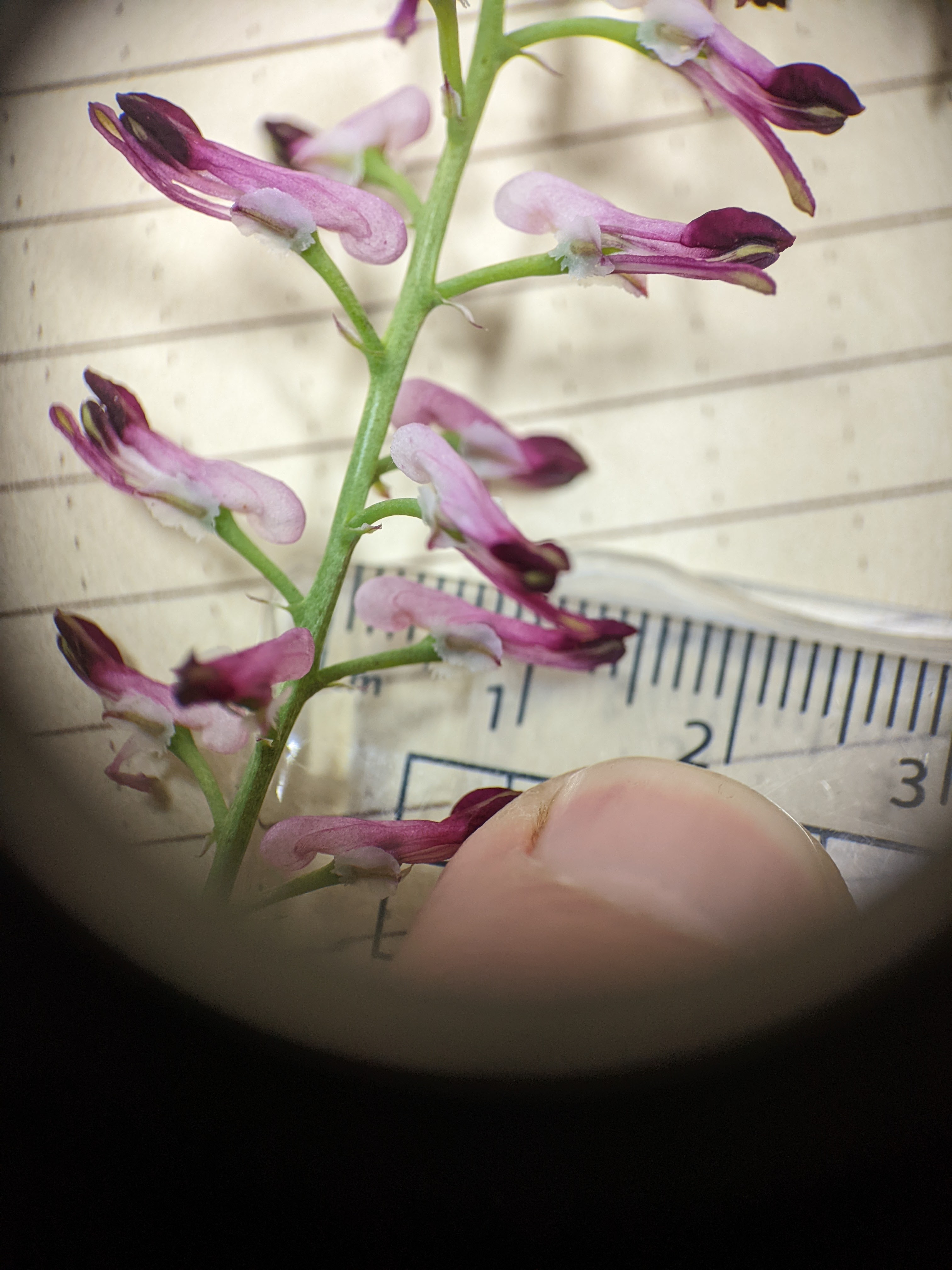
This is not a tale of derring-do on a precipitous cliff face or hacking my way through a jungle. This pretty plant practically threw itself at me about five feet from our path. It was tall – a couple of feet tall anyway, rambling, fragile and faintly resembled a sweet pea flower but the leaves were wrong. I got the genus name right off – it was a Fumitory, a Fumaria ‘something or other‘. but to get the species was a world of woe away. Once I’d spun my head a few times in the field guides I knew that getting the species right was way above my level of competence. The differences between the ten British and Irish species are very small and demand experience, accurate measurements and even a low powered microscope. So I turned to a friend – Rob – who’s way better than me and – bless him he wandered up to the allotment and his ID was pretty provisional, plus I didn’t think he was keen on volunteering to carry a burden that was rightly mine. I’ve lost count of the number of times I’ve had cause to be grateful to someone who has given me the confidence that I’ll eventually be able to solve a problem.

Happily we had a lovely holiday in Cornwall this year and the coast path yielded two slightly different Fumaria species which, by that time, I’d learned to key out for myself. I photographed, inspected and measured them before submitting them to the County Recorder who to my great surprise accepted both ID’s. By this time I knew which parts of the plant demanded that intense attention to detail I wrote about earlier, so I sent off for the BSBI monograph on Fumitories and suddenly the light began to dawn. However there was one further obstacle to overcome. Confirmation bias afflicts keen amateur botanists as much as it wrecks the judgement of players in any other discipline. There’s no point in picking the rarest of a bunch of species and then only looking for evidence proving the hypothesis. But refusing on principle to believe that your specimen is that rare plant is equally daft because – well, it might be. My Fumaria by this time had migrated into the garlic bed and was wreaking havoc in the leeks. The word “ramping” attached to some of the species is more than appropriate.

Eventually, after much head scratching it occurred to me that it might (just) be Fumaria bastardii – a thought that I squashed immediately because even a cursory glance at the map showed that it just didn’t grow here. So I sent the photos and measurements to the North Somerset County Recorder suggesting it might be Fumaria Capreolata. She emailed back and said she thought it was more likely Fumaria Muralis but also suggested I send the details to the National Referee for Fumarias and very quickly he replied that it was Fumaria bastardii var. hibernica – the very one that doesn’t grow here. So – going back to the photo at the top, there’s now a list for this area on the national database which includes my solitary record which I’ve highlighted. There’s also a single red square on the map that gives the approximate location – this is done to protect vulnerable plants like orchids from predation by collectors. And finally I had an email saying my find had got on to the Somerset Rare Plants list as well as on the annual Bath Nats report.

The key point in all this is that if I can make a small difference, then trust me – anyone can. My little find is only rare here in Bath – in Ireland for instance – it’s everywhere; and I couldn’t have got near it without the knowledge and skills of three volunteers who gave me the time to finally get the ID. My biggest contribution is in noticing the plant and then banging on about it. I’m stubborn and I don’t like being beaten!

So my main – possibly entire – indelible contribution to field botany might well turn out to be a single dot on a map, and I’ll settle for that. Nerdery has its own rewards and my sense of pride in getting that dot on the map more than vindicates the hours I spent achieving it.

All’s well on the canal

Winter Heliotrope – Petasites fragrans

Exactly as I predicted there was a really good showing of Winter Heliotrope on the Kennet and Avon canal today. As we walked to the first deep lock the river was in full spate and at its most dangerous as we went along, and in places the banks were flooded. At Pulteney Weir the steps had disappeared and water was shooting upwards like a fountain as it curled back at the river bed. Heaven help anyone falling into that maelstrom – they’d have no chance at all. The eddies and deep currents seem to illustrate constantly changing anatomical illustrations of the musculature of unknown beasts. Fallen logs lifted helpless arms into the air, like Excalibur, and all the while there was a dangerous sound – far from the comfort of waves and waterfalls but the fretting water feeling for any weakness along the bank. The boats moored alongside the footpath were lifted high on their moorings. Any higher and they’d start to list into oblivion as the water flooded in. The canal, of course, is at one remove from all the mayhem and there’s a more peaceful regime altogether.

Once again we revisited the walk that kept us sane during the lockdowns, and in Henrietta Park an ever reliable tree stump was growing Oyster Mushrooms and what I think was almost certainly Silverleaf Fungus as well as the usual Turkey Tails. Further back in the park the magnificent trunk of an old pine looked especially beautiful. Hundreds of walkers were out and about celebrating New Year. We were passed by one crocodile comprising upwards of 20 walkers – no doubt a rambling club. It’s crazy how easy it is in England to assign social class to whole groups. I remember once taking a midweek communion service which usually had about four or five communicants but on this particular Wednesday the Lady Chapel was full to the brim with identically dressed, late middle aged men in tweed jackets and flannel trousers. It could have been a Monty Python sketch. Afterwards I asked them who they all were and they told me they were all High Court judges on a course in the hotel next door. Today’s walkers were equally monocultural. Several of them wished us a happy new year in clipped received pronunciation and I relapsed into full churl, willing my cheek muscles into a rigid smile as I responded with imperceptible grace.

It was a joy to find plants and fungi to identify at this time of the year. Even the vivid green of new foliage brought a foretaste of plants just waiting in the earth for the kairos – the appropriate time. Alongside the river a large group of Long Tailed Tits kept themselves busy in the branches of trees overlooking the cricket ground. On the other side at St John’s Church we not only saw a pair of Peregrine falcons on the tower but also heard their unmistakable voices. Before we’d even taken that unusual sight in, a pair of herons fled downstream in their prehistoric way, and later a couple of cormorants flew downstream as well. All this in the very centre of the city.

Back home again I cooked the last of the Christmas leftovers and we had an early supper. Below are some of the things we saw.

Spring in my step at last

Sea Campion, Silene uniflora -photographed near Gunwalloe church 18th January 2022

It really shouldn’t be a surprise because it happens every year, but suddenly the thought of another year’s joyful plant hunting is filling my mind. The photograph – taken in Cornwall – is proof that spring is just around the corner and I am so looking forward to it; sorting out the books and maps and planning our visits to try and maximise our chances of finding one or two rarities amongst the old friends. When we go out plant hunting in the company of the vastly experienced Bath Natural History Society leaders I can only marvel at their sharp eyes and encyclopaedic knowledge, but they are so willing to share their expertise I’ve realized that half the battle is learning to access the databases that are available to anyone with an interest in plants, so now we go out equipped with maps and lists which save endless wasted time looking for plants that just aren’t there.

Is this sudden shift in mood just down to day length? Is there – somewhere in my brain – a sensor that, just eleven days after the winter solstice, sends a signal to somewhere else in my brain, telling it (telling me) to clear the decks? Is there a causal relationship between day length and the fact that I just opened Google Photos and searched for images taken in January? Is there an underlying hormonal link between this rain soaked day which lasts just a few minutes longer than it did a fortnight ago? – because I’m quite certain that it wasn’t opening the application that led to the shiver of anticipation but the reverse. Opening the photo album merely confirmed what I already knew – somewhere deep inside – that Coltsfoot, Celandines and Sea Campions will be there waiting in a couple of weeks when we return to Cornwall. I remember, one December, visiting my Spiritual Director, a truly radical Roman Catholic Sister. I was full of woe and feeling thoroughly sorry for myself and she told me that I probably just needed some sunshine.

Now we’ve moved into a (very small) city there won’t be any Plough Monday celebrations and I’ve no idea whether the Littleton Cider Club will organise a Wassail in the orchard behind the White Hart that Madame once helped to plant; although I have heard that the cider apples were very small this year, and so full of sugar the resulting cider is fearfully strong. I’m sad that I’m no longer involved in all those ceremonial markers of the farming year but it seems that my mind is still ahead of the game without any need for dressing up or handmade prayers.

It’s New Year’s Eve. We shan’t be up late – but tomorrow morning the old year will be vanquished in all its economic and political stupidity. Half our Christmas cards this year have contained critical remarks about the state we’re in, and that’s something I don’t think I can ever recall happening before. Is the serpent awakening? Tomorrow looks grey, with more seasonably cold weather returning, but Monday will be sunny, briskly cold and we’ll be out like plant hounds – sampling the air with cold noses and thick sweaters and greeting each tiny promise of new growth with hoots of pleasure.

I’m tempted at this point to quote Mother Julian’s “All will be well and all manner of things will be well”, but there’s got to be a caveat because of course unless we change course, things will not be well at all. The government will tell us that there’s no alternative but only a fool would believe them. Madame and I have the tremendous advantage of being old enough to have lived some of the alternatives to the way we do things around here (one of my favourite definitions of culture). There’s no state sponsored cure for the challenges we face because turkeys don’t vote for Christmas (or Thanksgiving)! The answer may feel as if it’s occluded by anxiety and sorrow but it’s there, waiting to be rediscovered and it looks a lot like a successful human community rescued from the debilitating clutches of the Gradgrinds, the curators and gallerists and all the other gatekeepers defending the system against artists and poets. We’ll banish the ambitious and the greedy and those who have never even discovered their own shadows, let alone learned to live with them. We shall only escape the tyranny of spreadsheets, efficiency curves and economic growth when we refuse to play that game and return to joyfully experiencing of the riches of nature without giving anything an economic value. We’ll get back to singing, dancing and feasting together in ways that defeat all the categories of sponsored division and to a community where Jacob Rees Mogg and his pals will have to make a thin living as pantomime dames, being laughed at in village halls and impromptu community centres all over the country: what a wonderfully cheerful thought.

Here are some more January 2022 photos – Happy New Year.

Where wild means wild!

How about watching a family of long tailed tits; great tits; several robins; nuthatches; blue tits and a wren in about ten minutes of pure rapture, looking out of the kitchen window – 900 feet up a hill on the Brecon Beacons? Autumn gets to me – that’s no secret – the reasons are so obvious that I’m not even bothering to rehearse them here; but there always comes a time, often a single day, when the black dog slinks away and feel I’ve turned a corner.

I haven’t written for a while but that’s not because I’ve been sitting in the corner weeping silently (not my style) – but because we’ve got the allotment largely under control, and we’ve spent hours and days fungus hunting. I’ve been interested in them for years but this year we’ve gone into hyperdrive; photographing, identifying and recording these beautiful and fugitive life-forms. Fungi live on decaying matter; they also share resources with plants and trees and – at this time of year especially – are the tangible evidence of the ever renewing web of life beneath the fallen leaves.

My friend Nick who graciously let me play with some serious machinery.

And so we came up to stay for a couple of days with old friends on the Brecon Beacons where they keep a smallholding. Feeding the pigs and the chickens, moving the sheep around and helping out around the place – oh and eating the freshest eggs and the best organic produce; planking and planing seasoned oak from the woods; keeping the stove going; cooking together with food grown and raised less than a couple of hundred yards away and talking, talking, talking. These are truly – and I’m avoiding the therapeutic clichĂ© – renewing activities. In between showers, the sky cleared and the sun shone through the raindrops, illuminating the landscape with pinpoint jewels of refracted light.

At night the Tawny owls called to one another over the sound of the springwater filling the cistern outside our bedroom in a musical series of spurts and sputters. Even the sound of a dog barking down the valley in the darkness engorges the imagination. The autumn ground was a pointillist painting in ochres offset by dazzling yellows and reds and buzzards and carrion crows called overhead. For three days we escaped the tyranny of linear time and allowed ourselves to be embraced by the greater and lesser cycles of sunrise and moonrise; season and lifespan.

Sheep on the horizon – looking as if they’re about to charge us

Even the farmhouses have their span. In the year I was born, just after the war, this cottage was derelict, and for the past thirty five years we’ve watched it come to life under the care of our friends. It’s been a home, playground and a natural history mentor to three generations of children and their friends. If intuition and imagination aren’t included among the senses how we are ever to understand how neighbourhood, community and mutual aid, along with an understanding of our vulnerability and finitude are the foundation to our flourishing. Yesterday evening we sat in the old parlour and talked by the light of the only remaining gas mantles I know of. The mantles themselves now cost something like ÂŁ14, but this isn’t a life of self indulgent luxury – their car has done 220,000 miles.

On Saturday we visited a couple of community projects in the village. One of them was an orchard run by the Marcher Apple Network which is a voluntary charitable organisation set up to preserve traditional apple varieties from the Welsh Marches.

They have collected and grafted all sorts of almost unknown apple varieties on to modern rootstocks and have begun to set up a DNA database so they can be identified and propagated through grafting – as a service to the future. I have to confess to scrumping a few, and trust me, they’re not all utterly delicious! One of Madame’s first jobs after leaving Art School was working as a trials assistant in a cider research station and so she was in seventh heaven as we walked around photographing some of the apples for our records. While we were there a couple of young people from the local community run pub were picking up windfalls for the apple bobbing at their Halloween party. This village is rich in community projects. You’ll see below why some apples have rudely descriptive names such as Goose Arse and Pig’s Snout

Possibly one of the ugliest apples I’ve ever seen.

Then we went up the hill to a community run woodland which we scoured for fungi and found quite a few we’ve never seen before. One of the best things about being a relative beginner in any field is the fact that even very common and well known species are exciting first time finds. A fungus like the Panther Cap – deadly poisonous – takes on a whole new reality when you’ve got down and dirty photographing it in a rain soaked woodland. Our friends were generous enough to scout the wood for new fungi for us to see – we had a ball – and then finished up down at Llangorse Lake drinking tea in the cafe as the clouds gathered over Pen y Fan.

So what could be better than eating with friends? Well cooking with them surely comes to the top of the list. I cooked one of my party pieces – Carbonnade Nimoise, and with a free run of the food stores we used some hogget leg steaks. Hogget is lamb in its second year, so it comes between lamb and mutton. Most butchers give you a funny look if you ask for it but it’s worth searching for. It’s more expensive than lamb because it’s been fed for an extra season but the flavour is marvellous. Oh what a weekend!

So here are a few of the fungi we saw – they’re not named because we need to check and double check, but they are so beautiful that they need no justification at all.

And yes, the one at the bottom is almost certainly a Panther Cap – greatly to be avoided when you’re foraging! In fact its neighbour in the centre is almost as bad. The lesson is – never forage unless you’re with someone who really knows what they’re doing (so don’t ask me!). And if you recognise the only innocent one in the ID Parade – good for you. And I hope you’ve had as much joy from finding out as we have.

As for us, we drove home contentedly with a couple of big bags of fragrant sheep daggings in the back of the car. It’s an acquired taste I know, but they’re better than Chanel Number 5 for arousing a compost heap!

Forbidden fruit?

As I began to write, Madame was eyeing up this bowl of quinces and wondering what to do with them. At the moment they are filling the room with the most wonderful fragrance. However as she was Googling possible uses, she informed me that they are thought (by some people) to be the fruit eaten by Adam and Eve in the Old Testament. Other (equally benighted) people – think it’s the apple. My goodness how awful that would be, if we could have avoided all that suffering if they’d just turned down the chance of a scrumped Bramley. Sadly, if people actually read the Bible instead of furnishing their prejudices with it, it was neither the apple nor the quince that introduced sin into the world – according to the incredibly important mythical story. The tree in question – and I quote – is the tree of the knowledge of good and evil.

A short diversion into dangerous territory

The power to determine between good and evil – or to remove the terms from their religious frame – right and wrong, is almost the only power not awarded to Homo sapiens in the Old Testament and it’s the usurpation of that power by fragile, impatient, greedy and none-too-clever humans that has been the Granddaddy of all the pain and suffering ever since. It’s called idolatry and it’s the almost universal temptation to worship the partial over and against the whole. And that’s my considered view as a card carrying Post-Christian lost soul!

It may seem anachronistic to brandish an ancient myth in a modern scientific and rational culture but – to risk just one more spadeful before the hole closes over my head – I’d say that idolatry is a greater danger now than it was in the past, except we are more inclined these days to worship ‘rational’ idols like The Economy, Efficiency, Productivity, GDP and so on, and these false gods come disguised as common sense. The high priests of this death cult wear suits rather than robes but make no mistake, they wouldn’t care if they reduced the earth to ashes and humanity to slavery as long as it turned a profit.

Back to Quince and Redlead Roundheads

It may be SAD (Seasonal Affective Disorder) – or perhaps it’s a perfectly rational response to the impotence of our democracy to find anyone with more than half a brain to find the way back from the cliff; but this time of year always gets to me. There’s something inherently melancholic about the allotment which – until we clear it – is populated by the ghosts and skeletal remains of crops past. Angelica, Lovage and Sunflowers have passed into dry senescence, their seeds eagerly consumed weeks ago by birds and mice. After a drought-blighted summer, we went away for a couple of weeks and returned after the rain had encouraged a billion weeds to burst into new growth. The patch of Common Ramping Fumitory amongst the leeks, which I’d reprieved because it’s rare round here, had repaid my generosity by swamping the bed; I suppose there’s a clue in the name! Slightly late, we spent yesterday clearing and sowing winter salads which would stand a chance if the autumn is warmer than average. However average weather is an increasingly fragile concept as climate change moves into its terminal phase.

On the bright side, we dug potatoes and beetroot – we’ve been blessed with the best ever crops this year – and as I carried a box of apples up to the car, Madame disappeared for five minutes and then reappeared with four quinces, foraged from a neighbour’s tree. Neither of us have ever seen such a huge crop on that tree before; there must be hundreds of ripening fruits there. We’ll email her and ask her permission to take about ten pounds for jelly and, perhaps, marmalade. Meanwhile they’re a far better fragrance around the flat than the stuff that comes from an aerosol and makes your eyes water.

As for the Redlead Roundhead fungus, it was hiding under a wayward clump of Catnip and my eye suddenly caught a glimpse of bright red – hence Redlead – lead oxide. The battered specimen in the photo hardly does it justice, but it has an interesting backstory because it seems to be a species from Australia and although it used to be quite rare, the fashion for woodchip (its favourite food) for mulching and paths has given it a new lease of life.

The life of the allotment is the perfect antidote to the terrible modern myth that time is an evolutionary straight line where everything except us humans – the allegedly most highly evolved – is an exploitable resource. Real life, away from the trading floors, is cyclical, seasonal, rich and vulnerable; dependent upon wind and weather. Old Pete – something of a fixture on the allotment – leaned over the fence as we were packing up. “It’s a bit of a mess” – he said. I responded, through gritted teeth, “Well we’ve had the best crops ever this year”. Nature – real nature – is glorious, extravagant, messy and governed by relationships that the new high priests will never begin to comprehend. It’s just too immersive; there are too many variables, there’s too much about it that challenges their grey reductionist orthodoxy. So we choose not to throw in our lot with their nasty little gods. The Potwell Inn is on the side of the natural mess.