Meanwhile, back on the farm ….

I rather enjoyed dating the damson vodka “April Fools’ Day”. As spring advances, we feel the urgent need to do something useful with the produce which we abandoned to the freezers last autumn because we were tired and wanted a break. That’s the biggest danger with freezers. We chronically overproduce on the allotment and then use the freezers to hold the surpluses until we can think what to do with them. Consequently the 5 kilos of damsons were removed from cryogenic storage last week and were turned into 2 litres of damson vodka and 11 lbs of damson jam. The last couple of kilos will become damson ketchup early next week. They were a gift from a friend on Severnside who didn’t know what to do with them either. His tree is old and marvellously productive and ours is just two years old and may take 15 years to bear any serious quantities of fruit – by which time I’ll be 91 and possibly too wobbly to climb ladders! I seemed to have inherited from my mother some kind of Jungian shared trauma which impels me/us to bottle, pickle and jam at the mere sniff of a plum, ‘because we might need them one day’ .

Of course there is an upside to this. I curl my lip at recipes for instant pickles in the glossy supplements because they just taste like raw veg with vinegar on them. If you enjoy the feeling of your taste buds doing a Mexican wave inside your mouth then be my guest. I prefer to make chutneys and pickles, label them and pack them away somewhere so hidden they come as a complete and marvellous surprise 2 years later when we find them just coming into their prime. Plums, green tomatoes, mixed vegetables and damsons all make lovely chutney but our absolute favourite is a Delia Smith plum chutney called “Dower House Chutney”. Immediately after it’s made it tastes like paintstripper with chilli sauce, but after a couple of years at the back of a cupboard it’s the go-to for anything with cheese – dark, rounded and perfectly blended. The same goes for the ketchups ( we make all our own).

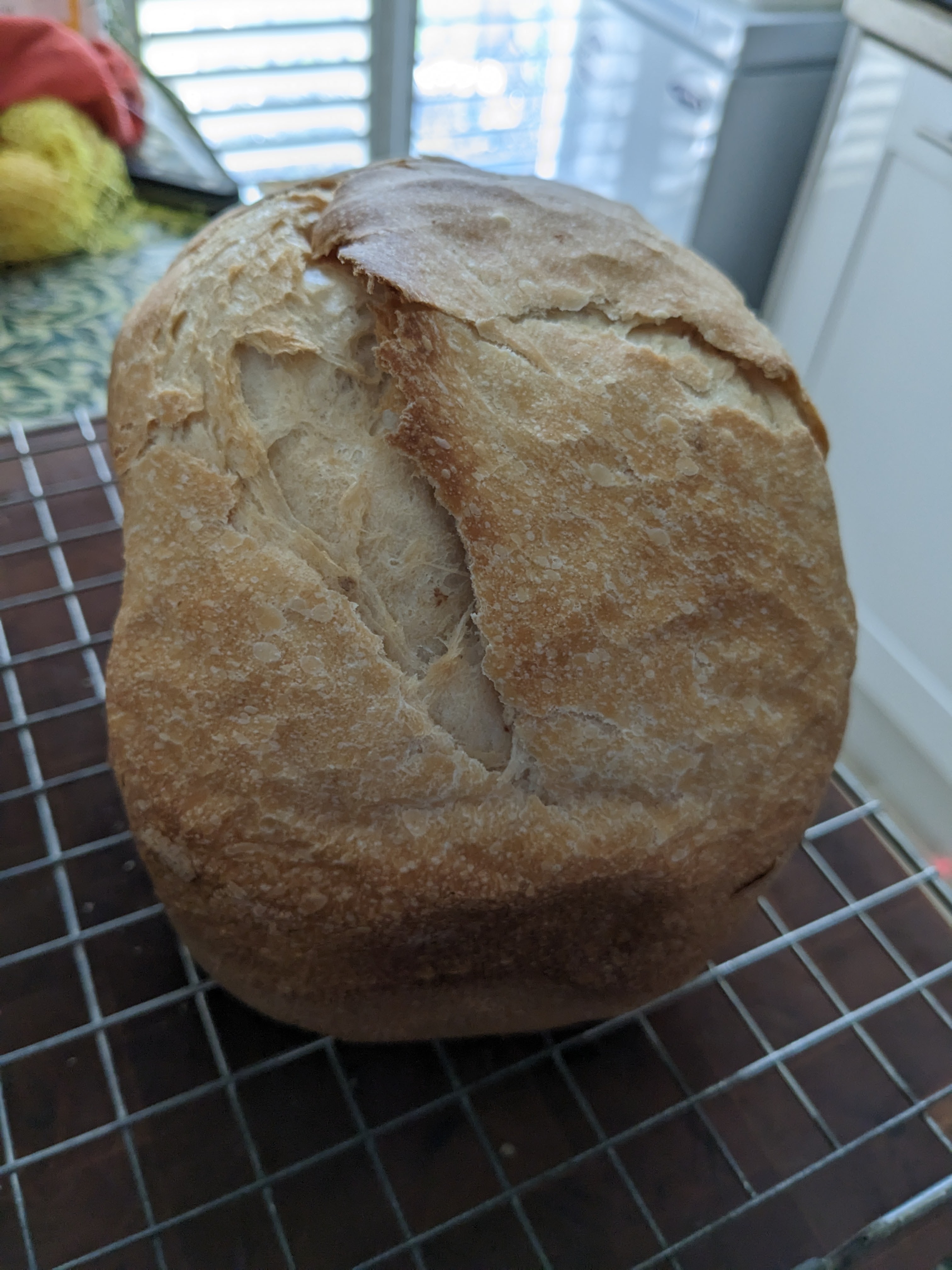
Damson jam is my favourite breakfast treat after marmalade. I don’t think we made any last year – at least we haven’t found it if we did! – and so it was a joy to have some again. Unlike pickles and chutneys, jam is ready to eat as soon as it’s cool. The vodka is blissful after dinner. The books say to strain the fruit off the vodka and sugar after six months, but once again we’ve sometimes left it for well over a year and extracted some of the almond flavour of the stones – giving a much more nuanced and darker taste. Sloe Gin, which we also make, needs a couple or three years to reach its state of grace so the vodka is an easy standby. The other couple of photos are of some bread and a lemon meringue pie that I was practicing for a family meal on Easter Sunday – (I’ve never made it before).

I haven’t written much about the allotment recently simply because the wettest March since records began was a bit of a deterrent. But a few brighter days have made it possible to almost complete the spring preparations whilst we eat spinach from the polytunnel and parsnips, leeks and parsley out of the ground. The potatoes are chitted ready to go in on Good Friday – that’s tomorrow – as per long British tradition. It’s a bit of a daft tradition because Good Friday – as does Easter Day – wanders around all over the calendar simply because solar and lunar calendars can never quite sync; so for the church festival and for allotmenteers we revert to the lunar calendar for planting potatoes. Kind of Steiner lite, you might say.

The broad beans are in, the asparagus is just shooting and the damson (our damson) is in flower. Gratifyingly, the fruiting buds on the apples are looking hearty and – this is down to Madame – beautifully pruned. So it’s all looking good for another season. As I finished bottling the jam the other day, Madame was musing whether we might be that last generation to have learned these skills. On the other hand, our middle son and his partner are keen cooks and gardeners (well he’s a chef, like number three). And post lockdown there are far more young people on the site – which is marvellous too.

The first Cowslip this year, in Alveston Churchyard.

There’s nothing like a day on the allotment, with the sun on your back. It can lift the heaviest gloom. For some fine weather gardeners being tempted out for the first time this year, the plots may look a bit overgrown and neglected but that’s just nature doing what nature always does – healing its wounds. Although most of the time we don’t dig but just cultivate the surface; some infestations like Couch, Bindweed or Creeping Thistle really do need to be dug out carefully. That can be hard work, but the robins will come and keep you company and a host of birds will visit the turned earth and eat some pests (so long as it’s an occasional digging and not an annual religious ritual). We think too highly of ourselves if we come to believe that the Earth depends upon us for her vitality. Quite the reverse is, in fact, true. It’s we who depend absolutely on the incredible generosity and healing power of the Earth.

In which I reveal the true identity of Uncle Jim.

Lone canoeist on the river at dusk

I picked the photograph carefully by typing “river” into my photos database and going through them carefully, waiting for the spark to happen. This was it; the Potwell Inn expressed in a single image. Incidentally my sister once told me off because, (she said), every time I wrote a lyrical piece I would throw a spanner in the works at the last moment, as if I couldn’t bear the thought of a happy ending. It was a reasonable criticism because, on reflection, that’s something I often do. Yesterday I read a single page of an essay concerning grass written by John Ruskin. I thought it was so gushing and overheated that I counted the adjectives on a single paperback sized page and there were 25. As I wrote a couple of days ago, my inner eye could scan the grasses on Mendip or – let’s say on the Lizard with interest, but alight with joy on a heap of mine spoil or bare serpentine rock. My defence would be that I’m far from being pessimistic by temperament; it’s experience!

The Potwell Inn is, and always was, my safe place. Since I read it as a set text at fourteen years old I’ve never lost the liberating sense of delight when Alfred Polly, the hero of HG Wells comic novel stumbled upon this idyllic pub with its own ferry after running away from his own bungled suicide which (long story) resulted in inadvertently burning his hated shop down and heroically rescuing an elderly woman from the blaze. From that moment all my ambitions centred upon finding my own Potwell Inn and my very own landlady. Someone – was it William Goldman? – once wrote that the structure of all great adventures is the Grail legend; the search for an answer to the question “what ails you?” – the one question in life that can never be answered through introspection.

The fact that sixty years later I chose the Potwell Inn as the name for my imaginary happy place, should be an awful warning to parents, teachers and economists about the power of stories. But there’s another thread that animates all great stories and that’s threat and release. Love is only truly love because it always ends in loss. Bereavement is the price we pay for flying, like Icarus, too close to the sun. If you look carefully at the sidebar you may notice the odd category “Uncle Jim” which I hardly ever use, but refers to the threat of annihilation by the large woman’s drunken brother. His threats are comical, but the menace is very real, and occasional confrontations (and dunkings in the river) only end with Uncle Jim’s accidental death wearing Polly’s jacket; relieving the unhappy Polly of his identity and allowing the new beginning he’d dreamed of.

So in one sense, the idea of the Potwell Inn as a safe place is only partially true. Which brings me back to the photograph. The canoeist in question is not paddling – as you might imagine – towards a magnificent sunset. The light floods across from the huge and mythically unlovely blocks of flats that were built on the old gasworks site across the river from us. Grossly overpriced, jerrybuilt monstrosities that resemble Russian bonded warehouses. The old gasworks site on what’s been named by an overheated copywriter as “The Western Riverside” was an ecological hotspot as well as providing a wide wildlife corridor towards a brief strip of countryside – awaiting ‘improvement’ from an ambitious architect with a couple of prisons under their belt. In my view that’s a crime that unites Gerard Manley Hopkins’ “Binsey Poplars” with John Masefield’s “cheap tin trays”. [sorry – this is a rant so no prisoners!]

But the threat element of my story goes further because the Potwell Inn of my imagination is also bordered by the river on which my canoeist paddles; but this real river is carrying more than its share of human effluent – the telltale signs are the ice floes of detergent foam that signify that someone – in a treatment plant somewhere close – has dumped another load of shit into the vicinity of my safe place.

I worry that my frequently elegiac rendering of the Potwell Inn distracts from the reality that Uncle Jim, who regenerates more often than Doctor Who, currently wears an expensive suit and loves to entertain Councillors and Planning officials at party conferences : – ( it’s all in the declarations of interest so no-one need bother denying it).

It’s too much – sometimes – this sense of threat. One of my producers once said that my best writing was in the lyrical style. Well yes – but the lyricism of mine and much current nature writing is in danger of becoming politically useful greenwashing. When was the last time I heard a cuckoo? In North Wales last week we were both startled with joy at the sound of a cuckoo which turned out to be no more lyrical than the dishwasher doing its rhythmic thing. The last real cuckoo was probably five years ago on our friends smallholding on the Brecon Beacons. How long will it be before we forget altogether?

On the other hand I’m having a bit of a fern binge at the moment and we found loads of Wall Rue on the wall outside the flat. How ironic that in my previous post I wrote about the way the plants and insects will outlive us when the catastrophe finally happens. Today I’m thinking how unutterably sad it will be if the only witnesses of the unfolding tragedy are dead?

Life on the edge

Another week on the Lleyn peninsula, at the feet of the Snowdon range and jutting out into the Irish sea. The drive home was an idyllic spring journey through three mountain ranges, Snowdonia, the Cambrians and then the Brecon Beacons. I suppose we could have driven home the quick way via the motorway network but then we’d have missed the superb clear views of the mountains. On one occasion a couple of years ago we took a wrong turn and drove up beside the Arenigs and Lake Bala. It cost us a couple of hours finding our way through the Welsh Marches but it felt as if we were following in George Borrow’s footsteps as he researched for his book “Wild Wales”.

The weather was iffy to say the least, but then it usually is in North Wales, and we found sunshine and time for walking every day – which led to a surprise discovery. Coltsfoot (bottom left) isn’t rare by any means but I haven’t seen it for over a decade. The last occasion was on a bike ride along the Severn estuary when the verges were thinly covered by melting snow. It’s one of those plants which flowers before the leaves emerge and I suspect the contrast of golden yellow against the mud spattered roadside snow caught my eye. I’ve been back to the same place often at this time of the year to see it again, if only because it cheers me up to see it defying the last of winter, rather like Celandines do. It’s possible, though that I haven’t found it because it just wasn’t there – because it’s fussy about its environment, but only in the sense that (like the Twits) it relishes disturbed and unpromising environments like landslides, mudslides disturbed ground and generally mashed up land. Last week there were so many Coltsfoot plants punctuating the wind and sea-lashed mud cliffs of Porthor beach, I thought I’d gone to heaven.

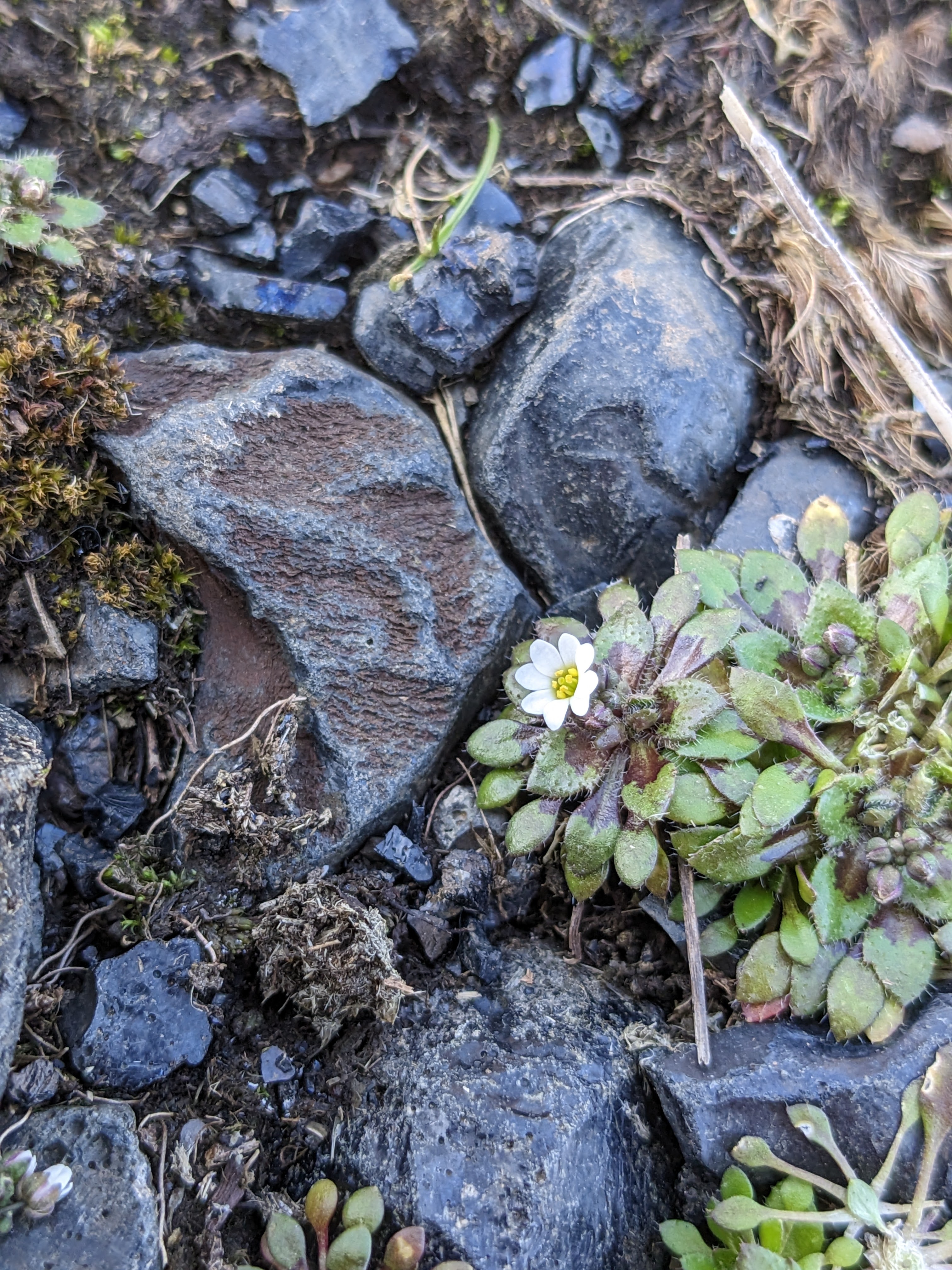
And I really like these places. Madame rolls her eyes and laughs at me when I run rapturously towards a slag heap, but here you can find some of the great survivors of the plant world. Often absolutely tiny, they make a scant living in the most unpromising places; for instance those lumps of dark rock in the bottom right hand photo are actually lead slag and in early spring, Common Whitlowgrass is among the few plants that can tolerate the concentrations of heavy metals like lead. The top right photo is of Danish Scurvygrass growing in pure sand. It’s common all around the coast, and I once chewed some (picked out of dog range) and it tasted pretty horrible – like gone off horseradish with mustard. For sailors however it was once a lifesaver due to its concentration of Vitamin C. Foragers like it for reasons best known to themselves and for them the good news is that salt gritting the roads has created Scurvygrass highways, reaching inland on verges.

Many ferns too can scratch a living on drystone walls and almost bare rocks, and so the list goes on. The adaptations to allow these precarious lives are as varied as the species themselves, and that’s the thing about evolution – it’s got time and sheer weight of numbers on its side; so many combinations and mutations to select from. One seaside favourite is the thickening and toughening of the skin – the description succulent kind of misses the emphasis that should rather lie with the plant’s capacity to resist drought, salt and all the other indignities of marginal life. Some ferns rely on what’s called apomixis – they’re self fertilised and so the minute spores can set up shop almost anywhere without fertilization by another plant – and my goodness they can travel in a favourable wind.

I get bored by formal gardens mainly because their glorious arrays are almost always the result of intensive breeding and human effort. They’re the well bred six footers who always get noticed first at the bar whilst the rest of us poorly bred peasants have to wait.

The most misused concept in farming is the idea of “improved pasture” because it’s not improved in any conceivable way- it’s just more productive in the single sense that it makes cattle fatter quicker. But the fact is that unimproved grassland yields better, stronger, far more biodiverse, health promoting and nutritious food; not just for meat production but also capturing and sequestering more carbon whilst sustaining the intricate web of wildlife – birds, flowers, pollinating insects in balance. Improved grassland is just a wasteful and expensive way of turning soil into dirt!

I don’t blame the farmers for this impasse. Decades of government policy and propaganda from supermarkets and agrochemical businesses have promoted the gods of economy, “progress” and yield, but just as the Canaanite god Moloch demanded child sacrifice, the gods of intensive agriculture have sacrificed the soil; offering only dwindling returns and throwing countless small farmers into bankruptcy and poverty.

Of course, picking up my initial thread, some plants will succeed in the most impoverished and polluted situations – which may be of comfort to those foragers who haven’t yet tried salad leaves contaminated with heavy metals. But there will be no botanists there to record and admire them. You see, to return to the idea of evolution, we have to remind ourselves that evolution carries on whether or not there are any humans around. After the barren earth and the inevitable famines, there will be plants and every other kind of wildlife, doing what my favourite plants have always done; adapting surviving and flourishing. This is the point we’re missing. If we want to survive as a species we need to follow their example and adapt the way we live until balance is restored once again.

There will always be snake oil sellers who offer fossil fuelled shares in going back to the good old days. Laugh at them. Laugh in their faces at their risible stupidity, because if there’s one thing we’ve forgotten in this scientific age it’s encapsulated in this adapted quip.

Q: What’s the difference between God and Nature?
A: You can negotiate with God.

Hell’s Mouth lives up to its name

Porth Neigwl beach in a fierce onshore gale yesterday.

Here on the Lleyn peninsula we’ve had to cut our cloth according to the southwesterly weather systems that (as always) brought periods of blissful sunshine punctuated by rain-bearing fronts that threw everything bar the kitchen sink at us. The gale even found the resonant frequency of the steel chimney and periodically filled the cottage with the sound of a full Brahmsian symphony orchestra tuning up. It was quite unnerving until we worked out what it was.

But it wasn’t the end of the world – or our break – because we both had indoor things to do; sharing the dining table, with me identifying plants from photos and Madame drawing. Just how interesting this is for anyone else is a moot point at the moment because the bill for the next two years of the Potwell Inn blog just arrived and I have been thrown into introspective maunderings as I try to interrogate my own motives.

If raw visitor numbers were the sole criterion the decision would be easy because I know that this is one of those niche blogs that tend to disappear beneath the waves of controversy and narcissism. I’m not, and would never want to be an “influencer” of any sort, neither would I dare to set myself up as an expert in any of the subjects I write about. I’ve covered over the years, for instance, the allotment; cooking – especially baking sourdough bread; growing, harvesting and preserving food; wildlife, especially wildflowers and then a few branches in the road towards art, poetry, philosophy and especially global climate catastrophe and ecological destruction. Not quite in the – “an ill-favoured thing, sir, but mine own” category – I’m rather proud of it in fact – but by no means essential reading for saving the earth. My unspoken aim since I first started this as a private journal nine years ago, was to try to reflect the arduous business of being human at a time when our humanity, our survival is under threat; and lest that sounds too worthy by half I’m bound to say that I just love writing. Three quarters of a million words don’t seem nearly too many to me. I’d like to get up to a million but ………. here’s the thing …….. I wouldn’t want to get there by just focusing on my most popular subjects because – frankly – I’m easily bored. I’m a grown up and I’m sure that my loyal readers are grown-ups as well, and can cope perfectly well with a bit of complexity. I even like to think that my occasional literary or philosophical references are part of the fun. And so my readership increases at the glacial pace that would make a sloth feel pleased with itself, and I’m denied the egotistical pleasures of boasting about my immense popularity.

However, that doesn’t mean that I’m not interested in numbers. The challenge, for me, is to give myself and my interests (OK obsessions!) space to evolve and mature. Right now I’m pretty busy with naming plants, but I’m nowhere near competent enough to set myself up as an expert. I rely on a whole network of fabulously competent people to referee and mentor my efforts. They could easily write their own field botany blogs but my interests are slightly divergent from the mainstream. For instance I’m enchanted by the English common names of plants, and today as we were waving goodbye to our son I caught sight of a ferm I didn’t recognise – a very small thing. So I turned to the books and came up with Black Spleenwort. Isn’t that just beautiful? Just as Vipers Bugloss, or Lungwort and Wolfsbane are beautiful, evocative and poetic words weeping with historical associations. But if I add the Latin names to them is that off putting to non specialists? – or should I press on with them because they add a whole new depth and dimension. As my interest and knowledge deepen I’ve had to learn about huge databases, ecological niches, brownfield and polluted sites – not to mention geology, and so it goes on.

A bellringer once tried to explain method ringing to me. We were in the kind of pub that – back in the day – had nicotine dripping from the ceiling when it got crowded. In order to explain his passion for bellringing, he upturned the ashtray on to the table and drew in the slurry with his finger to illustrate the sinuous complexities of the method. I was utterly lost after the first couple of sentences. That’s just what I don’t want to do! On the other hand I once drove a blind bellringer to a tower in Winford and they rang a method which I probably misremember as Bristol Surprise and which – like the song of a blackbird – almost broke my heart with its beauty.

How far do you go to communicate that intense feeling? Well I think I have half an answer to that question. I’ve never forgotten a “joke” cracked by Canon David Isitt while I was training. We were planning a service soon after our ordination, and he said “I want you each to bring a symbol of your ministry – I’m bringing a condom!” He was so right about all too many people except himself. Too much of any kind of ‘ology’ can shut an audience down in seconds. My (entirely personal) theory is that technique and deep technical understanding are absolutely essential to creative work – BUT they should always remain hidden. No-one needs to be told how clever you are, and showing off is fatal. On the other hand the best teachers draw you into their world and encourage you to try for yourself.

So the future of this blog is under consideration, but meanwhile here are some photos of the Black Spleenwort – Asplenium adiantum-nigrum, but don’t worry too much about that. More to the point is the fact that – with a small magnifier – the world becomes ever more intensely beautiful as you look more closely. British summer time began today. Make the most of every precious moment!

Equinox

Stone wall in Tudweiliog last autumn

It’s been – frankly – the crappest winter I can remember. After the last equinox in September I wrote something about the capacity of language to speak about realities beyond concepts, and I finished up by describing the change in season as a crisis. I had no idea at the time that the rather smartass description failed to grasp that the coming crisis would render me almost speechless. If I’ve written very little in the last couple of months it’s because words felt like dust in my mouth. I could go on but I won’t. Most people with any grasp of the steep slope we’re collectively tottering down will understand.

So one thing I could do, I found, was to go through the hundreds of photos I took last year, to try to identify plants and fungi. Most of them were either fairly straightforward or beyond identification – cue for a return visit.

Today we’re back in Lleyn looking towards a grey and bad tempered Irish Sea. Cold, miserable and damp we stayed indoors and I spent the day botanising the garden. I love ferns – I love any group that gives itself up so slowly and after intense study, and today I embraced the challenge that not all ferns are bracken. After photos, close inspection with a x20 magnifier; surrounded with books and hunting furiously on the new BSBI Flora, I can definitively identify the Soft Shield Fern. If that sounds like a small achievement (and it may well be) it felt like a big one to me.

I’ve spent most of the winter in a state of despair but now the allotment is going again, and I’ve a welcome sense of direction and purpose – no thanks to our appalling government.

Hello world!

Orion over Buckland Hill

This weekend we took the campervan to the Brecon Beacons for a couple of nights – just to test all the repairs we made over the winter. I know I write a lot about Snowdonia and Cornwall and if you follow this blog you’ll know that many of my favourite places are wild, lonely and close to the sea, but there’s another side to my landscape yearnings and it’s right here in Breconshire. I took the photograph from the campsite in Pencelli, just up the road from Buckland Hill. It was so clear I was completely foxed for a while as I tried to find my way around a sky unexpectedly full of thousands of visible and perhaps millions of invisible stars – so numerous and so beautiful they felt like a kind of blessing. I know it’s fanciful but sometimes I can almost hear them singing an ethereal Spem in alium by Thomas Tallis transposed many octaves upwards. I guess I hear them through my heart. You might think that’s all a load of spam in allium but this place has that kind of effect on me. It excites me to know that J R R Tolkien stayed for a time in the village of Talybont, immediately below Buckland Hill – while he was writing “Lord of the Rings”.

Top centre is Pen y Fan in mist

The (definitely non politically correct) smell of wood fires never smells sweeter and more homely than here between the river Usk and the hills and peaks like Pen y Fan. The Buckland of the saga jumps off the page in the narrow strip of small farms between the River and the accompanying Monmouth and Brecon Canal under the shadow of the misty mountain. The sounds of sheep, and the early spring birdsong all add to the music. I saw my first kingfisher here many years ago. The Mallard in their breeding plumage never looked more incandescent and for a few hours, instead of walking head down looking for plants I could have leaned on a gate and just gorged on the sounds. Even as we drove towards Abergavenny we spotted a Kestrel hunting the hedge alongside the road as well as a Buzzard and a red Kite. The three raptors were just a taster of the riches to come. This landscape is far closer to my personal psychogeography than all my other post industrial hotspots, roaring seas and austere mountains. Celandines in abundance announced that Spring really is here and we drank pints of magic to celebrate in the local pub.

Finding any kind of lyrical inspiration these days, demands we mine it from granite with our bare hands. Every dark hole has a poet at the bottom of it.

Royal Oak at Pencelli – highly recommended for paroled melancholics

Juggling with three landscapes makes my mind spin

Heavily polluted runoff from an abandoned tin mine

Just before we left Cornwall the week before last, and after we’d loaded the car and returned the key, I had a quiet couple of minutes leaning on the gate looking out to sea while the birds were singing their hearts out in anticipation of spring. A Mistle Thrush rehearsed his repetitive chorus; Robins sang their plaintive songs, Great Tits, Blue Tits and gulls of several persuasions added their descant; crows and Magpies rattled on about nothing much – all adding to the rhythm of waves beating on the pebble beach below; and I realized how little I wanted to leave. I struggle to quantify or even understand the healing power of nature, but I completely and gratefully accept it.

However, there were things to do back in Bath, not least a Bath Natural History Society lecture on regenerative farming given by local farmer, Jeremy Padfield. It was an excellent talk on a subject I’ve often explored in the Potwell Inn and I made so many notes that I felt inspired to write an account for the Bath Nats website and the annual report. A quick enquiry about length solicited a noncommittal response and so I set to and wrote just over 1000 words just as an email from the editor of the annual report arrived to suggest 350 words. So a postcard then! Much anguished editing and sacrifice of my little darlings boiled the stock down to a thick jus and off it went.

Simultaneously a report in the Falmouth Packet, (local Cornish newspaper which I like to keep an eye on), printed a story about the lovely strip of coastal land running up from St Just to St Ives. It’s a place we know well and have often walked, and the newspaper was working itself up into a froth because the area has just been designated a SSSI (Site of Special Scientific Interest) due to the rich biodiversity of the land which has a tremendously wide variety of habitats rare flora and fauna and even a breeding colony of Dartford Warblers. Sadly and predictably one or two farmers were describing the move as a “land grab” – comparable to Putin’s invasion of Ukraine – well Natural England weren’t exactly bombing the area in order to protect it, and at first sight this seemed like a bit of a Luddite knee jerk reaction. Nonetheless I was interested to see whether their fear of being driven off their land was justified.

The outcome was that I was reading the (54 page) Natural England report on the West Penwith SSSI at the same time as I was reading about the new ELMS scheme for Farming subsidies; trying to discover what actual subsidies would be available to Cornish farmers in the SSSI, whilst writing my piece on Regenerative Agriculture.

The lecture itself was illuminating . Since 2009 when two Duchy farms reached an agreement to work together it seems that tremendous progress has been made: here’s my shortened report.

Regenerative Farming has become a bit of a buzzword recently but it’s an idea whose time has come, not least because of the new Government policy – the ELMS scheme – which aims to move farm subsidies completely from the old system based on farm acreage to “public funding for public goods” – rewarding farmers for carrying out important environmental work. Compensation for lost output will now be based on income foregone. LEAF has two functions, firstly as a charity promoting Integrated Farm Management and secondly as a marque for food produced under LEAF standards. 

Jeremy Padfield and his business partner Rob Addicott, farm about 1000 acres of the land under Higher Level Stewardship Agreements of which 80 acres are specifically conservation managed for wildlife.  Their combined Duchy farms became LEAF demonstration farms in 2006. Over subsequent years soil organic matter averages out at around 5%; no insecticides have been used within the last 5 years; weed killing is targeted only reactively; antibiotic use has been reduced by 58% and  plastic use is down by 60%. Minimum tillage leads to a 68% drop in fuel consumption; water is intensively managed and stored, and solar energy meets much of the needs of the farm buildings. As well as wider wildlife field margins, Stratton Farms have been experimenting with skylark plots and wide strips of wildflowers and companion plants through the crops. Additionally, 20 acres of trees and 2000 metres of hedgerow have been planted. 

This may sound like a revival of traditional farming, but what makes it profitable is the use of very hi-tech equipment like drones with three yearly intensive soil testing and highly technical GPS delivery systems which have dramatically reduced the amount of artificial fertilizer applied to the soil. 

The most memorable illustration of the evening was when he took an apple to represent the earth and then cut successive slices away to represent otherwise unprofitable land. The proportion left on which food crops could be grown turned out to be breathtakingly tiny. A well attended talk which drew together the threads of shared interest that unite farmers, environmentalists and consumers. 

Dave Pole – report to Bath Natural History Society.

Impressive stuff, we thought – as seemingly most of the members present agreed. However when I checked on the DEFRA website, some of the subsidies looked pretty minimal – the best example being the skylark nesting patches for which they would receive just £10. Lapwings come in quite a bit higher. Just how much admin time it would take to replicate the old EU subsidies, or whether it’s even possible is a moot point. If these measures are not properly funded then the government will be expecting farmers to fund environmental improvement of the land from their own pockets. That would be a good deal easier for a farmer on 2000 hectares of prime land than for a small mixed farmer with just a couple of hectares of grassland in the middle of a SSSI.

Then, shockingly, the Observer this weekend featured a piece on the present state of the replacement farm subsidies being managed by DEFRA. It’s almost unbelievable, but only .44% – less than half a percent of the sum set aside has actually been paid! There was no detail on which farms and farmers had actually received their payments, but one regenerative farmer reported a 48% fall in government payments.

I’m beginning to wonder whether the undeclared policy of the government is to do precisely what those West Penwith Farmers fear most – drive them off their land in order to achieve heaven knows what objectives. After a recent edition of Countryfile on the BBC featuring the mining of lithium and selecting Cornwall as a prime area for reviving the (all kneel please) economy , I wrote to the BBC complaining that there had been no spokesperson opposing the extension of this wasteful and polluting process. If joining the dots is the only way to figure out what this government actually wants to do with the countryside I’d say that on present evidence their policy amounts to greenwashing the continuation of an extractive economy which has brought the environment to the brink of destruction.

Come on George Monbiot – you can do better than this!

Cattle doing what comes naturally – eating grass.
“‘Let them eat lentils’ won’t save us from animal farming – we must embrace meat substitute”.

From the very first sentence – “Our insatiable appetite for meat is laying waste to the planet. But the alternative is looking (and tasting) better by the day” – I can hear the voice of my one time sociology lecturer Sid Harris demanding “It all sounds very nice David, but where’s the evidence?” and this piece by George Monbiot is all too characteristic of some of his recent writing. It’s peppered with hot links most of which are references to scientific papers, some of them hidden behind paywalls so we get the headline but none of the supporting evidence. In fact they create the illusion of hard facts without letting us judge for ourselves. The hotlinks and the somewhat breathless style suggest an overuse of green ink and handwritten capitals. The most tendentious statements – like the one above – “Our insatiable appetite for meat is laying waste to the planet ……” is plain silly. I’m pretty hard up but I’d still bet a tenner that Monbiot couldn’t stand that one up without being allowed to empty the shelves of available prejudices and heavily redacted papers. I’ve linked to the whole article, not because I want to promote his fundamentalist views but because they’re an example of the evacuation of analytical thinking from too many mainstream media opinion columns.

Clearly we have an environmental crisis bearing down upon us, and clearly there is some evidence that some farming practices – like intensive feedlots and so-forth make a substantial contribution to that, but to pretend that there is any equivalence between small mixed farms, peasant and subsistence farms and intensive farms with thousands of cattle being fed intensively farmed soya is a deliberate distortion of the statistics. To suggest that meat farming is the principal engine of global climate change is pure vegan wishful thinking. In fact the continuing burning of fossil fuels in every part of the so-called developed world – some of which is used to drive farm machinery and make chemicals and fertilizers – but much of which is used by aviation, private car use, and the transport of foodstuffs over hundreds if not thousands of miles; this is what’s driving the crisis.

Do we eat too much meat? – undoubtedly the answer is yes. We eat too much of it and especially we eat too much of the wrong kind of it; the kind that’s fattened in conditions of appalling cruelty and fattened on food that makes cows sick. They’re ruminants, they evolved to eat grass not grain and soya meal. Should we ignore ethical questions surrounding farming and troll people who elect not to eat meat? Of course not, and I wish they’d stop the trolling in the opposite direction. Does referring to milk as an “animal secretion” encourage sensible debate? Do I really need to answer that? Is there any doubt among scientists that the way in which Co2 equivalent is calculated is at least questionable? – here’s a link to a paper in Nature that you can actually read!

As long as we allow this critical debate to be dominated by cherry picked evidence and hyperbolic statements on all sides, the battle to save the earth will be stalled. We don’t have the leisure of all the time we need to sort this out – successive COP meetings have seen time and energy wasted by bad faith and bad data.

The wildlife and plants that are so important to me and to millions of us have value in their own right, although they have no seat at the table to make their case. They are the canaries in the mine and they are disappearing by their hundreds and thousands while this sterile debate goes on.

If only it was true that we could save the earth by doing just one thing – ban farming; ban big cars, blah blah blah – but we can’t because it’s a hugely complex problem with more tentacles than the Hydra in Greek mythology. The simplest explanation – but it’s not that much help – is that the age of extraction, burning, waste and neoliberal economics has run its course. We need to find an alternative, but much as I admire some of George Monbiot’s work, columns like this one are not going to be part of the solution because they’re part of the problem.

Forget what these plants are and think what artists they may have inspired.

Exploring the links between nature and art.

If you asked me to nominate one invention that changed the world irrevocably for the better it would be the lens. My friend Chris Lee uses a telescope lens and some pretty fancy software to make the most thought provoking images of space. Most of us use cameras of one sort or another and they’re dependent on lenses of course, but today I was using nothing more sophisticated than a clip-on macro lens attached to my Pixel 6a to reveal some of the secrets of the Common Polypody fern. Those are the pictures at the top and I ran out of magnifying power at the last one which really needs at least a x100 microscope.

The others are all photos I’ve taken in the last ten days and as we looked at them we were both excited by their capacity to surprise and inspire us – not as botanical specimens at all but as objects of beauty. So the fern makes me think instantly of the Victorian fashion for the terrarium and the wonderful images of ferns made by botanical artists across the centuries. The middle row has an impenetrable blackthorn bush at Kynance Cove today which surely must have influenced Graham Sunderland in his tapestry of the crucifixion in Coventry Cathedral, but equally seems uncannily close to Jackson Pollock. The stonecrops could be models for the roof bosses of a thousand churches and if ever William Morris needed inspiration for his wallpaper designs surely the Buckshorn Plantain and the leaves of Mugwort would have served him well. The little Sea Campion has an uncanny resemblance to Tiffany glass; the rosettes of emerging Hedge Mustard are a glorious reminder of symmetry and the catkins – well I just love the colour. Nature’s palette is incredibly restrained and yet limitless in its applications. Whilst I was learning some botanical illustration, we did an exercise of limiting ourselves to three colours and I never subsequently saw the point of using more.

Almost exactly seven years ago I set myself the challenge of painting a Hyacinth in flower. I took hundreds of photos and practiced drawing the flowers from every angle; above, below and from the side and with light falling on them from different directions. I still have the practice drawings and paintings but I abandoned the painting because it was just too complex.

The take home point for me was that minute attention to the detail of a plant, whether flower or leaf was both meditation and scientific exploration and linked deeply with the creative process. Hard, then, not to attribute natural form to some benign guiding hand. But these days I think that’s a shortcut and a cop-out. I’m happy with not knowing because for me, doubt was always the beginning of faith. The lens takes us to places we never even suspected to exist and that’s why it’s my nomination for the world’s greatest invention.

  • and a postscript to this piece. As we walked up the valley from Kynance Cove we spotted what looked like a (too) small buzzard sitting high on the crest of the rocks. We tracked up the footpath and came level and behind it and we could see from its beautiful chestnut brown back that it was actually a kestrel as it set off in a zigzag hunting flight across the valley. There was a bitterly cold northwest wind and it must have been puffed out viewed from below, but there was no mistaking its colour as it set out with what Gerard Manley Hopkins described as its “wimpling wing”. Cue “Windhover” – one of his finest poems.

“Wait your turn, Sir!”

The first Celandine of spring – or at least the first we’ve seen.

A great friend and mentor of mine; a parish priest like me, was leading the graveside prayers at a burial service when he lost his footing and very nearly went down with the coffin. He was held firmly by one of the pall bearers who whispered in his ear “Wait your turn, Sir – wait your turn!”.

It would be comforting to think of nature as a basically static display of plants that come up in the spring and die in the autumn. Except it isn’t like that at all. The emergence of the first spring flowers depends on a whole heap of factors like ambient temperature, day length, amounts of sunshine and space to grow. This year, for example, the first Celandine we saw was here on the Lizard exactly as it was last year, but 13 days later. That was it – the only Celandine in flower in a five mile walk. Look closely at the photograph and you’ll see that there’s another plant there that’s growing fast enough to steal its sunlight in a week or two. Cleavers is an extremely vigorous climber – you’ll know it from the burrs that stick firmly to most clothes by way of the tiny hooks which were the inspiration for Velcro.

Look closely at the hedgerows around this time and you’ll see the first leaves of many plants which follow in strict succession right through to late autumn, and all timed like a glorious firework display to flower and fruit in their unique optimal conditions. Not all buttercups are buttercups and not all dandelions are dandelions (in fact they’re so complicated they can’t even make their own minds up). Some will flower for weeks and with others you can blink and they’re gone. Nothing stands still for a moment in nature and for me the first Celandine is both a joy and a warning that from now on it’s an unstoppable torrent of flowering and fruiting that will change the whole appearance of fields and hedgerows every couple of weeks. The succession of the plants ensures that each one has its own space. Cow Parsley gives way to Hogweed and so forth. It can be exhausting trying to keep up, especially for Madame who will beg me to leave the notebook and hand lens behind and just go for a walk . I note, however that she always takes her binoculars out – “just in case”.

Today we started on the Lizard Green and walked down the lane to Church Cove and then took the coast path as far as Housel Bay and then turned off to avoid a monumental flight of steps and took the easier path to the back of Lizard Lighthouse stopping for some food and then back to the car park. Ten years ago we’d have bounded up those steps without a care, but one of the less talked about advantages of getting quite old is that we walk rather slower and so we see much more. This was a walk we tried to do on Saturday but the coast path was rammed with runners doing a 100 mile ultra marathon. I bet they’ll be walking slowly with ultra knackered knees long before their 70’s.

Anyway, the short cut was marvellous because we caught sight of a very big Buzzard eating his/her kill on a Cornish wall. Within ten feet of the Buzzard there sat a lovely Carrion Crow waiting apparently unafraid until the superior hunter got bored with lunch and flew off – whereupon the crow hopped sideways along the wall and polished off the remains. That was surprising enough, but half a mile later we saw the same two birds repeating exactly the same routine. It was clearly a relationship of more significance to the Crow than the Buzzard but I suppose the crow – Corvids are among the smartest birds – probably reasoned that it was best to keep your friends close and your enemies closer. There was no way that the Buzzard could launch a surprise attack from ten feet. But whatever the rationale it looked as if both birds were in fine health and as fat as butchers’ dogs – which is the closest I could get to an appropriate metaphor.

Ulex europaeus

There was another surprise on the walk because I’ve been spending some time trying to identify a species of Gorse called Western Gorse – Ulex gallii. It’s one of the plants that are plentiful around the Lizard and Kynance Cove but rare everywhere else; but which is very similar to its larger cousin Gorse – Ulex europaeus. The difference between the two comes down to size – ordinary Gorse is bigger; its thorns are longer and deeply grooved, like the one in the picture. But the clincher was (note the past tense) the fact that Gorse ordinaire flowers all year round, but Western Gorse flowers in summer. Or at least that’s what the books say, but unfortunately plants don’t read textbooks and today we found hundreds of Western Gorse plants around the coast path, and many of them were in flower.

Ulex gallii

The Lizard peninsula has two things going for it. One is its unique geology which gives a home to hundreds of wildflowers some of which are only found here. The other thing derives from its geography. It’s the furthest southerly point in the UK and it enjoys a unique climate as well. It’s warm. On first seeing it many years ago it looked completely wild and windswept – and indeed it is, but its warm microclimate means that some wild plants better suited to better to warmer places actually thrive here.

Good news too on the recording front because the County Recorder emailed yesterday and accepted both records I’d submitted. I’ve already posted a picture of the little perennial Leek – Babington’s Leek yesterday. He was kind enough to say that I’d found two sites where it hasn’t previously been seen. The other plant was a real outrider – Wireplant, Muehlenbeckia complexa a New Zealand visitor and that one passed as well. Three more little red squares on the national map.

Approaching retirement I often wondered what I would do to fill my time. The idea of voluntary work often came to mind but I never fancied any of the options because many of them felt like not retiring at all. But this combination of allotmenteering and field botany have turned out to be my happy place. Spring? Bring it on!