The Potwell Inn and the modern peasant

I’ll get to the dog later, meanwhile the fruits of a morning in the kitchen; some bread proving on the stove , some Tayberry Jam, some Dutch apple cake and a delightful but very hungry Bordeaux Mastiff.

Being a modern peasant

Like all the best thoughts, this one popped into my mind after a couple of days on the stove. Beaten back into the kitchen by 90 mph winds and repeated floods, we’ve moved into one of my favourite times of the year – the pre-Christmas cookathon. In the last couple of weeks I’ve made the Christmas puds, the Christmas cake and a Dundee cake plus a lot of experimental bread baking of which more later. There’s method in the madness because it involves emptying the freezer as much as possible to make room for the Christmas onslaught, as well as emptying the cupboards of all the dried fruit that’s been lurking in the larder since last year. I appreciate that the real focus should be on buying the new seasonal dried fruit that’s just coming on to the market but I’ve never been that organised. I’ve often mentioned here that I get the feeling I’m channeling my Mum when I cook the Christmas food. It was she who taught my sister and me to bake bread and make the cakes and puddings. She taught me to make Yorkshire puddings with an unforgettable demonstration of the specific gloppy sound of a batter at just the right thickness. I admit that I dropped the added bicarb in greens as soon as I could, but the basics were all there.

This mindfulness of the past is an essential peasant quality. Peasant consciousness is filled with connections – with seasonality; with location; with nature; and all of them forged into instinctive knowledge. My Mum could judge the approaching weather by looking into the sky and seeing what was going on over Granny Perrin’s Nest which I could never see! She’d never used anything other than an outside earth closet until she’d lived her first decade in the Chilterns. She knew the flowers by their local folk names which makes it difficult to know what she was actually describing when she talked about her favourite flower – Ladies Slipper – which is used for seven flowers in Somerset alone.

I hate the way we use the word “peasant” to denigrate people whose knowledge is so profoundly integrated and I much prefer the French paysan which embodies the sense of rootedness and place; of flora and fauna and of the knowledge of how to grow things well and how to heal them; how to cook and eat and how to move in a landscape without damaging it. Peasant speech is full of earthy, hard won wisdom – not from the latest scientific paper but from generations of experience. My Grandfather Tommy Cox whose family had lived in Stoke Row since the eighteenth century; so long that the village had both Cox’s Cottages and Cox’s Lane within its boundaries, would say of cow manure – “There’s more heart in a sheep’s fart!”. He was a self-taught carpenter who gave me my first slide rule; taught me how to use logarithms and helped me build my first radio sets. He was as far from stupid as you could get; the prototype of all modern peasants.

Peasant knowledge lives in the hands and fingers, in the senses of touch and vision, taste and smell; in the ability to mend and repair; to ride the waves when the going gets tough, in the collaborative community of mutual aid and barter. All this came back to me as I was writing my talk on AI and plant phone apps. Yes we can use the correct name – in Latin too – but do we even begin to see what my Mum saw? do we know if Ladies Slipper was an almost extinct orchid, or perhaps a more common Kidney Vetch whose specific name “vulneraria” suggests healing properties. Was she laughing because she knew the name, on that walk back from the Crown at Parkfield when the old man passing us described the Dandelions my sister had picked as “piss the beds”. She was the most larcenous mother in history. Any walk around a garden would see her dropping snaffled plant material into her pre-prepared handbag. My sister is still growing one of Mum’s liberated Speedwell plants on the steps outside her flat. Both of us inherited her love of gardening and both of us have had city allotments. We two seem to have inherited that peasant blood; of growing and eating our own produce and in my passion for hand crafts.

Meanwhile it’s been radio silence on the Potwell Inn blog, largely because it’s been a pretty chaotic time, with hospital and GP appointments (we are now both officially alive!); failed hot water boiler; four named storms; dentist appointments – we like to squeeze them all in while we’re not off camping; family birthdays; physiotherapy appointments; winter repairs to the camper van, a field trip to the Mendip Hills; writing a talk on artificial intelligence and wildlife phone apps which I gave last Tuesday to the Bath Natural History Society; and a four day trip to our friends in the Bannau Brycheiniog aka the Brecon Beacons – which is where the dog comes in. Last weekend we drove up to the Bannau to our friends’ smallholding. As ever it was a full four days which included loading a couple of pigs to take to the local slaughterhouse, and trips to Brecon and Talgarth where we watched a dozen or more Red Kites milling around in search of scraps from the local butcher who feeds them. Red Kite were a rarity a few years ago and now they’re fanning out across the country. They don’t kill their prey but are mainly carrion eaters – tidying up and reaping where others have sown. Recently we saw approaching fifty milling around a rubbish tip north of Rhayader and it can only be a matter of time before we fickle humans start to regard them as a bit of a nuisance and accuse them of stealing babies from their prams.

Much of the weekend was occupied by fun cooking, and we worked together to produce a lavish Sunday lunch from their own produce. Star of the show was a largish lamb joint which was placed on the side while we ate. Almost unnoticed the dog’s enormous head appeared silently above the counter and he took the whole joint in his jaws – slinking silently off followed by the irate owner and our friends who had nurtured the sheep. As Sam Weller might have said whilst describing a human kerfuffle in Pickwick Papers- “collapse of stout party!”

A revelation in the breadmaking department

I’ve had a breakthrough on the hunt for the perfect sourdough loaf. I’ve always gone with the prevailing wisdom (i.e. fashion) which insists that loaves should be bursting through their crusts with what’s known in the trade as spring, and with crusts as hard as hell that lacerate your mouth, and crumb that’s full of holes through which butter runs and greases your armpits. If it’s also got a pH around 2 and keeps you up all night with acid re-flux that just proves how hard you are. Of course some of these aims are mutually contradictory, for instance it’s virtually impossible to get anything other than a brick out of 100% wholemeal grains, and your four year old sack of flour bought during lockdown wouldn’t rise even with the addition of plastic explosive. As ever, ruthless orthodoxy is a blind alley with a big argumentative crowd of evangelical artisan bakers at the end.

What we’ve always wanted was rich sourdough flavour from a tin loaf with a regular cross section for slicing and toasting and a flavoursome crust with good colour which is soft enough to eat but adds to the whole taste – like the breakdown on good cheese; the bit between the rind and the main body which, by the way, I love. In search of this goal I just bought three black iron bread tins which are just fantastic – heavy and needing regular care but never washed. I bought a similar French crêpe pan twenty years ago which never ever sticks. But the real change was of mindset. I’ve always been the kind of cook who would slavishly follow the recipe or instructions in search of so-called perfection. But over recent years, and as my experience deepens, I’ve become more thoughtful; more creative and more willing to branch out. The arbiters of sourdough orthodoxy have always tended towards a ruthless rejection of yeast. Purity is everything – even though sourdough starters must naturally vary greatly. I’ve got two; both rescued from my own neglect; one (called Tigger) was grown from some dried flakes on a dead starter tub and the other (Eeyore) came from the impoverished and terminally sick original. Tigger took off like a rocket – hence the name, and Eeyore was always slower but after months of comparison bakings much nicer and better adapted to the Potwell Inn timetable.

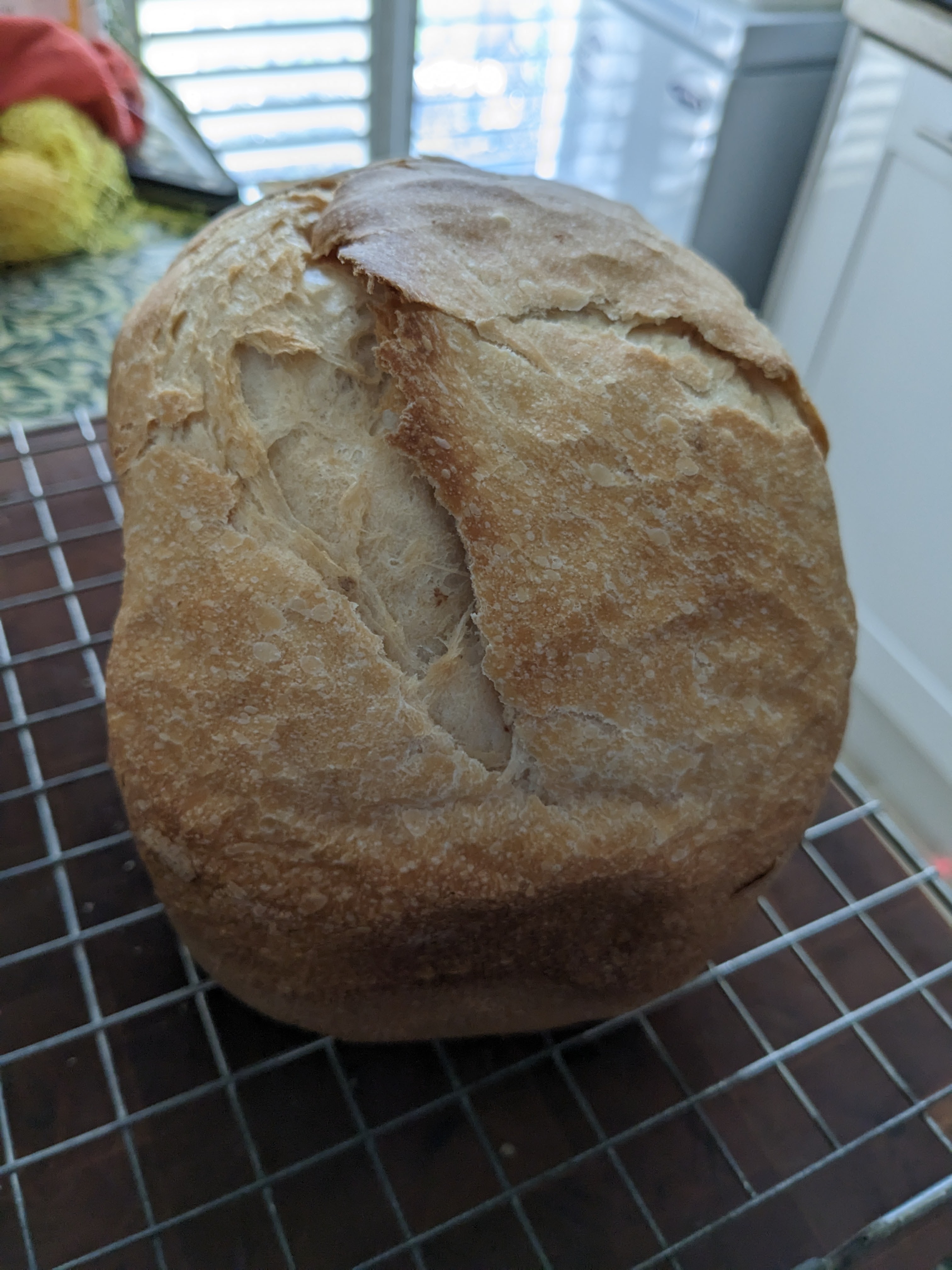
The breakthrough came when I came across Ken Forkish’s book “Evolutions in Bread” and skimmed into a page that described adding conventional dried yeast to the initial sourdough batter after maturing it overnight. You’ve no idea how I resisted the very idea of polluting my sourdough, but I tried it with some leftover supermarket flour and to my great surprise the combination of black iron tin and a sprinkle of yeast halfway through gave just the kind of softer, moister texture with all of the genuine flavour that we were looking for. The photo shows the third batch using Eeyore starter, the heavyweight tin and my favourite organic traditional flour.

The talk

So finally, the talk to the Bath Natural History Society was last Tuesday and as luck would have it, I was speaking in the next door room to A C Grayling the philosopher. He popped his head around the door and I was able to offer my condolences for having to share the evening with me, even if we were in different rooms. He seemed to bear it bravely. As it was I had an audience of around 35 (I didn’t count) – including 3 Vice County Recorders and two national authorities – so anyone with more brains than me would have been intimidated but I was well prepared for a degree of hostility; AI raises very strong feelings so in full diplomatic mode I kicked off with a faked photo of a ghost orchid made (by our son) using Google Gemini. Things could only get better after that, I thought.

As it was the talk went pretty well – I wasn’t aiming at the experts but at the newer members who are quite intimidated by conspicuous upstaging in Latin. I treated it as a kind of seminar where it was acceptable to lob questions at the participants – only one of whom appeared to have nodded off. He paid rapt attention for the rest of the talk. Given that I’d had to teach myself an entirely new programme and use a bunch of software on equipment I’d never seen before, my feared wipeout didn’t happen and the presentation ended just at the moment I caught sight of Madame tapping her watch. What a coincidence!

A catch up on the allotment and a warning to be careful what you wish for – just in case you get it!

So here, at the end of a heavy duty week on the allotment are some of the fruits of our labours after a long and difficult winter. Crops are growing; even broad beans in the polytunnel are in pod and fattening up – which was especially nice when we saw that they were selling at £7 a kilo in the supermarket yesterday. Spuds are pushing through and the tunnel strawberries are about to begin their ripening. Spared any early frosts this year the trees have had a good fruit set. The bottom right photo is of a hybrid blackberry that languished in the fruit cage for three seasons so we took a chance on moving it to a better position with more light and air. Eight years after taking over an overgrown field, the plot is finally looking established. There’s a settled feel to it that; after a lot of to-ing and fro-ing; suggests that the allotment has accepted our guardianship. There’s a profound difference in the progress of happy plants over unhappy ones and any successes we have are down to noticing what the plants like best and making sure they get it. The strawberries, for instance, have runnered all over the place and made their way to a narrow bed beside the polytunnel where they are protected from winds in any quarter, and bask in its radiated warmth. It would be the last place I’d have chosen to put them! – but the earth is kept moist from rain runoff, the sun passes happily through the polythene cover and it’s one of the few low-traffic areas on the plot.

Gardening takes up a lot of time and energy, but I’m a great believer in texture and so we’ve tried hard to keep going on other things – like botanising and taking trips in the campervan. I’ve written before about the degree of planning that I do before a trip and I’ve made great use of the Botanical Society of Britain and Ireland’s magnificent databases and distribution maps. But one thing that’s always frustrated me in the past was the fact that ordinary members of the public (like me) only got limited access to the detailed information contained in 40 million records. This meant that if I wanted to check the location of a plant I was interested in I could only get an approximate 2X2 kilometer square on the map. Trust me, scouring 4 square kilometers of bare countryside for a tiny clump of flowers doesn’t half slow you down. There is one particular plant that I’ve been looking for for three years.

Anyway this last week the database was opened up to all BSBI members, with some provisions for protecting especially rare and endangered plants and this gave far more detailed locational information. I’m much more interested in the kind of unthreatened plants which are especially fussy about their environment whether that be pavements or lead mining slag heaps. I had to apply for access and rather to my surprise it was granted. I fell on the database like a hungry wolf and quickly discovered how close I’d been to finding my three year quarry – that’s a trip for the next couple of weeks. But then we’d also been to a lecture on ferns a few weeks ago and one difficult to find plant had cropped up in the midst of one of my favourite places on earth; not pretty but, let’s say, post-industrial. So a quick search online and within seconds I’d got a reasonably precise location. But instead of the adrenaline rush I’d expected I felt a bit ashamed of myself – as if it was cheating. That’s one to resolve later but it feels as if I enjoy hunting more than finding.

My research into AI wildlife recording applications took another step forward when the BSBI released a phone recording app at the same time. Good for them! Of course we shot out for a walk as soon as it stopped raining and I entered a record on the hoof, as it were, with a minimum of fuss. Coincidentally I’d been tasked to produce a precis of several longish reports on the work of the Natural History Society that we’re members of. I always swore that I’d never go to another meeting after I retired but I relented in a moment of weakness. So – and here’s a major confession – I fed all three long reports into Gemini, the Google AI machine and analysed them one at a time and then it took less than half a minute to produce a brilliant summary of all three, of a quality it would have taken me days to produce. My personal prejudices, likes and dislikes played absolutely no part in it because it was produced by a deep text machine with no knowledge of which ideas I liked and which I hated. All my work was focused on asking the best possible question and setting the task in logical and unambiguous terms. You might call it a scientific approach.

I presented the report to the committee and one member kicked off about the absence of the term “research” that wasn’t in any of the contributory papers. I could see that the discussion wasn’t going anywhere and backed off, but I left the meeting feeling that I’d been the victim of gaslighting. My hard work was being dismissed because -well because what? Antonio Gramsci, the Italian political theorist distinguished between organic and traditional intellectuals; the first group theorizing from a world of lived experience and the second (such as philosophers and clergy) giving history and tradition the whip hand. Give me the wisdom that comes from lived experience any day!

Back in the real world, I read two articles that seemed to treat plant recording as a kind of Ian Allan trainspotter discipline – more was clearly better. I get very fed up about this kind of thing, because it puts the amateur naturalist at a tremendous disadvantage. In one instance a recorder had submitted 135 thousand records to the big database. A little bit of basic maths suggests that with 3,500 plant species in the UK you’d have to find every one of them almost 40 times to amass such a score. The real scientific impact of such a magnificent effort is not in the gross total, but in building our knowledge concerning the distribution of plants across the country, their seasonality and preferred environments, the variations in their appearance and whether they are increasing or decreasing in number or in danger of disappearing altogether. Ten thousand records of a single plant – let’s say, bluebell hybrids made right across the length and breadth of the country could be tremendously useful. Amateur naturalists can be a vast army of potential volunteer recorders who, with targeted and appropriate help from the professionals, would get better and better at identifying plants and therefore contribute to the data that scientific research depends upon. There’s no hierarchy needed here; no need for anyone to feel intimidated or inhibited from having a try by the thought that they might get laughed at or patronized. The academic gatekeepers, far from preserving the integrity of the discipline are holding it back; squeezing the life out of it.

But hey! we’re off down to beloved Cornwall in the campervan and I’ll be testing the apps, looking for plants, doing a bit of recording and hopefully some sunbathing too, alongside a few trips to the pub. Here at the Potwell Inn, we celebrate the life ordinary. This weekend an old friend died of Motor Neurone disease. I have no idea how to process that.

An evening in the campervan with an excellent documentary series on Frida Kahlo. I really didn’t notice she wasn’t wearing much when I took it. Madame was consulted and she approved before I included this photo!

A genuine first for me – I’ve seen opium harvesting on the allotments!

I thought I was pretty much bomb proof after my years working with extremely marginalized people, but this one took me completely by surprise. We were walking up from our plot last night after shutting the greenhouse and the polytunnel when Madame spotted a young man, in his late twenties or early thirties crouching on a neighbouring allotment. I asked him what he was doing and he answered rather unconvincingly that he was taking photographs. I couldn’t see a camera and judging by his whole appearance he was more likely to be a drug user nicking strawberries or soft fruit – he had that hollowed out sallow look and couldn’t even be arsed to make a plausible excuse. How did I make that rather harsh judgement? – well experience I suppose.

Anyway he wandered off and climbed back over the gate and I thought no more of it until this morning when we went back to work and I took a look at the spot he’d been crouching in. There were neither strawberries nor any other edibles anywhere near where he’d been but there were poppies and it took no more than a glance to figure out that what he’d been up to was cutting seed heads to get the milky sap which is the precursor to most of the dangerous drugs in the world, and mother to the crime that is endemic to the trade in drugs.

But I’m not accusing this poor young man of being some kind of drug baron because clearly he is one of the victims. It’s when that sticky white sap is scraped off the seed heads and pressed into dark brown balls that it enters the drug trade. I suspect that his intention was to scrape a little sap and then smoke it in a pipe; inhaling some of the fifty alkaloids which include heroin, morphine and cocaine but heaven knows what other poisons. A few minutes escape, perhaps, from a dreadful life or perhaps a misjudged permanent escape.

Is the economy now an object of worship to which we must sacrifice human lives?

Of course we could do more to help, but listening to the news at lunchtime today, the government seem to be saying that another 100,000 people thrown out of work is a price we have to pay to stabilize the economy. Grenfell and Covid suggest a rebalancing of the economy based on the sacrifices of the weakest in society and the continuing enrichment of the already wealthy . Somehow the shaming of Johnson has not made me as happy as I’d hoped. Now we see the problem, and it’s a metastasising tumour for which the only cure is to root out the intolerance and indifference to suffering that feeds it.

Here at the Potwell Inn we see the results every day. Notwithstanding the eagerness of the local businesses and the Council to project an image of Bath as the place where history comes to life; here in this neglected ward so close to the city centre we see how badly the dreams of Bridgerton and Jane Austin unravel in the harsh light of neoliberal economics. In a world of transcendental beauty – if you know where to find it – the rats still fight over fast food litter – and slavery, however modern, still stalks the earth; out of sight, and so out of mind. The drug dealers still gather on the corner of the Green to sell their wares, the street beggars pass us morning and night as they return to their shelters – and the deranged, denied any proper mental health support, howl at one another and at the skies with inarticulate rage. But I would argue that we are fortunate to live in a place where the contradictions are so cruelly exposed because, however painful it might be, we can’t look away.

The young man on the allotment is not the folk demon crackhead; but the political and economic culture which has trodden him down to such a desperate and vulnerable state is the true work of the devil, where vice masquerades as virtue and evil wears a suit and handmade shoes. Three calamities – the climate emergency, the environmental emergency and the economic emergency are the unholy trinity at the root of all these phenomena and confining our response to saving a few rare species, recycling, going vegan and buying a bike just won’t do. It takes will and determination and – as Ukraine demonstrates – courage to rise to the challenge and resist.

Meanwhile, back on the farm ….

I rather enjoyed dating the damson vodka “April Fools’ Day”. As spring advances, we feel the urgent need to do something useful with the produce which we abandoned to the freezers last autumn because we were tired and wanted a break. That’s the biggest danger with freezers. We chronically overproduce on the allotment and then use the freezers to hold the surpluses until we can think what to do with them. Consequently the 5 kilos of damsons were removed from cryogenic storage last week and were turned into 2 litres of damson vodka and 11 lbs of damson jam. The last couple of kilos will become damson ketchup early next week. They were a gift from a friend on Severnside who didn’t know what to do with them either. His tree is old and marvellously productive and ours is just two years old and may take 15 years to bear any serious quantities of fruit – by which time I’ll be 91 and possibly too wobbly to climb ladders! I seemed to have inherited from my mother some kind of Jungian shared trauma which impels me/us to bottle, pickle and jam at the mere sniff of a plum, ‘because we might need them one day’ .

Of course there is an upside to this. I curl my lip at recipes for instant pickles in the glossy supplements because they just taste like raw veg with vinegar on them. If you enjoy the feeling of your taste buds doing a Mexican wave inside your mouth then be my guest. I prefer to make chutneys and pickles, label them and pack them away somewhere so hidden they come as a complete and marvellous surprise 2 years later when we find them just coming into their prime. Plums, green tomatoes, mixed vegetables and damsons all make lovely chutney but our absolute favourite is a Delia Smith plum chutney called “Dower House Chutney”. Immediately after it’s made it tastes like paintstripper with chilli sauce, but after a couple of years at the back of a cupboard it’s the go-to for anything with cheese – dark, rounded and perfectly blended. The same goes for the ketchups ( we make all our own).

Damson jam is my favourite breakfast treat after marmalade. I don’t think we made any last year – at least we haven’t found it if we did! – and so it was a joy to have some again. Unlike pickles and chutneys, jam is ready to eat as soon as it’s cool. The vodka is blissful after dinner. The books say to strain the fruit off the vodka and sugar after six months, but once again we’ve sometimes left it for well over a year and extracted some of the almond flavour of the stones – giving a much more nuanced and darker taste. Sloe Gin, which we also make, needs a couple or three years to reach its state of grace so the vodka is an easy standby. The other couple of photos are of some bread and a lemon meringue pie that I was practicing for a family meal on Easter Sunday – (I’ve never made it before).

I haven’t written much about the allotment recently simply because the wettest March since records began was a bit of a deterrent. But a few brighter days have made it possible to almost complete the spring preparations whilst we eat spinach from the polytunnel and parsnips, leeks and parsley out of the ground. The potatoes are chitted ready to go in on Good Friday – that’s tomorrow – as per long British tradition. It’s a bit of a daft tradition because Good Friday – as does Easter Day – wanders around all over the calendar simply because solar and lunar calendars can never quite sync; so for the church festival and for allotmenteers we revert to the lunar calendar for planting potatoes. Kind of Steiner lite, you might say.

The broad beans are in, the asparagus is just shooting and the damson (our damson) is in flower. Gratifyingly, the fruiting buds on the apples are looking hearty and – this is down to Madame – beautifully pruned. So it’s all looking good for another season. As I finished bottling the jam the other day, Madame was musing whether we might be that last generation to have learned these skills. On the other hand, our middle son and his partner are keen cooks and gardeners (well he’s a chef, like number three). And post lockdown there are far more young people on the site – which is marvellous too.

The first Cowslip this year, in Alveston Churchyard.

There’s nothing like a day on the allotment, with the sun on your back. It can lift the heaviest gloom. For some fine weather gardeners being tempted out for the first time this year, the plots may look a bit overgrown and neglected but that’s just nature doing what nature always does – healing its wounds. Although most of the time we don’t dig but just cultivate the surface; some infestations like Couch, Bindweed or Creeping Thistle really do need to be dug out carefully. That can be hard work, but the robins will come and keep you company and a host of birds will visit the turned earth and eat some pests (so long as it’s an occasional digging and not an annual religious ritual). We think too highly of ourselves if we come to believe that the Earth depends upon us for her vitality. Quite the reverse is, in fact, true. It’s we who depend absolutely on the incredible generosity and healing power of the Earth.

Equinox

Stone wall in Tudweiliog last autumn

It’s been – frankly – the crappest winter I can remember. After the last equinox in September I wrote something about the capacity of language to speak about realities beyond concepts, and I finished up by describing the change in season as a crisis. I had no idea at the time that the rather smartass description failed to grasp that the coming crisis would render me almost speechless. If I’ve written very little in the last couple of months it’s because words felt like dust in my mouth. I could go on but I won’t. Most people with any grasp of the steep slope we’re collectively tottering down will understand.

So one thing I could do, I found, was to go through the hundreds of photos I took last year, to try to identify plants and fungi. Most of them were either fairly straightforward or beyond identification – cue for a return visit.

Today we’re back in Lleyn looking towards a grey and bad tempered Irish Sea. Cold, miserable and damp we stayed indoors and I spent the day botanising the garden. I love ferns – I love any group that gives itself up so slowly and after intense study, and today I embraced the challenge that not all ferns are bracken. After photos, close inspection with a x20 magnifier; surrounded with books and hunting furiously on the new BSBI Flora, I can definitively identify the Soft Shield Fern. If that sounds like a small achievement (and it may well be) it felt like a big one to me.

I’ve spent most of the winter in a state of despair but now the allotment is going again, and I’ve a welcome sense of direction and purpose – no thanks to our appalling government.

Hello world!

Just when we thought it couldn’t get any colder!

Ice formed in a ditch

Looking back to my optimistic post about making 36 hour sourdough in late November I see that I wrote that the temperature outside in the communal hallway drops to about 12C in winter. Well that was then! After record breaking warmth in November we’ve switched to record breaking cold and this week the overnight air temperature has dropped to -6C and it hasn’t risen much above zero all day, and so the hall temperature – assisted by the open window downstairs which our neighbours use to disperse the tobacco and weed smoke – drops to about 6C. This last couple of weeks we’ve used the hall as a large additional fridge.

Living as we do in a concrete block of flats built to 1970’s specifications, we’ve been struggling with black mould on the walls for which the only remedy is keeping the flat warm – which costs about £120 a week; rotating a dehumidifier around each room and spraying the affected areas with bleach. A request for advice from our landlord (Church of England Pensions Board) has gone unanswered for three weeks. Just feel the love!

This morning it was so cold inside the flat that I had to resort to three layers and a woollen hat. Madame thought this was so funny she took this photo from the warmth and comfort of our bed – I possibly look like a miserable old git. But amazingly the sourdough had hardly slowed down during the night and so I was able to knock it back early – hence the grubby apron; not really grubby more spattered with bleach stains (see above). I make all sorts of bread, and the difference in flavour between the slow 36 hour sourdough and a quick four hour yeast loaf is so huge you wouldn’t believe they’re made with exactly the same flour

The kitchen is a real sanctuary during these troubled times. With the allotment frozen it’s the only place I can make things happen. This morning I knocked up some eggs benedict for a breakfast treat. The loaf is proving until this evening when I’ll bake it, and there’s a casserole in the oven – it feels like a small victory against entropy except that when we went up to the allotment to get some bay leaves we discovered that the rats had found our stored squashes and eaten the lot. I can’t get too cross about it though; there are bigger challenges to face.

I read somewhere this week that blogs with a vaguely homestead/self sufficiency feel are doing especially well at the moment. I can’t say I’d noticed it here at the Potwell Inn – maybe because this blog is not about polishing the political turd with a bit of lifestyle blather. We won’t bring about the desired paradigm shift with home made marmalade. Although I loathe William Cobbett’s reactionary politics, I do think that Rural Rides and Cottage Economy are an indispensable record of a period of great hardship in the 18th Century, and I’d be pleased if the Potwell Inn provided a similar account of these low and selfish decades.

PS – The algorithm that WordPress uses to pick similar postings has selected three that mention marmalade. Obviously artificial intelligence has a way to go just yet!

Less is more on the Potwell Inn allotment,

To be honest, after a two week break in Pembrokeshire I was dreading going back to the allotment. Two weeks is an awfully long time to leave any garden to nature and my particular worry was that our plot – in which we deliberately allow nature to have an almost free hand would have totally succumbed to the fatal embrace of the bindweed which has been an absolute pain this summer.

The reason, of course, is that bindweed roots travel deep and fast so it laughs at drought while many other shallow rooted plants keel over. Our strategy this season was to keep the ground covered at all costs, and so as a matter of principle when the drought began to grip we largely stopped weeding in order to keep the soil shaded and as cool as possible. I know people make the most tremendous fuss about weeds stealing sunshine, water and nutrients from the crop; but in our own wildly uncontrolled trial we found that our crop plants, so long as they had a bit of headroom, soldiered on through the heatwave, and whatever nutrients the weeds steal will be quickly returned to the soil via the compost heaps.

There were two other weed species that had a field day this year. One was the Sow Thistles, and the other was the clump of Fumitory which I was unwilling to weed out, because it is a notable rarity here in the centre of Bath. However two weeks of rain and sunshine tested the theory to the limit and it was that thought which was beginning to bother me as we recovered from a pretty exhausting harvest.

But what we didn’t expect was such a large late crop of vegetables, as we approached the Equinox on Friday. When we went to see the allotment yesterday we harvested two whole deep bags full of produce. Old potatoes were weighing in at a pound and a half each and of course it’s been so dry we didn’t have blight to contend with this year. That said we always grow blight resistant varieties of both potatoes and tomatoes. There were aubergines, peppers, runner beans, carrots, cucumbers, courgettes and apples and yet more tomatoes grown outside. The large crop of squashes have been hardening off in the sunshine ready for winter storage, so contrary to all expectations we’ve had the best overall harvest ever. We even managed to eat the whole crop of sweetcorn and didn’t concede a single cob to the marauding badgers.

The downside to all this was the excessive amount of watering we still needed to do. With just 1750 litres stored it’s clear that we would have lost crops if we hadn’t used the council provided cattle trough. Quite apart from the shame of using high quality drinking water on thirsty crops, there’s the physical wear and tear on us and our knees, carrying two cans at a time which weigh in at forty pounds and need to be carried down very rickety paths at the risk of damaging tendons and joints. I may just have muttered “I’m getting a bit old for this malarkey” once or twice! And so we need to think about drought resistant crop varieties and perhaps consider growing more perennials. The tap-rooted vegetables were left pretty much to their own devices and they’ve done amazingly well. The second issue will be weed seeds, but in early season it’s relatively easy to keep them down with a sharp hoe. The final part of the climate change conundrum is to keep the ultimate height of plants lower, which will make frost and wind protection much easier. That the climate is changing rapidly is beyond denial and hoping that next year will bring better weather is wilful magical thinking. The biggest sadness would be to lose the wonderfully flavoured -Robinson’s “Show Perfection” pea. Make no mistake, this is not a cardboard flavoured show variety, but it does grow easily to 6-8 feet.

We had also theorised that growing far more insect attractors and digging a pond would attract more predatory wasps and pollinating insects. For whatever reason the Ladybirds never really got going this year, but aphid numbers were well down so maybe the other predators took up the slack. It’s impossible to make any great claims, but our deliberately scruffy approach – although it looked terrible enough to earn reproachful looks from our tidy neighbours – kept producing abundant crops where the weed free and bare earth allotments failed on a grand scale.

I think obsessive tidiness is an entrenched value in British allotments. The catalogues are full of model specimens growing in straight rows on cleared ground, but our holiday in Wales, next door to a large organic farm, showed just how much of a role natural soil fertility and good, rich, moisture retaining soil, plays out in providing increasingly good yields over time. The grassland wasn’t overrun with any noxious weeds in spite of a no-till and no chemicals regime. What this means of course is that it’s almost certain that the kind of approach we’ve been trying to master on 100 square metres, could be upscaled to hectares. Sadly, though, the Council allotments Officer’s twice yearly assessments still seem to overvalue the straight row, weed free allotment over and against the holy disorder of our own attempts to garden thoughtfully.

So our holiday fears were not realised, and that was the most tremendous morale booster. But a second bonus followed quite naturally because all those fresh ingredients led straight back to the stove, just as the new seed catalogues were dropping into the post box. Today we ate the best mushroom soup ever, thickened with bread and made with one and a half pounds of field mushrooms brought back from the organic fields in St David’s. With the equinox two days away and the nights drawing in, there are a few joyful hours still to be had, planning for next year as we clear the beds and pile on compost and leaf mould ready for next season.

Runaway season brings early blackberries.

I was going to write about our polytunnel tomatoes which have done very well this year – just loving the hot weather. So a piece I was thinking about on the making of panzanella will have to step aside because we were totally gazumped by the blackberries yesterday.

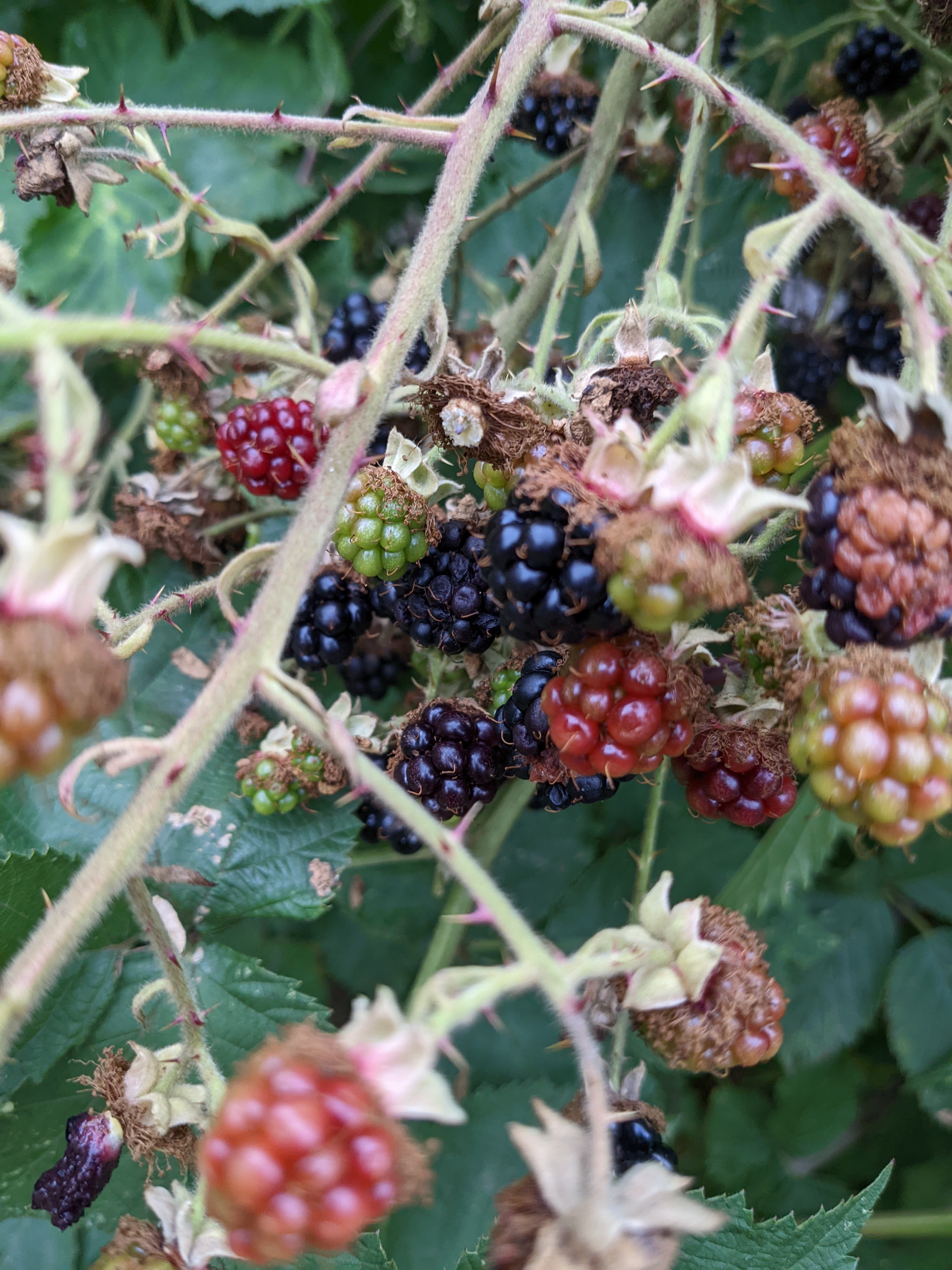
Given the number of privateers who like to climb over the fence and nick our produce without the bother of paying for it or growing it; we’ve capitalized on two of the most useful properties of the blackberry, that’s to say its murderous thorns and its ability to put down roots whenever one of the shoots touches the ground. The third property never really entered our heads, that’s to say the marvellous eating qualities of some wild blackberries. That italicised “some” comes from the fact that the blackberry hybridizes like nothing else, and whilst they all look pretty much the same they vary in palatability from heavenly to a mouthful of sour grit. So what are the chances of choosing a random blackberry to make a fence impregnable and hitting on a bigger, sweeter and more fragrant variety than any of the professionally bred hybrids we’ve all been planting at no little expense.

The downside of this horticultural magic trick, is that word gets around and a polite but steely middle class battle to harvest the fruit is conducted. There are no rules, but the winner takes all. This year we won! And after a dawn raid we came home with a carrier bag and four pounds of sweet blackberries plus a few assorted spiders and grubs.

It was an early encounter with blackberries that introduced me to the spiritual conundrum – that the profound gratitude I was feeling had no home to go to. Who to thank for this outrageous generosity? It’s a question I’m still working on – so please, no easy answers! I’m ashamed to say that we repaid the generosity by making forty pounds of the most disgusting chutney ever, and giving it away to friends. That’s probably why we haven’t got many friends.

Good blackberry bushes, like good spots for harvesting field mushrooms and other fungi are family secrets and never divulged to strangers. Just as when asking farmers how they’re doing you expect nothing more than noncommittal shrug and a mournful shake of the head so too, the passing stranger – asking if the blackberries are any good – will likely be told that they’re very poor indeed, but the rabbit seems to like them; but in the secrecy of the kitchen where the ripe berries have a perfume as fugitive and erotic as truffles, we hug one another and celebrate our great good fortune. In the midst of bad news we’ve pulled a rabbit out of the miserly hat. My uncles were pretty good poachers apparently and doubtless shared the same feelings.

Of course, harvesting them is one thing and locking that exquisite floral perfume into food is another. Blackberry and apple pie never really floats my boat and blackberry jam shares the same pippy texture even when the perfume is there; and so my very favorite way is to make bramble jelly. It’s tricky to make because it needs a bit of pectin to set it and if you add apples you tend to lose the glossy burgundian transparency and so we use proprietary jam sugar which seems to give a better finish.

The other challenge is that the fragrance is really very fugitive and so gentle cooking followed by the shortest possible boil to setting point is the only way to lock in the perfume of the blackberries; but when you bring it off, it’s worth all the faff. Jelly making always seems a bit wasteful but I usually let the initial ingredients drip for at least 12 hours. Our blackberries yielded just under a litre of juice (another reason for finding the best bushes) and with under a couple of pounds of jam sugar it made four and a half small 14oz pots which will only be brought out for special occasions. I remember my grandmother dropping a spoonful of bramble jelly on a rice pudding as a special treat.

And so an intimation of the harvest came early in this season of drought and heat – but it sent us singing into the kitchen where Madame cooked while I assembled the first panzanella of summer. If the Government Scrooges knew how good it felt they’d make it illegal!

Three for one offer!

So after the philosophical tone of the last couple of posts, I thought I’d share an anxiety free photo of a wheelbarrow. There’s not much going on at the allotments at the moment – mostly the site is like the Marie Celeste; full of signs of occupation but devoid – apart from the diehards – of human company; no gossip to be had.

There are two especially dangerous moments for new allotmenteers – six months apart but equally fatal to the morale. In July the early optimism of cleared ground and early sown crops gives way to an explosion of weeds – especially on newly won ground. In December, once the pruning is done and any bare earth covered or mulched, the cold and often grey, greasy weather is a powerful disincentive to gardening. These days, knowing what we do about air pollution, it’s even difficult to justify the bonfire – the old friend of bored allotmenteers on winter days.

But composting goes on whatever the month, and with time on our hands it’s the perfect opportunity for clearing up, leaving lots of habitat for overwintering insects; any bits of civil engineering that have been on the “to do” list for several seasons and, if you’re lucky like us, starting next season’s leaf mould. I remember many years ago buying one of Christopher Lloyd’s books – I think it was The Well Tempered Garden – and becoming increasingly dismayed that his idea of a small garden was about the size of three football fields, complete with mature trees and an abundance of compostable materials. For the vast majority of us, the materials available for composting are extremely limited.

However, our local authority, in a bid to save money, has now built a number of gigantic bunkers on various allotment sites around Bath in order to save the cost (I can hardly believe this!) of dumping leaves. Obviously we’re delighted but slightly overwhelmed with this generosity. Added to regular supplies of free wood chip they’re a blessing and in the past they disappeared almost as fast as they arrived. Possibly not so any more.

Leaves are a threefold blessing, as well as being – for different reasons and in different phases – biochemical miracles. As green leaves attached to their trees they convert sunlight and water into sugar and, with the aid of countless fungal networks and bacteria, swap sugar for micronutrients in ways we’re only just beginning to understand; storing carbon in the soil at the same time. As fallen leaves they make a perfect mulch for soft fruit bushes and empty plots. We once covered a patch of cleared ground with six inches of leaves and threw a cover over them. When winter was over we removed the cover to find that they’d all but disappeared due to the actions of worms..

But stacked in one of our compost bins – ours will accommodate ten bags similar to the one in the photo (just big enough to be able to lift and empty when full)- and through the action of moulds, fungi, bacteria and the whole gamut of leaf eating insects they slowly decompose. By March the heap will have shrunk by around a third and we’ll cap it with six inches of compost to grow a prolific crop of ridge cucumbers whose roots reach deep into the moisture holding leaf mould.

Then in a final act of beneficence the finished leaf mould will be mixed 50:50 with our own compost which will be spread on our plot in the autumn when the whole cycle starts again. I suppose in a perfect world the leaves would be left to rot where they fall, but we try to accomplish the same thing whilst growing food – which brings me to an excellent article in today’s Guardian which reports on a new piece of research that supports the idea that allotments can make a substantial contribution to food security and local (ie low carbon footprint) sustainable food networks. If only forward thinking local authorities would take up the challenge and secure leases on plots of suitable land surrounding villages, towns and cities, the waiting lists (thousands in some cases) could be reduced and a secure supply of wholesome, mainly organic food could be in place within a couple of seasons.

Nature as prophylactic?

Once again today, in the newspaper, an article spelling out how uplifting and mentally stabilising is a dose of nature. I’ve seen dozens of these pieces recently and I recall reading somewhere that John Seymour has expressed some regret that his book “Nature Cure” had been rather misunderstood as a self-help guide for the depressed – it isn’t at all, but that didn’t stop someone writing and expressing their disappointment that there were only a couple of pages in the whole book devoted to the subject. I’ve read loads of excellent books describing an author’s recovery or self-discovery through engagement with the natural world, but that engagement has always been much greater than a walk in the woods. My first thought was to make a list of all the books that I think fall into the category but it would have been huge, and the first one that came to mind – Helen Macdonald’s “H is for Hawk” – which I loved – has disappeared into the chaos of my bookshelves.

I’d be the last person to criticise outdoor exercise and I’m sure that a bit of fresh air and sunshine can lift the spirits in a way that almost nothing else can, but the natural world isn’t a one-a-day prophylactic for all the derangements of life in the lockdown when it’s passively consumed – especially by way of television programmes! What most people discover is that it’s deep engagement that triggers the endorphins and gets all of those crazy biochemical events going.

Four years ago I made a hubristic resolution not to walk past a plant I couldn’t identify without at least trying to give it a name. It was a bonkers idea and Madame nearly killed me from frustration that our brisk walks turned into 100 yard crawls as I dragged along a bagful of books and a hand lens – but pretty soon I could get quite a few yards without having to stop and walking became a deeper pleasure than it had ever been before. My suggestion is not to go for a walk without choosing a common plant as a target (make sure it actually grows in your area) and going to look for it. Dandelion – tick; hawkbit – tick; cat’s ear – umm – tick? I think natural history works because it takes you out of yourself which, strangely, is what the word ecstasy is derived from. It’s hard to be worrying about getting old and fat when you’re face to face with a water vole in a ditch (mind you I was pretty drunk that time!)

As for allotmenteering and gardening being good for your mental health, try telling our neighbour who had one of the pots stolen from outside his front door last night. My second contribution to the prophylactic qualities of gardening is that it teaches you resilience.

Overnight the rats, or maybe mice, raided our broad beans and ate maybe fifteen pods, scattering the remains all over the path. Merciless traps have been set but they seem to recognise them and use them as a kind of table. The slugs too have visited the strawberries – so no, allotments do give joy but it’s always well seasoned with disappointment.

Is there a third prophylactic quality? Well I think it links to my theme of the week, as it were because growing things is always a dialogue in a language you haven’t quite learned. We can dispense with Dorothy Frances Gurney’s awful doggerel about being ‘closer to God in a garden than anywhere else on earth‘ – and say that the best we can ever hope for in gardening is a successful relationship with nature. And finally, I really enjoy the mindless repetitions of gardening. Hand weeding, pricking out and planting out, tying in, taking out side shoots. It’s hard to brood when you’re fully occupied, even in a very simple task.

But I suspect that some of my friends are quietly concerned that I’ve been brooding – perhaps it’s something I wrote – because I’ve received two books by post in the last 24 hours. So thank you Rose for sending me Patrick Barkham’s book “Islander” and thank you Mags for F G Brabant’s 1920 pocket guide to Snowdonia – both now perched at the top of the bedside stack, although I couldn’t resist a look at Barkham’s chapter on Bardsey and Brabant’s photos of places we’ve been to often. I’m really not depressed or anything like it; I was born with a restless, questioning temperament and a complete inability to relax – ask Madame!

And there’s always something new to try – like, for example – the new WordPress block editor which is miles better than the old one, with many more features but is a bit of a step up. Things aren’t where they were and adding photos to the media directory is much harder than it was. Well actually, it was pretty much automatic before but now it demands planning. This was all prompted by a solemn warning that there would be a switchover in ten days time. This has happened to me before and bitter experience teaches that getting your head around the new software is best tackled in advance. But I like it very much and this posting is the first I’ve written and edited in the new software. I’m a writer and anything that gets in the way of the process of writing is a terrible nuisance so I’m feeling quite pleased with myself.

Outside it’s blissfully sunny with high gusting winds bending the trees so that, if you closed your eyes, you could hear a sound like the sea in Cornwall or on a beach on Lleyn. Yesterday we staked and tied in all the tomato plants and the sunflowers in anticipation of the wind today. We’ve had a couple of sharp showers too, enough just to wet the ground and prove that the revised guttering on the shed roof is finally sending the rainwater where it’s meant to go.

Clay pipe bowl – possibly Richard Tylee of Widcombe and made in the 1690’s

And finally, another piece of archaeology from the plot. We often dig up clay pipes. There was a factory in the centre of town and another across the river in Widcombe where we think – from the incomplete stamp – this one was made. There are apparently signs that the site was a vineyard in Roman times, and here’s evidence of workmen in the seventeenth or eighteenth centuries. It been a market garden too, but since the war – an allotment site. It gives us a sense of history, linking us into the past as well as into the future. Our little plot gives us history, spirituality, natural science, organic food, great neighbours, fresh air and exercise. Not bad for less than £100 a year.