Food as resistance – pushing back against the lies that blind.

Home made lentil soup and home baked sourdough with autumn sunshine.

Eating is an agricultural act

Wendell Berry

That memorable quotation from Wendell Berry is the same sentence that inspired Michael Pollan – both of them profoundly important voices within the US farming and food scene. You’ll find posts about both writers here on the Potwell Inn site. For Wendell Berry the point is that eating is part of the agricultural cycle. Crops are sown, cattle are tended and the culmination of that process is eating. Of course there are good and bad ways both of growing and tending, and these form a crucial moral prelude to the decisions we make about the food we eat. Here at the Potwell Inn we’re neither vegetarian nor vegan but we absolutely respect the rights of others to make their own ethical decisions about eating. We all have to accept responsibility for our food choices.

But it’s not that simple to know what’s happened to the foods that supermarkets sell and the advertising media promote at vast cost. Yesterday Madame and I watched every TV news channel we could find in order to get some information about a big demonstration in London. The media were silent; but not the kind of silence that comes from simply not knowing anything. This was the silence of omerta. A tacit vow of silence that evades scrutiny and protects the powerful. And so we turned to a reliable source of news on the internet – Double Down News – where we watched a powerful video by George Monbiot, forensically examining what Vance Packard (more than sixty years ago) called “the hidden persuaders”; building his case on an examination of the intensive salmon farming industry. Monbiot is a vegan, but this was not an attack on eating fish. It was an examination of the hellish conditions surrounding intensive fish farming, the slaughter of seals if they threaten the “crop” and the utterly misleading advertising that leads consumers to believe that this industrial product is somehow the natural expression of historic and wild Scots culture. That’s “natural”; historic”; “wild”; “Scots” and “culture” stripped of their red light warning apostrophes and stapled on to an unforgivable product like a prom dress.

Before lunch today we were sitting and wondering how it is possible to live honest and virtuous lives in a post-truth culture when Wendell Berry’s sentence popped into my mind. I’d love to be able to say that I’d spent hours preparing the bread and the soup, but in reality neither take up that much time. Sourdough bread matures slowly like a narrow boat journey but with a bit of forward planning it always arrives bang on time with no more than 20 minutes of actual work. It takes longer than that to walk to the supermarket and back.

The lentil soup is act two of a very simple meal of gammon poached in cider and vegetables. The (very small piece of) meat, free range Gloucester Old Spot, raised on a local farm and sold by the farmer at the Saturday market, lasts us for at least two meals. The poaching liquor becomes stock for the soup. The herbs and vegetables are either grown on the allotment or bought at the same market and the cider comes from Herefordshire – forty miles up the road. In this way an occasional treat stretches to three meals and four batches of nourishing winter soup. This kind of thoughtful eating pushes back at the tide of disinformation, challenges the lobbyists and PR execs and enables us to live really fulfilled lives, eating cheaply and well and staying healthy without falling under the spell of the industrial behemoth.

At every stage in the production of food there are moral and ethical decisions being made which we know nothing about. At every stage there also are bad and downright greedy decisions being made that lead inexorably to eutrophic “dead” rivers and contaminated soils producing food that may even have carcinogenic properties. The story that’s not being told is about the many, often small pioneering projects that are producing foods which are ethical, organic and taste wildly better than their industrial imitators.

Nick and Kate’s eggs

A couple of days ago I wrote about our friends’ smallholding in the Brecon Beacons. Amongst the sheep and pigs; half a dozen hens spend their days scratching amongst the fallen leaves and dirt. Between them in peak season, in a good week they probably produce three dozen of the best eggs you’ll ever taste. Dark yolked and full of goodness, the eggs are the product of a free-ranging diet of insects, grubs windfall apples and worms with a feed of layers mash at night. These are eggs you can poach without being ashamed. The yolks sit up proud in self contained whites. What if the price of this kind of food to us, the eaters of it, is that we must confine ourselves to eating less of it? Well, why not?

Of course even finding such food can be a slow business, but the farmer whose meat we finally settled on is someone we now know and trust. The dairy farmer whose milk we buy sells better tasting milk and is able to run his herd profitably by selling direct to consumers. The flour we bake with is organic and comes from UK farmers – some of them no further than a short drive away. Again we buy direct from the producers; and of course our vegetables are mainly grown by us on the allotment.

So it turns out that growing, harvesting, shopping, cooking and eating really can be an act of resistance – pushing back hard against the lies that blind us to the realities of intensive industrial food production. Just as a thought exercise, imagine asking the manager of the local Sainsbury’s supermarket where his eggs come from? How much dairy farmers are paid for their milk? What exactly Red Tractor standards represent? I imagine the reaction would be one of bewilderment followed by the dark suspicion that you, as a dangerous radical; possibly hippy communist agitator would very likely be gluing your hand to a till, or throwing tomato ketchup at the security guard in the next couple of minutes.

So if you can’t get answers to these perfectly reasonable questions, don’t buy the product. Nothing is more likely to change attitudes than mindful shopping. You’d think, wouldn’t you, that selling milk from a vending machine at 20% above supermarket prices – next door – to a supermarket would be a sure fire failure. But it’s not. I regularly have to queue behind several other economically illiterate people to fill my bottles. Resistance – it seems – is anything but futile because every BS resistant customer represents a tiny but significant dent in the profits.

A simple meal with love is better than a feast where there is hatred.

Proverbs 15:17 Contemporary English Version.

Of course you might be thinking to yourself “how on earth would I find the time to do all this searching and growing? – and in any case I can’t cook !” There’s no denying that’s a tremendous problem for all too many people but I might respectfully suggest that a long and penetrating reflection on the kind of life we live; on work-life balance and whether cooking for and eating with people you love isn’t more deeply fulfilling than a solitary microwave meal in front of the idiot’s lantern – might signal time for a whole change of lifestyle. Madame and I have been hard-up all our lives and yet we’ve had tremendously fulfilling times. We somehow understood that living as simply as possible freed us from the tyranny of lies. Greed and dissatisfaction are symptoms of an autoimmune disease of the soul for which the only cure is withdrawal from the steroid fuelled world of unfulfillable aspiration. Our eyes are all too often fixed on the destructive and false goal of freedom to do as we please, whereas true freedom is not so much freedom from want – we all deserve to have our basic needs met – but freedom from endless wanting. And if such a philosophy drives a few PR operatives out of business that’s a price I’m more than happy for them to pay!

Dawn baking

For five days a week and over many decades, Brian English – once our village baker and now sadly passed away, set his dough to prove in the early evening after the bakery closed and then got up at around 4.30am to bake. It’s a punishing regime and when he retired he told me how glad he was to escape the grinding routine. You didn’t often see him in the shop unless you went early; he was a great countryman and would take his dogs out for long walks along the banks of the Severn. Sometimes he would emerge into the shop, dusted with flour, wiping his hands on his apron and share a joke or a yarn about the old days when they delivered bread by horse and cart . Jenny, his wife would sell the bread, cakes and buns adding to their value with abundant village gossip. An invaluable source of information for anyone involved in pastoral work.

So with his example in mind I can’t claim any virtue for getting up early to bake. This hot weather – it was above 22C all night – encouraged the sourdough to run away with itself and by 5.00am it was threatening to overtop its banneton like a giant muffin so there was no alternative but to bake or waste the time and flour and start again. Fermentation, being a process of nature rather than the plaything of human will; will have its way and we have no alternative than to respond.

It’s been a tricky few days; unremittingly hot and growing hotter with no respite forecast until the weekend. Hot weather brings its own challenges and out on the green, sunbathers pick their spot as if on the beach; children play all day, their happy sounds echoing around the crescent; dog walkers are out two or three times and not all of them pick up the mess. Later in the afternoon the barbecues are lit and small groups of friends take the opportunity for some alfresco dining. As afternoon turns to evening the parties grow rowdier and after dark the impact of all the alcohol begins to unravel the temporary alliances, and the conversational noise can easily turn to hostile shouting. Yesterday we had a major incident in the house with the police and ambulance attending for a couple of hours. A young man had gone off the rails in the middle of the night and needed help. Dogs bark incessantly and doors slam as the revellers return home. We’re lucky to be able to snooze during the hottest part of the day.

So I’m sitting here wearing next to nothing, drinking tea which I know will prevent me from going back to sleep and writing this post as the timer counts down. The flat is fragrant with the smell of baking. They say that change is as good as a rest – but with the climate breaking down, brush fires blazing, drought gripping the farms, fuel prices going through the roof and poverty stalking the streets with the government indulging itself with an onanistic month away from their desks, it seems like our society is hovering – two cans of cheap cider away from a riot.

If it ain’t broke …

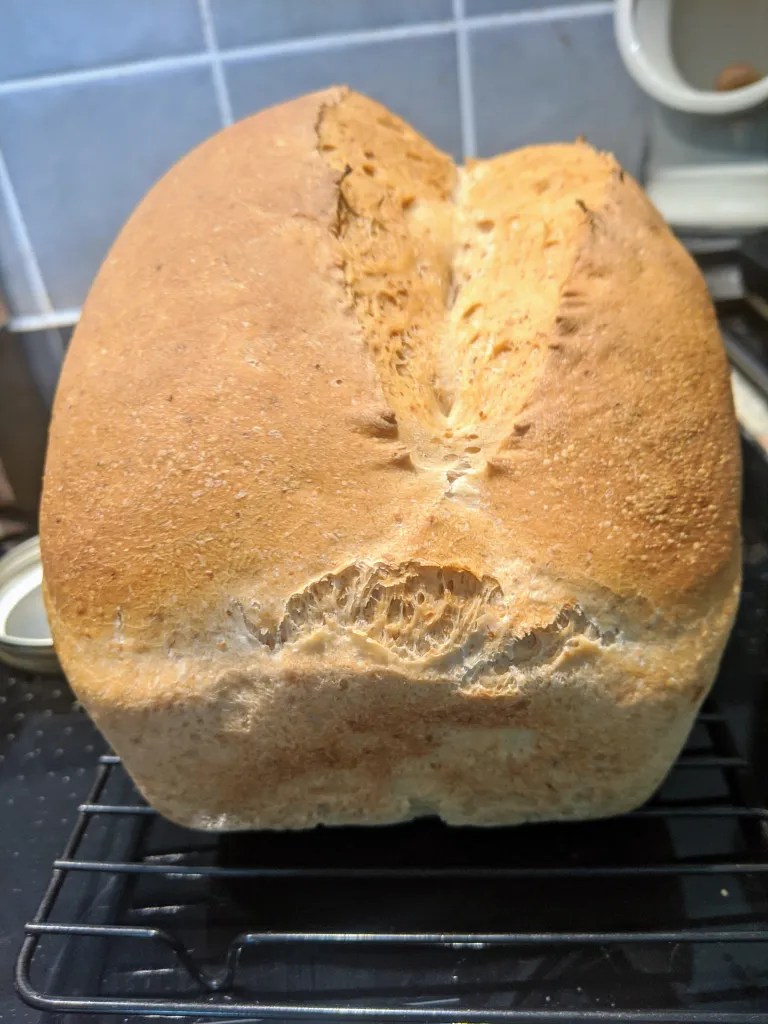
Proved on a couche cloth and supported by a couple of rolling pins.

Being a conservative (with a small C) kind of person, I can get absurdly attached to the way we do things round here, and after a couple of successful outcomes with loaves, for instance, I have to almost force myself to try something different. There has to be a strong reason for me to change; and happily a strong reason came along just at the very moment I’d grown a bit tired of circular bannetons which I’ve been using for years after an even longer period of using nothing but tins. You may call it boring, but for me it’s a way of taming an unforgiving and unpredictable world. Of course I know perfectly well that the fact there’s a familiar shaped and flavoured loaf on the table with some home made marmalade at breakfast time – doesn’t guarantee that the roof won’t fall in by lunchtime, but ….. well most of the time it doesn’t!

So it was the impossibility of cutting two slices the same size from a circular loaf that finally pushed me towards the sandwich maker’s friend, a broadly rectangular loaf that yields lots of similar sized slices. Nothing else changed at all; same recipe, same proving time, same baking times. However it wasn’t all that simple to achieve because clinging to the lifebelt of a banneton I bought a rectangular shape without thinking through the obvious problem of getting the dough out of the banneton and on to my improvised peel without at some point turning it over. The resulting loaves were fine tasting but looked like baboons bums by the time I’d deflated them by clumsily handling them. And so I bought a linen couche cloth to line the banneton so I could gently lift the risen dough out and slide the peel underneath it. Nice theory but there was one problem. I’d got very used to producing soft, sticky doughs and baking them on a cast iron griddle plate heated to 240C – smoking hot – so that they wouldn’t spread out and pancake in the oven. Even in the short time it took to transfer the loaf from the couch cloth to the peel, my infant loaves were spreading like regency ladies when they removed their corsets. Good fortune intervened when I had to knock out a couple of batches of morning rolls and I discovered that proving them on the couche cloth firmed the outsides and bases just enough to make it a breeze to transfer them to the oven; and if you could do it with rolls, I thought to myself, why not a whole loaf? I just needed to make the dough a tiny bit stiffer.

Consequently the familiar everyday loaf has suddenly mutated and changed its shape. The slashing was a bit iffy and needs to be a touch deeper next time, but given the new shape it occurs to me I could bake two or even three – side by side – if I could lay my hands on a larger cast iron sheet or baking stone. Then I’d probably need to get a proper peel instead of my improvised cake tin base, because the rectangular loaf overhangs the tinned sheet by about three inches. You see how this baking business sucks you in! before you know where you are you’ve graduated from the occasional recreational loaf to full fledged addiction and the purchase of quite unnecessary accessories like waxed cotton aprons. Luckily Madame has an abundance of common sense which she shares with me whether I like it or not.

I’m perfectly prepared to admit that my loaves would rarely win a beauty contest, but on occasions that we give in to the temptation of a shop loaf we’re almost always disappointed. As I wrote a couple of days ago; when style and ease of manufacture triumph over flavour, food declines. I’m always reading that bread makes you fat, but our experience suggests that the better the quality of the food we buy or prepare, the less of it we actually eat; and in any case when bread making, a little extra time can mean you are able to incorporate more wholemeal flours. 100% wholemeal sourdough can be very hard to bring to life, but our everyday bread has a combination of wholemeal wheat flour, dark rye flour and also strong organic white flour. It tastes, as I’ve said before, like the granary and wonderfully complements a piece of raw milk farm Cheddar. Expensive, yes of course, but the bread comes in at a third of the shop price and the cheese is so well flavoured you need much less of it to satisfy your appetite. It’s junk food – sugar, salt and fat combinations that make us overeat, then makes us sick and overweight. Am I sounding a bit evangelistic? Sorry!

Properly made bread is good food – we can’t emphasise that too much. The process of milling and then fermenting grains outside the body enables us to easily digest a truly amazing source of carbohydrate, protein, vitamins and minerals. Wonderful stuff even if – like me – after years of exploration you’re still wandering around in the foothills!

Organish? – not all turtle soup and silver spoons

Found on the green yesterday – bluet?

Another trip to the farmers market yielded a chastening surprise at the weekend. We were in something of a hurry because we we expecting a family visitation to celebrate our son’s birthday and so we sold our souls and picked what looked like a healthy looking bakery stall and stocked up on padding. Not – I should add – the indispensable thin sliced industrial white (only used for summer pudding at the Potwell Inn), but sourdough loaves bearing all the imprints of banneton and human labour and with a corresponding price tag.

Being a regular home baker myself, I expect to make better bread than most bakeries simply because my time and experience come free of charge. There are no rents, rates or wages to find each month and if the loaves are a couple of hours late coming out of the oven, nobody dies or goes bust. So what can you say about bread that looks exactly like the real deal but lacks any single distinguishing feature? With bread, and almost any other artisanal food you could name; time equals flavour. Bread that’s rushed through the process in a few hours will never, can never develop the full flavour of the wheat or rye. It might look like the real thing; the crust bursting with energy, the crumb textbook, the rise prodigious but without time – and I mean lots of it – it will never taste of anything and be fit only as a platform for something that does taste delicious. Good bread, cheeses, pickles and ferments are all the same in their demands for time and human judgement.

There used to be a Chinese restaurant in Bristol whose menus were masterpieces of brevity. “Steamed fish”, for example was a whole carp, steamed on a bed of aromatic vegetables – wonderful. It was always honest as well; no item on the menu was buried under a landslide of adjectives. You either liked chickens’ feet or you didn’t with or without the anointing of such words as luscious, velvety or exotic. There’s a huge Chinese supermarket in East Bristol that will sell you a box of frozen pork cervix. Please don’t feel obliged to buy them on my account!

We’re so accustomed to supermarket photographs of fictionalised farmers surrounded by their happy animals (my chickens are soooo free range they even have a community centre and a table tennis team) that we don’t so much buy nourishment as lifestyle narratives, and of course this means that we rarely get to taste the real stuff. Of course you can bake bread that looks like the loaves in the latest edition of Country Life but I fear that a splash of sourdough starter for flavour accompanied by a good deal of conventional yeast, a short warm rise and a lot of steam is what we usually get. Worse still, our palates are so habituated to bland food, we find fully flavoured properly made food overwhelming, even unpleasant. Just as a treat I bought in some really good cheeses for the family to try on Saturday. Apart from me, nobody liked them – their loss, my gain I suppose but what a shame to live in a world of bland, grey flavours when you could experience the orchestra of a well made Cheddar. Sadly, in marketing food, all too often more creativity is expended on the promotional material than on the product.

Anyway, there’s been more than food alone on our minds this week. The campervan roof light has been leaking recently and after a few abortive emails to local repairers we made contact with the company that built our van and they immediately agreed to repair it yesterday. The snag was that we had to be there when the workshop opened and it was on the far side of Dartmoor. So it was a 4.00am alarm and then a drive down to the banks of the Severn to collect the van from its storage facility, and then driving down the motorway in what still felt like the middle of the night. There’s always something exciting about night driving and by 7.00am we could see the first intimations of sunrise as the sky took on a faintly damson flushed with peach hue to the east, with a three quarter waning moon in the sky above and the Somerset levels frosted in the first really cold night of winter. We arrived in good time and after three hours the van was restored and we drove north with Dartmoor to our left, looking ravishing in the clear blue skies.

More about rats

I was turning the compost heap last week and, one after another, three large and very sleek rats abandoned ship and scooted off up the path. One of them went in the general direction of Madame – who was weeding – and a piercing cry went up – an eeeeeeeoooooaaaaaaach – sort of noise. I don’t know about the rat but it scared the living daylights out of me. I think it’s as much the unexpectedness of their appearances that’s the most unnerving thing.  They have a tendency to sit the disturbance out until there’s no alternative but to bolt.  I’ve had one jump right over my shoulder on one occasion. We’ve got a trail cam on the plot and we’ve filmed cats, mice, foxes, squirrels and badgers, but it’s the ubiquitous rats that trigger the camera more often than any of the others. 

So are there so many more this year? Without the benefit of a proper survey, I’d say that without doubt this year has seen the largest infestation we’ve ever seen.  It’s not quite Hamelin but it’s almost impossible to drive past the entrance without disturbing two or three, and there can be very few allotmenteers who haven’t seen a few at least. They have a prodigious capacity to breed, and therein lies one possible solution to the problem. It’s entirely natural for populations to grow to the point where disease, overcrowding and food shortages drive the population down again. It’s a possibility but we shouldn’t hold our breath.

It’s said that the lockdown and the closure of the restaurants and fast food outlets led populations of rats and gulls alike to look for food beyond the city centre and, I suppose, we’re providing it. I’ve read that the gulls hardly bred at all in the first lockdown although they certainly seem to have recovered well by now. We’ve tried just about every conceivable way of discouraging them and there’s no single answer. I suppose not composting kitchen peelings and veg waste would be a start but it would be at the expense of our compost heaps.  You can always see when they’ve paid a visit because they dig distinctive tunnels in the upper surfaces and often have toilet areas where you can see their droppings.  We all know that rats can be carriers of leptospirosis so at the very least we need to be meticulous about wearing gloves and observing personal hygiene when handling compost.  They don’t like being disturbed and they won’t enter very hot heaps – which is an encouragement to turn heaps regularly and work them hard.  55C plus a yard fork will put the most determined squatter off. 

I’ve never made bokashi but it’s said that rats don’t like the strong taste and smell of fermented waste.  Kitchen waste can be converted in a wormery so that there’s little left of any interest to the rodents.  Traps, to my mind, are a waste of money because rats are clever little critters and once they’ve been activated they’ll never go near them again.  We won’t use poisons because we love the other creatures, and secondary poisoning is a real issue with rat poison and slug pellets alike.  Ask yourself why there are no hedgehogs on our allotments? 

And that leaves barriers – fine chicken wire wrapped around wooden heaps and tight fitting lids because they’re great climbers. But they’re also great tunnellers so the chicken wire needs to be brought out horizontally at the bases of heaps as you might do when fox-proofing a chicken run.  One final suggestion which we’re testing at the moment is to fill any tunnels with wire wool and ram it in firmly with a crowbar. Apparently they are greatly averse to chewing through it! – and who could blame them? 

What doesn’t work? Gardening lore is about as useful as Old Moore’s Almanac so ignore the advice that they don’t like citrus peel because they do, as do the worms as well. And there’s one more tactic which does absolutely nothing to reduce numbers but it can transform our relationship with rats. Actually they’re very clever, very resourceful and often quite handsome animals. If we’re serious about wildlife gardening then we don’t get to choose the cuddly bits and slaughter the rest. This year we managed to keep the badgers off most of the sweetcorn with a ring of steel; but the rats simply moved in and took their place. We would see them swaying at the top of a plant nibbling away happily. But we managed to harvest about half the crop and enjoy it. We don’t moan when the bees eat our pollen or the birds eat our seeds so maybe the rat too should be considered part of life’s rich tapestry and a perfect supper for a hungry fox too. 

Marmalade crisis strikes the Potwell Inn

I suppose running out of marmalade would be fairly low on the agenda as COP26 falls through the wormhole that is Boris Johnson’s mind and into alt reality territory where anything can be true as long as you want it to be, and Bobby Ewing will still be pumping oil after all.

But here, in what we cling to as the real world where in January – as a result of the lockdown – we were unable to make marmalade because we couldn’t get any Seville oranges, and the cupboard is now bare, of marmalade at least. In my fragile frame of mind something as trivial as marmalade can loom large and grey. However this is also a season where some pretty hard work on the allotment takes place. For much of the year the management of the compost heaps means turning one of the bins at a time; but this week we needed to move the contents of all four bins – amalgamating the leaf mould with the finished compost, refilling the empty leaf bin with this year’s leaves and then turning the active heap into the adjoining bin. I reckon that involves forking, shovelling and wheelbarrowing approaching 1.5 tons of decaying plant material. The upside is having up to a couple of tons of black gold for free every year.

I’ve discovered over the years that there’s nothing more likely to send the black dog away into the wilderness than having some sort of plan; the only obstacle is taking the first step. Going back into the gym was one part of the plan and doing the compost was another. If there’s a downside to turning compost it’s the lingering smell of an anaerobic heap which penetrates your clothes and takes up residence in your nostrils. Letting the air in to a heap is essential to prevent this from happening, but it’s not always possible to do it in time to head off the stench. The rule is – if you can smell the heap it needs turning and shaking up. Yesterday’s active bin was on the edge of becoming a nuisance and by the time I’d moved it all into the empty bay next door, the previously mentioned penetration had occurred. I didn’t notice it until I sat down in the armchair to rest my aching muscles, but such is the power of the stink, it seems a couple of molecules of whatever it is could clear a lift in ten seconds. So that meant my overalls and shirt had to go into the wash even though they looked perfectly clean. The hard manual work, though, had exactly the desired effect on the black dog which withdrew – at least for a few hours.

I know when I’m down because otherwise enjoyable jobs get neglected. The sourdough starters aren’t fed, the kefir sulks in the fridge and I can’t be bothered to do anything about it. So the good news was that after a discussion with Madame we decided to drop the experimental white sourdough project and go back to the old everyday sourdough bread recipe based on a dark rye starter; 250g of stoneground wholemeal wheat flour to make the batter and then after 12 hours adding 300g organic white strong flour, mixing it (it’s very sloppy at this stage) and adding enough dark rye flour to bring it to a kneadable consistency then 10 mins kneading a rather soft and sticky dough, and transferring it to a banneton seasoned with rice flour which has no gluten and releases the risen loaf easily. All this, then yesterday evening, and foolishly, I left the loaf to rise in the only room in the flat with heating turned on. I have to say that this is an extremely lively dough, and so – resisting the temptation to peep during the night, I woke at 6.30 and the exuberant dough had overflowed the sides of the banneton and was making its way onto the table. Luckily I was able to fold the billowing belly back into the banneton; slash the top and transfer the loaf into the oven (240C for 10 minutes then 180C for about 25 mins more). Sourdough evangelists will notice that I don’t give this loaf a knock back and second rise – mainly because if you leave it too long the acidity builds up rather more than we like. It’s dead easy and takes 24 hours from start to finish with no more than 20 minutes of actual work. I hardly dare say that there’s no ur loaf lurking out there virtually beyond Plato’s cave. Cooking is just the best way of making exactly what you like eating – end of!

Old? Moi??

Any way, this morning we were back at the gym and after a 20 month layoff I finally did a 10K row with no more serious repercussions than an aching bottom. All that’s left now is to work on reducing the time! The black dog has gone off with his tail between his legs. I hope he goes up to the allotment because as I was turning the live heap yesterday three very fat rats beat a hasty retreat; one of them provoking piercing screeches from Madame who was weeding nearby. We have a real problem with rats across the site at the moment but I won’t use poison and they quickly get wise to traps. Disturbance seems to be the best way of upsetting them.

Oh and I have a new project forming in my mind. Having sourced some farm fresh milk that’s only pasteurised at low temperatures and which, ironically, we buy from a slot machine in Green Park Market; I think we’re (I’m) in a position to have a go at making some some cheese. Madame will say it’s the thin end of the wedge, and I wish that could be true – but I’m thinking of the soft and smelly end of the spectrum. My cheese library is growing rapidly and it seems this rotting business filled the whole of the day yesterday. From compost heaps to bread and kefir and – hopefully – cheese; the beloved fungi, bacteria and yeasts of the earth, knowing nothing of black dogs or Boris Johnson, continue to transform our lives for the better.

Eating above my pay grade

I can only think of three ways of being able to eat fine food most of the time: being born filthy rich; being fiercely ambitious and earning a pile yourself; and finally- teaching yourself to cook. Mulling over this thought today a quotation floated into my mind from heaven knows what remote corner of my memory.

When the painter was in funds he put mushrooms, fried eggs or tomatoes on top of the cheese; being very young when he evolved this recipe, he often smothered the cheese with fried onions, but this would be too much for most digestions

Recipe for ‘painter’s toasted cheese’ from Elisabeth Ayrton’s “The Cookery of England. Published in 1974.

Michael, if you hadn’t guessed, was Elisabeth’s painter husband, and the book isn’t so much a recipe book but a work of serious historical scholarship covering many centuries of cooking. What I loved about the quotation from the moment I first read the book decades ago, was the tremendous encouragement it gave me, knowing that there existed other people who understood and loved good food but were often reduced to cheese on toast when funds were tight. Most creative people; artists and writers particularly, would understand the challenge. If you love the thought of eating well on a cheese on toast income, you need to roll your sleeves up and get cooking.

Many years later, and with two of our sons working as professional chefs (the other is a fine cook too) I’m all too familiar with the cheffie tricks and shortcuts that make the provision of good enough food, night after night from a small kitchen – almost tolerable. If you want to pay for the kind of dishes you read about in the food porn magazines, you’d better get a better paid job – but it might come as a surprise that the best way of all is to forget about restaurants, because you so often come home thinking to yourself ‘I could have cooked that better for a third of the price’ – and remind yourself that the other 2/3 of the price of a meal out is to pay for the owner’s Porsche and all those well trained staff fussing over you.

Anyway, that’s the conclusion that Madame and me reached when we first moved in together and, every day, passed a classical French restaurant that boasted the sort of dishes I had to look up in my (then new) copy of French Provincial Cooking. Since then, the skills and the knowledge have grown and now growing our own vegetables and cooking all our own food has become a way of life, and when I don’t know how to do something, one of the boys will know exactly how. I have still never tried to cook calves brains, however, and it’s not a bridge I want to cross. I will have a go at most things and occasionally come well and truly unstuck – like I did with the andouillette I bought in a French motorway service station and which tasted and smelt of colon; oh and a raw seafood salad in southeast France that gave me toxic shock and my first encounter with complete fasting as a cure.

What this means, of course, is that the greatest challenges of the present anthropocene age are a bit less frightening to us than they might otherwise be. For instance it wouldn’t break my heart if I never ate another fillet steak because I can’t remember the last time I tasted one. Very occasionally we share a single sirloin steak but circumstances have taught us how to get the best out of the cheapest cuts.

What has changed irrevocably for us is that once we decided that wherever possible we would only eat locally farmed, organic produce our food bill increased and even the cheaper cuts of meat got a whole lot more expensive. That’s the downside I suppose, but the upside is that the flavour really is better. Less can be more it seems – for instance, if you’re a cook, you will almost certainly recall trying to brown chunks of meat before casseroling them – and watching glumly as a copious amount of added water seeps out and broil the chunks to an unsavoury looking grey colour. Supermarket pre-packed meat is especially prone to this and it’s because the processors are allowed to inject up to 10% water into their products – allegedly to make them more acceptable to the customer. So already 10% of your cheap meat is water, and it gets worse when you start to add in the environmental costs of intensive farming which have often been subsidised by the government – i.e. by the taxpayers, you and me. In fact if the environmental costs were added to the total the ‘expensive’ meat would almost certainly be cheaper than the cheap meat from the supermarkets and if you only eat meat occasionally you get the best of all possible worlds, while the world gets the best of all possible inhabitants.

Compare this kind of adulterated industrial meat with the locally produced pork shoulder we bought on Wednesday for a dish including shallots and cider. Browning the meat was a total dream – no fuss and lovely results. The meat in the finished dish hadn’t shrunk to half its original size so we could have probably bought less; bringing the price down again. You just have to be careful how you buy food. Our chosen suppliers get only one chance and if they try it on we don’t go back. We do the research, visit the websites and make some exploratory purchases because not everything with a locally produced label is perfect. Cheese is a particular example and although our local supplier of blue cheese is brilliant, ironically the Cheddar cheeses are very variable and some of them taste extremely mass produced in spite of their price – and Cheddar is only twenty miles away!

But we don’t cook simply in order to help the earth or save loads of money; we cook since we’re greedy and love eating good things – and this is the only way we can do it; the way we’ve had to do it all our lives, because the wealthy parents and highly paid jobs seem to have passed us by. The lifestyle changes that we need to embrace seem to us to be a far better way of being human than the stressful, dog eat dog, and endless slavery of vulture capitalism. Buying locally means we get to know the producers and we are becoming part of a whole new community of shared values. Come on in – the water’s lovely!

More sourdough experiments, bread and butter pudding and Cornish pasties – well, it was raining outside.

Whereof one cannot speak, thereof one must be silent.

Well yes, Captain Kipper (OK actually Ludwig Wittgenstein) – but what if there’s something you’re trying to articulate that’s so liminal, so at the boundary of a concept, yet to be properly mastered, that words and their meanings need to be forged anew? Surely that’s the work of the poet? and can’t be shirked in favour of silence. Language is endlessly adaptive; always finding ways to speak the previously unsaid, and one of those ideas that’s slowly being forged into speech is the curious relationship we have with nature.

We arrived back from our family get-together in Cornwall and went straight to the allotment, as you might expect. Then we prowled around to see the state of things; set up the trail camera and made plans for today – and today it rained; so we put on our waterproofs and got on with picking out the courgettes that had swollen to blimp size during the week; harvesting tomatoes, aubergines, runner (pole) beans, potatoes, peppers, summer squashes and masses of herbs. As you will know there are only two of us so this season of plenty has to be matched with a positive frenzy of pickling, preserving, boiling, reducing, freezing and fermenting. It’s been a crazy weather year and right now with the jetstream moored south of the UK we’re stuck in a series of lows, bringing cold winds and rain in off the Atlantic – it feels like autumn already.

So today we got wet and yet we both felt completely content just to be there. After finishing harvesting, Madame got on with summer pruning the fruit trees while I wheelbarrowed down enough woodchip to level the path in the polytunnel. There’s a reason for this because our plan is to clear the tunnel completely by the end of August and then we’ll need easy access with a wheelbarrow to bring compost in to feed the beds ready for the winter crops. Later in the kitchen I made stock and prepped a dozen half litre jars ready for tomorrow’s new batch of roasted tomato passata while Madame prepared to cook a bulk batch of ratatouille which freezes very well. All the while I was making sourdough bread and attending to the starters after their week in the fridge.

Perhaps one reason for the rather philosophical opening paragraph was some marvellous video footage of our friend the badger failing to find the sweetcorn beyond two layers of soft net and a maginot line of tagetes and mint – which we make portable by growing it in pots. Badgers hunt by smell and we aim to confuse them as much as possible. The three sisters experiment is exceeding our expectations and we have corn ten feet tall with borlotti plants climbing to the very top, whilst below some fat winter squashes are developing nicely in the shade. It looks a mess but it also looks like a success. The only predator likely to get to them before us is the badger; but since we invested in the trail cam we’ve grown to love the nocturnal intruders. We want to deter them of course but we wish them – with the foxes, squirrels, magpies and even the rats – no harm and the reason for that is that we have begun to see them as having their own inalienable rights over the land. The thought that they’re out prowling during the night gives us as much pleasure as the sound of a tawny owl calling does. We share their taste for the vegetables we grow, but perhaps value them more in their appetite for the slugs, snails and rodents that trouble us. The old binary division between crop and pest is dissolving and it’s that disappearance which demands a new language. The actors haven’t changed at all – badgers love corn and that’s unavoidable. What’s changed is that we are beginning to accept that if we want to save the earth; all those binary distinctions will have to be overcome through an unprecedented change in the way we understand, and therefore speak of our place in nature .

Wheelbarrowing woodchip with the rain running down our necks; stacking the compost heap with a mixture of green waste and wood chip and feeling its rising heat the next day; summer pruning, rooting strawberry runners and sowing chard for the autumn is done not though the domination of nature with powerful tools and chemicals but by attempting to think like a fox or a badger or – more oddly still – to think like a compost heap, or like the earth in a raised bed. It demands that we learn to think like a tomato or a potato; to ask what ails you? as we did today when we were examining what might have been tomato blight but turned out to be (in all probability) didymella stem rot, caused by stress – in turn caused by a poor watering regime. Failure often brings knowledge. Yes we talk to our plants; but more mysteriously – and only when we listen with complete attention – they speak to us in a language we have barely begun to understand, and which stands on its head, centuries of binary thinking through which we believe ourselves to be independent, separate subjects moving through a sea of resource objects. In this new state of being we are (imperfectly) in what Gary Snyder described thirty years ago as a “trans species erotic relationship” with nature; which sounds clumsier today than it did when it was written – but the word erotic captures the sense that this relationship transcends the instrumentality of the old ways and enables powerful feelings for nature which offer a pathway out of imminent destruction. Talking to the trees – it turns out – is a two way conversation as long as we are willing to get over ourselves and listen.

Trench warfare at the Potwell Inn allotment

The sticky end of the unwanted grape vine

Regular readers of this blog may remember our ongoing struggle with underground streams on the allotment. In many ways we’re very fortunate to have a stream percolating somewhere beneath our feet that is able to supply water to the roots of any our plants with the means to access it. But it cuts both ways when we get very wet weather and the water table rises to about a foot beneath the surface; the clay/loam soil is desperately liable to poach and so many plants hate having wet feet.

The grape vine was on the allotment when we arrived. In fact the whole site is populated by genetically identical black grapes, all of them planted in the heyday of the Italian restaurants when a team of waiters and chefs took over plots and grew food to remind them of home. The very last of them died just this year and well into old age he still browsed our allotments as if he and his friends were still running them. I once saw him take two carrier bags of ripe figs off an allotment that used to be theirs. They would also pick many buckets of grapes to make wine which is, or was, reputed to be pretty good. We’ve got a vine on each side of our plot and one of them looks after itself with a bit of pruning in the winter, and gives us a good crop of small, sweet black grapes rather spoiled by over large pips. The other vine has always functioned better as a windbreak and screen, producing copious growth of leaves and shoots but never setting a decent crop of grapes. We made 25 litres of wine from the other vine a couple of years ago, but there wasn’t enough sugar in the grapes so it was very ‘thin’, lacking in flavour, and in the end we poured it away. When we decided to stop drinking alcohol 18 months ago it removed one of the reasons for growing these small grapes. Ironically our present allotments are on a site thought to have been a vineyard in Roman times.

So when we rationalised the fruit cage this autumn we decided to dig up the less successful vine to make space for a redcurrant, and today I attempted to dig it out. After a nominal first foot it was clear that the reason for unsuccessful growth was that it’s had its feet in water every winter. In the end I had to give up because the hole was filling with water within minutes and the stump appeared to be sucking itself deeper and deeper into the soil as I squelched around it with a spade and crowbar. I was experiencing the legacy of the wettest October on record – which leaves a question mark over replanting a redcurrant bush there. At the very least the patch will need a lot of grit incorporating to improve drainage. I might be able to redeem it a bit by diverting rainwater from the adjacent row of compost bins into more water butts. The council turned off the water supply today so I’m glad we’ve got about 1000 litres stored already. Over recent years we’ve experienced problems early in the year before the site supply is restored, because we’ve been blessed with fine dry weather.

While I was getting hot and muddy, Madame planted another two rows of broad beans to stand over winter. She was planting them in a bed that we’d augmented with some bought-in topsoil that had an even larger clay component than our own ground and which I had to dig a whole bag of grit into today before she planted it up. In the fruit cage the winter pruning is almost done now, and on the veg plots the garlic is growing steadily as are the peas which are always a bit of a gamble. If they survive the weather and the mice we’ll have an early crop next year. The brassicas were mostly planted on a bed that was well fed with our own compost and now the early purple sprouting broccoli are almost as tall as me. Let’s hope they’re as productive of shoots as they are with leaves.

The rats have returned to the compost heap since I drove them out by turning it repeatedly; so today I had to set one of the powerful spring traps baited with crunchy peanut butter. Hopefully greed will overwhelm their caution and I can get rid of them before they breed. We do have a lovely but rather wild cat on the site but even he can’t eradicate them all on his own. I say a quiet prayer to bring on the hungry peregrines, buzzards and kestrels and multiply the stoats and the owls!

I was thinking during all these labours about the strange way we misrepresent the allotment as if it were a haven of peace, tranquility and rest. An organic allotment may not have anything like as high an energy footprint as a non organic one, but only if you discount the gigacalories of human toil that goes into replacing the chemicals, pesticides and nitrate fertilisers and the very considerable financial expenditure on bringing the soil back into condition. One survey I read claimed that an allotment can be ten times as productive as an equivalent sized plot of farmland – which can only be true of a very intensively managed allotment. Once a plot becomes a significant contributor to the household food supply, it becomes a place of work – good creative, skilled and satisfying work but work nonetheless. I’ve been reading Chris Smaje’s book “A small Farm Future”c Chelsea Green Publishing and I was interested to see (Page 106) a chart that placed gardening in the same category – high labour input + high productivity – as the conventional arable farm. The difference is that the energy input is mostly human toil rather than fuel, fertilizer and chemicals. It’s a great book, well worth reading and presenting a well argued case for small farms and locally sourced food chains. So while I’m in the mood, here are three books I’ve learned a great deal from:

  • Chris Smaje “A small Farm Future” – Chelsea Green Publishing
  • Dieter Helm ” Green and Prosperous Land” – Collins (an economist’s view)
  • Simon Fairlie “Meat – A Benign Extravagance” – Chelsea Green

I could add many more, but these three are extremely practical, albeit quite polemical contributions to the debate about the future of food production. One thing’s for sure; this is a debate we’re going to have to engage with whether we like it or not.

And finally we’re off to the flour mill tomorrow to get 25Kg of stoneground wholemeal flour. I was expecting to be turned away but lockdown part deux hasn’t had the same impact on flour supplies as the first round. It’s an excuse to drive 20 miles along the Cotswolds in the most beautiful scenery, so Alleluia – life feels good. This morning after our saintly breakfast of home made muesli, I had a slice of the first loaf of everyday bread and the first teaspoon of marmalade (also home made) in four months. Oh joy!

The thrills and spills of seasonal work on the allotment

Our neighbouring allotmenteers went on a gardening course with Sarah Raven last week and among the multitude of new ideas they were buzzing about afterwards, one in particular stuck in my mind. The soil is all important – the beginning and the end of any attempt to grow things. Of course that’s right, but it was only as I was turning the compost heaps again today that I remembered how much I enjoyed this time of year when I was working as a groundsman, and we began all the routine maintenance jobs; repairing the wickets, hedging and draining and looking after the machinery. Of course we had to maintain the football and rugby pitches and mark out the white lines every week., but it was the time when all the foundations for the next season were laid.

And on our plot today we were already setting things out for next season. Peas and broad beans are all ready, in fact the first batch of broad beans is already growing in the ground. The fruit trees are ready for their winter pruning and we’ve prepped ready for five new trees. The tall perennial herbs have been divided and moved to their new spot near the pond; the asparagus bed has been cleared, weeded, given a supplement of calcined seaweed , then composted and sheeted. All the beds have been manured or mulched with leaf mould and sheeted even though some of them will be planted up before Christmas. We’ve had rain and then a few days of early morning frost which will help the garlic; the new batch of leaves is stored for next year – there should be about two cubic metres of finished leaf mould.

Then the paths have all been topped up with new wood chips which rot down surprisingly quickly so they swallow up to thirty wheelbarrow loads every autumn to bring them level with the path edging. That’s a lot of trudging up and down the steep site, but when it’s done the plot looks somehow more purposeful if that makes any sense.

Sadly, today I dug out all of the leeks for burning, because they were attacked again by allium leaf miner and were beginning to rot where they stood. That’s the third year we’ve lost them all and so I think we’ll give them a miss now for a few years. although I’m sure the plant breeders will be looking for more resistant varieties. We don’t put the affected leeks into the compost because especially at this time of year we’re unlikely to reach high enough temperatures to kill the pupae, and today I found a cluster of eggs laid near the base of one plant. These obviously need to be destroyed or we’ll just perpetuate the infestations, but the insect now seems to be everywhere in the UK. Our best hope of control is the same as it is for any other pest – physical barriers, good soil, strong plants and masses of predators at the right time. That’s why we overwinter the broad beans – it toughens them up enough to resist the aphid attacks until the ladybirds arrive.

There really is a correlation between abundant insect attractors and improved predation on garden pests, and one of the principal deficiencies of spraying with chemicals is that it often kills the predators as well as the target pest; thus making yet more applications of spray necessary. Modern apple production requires quite staggering numbers of spray applications; every one of which can make the situation worse.

The compost heap still heats up obediently every time it’s turned, and the more often it’s turned the quicker it does its job. One indicator of how well it’s doing is what’s happening to the bean vines which are often quite slow to rot. This year the vines were taken down in mid September and a couple of months later they’ve all but disappeared in the the heap. the worms don’t like it too hot and so they move up and down in the bin until they find a congenial spot – many thousands of them can congregate of a single bin. You just need to keep the heap at the right level of moisture – not too wet and not too dry but just right.

The same goes for plants which prefer their moisture in modest amounts; so this time of year too, when we get heavy rain, we can see which parts of the plot need additional grit to help with drainage. With the exception of bog plants I can’t think of any normal garden vegetables that don’t absolutely hate standing in waterlogged ground. Plants can die from lack of oxyen – they can easily ‘drown’ if they’re left too long.

It would be quite wrong to think that allotments can be ‘put to bed’ in late September and not tended again until spring. These quieter growing months are a marvellous opportunity for planning, remedial work transplanting and new planting of trees, and the odd bit of civil engineering. I wish I could add digging to the list because I absolutely loved doing it and miss it terribly now we’ve given it up; but I honestly can’t think that, aside from keeping me warm and fit, it does anything for the soil at all – and if you miss the exercise, get a bigger wheelbarrow and fill it up – or, if you must, drag a tractor tyre up a hill with chains.

And there we are – a whole posting without a single apocalyptic rant about the environment, but I think our chat with the young smallholder yesterday reminded me that while, as the astrologers might say, our economic and political systems might dispose us towards destructive practices, they really can’t compel us. We can resist and go our own way, knowing that although we may not be saving the planet on our own, we’re at least not making it any worse.

And finally yesterday’s 100% wholemeal sourdough loaf. I’ve eaten my words and unreservedly recant all my previous statements on the impossibility of making a decent 100% loaf. Thinking back, during the first lockdown I changed a large part of the time and temperature settings during baking, none of which changes I’d ever applied to a wholemeal loaf. So the combination of leaving out the second rise – cutting the overall proving time down to 18 hours instead of 26; and shortening the bake by 30%, the first ‘new method’ loaf emerged pretty triumphantly with a soft crumb, open texture and a good crust, not an impenetrable barnacle hard carapace. The flavour was intense – as you’d expect – but with none of the bitterness you sometimes get with a fast, yeast driven wholemeal loaf. And best of all, it tasted of wheat: really wheaty with a rich taste of the granary floor (if that makes any sense). As children my sister and I used to love feeding the chickens at my grandparents’ smallholding in the Chilterns. The grain was kept in a shed, and we would go and fetch an old pot, fill it with grain and go out to feed the hens. The loaf reminded me of, and tasted as good as that experience.

Busy bee

OK its probably a hoverfly, but cherry blossom on the riverside in November is a lovely sight!

By 5.00am I was wide awake and in the kitchen today. Yesterday I resumed breadmaking after a break since August when we put ourselves on a low carb diet; and, notwithstanding all my protests that it’s impossible to make a really satisfying 100% wholemeal sourdough loaf, I went ahead and started one anyway.

We survived the first lockdown by cooking (not so bad) but also eating far too many portions of comfort food; bread, cakes, biscuits and preserves and thus it came to pass that we were becoming more generously proportioned than is good for us; in fact we were as fat as Christmas hogs. The last three months of frugality have worked well, we’ve both lost approaching a couple of stone and the threat of nameless but horrible consequences has receded – no doubt like the devil seeking an opportune moment. I won’t bore you with the self glorifying details but there were two particular milestones – rediscovering my waist, and then a joyful reconciliation with a load of clothes that had been folded up and stored with a sigh years ago when it all started. Hilariously, I also discovered that when my old jeans were properly installed around my waist rather than clinging precariously under my belly I no longer needed the shortest leg length. Toulouse Lautrec eat your heart out!

The challenge with wholemeal sourdough is to get it to rise without the sharp edged bran damaging the structure by puncturing the bubbles of carbon dioxide. Those of us of a certain age will remember the Grant loaf – often as hard and dense as it was possible for a dough to be. But Doris Grant had one thing absolutely right; wholemeals don’t need as much kneading, and they ferment quickly, so leaving them for too long is more likely to lead to a collapsed dough than a life-changing loaf. My idea was to cut out the second rise altogether and see what happened; I just had my illumination at exactly the wrong moment and so I started the batter at a time which ensured I would be awake at 4.00am worrying about the dough overflowing the banneton. The idea is to catch the dough when a poke with a finger creates an indentation that feels springy and mends itself immediately. This morning I missed the optimal moment by a couple of hours and a dangerous looking muffin top was just overhanging the banneton (reminding me of my old jeans) , but mercifully the loaf forgave me and with a good sprinkle of rice flour as lubricant it slid from the peel into the hot oven without collapsing.

Yesterday the sun shone and so we took ourselves for a long walk along the canal and back – about eight miles in all. Aside from the cherry blossom I also spotted winter heliotrope in flower on the canalside. In fact there were intimations of life and growth everywhere, if you took the time to search them out. But the other thing we noticed was how much larger the population of permanent narrow boat residents has become. At a time when decent housing in Bath is beyond reach for so many young people, quite a few have taken to the water in a range of boats from the spick and span to the downright messy. In fact one of the floating homes we saw yesterday isn’t a narrow boat at all but an improvised raft.

Noah’s Ark?

A little further on was another boat stacked so high with stored artifacts and second hand timber it seemed to be anticipating a siege –

Are we supposed to get annoyed about this? To me it shows resilience and, after all, people have to live somewhere and if we allow a housing crisis to develop we have no right to criticise the improvised methods of survival that desperate people are obliged to adopt.

The highlight of our walk was a conversation with a young man who is developing an organic smallholding on an unpromising strip of land between the canal and the railway line. There are several such allotments dotted along the canal and this one was well stocked with pigs, goats, chickens, geese, ducks and one or two exotics in the background. A strip of land that would otherwise be producing nothing but brambles is coming to life and producing food in a largely self-sufficient way. What was so nice about our conversation was that notwithstanding maybe fifty years of difference in our ages, we shared the same experiences and enthusiasm for low impact and sustainable agriculture. I’ve just started reading the recently published “A small farm future” by Chris Smaje – you should check it out – it’s a closely argued book that repays slow and careful reading, but if our conversation with the young smallholder yesterday is anything to go by; the ideas that inspired and motivated us in the seventies and which have been so diminished and derided within this grim era of neoliberal economics, have been slowly gathering momentum and heft in the background. There’s a whole community down on the canal and it’s functioning with its own distinct (and distinctly more sustainable) culture. In my darker moments I’ve sometimes feared that everything we believed in and worked for over the past fifty years has been crushed, and that there’s no-one left to pass all the accumulated experience on to. After our long walk we came back to the flat with more of a spring in our step because there are signs of hope along the canal and in many other places. Goodness only knows how this will play out over the coming decades, but yesterday it felt as if the cultural tectonic plates really are moving – too slowly for some, no doubt – but that’s the way of the paradigm shift. For decades there is nothing but almost inaudible questioning of the status quo, the way we do things round here – and then suddenly one day it all clicks. Like sourdough, the best things are worth waiting for – and I think I’m about to have to eat my own words about the impossibility of creating good 100% wholemeal sourdough. Let’s have a taste!

I’ll tell you what it tastes like tomorrow ….