A couple of days ago I had a conversation with a dog.

Well it wasn’t quite a conversation. I was holding a gate open for Madame when a dog – it was a Springer spaniel – rushed past me nose down, hoovering up a scent line as they do, head low and moving from side to side, tail held almost straight out in a don’t bother me, I’m busy – sort of fashion. I could see its owners about 30 yards back on the track and I said to the dog “Hello you”. The dog being otherwise engaged barely paused to look at me and stopped his forward dash, turned on a sixpence and ran back to his owners. I walked on with Madame and, maybe thirty yards later, a light went on in my head and I realized I’d not only spoken to the dog but I’d spoken in dialect. I was so taken by this slip (I’ve had many decades of practice at not slipping into dialect and I think it was because I was talking to a dog. “You” – used as a pronoun in Gloucestershire used to be confined to strangers and could be construed as faintly hostile. I worked as a labourer in an engineering company when I was about seventeen; after leaving school unceremoniously accompanied by the Headmaster who had me by the shirt collar. This company was in the process of moving from farm buildings to sheet metalworking and chemical engineering and highly skilled (coded) welders were worth their weight in gold. Twin brothers were the welding superstars; they’d both worked on pressure vessels in nuclear power stations and they were so indispensable to the company that they freely abused the managers with the most foul insults. I learned a great deal from them. Anyway, to get back to the point, they never addressed me as anything other than “you”. They would invariably greet me with a surly “alright you?” which absolutely did not require an answer.

But why the sudden “you”? was it because it still lives there unused in my everyday conversations? the bedrock language of my locality. It still seems very precious to me. When I go to the local sawmill to buy posts for the allotment, all the people on the counter speak like me – not like my dad who was Bristolian, or my mum who came from deepest Oxfordshire – but like the language of my childhood’ the language that A F Woodman our Music teacher would try to din out of us. “Boughten” was one of his pet hates. “Thee” and “thou” still had some lingering currency among our elders. When I hear it echoed today it moves me, makes me feel at home, because in its dropped aitches and extended aar sounds, in its you’s and thee’s and its overall timbre and slow pace it gives me a place, a location. Without a local accent of some kind, words are like bus stops without a grid reference – meaningless until you know where to find them. The minute particulars of pronunciation function like tags; they signal important information about the speaker and their message to any listeners who are attuned to the patterns. The last person I knew who spoke full Gloucestershire was Lenny Clark, a fine gardener who died a few years ago. The difference between you and thee , like the French tu and vous are important indicators of relationship and we’ve let them go, although the now redundant differences in speech still express the same divisions in society. Some like to imagine that people who cling to local speech patterns are slow witted and stupid. I think that those people who speak like politicians without giving any clue where they come from, and what background, what hinterland they have – are the true citizens of nowhere. When they appear on the national news I make tea because the voice of authority hides behind received pronunciation – it’s disembodied, bloodless. I don’t suppose there’s much trace of Gloucestershire in my voice these days but that’s where I come from.

There are two bits of data you need to plan any journey on a map. Firstly you need to know where North is but crucially you need to know exactly where you are, where the starting point is on the map. If a harbour is the place a hero sets out from, not knowing where you belong, where you’re starting from, means you’re lost as soon as you sail over the horizon.

I used to walk with a retired farmhand on the banks of the river Severn, and one day he amazed me by naming, with their local names, the fields almost a mile away on the far side of the river. When I speak, I speak with the ghostly voices of my dad, a railwayman; my mother, a dressmaker; my grandfather, a carpenter and smallholder; and all the people I’ve known – not least the already mentioned A F Woodman who taught me to love music, and Chris Levinson who introduced me to the Beat Poets. I went to a so-called technical school but listened to the voice of Chaucer read in its rich original dialect by another English teacher, and learned French from a teacher who seemed to have spent the war in France. There’s a lot of freight in a voice if you care to honour it, and none at all in the aetiolated speech of those who’ve left their history in the dustbin. Losing thee means we have no way of signalling a whole stage of human connection.

This is not in any sense an appeal to return to a kind of local tribalism but to escape the awful snobbery of the tribe which most often causes the trouble and whose dialect history has been brushed away by many coats of magnolia so they can advance in their social class. A truly diverse society wouldn’t insist on young people airbrushing their local dialects out of existence. We can all learn to hear each other. I barely speak a word of Welsh but even I can hear in a sentence or two whether the speaker is from North or South Wales , or Pembrokeshire, or somewhere in the borders west of the Severn, or from the Valleys where I once worked for a while running worker-writers’ workshops.

I called the dog “you” instinctively because we didn’t know one another. The dog, possibly understanding the nuance scooted back to its owner. I think that’s quite wonderful – how about thee?

The River Severn at Purton

What do we teach the children?


Sometimes reading a single book can make me sit up and think seriously about one of my own taken for granted understandings, but sometimes it takes a combination of two or three, read almost simultaneously. This past couple of weeks I’ve been reading three together:

Suzanne Simard – “Finding the Mother Tree”
Merlin Sheldrake – “Entangled Life”
Robin Wall Kimmerer – “Braiding Sweetgrass”

It’s fair to say that my grasp of what goes on under our feet on the allotment was – until recently – pretty scant. We had made up our minds to do our best to grow more pollinating insect attractors and dig the pond, but this is the first year we’ve set out to associate plants with their companions and the first time we’ve made an informed effort to try the three sisters method. I couldn’t say it’s made our life any easier as we’ve had to do a great deal of rearrangement and grow dozens of companion plants from seed. The no-dig philosophy was already baked in from the time we finally got the beds sufficiently weed free and rich in organic matter. The pond has been a triumph for the wildlife, with a crop of fat tadpoles already, and, at the weekend, three Large Red Damselflies – Pyrrhosoma nymphula two of them mating and laying eggs (Still joined together) on one of the pond plants.

Suzanne Simard and Robin Wall Kimmerer begin their stories – as it were – from opposite positions; Simard is representative of the settler traditions and Kimmerer of the First Nation/ Native American. Each writer seems to move through her life and scientific work, towards a more sympathetic understanding of the other. Merlin Sheldrake (and I’m simplifying horribly) struggles with the tension between anthropomorphism and detached observational science but concedes in the end that so long as we understand that we’re using metaphor to describe things for which we have no adequate words and that metaphors can’t be swapped for facts; then referring to the invisible networks and affinities that enable plants and trees to communicate in ways we don’t fully understand can fairly be described as like a brain. All three books are wonderful contributions to a changing mindset.

In my case I came away understanding much better not just the terrible and bitter effects that follow the destruction of a whole culture, but also the grievous loss of wisdom and experience embodied in it. To lose a language is to lose a way of thinking, and to learn one is to open the door to thoughts and understandings that can only be spoken in their native tongue. In the end, the culture, languages and philosophies of settlers and Native Americans alike were crushed and destroyed by extractive profit seeking and industrialized farming. In a much milder way we were schooled out of our local dialect and fed a completely bizarre diet of altered history to convince us that we were the most fortunate and blessed nation in the entire world. As a child, when there were no adults around we would speak in dialect using archaic terms like thee and thou and understanding perfectly without the aid of Eng Lit and William Shakespeare, that calling someone “you” was a distinctly cool form of address. The highest aim of our education was to make us middling; loyal and obedient to the status quo; so creativity and leaps of the imagination were ruthlessly stamped out. Here I am aged 74 and only now are the dreadful facts of slavery and colonialism being examined as part of our national story.

But we too have seen an ancient culture erased, enclosures and clearances driving people off their ancestral land and into cities. We’ve seen famine, poverty and disease accompanying the slums of growing cities populated by displaced people. My grandmother died of tuberculosis caused through poverty and overcrowding, and one of my great aunts died in the workhouse. You can’t say that we lacked knowledge of traditional medicines but they were useless against the diseases caused by overcrowding, poverty and poor sanitation. Thank goodness for modern medicines, but wouldn’t it be better if we could return to healthier ways of living? Slavery in the colonies was the bedrock, supplier of raw cotton, and paymaster to hundreds of thousands of jobs in the mills of Northern Britain – many of them involving children in arduous dangerous labour. Charles Dickens’ novel “Hard Times” paints a bleak picture of the consequences for the other end of the Atlantic slave trade.

We stretched the family reunion to five days with the bank holiday and it was joyful. Some of the grown-ups had breakfast together outside Widcombe Deli, on the pavement; we had a barbeque on the green; lots of walks outside and yesterday we got together with the grandchildren and their mum at Dyrham Park – our first visit there in 15 months. I could put up the family snaps, but they look just like everyone else’s family snaps. Viewed through loving eyes, of course, three children sitting on a tree branch is a Leonardo and, like Madame, they deserve their privacy so you’ll have to take my word for it – they are the cleverest, most beautiful and talented children ever to walk the earth!

So yesterday as I walked across the field at Dyrham Park with our grandchildren; the tongues and welts of my boots bright with yellow grass pollen I started showing the oldest how you could judge the fertility of the soil, and therefore the likelihood of finding some really good wildflowers, by looking at the vegetation. Too much nitrogen is the great enemy of plant diversity.

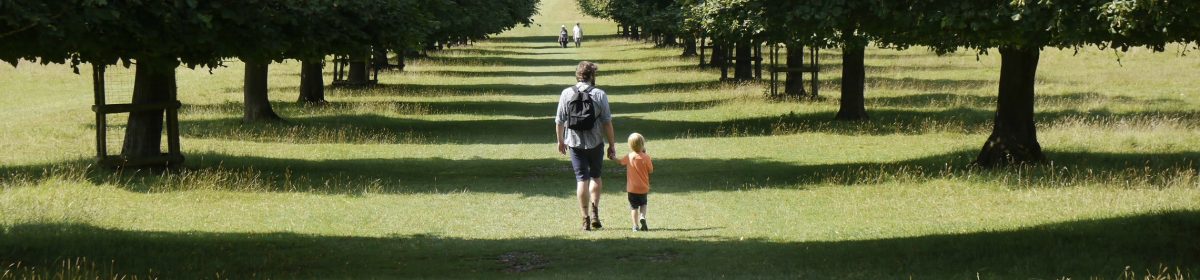
There was nothing much there except for rank grasses, ryegrass, cocksfoot and buttercups. Then I spotted a patch of darker green and I sent him over to take a look. Sure enough he shouted that he’d found a fungus and we went to take a closer look. It was a St George’s mushroom; named on account of normally fruiting around St George’s day – 23rd April; which goes to show how late the season is this year. So I cut it in half and showed him the white gills; gave it to him to smell – it’s an unmistakable smell often described as mealy which is pretty useless since you’d need to be over 100 years old, probably, to know what a sack of meal smells like. Then later I spotted another dark patch of grass and sent him off again to find some more. Finally we fetched up on a large ring that I know will produce parasol mushrooms in the autumn. As we left he brought me a leaf from one of the avenue of limes dotted with Eriophyes tillaes – gall mites. I was so delighted he’d got his eye in I said to his mum “I’m going to make an ecologist of him” (he’s only eight) and she said “good” – so I guess that’s permission to continue.

Later I was talking to our allotment neighbour – always known as Flash – about our day at Dyrham Park. His mum was born in Jamaica and he was born here in Bath and we discovered that we had both, as young teenagers, regularly climbed the walls of the park and trespassed on the estate. I wondered what we would have thought of one another if we had ever met sixty years ago, as trespassers in the shadow of the great house, built on the proceeds of slavery. Racism would always have been, and still is the elephant in the room. That today we can gossip as equals about growing beans and killing slugs is a kind of grace.