Our cunning plan to escape the storms falls at the first hurdle

It was, after all, slightly counterintuitive – to escape a yellow weather warning yesterday by driving towards the problem – but we figured that if we drove down to Cornwall early enough we’d arrive before the approaching warm front hit the coast and turned the cold air that’s been squatting like a toad over us for days, into snow and hail; giving us time to unload the car before the heavy stuff began. I was so excited about my plan that I woke up at 4.00am and couldn’t get back to sleep; so I got up at 4.30am and made tea. There was nothing we could do about the 7.00am grocery delivery except pack everything up and get the car ready to leave. It was -3C when we left and the temperature rose slowly as we headed towards Cornwall in the gathering dawn light.

And it should have worked if it weren’t for the caretaker at the cottage we were going to. The rules – she pointed out – were not to arrive before 4.00pm and we were far too early having almost beaten the storm’s landfall. It rained fairly hard for the last couple of miles and we had hoped for a less belligerent welcome. The temperature had collapsed again and Madame suggested (in the absence of anything resembling a warm fire) that we go for a walk.

Now we both love the Roseland peninsula – we’ve been coming here for decades – but yesterday didn’t feel like one of those old Great Western Railway posters; the blue skies, the seagulls and sandcastles on the beach. The sky was slate grey and mantled a freezing gale which carried sharpened slivers of ice that sliced away at our faces. Unbelievably there was a party of litter pickers working across the beach – I wondered if they were the Portscatho Bloods doing a bit of community payback. “What fun” said Madame as the rain ran down her trousers and into her boots – but I didn’t think she was being completely honest when I looked at the photo. The sea was – as they say around here just before the boat capsizes – “a bit lumpy!” and with a couple of hours to while away, I wandered off plant hunting and found the only thing on the beach with a smile on its face. In fact I couldn’t quite believe how healthy the Buckshorn Plantain looked, clinging to its crack in the shallow cliff. I had been hoping to find a Sea Spleenwort – I know they used to be here but after several years of hunting I’ve never found one, and nor has anyone else for the last 23 years according to the wonderful BSBI database, so I’m not going to beat myself up too much. By the time we got back I was so cold I couldn’t open the cottage door; we were both soaked to the skin and – if I’m completely honest – I was a tiny bit grumpy; warming my corpse fingers in a pair of heated gloves. When we finally got the kit inside we turned on so many heaters they probably had to start up a power station somewhere and ate ultra processed pizza (breaking several rules at once!). We don’t travel light when the Potwell Inn goes off on an expedition. Cameras, binoculars, books and computers; power units and leads and spare batteries, walking sticks and just the one tripod this time; oh and drawing equipment in case we run out of things to do.

We were in bed by 9.00pm and then this morning, Madame was reading aloud extracted best moments from the internet when she came across some excellent naughty bits which included a video interview with David Hockney where he was talking enthusiastically about spring – his favourite season. “It’s like an erection” he said. “Everything is upright, and primed to go – but it doesn’t last very long”. I couldn’t have put it better myself.

Outside in the lane we could see the beginnings of the spring erections. Alexanders, Cow parsley and even Hogweed were already shouldering one another aside in the great competition for growing space. Pennywort has sprinted away from the blocks, and the Sea-radishes have reached their moment of ravishing beauty before it all goes wrong and they leave their rosettes aside to go for broke in the dune margins. There were even a couple of impoverished looking Red Campions in flower, like ragged beggars waiting for a hot meal.

So today it’s still raining and we’re resting. Madame is reading and as soon as this is finished I’ll go back to the soul-destroying boredom of converting my database dates from English to American format so that the software can list accurately by date. I’m sure there’s a way of automating the process but it would probably take longer to learn how to do it than to amend each (of 350) dates manually. I’ve almost finished sorting the wheat from the chaff in Google Photos so that just leaves all the photos I took in 2022, 23 and 24 to be identified and catalogued. This path is not lined with primroses!

Looking across Gerrans Bay in May 2023 on a sunnier day. This time we’re on the far side of the bay on the right hand edge of the photo. Invisible, sadly, because of the sea mist!

Sunken lanes

There were 21 species of wildflowers that we found in a rapid count along our favourite lane here in Cornwall on Thursday. Today we took a long loop around the coast path and then finished by walking back up the same lane and I identified four more – ground ivy, hairy bittercress, germander speedwell and common fumitory. I have to say the fumitories are a bit of a monster to identify, but I think I got there in the end and there are now 25 entries in my list. Of course there are many more to come because plants sensibly arrange themselves to emerge in sequence through the growing season. Sadly we’re unlikely to be here to identify them all unless we come back every month – and with the allotment demanding attention that’s not likely to be possible.

Sunken lanes – and there are lots here in Cornwall – are an absolute joy to walk along and to look for wildflowers. We were blessed with a strong northeasterly wind today and although the sky was clear and the sun shone without interruption, it was bitterly cold along the coast path where there was no shelter. Northeast being an offshore wind, however, we were able to sit at the base of a rather dodgy cliff and enjoy the sea. When we turned up the lane we entered an entirely different microclimate. Sheltered from almost every direction and yet wide enough to be in sunshine for much of the day, it’s hardly surprising that many of the flowers we were finding are very quick out of the gate; stealing two or three weeks of early spring.

When I used the metaphor of an earth-sized PV cell yesterday I could have explained the idea better. Without the sun there would be no life on earth. Every blade of grass and every leaf of every tree is busy converting sunshine into carbohydrates – that’s to say that water plus sunshine plus essential minerals transported to plants by subterranean fungi make food for us and for every other living creature; and so at this time of the year I always sense the prodigious energy gathering within the earth ready to burst into new life. You can almost hear it on a day like today.

Winter wheat

I’m not going to nag about this. The way we abuse this annual gift is creating huge problems that we’ll have to answer for – soon and painfully; but the pain of giving up some of the things we’ve learned to rely on – mostly fossil fuels – could be offset to a degree by the re-enchantment of the earth. Wandering around bent over looking for mostly tiny plants might seem like a rum way of enjoying yourself on holiday, but don’t knock it if you’ve never tried it. The earth and her fruits get more lovely, more complex and more full of joyful discovery the closer we look.

It’s often a pain to identify a plant, but the exercise takes us deeply into their structures and processes; it is – if you like – a meditation on the thusness of nature. Drawing is another way. Gardening reminds us that at best we do best when we walk with the earth and her processes. It puts us in our proper place, and that place turns out to be very good.

While I was writing this Madame was drawing some cones from a Corsican Pine that we picked up on the walk. The two of us in the campervan, so absorbed in our work we didn’t even notice that it was getting dark.

What do we teach the children?


Sometimes reading a single book can make me sit up and think seriously about one of my own taken for granted understandings, but sometimes it takes a combination of two or three, read almost simultaneously. This past couple of weeks I’ve been reading three together:

Suzanne Simard – “Finding the Mother Tree”
Merlin Sheldrake – “Entangled Life”
Robin Wall Kimmerer – “Braiding Sweetgrass”

It’s fair to say that my grasp of what goes on under our feet on the allotment was – until recently – pretty scant. We had made up our minds to do our best to grow more pollinating insect attractors and dig the pond, but this is the first year we’ve set out to associate plants with their companions and the first time we’ve made an informed effort to try the three sisters method. I couldn’t say it’s made our life any easier as we’ve had to do a great deal of rearrangement and grow dozens of companion plants from seed. The no-dig philosophy was already baked in from the time we finally got the beds sufficiently weed free and rich in organic matter. The pond has been a triumph for the wildlife, with a crop of fat tadpoles already, and, at the weekend, three Large Red Damselflies – Pyrrhosoma nymphula two of them mating and laying eggs (Still joined together) on one of the pond plants.

Suzanne Simard and Robin Wall Kimmerer begin their stories – as it were – from opposite positions; Simard is representative of the settler traditions and Kimmerer of the First Nation/ Native American. Each writer seems to move through her life and scientific work, towards a more sympathetic understanding of the other. Merlin Sheldrake (and I’m simplifying horribly) struggles with the tension between anthropomorphism and detached observational science but concedes in the end that so long as we understand that we’re using metaphor to describe things for which we have no adequate words and that metaphors can’t be swapped for facts; then referring to the invisible networks and affinities that enable plants and trees to communicate in ways we don’t fully understand can fairly be described as like a brain. All three books are wonderful contributions to a changing mindset.

In my case I came away understanding much better not just the terrible and bitter effects that follow the destruction of a whole culture, but also the grievous loss of wisdom and experience embodied in it. To lose a language is to lose a way of thinking, and to learn one is to open the door to thoughts and understandings that can only be spoken in their native tongue. In the end, the culture, languages and philosophies of settlers and Native Americans alike were crushed and destroyed by extractive profit seeking and industrialized farming. In a much milder way we were schooled out of our local dialect and fed a completely bizarre diet of altered history to convince us that we were the most fortunate and blessed nation in the entire world. As a child, when there were no adults around we would speak in dialect using archaic terms like thee and thou and understanding perfectly without the aid of Eng Lit and William Shakespeare, that calling someone “you” was a distinctly cool form of address. The highest aim of our education was to make us middling; loyal and obedient to the status quo; so creativity and leaps of the imagination were ruthlessly stamped out. Here I am aged 74 and only now are the dreadful facts of slavery and colonialism being examined as part of our national story.

But we too have seen an ancient culture erased, enclosures and clearances driving people off their ancestral land and into cities. We’ve seen famine, poverty and disease accompanying the slums of growing cities populated by displaced people. My grandmother died of tuberculosis caused through poverty and overcrowding, and one of my great aunts died in the workhouse. You can’t say that we lacked knowledge of traditional medicines but they were useless against the diseases caused by overcrowding, poverty and poor sanitation. Thank goodness for modern medicines, but wouldn’t it be better if we could return to healthier ways of living? Slavery in the colonies was the bedrock, supplier of raw cotton, and paymaster to hundreds of thousands of jobs in the mills of Northern Britain – many of them involving children in arduous dangerous labour. Charles Dickens’ novel “Hard Times” paints a bleak picture of the consequences for the other end of the Atlantic slave trade.

We stretched the family reunion to five days with the bank holiday and it was joyful. Some of the grown-ups had breakfast together outside Widcombe Deli, on the pavement; we had a barbeque on the green; lots of walks outside and yesterday we got together with the grandchildren and their mum at Dyrham Park – our first visit there in 15 months. I could put up the family snaps, but they look just like everyone else’s family snaps. Viewed through loving eyes, of course, three children sitting on a tree branch is a Leonardo and, like Madame, they deserve their privacy so you’ll have to take my word for it – they are the cleverest, most beautiful and talented children ever to walk the earth!

So yesterday as I walked across the field at Dyrham Park with our grandchildren; the tongues and welts of my boots bright with yellow grass pollen I started showing the oldest how you could judge the fertility of the soil, and therefore the likelihood of finding some really good wildflowers, by looking at the vegetation. Too much nitrogen is the great enemy of plant diversity.

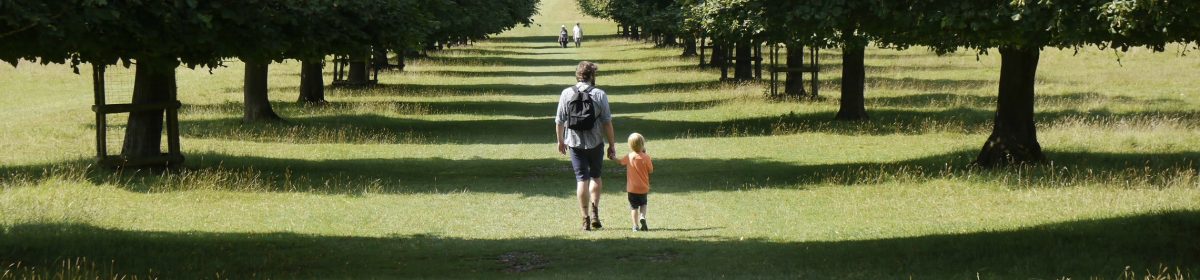
There was nothing much there except for rank grasses, ryegrass, cocksfoot and buttercups. Then I spotted a patch of darker green and I sent him over to take a look. Sure enough he shouted that he’d found a fungus and we went to take a closer look. It was a St George’s mushroom; named on account of normally fruiting around St George’s day – 23rd April; which goes to show how late the season is this year. So I cut it in half and showed him the white gills; gave it to him to smell – it’s an unmistakable smell often described as mealy which is pretty useless since you’d need to be over 100 years old, probably, to know what a sack of meal smells like. Then later I spotted another dark patch of grass and sent him off again to find some more. Finally we fetched up on a large ring that I know will produce parasol mushrooms in the autumn. As we left he brought me a leaf from one of the avenue of limes dotted with Eriophyes tillaes – gall mites. I was so delighted he’d got his eye in I said to his mum “I’m going to make an ecologist of him” (he’s only eight) and she said “good” – so I guess that’s permission to continue.

Later I was talking to our allotment neighbour – always known as Flash – about our day at Dyrham Park. His mum was born in Jamaica and he was born here in Bath and we discovered that we had both, as young teenagers, regularly climbed the walls of the park and trespassed on the estate. I wondered what we would have thought of one another if we had ever met sixty years ago, as trespassers in the shadow of the great house, built on the proceeds of slavery. Racism would always have been, and still is the elephant in the room. That today we can gossip as equals about growing beans and killing slugs is a kind of grace.