No finer view of Bath on a frosty December morning?

South Riverside development – not what the PR goons want you to see.

Bath, of course, thrives by stoking a whole cruise liner full of hype. This year it’s Jane Austen but the Georgian builders also get roped in to set the scene (please don’t mention the slave trade) and otherwise we have to make do with the Romans who turned a boggy hot spring into a R&R destination for grubby and probably smelly legionnaires who needed a soak after marching around subduing the natives. We do not talk about the brothels on London Road, the extra marital uses of the Sidney Gardens or, indeed the drinking dens and brothels of Kingsmead. We don’t talk about Bath’s industrial past; the pong of the dyeworks, the pioneering engineering, the digging of the Kennet and Avon canal which – when joined to the Somerset coal canal – provided an easy route for transporting coal from the North Somerset to what William Cobbett called the great wen (London). We don’t talk about the pollution of the river which was probably as bad then as it is today, or the Great Western railway which most of us can’t afford to travel on. We don’t talk about the Somerset and Dorset line (known as the S&D i.e. slow and dirty) or the twin tunnels which were so small in girth that engine drivers and firemen expected to pass out regularly in the carbon monoxide and smoke, praying that they didn’t do it at the same time.

Perhaps I’m being unfair. If you drive into any major European city; in France for example, it’s almost obligatory to pass a few cement works. Drive north from Barcelona and you’ll see an industrial landscape comparable with the finest of Middlesbrough or Wolverhampton – and they don’t brag about it either. But personally I’m glad that I can still walk along the riverside and the canal and find hundreds of interesting plants without the danger (apart from some cyclists) of meeting anyone wearing a voluminous dress and bonnet or a soldier sporting a skirt, hobnailed sandals and shaved legs. Bath is divided by the river into two utterly different psychogeographical regions. North of the river is the posh, Georgian architectural bit where the visitors come, and to the south where the industry used to be, we have student accommodation and the uncontrolled growth of hideously expensive retirement properties which are a very profitable way of extracting value from pension savings – and for anyone contemplating buying one I’d advise that finding a GP, an NHS dentist or an appointment with the NHS Hospital may be the quickest way to lose the rest of your savings. Private care is booming here.

But a quiet, early morning stroll along the riverside path reminds me that nature always manages to make an appearance regardless of the noise and dust of building sites and traffic. I’m a creature of habit and so my walks tend to concentrate on a few areas. If I was trying to impress I suppose I could call the walks transects – which is a natural history word for repeating a walk along a particular route and recording everything I see. When this is done over a period of years, it yields invaluable scientific information about climate change and its effect on wildlife. I can begin to see which unusual plants are the chancers with no chance of setting up home. I could see (but haven’t yet) both otters and beavers in the river and we have filmed mice, rats, deer, badgers, foxes squirrels and cats on our allotment; and I can also see newcomers settling down having found a new niche for themselves. Slow walking could be a thing just as slow cooking has, because everything becomes richer and more engaging as I learn more about the area. The wildlife of an area has a certain “thusness” and directness about it that the muddy pond of mediated experience – (can you see the word media barely hiding in there?) – just can’t match. Mediated Bath is like the worst of takeaway food – it always leaves you malnourished and hungry – but wild Bath is always at hand; in the pavement cracks, in basement walls, in unkempt verges and building sites and instead of scuttling along my walks like a rat, I can walk slowly and savour every moment as a kind of epiphany. So build on – you rubbish architects, greedy developers and landlords. You and your buildings as ephemeral as a hatching mosquito and less deserving of our deference.

As you may have noticed, I’ve been reading a lot about fungi, and it seems to me that if we’re taking the latest science at all seriously, we have to accept that a serious amount of mutuality goes on in nature. Plants and fungi almost universally exchange nutrients to their mutual benefit. Lichens have evolved an even closer togetherness by uniting bacteria and/or algae into an apparently singular life form. Plants rely on insects and larger animals for pollination and seed distribution; swapping pollen for nectar and taking seeds away in paws and fur and droppings. Even apex predators normally tend only to kill and eat when they’re hungry. In fact Nature seems to prefer a situation where every life form gets something out of the arrangement: all of nature except we humans who think we’ve got the right to take it all without regard to the needs of any other creature.

I have a correction – or perhaps an addition to my piece yesterday which mentioned a black apple which I was told was French in origin and called L’Abri. The apple tree on the allotment site matched the description of an American apple called Arkansas Black very closely especially in its perfumed flavour of apple and custard; but today in a bit of further exploration on the National Fruit Collection website – which is brilliant – I came up with a Belgian apple called Abi Noir which looks almost identical to the American is much cheaper – £14 as opposed to a greedy £350 for the bare root tree.

This morning we worked in frost and sunshine on the allotment and it was lovely to be outside in the winter weather. Our son phoned to ask about presents at Christmas and said he’d be happy to buy us a portable moth trap if we’d like it. Well yes we would, rather!! trying not to sound too excited. There’s more wildlife around in city centres than you’d ever imagine. Below are a few photos of bits of the wild that caught my eye as I walked back from the garage, all within sight and sound of the building site across the river. They are, clockwise, an abandoned bird’s nest, the riverside path, the last bloom on a dog rose and the river bathed in mist. If you look carefully at the nest it includes bits of wool, bindweed, insulation mat, grass and twigs. You see, nature is even better than we are at recycling. The nest, by the way, was right next door to the recycling depot.

Ghostly presences

Ghost sign on a wall in Bladud’s Buildings, Bath

It would be nice to be able to believe that the story of Bladud – the mythical king who founded Bath after noticing his rather scabby pigs liked to roll in the black mud of the heated swamp that was once all that existed of the Georgian/Roman/1960’s redevelopment horror – was so fanciful that no-one, not even a PR consultant, would ever come up with such a fanciful story again. Such people still exist in droves as hack journalists and are only too happy to use Geoffrey of Monmouth’s 11th century yarn to attract visitors/shoppers to the City. Naturally they’re not coming for the black mud any more, and leprosy has dropped off the radar for the well-to-do; but they are coming to experience the rather confusing melange of Roman Bath and Jane Austin’s Bath alongside a bit of shopping and more chain restaurants than you could shake a stick at. We don’t mention slavery except perhaps to mention the brave attempts to abolish it. Kingsmead doesn’t feature much in the story because it was heavily bombed in error by enemy pilots during the war who were using an old version of Google Maps and missed the Abbey and the Admiralty offices by a quarter of a mile. Kingsmead has always had a bit of a reputation which it clings to even after the loss of the medieval brothels, stinking dye works and unruly drinking dens. We’ve had two stabbings, and a drugs arrest since we got back from Cornwall on Monday. Bladud, just to clarify things, was not a Georgian builder and had no hand in building the rather lovely terrace that bears his name. But hey! truth is whatever you want it to be and if you’d like to believe that the Bell Inn on Walcot Street was landlorded in the sixth century BCE by King Lear (Bladud’s Son) be my guest. You’ll be working for the Conservative government in no time.

Sorry, honestly, for that little eruption of bile, but living in the gulf between what we experience every day and how the media chooses to report it is depressing and debilitating in every way. However back to ghost signs, and the one in the photo was only uncovered in July of last year, and all credit to the owners who understood that historical relics like this are a marvellous reminder of the real life of the City in the past. Actually there are two signs, and the one underneath can be dated to around 1847. You can check it out on the Akeman Press website run by Andrew Swift, the author of some of the best historical guides to Bath. We ordered one of his books online and they delivered it by hand!

These ghostly remains are a powerful reminder that we don’t live exclusively in the present, whatever the therapists may tell us; we really can be in two places, or two centuries at once, and that experience can be profoundly important. Seeing and touching the insignificant artifacts of the past stretches the imagination and informs a kind of empathy with the challenging and different cultures of the past. I was once asked if I was a member of the “Somerset Poles”. I assumed that the question referred to the direct descendants of Margaret Pole, 15th Century Countess of Salisbury, and for all I know I could be. What I didn’t realize until last year, was that there are many more people with my surname living in places like South Stoke than I’d ever known about. There are family stories about my dad going to visit to old aunts “somewhere near Cheddar” who were part of my great grandmother’s family; so yes I probably am a Somerset Pole but I harbour no delusional thoughts about living in one of those grand Georgian houses. My first thought on seeing those ghostly signs was to imagine myself driving a small cart down the street, collecting urine for the dye works. I’m really not gentleman material.

The signs also remind me that I won’t be here forever. Andrew Swift suggests that an early owner of the building would have been the surgeon and apothecary William John Church. Where is he buried? who knows? There are no surviving grateful patients or litigious failures to ask and in any case he moved on when the eye infirmary set up shop. I can close my eyes and imagine well heeled patients entering and leaving through that very door. People began coming to Bath in Georgian times because they were often sick and believed that the sulphurous waters could make them well. Later, when it became fashionable, there’s no doubt that some of the visitors could have been found in the brothels of Kingsmead and up the London Road.

Bath has an incredible abundance of ghost signs and most visitors hurry past without looking up at them but for me they’re better than all the carefully curated signage. Dog food, engine oil, eye infirmaries, dairies, cafes; in fact all the everyday stuff tells us more about Bath than the glossiest shop window. When I was a child and we caught the bus into Bristol, I was always intrigued by a sign above a fairly grubbly looking shop front in Old Market. It announced “Ace Erections” by way of a curly neon tube in red. I always thought it was a building company!

On hot nights and secret lives

It’s been as hot and sticky as a short story these last few nights. If I look at the sunrise time on my phone in the evening it’s a fatal invitation to be wide awake by 4.30am, and if – on top of that – I feel guilty because I haven’t posted for a couple of days, I’ll inevitably spend half an hour trying to go back to sleep before I get up and face the creative music. Trying to go to sleep is, of course, an oxymoronic concept like trying to fall in love. Then there’s the microscope, sitting on the desk next to the laptop in the most distracting possible way. I give it a half hearted stroke as if to placate it, but putting a new and important object on the desk demands something like the traditional way of training a hawk; you have to stay awake for whole nights, locked in a shed together until the resistance is broken and you can begin to work together.

During the past two unrecorded days we’ve been busy with our family. Babysitting duties were joyfully revived after a four month break – Zoom meetings might be OK for the office, but children don’t do them. Somehow, and without planning it at all, we took a break from constant work at the allotment and spent a good deal of time researching and seeking out new parts of the city and its surroundings. The sunshine has allowed us to explore further down the river than ever. There’s real joy in building up our understanding of our new home (of five years) by exploring all the interconnecting footpaths and roads that express its deeper history as much as they provide convenient short cuts. Behind the showy Georgian architecture – more closely connected to slaving wealth than we like to admit – there are visible remains of stone mining and coal mining. The canal was the trading motorway of its brief period, supplanted by the railway and now by the motorway that runs to the north of the city; and the Bristol/Bath cycle path which runs past our flat completes a wildlife corridor that runs almost uninterrupted from East to West. The upshot of all this is that you can see otters and peregrine falcons (if you’re lucky and persistent) in the middle of the city.

The tourists flocked to the Roman baths and the Jane Austin Disneyland experience (and of course the shops); and missed much of what’s most fascinating about our adopted home. Now they’ve gone, the shops pubs and restaurants are really struggling; unemployment is soaring in the occupations that onced serviced them and we can walk through a largely quiet town on sunny evenings and enjoy it in a way that’s become increasingly difficult over the past decades.

If you include humans in the wildlife of the city it becomes even richer. A couple of days ago we found a whole new north/south crossing of canal, railway line and river. On the river we watched a solitary wild swimmer making her way gracefully against the flow, but in the background we could hear the hoots and screams of young people having great fun tombstoning off the bridge and into the Avon. I think we’re supposed to disapprove of all this and remind them that this kind of mating behaviour is expressly forbidden by the notice. Yes it’s dangerous, and yes they might get into all sorts of trouble, and yes, I knew a child when I was young myself who drowned near here and yet ….. I think we both said a silent prayer for them and left them to their fun. These days of sunshine shot through with erotic desires and the certainty of living for ever don’t last. Tempus fugit and before we know where we are, we know where we are.

But don’t run away with the idea that only the young get themselves inflamed by a summer’s day. As we walked along the canal last night a middle aged couple met at the middle of the footbridge above the Widcombe flight – each coming from the different direction; and kissed one another with ferocious intensity. Well well, we thought, putting aside for a moment thoughts of the deceptions and misery that lurk in the hinterland of an affair. People watching is almost as engaging as spotting the cormorant preening itself on one of the chimney pots of the old granary, opposite the bus station or seeking out the fledgling gulls that make the most terrible screeching during those weeks when they’re just about capable of flying but still depend on a parent for food. Last night we spotted a couple of young peregrines touching base for a moment at their nest before soaring off again.

Thoughts of grass (not that sort!) have also been occupying me, and I discovered four and a half hours of a webinar on grass identification run recently by the BSBI and now on YouTube. They’re pretty chewy sessions but well worth the time if you’re at all interested in identifying these tricky subjects. The greatest challenge in combining botanising with walking is the need to identify things very fast. Too much kneeling down, rooting around, note making and photography can lead to friction in our perfectly harmonious (ho ho) relationship; and so the art of snatching a bit of material and identifying it without stopping needs to be backed up with a great deal of reading and study so that, for instance, I can finally nail the ragworts without actually getting caught botanizing – slightly less dangerous, I have to say, than kissing strangers on bridges, especially at my age!

The secret life of the City can be compelling, and a welcome antidote to the tide of lunacy that besets our politics at the moment. Whether we shall emerge from all this with a new understanding of how badly (and quickly) we need to reshape our relationship with the earth remains to be seen, but the parallels with Weimar Germany and the memory of the way that whole civilizations can perish under the weight of their own contradictions, is just another of the things that keeps me awake at night. Being human has never seemed so challenging.

The millpond of our lives is disturbed by ten burly policemen.

I had intended to write a post about the – shortly to be ended – peace and quiet of the city while the tourists have gone. I hardly need add to the thousands of words that have been written about nature and its beneficial effects and it’s mostly true, save for the reservations I mentioned a few days ago. We’ve had wonderfully quiet walks along the river and up the canal – undisturbed by hen parties on narrow boats or young men dressed as pirates.

There was a tremendously amusing moment a couple of days ago as we were sitting on the canalside enjoying the sunshine when we heard a very loud voice performing one half of a conversation, the other being in her earpiece. Why people find it necessary to hold the phone three feet from their face and shout at it is a bit of a mystery. Perhaps it’s so they can watch the other participant on the video screen- who knows? But anyway this young woman, dressed entirely in black slowed down when she saw us and taking a wide path around us hissed into the phone “I’m just passing two elderly people!”

The canal, and the river too, was like a millpond

  • and the inverted reflection of the trees, houses and the sky blessed the whole view with perfect symmetry. You felt you were looking beyond the surface of the water into an infinite depth. Cleveland House never looked more Georgian or more stately as it straddled the canal above a tunnel which was dug purely to protect the wealthy patrons of Sydney Gardens from having to see the bargees. It was built as a toll house above the canal and the tolls were collected by means of a basket lowered through the floor of the house.

Pellitory of the wall - Parietaria judaica
Pellitory of the wall

Alongside Cleveland House I spotted a patch of pellitory of the wall – Parietaria judaica growing as you might expect, on a wall. It’s not the kind of plant that you’d likely notice, with its inconspicuous flowers but it once had some fame as a useful medicinal herb for urinary problems. Culpeper really rated it and I dried a bunch last year but haven’t had occasion to try it out!

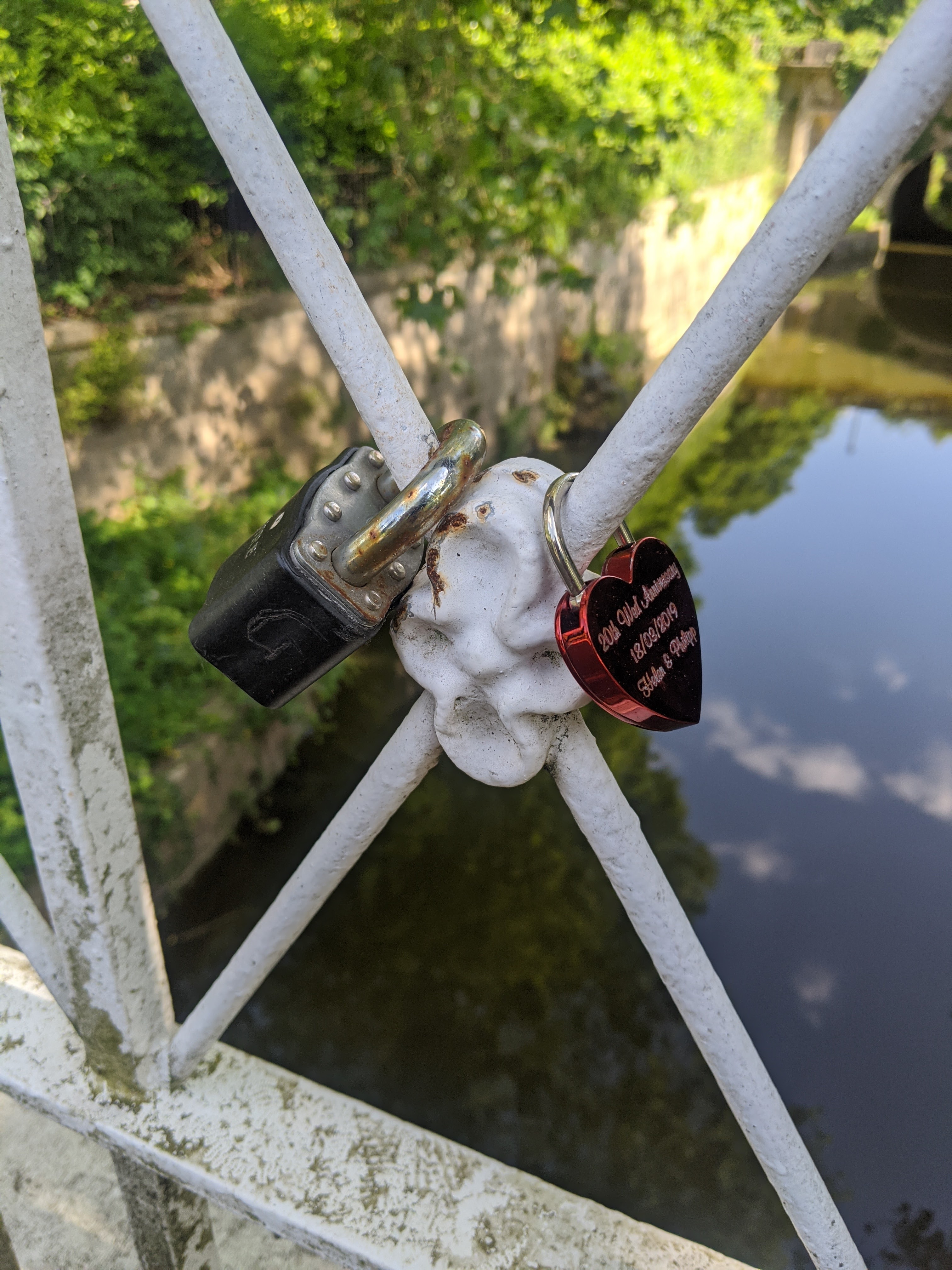
Crossing the canal by way of an iron bridge, we found a group of love token padlocks each one, no doubt, carrying a story that only the lovers will know. Sydney Gardens was full of sunbathers – it was lovely.

Bath felt really strange when the lockdown began but we’ve so enjoyed being able to cross the centre of town with all the shops closed and streets virtually empty. Sixty years ago, in Bristol, the shops in Whiteladies Road and the rest of Clifton all closed on Saturday afternoons and that was when Clifton village (where the Brunel suspension bridge is), was at its Georgian best. That’s what it was like here for a few weeks, but if the non-stop carnival on the green outside is anything to go by, most of our neighbours think it’s all over. I think to myself, it’s not over until people stop dying, but the shopkeepers and hoteliers are getting quite wet-lipped at the prospect of “putting it behind us”.

But back in the Potwell Inn, the work on the allotment has been relentless. This weather – very hot and dry for a couple of weeks now – means watering every day. The tender plants are fairly rattling out of the greenhouse, and the first wave of broad beans has almost all been harvested. The overwintering Aquadulce Claudia have given us about 30 lbs of beans in their pods, which translates into around five pounds of shelled beans.,and they freeze really well. Elsewhere the frost damaged runner beans and borlotti beans have all been replaced (we always grow spares) and are beginning to climb their poles at about six inches a day. The earliest asparagus is now being allowed to develop its leaves and we’re harvesting the middle and late varieties. Once again, the 12′ by 4′ bed provides all that we need. The first flowers are setting on the outdoor tomatoes and we’ve abundant pollinators arriving constantly on the allotment, attracted by all the nectar rich flowers we’ve scattered everywhere.

The view of the green from our front window.

These warm nights have made sure I was awake with the lark, and first thing in the morning the green is usually quiet aside from our regular martial arts couple, training and perhaps a dog walker or two. For the rest of the day it’s becoming busier. It’s used a lot for drug dealing because there are so many escape routes inaccessible to cars and some properly dodgy looking characters pass through every day. We also have (hardly a coincidence) a very large number of homeless people with multiple mental health and addiction issues who sit in noisy groups on the green. Many people find them intimidating, but moving them on isn’t helping to solve their problems and they leave us alone.

Yesterday we noticed two police cars parked up on the main road and right opposite where we live we saw a young woman hiding behind a tree clearly watching for someone. She didn’t look at all like the usual drug customer but we thought no more of it until this morning when all hell was let loose and ten police, three police cars and two ambulances converged on the green, pursued a young man into the woods, and brought him back out again protesting loudly. I’ve no idea what they were detaining him for, but they should, perhaps, have thought about bringing along a sniffer dog because this afternoon the same young man walked boldly into the woods at exactly the point he’d gone in earlier – presumably to retrieve his stash and jump over the fence, never to be seen until next time. I tell you there’s never a dull moment at the Potwell Inn – very edgy, you might say.