It’s that time of the year when harsh decisions need to be made.

Two of the oversized aubergines waiting for us when we came back from St David’s. I thought they looked like one of those mid 20th century paintings of four herrings on a plate

Like most/all allotmenteers we, at the Potwell Inn, produce far more than we can eat; after all who likes courgettes that much? and this is the time of year when the crops start to come in fast. Also – in common with almost all our compatriot gardeners we hate throwing the stuff we can’t eat away, and so we give some away (although offers of courgettes seem remarkably unattractive), or we shove it in the freezer in the hope that one day we’ll be able think of some way to eat it. Naturally the embarrassing surplus disappears from sight for about 9 months until now, because this is the exact season when the cunning plan hits the wall. The freezer(s) are stuffed, we’ve got soft fruit flying off the plants and we urgently need more space.

It’s a week since we drove back from our very windy and grey break in St David’s and I haven’t posted because we’ve been so busy on the allotment. The bindweed is winning, the polytunnel plants needed urgent pruning and feeding, and there was no alternative but to get the damsons, raspberries, red and white currants, soups and stocks out of the freezer and do some serious jam and jelly making; fortified by some anonymous bags of soup for lunches. As for the soups, (we thought), they wouldn’t have been in the freezer at all if they’d been any good.

And so we’ve now run out of honey jars but we have another box of jams to add to the already creaking shelves, and worse still we’re hardly eating them because we’re both trying to lose weight. However Madame made summer pudding for the grandchildren today and some of our produce will go to the family at Christmas. Just imagine us as a kind of dacha. The three year old aubergines in olive oil still seem to be OK and the dill pickled cucumbers have failed to explode in the cupboard. Pickles, sauces, ketchups, jams, preserves and chutneys mature in any case and taste better after a year or two regardless of what the food hygiene purists may say. Then of course there’s sloe gin and damson vodka and …… I could go on but there are still jobs to be done in the kitchen.

That’s the thing; if you’re a keen allotmenteer you absolutely need to be a keen, or at least competent cook as well and you’ll be paid for your time and effort by the freshest tasting food you’ve ever eaten, but only if you clear out the frosted remains of fish pie or bean casserole before the last of their flavour disappears and it goes into the bin; which probably it should have done in the first place.

However, today we had a revelatory moment with one of the unlabeled soups in the fridge. The story (not the soup) goes back decades to the time when our middle son started his career as a commis chef with Stephen Markwick at Markwick’s in Corn Street in the centre of Bristol. The restaurant was in a basement, so there was no peeping through the window and, I’m bound to say it was expensive beyond the reach of our precarious finances. We ate there just once when someone took us and the food was unbelievably good. Our son moved on after a tough apprenticeship (Stephen could be very demanding) and then Markwicks closed down and he and Judy opened a small bistro called Culinaria in Redland where we sometimes went for a treat.

There was never any issue about starters for me. The Provencal fish soup was always awesome and it was almost always on, by popular demand. Then Stephen published two books – “A very honest cook” and “A well run kitchen” containing many of his most popular recipes including the soup. For years I looked occasionally at the recipe but lacked the nerve to cook it – there were a number of elements to the dish and Stephen, I knew, paid minute attention to detail. Anyway, last year our grandson wanted a lobster for his birthday – his dad after all is a chef! – and I decided to have a go at the soup with the remains, in spite of the fact I knew I would never be able to replicate it. So I sweated it out in the kitchen and made the soup, the aioli and the rouille and ……. well ……..

It was a bit of a disappointment. How could it not be? It wasn’t at all how I remembered it and I felt I’d let the side down. We ate it dutifully but it felt like a failure and so the leftovers went into the freezer unlabelled and came out today. Is resurrection too strong a word? As soon as I sipped the first drop I realized that the disappointment had come from trying to cook a lovely memory and what I was eating was a real soup that was not a clone of the remembered one but its own new thing, made by me. Oh glory it was good! My resolve is complete and I’ll do it again with gratitude in my heart for Stephen’s amazing cooking.

Anyway that’s enough soup, and apart from the kitchen and the allotment we found time to actually meet up with my sister after years of just phone calls. We had become distant for no particular reason but then when our mother was suffering from dementia we would visit her together so we could support one another – it was very emotionally draining. Then it was just blah blah and lockdowns and we drifted again. Seeing one another was wonderful and we ate joyfully in Bristol. I also got confirmation of a couple of difficult fern i/d’s from Wales which was great, and we bought a little 18V battery powered water pump to relieve some of the pressure of repeatedly carrying two at a time ten litre cans of water weighing 42 lbs in total from the cattle troughs to the plot. Oh and we managed to work in a visit to the Victoria Art Gallery to see an exhibition of quilts by Kaffe Fassett. Whoever said retirement was a well-earned rest??

Mayday

This photograph of the allotment was taken on May Day 2016, two months after we took it on.

There was me, writing here a few days ago lamenting the absence of what I chose to call cultus; call it what you will really but it’s about moments of communal celebration – and then today it’s May Day.

Not that anything very discernable happened. No maypole to be seen on the allotments; no May Queen, no carousing and drunkenness; no dangerous and profligate behaviour. All you could say was that the allotments today were busier than they’ve been since last autumn. We’ve endured long periods of solitary allotmenteering as winter extended its grip to a full six months and we wondered whether we would ever see the sun again. Now we have two consecutive bank holidays and a coronation and aside from a meet the street gathering here next Sunday it seems that big and boozy community events were dealt something of a death blow by Covid. Somehow we’ve got out of the habit – out of the habit of harvest festivals, Christmas carols, plough mondays, Whitsun; and beating the parish bounds; other flavours are available if you can remember them.

There are probably many who wish good riddance to the lot of them – Christian festivals are a bit passĂ© now – except for the fact that most of the meaningful festivals that still exist were pinched from the pagans centuries ago. Oliver Cromwell did his level best to ban the lot of them but the moment the Restoration happened they emerged from their brief hibernation as full of energy as before.

When St Augustine of Canterbury arrived in Britain in around 597 he discovered that a fully functioning pagan religion had returned in the period since the Romans left. He sent a desperate email – (OK letter!) – asking the Pope what he should do and in one of the few sensible decisions in the history of Christian evangelism; some months later the Pope replied that it was better to take on the pagan buildings and traditions and give them a Christian backstory. Welcome to Plough Monday, the first Monday after the (Christian) feast of the Epiphany – OK then, Twelfth Night – when traditionally the sowing of crops began after the Christmas lockdown. Plough Monday was the pagan festival celebrating the beginning of the agricultural year. In fact there’s an uncanny tie-in between the surviving Christian festivals and the old pagan calendar; and some, like Wassailing, that were never successfully co-opted at all.

All of which is a rather long winded approach to the fact that today, May Day, is also celebrated as Beltane; the traditional festival celebrating the beginning of summer. Fires, singing and a bit of carousing would once have taken place all over the country. I’ve got a photo of my mother as a child (born in 1918) dressed in white, with a garland of flowers round her head and standing next to a ribbon decked maypole on an Oxfordshire village green. Sadly since the triumph of the Evangelicals – Cromwell’s withered soulmates – most of the Christian Churches see these entirely innocent reminders of the earth cycle as heretical if not as devil worship. If you really want to see devil worship go and stand outside the chemical works in Huddersfield that still produces Paraquat and sells it to poor farmers in India.

The point here is that the earth cycles – the solstices, Winter (Christmas); Summer (Midsummer Day); equinoxes; Spring (Easter); Autumn; (Michaelmas) and the intervening quarters; Imbolc (Candlemas); Beltane (May Day); Lughnasadh (Lammas) and Samhain (Halloween) need to be detached from their captivity within institutional Christianity not because I would like to damage what became my own spiritual dialect but because the context has changed; history has moved on and – in the story shaped universe that we created and now inhabit – the earth cycle has (once again) become the story we desperately need to move us away from the dominant narrative – neoliberal economics and politics – towards an earth centred spirituality, not because it feels like a nice idea, but because our lives depend upon it.

So today we were on the allotment. Madame was mulching our fruit bushes with sheep fleeces given to us by our friends NIck and Kate who live in Bannau Brycheiniog – the old and original Welsh name for the Brecon Beacons. We’re expecting a plot inspection any day now and, to be honest, it looks as if a small flock of Jacobs Sheep has died in the fruit cage, under the blackcurrants and gooseberries. Fleece, which is almost valueless these days, makes an excellent mulch and slug repellent and it’s very good as an additive to the compost heap. Anyway we hope we don’t give our neighbours palpitations.

While Madame was engaged with the fruit cage, I was earthing up the potatoes. Years ago I bought a ridging tool which I only ever use once a year but it’s exactly right for earthing up spuds. The soil is black and friable and smells lovely with a bit of sun on it. It’s worth ridging up this time of year because it protects the emerging leaves from a late frost better than fleece, which allows Jack Frost to do his destructive work wherever it touches the leaf.

Everywhere there are signs of growth. The immense energy of spring drives the plants upwards into our realm and as I hoed the soil, I touched, for a moment that sense of sacredness that occasionally visits a gardener in quiet thought. This moment of inspiration was accompanied by a speaking; not at all an auditory hallucination but the clearest intimation that the soil itself is the mother of all life. We might imagine for a moment that those Buddhist monks who rake gravel temple gardens have, somehow, a higher form of spirituality. It’s not true of course. The sacred is always ordinary; the ordinary seeking us out.

But I can’t leave this thought with any suggestion that the paganism which I have referred to here is in any sense inferior, heretical or dangerous. My point in using it is to suggest that its connection with the earth cycle may be an insight whose time has come again. In 1966 First Nation Canadian, Buffy Sainte Marie, released a song called “Little Wheel Spin and Spin” and it just wouldn’t leave me yesterday. You might like to listen to it – it’s on YouTube music. Fifty seven years on it’s as powerful and prophetic as it was when I first heard it.

Christianity has been a rather poor guardian of the ancient traditions it once co-opted. Maybe it’s time to ask for our ball back? Happy Beltane.

Without Lennie there was no flower and produce show.

Our own rather amateur efforts

Lennie died a few years back, after we left Severnside. To say he was a character would be a massive understatement. He was, for instance, the last person in the village who still spoke in a Gloucestershire dialect so thick and uncompromising that I had to dredge the silt of my childhood speech to remember the subtle but occasionally life saving difference between ‘thee‘ which was friendly and ‘you‘ which wasn’t. The texture and cadence of his speech was pure King James bible, but not as spoken by a posh London type so much as a hefted peasant; the vowels stretched and broadened by fag smoke and cider. His cap was a permanent fixture – bolted on against inclement weather but worn equally indoors and out. His wellingtons were equally joined on to his feet, but turned over at the top as a kind of one fingered salute to the village incomers with their green Royal Hunters. I never quite understood the complications of his family life but his later marriage to Beck, who brought her own extended family, was rock solid. She was always smiling and unlike Lennie, never swore – ever. But when Beck had her stroke she suddenly started to introduce extraordinary swear words at quite the wrong places in her sentences. The local middle classes were appalled of course, and gratefully retired from patronising her. After she died – we filled the church with balloons and there was a real party atmosphere at her funeral (another black mark I’m afraid). Lennie would come to her grave twice or three times a day and talk to her; tell her all the news and hope for some news back from her. We wondered if he would step back from his gardening but he carried on much as before, winning all the prizes at the Flower Show (another black mark) and modestly accepting his place in the sun as the best gardener in the village.

I loved talking to him and had ample opportunity because I allowed him carte blanche to take away as many wheelbarrow loads of manure and topsoil as he wanted. There are very few perks to being a country parson but the regular marrying, baptising and burying of those who never came to church but liked it to be there when they needed it, attracted the kind of loyalty which could stop you in your tracks. I came back one day to find twenty tons of farmyard manure dropped off in the car park outside our front door. Wood chip appeared in huge piles after I mentioned that we’d be glad to have it – and one remarkable day I drove back and saw the outline of a giant quarry lorry depositing another twenty tons of topsoil; overburden from the local quarry – courtesy of a bellringer friend. Lenny made full use of the bounty and was always up for a chat because he was probably quite lonely after Becks was gone, and also because he was tickled pink at being able to wind me up without being told off.

When I say that Lenny was a good gardener I mean a really really good gardener. A single one of his prizewinning onions heavily filled two cupped hands. The skin was polished to satin, the roots pure white and the stalks neatly tied off with raffia. It was bewildering to see three or four apparently cloned vegetables side by side in their baskets at the show; identical in every way. Runner beans at exactly fifteen inches and all ramrod straight; potatoes perfectly true to variety and tomatoes, strawberries ………. I could go on! He was generous to a fault when it came to gardening but his secrets went to the grave with him because they always do.

But the village was changing. In fifty years it had grown from a small hamlet to a suburbanized dormitory village. The old-timers were disappearing one by one and the Flower Show – Lennie had always been on the committee – was taken on by an incomer who had no sympathy for the tradition and saw the way forward as a moderniser. The day we won all the prizes was a sad day for all of us. Lennie had had a falling out – he never uttered a word on the subject to me – and he failed to enter a single class, in fact he didn’t even turn up for the show. It felt as if the world had shifted in its orbit and the prizes we won that day had “dust” written all over them. We didn’t mind being second or third best – we never minded it because Lenny was so obviously better. He was the standard we all aspired to. It was the beginning of the end for the produce section and I wished we’d told him what an epic role model he was.

There are a handful of those gardeners who inspired our lives. Perhaps one day I’ll write about my grandfather Tommy Cox; Trev; Mr King and Mr Monks, but meanwhile we’re itching for the rain to stop so we can go up to the allotment. On Saturday we top-dressed the asparagus bed with a mixture of sand and leaf mould and today we’ll give it a small feed of blood and bone in the hope it will do better this year. I’m afraid the asparagus is dining in the Last Chance Hotel. Did I mention utter ruthlessness as one of the qualities all allotmenteers need?

Winter squash ravioli – eventually.

Yesterday didn’t go well – at least it started to go wrong not long after successfully finishing the quince jelly. We had about three quarters of a large winter squash in the fridge and it needed eating up. Crown Prince is a brilliant squash to grow, and very occasionally you see them in the shops. They’re thick skinned and as long as they get a spell maturing in the late autumn sun, they’ll store until late spring. They’re also delicious – orange fleshed and far and away richer and sweeter than the butternut squash that’s mainly popular with supermarkets because it’s almost indestructible.

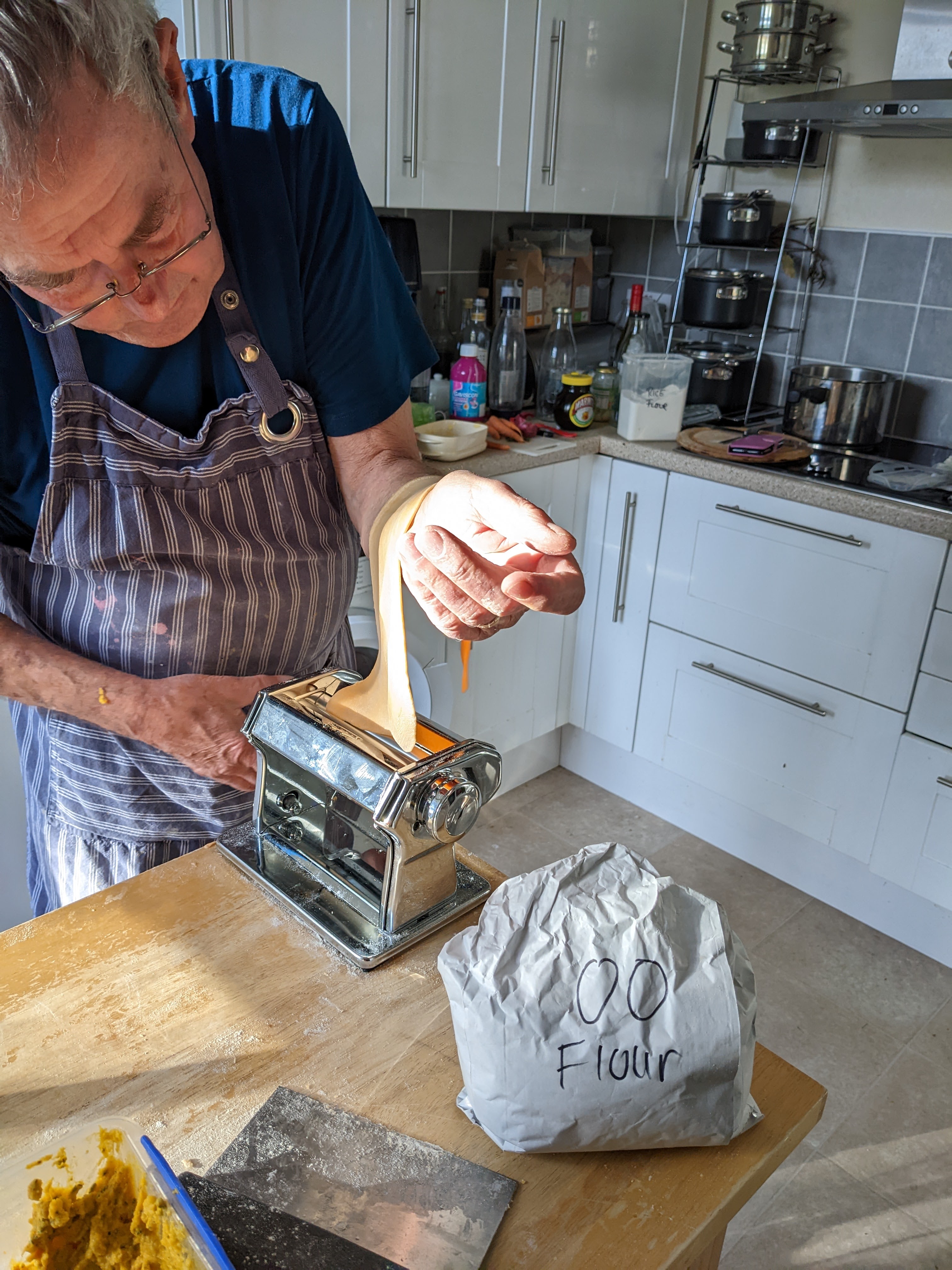
Anyway I cut the remaining Crown Prince into chunks; roasted it in a splash of olive oil until it was tender and then separated it from its skin with a spoon; mashed it with some ricotta cheese, pepper, salt, chopped sage and nutmeg. That was the easy bit. The next stage was to make the pasta and that’s where it all started to go wrong. Somewhere along the line I managed to get the proportions of egg and flour wrong. It’s supposed to be 1 egg for every 100g of 00 grade flour so I cracked four eggs ready and then weighed out the flour but somehow must have weighed 300g instead of 400g. The wholly predictable result was an unholy and virtually unmanageable sticky dough which I was only able to partially rescue by kneading in more flour – but I made the fatal error of sticking to my guns and assuming that this recipe (Marcella Hazan) was somehow meant to be that soft. Not surprisingly the resulting paste had to be as thick as boot leather just to put it through the machine and the resulting struggle to fill the ravioli would make an entertaining video clip.

So wholly unaware of the grave offence she was causing me Madame sat in bed this morning and Googled up half a dozen videos demonstrating how far from the straight and narrow I’d strayed. I bravely endured the torrent of supportive advice and agreed through gritted teeth that we would repeat the adventure today and do it properly this time. Sadly, though I’d used up most of the 00 grade flour and used up all but two of the eggs, so we had to go down to our son’s pizza shack and borrow a kilo – he gets through at least 75 kilos a day so it wasn’t a big deal.

Then slowly and methodically we worked through the recipe again and of course the dough was perfect – (no need for any smugness darling). There is nothing, really nothing to compare with the fun of making your own pasta when everything goes well. The sheets were coming out of the hand cranked machine like gossamer; I’d already decided to serve them with a sage butter dressing so today’s return match snatched victory from the jaws of defeat.

I recall a self op satellite radio studio I once broadcast from. Over the desk there was a large notice which said – “In the event of equipment failure RTFM”. One day I asked the engineer what it meant. He said “Read the manual!”

A cautionary true story about my favourite river.

On 30 January 1607, around noon, the coasts of the Bristol Channel suffered from unexpectedly high floodings that broke the coastal defences in several places. Low-lying places in Devon, Somerset, Gloucestershire, and South Wales were flooded. The devastation was particularly severe on the Welsh side, extending from Laugharne in Carmarthenshire to above Chepstow in Monmouthshire. Cardiff was the most badly affected town, with the foundations of St Mary’s Church destroyed.

It is estimated that 2,000 or more people were drowned, houses and villages were swept away, an estimated 200 square miles (51,800 ha) of farmland inundated, and livestock destroyed, wrecking the local economy along the coasts of the Bristol Channel and Severn Estuary.

The coast of Devon and the Somerset Levels as far inland as Glastonbury Tor, 14 miles (23 km) from the coast, were also affected. The sea wall at Burnham-on-Sea gave way, and the water flowed over the low-lying levels and moors.

Wikipedia

Of course, you might think, it could never happen again here. You might think it but it would be wishful thinking. I’ll come to that in a moment. The domain name for this blog is “Severnsider” for a reason. I’ve loved the Severn since long before I found myself working in a parish whose boundary ran somewhere in the middle of it. I knew the parish boundary well enough to guide the skipper of the paddle steamer MV Balmoral to the spot where I once slipped the ashes of a retired Severn Pilot called Peter into the swirling waters, to the mournful sound of three long blasts on the ship’s steam whistle.

The river Severn is Britain’s longest river at 220 miles and it can be dangerous; overtopping its banks regularly as floodwaters pour down from the Cambrian Mountains, joined by its many tributaries. The estuary itself, is vulnerable to the South westerly prevailing winds and has the largest volume of water flowing into the sea of any river in England and Wales. When the enormous downstream spring tides meet gale force winds blowing upstream, flooding will follow as night follows day. Not often, but often enough in the past and in the last decades becoming the norm.

As a river it’s been hammered by industrial developments and pollution, warm water from a couple of (now closed) nuclear power stations and more recently by the eutrophication of large stretches by intensive farming – especially in the River Wye which joins the Severn beside the first modern Bridge carrying the M48. I knew the last putcher fisherman on our side of the river and he once told me that salmon were turning up with terrible sores on their flesh. Before he gave up he said he’d only caught three fish in several years.

Nobody in Government seems at all keen to tackle the pollution, but the many thousands of homes on the floodplain are a real political problem when, year after year they’re being inundated for weeks on end by filthy polluted water – and so in these decades of austerity, the combined forces of local, regional and national funding have found ÂŁ100 million to improve flood defences . Amazon have built a huge warehouse in the middle of one of the affected areas and their astute tax lawyers will have made quite sure that none of their profits are diverted into protecting their own warehouse.

Notwithstanding all these problems the Severn still manages to be a hauntingly beautiful river; visible from miles away as a silver ribbon threading down through small farms and villages with their patchwork fields divided by rhynes and cider orchards along with one of my clutch of country parishes whose church and churchyard were sensibly built on a prominent knoll from which I expect to spend eternity keeping an eye on the river from my high vantage point – immune to winter storms and exalting in the sounds of migrating geese.

Anyway, enough maundering; my point is that the river floods but over the past years ÂŁ100 million are being expended on keeping our feet dry. Except …….

For the past eight years we’ve kept our campervan in a locked compound barely fifty yards from the sea wall. There were occasions, before the works began, when we kept an anxious eye on the weather forecasts and then after a couple of major floodings up and down stream we joined an automatic warning service which sends out a text message when flooding is expected. We hadn’t expected that yesterday – well outside the normal flooding season – we would receive this text message.

Flood Alert Issued. Severn Estuary at Severn Beach. floodline.uk/112WATSVN1. To hear more information on this Alert, call Floodline 0345 9881188,8

UK Floodline alert.

Once again, the same scenario as 1607. A flood tide meeting stormwater plus a Southwesterly upstream gale heaps up the water (106 cubic metres a second at Apperly on a normal day – that’s a lot of double decker buses!) – and the defences are broached – even after all that money is being spent!

The point of all this is that we’re not preparing for the catastrophic effects of global climate change, we’re limping along after it; parsimoniously spending too little and too late while doing nothing to address the causes. Here we are again as politicians gather in Egypt for COP 27 and make promises they’ve no intention of keeping, while the lobbyists and their tame journalists spend billions persuading us that there’s no cause for alarm – it’s all a long way away and somewhere else. Well it isn’t. It’s right here and right now

But to say a little more about Peter, the Severn pilot. I discovered that during the 2nd World War he would pilot the petrol barges up from Avonmouth to the lock at Purton, just below the old railway bridge. In wartime this was a terribly hazardous journey against fierce tides, numerous underwater shallows and a winding course without the benefit of radar or even lights. Peter – who was a quiet and thoughtful man, would walk the banks of the Severn whenever he had some time off – to memorise the hazards. At his funeral service one of his old friends told me that one day he was prowling the bank in thick fog and as a ship drew near he heard a voice calling – “Is that you Peter?” On  25 October 1960 a couple of petrol barges misjudged the lock at Sharpness and were swept out of control upstream, colliding with one of the piers of the Severn Railway Bridge which, in the ensuing explosion and fire, collapsed. Five crew members died that night. The Severn has claimed many more victims over the previous centuries and we can only hope that she will not take many more lives as a consequence of our wishful thinking about climate change.

Autumn song

Heron spotted on the River Avon on Saturday

If you’re a regular reader you’ll know that I’m not a fan of the recent changes to the seasonal calendar brought in by the Met Office. I know it’s tidier to begin the season of Autumn on September Ist and then rotate the rest on a three monthly cycle; easier but plain wrong. For me the seasons will always be marked by the solstices and equinoxes. Messy but holding tight to the astronomical events surrounding the hours of daylight. Last Friday saw the autumn equinox at exactly 2.03 am marking the moment of equal day and night and from now until December 21st the hours of darkness will get progressively longer.

Nature is, by and large, pretty orderly in her seasons too and so we instinctively recognise them by the quality of the light, sounds and smells. I’m interested that these phenomena actually seem to speak to us. Our absorption in the earth and her seasons means the bare sensation, of a birdsong for instance, becomes encrusted with memories. The smell of newly turned earth in the Spring evokes in me a powerful memory of Good Friday when, according to tradition, potatoes were planted. I think of a steady queue of customers at Palmer’s Seed Store and the smell of National Growmore fertilizer and Mr Flook the fishmonger in his wellingtons and yellow oilskin apron.

So these accretions of memories make simple things like listening to a singing Great Tit into a deeply embedded, often emotional, complex. Scientifically, and some would say factually, it’s just a singing bird with a Latin name representing something so common as to be beneath a birder’s dignity; but in the far greater field of meaning it’s as affecting as a Nightjar like the one that kept me awake much of the night, camping in France, or the Nightingale that I heard on a retreat near Ilfracombe one evening as I walked in the grounds.

But to get back to the Great Tit and the Autumn Equinox, something profoundly odd happened on Friday morning. I was helping our youngest move some last belongings out of the flat he’s just left. It’s been a sad few weeks because his relationship with his girlfriend has broken down and everyone’s been walking on eggshells. Anyway I was parked up in a place I shouldn’t have been, close to the old flat and keeping a sharp eye out for Parking Wardens who are pretty ruthless here in Bath. Then, as he carried the last load across the road, with his bass guitar in one hand and a bundle of clothes in the other – he looked just like the cover of the Bob Dylan’s “Freewheelin” Album sleeve. I would have been sad to see him that way except that as I sat there in the car with the window wound down, completely out of the blue I heard a Great Tit singing its two note ‘saw sharpening’ song, somewhere in the trees above. It’s a song I associate so powerfully with Spring and new beginnings that it felt like some kind of omen. “Stupid, irrational, meaningless emotional nonsense” say the ghosts of the old Logical Positivist philosophers, and “Hear Hear” say the materialist scientists, and yet ……. and yet?

Nothing I’ve ever come across shakes my understanding that language – whether human language or the subtle languages of mammals, birds and insects; or flowers, or the incomprehensible silent language known as the “Wood Wide Web” – that language is more like a coral reef growing in a sea of meanings, with living ideas on the outside and deep within, the whole history of human speaking, singing and dancing. The simplest level of reference in that unexpected out of season birdsong is probably the least interesting.

It’s been a long hot and dry summer and so it must have been the case that the bird I heard was singing out of season because in this settled weather a second brood was still “thinkable” and “do-able“. But he said much more than he intended. That Spring embodying song on the very day of the Autumn Equinox was a portent of new beginnings, a sign of environmental crisis, a reminder that Nature has her own ways and heaven help us if we ignore her signs.

Suspend disbelief – dip toe in water!

St Non’s Well – near St Davids.

The tag at the head of all my posts reads “A sceptic’s take on being human”. Maybe that’s a little too firm. The title of this post dropped into my mind without warning and then, 12 hours later I realized that it sounds exactly like a reading from the I Ching – which are always ambiguous, no more than a suggestion as to where an answer might be sought. My scepticism is mainly about the kind of idea that’s fed to us like the predigested food that seagulls vomit into their chicks’ eager gape, and which may never be examined or questioned. The BBC have been re-running a series of brief 15 min talks by Neil Macgregor in which he quoted an intriguing thought. “Religion” he said, “is always political, and politics is always religious”. In the light of a new and even more deranged government dominated by an obviously religious fervour for neoliberal economics. I’m inclined to agree. These people remind me more of evangelical theologians (an oxymoron) than rational beings.

So scepticism is a tricky term to use because it depends on who’s being sceptical and what they’re being sceptical about.

And so, down to business

My scepticism is of the kind that functions as an adjunct to curiosity – the don’t knock it until you’ve tried it kind of scepticism. Oscar Wilde once wrote that you should try everything once except incest and morris dancing. I’d be happy to keep morris dancing on my bucket list. And so today we walked down to the well at St Nons and because I have been suffering from a painful ankle for ages I took my boots and socks off and dangled my feet into the cold water. Several coast path walkers passed in stony silence, too fixed on their destination to wonder whether I might do a little dance and declare myself healed. It wasn’t expecting much to happen – that would have been very challenging – but it was incredibly comforting to join with the countless other pilgrims who have visited this place over the past 1500 years looking for exactly the same kind of comfort. To steal a line from TS Eliot:

You are not here to verify,
Instruct yourself, or inform curiosity
Or carry report. You are here to kneel
Where prayer has been valid. 

TS Eliot – Little Gidding.

I’ve been in that place before – well yes, in this place but also in this headspace. Full of doubt; hoping but not daring to hope; clinging to the possibility that there are mysteries that can’t be explained – the possibility of surprise without explanation. I’ve been on many pilgrimages, and rationally they’re pointless but emotionally; spiritually; the sheer plod of putting one foot in front of the other can speak to a realm beyond words. I love St Davids and I’ve pondered whether to walk here from Bath on a number of occasions, but if I ever do – if my ankle and my knackered knees will allow it – I’ll walk to St Non’s Well not to the cathedral which I can never bring myself to enter because in the end religion is all too inclined to be political; acting as a chaplaincy to the status quo; a monument to the wealthy and powerful; a message in stone to the peasantry that the rich man in his castle and the poor man at his gate (a line from ‘All things bright and beautiful’) is the way that God ordained it to be.

I intend to write more on this next time I post.

Barm pots in high summer

A very happy sourdough starter

There are two pieces of kitchen ware I’d dearly love to own but I’ve never found at a price I could contemplate. They were utterly commonplace until the end of the 19th century but fashions change and these days you’re more likely to see them adorning a high-end gastro pub, or in a museum. Both of them are associated with baking; they are the barm pot – used for keeping a (mostly) yeast starter alive, and a combined mixing/proving bowl. The bowl I have used forever is a very scratched Pyrex bowl – it’s been a familiar friend for over fifty years and the barm pot, sadly, is a cylindrical 500ml Lock and Lock plastic container which just happens to be the one I created the first sourdough starter in years ago. It’s the one in the picture.

Being a potter by (long neglected) trade, I could easily have made both objects in brown and cream slipware, but for all their artlessness they’re fiendishly difficult to make a good job of. The second reason is that many of the most delightful examples of traditional slipware are lead glazed – it’s what gives the glossy melted honey finish that’s not easily replicated, and so I’ve carried on baking with same pair of less glamorous but perfectly serviceable containers that I do own. Of course it doesn’t matter what you make bread in – it’ll still tastes the same. Lead glazes are no longer used because they were so dangerous both to the potters and to anyone who was silly enough to store acidic foods in them. Village baker Bryan English – a truly delightful man – still used wooden proving chests until he retired. His wife Jenny was always known to our boys as “Mrs Bun”.

Anyway, this long chain of associations came about because having neglected the sourdough starter for ages in favour of quicker yeast bread, it had grown sulky and sad; so much so that I was rather afraid I’d killed it. But long experience shows that these sourdough starters are far more resilient than the people who write books and sell bakery supplies would have you believe. After all, it only takes a few cells of the wild yeast to fall into your initial starter to get the whole thing going, and so I guessed that among the casualties there would be thousands of still alive cells that just needed a feed; and so it proved to be. After a week of intensive care and feeding up the result is a barmy, fizzing mass of eager starter and the first batter is sitting in its Pyrex bowl on the side. There’s no reason to be paralysed by the mysterious process, these wild yeasts are as tough as old boots. If you can dry them out and send them around the world by post then why would they expire so easily in the container?

2 Kg batch of tomatoes on the way to becoming 4 X 500ml jars of roasted tomato passata.

Meanwhile, we’ve started harvesting ripe tomatoes from the polytunnel. Most of these early crops will be turned into sauces and different recipes of passata for storage. We’re completely self-sufficient in these base sauces, and along with drying them and eating them fresh they’re probably the most valuable crop we grow. What with the blackberries yesterday, and now the Mediterranean aromas of tomatoes shallots and fresh herbs, roasting in the oven, this marks a change of seasonal gear change on the allotment. High summer means more time in the kitchen, and more time spent in frantic searching for clean jars and lids.

It’s relentless work in the kitchen but that’s where the focus needs to be if we’re to make the most of our hard work on the allotment. We did manage to find an hour so go to an exhibition of Mary Fedden’s work in Bath and I felt utterly at home in her lovely paintings, any one of which I’d love to have – but hey! we did at least see them and they perfectly displayed – in two dimensions – the tricky business of being human; an unfashionably domestic kind of life.

Early this morning we went to the market and whilst I was standing in a queue for the farm milk dispenser a casually (but perfectly judged casually) dressed woman passed me to stand beside the man at the machine, who had his back to me. She immediately apologised and said “I’m with him”. I replied – hoping to make a joke of it “I wasn’t planning on hitting anyone!” She flinched a bit, which seemed odd and the man at the machine turned around and they went off together. I had the strange feeling that I knew him from somewhere and Madame (who’s brilliant with faces) said – “you know who that was?” “No” I said. ….. “it was X” – a well known minister in the Thatcher government. The flinch suddenly made sense. Ah well, welcome to the hostile and divided Malthusian world you helped to create my friend. What goes around comes around.

Just the most utterly delicious roasted tomato passata.

At last, a signal

Full moon over Cadgwith – maybe a wolf moon?

After a week of glum silence, suddenly my phone sparked into life this morning when the clouds rolled in. Who knows whether there’s a link? It’s probably nature’s way of telling me to get out there, rather than waste a week of exceptional sunshine brooding over a laptop. We’ve been staying at the very end of the Lizard peninsula in Cornwall and we’ve been walking and photographing around the coast every day.

Of course I’ve also been reading, writing and doing stuff offline and I’ll post at greater length and with some of the photos when we’re back on broadband. Meanwhile this picture was taken a couple of nights ago from the kitchen door!

How did this happen?

I wondered if this might be a good time to write a bit about crop damage by some of the other members of the allotment community – not the two legged oned – but the insects, mammals and molluscs who were there before us and will still be around, hopefully, long after we’ve been recycled ourselves. So this post comes in two parts. In part one I’ll try to give some pointers to what might be causing the damage; but in part two I’ll be pondering on whether we’ve got our attitude towards what we choose to call pests completely wrong.

I’ll start with the causes first, and there are dozens of excellent books that will explain a lot better than me what’s causing the problem – so I’ll just give some very general pointers. The biggest of the problems comes with deer (we don’t have them here, but we had as many as a dozen at a time in our last garden – happily scrumping apples as we watched in amazement from the bedroom window. Deer are heavy duty munchers of grass, but also of leaves and bark, so they’re a bit of a menace in an orchard. The only preventative is good strong fencing.

Next comes badgers. Badgers love sweetcorn and so if you grow it you’ll have to engage in hand to hand combat with them and they will invariably win because they tend to be about in the darkest hours of the night. You can always tell when a badger’s been in the corn because they smash it down flat – as in the right hand photograph in order to bring the corn within reach so they can eat the cobs whole.

Rats (left hand photo) are brilliant climbers who love the stuff just like the badgers. However they’re much lighter and climb up for a feed, eating just the grains and leaving the empty cobs on the stalk. While strong fencing might work for a badger – although I once watched a big boar throw himself at a newly built stock fence until it fell down – rats will burrow under it or climb over it. Since there are a lot of rats in the world; and since they are admirably smart; traps – however expensive or fiendish – tend only to work once and since rats breed like rabbits, in a manner of speaking, you’re stuffed anyway.

Squirrels don’t seem to attack corn, but they love broad beans which they shell tidily and extract the beans from the pods which they stack tidily on the side. Rats also like them but they just nibble into the pods, wandering from plant to plant in a thoughtfully destructive way.

Mice love seeds and seedlings and often you don’t even notice they’ve visited until a tray full of seeds fails to germinate. My problem with all of these nuisances is that I’ve increasing come to believe that they’re all – even rats – rather beautiful and simply doing what nature intends. It’s not always possible for us to understand nature and its huge “brain” stuffed with trillions of connected species, and our scientific, mechanistic mindset encourages us to think we can remove all these irritants by fair means or foul. But removing a pest from a hugely complex system is like removing a wire from a signal box. It might take a while but sooner or later a consequence will emerge.

Mentally declaring war on insects, molluscs and mammals is a miserable attitude to live with and, worse still, it won’t solve the problem because on balance they’ve all got their own place in the grand dance, predating on some living beings and being predated on by others. I was leaning on the fence looking at our pond earlier today and the most gloriously beautiful dragonfly stopped by, idling with its twin pairs of wings like a Chinook helicopter but in a far less warlike way. Just below it was a hoverfly of a type I’ve never seen before. They may well have been eyeing up the water boatmen on the surface.

Yesterday as we came to unlock the greenhouse I spotted a sleek rat scarpering away along the top rail of the compost heap, and I realised I had no thought of taking its life. It’s a nuisance – get over it!

So where it’s important, and likely to be effective, we’re evolving ways of keeping the nuisances away from the crops we want to preserve. Our leeks, for instance, have been felled by allium leaf miner three years on the trot so this year they’ve spent their entire lives under fine insect mesh – and at last we’ve got a crop. On our allotment it’s not worth even trying to grow cabbages without keeping the white butterflies and the pigeons out. Protection is so much much better than spraying and damaging the very soil that gives us healthy plants.

I’ve increasingly come to think we should make peace with nature and stop throwing our weight around in the way that’s brought the earth close to catastrophe. We had some corn this year – it was the best we’ve ever grown – and between them the badger and the rats took the rest. I bet they’re looking sleek and plump; fit to survive the winter. However much harm they do it pales into insignificance when compared with the damage that we as a species have done over the past couple of centuries.

Tomorrow is the equinox, when this charged season of late summer comes to an official end. Late August is always a bit depressing because the season has given all that it can and the allotment is looking a bit tired. But with the equinox we clear away the remains of the last season and start feeding, mulching and planning as we sow the winter crops in the polytunnel. The compost heaps are working flat out and every minute we don’t spend on the allotment is spent in the kitchen, cooking and preserving ready for the winter. We too, like the badgers and the rats, need to be ready for the months ahead. Today we made 5 jars of cucumber relish with our final crop of blimps. We don’t throw them away we just remove the tough seeds and the skin and make a lovely condiment; flavoured with celery seeds, dill seeds, saffron, onion and peppers. Bring on the Boxing Day feast I say !