In the 1940’s *Howard argued that the widespread application of chemicals and fertilizers would disrupt mycorrhizal associations, the means by which “the marriage of a fertile soil and the tree it nourishes …. is arranged’. The consequences of such a breakdown would be far reaching. [ …. ] Howard’s tone is dramatic, but eighty years on his questions cut deep. By some measures, modern industrial agriculture has been effective: crop production doubled over the second half of the twentieth century. But a single minded focus on yield has incurred steep costs. Agriculture causes widespread environmental destruction and is responsible for a quarter of global greenhouse gas emissions. Between twenty and forty percent of crops are lost each year to pests and diseases,despite colossal application of pesticide. Global agricultural yields have plateaued despite a 7oo-fold increase in fertilizer use over the second half of the twentieth century. Worldwide thirty football fields worth of topsoil are lost to erosion every minute. Yet a third of food is wasted , and demand for crops will double by 2050. It is difficult to overstate the urgency of this crisis.
Merlin Sheldrake “Entangled Life” – published 2021 by The Bodley Head
*Sir Albert Howard – organic farming pioneer and author of “An Agricultural Testament” published in 1940 and still in print.
I don’t think I’ve ever seen the numbers above so succinctly organised and for that reason alone I recommend the book; but it’s also full of research on fungi, bacteria and plants and their often poorly understood relationships. If you read it and go out into the garden; take a good handful of soil and consider that it contains more microorganisms than the total cumulative population of the earth across the whole of human history.
I had a comment from an old friend today after my mention (24 hours early it seems) of a supermoon. He’s spent a lifetime on space research and is a seriously experienced astronomer as well. He said I might get into astronomy if I went on in this way. Well Chris, I reckon my handful of earth is a worthy counterbalance to mind-bogglingly complex thoughts of space. Either subject invites awe!
Well, not really – but I found the tiny Coprinus (bottom right) growing down in the dark in the compost heap today. I don’t know why but it surprised me because the heap, being full of green waste, was rather hot and the reason I was scratching around in there was to add a barrow load of dead leaves to bump up the brown waste proportion. I’ve learned that if I can smell the heap it’s going (or gone) anaerobic and needs turning along with more brown waste. The effect of the two actions is often surprisingly quick as the heap heats up so quickly.
It was whilst looking for a photo of fully grown member of the species (Lawyers Wig in old money) I randomly typed “fungus” into the Google Photos search line and after a brief interval, hundreds – and I mean hundreds of my photos of fungi going back over a decade suddenly appeared. I’d heard that the search engine had been improved, but this was wonderful because I usually spend ages searching manually through the thumbnails to get the picture I need. It’s a blogger’s dream because I almost always use the photos I’ve just taken because the prospect of searching is so long winded.
Anyway, this is yet another serendipitous moment (synchronistic if you’re a Jungian) because I’m halfway through reading Merlin Sheldrake’s book “Entangled Life” and it falls neatly within a current line of science that’s rewriting our whole view of ecology. For me the most impressive learning point is how well it supports the view that all life is – at its most fruitful – collaborative and cooperative. If ever an idea needed to be born today it’s that one!
After a day working on the allotment in the rain we were glad to get back home. Complete with a meal of the first tiny potatoes and a bag of broad bean tops. There’s tomorrow’s food sorted,
Lovely mature beech – photographed in the grounds of Muncaster Castle, Cumbria in 2017
I’ve just finished reading Suzanne Simard’s newly published book “Finding the Mother Tree” and I’m a bit – well, breathless! – and I’m also slightly ashamed of myself for never having heard about her work before; except that by her own account she’s been regarded with some suspicion by both the forestry industry and the academics too, because her painstaking scientific work was overturning their received wisdom – oh and, of course she’s a woman in an overwhelmingly masculine world. You can get an 18 minute summary of her work on YouTube in her Ted Talk but the book is far fuller and more detailed.
OK so I found parts of it troublingly anthropomorphic – but that turned out to be my problem because in the light of her researches over thirty plus years she has discovered not only that trees communicate with one another (you can read that one once a month in a glossy magazine somewhere), but much more thrillingly that they cooperate; that over time they build huge supportive networks through symbiotic relationships with mycorrhiza which transport so much more than carbon; that the old forests function almost like a biological internet, and that the oldest – mother trees – recognise and nurture their own offspring selectively and strike up mutually beneficial relationships with other species of tree. The forest – she argues – is a perfectly functioning cooperative where mutuality rather than competition rules. Describing all this complexity in human metaphorical terms is entirely justified so long as we understand that it just helps us to embrace the central point she’s making: that just as we have mutually supportive and complex relationships, so too do forests and so to think of them as commodities is to become part of the problem.
Turning a reified version of Nature into a secular object of worship has its millions of followers, but the point here is that our methods of harvesting forests for profit is misguided on many more than aesthetic grounds, or for their capacity to cheer us up in stressful times. The practice of clear cutting forests at once destroys invisible and underground mycorrhizal networks which also embody untold amounts of carbon that is then released into the atmosphere. Clear cutting frequently uses vast amounts of herbicide to kill the weeds and finish off any remaining fungal networks, with the result that newly planted seedlings die because their support network has been destroyed. That’s not to mention the hydrological damage and the incredible damage to wildlife. Depriving humans of a walk in nature comes way down the list of harms.
OK so review (lecture) over I’d urge you to read the book because you really won’t ever feel the same again when you walk through an ancient woodland and feel the decaying sticks crackling underfoot or stoop to pick a fungus: – and when you read that the government wants to drive a railway line through ancient woodland you might see it as a crime against humanity rather than swallow the old economic necessity lie.
As I put the book down, a picture of my grandfather’s smallholding in the Chilterns came to mind. Beyond the house he built for himself, the land shaded into beech woodland and there was a favourite place that my mother would take my sister and me to, beneath a mature beech straddling a mossy bank, exactly like the one I photographed in Cumbria a couple of years ago where I was forced into silence by its beauty and my memories. The beech was nothing in comparison with the enormous mother trees of British Colombia; and nothing at all now, because when my sister and me thought we would scatter our mother’s ashes in the woods there, I discovered that the entire area has become an industrial estate. I also have a memory that our father had carved his and my mother’s initials in the tree. They became engaged during the war without ever having met, after a courtship by letter, and although nothing was ever said, my father’s black depressions and unpredictable moods affected all our lives.
But I need to round this off by saying that for me the takeaway points from the book weren’t just about being abstractly angry at environmental destruction. There are lessons that affect our understanding and management of the allotment that need to be embraced. Something that became clear as the book progressed through her research was that many of the pieces of this vast jigsaw existed previously in their separate compartments and she was able to draw together lab and field research from which she could formulate her own enquiries. For allotmenteers, it’s all too easy to compartmentalize the things we know into the well worn categories – no dig, organic, composting, companion plants and so-on. But as I put the book down I think I understood better than ever before the relatedness of all these ideas. The soil isn’t separate from the crop, the plant nutrition, the pests, the harvesting and eating – they’re one single complex system with us as participants. I began to think my understanding of the three sisters combination; growing beans, squashes and corn together, was hopelessly narrow. The corn isn’t just there to provide a physical support for the beans and neither is the sole function of the squash the suppression of weeds. Many generations of First Nation experience suggest that there is something far more significant going on.
The ancestral understanding was of a symbiotic relationship between the sisters. We ‘know’ (in separated mental compartments) that legumes have nitrogen fixing nodules. Is there – in their patch of earth, teeming with microorganisms, worms and insects, yeasts, and fungi – a similar collaborative and mutually beneficial relationship going on? Are almost invisible mycelia, dependent upon the organic health of the soil, transporting carbon in the form of sugars from species to species? Are they messaging one another, assisting in the repulsion of insect and fungal pests, firing up defence mechanisms? Our whole atomised and compartmentalising scientific logic encourages us to step back dispassionately and regard each phenomenon in its own right. But what if they’re communicating with one another and it’s us who are the dummies, unable to comprehend their language. Companion planting must have a biological mechanism that we could investigate; and suddenly talking to trees makes more sense.
Writing yesterday about turnips I recalled in the middle of the night that North Americans might know them as rutabaga and there’s also an ongoing argument between England and Scotland between swedes and turnips – so in an attempt to disambiguate this tricky topic I’ll say that as far as I’m concerned the turnips that we grow are either Milan Purple Tops (which have purple tops) or Tokyo Cross F1, which was the one I was writing about yesterday. As Winston Churchill once said, we’re distinct nations divided by a shared language. As for swedes they’re fabulous in Cornish pasties but pretty grim unless they’re mashed with carrots and more butter and pepper than is good for you. Please don’t ask about mangel wurzels.
Anyway, it was supposed to rain all day today so I’d pretty much settled on doing some batch cooking to restore our depleted stores. It’s the closest I get to restaurant cooking in sheer quantity and over the course of the day I cooked around two and a half kilos of ragu, a couple of litres of concentrated chicken stock that came as a sideline to a very large chicken that I poached and which will provide soup, stock and meat for five or six meals – oh and a quiche Lorraine to which I added a pound of spinach because we picked the last leaves off the plants in the polytunnel which are beginning to bolt. What with last night’s rhubarb, lettuce, chervil, rocket, asparagus, radishes and turnips we’ve vanquished the hungry gap, and my mind has turned again to cooking.
Growing, cooking, and eating belong together; there’s no doubt. If I speak about these three in rather sacramental – even religious – terms it’s because together they act as a profound matrix, glue if you prefer, for all that we do. I can’t wait until we’re allowed to invite friends to eat with us again when this pandemic has abated.
When Madame and me were first married we used to drink at a pub called the Greyhound which was notable for the fact that the couple who were the tenants, hated one another with a venomous passion and would exchange insults between the lounge bar and the public bar which were their respective redoubts. It was worth going just to make notes on the endlessly inventive wind-ups that they concocted for one another. The other thing it was worth going for (the beer was rubbish but the pub was close and the only one that hadn’t been taken over by the Hooray Henrys) – was the arrival at precisely nine thirty each evening of Signor Rossi. The moment service finished at his restaurant he would cross the road in his apron and drink a couple of pints. The thing is, we could never have afforded to eat in his place but if you could manage to sit next to him and bathe in the perfume of his apron it was almost as good, A packet of crisps and a pickled egg could taste as good as a three course Italian some nights when he anointed them with the smell of his kitchen. I dare to claim that when I finally finished cooking today, my apron smelt like Signor Rossi’s.
As an entirely self-taught cook, I had very little to go on except the lists of ingredients and the smell of Signor Rossi. I had to figure out the bit in between for myself. It’s been a joy! – and nowadays my two chef sons teach me the tricks I wish I’d known fifty years ago. Tonight we’ve got 27 meals worth of food about to go in the freezer to cover us for a couple of field trips in the campervan, but mostly so we can work long days on the allotment getting everything into the ground, and have something nice to eat when we get back.
But I haven’t stopped reading – as if! I’ve just started “Braiding Sweetgrass” by Robin Wall Kimmerer and “Finding the Mother Tree” by Suzanne Simard. It’s fascinating to read them in parallel because it brings out the poignancy of the conflict between Native Americans and the settlers who displaced them. They each tell their story from a different perspective although they are both scientists separated by generations from the original offence. The third book isn’t much more than a pamphlet entitled “Start to Identify Composite Flowers” by Faith Anstey, but she’s obviously a gifted teacher and I learned things I hadn’t previously known from the top of page one, so it makes up for its brevity by being extremely useful and a good deal lighter to carry around than the Book of Stace which weighs in at two and a half pounds and twelve hundred and fifty pages – even printed on bible thickness paper, which befits its status in the botanical heavens.
Graphis scripta – script lichen or secret writing lichen
Or in this case the writing is on the trunk of a tree. Madame spotted it first as we were walking down Eastwater Drove (we’re back on Mendip) – and at first thought someone had fixed some waymarkers on the trunk. As soon as I saw it I knew that I knew what it was but couldn’t put a name to it without photographing it and doing a search in Google Lens. It’s a free app on my Pixel 3 camera phone and the more it’s used the better it seems to get. Even if it’s only in the right area it gives you a start on where to open the book. At first sight it looks like it’s an illustration in a Tolkien story; a runic sign saying this way to the cavern. Anyway, although the van is loaded with plant books – bird books and butterfly books the lichens were left back at the Potwell Inn. I have to say there’s a good side to getting into Lichens and Bryophytes which is that they’re always there, and there’s always something to look at, even in the bleakest of midwinters. Here around Priddy, many of the walls are so covered in mosses that the stone structures underneath are all but invisible.
These last few days I’ve been thinking a great deal about the future, and especially how we can get to a sustainable and equitable future for the whole earth without the kind of violence and instability that often accompanies profound cultural change – without waking the bear as I often used to say to our teenage sons. “What’s gone wrong?” we ask, and more often than not we land up with the notion that changing our personal behaviour is a step in an iterative process that leads to our goal of a world in which we can all be fully human and live without fear; sustainably and equitably.
The gaping hole in that argument is the word ‘iterative’ – step by step. Even if step by step progress towards our goal could work eventually, our present situation is so perilous that collective action is the only possible way to head off the coming tragedy – economic turmoil, climate crisis, ecological disaster, famine, migration and pollution to name but a few. The real problem is that our solitary actions can give us the individual space to feel extremely virtuous while doing little or nothing to solve the problem.
Here at the Potwell Inn, and on our allotment we try to do the best we can; we grow our own food as best we can and when we can’t we buy organic. We recycle, walk whenever we can and cut down on meat eating and read all the books to stay in touch with the issues. We ought to feel insufferably virtuous and yet we don’t because when the elections come around we vote carefully and thoughtfully and …….. nothing happens.
I wrote a couple of days ago about the I Ching. It’s a book I’ve read a great deal but only used infrequently over the years – probably due to my somewhat austere Christian and Protestant background. I have almost instinctive reservations about divination – Old Moore’s Almanac, astrology and all that. But that’s not the whole story because behind my very 2oth Century scientific rationalist upbringing lies a real fascination with them, and against all cultural expectation I’ve studied most of them; so among the faiths I’ve studied, Taoism is the one I come back to most often – fascinated by its immersion in nature. You should realize that four of the five paragraphs I’ve just written would have been enough to get me into big trouble with the church authorities. Taoism, Tai Chi, the I Ching relate to one another, feed from one another, and always bring to my mind the possibility of peace; of equilibrium with nature and of justice. Unlike many of the world’s religions it seems to me that Taoism places less emphasis on individual salvation while stressing that we humans can only flourish when our lives are aligned with with the Tao. Just, peaceful and equitable lives are very much this worldly and experiential, rather than distant and abstract.
The incomprehensible ‘writing’ on that lichen brought to mind the I Ching whose history began by interpreting the cracks on animal bones created by burning. So yesterday, because we’re away from home and in a very peaceful place, I cast a hexagram with the question in mind that I’ve tried to explain in the opening section of this post and I was given gua 7 Shi. Having pondered it (there were some [jargon alert] moving lines) I’m simply not experienced enough to give a reading (and by withholding the moving lines I’m not inviting anyone else to do one) BUT – in a way that’s close to a this-worldly creative insight such as you might gain during psychoanalytic psychotherapy, the suggestion came to me that one deeper issue here concerns leadership. Of course our personal behaviour and the choices we make matter; but when they are drawn together in united action they have the capacity to achieve change. Our present crisis is as much about poor leadership as much as anything else. In a parliamentary democracy we’re encouraged to believe that leaders appointed by election are somehow anointed with the qualities needed to lead well. It’s called the “grace of orders” in some systems, and I think it’s a load of old hokum. When we elect fools and liars we get foolish and dishonest leadership that puts peace and tranquility beyond reach.
So as well as doing what we can personally, we also need to pay attention to recognising and nurturing the kind of leaders whose lives and behaviour are worthy exemplars – all of a piece with their professed beliefs, humble enough to hear the cry of the poor, wise enough to seek the Tao and lead in the right manner, and decisive enough to act when the moment is ripe. If we have a collective responsibility for the crisis it’s been in delegating power to the wrong people.
We know well enough that the writing is on the wall for the present system. The hexagram I was given speaks of ‘the multitude’ in the Alfred Huang translation where he refuses the usual name which refers to an army. The Ritsema/Sabbadini translation gives the title “Legions” which is at least ambiguous. The Huang translation speaks more loudly to me. A leaderless multitude can be dangerous (a mob) or ineffectual (a rabble) turned in on itself and riven by factional disputes.
You may hope that this post is just an aside and that I’ll soon get back to the real business of the Potwell Inn which must be (according to the stats) growing borlotti beans. But allotments are part of the real world, not an escape from it. Our lives are always far richer as we discover that we’re not the two up – two down kind of useful and compliant but rather dull people our culture is so good at creating.
I once spent an evening talking to an hotelier in St Ives (Cornwall). His mother used to deliver meals on wheels to people in the town, and one of the people they delivered to was Alfred Wallace- an artist who was discovered and nurtured by many of the great names of 20th century art who lived in the town at that time. Wallace was (rather dismissively) known as a naive or primitive painter and he would make paintings on any surface that came to hand, including dinner plates. The hotelier’s mother would take them back to base and wipe off the paintings which would now be worth tens of thousands of pounds. That’s what the system does to millions of human beings and we say it’s a crying shame but there’s nothing to do about it because we’re powerless. No we’re not – we’re disorganised and leaderless.
Here’s a photo I took of Alfred Wallace’s grave – tiled by Bernard Leach the famous potter.
On the allotment there are signs that our attempt to draw in more wildlife is beginning to bear fruit. The pond is the most visible result of our decision and it’s already got tadpoles, snails and water boatmen and there are often hoverflies nearby – plus it’s being used by birds to take a drink. The bird feeders too have drawn in robins and blue tits, but the most remarkable visitors are jackdaws that can hover just long enough to peck a few seeds out. When we put fat balls out they disappeared overnight until we moved them into a double walled holder where the mesh is too small for them to get to the food. The bee in the photo is hard to identify but it’s probably one of the many species of miner bee – it was sunning itself on some fleece. The jackdaws, like the robins, are quite unafraid of us – rather like the female blackbird who scratches around on the edges of the wood chip paths extracting slugs and their eggs while keeping a comfortable couple of metres between us. There are also blue tits, jays, magpies, crows and pigeons which can be a thorough nuisance if you don’t protect your crops with nets.
St Francis in the corner is doing a good job with the local wildlife – except for the rats! Notice the robin on the trellis
A red letter day
Yesterday we took the plunge after checking out the weather forecasts which all said there would be no frosts for the next 14 days, which takes us beyond the latest ever frost date. So out went the potatoes in their containers, and several trays of young plants were moved to the next stage of their hardening off, this time outside, just under some insect netting and protected from the wind. Then we sorted the tomato plants into their various varieties and removed their protective hoops and fleece.
Over our heads the strawberries – Malling Centenary are showing the promise of a couple of delicious feeds at least this summer. We were supposed to be growing on a couple of dozen-year old plants but the nursery failed to deliver them and these were a consolation – on offer from another seed merchant. As soon as they’ve fruited we’ll be taking runners off them to increase numbers. The strawberry bed has already been repurposed, but they’re growing so well in the polytunnel we’ll probably just get some more hanging baskets which are very space efficient.
The big day will be next weekend when we plant up the tunnel with all its new seasonal occupants, some of which are hardening off at home under a window in the cool corridor outside. Meanwhile we conducted a bit of an experiment with large recycled milk containers to water the summer crops below the surface to minimise the risk of drying out. Small tunnels get very very hot- even with the doors open. Then we planted out a new variety of pot leek and covered all the seedling parsnips and leeks with fine insect mesh against carrot fly and allium leaf miner – we’re determined to overcome these formidable pests.
Sound advice from the first millennium BC
Overshadowing all this allotment activity was another round of disappointing election results. My usual defence is to turn off the radio and television and avoid reading any newspapers because frothing at the mouth and shouting is a waste of spiritual energy. Then for some reason I turned to my collection of books and translations of the i Ching, or Ji Ying if you prefer and in the introduction to the Ritsema and Sabbadini translation, which Jung had some connection with, on page two, I read this amazing quotation from the Shu Ying – the book of documents, written some time in the first millennium BC. I should add that the Chinese word yi refers to change, not so much as the evolutionary change we in the West are used to – moving gently towards some kind of final paradisiacal state (hmm; as if!) – but to unpredictable, disruptive change; the endless variety of unexpected change that both thwarts us and invites creativity.
When in years, months and days the season has no yi, the hundred cereals ripen, the administration is enlightened, talented men of the people are distinguished, the house is peaceful and at ease. When in days, months and years the season has yi, the hundred cereals do not ripen, the administration is dark and unenlightened, talented men of the people are in petty positions, the house is not at peace.
Bernhard Karlgren, The Book of Documents, Stockholm 1950 p33.
For reasons I can’t explain this small quotation gave me a tremendous sense of peace. Perhaps it’s because almost three thousand years ago a Chinese thinker was experiencing the same kind of dismay that we feel today, but concluded that change is at the deepest heart of the natural order and that the seeds of a new beginning are sown even under the darkest and most unenlightened administrations. There is no occasion for despair.
For reasons that I doubt stand up to scientific scrutiny, May 12th is a red letter day in the Potwell Inn calendar, because it’s the day we feel safe to plant out runner beans. Should you be tempted to follow this piece of jumped up wisdom, I’d warn you that May 12th is no more significant than being two days after the latest date we’ve ever lost an entire crop to frost. Logically speaking, in this age of climatic catastrophe, it’s possible that we could see a severe frost a week later but we’ve got that covered because as usual we’ll sow a second lot a fortnight later. The allotment is a test bed for delusional theories about almost anything but we do need some kind of structured timetable, however unreliable – if we’re ever to grow anything. Folk wisdom takes us a little way; February fill dyke certainly lived up to its name; March came in like a lion but carried on prowling long after the lamb was meant to take over; and where are the April showers? – a bit of drizzle tomorrow and that could be that. The water butts are already nearly empty; and don’t even mention this relentless east wind!
However the two week weather forecast is showing a clear, frost free run through to May 10th which means (or perhaps may mean) that we can look at the apple blossom with fond hopes of a crop, rather than fearing that things can only get worse. Borrowing from the sinister language of covid, the allotment has been divided into areas. We have critical care for the tender plants outside that need constant covering and uncovering at night. Then there’s the polytunnel which speaks a high dependency language we’ve yet to master; and after that there are the overwintering brassicas; the cauliflower and purple sprouting, which seem to endure whatever nature throws at them.
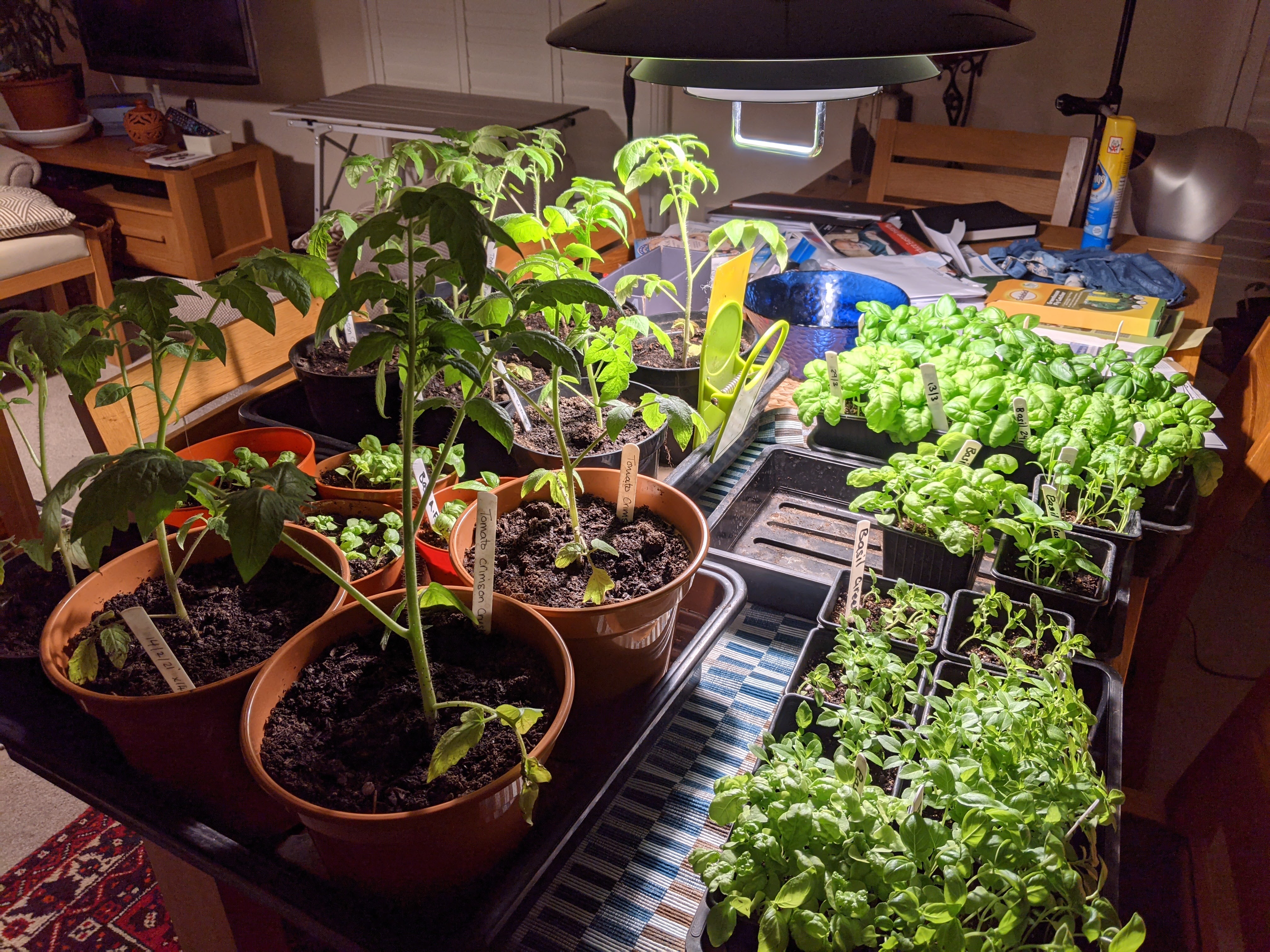
After a very shaky spell in the greenhouse, the tomatoes are now inside the tunnel and underneath a large hoop cloche. Every morning we roll back the fleece to let the sun to them and they’re looking well. We’re greatly indebted to Eliot Coleman’s “Winter Harvest Handbook” for this idea. However, with the end of the frosts we’re having to contemplate digging out some of the other polytunnel crops to make space for the summer vegetables. It’s been the most exciting revelation to see just how well crops like strawberries, spinach, chard, radishes, lettuces and early potatoes thrive under plastic. The container potatoes can be moved outside of course, as can the container carrots but whether we’ll be able to harvest the young turnips in the next ten days is doubtful. At home we’ve got chillies, peppers, aubergines in 5″ pots and trays of basil ready to go into the tunnel alongside the tomatoes, and while they all harden off we’ve got runner beans, borlotti and french beans going into root trainers to germinate; and melon (Minnesota Midget), winter and summer squashes, courgettes and cucumbers sitting in the heated propagators with corn to follow.
But this isn’t by any means all that’s been happening on the allotment because we’ve been setting out the rest of our list of insect friendly plants – so aside from the herbs, we’ve introduced four lavenders (Hidcote Giant), Bee balm (Monarda), Lemon Balm, Winter Jasmine, pot marigolds, Erysimum, catmint,Salvia, Hyssop, Echinops (globe thistle) and borage. They’ll join the fruit trees, soft fruit bushes and globe artichokes. The pond is planted up with iris, horsetail, water mint and other bits and bobs we’ve been given by other allotmenteers.
Surprisingly, perhaps, it’s been the kitchen herbs that have almost given us most pleasure. For more serendipitous reasons than cold logic we’ve collected six different mints and we’re growing four types of basil this season. We’ve thyme, marjoram, oregano, winter and summer savory; French sorrel, lovage, two types of parsley, rosemary, sweet cicely, coriander, chervil, French tarragon, chives and sage. There are probably more that I’ve overlooked. Ironically one of the healthiest marjoram plants we’ve ever grown is a self-seeded plant clinging to the foot of the compost bin on the edge of a path. Like so much in nature, plants are often best left to find their own favoured spot. We’ve lost so many thymes over the years but we still carry on hoping that one day they’ll find their own sweet spot.
Finally, it’s good to write that the latest cordons, (Victoria plum, damson, bramley and Conference pear) have all taken root. They’ll take three or four years to produce any fruit at all but they make me feel optimistic. And the asparagus bed is just beginning to produce useful quantities. When it was planted out we used a bulk offer to put in crowns of three different varieties but to be honest only one of the varieties ever did well. This year the bed has started throwing spears across the whole area at once. Our neighbour has has exactly the same experience and we wonder if the dominant variety hasn’t spread into the space once planted with other types. I’m no expert, so we’ll wait and see.
As I look down this posting I’m a little amazed that we’ve managed to stuff so much into 200 square metres and I wish I could claim it was all down to our expertise; but our guiding principle has more likely been greed, optimism and naivety. It hardly seems five minutes since the day when I’d never seen a green pepper, never smelt garlic and didn’t know any herbs apart from thyme, parsley and sage. Our very first herb gardens were fuelled by the need to furnish our cooking when you simply couldn’t buy herbs. The upside of a childhood lived through food rationing was that every new flavour was a genuine discovery. How could you not be blown away by the discovery that tarragon tasted even better with chicken than it sounded in the books. Even this year I discovered how good sorrel tastes – because we’ve grown it and now it’s free!
As we emerge from the lockdown more or less intact, my phone keeps reminding me of the things we were doing three four five and more years ago. Today this picture of Bardsey Island popped up and my heart sang with joy at the thought that this year – perhaps in September – we’ll be able to go back. Below Bardsey I’ve put in some other pictures taken yesterday on the allotment. Don’t ask whether the loss of the one is compensated by the gain of the other. Life doesn’t work like that.
2017. Bardsey Island from the mainland on Lleyn. It always reminds be of a leech!
For reasons I’ve no intention of writing about, the perfume of wallflowers has the most powerful erotic overtones. This is probably the least written about aspect of gardening but it deserves at least a mention, not least since today one of our neighbours caught me on my hands and knees on her allotment, inhaling great draughts of the memory laden perfume. Madame knows all about this odd affliction so I’m not letting out any damaging secrets here, but if there are any enterprising perfumiers out there, you’ve definitely got one customer. However a lifetime of hearing confidences (and occasionally confessions), has taught me that erotic stimuli are as various as there are people. The oddest I ever heard was a female friend who fantasised about a mechanic with oily hands emerging from under a car and ravishing her. OK?
Anyway, to return to what passes for reality on the allotment, it won’t surprise you to know that the wallflowers (or Erysimum as they’re known by the RHS) are in flower. There’s a survey of the best bee attractors in Ken Thompson’s book “The Sceptical Gardener” which is an excellent read , and the plant Erysimum Bowles Mauve came at the top of the list. We always keep a few on the allotment and their reputation is absolutely deserved. The lavender variety Hidcote Giant also scores highest among the lavenders. Here’s the list in full.
We have been gradually introducing all of these – and lots more – into the allotment. Today I planted out the lavenders and split the catmint into two while Madame interplanted herbs among the broad beans. Mainly, however, we were watering because it’s so very dry. Yesterday we moved the tomato plants into the greenhouse but a very cold morning knocked them about a bit so they’ve been moved into the polytunnel under a second set of hoops and fleece to recuperate.
During the winter I did a lot of thinking about the design of the plot – partly because we’d resolved to make insects and wildlife a priority, but also because parts of the design made it downright difficult to keep up with necessary work. There’s a whole permaculture philosophy centred on what are called “zones”. The general idea is that different parts of a permaculture setup are zoned according not just microclimates and suchlike, but also proximity. In a conventional house and garden, the house is zone 0 and the garden is zone 1. It would be easy to think that therefore permaculture principles don’t (or can’t) apply to allotments which are always some distance away. However, we noticed that our first row of cordon trees were always vaguely neglected because it was so difficult to get to them. They were inside and much too close to the edge of the fruit cage. So this winter we simply moved the side of the fruit cage inwards and left the cordons outside it. Six months on and they’ve never looked happier. They’re in full bud; properly pruned and mulched and generally better looked after because every time we walk past them we can take a close look and take any remedial action that’s necessary.
It’s worth bearing accessibility in mind when you’re designing a plot. We’ve moved the strawberries three times in five years for exactly the same reason. Now we’re growing them in the polytunnel in hanging baskets and they’re in flower and looking blissfully happy. Incidentally we were asked today by a visitor why we talked about our plants as if they were little people. Our answer was “because they are” – which she found almost as difficult to understand as she did when we talked about them being happy. All I can say is – just ask the Nepetas that I split and moved today, if they’re happier after six weeks in the sun, after a year on the north side of the shed.
One last point. It’s commonly thought that gardeners are all amiable, peace loving and non competitive beings. This is not true. We allotmenteers take a keen interest in everyone else’s allotment because we can’t bear to let them get one over on us. It’s a useful sort of competitiveness because it drives up standards across the whole site. A similar competitive spirit has fallen upon us since one of our neighbours started building a magnificent seat and shelter on a plot nearby. I had given up the idea of building a similar structure earlier in the year due to lack of time and funds, but now I’m dreaming of trellises, dog roses and festoons of clematis surrounding our own little shelter. Naturally we congratulated him on his magnificent work through gritted teeth, even while plotting pagoda revenge.
Every day closer to May 10th brings us nearer to removing the last of the fleece, planting the tomatoes into the ground and moving the container potatoes out into the allotment to embrace the sun and grow fat and slick and full of flavour. We’ve cut the first asparagus, but we always throw it on to the compost because it tends to be bitter – possibly through slow growth. By the end of next week it will be in full flush; and speaking of flushes, the two mushroom logs undercover behind the shed are at last showing signs of producing a crop of shitake and oyster mushrooms- if the little white excrescences on the logs are anything to go by.
You know how it always takes a while to figure out what’s going on, but surely (at least in the UK) we can agree that it’s a cold spring – and I don’t mean that we’ve had some cold weather because that goes without saying, but after being lulled into a sense that winter is over by a couple of balmy days, we’ve gone backwards by what feels like six weeks; chilled by a seemingly immovable wind from the northeast which only occasionally swings around to the west to gather some more sleet. Over in France and Spain too they’ve experienced some very extensive damage to crops, including grape vines. It’s difficult to make a direct link to the climate emergency but these extreme events have every appearance of being the smoking gun. Something’s wrong when the average temperature is way below normal and yet we’re having to water because the earth is so dry. “That’s gardening” we say to ourselves hopefully – “… you win some and you lose some”; but are we just kidding ourselves? In Bath we’ve had to cope with illegal levels of atmospheric pollution for years because local politics has been torn between reducing traffic and increasing income from students, businesses and tourism. Now, to add to the evil mix, the SUV has become the vehicle of choice for city centre aspirationals. It seems we all agree that something must be done, but the proposals for reducing traffic have been so watered down by the tourism and transport lobbies that the politicians are running scared. Councillors elected on a green manifesto to reduce traffic have crumpled under the pressure and there are rumours of palace revolutions while local bloggers have poured out their bile on those of us who challenge their so-called ancient freedoms – like driving a three litre Range Rover 1/4 mile to collect Tarquin and Cressida from school.
Anyway, all this cold weather presents us with a storage problem at the Potwell Inn, because a traffic jam of tender plants has built up and is now occupying every conceivable space in the flat, leaving nowhere to germinate the next wave of cucurbits; the cucumbers, squashes and melons – not to mention the sweetcorn and the runner (pole) beans. We’ve hatched a plan to construct a third unheated propagator under our original daylight fluorescent lamps because they give out far more heat than the newer LED’s. Desperation inspires ingenuity and we can probably get by.
Not all ingenuity seems to work, though, and I have to report that my genius attempt to lure the rats into the traps with exceptionally smelly camembert cheese fell upon deaf nostrils, as it were, and the hoped for carnage did not come about. It was at least reassuring that the trailcam worked perfectly. Alas we’ve yet to find a reliable way of controlling their numbers.
If you look very closely you’ll see the rat emerging fit and healthy from the trap before exiting down the path.
Much of the week has been taken up by getting the campervan ready for a single night on the Mendips to make sure all the systems are working properly. Our last trip – over a year ago – saw the electrics collapse in domino fashion and we spent the week reading by torchlight and huddled in the sleeping bags to keep warm. When the electrics go in a campervan nothing works – water pump, stove ignition, lighting and heating all go into a sulk. All this was replaced and patched up a year ago but during lockdown we’ve never had a chance to test it out under normal conditions. I’m almost anxious about taking the van back on to the road but, on the other hand, it’s spring and I’ve got a year’s botanising to catch up with. I think I’ll get back to grasses and try to identify the early risers. Goodness why I find it so exciting to know the latin name of a clump of anonymous green stuff with almost invisible flowers – but I do, and yes, Madame finds it inexplicable as well. Glory be! a new book on UK grasses is on its way to me and I’ve already polished the hand lens (this is not a euphemism). It’s called “Grasses A Guide to Identification Using Vegetative Characters” published by the Field Studies Council – end of plug, except to mention that you can get it from the NHBS bookshop which carries an amazing collection of titles on every aspect of natural history, and not so much as a third cousin seven times removed has links to them.
Finally, I’m publicly registering my ferocious dislike for any newspaper or magazine article headed “Ten top ****” I remember one of the chief reporters on a local paper telling me once that most journalists are irredeemably lazy and the best way of getting your copy into print is to do the job for them. A whole industry has grown up around this character defect; it’s called lobbying – and/or – dare I say – influencing in which winsome young people earn money by making videos of themselves promoting various kinds of snake oil. These videos readily supply ten best anything stories about anything from parma ham to windscreen wipers. In this way I was provoked by a “ten best” on the subject of growing veg.
As a potter, way back, I was often penalized for my passionate interest in technique. Somehow a whole generation of art schools managed to make a distinction between “technique” – which you had technicians for; and “talent”. The outcome of this lamentable attitude was that many students completed their degree courses without the least idea of how the elements of their pieces were conceived of and built, and how they all fitted together to make a finished piece. I remember visiting a degree show where I spotted a glaze that I’d designed as a favour to the technician in that department. The student, not knowing me from Adam, was astounded when I gave her the outline of the recipe. The very best students had a firm grasp of technique as well as the creative competence to carry out their ideas.
This need for technique applies just as much to gardening or cooking as it does to ceramics, and one thing I’ve learned over the years by watching really inspirational potters, gardeners and chefs is that there are always more and different ways of achieving what they’re doing. Being trapped by any sort of ten best ideology is like handing over your brains to a stranger. I’m miles too old and ugly to be a persuader but I’ve been tempted. However I’m constrained by the terrifying thought that someone might have been so impressed by my fluent and articulate promotion of camembert cheese as a rat bait that they actually bought shares in in a cheese company and created an online rat bait outlet with its own logo.
I remind myself of Ernest Hemingway’s comment to his daughter that the purpose of education is to teach us to recognise bullshit. I would hate to think that my epitaph might read “Dave Pole – he couldn’t tell shit from pudding!” – so please pay no attention at all to anything I write. My life is a work in progress – until it’s not.
With the threat of (another) icy spell for the early part of this week we spent Easter day wrapping the apple trees, whose flowers are dangerously close to opening; and sorting all the young plants into degrees of tenderness so they could be appropriately covered. This left the allotment and the inside of the polytunnel looking like a hallowe’en display or a Christo sculpture but it’s worth the effort – plants cost time and money and having nurtured them this far it would be a tragedy to lose them. This morning we went up to see how the plants had fared and we’ve lost two half trays of tagetes (marigolds) which were at the end of a suspended shelf in the tunnel and from which the strong north-westerly winds had lifted their covering of fleece. For some reason this was more of a surprise than it ought to have been. Because we grow so many marigolds we tend to see them as indestructible workhorses but of course they’re tender little plants and did much worse than the lettuces and other salad crops – all fleeced too – and which were completely unscathed. The other casualties were the few autumn planted broad beans that survived an icy ten days early in the year, but were severely weakened in the process. Most of them have tillered so we haven’t lost them completely, but the few which staggered into spring more or less upright have now fallen. We’ll have to rethink our autumn sowings, perhaps keeping them under cover throughout the winter. It seems that it’s the dehydrating character of the arctic winds that almost does more damage than the temperature alone. Last week until Good Friday we were wearing T shirts and enjoying temperatures approaching 20C (70F). This afternoon as I write this, there is sleet and hail strafing the green in a fierce wind.
April being the cruellest month you can spend quite a bit of time rooting around in the stony rubbish to see what’s survived the winter. The nicest thing is finding that below ground, one of those congregations of dry and hollow remains is sprouting green shoots. Today it was the turn of the fennel. In the autumn during the great sort-out we moved angelica, fennel and lovage into a bed next to the new pond which eventually will be home to all our favourite tall herbs and insect attractors. The lovage is already a foot tall, the angelica seems not to have survived (but who knows?) and today we dug up the fennel only to discover it’s sprouting below the soil. Having read that herb fennel is a surly neighbour to most of the other plants we grow in that bed, we took the opportunity to relocate it in another perennial bed behind the shed. The pleasure that such little discoveries brings is beyond price; each opening bud and flower is a blow against the rule of winter. The little line of new bare root trees arrived rather small and in one instance frail; but I knew if I returned them the chance of replacement this season would be zero. Madame is marvellous at coaxing life out of no-hope bargains. I remember we once had a brief competition with another potential buyer of the most forlorn scrap of rhubarb in a pot I’ve ever seen a nursery attempt to sell. Madame won the contest (as she always does) and the plant has thrived so much we’ve had to split it twice – it cost £1.
I couldn’t countenance a year without angelica, it’s just so stately and beautiful, but it’s a biennial and so although the replacements we sowed in the greenhouse two months ago have germinated we won’t have a fresh supply until next year. For decades I’ve thought about candying some of the stems but I’ve never got around to it because cutting them off when they’re still tender seems sacrilegious. However, you can almost never find it in the shops (in the UK at least) and for me the sweet green and fragrant strips are an essential ingredient of the Christmas sherry trifle as taught to me by my old friend Gill Lough.
After my mention of Uncle Charles in the last posting, my sister reminded me that we had “learned” to milk a cow when staying there with the aid of the outside tap and a pair of rubber gloves. You may laugh, but that’s the exact method used by our teacher when Madame and me did a course on keeping goats. Charles – always known as Uncle Char also had a “garage” made from the empty packing case in which cars were once delivered. He could just squeeze his Austin A35 van into it, but it would collapse every time he reversed out, removing the only solid foundation for the trapezoid box to lean upon. My sister also reminded me that the door to the tiny dairy in which the cream was clotted was painted green. Our working lives may be logical and deductive but our most powerful memories are always sensual. These ghostly presences have a more powerful effect on us than we willingly acknowledge and I often wonder if the very specificity of our gardening tastes, down to the exact plants that we must have to constitute our ideal gardens, isn’t a forlorn attempt to recapture the moments when our memories were at their most plastic.
At the end of the new row of trees (it’s really tiny!) there’s a space for one last newcomer. I’ll probably dig deeper and get a container grown tree for this last one which absolutely must – without any doubt – be a greengage. Even if it never bears a single edible plum I want – no I need – it to be there for us to look at every day, next to the Victoria and the Shropshire damson and know that I have honoured this part, at least, of my grandfather’s gift. The greengage is a small miracle of perfume and sweetness and he grew them at The Crest, his smallholding in the Chilterns.
Life can be driven by all sorts of irrelevancies like expediency and ambition or plain self-interest. For me (for us) the allotment allows us to live life, in short moments at least, as an enacted poem because nothing that’s remembered can ever finally die.