

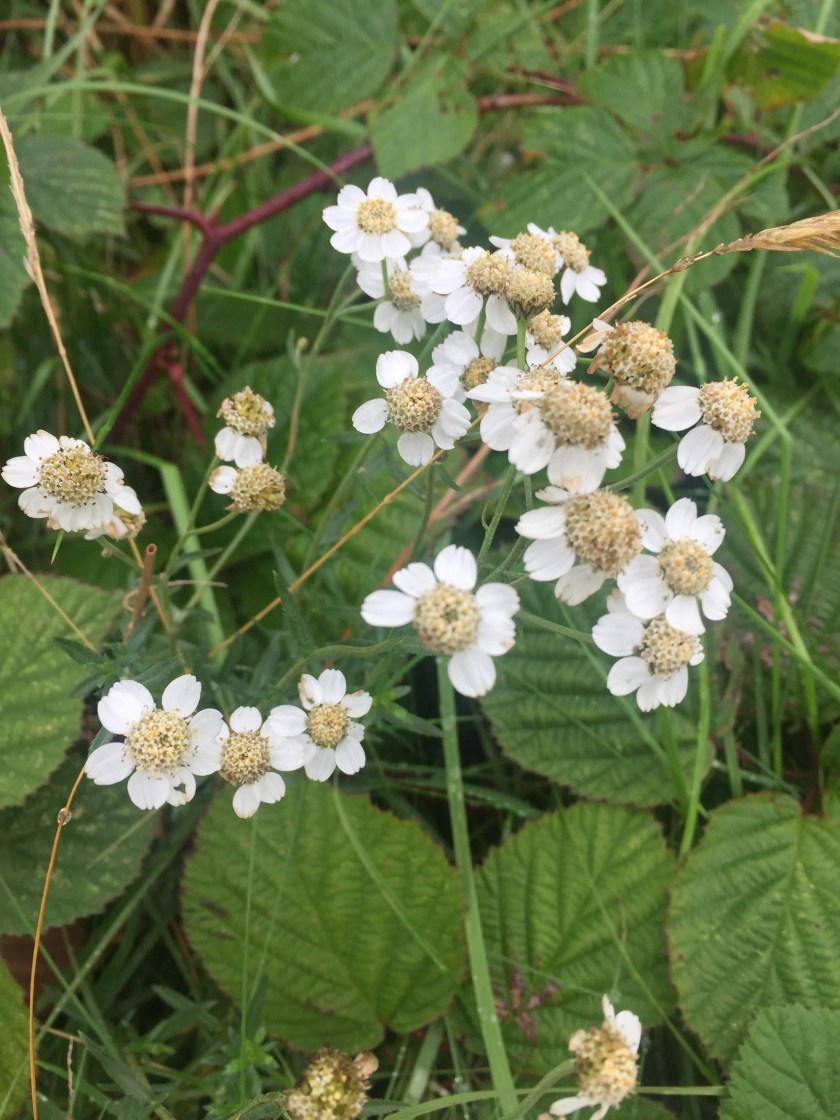
The two pictures don’t belong together geographically. The eyebright – Euphrasia officinalis agg was photographed in St Davids and the sea-wall was in Mousehole, Cornwall. Linked together (just about) by the Atlantic ocean which they shared, but opposites in almost every other respect; the one transitory and vulnerable and the other adamantine and massive. There’s one other thing that they share: they both made me stop and pay rapt attention to them.
Identifying flowers can be quite challenging when they’re very variable. The little “agg” after the Latin name means that there are in this case something like 30 recognised variants and/or 71 wild hybrids – they all look a bit like this apparently but how would I know? Even the magisterial Clive Stace makes it sound hard – it’s an eyebright and it’s very small and very beautiful and I’m resisting any temptation to enlarge on its healing properties except to say it seems that it’s still in use for its medicinal properties.
The harbour wall, equally could have been built in an almost infinite variety of configurations from the stone at hand. That monster five-sided stone must have taken the combined strength of three, maybe four masons to lift into place, and it could have been laid with any of its sides at the base. Was it a collective decision? Did the foreman say “it goes like this”, or was the culture of building so strong that they all just knew where it should go? The form, the pattern of both flower and wall are characteristic of a basic structure but capable of many variations, any of which seem, as I discover them, to be absolutely perfect. To use an analogy from jazz, there’s a pulse, a starting key, a sequence, an idea, and thereafter an emerging and embodied performance.
I’ve never thought of a plant or a wall as a performance before, but it’s an exciting and provocative thought. And what about a moth or a cat or a daffodil? Or to use a much simpler (because speeded up) example – what about a sudden parting of the clouds over the horizon as the sun sets? Why is it that my response, so often, to the unexpected discovery of something lovely – is to cry out, to clap my hands as if I’d just heard the most brilliant improvisation.
That’s exactly the underlying idea from the title of John Parkinson’s 1640 book “Theatrum Botanicum – The Theatre of Plants”, reworked again by Richard Mabey’s 2015 book “Cabaret of Plants”. Plants, flowers and all of nature wrest from us an emotional response that goes way beyond our recognition of their usefulness. We give them names and use their names because in their performance they force us to go beyond any instrumental, reductive thoughts and into relationship with them. And the idea of treating our relationship with plants (or sea walls) as a kind of performance reminds us that performances are not complete without readers, listeners or viewers – and the better we are at those tasks, the greater, the more illuminating and powerful the performance can be. I owe to A F Woodman, my much loved music teacher at secondary school, this phrase – “I know you can hear it Pole – but are you listening?!”
On a plain, grey day in November with nothing much going on, I’m flicking through my photos looking for inspiration. Nine times out of ten, my postings are initiated by a photograph – something that caught my eye, made me stop what I what I was doing at some point during the day. But some days are unrelieved by those moments of illumination. Some days when everything seems flat and spare I have to wrest a blessing from the moment, hang in there. And today my consolation is in the eyebright I found at St Davids in the summer, and in contemplating that great granite sea-wall, shouldering off the waves tide after tide, storm after storm and still there as the first celandines peep through the snow – upcountry.

 So yesterday I started thinking about the colour set for the red cabbage leaf painting. If I were to use the closest colours I could get to the ones printers use in three colour printing, I could use them in two alternative combinations of warm and cool. But this morning as I was trying a few swatches, it occurred to me that I could get closer to the purple red I need by using alizarin crimson. Then a couple of experiments with the two blues moved me towards French ultramarine which gives a warmer touch. But there are also many browns and greens to be got and sticking with my three tube resolution I tested cadmium orange and Indian yellow. Why bother? Why not just open a different tube for every colour I can see? Well, because it’s far less interesting and it costs a fortune and I don’t need to work that way. I’m just an apprentice, and I just learn a lot more by using a restricted palette. Didn’t I learn all this at art school decades ago? No I didn’t because art schools went through a long phase of treating technique with great suspicion. Imagine a conservatoire that didn’t allow students to practice scales because it might disrupt their inner musicality? That was what art schools were like in the seventies – ideas were supposed to emerge untroubled by anything resembling skill. I’ve no idea whether things have changed, but if I were offered that kind of education on a huge loan I’d think twice.


 At home the summer window boxes are all inside now and we’ll be taking cuttings for next year. Tomorrow looks set to be wet from the outset. Before we left this morning, I sorted out a corner of my room because we’ve decided to have a ‘drawing day’. I aim to spend an hour or so doing the colour swatches tonight so that I can begin the first draft paintings tomorrow. It’s fascinating to see how different “daylight” lamps can be from one manufacturer to another. I prefer to work with quite high light levels to bring out all the subtleties of colour, and for very fine work I use a big desk magnifier, so you can see three distinct ‘daylight colour’ sets on my desk, and I have to negotiate my way through the various options.


 “Hello” – I say, as I shuffle up the garden in my baggy corduroy trousers with my two ancient laboradors following – “I’m worrying about my hyacinth.”



 Sometimes the success or failure of a day out hinges on something essentially random – like finding a shop that sells crystallised angelica. We last bought it in Penzance at least three years ago, and so as we set off up Causeway Head I had little hope of finding the shop, which even then had the air of a pop-up, still in business. But there it was, very much in business and pleased to sell me enough for three Christmas sherry trifles at least. I’d despaired of ever finding it again but somewhere there’s a person with the energy to simmer angelica stalks in increasingly strong sugar solution for days, until the tender stalks are preserved ready to add a touch of green to contrast with the morello cherries floating on whipped cream atop the trifle. The Potwell Inn always produces Christmas puddings as well, but we rarely eat them until well into the year because sherry trifle made according to a recipe given to us by an old friend has become a Christmas fixture. As you can see my thoughts have turned instinctively to Christmas for no better reason that the preserving and pickling are all but finished. Once upon a time, Gill made us the trifle as a gift every year, but when she became too old I took on the task as a tribute. No Christmas could be complete without it, and because she always aded angelica it never looks right without it.
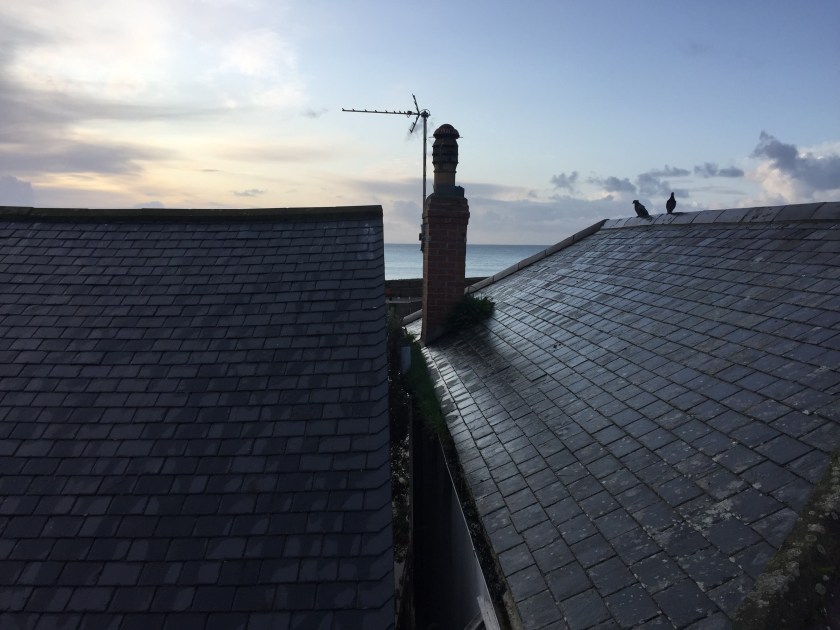 There’s nowhere to park here: the village was fully formed before the car was invented and the old fishermen’s cottages form a maze of narrow alleyways but there’s an excellent bus service back and forth to Penzance and from there onwards to anywhere in the county. On the roadside facing the sea there are allotment gardens, with some sculptural and whimsical scarecrows.


