Camino 15: Decazeville, by the rivers of Babylon

30th May 2010

Woke to pissing rain – so glad we’d ordered breakfast for 7.30.  Packed tent wet and put on all our waterproofs to leave at 9.00am.  We’d inadvertently exchanged trousers so I was wearing M’s extra large ones and his looked extremely slim and tight!  Flogged up awesome track out of Conques so we were wet with sweat by the time we reached the top. Miserable cold, windy and very wet.  Hard walking all the way.  Decazeville looked like Blaenavon on mogadon.  Dropped down 300m and the straight back up the other side. Arrived at Livinhac le Haut at about 3.00pm, knackered again.  Found campsite on river but couldn’t face wet tent so we rented a caravan for the night and paid 60€ for dinner bed and breakfast. So we could dry out all our stuff in the caravan.  My rucksack leaked badly at the bottom so my shoes were wet through.  Slept on a bed this afternoon – bliss! Own shower own toilet.  Bed 8.45

31st May 2010

Still cold, windy and pissing down at 6.30 so we discussed our options.  Me very pessimistic.  M (as so often) practical and positive. Shower out of gas too – so got cold and wet while I struggled with the controls and then gave up. We were the only customers at breakfast.  I think the campsite has fallen on hard times.  Only about 8 diners from the nearby gîte d’etape last night.  Onion soup (I was so hungry I ate it)  Salad of grated carrots (that’s all)  chips,  duck and the ubiquitous haricots verts – the French cook these with real hatred like my mum used to cook sprouts.  M noticed a burned out caravan and a similar tent just left there.  I expect if you looked in the orchard you’d probably find the previous owner’s body still hanging there.   Anyway I negotiated with the owner and he offered to drive us to Figeac for 50€ –  so 118€ for bed breakfast evening meal and transport for 2 – deal!

Figeac on a wet Monday made Haverfordwest look cosmopolitan. Everything shut except a couple of rainswept cafés.  Thought for a moment the whole town had a crack cocaine problem – certainly saw some edgy looking people around.  Just about lost the will to live when we noticed 2 bedraggled pilgrims carrying shopping bags so we went back into the centre of town and found a LeClerc open and several other signs of life (3.00pm) Bought food and a Guardian Weekly went back to the campsite, nicked a couple of chairs from an empty chalet and read.

Journal

Of course anyone with a grain of common sense will be asking me how I have the nerve, after all I’ve written about the church, to put on a frock and say things I’ve apparently long since stopped believing. My answer would be that I have always believed that Christianity can only be accepted as a practise rather than a rosary of written propositions about unfathomable mysteries. My biggest difficulty with the day was taking on the persona – Rev Dave – even for a few hours – after laying him to rest for eight years. I don’t believe for a moment that my blessings would twist the arm of any conceivable non material being; but I do believe in grace

13 years later

I swore I’d never do it, but when Harry’s daughter asked me I couldn’t say no; and so yesterday, for one day only, I came out of retirement and agreed to bless his grand daughter’s marriage. I owe him too much to do any other; however I named my price – that I would insist on wearing trainers – and the deal was done. It was – as I’d always known it would be, totally exhausting – but spending a few hours with Harry (96) and his family was pure joy. A haircut and beard trim were obligatory on my part- Harry is an ex soldier and retired surgeon and the man I’ve looked up to for more than thirty years; a true role model and inspiration. He was also my Churchwarden for much of that time and saved my skin more than once from a small contingent of members who wanted me out/dead/whatever …..

Of course I was absolutely running on empty by the time we drove home, and all I could think of was a glass of wine – but having poured it out I took a sip and flaked out in an armchair. I woke almost ten hours later dreaming about David Attenborough driving children off the beach at Severn Beach (where there isn’t one) – waving a radio handset and shouting dark threats against trespassers. I’ll leave you to work that one out because I haven’t a clue. I was, however feeling unsettled and flat because I knew I was about to write about Decazeville. But Madame had a cunning plan, and – as ever – it was a good one. “Do you fancy driving up to Mendip” she asked casually after a very late breakfast.

The sun was shining, it was unusually warm and we walked in T shirts around Stockhill Plantation where last year we found dozens of species of fungi but today almost none. All of the mycology websites have been lamenting the late start of the autumn flush of fungi and they are entirely correct. It was spookily fungus free – BUT – today I found one I’ve been looking for, for ages. It’s beautiful, delicate and unusual for a fungus with a cap it lives up trees – particularly beech trees. Here it is: Pleased welcome the Porcelain fungus – Oudemansiella mucida

But there’s an irony in this excursion on to the Mendip Plateau but although I grumble about the depressing ugliness of Decazeville it shares an origin with high Mendip because they are both former mining areas and still bear the scars. Mendip was mined for lead and copper, and Decazeville for coal – an industry concurrent with the industrial revolution. I can think of walks nearer home where you experience the same disjunction between two adjoining landscapes; empty hillscapes and semi derelict industrial areas. Walking south from the Bannau Brycheiniog (Brecon Beacons) you might take the Beaufort road and, crossing the empty hills, walk downhill past an opencast coal mine and into the Welsh valleys which once powered the industrial revolution here. The same slightly depressed feeling hangs like a miasma over these post industrial towns. Our walk yesterday was through a plantation that has now pretty much covered about 24 acres (12 hectares) of what’s known locally as gruffy ground; covered in shallow exploratory pits where miners from Roman times onwards have prospected and mined surface deposits of lead ore.

The great advantage of writing up the Camino journal is that these parallels constantly crop up. Obviously being wet and miserable I failed to do justice to a little town that has fallen on hard times. I just checked the local statistics and discovered that the town has only existed for 150 years; the sole raison d’etre being the extraction of coal which ended in the 1960’s . Population about 1500, just 26 two star hotel rooms (and no others at all) and no campsite – so by inference, the Pelegrins don’t stop and spend their money here. The Transit vans and crew buses full of paying pilgrims pass quickly by to more attractive places. My strongest memory of Decazeville is the smell of dog poo wetted by the rain and the continuous procession of gigantic Renault lorries – oh and one of those very thin pilgrim ponchos abandoned in a hedge like a giant pink condom.

But why should pilgrimage be an endless sequence of more or less beautiful places and memorable stops. Life really isn’t like that and I guess I’ve waited 13 years to allow that thought to emerge into the light of day. I feel slightly ashamed of my negative reaction to Decazeville. On a sunny day and with time to explore more fully I’d probably be praising it as I regularly praise all sorts of heritage industrial remains. I don’t think Madame will be wanting to join me on that expedition, though!

Finally – to complete our afternoon on Mendip a few shots of a very beautiful Scaly Male Fern, Dryopteris affinis and a tiny lichen, British Soldiers Cladonia cristatella. Maybe the Rivers of Babylon aren’t so bad after all?

Camino 14: Conques

Conques 2010 – the path out is opposite.

29th May 2010

Well [the school party] didn’t quite stay up all night but the DJ had them singing all their favourite pop songs at the tops of their voices until quite late.  I’d gone to bed at about 8.00pm leaving M to finish off his (2nd) bottle of wine. I always feel very anxious when he starts drinking.  Slept all but 11 hours with a few interruptions.  M unzipped the tent several times and told me he’d spent £40 on a [phone] call …… in the night. That’ll teach him!

Woke in the morning to the sound of 50 suitcases and accompanying children being herded right past the tent.  Daren’t get up for a piss even, as they were overrunning all the facilities. When calm was restored 2 hours later I went to the toilets only to have myself photographed several times by children on the coach which I hadn’t noticed was overlooking me.  Left M sleeping and went for breakfast – better than last nights dreadful pizza and chips.  2 coffees, fruit juice, pain au chocolat bread and preserves.  Did all the washing in the morning  and left it to dry in the sun.  Dozed by the swimming pool.  After minimal lunch – picnic –  went to Conques.

All very picturesque but the abbey was cold and, for me, spiritually meaningless.  The town itself is overwhelming but ultimately a gift shop. If you came here looking for faith I’ve no idea how you would find it.  Resting again now. Meal booked at the auberge along the road for 7.30.  Owner looks just like the one of the *Two Fat Ladies who died. As the days go past we just walk, sleep, eat and search for toilets.  That’s about it really. What a strange way to spend a summer. Not very religious and not remotely what most people imagine we’re doing.

* well known TV chefs of the time

Journal

Thirteen years is a long time; long enough to change perspectives, long enough to be led out of Europe by a bunch of liars; long enough to see poisonous and cruel ideologies strip away our security and dignity; long enough to see our civil rights taken away; long enough to see the poisonous fruits of environmental degradation set fire to the atmosphere forcing the thought that my memories of a pristine landscape and historic culture may have already been erased; long enough to know that I’d never be able to undertake such a long walk again. In truth it’s likely me who’s disappearing and I’m finding it hard to adjust to the loss. The sense of morbidity grips like winter – grips my joints; grips my hearing and my eyes; grips my heart which is always liable to go off on a cadenza of its own devising.

This week, on the television we watched “Partygate” – the horrifying documentary that chronicles the carousing and lawbreaking in Downing Street, going on while thousands of people died of Covid. We watched Tory Party conference speeches that were psychotically detached from reality, and we watched the David Olusoga documentary “Union” which dealt with the bloodshed, greed and corruption that fuelled the union of England, Wales, Ireland and Scotland. Any residual faith I once had in our human capacity for compassion, generosity and communal life is being slowly crushed. I was born in Bristol and raised on the horror stories told by my father and grandfathers of the Bristol riots; how the middle classes allowed the miners of Kingswood and South Bristol to fight for the reform acts knowing that their sacrifice would only benefit a couple of thousand wealthy property owners. I was fascinated by Rolinda Sharples’ painting of the trial of Colonel Brereton which still hangs in the Museum. Brereton was court martialed for losing control of the riots, but had been made a scapegoat and committed suicide before his trial ended. Nobody knows how many rioters were killed by the Dragoon Guards.

History and its relics makes fools of us all. I wonder if the only way to conduct a real pilgrimage today is to start with the pot of fools’ gold bought in the cathedral gift shop and then walk away with it into the reality of twenty first century suffering. Who knows? the alchemical work of walking might transmute it into real gold; spiritual gold.

In my twenties I went into a prolonged period of anxiety and depression and so I curse this mood as if it were an estranged acquaintance turning up out of the blue. The doctor diagnosed morbid anxiety and assured me that I would get better with a bit of human company. “Go down to the pub!” he advised. “Pills are no good”. I took him at his word, and months later I met him at a party. I was standing at the top of a rather ornate Georgian staircase. He climbed towards me clutching a large glass of wine. “Ah, I see you took my advice” – he said – and then toppled drunkenly backwards down the stairs in a well practiced cartwheel. Months later it suddenly dawned on me that – of course – I was going to die; but not yet!” Those few imagined words were what you might call a performative utterance and I got better. Ever since, but mercifully rarely, winter trees take on the appearance of blackened lungs and the feeling returns but I’m reasonably hopeful it won’t last

So possibly this wasn’t the best time of year to start remembering the Camino. On the allotment, autumn is my least favourite season because the crops are harvested and all our energy is directed towards clearing up weeds and dead plants. The Camino has always felt like a comprehensive personal failure – so much so that I can only manage writing about it for a couple of days at a time. And yet I go on writing because there’s a tiny part of me that knows the only way to move on is to turn and face the black dog. When faith becomes fetid and blocked with the debris of false belief, the clearing out has to begin. I have to drag the bindweed out of my heart.

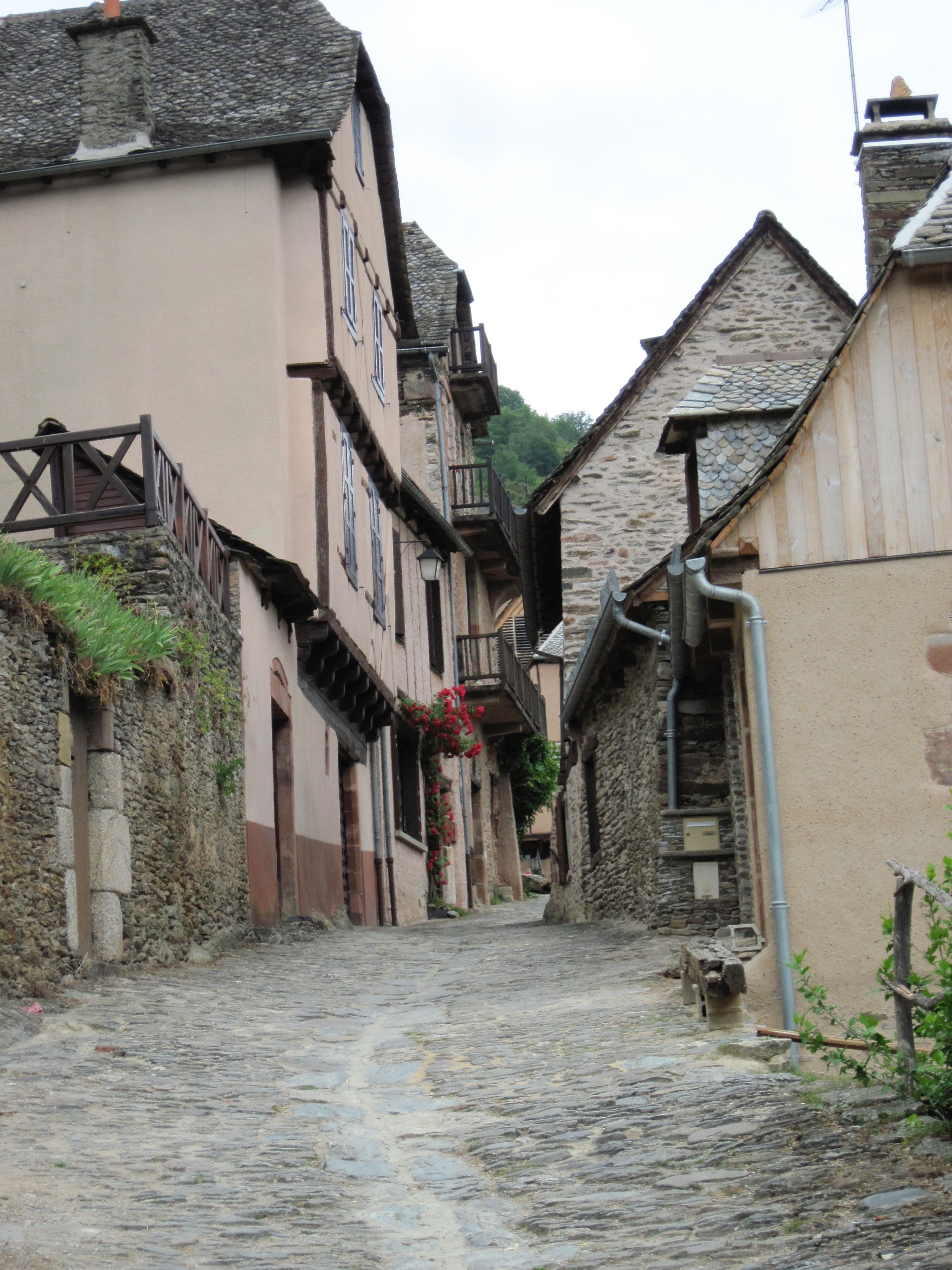
My photographs of Conques were enough to set me off on this gloomy excursus. We came down from the Aubrac Plateau exhausted but buoyed up by the landscape we’d been walking through, and were then thrown into Disneyland; the relic of a town, dusted with cobblestones, and rolled into a preserved, boned, rolled and stuffed religious experience.

If you’ll allow me a small biblical moment, some may be familiar with the Gospel story of the Transfiguration – when Jesus goes up the mountain with Peter James and John they see him transfigured – glowing – and talking to Moses and Elijah ( a heap of theology there!). Peter, as always, gets over excited and offers to build three shelters so that (presumably) later pilgrims can return to the place. Jesus (and I’m translating roughly from the Aramaic) shouts at Peter and says don’t you effing well dare you moron – that would be an epochal piece of misdirection. Sadly, ever since then, generations of Peters have been throwing up more and more effigies, buildings and reliquaries in complete defiance of the instruction to remain silent. Now I realize that this is a very loose interpretation of some greatly loved and important verses and that some will think it’s heretical but the central idea is that God can’t be trapped in a location or a building or relic. The Tao that can be spoken is not the Tao.

So there’s a sense in which Conques was a kind of turning point for me. The coldness and emptiness of the Abbey exactly mirrored my feelings of coldness and emptiness. The rest was gift shops, bars and bakeries specializing in sweet treats baked with chestnut flour. We got our pilgrim passports stamped and wandered down to the bottom of the valley, knowing that we’d have to sweat it out up the other side in the morning – see the photograph at the top. The untouched beauty of the small town was rather undermined by its chocolate box alleyways and streets and oddly (to most people who don’t know me) I became fascinated by the leadwork gutters and downpipes and took any number of photographs – which I’ll spare you.

This was where the idea of walking away from the iconic place was born. Next time I’ll write about the phone call that changed everything.

Postscript

My friend Rose reproaches me mildly by sending some photographs of Fontenay Abbey which she says is “scoured free of crap” – and I agree entirely. Getting rid of the clutter, the explanatory material and all the accumulated cultus at least allows the buildings to speak. But it still seems to me that occasionally the still small voice can speak through the carnival of distraction – however I think those occasions are determined by grace and not design. So here are a couple of pieces from the past that – I hope – paint a more nuanced picture.

St Thomas a Becket and St Francis of the boot rack

Camino 13 : Puy lentils and confit duck

Sénergues

28th May 2010

Woke up feeling cold, miserable and pessimistic.  My feet had been sore all night and I couldn’t seem to get comfortable.  Dragged myself out of the sleeping bag and went for a shower while M slept.  Then I had a proper look at my feet and peeled off the pile of three compeed plasters on the ball of my right foot.  To my surprise – though the plasters stank – the skin was intact so I replaced them with a new one which was much more comfortable.  M woke in a more positive frame of mind and we packed up and blagged a couple of free coffees at the campsite café.  Walk was much easier today. Arrived in Sénergues at 12.00 (didn’t leave camp ‘till 9.00 and found 2 pilgrims we recognized eating lunch at a café. It looked so good we stopped too.  Green salad, fresh tomato, hard boiled egg, confit duck and hot cooked Puy lentils.  We both had a panaché and then sorbet and espresso. Cost 30€ but it made up for yesterday’s privations.  Walked on new legs after lunch.  Finally got to Conques at about 4.00pm. Town is extraordinary – like a medieval film set – so we decided to take a day off tomorrow and explore then. 

Campsite by river – nice place – Pizzas tonight + sleep + rest and do some washing.  Only fly in ointment is 50 school kids on adventure camp.   Hope they don’t stay up all night.

Journal

Surprisingly, perhaps, I didn’t come back from France with a pocketful of recipes – mainly because our diet was so restricted by our budget and although we saw a lot of menus we didn’t really eat them. I wrote last time about the vegetable soup with aligot and local sausages. The vegetable soup has eluded any attempt to cook it myself and although we eat lots of veg soup at the Potwell Inn, I’ve never made anything as good. Maybe it should only be attempted when you’re half starved and completely exhausted. We were living off high energy tinned food that we could eat as we walked a lot of the time. Later on I’ll come to a cafe where I was so lonely I could have proposed to the owner on the spot except for her completely aloof manner (very French) and around a forty year age gap. I was missing Madame terribly.

But this little restaurant in Sénergues looked like the real deal and when we saw a couple we vaguely knew we didn’t hesitate. The main course was a kind of warm salad of confit duck and Puy lentils with a green salad. This one has become a mainstay for us. We buy the duck legs when they’re on offer and brine them overnight before preparing the confit from an enormous jar of duck fat at the back of the fridge and then pack them into our largest and deepest casserole with a few bay leaves and some thyme before we cook them very very slowly for several hours. Then we vacpack them in pairs and bung them into the freezer. We cook the lentil salad fresh each time – a mirepoix / soffritto of carrot and celery and a whole onion stuck with a few cloves, covered with stock (best you can get – preferably homemade) and dressed with a vinaigrette made from red wine vinegar, honey, chopped fresh shallot and chopped parsley. Green salad any way you like it. we defrost the confit duck and sauté until crisp and warmed right through. Then we usually pull the meat from the bones and mix it with the lentils – absolutely lovely to eat and easy to cook. Here begins and ends my Camino cookbook. As for tinned cassoulet it’s better heated up because the layer of cold goose fat cleaves to the top of your mouth in a most unpleasant way. I could retch just remembering it! However real cassoulet, whilst a terrible faff is a thing of beauty that doesn’t cost much more than a day of your life.

The changing of blister plasters became something of a ritual for us. Although I’d prepared and trained, as well as pickling my feet with surgical spirit for weeks, both of us suffered from really painful blisters, and we found that the best way of dealing with them was to dress, clean up and apply Compeed plasters to each others’ feet. An intimate and smelly job but much easier in the end for both of us. I don’t use this blog to promote anything – but I can honestly say that Compeed plasters are the absolute bees knees and can keep you walking with absurdly blistered feet. Perhaps I’d venture the advice that the time to deal with any soreness on a long walk, is immediately.

Next stop Conques.

Conques

Equinox

Towan beach on the Roseland

Last night we watched the moon rise and set behind the hedge on the campsite. Today is a brief period of calm between two blown-out hurricanes, and tonight Nigel barrels in. Does anyone else think Nigel is a bit of let down for the name of a hurricane? Anyway, at the end of last week’s storm Lee gave us 85K gusts without causing us any problems, and Nigel is forecast as a bit of a damp squib down here in the extreme southwest.

I’m a traditionalist when it comes to marking the seasons. I don’t buy the tidiness of the meteorological seasons and much prefer the solstice and equinox schema. These seasons relate to the inbreathing and outbreathing, the sleep and the oestrus of the earth. What’s the problem with that? So we sat on the beach today and soaked up the sun from which we’re slowly withdrawing for a while – because the earth needs rest as much as we do. It seems to me that part of the problem with our rolling ecological disaster is that our culture wants to press the override button on the seasons -in fact on all of the natural constraints that keep us and the environment sane and healthy.

Back on Monday with a pile of autumn work to do on the allotment – mulching, composting and prepping beds for the Spring.

Camino 12: which way? – the dance goes on

Celtic wayside cross – now outside the door of Gerrans church

This Celtic cross in Gerrans churchyard, (in Cornwall where we are at the moment) spent at least a part of its life on its side as a coping stone on the wall; which is a fairly ignominious fate for what must be the oldest Christian relic in the village. I have to remind myself that although we like to think that artistic, spiritual or historical value is intrinsic to the objects we treasure, it’s clear that what it’s worth is what we think it’s worth. So there were obviously times when this cross was valued more highly than it is today – and what’s more, by the 19th century it was no more than a handy lump of stone.

But hold on; what goes around comes around. What if objects, like words, accumulate meaning, and like words, also shed them. For instance while we were walking the Camino we found several enormous stone frames standing outside old farm buildings. One of them had an immensely strong looking set of straps, but I had to read some history to discover that these frames were used to restrain oxen while they were being shod by the local blacksmith. I’m perfectly content for the frames to be both redundant for practical use – because there’s not much call for oxen with shoes these days (perhaps there should be but that’s another argument); but now they are charged with meaning and resonate as object metaphors for a lost age.

Looked at in this way, the Celtic cross still resonates meanings from the past and still, if we choose to allow it, carries a kind of accumulated spiritual meaning for us. But it’s important to stress that whatever that meaning is, it will take the form of a dialogue. We take questions to these powerful objects; questions such as “what is your name?” “what was in the mind of your maker?” “what kind of world did they live in? and what were their beliefs? “What is your purpose?” Happily we know the answers to some of those questions; this stone began its life as a wayside cross, perhaps in the so-called Dark Ages after the Romans had left, taking their form of Christianity with them – whilst the Celtic church of an earlier – perhaps 3rd century – period which had been most powerful in the westernmost fringes, continued as before. The two spiritualities were very different and so too were the forms of organisation. The reason I think the wayside cross is significant is because the Celtic church was monastic and its monks were great travellers; setting up cells and monasteries wherever they could. In an age where people travelled on foot or by horse on more or less unmarked tracks and footpaths, waymarkers were vital, and continue to be so on pilgrimage routes.

So much then for their accumulated meanings, but could it be possible that the questioning I just mentioned is, in fact, a two way conversation? Would, or could the stone and other treasured artifacts speak back to us? I don’t think that’s a step too far towards some kind of wooly, ill defined spirituality. It would depend on the quality of the question of course, and the intensity of any meditation on the reply. This can sound a bit religious, but for me, the answers to good questions are almost never concrete but – let’s say – Delphic. The symbolism of the crossroads is crucial, because it involves choosing – the ultimate derivation of the word crisis is the Greek crino – to choose. So instead of answering the question where now? the function of the Celtic waymarking cross is to ask it – where now? All I know is that once I’d seen the 7′ high stone I felt compelled to go close to it and see. The stone called me.

Inside Gerrans church there are other speaking objects. A 14th century font carved from granite – Cornish stone; 15th century pew ends bearing the pineapple crest of Katherine of Aragon; the remains of candleholders from the early 20th century, Victorian floor tiles – and so it goes on. But the church is on its knees. The systematic withdrawal of support from these little parishes towards the centre exactly mirrors the social depredations of successive governments. Oblivious to the cultural and social significance of village churches they are being allowed to close.

As we went into the church I read the notices and after we left, I googled up their web page and it was enough to break your heart. These parishes with their 1500+ years of history are being abandoned. Here there are three voluntary churchwardens, but no licensed lay minister and no priest helping to keep them alive. You might think it seems as if the Romans are leaving all over again – which could, just could, lead to a rediscovery of Celtic spirituality. Wouldn’t it be wonderful if our tired and bankrupt churches gave up trailing thirty years behind secular fashions and arguing about challenges long-since settled by the rest of us; gay marriage stops being a “problem” when marriage stops being a property relation; women as priests and bishops stop being a “problem” when women stop being a problem.

So there’s a huge opportunity to rediscover the hospitality, the creativity and the profound love of nature exemplified by a Celtic spirituality that’s open to all and most importantly refuses to define itself in a series of attempts to imprison God into a linguistic cage. There is no theology beyond poetry, song and music.

So where does this all lead me?

18th March 2017 – the Wye in flood at Hay on Wye
This is going to be a hard one to explain ..

I had to give up my futile search for some kind of overarching meaning on 18th March 2017. I know it was that moment because I’d taken this photograph and I just knew it was over. We turned our backs to the river and then I turned back for a moment and said goodbye to God. Then I waited for some kind of catastrophic reaction – the full Kübler Ross experience; anger, denial, bargaining and depression followed at a decent interval by acceptance. No such thing happened because I went straight to acceptance, feeling nothing but a sense of relief that at last I could stop trying to hold the tectonic plates together. What I didn’t realize until this week was that the flooding river wasn’t moving away from me; it was offering me an object metaphor which I could return to six years later with a second piece of the jigsaw – the Celtic wayside cross – with which I could continue the journey in the right direction. The river flows, which is the state of everything in nature. I could go on for ever embellishing and working up the idea but that won’t do because it’s the dreary job of theology to explain, when what the river demands is wonder, that’s all. I filled the ensuing years with the allotment and with learning the plants, and intellectually as well as physically it was absorbing and rewarding – but there was no music in my life; I wasn’t singing any more. My sense of wonder couldn’t tolerate being spread so thinly.

Which was certainly why, on walking into Gerrans church I felt the most extraordinary sense of peace. How strange and how unexpected?

The way inclines but never compels. (To steal a phrase from the astrologers)

Writing up my notes on the Camino we walked in 2010 has led to some provisional insights among which is the understanding that the full Damascus Road experience isn’t really what it’s about, and also that that once you’ve signed up and set foot on the path, you’ll always be on it whatever happens on the way and however far you ranged in search of an easier route.

The initial landscape on the Aubrac plateau before it morphed into woods.

For a long while I’ve had a set of photographs taken in Estaing that I couldn’t place anywhere in the walk, and so finally I’ve gone back to the map and figured out that it’s a fairly short walk beyond Espalion, and so we didn’t hang around apart from a coffee, I think, somewhere down near the bridge and the river. Then we pushed on. So having finally got this piece into the jigsaw I could see that – far from leaving the hill country behind we were still in the thick of it. Unlike the Aubrac Mountains, this landscape was heavily wooded and the footpath – marked all the way, I’ve never mentioned before, by white and red posts- balises was mostly easy to follow.

And there we are – I’ve probably tried to say everything and actually said nothing.

27th May 2010 ctd:

Bed at 9.00pm.  It rained at night and it was raining when we set off so M was pissed of with the extra weight [the tent weighs half as much again when it’s wet].  Turned out to be a monster day again. Following the River Lot but crossing 3 tributary valleys so climbing maybe 1000 metres.  27K in all. M a bit hypo and cross.  Found campsite in Golinhac (650m) very good.  Pitched tent and had a couple of coffees before walking down to the shop to buy picnic tea.  Sadly I’m too tired to eat so we’ll have to make up in Conques tomorrow.  Easier day I very much hope.

Journal

Camino 10: Nasbinals

24th May 2010

Slept late and wandered off to the post office only to discover that today is a bank holiday in France so we’ll have to wait until tomorrow to post stuff off.  Dined on cold tinned cassoulet but by then I’d got the raging shits from too much rich food so I’m glad we’re not walking today. PO at 9.00 tomorrow meanwhile we did some washing and lazed about charging phones and cameras.  Supper at same restaurant tonight but cheaper menu I think.

“Supper at same restaurant”!  Les Sentiers d’Aubrac – remember never to eat there.  Andrew found 3 hairs in his salad.  The manager was running the service without a waitress so everything was appallingly slow.  The pièce de résistance was a bluebottle roasted and sauced on top of my stuffed chicken thigh (along with some tiny mushrooms).  I suddenly understood why I had been ill all day.  We left refusing to pay for anything except for a bottle of Pellegrino which we gave him 5€ for. Our journey across France is turning us into Bonny and Clyde.  We half expected him to get stroppy but he didn’t even apologise.  [Later, I] – had a wonderfully surreal conversation with a very old Frenchman who was obviously lonely.  I was washing out my water bag and it became clear, when he smiled and tapped his thigh, that he had mistaken it for a catheter and storage bag.  So we shared this precious moment of fellow feeling and he went on his way presumably encouraged that there was someone else on the site who shared his problem

Journal

There are several missing pieces from this part of the journal. My memory has muddled up several bits in places, but since I mentioned sending off any redundant equipment we had discovered we didn’t need or couldn’t carry any further, I’m clear that this is the place where we saw a market stall dedicated entirely to foraged wild mushrooms. In a better ordered narrative we would have brought a selection of them back to the campsite and cooked the kind of dish you see fêted in the Sunday supplements. However with no cooker and feeling a bit disillusioned we passed by in search of the closed post office and wandered back to the tent. Clearly, by finally crossing the Aubrac Mountains, we were about to reach something of a turning point on our walk and from this point onwards the villages – with their temptations – were closer together but the opportunities for wild camping greatly reduced. I celebrated my grasp of French by successfully buying some Imodium and I managed rather better than I did in Nîmes when I had attracted a small crowd of helpful locals whilst attempting to buy some hemorrhoid treatment for another member of our group. Madame’s helpful suggestion of “little balls” had to be courteously rejected. This was also the place where we came across a bizarre shop that sold stuffed wild animals set in eccentric poses; an extremely creepy shopfront that never made it into the journal.

25th May 2010

Up early.  I’d been listening to a nightjar I the trees near the tent.  The wildlife here is exquisite – flowers orchids and the happiest and healthiest cattle I’ve ever seen.  Post was very helpful (we were sitting on the doorstep when it opened).  The surplus gear was packed into 2 boxes and dispatched to Harry’s daughter in Le Houga.

Then we set out to cross the last and the highest part of the Aubrac Plateau at 1300 metres.  Dropped down through wooded landscape to St Chély at about 3.00pm. Best day’s walking yet ‘though only 17K.

Journal

I think all of my happiest memories of the camino were contained in the walk from Le Puy en Velay to St Chély; around 88 miles in all. It was admittedly gruelling going at times with our heavy loads – but that was more than compensated for by the variety of mountain landscapes, wildflowers and the kind of connection with the traditional ways that you could taste. Where else would you find the towable milking sheds which could be taken to huge flocks of goats and sheep? where else is the huge variety of local unpasteurized cheeses made and sold on the farms we were passing through? I don’t think I ever felt more like a stranger passing through and yet never so happy to be so because here were people whose roots went back many generations and whose stoicism, cynicism towards authority and lack of pretension made our own studiously cultivated freedoms look pathetic. Here is where less was more and the past was written everywhere in the landscape and where the present generation thought there was nothing odd about living amongst the relics of the past – a million miles from the Banlieues of the big cities. I don’t romanticise this kind of life because it’s written in sweat, failure and loss in a way we could never fully embrace; but I celebrate it because it’s a way of being completely human that concedes nothing to the money changers at the temple of neoliberalism.

To get the distance between Le Puy en Velay and St Chély I googled up one of the companies who offer fully organised Caminos with pre-booked lodgings, food and transport. The full route to St Jean Pied de Port would have cost us – this year – £8,400 minimum but you could pay more for more comfort. The question then is this. Is then the modern Camino the 21st century equivalent of buying an indulgence, or building a chantry chapel and funding a priest to say masses for you? and if there is, perhaps, a chance for a lucky few to leapfrog hoi polloi into advanced spirituality level five – what could you do with it? and how could you redeem it?

Next time – with a bit of luck – a reflection on creeks, tidal rivers and their mill pools and for my friend Rose a bit of lyrical thinking about how the nightjar, the nightingale and the curlew can undo us so completely.

Back in Portscatho, Cornwall

Each one of these photographs has a share in today’s post. The first two on the top line are celebrating the fact that we finally finished harvesting our summer seasonal crops on the allotment. So Borlotti and the last of the tomatoes are in the photograph, but outside the flat we’ve got old and new potatoes, and squashes while still on the allotment are peppers, cucumber, beetroot and chard, runner beans and seven varieties of apple; so all in all not a bad year and the stores are full for the winter and hungry gap. It was hard work getting everything ready to come away, especially in the midst of a heatwave but we got it all finished and ready so we could come down here and do some end of season botanizing.

Sadly the campervan had other ideas and so I’ve spent hours crawling around in impossibly small spaces attempting to diagnose three distinct problems – ghost drain on the leisure batteries, bad contacts on the fridge supply and an apparently non functioning battery charger. Apart from the lethal possibilities of poking around in the circuitry hidden behind the wardrobe, I tend to get cramps and my arms are covered in bruises. I found that the grey plastic distribution board had a big boys section (live mains) and a child’s play area for the 12 v circuits. Luckily there was no temptation to do anything other than housekeeping because the fine weather broke this morning with such vengeful and remorseless storms that we spent the rest of the day trying to get two sets of wet clothes dry again. On the plus side I’ve found fuses where I didn’t even know there were places and I’ve thanked Harold Wilson for inventing the Technical School which gave me the confidence to approach these problems rationally and without fainting. Classical education is all very well but it doesn’t understand circuits. I feel uniquely fortunate that in addition to the technical stuff I learned Chaucer, 2 modern languages, 20th century American poets and discovered singing before I discovered hormones.

There’s another day’s Camino lined up and I may try and finish it tomorrow but there’s one place I need to go back to again. It’s our absolute favourite walk down the bridleway from Gerrans to Percuil harbour. On Thursday we sat on the bank of the creek and listened to the Curlew and all the other seabirds and it felt as if I was floating halfway between earth and heaven. These liminal places, on the edges of sea, sky and land belong to no-one and are in constant motion. It’s possible, here, to imagine an earth without me and not feel sad about it.

Looking down Percuil River towards St Mawes and the English Channel.

Camino 9. The transhumance

Transhumance is about as ancient activity as human culture itself, and being so ancient means that it’s encoded with a wealth of cultural meaning. The cattle or sheep and indeed goats are moved up to mountainous grasslands where there are rich wildflower pastures that cattle understand and select from. These cows were the happiest and healthiest I’d ever seen.

Typically unprepared we hadn’t grasped that the late night drinking and music were connected to an event – transhumance – which may be associated in these parts of France with Pentecost, bearing in mind that Pentecost, being linked to Easter, and consequently linked to the first full moon after the equinox has a bit of a six week wander around the calendar from year to year. Pasture, on the other hand, pays no attention to such cultural frills and will burst into life when the weather and daylight conditions are right; so as we are discovering on the allotment year by year – spring is driven by weather and pays no heed to gardeners’ and farmers’ careful plans.

So let’s imagine that there is a solemn congregation of pastoralists in Aumont Aubrac that – after a long meal and a good deal of roughish wine – each year decide when the animals will be moved to the hill pastures whereupon plans are made, cellars stocked and musicians booked for the parties in the local villages. The huge circular stone watering ponds that speak of bigger flocks and better days are checked and the best animals are selected for a bit of dressing up.

Because, of course the transhumance isn’t just about good husbandry; it encodes meaning, history, poetry and relationships . In the way of these things, it’s important because it encodes a whole bunch of stuff that the governments of the day – or indeed the landowners – may not be so keen on. Oliver Cromwell was at least right in the reason he gave for banning music, carol singing, Christmas and dancing which were dangerous to the powerful because they embodied that thread of life-giving energy that gives the marginalised people of the earth hope for better things. And so these ancient festivals are greeted with suspicion by the powerful because they simply don’t get it. On the downside there’s a lot of potential for these ancient festivals to become overwhelmed by extreme right populists who feed on the anger of the marginalized whilst stoking up anger for their own reasons which are rarely to improve the lives of the poor. I remember well the St Paul’s riots in Bristol when the extreme right laid on a coach to take the local Southmead lads – who had a well deserved reputation for flaring up and rioting – down to St Pauls. I was working in Southmead as a community artist and I knew them all well. But they refused point blank to get on the bus because they saw immediately that this was not about St Pauls and neither would it help Southmead but an obvious attempt to use them to stir up trouble. I’m pretty sure that, had they got on the bus, there would have been photographers from the right wing press waiting at the other end to photograph them as they got off it. On another occasion our local community policeman came to see me with an inspector in tow after a flare up on the estate. The inspector – not a sympathetic man – said that it was the worst riot he’d ever seen in Southmead. Henry, the community policeman reprimanded him and said “that wasn’t a riot it was a carnival!” It reminds me of the time a bunch of Hell’s Angels turned up at a local village and behaved themselves impeccably. Then reporters from the News of the Screws turned up and offered them £1000 to kill one of Lord Methuen’s peacocks – an offer which they politely declined. Well perhaps not politely!

Anyway, to return to Aumont Aubrac; aside from the noisy parties and the menacing drunks passing our little tents we had no idea what was going on and so the photographs I took of the herding of the cattle were taken from half a mile away. They’re at the top of this piece and you can – if you inspect the photo carefully -see that some of the cattle are decorated with a French Tricolour (see above) and some with less potent symbols. We only noticed them at all because of the clanging of their bells, and the sound of some kind of band coming up behind, and I’m pleased to say that no government officials were harmed in the course of the transhumance – any sore heads were most likely self-inflicted.

But there was another transhumance going on at the same time; the relentless passage of pilgrims in search of some other kind of rich pasture but nonetheless inspired by the ancient culture of pilgrimage. Some, very few, were doing it the old way but others, and I suspect that this group of walkers is one of them, were making use of the huge infrastructure that’s grown up around the pilgrimage. Transit vans, cheap (not that cheap) beds for a night and basic food every day.

Since I didn’t have any idea why I was there it would have been churlish to take a position on their efforts. One person in particular has stuck in my mind. He was German and with our Serbian translator’s help, we discovered that he was walking from Rome to Santiago and picking up a stone at every place he slept. His wife, in Berlin, was dying from cancer and this was his desperate supplication to save her life. Sometimes crazy and beautiful flow together in the same stream and I hope, against hope, that he was choosing small enough stones to get there and big enough stones to impress God.

Camino 8 – on being an unreliable narrator.

Looking down on Aumont Aubrac at dawn

23rd May 2010

Left Aumont Aubrac early. We set the alarms for 4.45 and it was dark when we woke.  I had an extremely restless night – hardly slept.  We were right next to a main road and the transhumance festival parties didn’t begin until 11.30pm so all night there were drunks outside the campsite shouting and banging the railings.  I was praying they wouldn’t see our 2 little tents.  We didn’t want to wake Alain and his wife so we breakfasted at the camp gate on dried apricots and yesterday’s apricot pasties + water.  When we left – way before sunrise – there was a thick mist over the valley bottom.  We climbed and climbed for several hours knowing that this was the last day we would have the heavy (35lb) loads because we had agreed (long haggling session) to shed lots of stuff the previous night.

Big dream during my restless night.  I dreamed I was at Severn Bridge railway station* except it looked exactly like an SNCF station like the ones you see in French films (and in France of course). Suddenly this strange and sinister man dressed like the Sandeman sherry label logo comes towards me.  He’s all grey, very large with no face.  I start to tear at his clothes and in a kind of fast-forward sequence I tear all these clothes, disguises and appearances off one after another – he’s everyone, everything, and all these flash past in front of me until at last I’m left holding a plucked chicken!

After a stiff climb we reached Les Quatre Chemins which was just a bare road junction such as you might find on High Mendip.  Gloriously there was a café (Chez Regine) perched on the corner.  It was a proper French bar/café with Regine – if it was her – looking as if she had been hot smoked with tobacco. 

Previously in Lasbros we’d fond an immaculately clean toilet complete with paper, which made up for the lack of overnight facilities.

Due to the early start we crossed the Aubrac Plateau before the sun got too hot.  Unbelievably beautiful wildflowers – including [this is a misidentification I now realize] gentians which I’d never seen before.  Untouched pasture and some of the healthiest and happiest cattle I’ve ever seen.  In Lasbros we saw a foal that could only have been born an hour before – just standing up all knock-kneed.  It was a hard and hilly day and very very hot.  Even I drank 3 litres of water but fortunately there were many taps. Finally staggered into Nasbinals mid-afternoon.  Andrew had pulled a muscle and was getting grumpy.  Found campsite at other end of town, as always, so probably walked 27K.  Put up tent, slept , had a shower and walked back into town at 6.00pm passing a restaurant on the way in.  So we booked a table or 7.00 and had a couple of panachés in the local bar.  Meal was excellent and shared with 2 Germans and 2 French.  Young Frenchman reminded us it was Pentecost.

Journal

*Incidentally, although the Severn Tunnel (not the bridge) does have a railway station, on the Welsh side, I’ve never set foot on it – so its role in my dream is just one of life’s imponderables.

This afternoon I realized that I’d already mentioned, out of sequence, an evening shared with a nightjar as well as the worst meal ever. Having laboriously checked the previous seven posts on the Camino I thankfully discovered that neither incident was claimed as a component of the walk we’d already done and so I’ll continue gracefully along the Way but very aware of the fact that even with the aid of exif data from photos, a handwritten journal and a pretty reasonable memory it’s incredibly easy to slip up and transpose experiences from one day to another. Why it should be so important to me to get it exactly right is a question I can’t answer except for the fact that as I write this I’m constantly trying to answer a crop of my own questions. I hesitate to describe this exercise as therapeutic but I would love to think that when I press the last publish button on this group of posts, I might be just a touch wiser. Of course, 30 years as a parish priest taught me that life is irredeemably complicated and is very rarely understood by the people having to put up with it, and even less so by the people trying to explain it. That’s why psychoanalysis is so expensive. Not many caring professionals can resist explanations and keep quiet for as long as it takes for the client to hack their own way through the undergrowth.

The day was, as I’ve described it previously, full of wonders. Watching a transhumance take place is like watching a thousand years of history roll back. On a more mundane level, my mention of the newly born foal took me back to the day and the place so vividly I was able to revisit Lasbros in my mind as if it were yesterday.

Camino 7: when I finally mourned my mother

The church of St Roche

21st May 2010

I told you to eat when you can!

No energy today.  Every step (all uphill) a struggle.  Jacqueline caught up with us and gossiped us over the first huge pass.  Stopped at a farm and had café au lait + fresh bread and a small cheese made on the farm. Wonderful!

Ctd next day:- No room at Les Sauvages so we decided to press on to St Alban sur Limagnoles – 35K and nearly killed us.  Arrived at the church at St Roch and unexpectedly burst into tears.  On and on – it seemed even walking downhill was hard.  Arrived at campsite exhausted and on the verge of quarreling.  Mercifully the campsite manager cooked us a toasted sandwich and some chips.  Slept 10 hours and breakfasted on two bowls each of hot strong and sweet black coffee.  Left at 11.00am thinking we had an easy (17K) walk but it was 25°C  and uphill (2 big hills and their corresponding valleys.  [M] had to help carry my stuff as I was about to collapse.  Arrived at Aumont Aubrac to find the campsite closed.  Broke in and picnicked on sardines and apricot tart + UHT milk.  Still tasted heavenly.   We were both feeling demoralized as all the campsites we hoped to stay in were closed for the next three days.  Discussed sending some stuff home to save weight.  Bed at 7.30pm as we want to leave between 5.00 and 6.00am to miss some of the heat. 25K tomorrow.  Can’t get fuel for our cooker anywhere in France. Sharing our vagrant experience with Alain and his wife – he’s made a cooker from the end of a beer can!  Crazy as a coot! 

Journal

Well we didn’t exactly break in but we did clamber over a locked gate. It was a weird experience because the facilities were all locked up with the entrances full of leaves – a sight we were beginning to be all too used to. We’d met Alain and his wife a little while earlier. They were sitting at a table outside a cafe and being mercilessly teased by some of the locals. The village was heaving with visitors partly there for the Pentecost holiday – which we’d failed to factor in; and also because the annual transhumance was beginning and locally it’s a big deal as the cattle, decorated with flags and garlands, are driven up to the plateau to graze the wildflower rich meadows. The French are among the most secular of people, but they don’t appear to have given up on the holy days, and there’s a deep sense of tradition surrounding the transhumance. I found it very moving to watch the cattle being driven up the drove roads, but the downside was a good deal of drinking which left us feeling a bit unsafe at times. That was the evening when Alain – a retired tax inspector – showed us the tiny spirit stove he’d made from the bottom of a lager can. Later on in the walk by which time we’d all got blisters, we found him walking in pink plastic sandals with plastic bags on his feet.

The church of St Roche was almost the only church I actually entered on the walk. Inside was the obligatory elderly woman in black and with rheumatic chesterfield legs hobbling around and completely ignoring me. My mother had died two months previously, but as she’d died with Alzheimer’s and hadn’t recognized either me or my sister for several years, any acute sense of mourning had been dissipated over a long period of what we called pre-mourning– or so I thought. So in a rather blokeish way I went into the church, saw the old lady, came out and completely fell apart; howling all the tears I’d had locked away for a very long time. M looked at me and said – “that was a bit unexpected” and the subject was never mentioned again. I didn’t need a therapist to help me see what was going on there, but a long time later exactly the same thing happened in a psychoanalytic psychotherapy therapy session. I was trying to describe how moved I was by the way that Odysseus’ nurse had recognized him by the scar on his thigh and once again I exploded with what felt like a volcano of grief. Grief seems always to be a work in progress.

The way down to St Alban was steep, narrow and rocky, and with our heavy rucksacks much more of a struggle than grinding uphill. It would have made our journey easier if we’d realized how wonderful it would be crossing the Aubrac plateau the next day, but that’s the way of pilgrimage – everyday is a surprise.