Camino 4 – Monistrol d’Allier

20th May 2010 ctd:

Monster monster day.  Crossed over a big ridge to Monistrol d’Allier where we found an unlikely Englishman called Peter running a restaurant.  Couldn’t stop him chatting. Had a coffee and a triangular toasted sandwich – the machine for which he hopes to sell in Korea (!) –filling was made from last night’s leftovers gratin dauphinoise, bits of dry cured ham and cheese sealed in a kind of crĂŞpe.

Journal

This is becoming quite a chastening exercise because every bit of the journey I read back in the contemporary notes comes to me with extras I didn’t recall at the time – like the fact that Peter the proprietor of the hotel and restaurant brought out a wooden board with a lump of local sausage, olives and a large hunting knife for us to help ourselves as he (mostly he) talked. I got the impression he was quite isolated and rather lonely since his wife and, I think, daughter were away somewhere. I couldn’t resist this photo – “Poseur,” apart from the English loanword meaning, meant something like installer, and I wonder if it referred to houses built for the workers building the SNCR railway track from Paris down to Nice. If you drive rather than walk out of Monistrol d’Allier, you follow the railway line which looks incredibly scenic. The trains were still running infrequently a few years ago and there was a ticket that allowed passengers to get on and off as frequently as they liked. It’s a journey I’d still love to make. According to the Cicerone guide there’s a campsite where we stayed next to the river but I can’t remember anything about it.

Some years later, Madame and I retraced as much of the route as we could in our little Hyundai i10 and we stopped off at Monistrol to spend a night at the same hotel. Peter the owner was still there and at supper he walked through to the kitchen with a big tray of freshly picked bright yellow girolles. They would have cost ÂŁ50 at the market. Our room was spartan – like student accommodation – but on checking it just now it seems to have gone a bit more upmarket these days, although I don’t think the Korean toasties had taken off. There’s really nothing much to see in Monistrol; Madame vowed never to return, and I didn’t argue.

You get some idea of the terrain we were getting ourselves into from the photos below. The warning below them , which we hadn’t properly embraced, was in the indispensable Cicerone guide “The way of St James”. More on that tomorrow with a bit of luck.

I haven’t been spending all my time on writing up the Camino; we’ve also been incredibly busy on the allotment and tomorrow we’re back off to the Bannau (Brecon Beacons) to spend a couple of days with our friends. Hopefully we’ll have time to put out the moth trap and see some of the spectacular moths you can find there, even at 1000 feet – and the fungus season is cranking up nicely although a large box of girolles is probably not going to happen. Looking at the Camino photos the Aubrac hills, although they’re closer to 4000 feet, aren’t dissimilar.

This was only the second day of our walk but even by then we were beginning to realize the scale of the effort we’d be needing to make. Our rucksacks were back breakingly heavy and none of the training walks had been anywhere near the level of difficulty we were now attempting. Somewhere on one of my dead laptops there’s a spreadsheet with the weight of every single item we were taking – all neatly added up. On the night we actually packed them we weighed them on the bathroom scales and the rucksacks were around 5 kilos heavier – a powerful incentive to send some of the kit back to the UK. Individually the kit was as close to state of the art as we could afford; all of it – from bivvy mats, sleeping bags to quick drying clothes, overtrousers and raincoats, super lightweight – it rains a lot up there in the spring. Looking back, was it really necessary to take a spare pair of shoes? Two cameras rather than one? – the list of errors went on. But there’s a reason for it all that hid under the radar as I was planning, because I’m a bit of a hobbit – I believe I need my familiar objects around me.

I suppose most people would say – off the top of their heads – that the object of a pilgrimage is to get to the destination; the holy place at the end of the rainbow. But for me the essence of the enterprise is to embrace vulnerability. For me, not knowing where I’m going to sleep or eat each night is extremely challenging. Not knowing what the next day will involve or where I’ll finish up; not speaking the language very well; not knowing what we would do if ( as happened several times) when we arrived at the campsite, it was closed and locked, or all the shops shut. I could never come out of a period of vulnerability feeling smug or spiritual; just exhausted, wary and fearful but strangely exhilarated and open, with all my senses on steroids. There’s a clarity of thinking that comes alongside vulnerability. The dead hand of my scripted future is swept aside. One of the notes I found in the notebook today that didn’t find its way into the typed transcript was this –

My worst fear would be that my life would turn out to be a quotation from somebody else’s

Journal

Camino 3 – why then? why now? and why me?

I had a stroke of luck today when I found my original notebooks among a box of old files. I still use the boots on the allotment so they’ve lasted around 14 years of hard work. Still waterproof too!

Three questions, then – but not all questions have the same dangerous forensic quality or indeed the same capacity to disturb a night’s sleep. When I formulated them it seemed likely that – at this distance in time – they’d be easy to answer but – well, it seems not. You’d think, wouldn’t you, why then? would be simple; I was due a sabbatical, so who wouldn’t?

Why then?

The Church can be the devil, and when it thinks it can’t be it is!

Canon Francis Palmer in an ordination sermon.

On the one hand, I was an enthusiastic walker and I’d become fascinated by the idea of pilgrimages. I’d even invented and done a two day, forty mile walk from Malmesbury Abbey to Littleton on Severn, following the most likely route to be taken by monks travelling to one of my churches. An old legend told the story of one of my predecessors being murdered on the way to take a communion service, and having the chalice he was carrying stolen by robbers. It was said that a nearby spring turned red every year to commemorate his death. An alternative legend claimed it was the Saxon anchorite St Arilda who was murdered by a Roman officer called Nuncius when she refused to submit to him. I designed the walk to pass both churches dedicated to her as well as my own, and also the spring named after her – which involved a bit of mild off-route trespass. It is thought that the occasional red colouration of the water is due to a micro-organism.

Much earlier in my life I’d managed to include St Ann’s well in Syston into a cross country run which I invented to keep a sadistic PE teacher off my back. It’s difficult for much younger people to understand that we boomers – apart from all the good things like education – also had to put up with a significant percentage of our teachers suffering from PTSD after war service.

Anyway, aside from my interest in pilgrimage and the availability of the sabbatical there was something else. As Francis Palmer warned on the day I was ordained, the church is a dangerous institution. Bullying is endemic. Both congregations and senior clergy are all too willing to destroy, or encourage the destruction – physically, psychologically and spiritually – of anyone who challenges their authority or orthodoxies. I had to cope with a group inside the church who constantly belittled and challenged me; but also a local head teacher who attempted to destroy my career by making false accusations against me. The accusations were easily disproved but the church legal authorities refused to intervene on the grounds that he was clearly mad. We had church members on the doorstep shouting abuse at me or whoever answered the door. We were about to begin a major refurbishment of the church which was overwhelmingly supported by all but a handful of vocal diehards. Yet I was very close to burning out after approaching twenty years of constant headwind in spite of which we increased the congregation, built up a vibrant music group and extended our outreach into the village. Francis Palmer was right, and so was Dom Edmund Wheat who once said to me “always remember that availability is an ascetic discipline”. I no longer knew what, if anything, I believed in any more – apart from believing in the congregation who had stuck with me. I may have thought, without ever articulating it to anyone, that I might, just possibly, find God again out there in the wilderness.

So I filled in an airily optimistic proposal for some funding without mentioning any of what I’ve just written, and it was approved. I was awarded a few hundred pounds most of which I spent on an amazing Hilleberg two person lightweight tent because I thought that was how everybody else conducted long pilgrimages. Then came the maps, the guidebooks and spreadsheets and time ticked on as I bought essential boots and equipment and carried out long training walks.

Why now?

So why am I writing this after so many years? I can think of two possible answers. Firstly, and without any provocation from me, the thought that I might try and walk to St David’s Cathedral popped into my head last time we were in Pembrokeshire. To be clear, I would walk to St Non’s Well not the Cathedral which is 3/4 hour walk further on but far too noisy and full of tourists – and I would do it in short sections, over a period of time and preferably with Madame somewhere close.

The other reason is because I’ve been worrying that the wheels are increasingly wobbly and may fall off before I’ve accomplished a couple of goals. Nothing immediately life threatening is happening but I seem to be taking a lot of medication and visiting the hospital more and more. Bless them, they’ve done wonders, but it seems to me that it’s time – and this is a lovely euphemism – to get things straight; and the Camino is one of those life events that I need to straighten out while I can still put one foot reliably in front of the other. I don’t want to spoil the plot, but I’m still post-Christian and I’m still hoping, still looking for an answer.

The second goal – and this is pure hubris – is to finish writing a million words in this blog, about being human, or being virtuous I’m 80% there now.

Why me?

Well why not? However most of my life has felt as if I was being called to do or be something but I never found out what it was! Vocation is exactly that kind of thing which happens when you go for a job interview and protest that you haven’t seen a job description. At the risk of sounding psychotic, words sometimes land in my heart that are incapable of doubt. There’s a form of utterance in grammar that’s called performative. So these performative statements land without warning and because of their nature, what is spoken just happens. Mercifully they’re vanishingly rare in my experience, but it’s odd when the words “It’s alright” plop into your heart and immediately everything is alright and all melancholy and doubt fly away. There was another one – a bit cryptic but I knew instantly what “clear the decks” meant for me.

So moving on we’ll come to day one of the actual walk:

20th May 2010
Yesterday – bit of a slog (that’s an understatement).  We seemed to be climbing all day – could only get a coffee in St Christophe because the (food) service was finished.  Got to Montbonnet and decided to push on to St Privat d’Allier – which turned out to be all uphill. Arrived at the Camping Municipal (very good) at 6.30pm.  Feasted on the weirdest and thinnest cheese omelette ever + chips and lettuce leaves.  Bed at 8.30pm.  Up at 6.00 and faffed about until 8.00 so we could stock up on pain au chocolat at the boulangerie.

Journal.

Camino 2. Setting out – the devil’s in the detail!

This is a detail of the tympanum of the abbey in Conques – much further down the path

19th May 2010
Leaving Le Puy now.  Cleaner at the cathedral asked me if my water bottle was a respirator!

Journal

The preparations for the Camino took months. I was overdue a sabbatical in any case – I’d missed the previous opportunity because I could foresee that any progress we’d made in moving forward would be utterly undermined by a small conservative faction in the congregation who still thought my job was to chaplain the status quo.

Looking back, I was preparing for a pilgrimage that never was, never would be on offer. Pilgrimages were the package tours of the middle ages. They were fuelled by the fear of hell and the sheer difficulty of forgiveness; and the USP was the odd idea that kissing or touching a gold reliquary containing a dubiously authentic body part – let’s say the foreskin of the martyred St Superfluous – would confer bankable spiritual benefits. The early church must have been populated with a great number of genetically strange saints with a dozen hearts, twenty five fingers and innumerable other dangly and easily removed bits for sale on the open relic market. I’ll come back to what my motivation was further down the road; but rest assured that relic reverencing wasn’t part of the plan.

Anyway, moving on rapidly, the 21st century pilgrim can call upon a well resourced network of comfortable overnight stops and small cafes, not to mention the Transit vans which – for a tidy sum – will carry your luggage; transport you over the hard bits and even meet you with a picnic lunch.

Our budget, on the other hand, was 30 euros a day to cover everything – and as the journey unfolded we quickly realized that this wasn’t remotely enough. We had planned to carry everything we needed; tent, sleeping bags, bivvy mats, clothes, cooker – kitchen sink etc. Being completely self contained would mean we could wild camp with occasional nights in a campsite to grab a shower. Having spent the night at the youth hostel in Le Puy en Velay we set out to buy gas for our hideously expensive skeletal titanium cooker. I’d been assured by the good folk at Snow and Rock that suitable gas canisters were universally available across Europe. It seemed, after a fruitless trudge around Le Puy, that this was not the case. Before we had taken a single step along the Camino we had to accept that there would be no cooker; no warmed-up tins of soup or early morning brew ups. That was the first disappointment.

At the cathedral, where we needed to get our pilgrim records stamped, a friendly nun asked my companion if he was my carer and the cleaner expressed interest in my respirator (drinking water bladder). With that cursory medical out of the way, we staggered down the long flight of steps with much heavier rucksacks than were sustainable for some of the days we had planned. If that was a portent we ignored it, fiddled about with the straps – as if that made any difference – and set off, followed with quizzical regard by the locals who obviously thought we were rather odd. Within a couple of hundred yards we were slogging up a steep hill having learned our first pilgrim lessons. France is not wild; you shouldn’t believe everything they tell you in camping shops; and this was going to be painfully hard. Our first glimpse of La France Profonde was a small industrial estate where one of the units made patĂ©. It smelt like Brain’s pie factory from my childhood.

Tomorrow I’ll perhaps write a bit more about the kit as we tackle our first really hard day.

Camino – the long haul

Reconnecting – 13 years later.

It’s two weeks since we got back from France.  At first I was just confused, feeling terribly guilty and carrying a huge sense of failure.  Of course everybody made the right kind of noises, being very affirming and saying they’d have done the same thing under the circumstances but it’s been very hard to shake off the feeling that I somehow wimped out.  Since then I’ve been suffering from elective agoraphobia – not wanting to meet or talk to people, and skulking in and out of the village taking the quick way out onto the A38.  I kept myself busy at home, installing a mobile phone repeater amp and helping the boys to decorate a bedroom, but I knew I was avoiding the issue.  The fact is, my sabbatical project has gone down in an ignominious defeat, I’ve been sponsored for something I couldn’t finish, and I’ve got two months off with zero sense of what to do with it.  
On the other hand I can’t sit around forever feeling sorry for myself – and I did learn a lot even from the shorter walk.  On the plus side we walked 350K and across the 4000 foot high Aubrac Plateau in really tough conditions and carrying everything we needed – so we walked further than Offa’s Dyke Path (283K) The Coast to Coast (307K) and the vast majority of other UK trails.  The problems we encountered were mostly our own fault – not least a hubristic view of our capabilities and a failure to look carefully enough at the facilities we needed.  This led us into some mammoth 35K walks carrying far too much weight.  We also failed to realize that many French campsites only open during the school holidays – and many of the ones we stayed in that were open had not finished their winter refits – restricting facilities greatly.  
The one factor we couldn’t have foreseen was the exponential growth of assisted and guided walks along the route.  We were constantly surprised at the number of people who seemed to be carrying next to nothing.  It took several weeks to realize that their belongings were being shipped from place to place by transit van.  Sometimes we would find a large group sitting in the middle of nowhere eating a picnic that had been driven out to them.  On one occasion one such group took over the only restaurant in a small village in its entirety.  Naturally the infrastructure has followed the money, and so the facilities (which are expanding rapidly) are not for solo walkers and campers but for paying groups.  Consequently many of the gîtes d’etape were being swamped by large groups – a problem which could only get bigger as we approached Spain.  
If I was ever to attempt such an ambitious project again, I’d calculate the ratio between load and distance more carefully.  To do the whole Camino carrying the loads we had – i.e. carrying tent etc. would ideally break down into daily walks of 20K maximum – 17K would be better.  That would not be possible due to the uneven distribution of suitable campsites.  Wild camping gets less and less possible as you move into more populated areas and it’s illegal in Spain.  That inescapable limitation means that the only way to do it in less than 4 months (allowing one day off a week) is to ditch the tent and stay in gîtes d’Etap or B&B.  This would increase the daily budget dramatically – from 30€ to as much as 100€.  Even taking into account the shorter time it would still be twice as expensive and wildly more than I could afford. 
Looking back on my notes now they seem unbelievably brief, often missing out great chunks of stuff that seem far more important on reflection. I’ll be adding to them and matching them with photos over the coming weeks.  Watch this space.

From my notebook

Well that was then – 13 years ago, since when the photographs were gradually dispersed over three incompatible laptops, the original notebooks (which fortunately I transcribed soon afterwards) are somewhere buried in the strata that constitute my filing system and I’ve done everything I can to forget the whole thing. The sense of failure never left me and cast a long shadow over the following years. But gradually – and then suddenly in the last few weeks – I began to see a way to reconnect the threads.

Of course writing history, even the memoir of an event in which I was a participant, is a dangerous game. The temptation to gloss the hard parts; fill in the missing bits with fiction; to inflate or deflate those aspects of the narrative that suit purposes which I don’t even fully understand myself; or just to self-justify; blame someone else and whinge on about the blood, sweat, tears and blisters; all of which happened but all of which were mitigated by unexpected moments of grace.

So having spent a week organising all the written material I could find and united the photographs into a single and accessible library I’ve also got an idea (untested until today) of how to proceed. I’ll use the contemporary and unedited written notes and photographs to evoke some sense of our failed 1000 mile walk; then I’ll add some reflections on how we got to where we found ourselves; what we learned from it, how it’s played out in subsequent years; and to start at the beginning, the very first note which absolutely nails our unpreparedness :

18th May 2010 
Couldn’t sleep so up at 4.00am. Stella drove us to Parkway.  Saying goodbye was unbearable – I was praying she wouldn’t cry but she did anyway!  Then it was just endless trains all day.  We only just got to Paris Gâre de Lyon in time because I misread the tickets and forgot to advance my watch by an hour so we had to run up the stairs with our rucksacks on. People must have thought we were mad. Two hours wait and a grotty pizza at Lyon then the most beautiful train journey up the Loire valley: (I only worked out it was the Loire Valley when the conductor gave us a map).  The first conductor out of Lyon was a beautiful black guy with a lovely smile.  SNCF staff seem to wear whatever they like with one badge of office – often a cap.  Spent night at a youth hostel in Le Puy after arriving at 9.30.

WTF did I think I was doing? Subsequently Madame has wasted no opportunity to tell me how completely out of character it was for me to just clear off for three months, and she’s right. I don’t think I gave a moment to imagine how lonely and distressed she would be. I was just obsessed with this batshit crazy plan to walk across France and Spain to Finisterre – the end of the earth. My companion (Modestine? – he often carried part of my load) was someone very close to us whose marriage had just broken down and who was compensating by drinking far, far too much. I asked him along because I wanted (needed) to stay close and look after him. It certainly added another layer of madness to the adventure.

Much more to follow, including a reflection on this whole pilgrimage business – what it’s about and whether some sort of immaterial and supernatural God has any part in it at all. I’ve never felt so nervous about pushing the publish button before!

Taking a break.

A leftover shot from yesterday

The gall of Urophora cardui – a picture wing fly.

You may disagree, but for me this gall, growing on an old enemy to any farmer or gardener – Creeping thistle – is exceptionally beautiful. It suggests a tiny Baobab tree. If you were interested to Google up the fly itself – named on the caption – you’d see that flies too can be very pretty; these are called Picture Wing flies and I’ve never seen one, so there’s still plenty of wildlife for me to look out for.

I wrote a few weeks ago about the sowing of wildflowers along the edges of several paths in the grounds of Dyrham Park. I have to question my reasons for disliking out-of-place wildflowers because I’m quite sure that a kind of covert “wild-ism” can establish itself and become a brake on wildlife conservation. With global and disastrous heating of the climate; we’re certain to see many of our native species disappear and be replaced by migrating plants moving north to escape from the heat. We’re going to have to learn to welcome all sorts of human and non human strangers here and we’re going to have to learn to say sad farewells to old friends if we’re going to regain the earth as a friend. We’re also going to have to accept that when every news bulletin features the latest out of control fires across the world it’s we who are responsible. There’s no future (really!) in treating climate disaster as an abstract concept – we have seen the enemy – it is us!

I said at the time I wrote about this, that I thought many of the artificially seeded wildflowers would look lovely for a season and then fail to thrive and for once I’m sorry that I’m right, because it’s happening already and the thugs are reasserting themselves in a big way, and chief among them is the Creeping thistle. Yesterday in Dyrham Park the National Trust was deploying volunteers to cut them down. Truth to tell, the only way to control them properly is to pull the young plants out by hand, roots and all. The game volunteers were working with strimmers and sickles in a snowstorm of thistledown and undoubtedly this pernicious weed spreads viable seeds; but it gains control of large tracts of ground by spreading by rapidly growing roots which, like Bindweed, can regenerate from small fragments. Alongside the newly laid paths which, a couple of months ago were covered with wildflowers, the Creeping thistles already reign supreme in the overly rich and recently overturned soil. Re-establishing wildflower meadows is the work of decades. Meanwhile the Hogweed is showing the door to the Wild Carrot and a few poppies struggle to flower. Our son’s partner muttered that “they’re all weeds as far as I can see” and she’s right.

But aside from grumbling about missed opportunities; something else has been on my mind. A couple of days ago I mentioned Geoffrey Hill, the poet and writer of a poem sequence entitled “Mercian Hymns”. I was musing on what a strong sense of rootedness in a landscape means whilst reading “On the Black Hill” by Bruce Chatwin. I first read Geoffrey Hill maybe fifty years ago and although I loved Mercian Hymns I didn’t really understand the poem. This brought back to my mind one of those turning point memories from decades back. I was having real problems with the choir in one of my churches. There’s no getting away from it, they hated me with the kind of hatred that thrives like the creeping thistle in the virtuous people of the church when they’re not getting all their own way. So in a last ditch attempt to get them to cooperate, I enlisted a friend – a great musician and conductor who was struggling to teach me to play the piano – to come and run a rehearsal for me. The choirmaster had, by this time, walked out. Imagine this choir as a group of surly sixteen year olds in detention on a hot Friday afternoon. They were not going to cooperate even if the roof fell in. So we struggled on for a while and my friend suddenly marched across the chancel; tore the hymn book from the hands of one of the ringleaders of the rebellion; threw it violently on the floor and shouted in her face – “For goodness sake forget the notes and look for the music!” That was pretty much the end of the choir, but soon I recruited musicians and singers; learned to conduct and passed my music theory exams so I could engage with them on more like equal terms.

It was a thrilling intervention that, this week, suddenly helped me to understand what I was doing wrong with Mercian Hymns. I had been struggling to understand the words but failing to find the music. So I immediately searched and found a second hand copy of the poems for ÂŁ8.00. It arrived on Wednesday and I found that it was speaking to me in a language I could inexplicably understand. When the book arrived I tore open the package and at once saw the cover. It was Paul Gauguin’s painting “The Vision after the Sermon”.

I have to pause here and take a deep breath because this Old Testament story about Jacob crossing the Jabbok brook is immensely important. You can read it in Genesis chapter 32 if you wish, but you don’t need any faith at all to learn from it. Jacob is making a life-changing journey into a new life; leaving his family and everything familiar behind. He crosses the river and spends the night wrestling with an angel, demanding a blessing from this mysterious being. The angel gives him the blessing, but injures his hip at the same time. Psychoanalytically, this is about as important a story as they get. Carl Jung spoke often of our wounds as being integral to our creativity. We work from them; we grow from them. But the story goes further because it tells us that creativity and generativity are a relentless struggle with forces we barely understand. If you’re a writer or an artist; if you’re a farmer or an allotmenteer or a parent or if you wish to live a virtuous life seeking justice or compassion, you are going to have to wrestle with the angel, sometimes all night, and even at the cost of getting hurt – demand that blessing and live with the consequences.

So where does that leave us with the Creeping thistle with its very own gall? Where does it leave us with weeds and disappointments and failed crops? Where does it leave us when we confront injustice and inhuman behaviour? Where does it leave us with loss and gain?

Well, it leaves us exactly where we are already but suggests that the only way forward will – almost always – come at a cost. We need the kind of honesty that tells us – this is going to hurt – but it’ll be worth it in the end.

Deer and not cheap!

The same ride after two years without the deer

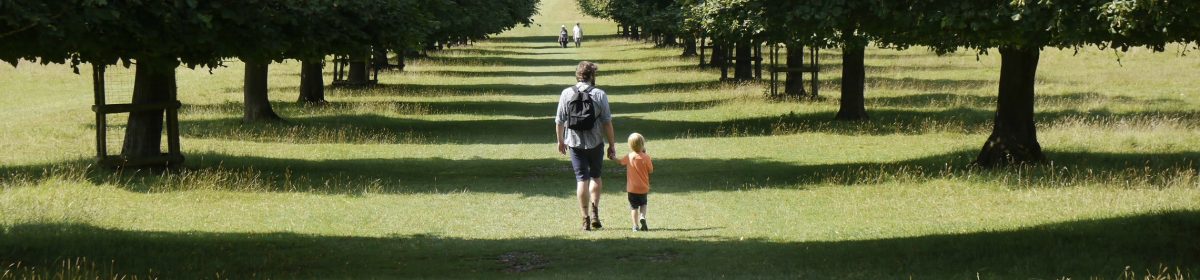
A lovely day at Dyrham Park with the Grandchildren and their mum. We’ve pretty much got used to the absence of the deer since it was culled due to so many animals being infected with TB. But the knock on effect of their absence is obvious when you compare the photo in the header with the one below. Firstly, of course we notice the much more ragged look of the avenue of Lime trees today. The header shows how closely cropped the lower branches used to be, and the avenue had a formal, clipped quality that led the eye forward. Elsewhere, the change in grazing has allowed the coarser grasses to take over because, sadly, mowing cannot replicate grazing as a means of improving grassland diversity. Let’s be fair, if you know where to look the variety of grass species is (so far) about the same but it’s consigned to smaller areas.

July 2019

Today the two figures are the mothers of the figures in the header – Madame on the left and our lovely daughter in law on the right. But there’s good news too. It’s been hard to get any official information about the return of the deer herd; but today we discovered – by talking to a couple of friendly volunteers – that there are plans to restore the herd some time next year. We’d noticed that there’s been a continuing programme of installing high fences around the park. In our helpful conversation we discovered that the fencing is not so much about keeping the Dyrham Park deer in but keeping the wild (possibly infected) deer out. The badgers in the park have all been trapped vaccinated and released, and soon – we know not when – a new herd will be brought in. Hooray!

Common grasshopper

For today our grandkids hunted grasshoppers, spotted buzzards and we were able to talk to them about wildlife.

Back home we’re up to our necks in produce; processing tomatoes for the winter, for instance. I’m completely knackered!

A dangerous music

Taken on Cap Corse in 2010

We were watching Stanley Tucci’s cookery series on TV last night and at the very end of his visit to Sardinia and after sharing a rather grisly starter of cooked sheep’s blood and mint with a group of shepherds they barbecued the lamb- basted with the bitter honey of the Strawberry Tree – and began singing the traditional shepherd songs of the island. We’d heard that sound before on Corsica; every bit as lovely in its rather chilling way. It’s called polyphonic music; a highly textured interweaving of voices. This kind of music appears all over the world in different registers between high culture and folk song- we were in Barcelona some years ago and next door to the Museum of Contemporary Art there was a sound installation where the forty parts of Tallis’ motet Spem in alium were each given a loudspeaker, the whole arranged on stands in a circle which we were free to move inside. We were transfixed with tearful joy. At a less exalted level, there are many traditions of circle singing around the world; some, but by no means all, associated with Psalms. What these traditions all share is the complex interweaving of a single phrase being sung in something like a round by singers following different intervals.

Shepherd music, though, is less associated with loosely organised religion than it is with various forms of independence struggle. We were on Corsica on Bastille Day, for instance and not a single firework was let off. Most Corsicans don’t give a toss for the French government. Similar song forms exist in Finnish and – closer to my heart – in Wales.

But this isn’t going to be a technical discussion. The point of it, for me, is that polyphonic song is powerfully spiritual, visceral in its intensity. One of the things the lower voices do in Sardinia seems to be very similar to Tibetan throat singing; the bass sings a very rich fundamental along with its harmonics. Even the single note at the bottom would be incredibly difficult for most singers to reach; but to allow the overtones and harmonics to develop around it takes the song to a different level.

I often talk about the absolute necessity of shared community values if we are to flourish, because the whole purpose of this blog is to find ways of being fully human while living in a culture that strips us of any vestige of humanity if we aren’t careful. Singing, we are encouraged to believe from infancy onwards, is (like art) a difficult and rare skill that few of us possess – which is a pernicious lie because it cuts us off from a turbo charged source of spiritual food. Look at a shepherd choir, a folk band, a string quartet, a circle of singers and watch them as they watch each other while they make music. There’s a wild and passionate engagement with one another as we make music, which breaks down the barriers between us and allows us to experience our own wholeness in, and with others. As I often said in my old day job; “if they knew what was going on here they’d tax it or ban it altogether”. When you join music with a shared culture, a shared memory or aspiration then it takes on a scary power.

What’s the first thing a colonial power does to subdue a culture? It takes away its language, its shared memories, its art, its poetry and its songs – and so singing, remembering and celebrating become a countercultural act. I’ve never forgotten a retreat I went on at Emmaus House in Clifton. There we were, a bunch of complete strangers, and we were invited to take both hands of the person next to us and behold them. You simply wouldn’t believe what a deep experience that was because it involved a profound letting go of boundaries. Singing does that too, but on steroids!

But I wouldn’t want to forget that these humanising experiences are additive. Add singing to a shared meal, a bit of drama, (carrying in the haggis, beating saucepans around an apple tree, a bawdy mummer’s play – you get the picture) and invisible threads are woven like cat’s cradles around the participants. So in answer to the question –how can I feel more alive? more human? get down off your solitary dung heap, stop crowing like a preacher, get your head out of your arse, lose all those inhibitions, eat your dinner together and sing as if your life depended on it – because it does!

Step away from the bonfire George!

An unknown apple in a collection of Welsh apples in Cwmdu last autumn.

I was casting around my collection of photos for the image of an apple suitable for a short piece on sin and the avoidance thereof, and then this cracker came along and I thought “That’s it!”. If you wanted an illustration for a little excursus on Girolamo Savonarola the last thing you need is an illustration that inflames the passions of the ordinary sinner like me. You’d need a manifestly ugly and dangerous looking specimen as seen through the eyes of – lets say – Savonarola; you’d need something like this. Seen through the lenses of his rheumy eye, this is what a cow looks like to George Monbiot whose latest pronouncement from the pulpit condemns regenerative farming as “Climate change denial” and urges that we bend every sinew (a questionable image, I know) to replace meat with some kind of fermented gloop, provided by the fast food industry by way of the very suspicious ultra processed food path, known to most of us as the royal road to diabetes and early death.

Savonarola, who was a gift to the Gucci handbag manufacturers of the day, persuaded the rich of Florence to burn all their luxury goods in what became known as the “bonfire of the vanities” four years later he was the one on the bonfire, and the members of the guild of luxury goods became even richer as they replaced the vanities so eagerly despatched to the flames. My fear is that George Monbiot’s fervour for heading off climate disaster has tripped into a kind of fundamentalist mindset where all means are justifiable if the end is (in his view) correct.

It seems to me to be obvious that the only people to genuinely benefit from these industrial foods are the producers of the feedstocks, the supermarkets and the PR industry who will need to spend billions persuading us that processed fungus with added bacteria is absolutely the thing. “Look” they say, “It even bleeds.”

You don’t need to be a vegetarian or a vegan to be utterly opposed to the deliberately caused suffering of farm animals. You don’t need, either, to be a halfwit to know that there is a strong connection between soil fertility, ecological diversity, food security and human health. These either/or arguments are cheap and easy but they’re still an extension of the old colonial attitude that would consign millions of the poorest pastoralists to unending poverty. Yes, industrial gloop might save the earth for the left behind in the west, but for poor farmers in India and Africa it would be a slow descent into starvation. The rich would, of course carry on eating foie gras and wagyu beef and driving their SUV’s. Michael Pollan’s advice – “eat food, not too much, mostly vegetables” is both sensible and achievable.

Yes we need to take immediate action to curb methane and CO2 emissions and to bring carbon back into the soil where it can be stored safely; and yes there are ways of doing this well short of the bonfire of the vanities; evidence based ways of reducing the impact of intensive cattle farming on the earth’s atmosphere, and yes it will require cultural change. But waiting for the Seventh Cavalry to come over the hill and save us all with some kind of ram stamped iron pump is an essentially religious assertion. And I’m just not that religious!

I’m not suggesting that regenerative farming will save the earth, but what it could do is form one component of a strategy for carbon storage and – ultimately – reduction, using less oil, less chemicals, less intensive production of effluent with nowhere except rivers to go. Using prodigious amounts of energy to store carbon is no better than an industrial wet dream afflicting those industries who hope to supply that energy. There’s only one way to reduce carbon and methane release into the atmosphere and that’s by releasing less of both – is that so complicated? The a priori rejection of regenerative farming that Father George is suggesting seems to indicate that there’s no point in arguing with him because he’s always right. That’s bad science, bad journalism and downright daft tactically. Short of a Robespierre style reign of terror casting farmers as terrorists, dispossessing them of their land and handing the land over to the oil companies to balance their carbon budgets by planting tree deserts so they can supply the energy to ferment human waste and turn it into cordon bleu toothpaste tubes of delight.

This is simply not a credible strategy but a Tory style culture war. I’m sad to see a previously solid green activist fall into this trap.

What a difference a day makes!

This view through the campervan door on consecutive days is a perfect cameo of Welsh weather. The patch of grass that’s visible on the right hand photo is just out of frame on the left. If you’re lucky you can make out the ridge of Talybont forest on the left whereas it’s clear on the right.

The campsite we stayed on is a place we’ve used several times. Right next to the canal it’s only a short distance to a place where we can easily launch the kayak, and we’re far from alone in seeing this as a perfect place for energetic walks and even more energetic bike routes over the hills on the Taff Trail. All day long the supremely fit come bowling into the campsite with their Volkswagen T5’s magnificent legs and haggard faces looking for all the world like sturdier versions of the crack smokers on the green outside the flat in Bath. I’ll get to them later.

Notwithstanding the physical challenges available, there’s also an awful lot of wildlife to be seen, although how you would get to experience any of it from the saddle of a bike is debatable. Ironically we saw more wildlife than we ever expected by just sitting still on the grass outside the van. There was a field mouse who took an hour to make his mind up and then shuttled back and forth collecting the crumbs we’d thrown down. He was sleek and almost chestnut in colour, quite beautiful. There were the two hedgehogs in the dusk and innumerable birds; sparrows, dunnocks, blackbirds, an amazing kingfisher bursting out of the hedge, buzzards, robins, wrens, blue tits, coal tits and woodpigeons – all seen without moving a step from the van. I was racking my brains to remember this line from W.H. Davies:

WHAT is this life if, full of care,
We have no time to stand and stare?—

W.H. Davies “Leisure”

It’s a bit corny, but then I remembered its uncanny echo of Milton’s Sonnet 19 on his blindness “When I consider how my light is spent”, that ends –“They also serve who only stand and wait.” – there’s a real spiritual point to standing still and waiting, that challenges our cultural obsession with success, hard work, achievement.

So we’d run out of milk when we got home and I wandered down to the supermarket to get some. Sadly, since the fire at Green Park Station, the milk vending machine has been disconnected. As I walked back in the sunshine a loud argument was being conducted across me on the street. “I’m effing desperate, I am” screamed a woman at the obviously sick man who was just in front of me. She was forging on, head down in that characteristic junkie walk. He shouted back – “It’s just here at the end of the block”. I knew in a second that they were off to meet one of the several dealers who work this area and use the corner as a rendezvous point. Sure enough as I followed them to the end of the road they were there, with a mobile standing on the corner; she was still shouting needlessly into the receiver. Then two, three and four people turned up to join the queue. They have the hunted look of those who have been shriven by their lives, bent over like the trees on the ridge of Freezing Hill, parchment skinned, incoherent bog burials.

The deal was a messy affair in several acts. She borrowed some crack from someone in the queue and stormed over to the privacy of the bushes at the edge of the green where she shared a pipe with her benefactor and walked back miraculously calmed. Arguments broke out – there was shouting and swearing until the dealer cycled up and then for ten minutes noisy negotiations broke out. People stormed off and returned chastened; shouting, more shouting, a big man was throwing haymakers at an invisible enemy. There were dangerous looking dogs barking. Eventually she got her drugs and sat calmly in full view, injecting into her neck. She wandered off again into the woods and returned with a bicycle. It was sad; so appallingly sad, to see these ruined lives.

Blaming the victim is always cheaper

Where do you even begin to find a way through this mess? There’s a strong association with mental illness, homelessness and alcohol – any or all of which could be tackled if we chose to resource it, but blaming the victim is always cheaper. In a world without the prospect of employment, drug dealing looks like a rational choice where the most successful and profitable business are centred on greed and entirely disregard the consequences. The street is a dangerous place so getting a dangerous dog is a rational response once again. I was having a conversation with a financial advisor recently and he told me that if you’re simply interested in making money and don’t give a hoot for ethical investments, then oil and weapons are the star performers. The tanks, guns and landmines are just flying off the shelves. The same old saw comes back every time – “We have seen the enemy, it is us”.

And then I remember A F Woodman who was the music teacher who introduced me and so many others to music – the “brandy of the damned” – according to George Bernard Shaw; and I remember him shouting at me “I know you can hear it, Pole – but are you listening?”

I’m listening!

A Day Lily in our container garden outside the flat

The taste of magic in the Bannau Brycheiniog

Pen y Fan hiding in clouds from the Monmouth and Brecon canal on an icy February morning in 2017

Just out of interest, Bannau Brycheiniog translates as Brychan’s Kingdom; Brychan being the fifth century king of this mountainous area. I’ve written frequently about this place because I love it to the core of my being. It’s a National Park but by no means a huge one; near to the Eastern border with England, more or less defined by the River Severn; a contested border which includes the Welsh Marches and Offa’s Dyke. A wayward and wandering line that’s been fought over for centuries as armies marched back and forth from Roman times onwards in search of gold and latterly for slate and coal, but whatever the quarry, the spoils were taken out of Wales and only the spoil heaps were left. The reversion to Welsh place names is one more skirmish between the Welsh and the colonisers; less spectacular than the burning of holiday cottages but no less fiercely fought for.

But we’re not here to pursue old rivalries. We’re here at the foot of the Bannau to rest and recuperate from hard work on the allotment and to adjust to a change in medication that’s left me feeling as if I’m recovering from the Flu. We have close friends who now live about 1000 feet up in the hills above Llangorse lake and we’ve been coming to this area for more than 30 years and watched as they worked a smallholding while working full time, and improving the cottage from an abandoned bothy to a family home.

So yesterday we lazed in the sun and then in the evening we went with our friends over to to the Three Horseshoes in Groesffordd for a meal and a couple of pints of a local light beer. Needless to say we had a brilliant evening because our interests overlap almost completely and predictably we talked about growing food, keeping animals, the relative merits of lamb (3/10) hogget (7/10) and mutton (10/10). We talked about beer and vegetables and favourite recipes and families and we all reassured ourselves that we hadn’t changed a bit in decades and laughed as if we would all live forever. We took one of the outdoor sheds with a spectacular view between the roofs of the village, across the valley to Pen y fan. The food was excellent and almost too unusual for pub food, we left with a couple of good recipe ideas and feeling that the expense of eating out was justified. The Three Horseshoes, predictably next door to a long closed smithy makes a good living in the most inaccessible spot, hidden deep in the middle of the village where it’s almost impossible to park. We chatted to the owner and he said it was because of their good reputation – and he was right. A delightful and affable landlord who thinks enough of his chefs to name them on the website.

We arrived home (at the campervan) as it was getting dark and sat outside watching the stars come out and listening to the evening sounds. To our great joy there was a wheezy snuffling and a couple of hedgehogs appeared, paused to take a look at us and shuffled off into the hedge again. We haven’t seen hedgehogs for something like 10 years. Way across there were tawny owls and all the usual roosting birds. It felt as if the thin thread holding us down to time and place, had broken and we were wandering in a more ancient time which came with all its literary associations.

Firstly, of course, Buckland Hill which is just down the road will be known to any lover of Tolkien who stayed here at Buckland whilst he was writing Lord of the Rings. We’ve walked miles of Offa’s Dyke, and I’ve loved Geoffrey Hill’s “Mercian Hymns “ set in the time of King Offa and which gets less difficult as I get older and feel the music rather than concentrate on the words. Madame has just finished reading A J Cronin’s “The Citadel” which is partly set just across the hills in the mining valleys. And then on an impulse I dug Bruce Chatwin’s book “On the Black Hill” out of the Kindle Library this morning. This has been one of my must-reads for decades, and I’ve actually got two paperback copies at home. Each of the three I’ve bought while we were up here and never got past about chapter three for the oddest reason. There’s a real “Vision Farm” below Offa’s Dyke facing Capel y Ffin and we once had a long and hard walk up Hatterall Hill, along the dyke and down past The Vision (you’ll need to take a map and a GPS to find the track down) and after crossing the Honddu river, back up past the ruins of the church built by Joseph Lyne, Father Ignatius, back along the opposite ridge and then dropping down the steep path turning left at a hawthorn tree, to Llanthony Abbey.

But I mentioned the fact that I’d always abandoned “On the Black Hill” after a couple of chapters, for an odd reason. It’s simply that the writing is so rich I never want to move on with the narrative, and so each page is an object of meditation. I finish the first couple of chapters and it’s if I’ve eaten a huge banquet and don’t want or need to eat for a week. Obviously this is a bit disruptive to the narrative flow. Cheap fiction does the exact opposite, using a narrative torrent to hurry you across the ludicrous improbabilities of the characterisation. Give me Bruce Chatwin any day, but I’d love to have the stamina to finish it.

One of my parishioners had a Welsh farmer as a distant relative, and she told me that this irascible man had married in a local church, started to drive his bride to the new marital home in the pony and trap . Somehow, on the way they’d had a fierce quarrel and she had got down from the trap and walked back to where she came from, leaving the bridegroom for good. A very Chatwin-esque yarn. I wonder if he’d heard that story independently?