

Well, we’re not exactly expecting anyone to break down the doors but every time we walk back to the flat we look up and see the daylight lamps blazing away over the propagators we think it should at least raise a tiny bit of interest. In any case I’m longing to invite a suspicious officer into the flat to check us out, with – “Sorry mate – Madame’s maxed out on the basil today and she can’t really speak at the moment, but do come in for a cup of green tea and a flapjack“.
We love our propagators. They take a bit of getting used to but once you’ve got the hang of it even so-called difficult subjects become a lot easier. The first year I sowed chillies I faffed about so much with the temperatures that the only seeds that germinated at all were the Hungarian Hot Wax. The second year went much better, but we discovered that far from being terribly delicate, the old monsters – well at least the Hot Wax and Jalapeno actually preferred it in a sheltered spot outside on the allotment. Only the hottest ones needed protection. They also resented overcrowding – so if you’re struggling with hot chillies try giving them more space. We also went from ordinary seed compost to composted coir, but we’ve decided that for all its green credentials it’s better to make a home made mix of compost, soil and vermiculite rather than pure coir. One more thing worth trying is to get them germinated and then turn the heat down a bit. Ours germinate well at 25C but once they’re looking healthy we’ll turn the heat down but still give them lots of light – about 12 hours. I’m sure there are dozens of experts out there who know better but this year we’ve had 100% germination of the chillies. ‘Don’t worry’ seems to be the order of the day.
But we’ve also had two dry days and so at last I made a start with moving the water butts to a new and much higher position alongside the shed. There’s room for three 250 litre butts, but when they’re full they’ll weigh 750 Kg and so the stand needs to be really – no really strong. The maths is easy – one litre weighs a kilogramme. I like that kind of unit. But I don’t like the proliferation of standards that makes joining the water butts together into a nightmare. When Britain ruled the world we just made up a standard, announced it to the world and expected everyone else to comply – and if they didn’t we sent a gunboat up the high street. So in what ought to be the simple issue of things like nuts, bolts and pipe fittings there are always two standards – one for the heritage lovers, let’s say British Standard Pipe fittings – doesn’t that sound grand – and another for the rest of the slightly more intelligent world. But marooned on this delusional island as we are, it becomes necessary to learn three standards for almost every fitting except those you can hit, and there is a flourishing but incomprehensible market in adaptors which sit like translating apps between a threaded hole and a pipe.
Why bother? you might wonder. Well it’s because standard water butt taps turn a big – 25mm outlet into a very small one – about 1/3 the diameter which, when you’re filling a watering can or trying to feed a soaker hose turns a generous flow into something with prostate problems. So my idea is to replace the cheap plastic taps with much more expensive 25mm all-the-way-to-the-pipe taps, and join all the butts together with fancy blue pipe so I can fill a watering can before it gets dark.
The carpentry bit went smoothly and I was able to build the platform without any outlay, just using timber left over from other projects on the allotment. I baled out the first butt and moved it on to the stand but my first attempt to fit a new bung failed miserably. Like all good gardeners I carry a vernier in my toolbox – no really – and the replacement seems to be just under 1mm bigger in diameter than the original, although they’re both supposed to be 3/4 BSP. Is this, I wonder, because these mains pressure components are meant to be what we experts call “a bash fit”? Who knows? But as a precautionary measure I’ve ordered a different manufacturer’s so-called ‘compatible’ component which I’ll try tomorrow. The take-home lesson for today is the one that all plumbers understand and cost into their quotations, namely nothing ever fits first time and endless waiting at the stores counter is just part of life’s rich tapestry.
The fates never smile across the whole of the Potwell Inn at once, and I’ll settle for 100% germination even if the payback is a lot of fiddling around with pipes – at least the sun shone and the birds sang and Madame sowed the first parsnips – which will probably take until midsummer to germinate. In a tiny vignette from our charmed existence at the Inn, we were sitting companionably on the sofa watching something tedious on the idiots’ lantern and I turned to Madame and said – “you smell nice”. “Oh” she said – “you smell sweaty”. Hm.


 Happily all was well in the tomato department but while Madame was picking some peas she found that the Pea Moth was cranking into gear – that’s why getting them sown and picked as early as possible is always a good idea.
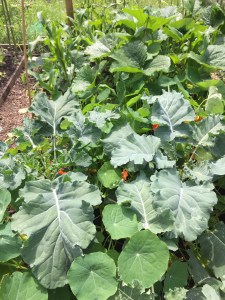 The only way to mitigate our water use is to increase the water capacity of the soil by increasing the amount of organic matter and making use of mulches to reduce surface evaporation. It’s clear from our experiments with mixed plantings, that covering the ground completely (courgettes, for instance under sweetcorn) lashings of leafmould and so-on really increase the moisture holding capacity. The Potwell Inn allotment needs most watering on the areas where the soil is exposed – it’s obvious really. Another approach – one which I’m sure the seed merchants will soon be all over – is to develop drought resistant varieties, but we could also start to develop extremely locally adapted plants through seed saving.

 Our allotment site is served by cattle troughs which are turned off in October and on again in April. That, of course, means that there’s a period – especially in early spring – where everyone is sowing and nurturing young plants, but there’s no water supply unless you’ve got some storage. For several days we’ve seen allotmenteers wandering around the site, watering cans in hand, looking for an inch of water at the bottom of a trough. I’ve never been so glad that we installed some storage last winter, and so at the beginning of spring we had 1000 litres of rainwater in the butts. We’ve moved into a period of high atmospheric pressure without any rain just at the time when the growing plants need it most. You wouldn’t believe the pleasure that turning a tap and filling a can can bring. This wasn’t so much for watering, the earth is hardly parched at this time of year and it’s only the plants under cover that need it. Yesterday I wanted to spray the growing plants with dilute seaweed foliar feed. Applying it to the leaves does seem to work but it involves getting out the big sprayer which, being bright yellow, is liable to send out misleading signals to other organic gardeners. On the other hand, allowing people to imagine you’re using all manner of toxic chemicals might discourage them from grazing.
 But there was no basil yet. We’ve got a succession growing well in pots, and just as an experiment I took one of the two varieties and stuck a pot in the propagator with the young chillies. Here’s a side-by-side of the difference between the two pots. It can’t be temperature making all the difference because the kitchen stays at a steady 20C, and that’s the setting in the propagator. So it must be mainly down to the overhead UV light.