Dig for Victory – seriously!

Granny aged around 19 – working on the farm in Winterbourne during the war

Madame has sorted through her vast collection of family photos and found a picture we both remembered. Somewhere – in our memory at least – there was a picture of her mother in full Land Army gear, holding a bull (she would undoubtedly have cracked a joke or two about his considerable gifts). And here she is, and judging by her polished shoes it’s a special occasion; perhaps a show.

What brought this to mind – as always – was the merging of several tributaries of thought during the day. It’s hardly surprising that one of them was the publication of the latest IPCC report on climate change which, judging by the summaries, is every bit as scary as we anticipated. A second thread related to fashion which, if our daughter in law is anything to go by, is going full retro in headscarf and dungarees. The final tributary was steamy windows, and I’ll get to that in a bit.

Here in the UK it’s National Allotments Week – we almost made it on to the telly but our chance of fame was scuppered when the producer found an allotmenteer closer to the studios. But the demand for allotments is huge, and many of the new allotmenteers are young; relatively inexperienced and full of ideas. It’s brilliant and I couldn’t be more pleased. The biggest problem is that twenty years ago it looked as if the movement was on its last legs. Local authorities – always strapped for cash – started to sell them off. At the time it looked like a good idea – we always need new houses. But now we not only need them all back – not a chance! – we need many more. The IPCC report really sharpens the need to move rapidly towards local and sustainable food chains and allotments could form a part of this while offering cheaper, healthier and vastly more vitamin rich food plus building closer relationships with the natural world. I’ve written before that this seems like an ideal time for local authorities to explore the possibility of leasing land from local farmers and landowners so that we can move towards the food system that sustained major cities in the past. Just to read about the productivity of 19th century Parisian market gardens makes your eyes water. It was all based on the ready availability of horse manure at the time; but now in the 21st century we have a chance to explore some of the new (mostly rediscovered) techniques like mob grazing to drive up productivity on allotments and smallholdings without resorting to chemicals.

The huge interest in allotments and the straws in the wind hinted at by changing fashions suggests that this is a cultural change that’s already under way. Well run allotments are six to eight times more productive than farms – that’s a fact; and the savings in food miles plus the gains in engagement with nature and healthy (hard) exercise make this a no brainer.

The Land Army connection came through thinking how the “Dig for Victory” wartime campaign captured the hearts of millions of new gardeners and helped us to survive the depredations of wartime rationing. If you asked my Mother in Law whether she enjoyed herself in the Land Army she would have answered with an unequivocal yes and then told a few risque stories about the goings on when work was finished.

As for steamy windows, well today the forecast was for rain early, clearing mid morning. We waited until just before midday and went up to harvest tomatoes from the polytunnel and do some urgent weeding. Madame had the inside job and I was sorting the noxious weeds from the goodies; the weeds to go in the direction of wailing and gnashing of teeth (autumn bonfire) and the beneficent to the warmth and comfort of the compost bins as the virtuous end to a virtuous life.

It rained – as they say – biblically and I felt it penetrate the Barbour, the woollen shirt and finally the T shirt until I was wet to the skin. In fact the only part of me that was dry was my socks. My bib and brace overall was so wet, the legs reflected the iron grey skies above, and my oilskin hat dripped water down my face as I worked. Ironically it was rather lovely out there in the elements; refusing to be daunted by a bit of weather.

Several hours later we were home and surrounded by drying waterproofs and clothes – such that the windows steamed up in a way that was deeply reminiscent of my childhood. The floor and table were heaped with tomatoes and other vegetables awaiting the preserving pan. The flat was full of cooking smells; aubergine, tomato, onion and garlic and today there were middle eastern spices – cumin, cinnamon, nutmeg and pimenton. It was one of those afternoons when the past and the future seemed to fill the present with memories and plans. A flow moment gathered and I thought – “We can do it!” We can repay the generosity of the earth and begin to repair the damage without the sacrifice of any of the things that really matter.

The IPCC report is bound to make millions of us ask ourselves – “what can we do?” The powerful corporations and their politicians may well try to keep us fearful so they can steer us in the direction of more and more profitable technological fixes; but if this really is a paradigm shift, and I think it is, then however bumpy the ride gets the change will happen. I was reading a speech by Gary Snyder a couple of days ago and he was talking about the wisdom passed on by grandparents. But he extended the thought by saying that these days and for many young people, the libraries are our grandparents.

Did I mention the other day – that the ancient Greek view was that we can’t possibly see into the future – but we can walk confidently into it because we can see what worked in the past – before the damage began – with 20:20 vision. Researched and field tested across the whole earth and passed on by grandparents, and in libraries.

Whereof one cannot speak, thereof one must be silent.

Well yes, Captain Kipper (OK actually Ludwig Wittgenstein) – but what if there’s something you’re trying to articulate that’s so liminal, so at the boundary of a concept, yet to be properly mastered, that words and their meanings need to be forged anew? Surely that’s the work of the poet? and can’t be shirked in favour of silence. Language is endlessly adaptive; always finding ways to speak the previously unsaid, and one of those ideas that’s slowly being forged into speech is the curious relationship we have with nature.

We arrived back from our family get-together in Cornwall and went straight to the allotment, as you might expect. Then we prowled around to see the state of things; set up the trail camera and made plans for today – and today it rained; so we put on our waterproofs and got on with picking out the courgettes that had swollen to blimp size during the week; harvesting tomatoes, aubergines, runner (pole) beans, potatoes, peppers, summer squashes and masses of herbs. As you will know there are only two of us so this season of plenty has to be matched with a positive frenzy of pickling, preserving, boiling, reducing, freezing and fermenting. It’s been a crazy weather year and right now with the jetstream moored south of the UK we’re stuck in a series of lows, bringing cold winds and rain in off the Atlantic – it feels like autumn already.

So today we got wet and yet we both felt completely content just to be there. After finishing harvesting, Madame got on with summer pruning the fruit trees while I wheelbarrowed down enough woodchip to level the path in the polytunnel. There’s a reason for this because our plan is to clear the tunnel completely by the end of August and then we’ll need easy access with a wheelbarrow to bring compost in to feed the beds ready for the winter crops. Later in the kitchen I made stock and prepped a dozen half litre jars ready for tomorrow’s new batch of roasted tomato passata while Madame prepared to cook a bulk batch of ratatouille which freezes very well. All the while I was making sourdough bread and attending to the starters after their week in the fridge.

Perhaps one reason for the rather philosophical opening paragraph was some marvellous video footage of our friend the badger failing to find the sweetcorn beyond two layers of soft net and a maginot line of tagetes and mint – which we make portable by growing it in pots. Badgers hunt by smell and we aim to confuse them as much as possible. The three sisters experiment is exceeding our expectations and we have corn ten feet tall with borlotti plants climbing to the very top, whilst below some fat winter squashes are developing nicely in the shade. It looks a mess but it also looks like a success. The only predator likely to get to them before us is the badger; but since we invested in the trail cam we’ve grown to love the nocturnal intruders. We want to deter them of course but we wish them – with the foxes, squirrels, magpies and even the rats – no harm and the reason for that is that we have begun to see them as having their own inalienable rights over the land. The thought that they’re out prowling during the night gives us as much pleasure as the sound of a tawny owl calling does. We share their taste for the vegetables we grow, but perhaps value them more in their appetite for the slugs, snails and rodents that trouble us. The old binary division between crop and pest is dissolving and it’s that disappearance which demands a new language. The actors haven’t changed at all – badgers love corn and that’s unavoidable. What’s changed is that we are beginning to accept that if we want to save the earth; all those binary distinctions will have to be overcome through an unprecedented change in the way we understand, and therefore speak of our place in nature .

Wheelbarrowing woodchip with the rain running down our necks; stacking the compost heap with a mixture of green waste and wood chip and feeling its rising heat the next day; summer pruning, rooting strawberry runners and sowing chard for the autumn is done not though the domination of nature with powerful tools and chemicals but by attempting to think like a fox or a badger or – more oddly still – to think like a compost heap, or like the earth in a raised bed. It demands that we learn to think like a tomato or a potato; to ask what ails you? as we did today when we were examining what might have been tomato blight but turned out to be (in all probability) didymella stem rot, caused by stress – in turn caused by a poor watering regime. Failure often brings knowledge. Yes we talk to our plants; but more mysteriously – and only when we listen with complete attention – they speak to us in a language we have barely begun to understand, and which stands on its head, centuries of binary thinking through which we believe ourselves to be independent, separate subjects moving through a sea of resource objects. In this new state of being we are (imperfectly) in what Gary Snyder described thirty years ago as a “trans species erotic relationship” with nature; which sounds clumsier today than it did when it was written – but the word erotic captures the sense that this relationship transcends the instrumentality of the old ways and enables powerful feelings for nature which offer a pathway out of imminent destruction. Talking to the trees – it turns out – is a two way conversation as long as we are willing to get over ourselves and listen.

News from La La land

To be honest, the last several days of silence on the blog are best accounted for by the feeling that I might be inhabiting a parallel dystopian universe where words have ceased to have any meaning at all – or at any rate they can mean anything you want them to mean. Even a simple blog like this one, about being human; growing things; cooking them; sharing them and struggling to find the Tao – has to use the selfsame words that make up the lies and distortions promoted by politicians and the dark money that keeps them in luxury. So in order to harness a simple idea like freedom, I need to pick the word up with a long stick and boil it in bleach for a couple of hours just to get the contamination off.

I don’t want to go on too much but when Bayer promote their new form of Roundup as being “glyphosate free” – they seem rather coy about admitting that the principal active ingredient is now vinegar, which you can buy at a fraction of the price at your local supermarket and, like its carcinogenic namesake, doesn’t kill pernicious perennial weeds either. Just for the record there is no evidence that the Potwell Inn tomatoes have any trace whatever of kryptonite and they are 100% natural. As it happens, most deadly nightshade berries are 100% natural and organic so that’s nice. “There is no evidence” is a favourite weapon of the lobbyists who spend billions making sure that the gathering of any evidence (especially the damaging kind) is discouraged.

This week the sun has, at last, started to shine again and through the wonders of AI my phone has started to taunt me with photographs of previous adventures in Europe (remember that?). So as we toted watering cans around the allotment my mind was driving down to southeast France where farmers seem to down tools in July and spend the next two months getting drunk and chasing bulls around the streets. I was so overwhelmed by memories of our visits to Uzès that I felt compelled to go out and buy a Panama hat, shake the moths out of my linen suit and drag Madame on a five mike walk around Bath pretending to be tourists. I’ve always resisted the Panama but as I approach 75 I think I’ve earned the right to be as silly as I like; and so I’ve shaved my designer stubble off and I’m growing my hair back until I can’t stand it any more. Sadly my attempt to provoke the neighbours on the allotment resulted in a single response – “you look very summery today”.

As we sweated it out with the watering yesterday morning, I realized that growing even a small proportion of our food demands a great deal of commitment. When we watch celebrity gardeners on TV, gliding effortlessly between rows of designer veg it doesn’t really convey the backache that hand weeding gives us (it works better than overpriced vinegar by the way), and it misses out the hours we spend constructing and dismantling windbreaks; clearing snow, digging emergency drains, turning compost and humping things like planks and paving stones around. The TV pundits never mention their failed crops and the incredible surpluses that courgette plants produce every year. Neither do they explain how they manage their impressive gardens without small armies of unpaid interns and helpers. I’ve tried telling the allotment that I’d like a couple of weeks off (I mean for a rest, not for making a new TV series) but it appears not to understand. Far from being a kind of restful interlude, it’s this time of year that harvesting and freezing soft fruit takes over, while the abundance of other crops means I’m constantly wondering what can be preserved and what needs to be cooked right now. The upside, of course, is that we can eat the freshest conceivable vegetables, bursting with flavour and goodness – no I mean really bursting – not the kind of PR bursting with flavour that refers to flaccid and exhausted, intensively grown lettuces driven a thousand miles from their impoverished lives under plastic.

As the photo shows we’ve also started harvesting the calendula flowers and drying them in the sun before extracting a golden essence from them in almond oil. Calendula cream really works and it’s so easy to make it’s plain daft to spend a fortune on tiny tubes of the stuff.

The trail cam has been a blessing, and we’re getting a much better idea of our many visitors, including a couple of different foxes, rats, magpies and a ginger cat who turns out to be a lethal predator of birds. I’ll put some shots up as soon as I’ve found a video editing application that allows me to do simple things without being inundated with ads. One of the unexpected outcomes of our move towards wildlife friendly gardening has been a loss of control – which has turned out to be a blessing rather than a curse. The wild plants and animals can’t be divided any more into friends and foes. We’re trying to leave things alone when unexpected volunteers pop up; so the carefully planned crops sometimes have to share their space with an interesting looking “weed”.

Some of the night shots from the trail cam show the presence of hundreds of small moths which it would be fun to identify, except it would be difficult to install a light trap that didn’t draw attention to itself – making it vulnerable to theft. We solved the problem with the trail cam by mounting it inside a padlocked steel box, and although it’s set almost at ground level we can often identify the human visitors to the allotment from their shoes!

Anyways here’s a short video of one visitor you’ll certainly recognise!

The glory (as well as the devil) – is in the detail

Sorry to use the same photo twice, but as I was making our second batch of elderflower cordial last night I was having a think about the way our prior understanding frames our perception of nature. The tree from which we harvested all our elderflowers this week, is an ornamental cultivar – that’s to say it’s got an extra name; not just Sambucus nigra but Sambucus Nigra “Guincho Purple”; which makes it – let’s be frank – not wild. Strangely in some circles the appellation “wild” confers an extra patina of grace. The tree is extraordinarily beautiful; so much so that one day when I was up at the allotment working I came across a fashion photographer plus assistants surrounding a model clad in the most expensive clothes including a purple leather coat that exactly reflected the colour of the flowers. As I passed the team of a dozen or so people, they parted to let me through and someone asked me in a faintly imperious (lord of the manor to peasant) tone, whether there were any lavatories on the allotments. “No” – I said – but offered the loan of a bucket if the need should be urgent. My offer was not taken up.

So – wild being necessarily good; does the fact that we picked our elderflowers from this effete suburban tree make the resulting cordial taste less authentic? Don’t be silly – it tastes every bit as good and looks superb in sparkling water and I’m planning to make an exotic dessert using the cordial, some prosecco and a couple of leaves of gelatine.

“Wild” and “cultivated” have become a bit of a battleground recently. Wild salmon, for instance, might well be wild in one sense, but if they’re unsustainably fished by industrial trawlers they might not be such a good thing. Almost every vegetable we grow is a cultivar of some sort; carefully cross bred to achieve a particular style of plant. Brussels sprouts for instance have had much of their traditional bitterness bred out of them. But there is one sense in which the closer a vegetable is to its origin, the more robust it’s likely to be. Robust, but not necessarily high yielding. The devil is always in the detail.

I once worked in a satellite radio station back in the wild west days, and over the mixing desk was a large notice saying – “In the event of equipment failure please RTFM”. I asked one of the technical people what it meant and he responded (I’ll paraphrase) -“Read the manual”. I guess it’s our ultimate responsibility to pay attention to the details and make a decision based on the fullest possible information. My much missed friend Don Streatfield always refused to label his honey as “organic” on the grounds that bees foraged wide and far and there was no way you could guarantee that they hadn’t been feeding on chemically treated flowers. The price premium – for him – didn’t justify a barefaced lie.

If I were to describe our elderflower cordial as ‘natural’ I’d be wondering if beet sugar – which I used because I couldn’t find any cane sugar – is as ‘natural as any other. Beet sugar is, after all, produced here but cane sugar has to be shipped around the world. It’s no wonder we throw up our hands and take the easiest course of action.

The glorious aspect of detail comes from a different perspective. Sitting on my desk is a small microscope and pretty well wherever I go I take a hand lens. Passing a very ordinary looking weed and stopping to look more closely often reveals a wonderland of unseen insects and inner structures of breathtaking complexity and beauty. Close attention to details – and especially in reading, close attention to the text – is a marvellous way of getting to know things we don’t understand. Who’d have thought, for instance, that growing wildflowers and digging a pond on the allotment would introduce a whole range of pests I’ve never seen before. In the photograph is the grub of an iris sawfly. We never had any such thing until we dug the pond and planted irises around the edge and now we do. We left them there, of course, because hopefully they’ll provide a meal for a hungry predator.

Another surprise came yesterday as we walked along the river. I was looking at a patch of brambles and wondering if it was going to be a good year for blackberries, when I spotted a leaf that looked completely wrong. Following the peculiar leaf back to the stem I discovered the most blackberry looking prickles you could hope for. So a quick search told me that this was a close relative of the blackberry – not a native so probably a garden escape – known in the US as a dewberry. A new plant I/D for no better reason than paying close attention to a weedy wall in an industrial area of Bath.

Hen party season is back with a vengeance here. Walking down the river a noisy boatload of bride plus friends were enjoying a male striptease dancer, cavorting in a thong on the deck. Two boat dwellers in a total drunken pickle were attempting to swim in the river so the police and an ambulance had been called out. Back home we settled for a sandwich because we were too tired to eat, and looking out we saw four addicts scoring and then injecting themselves – just across from the Potwell Inn. Then one of them lifted up his shirt and another knelt in front of him and tenderly injected whatever it was straight into his belly. Life’s rich tapestry you might say. These young men weren’t disturbing anyone while they destroyed their own lives; but they aren’t getting the help and support they need either.

People ask where we live sometimes and we say “Bath”. “Oh – Baath!” they say, imputing a social class far above where we live. They don’t know the half of it. After a noisy and vitriolic battle to reduce traffic in the city because of our illegal pollution levels, a much weakened Clean Air Zone was introduced a few months ago, pretty well confining its ambitions to pedestrianising the most popular tourist areas. The car lobby had worked day and night to win exemptions for all and sundry and so when the first set of traffic data was released last week we discovered that our traffic had decreased by just about 1%. The devil was in the detail as always, and I guess the majority of readers barely pushed past the triumphalist headline. One of the leading lights of the campaign to cut pollution has been sidelined by her party and has now resigned and joined the Greens. The last thing I want to do is alarm anybody, but is there a hole in the hull of this magnificent ship of state?

Ghostly presences

With the threat of (another) icy spell for the early part of this week we spent Easter day wrapping the apple trees, whose flowers are dangerously close to opening; and sorting all the young plants into degrees of tenderness so they could be appropriately covered. This left the allotment and the inside of the polytunnel looking like a hallowe’en display or a Christo sculpture but it’s worth the effort – plants cost time and money and having nurtured them this far it would be a tragedy to lose them. This morning we went up to see how the plants had fared and we’ve lost two half trays of tagetes (marigolds) which were at the end of a suspended shelf in the tunnel and from which the strong north-westerly winds had lifted their covering of fleece. For some reason this was more of a surprise than it ought to have been. Because we grow so many marigolds we tend to see them as indestructible workhorses but of course they’re tender little plants and did much worse than the lettuces and other salad crops – all fleeced too – and which were completely unscathed. The other casualties were the few autumn planted broad beans that survived an icy ten days early in the year, but were severely weakened in the process. Most of them have tillered so we haven’t lost them completely, but the few which staggered into spring more or less upright have now fallen. We’ll have to rethink our autumn sowings, perhaps keeping them under cover throughout the winter. It seems that it’s the dehydrating character of the arctic winds that almost does more damage than the temperature alone. Last week until Good Friday we were wearing T shirts and enjoying temperatures approaching 20C (70F). This afternoon as I write this, there is sleet and hail strafing the green in a fierce wind.

April being the cruellest month you can spend quite a bit of time rooting around in the stony rubbish to see what’s survived the winter. The nicest thing is finding that below ground, one of those congregations of dry and hollow remains is sprouting green shoots. Today it was the turn of the fennel. In the autumn during the great sort-out we moved angelica, fennel and lovage into a bed next to the new pond which eventually will be home to all our favourite tall herbs and insect attractors. The lovage is already a foot tall, the angelica seems not to have survived (but who knows?) and today we dug up the fennel only to discover it’s sprouting below the soil. Having read that herb fennel is a surly neighbour to most of the other plants we grow in that bed, we took the opportunity to relocate it in another perennial bed behind the shed. The pleasure that such little discoveries brings is beyond price; each opening bud and flower is a blow against the rule of winter. The little line of new bare root trees arrived rather small and in one instance frail; but I knew if I returned them the chance of replacement this season would be zero. Madame is marvellous at coaxing life out of no-hope bargains. I remember we once had a brief competition with another potential buyer of the most forlorn scrap of rhubarb in a pot I’ve ever seen a nursery attempt to sell. Madame won the contest (as she always does) and the plant has thrived so much we’ve had to split it twice – it cost £1.

I couldn’t countenance a year without angelica, it’s just so stately and beautiful, but it’s a biennial and so although the replacements we sowed in the greenhouse two months ago have germinated we won’t have a fresh supply until next year. For decades I’ve thought about candying some of the stems but I’ve never got around to it because cutting them off when they’re still tender seems sacrilegious. However, you can almost never find it in the shops (in the UK at least) and for me the sweet green and fragrant strips are an essential ingredient of the Christmas sherry trifle as taught to me by my old friend Gill Lough.

After my mention of Uncle Charles in the last posting, my sister reminded me that we had “learned” to milk a cow when staying there with the aid of the outside tap and a pair of rubber gloves. You may laugh, but that’s the exact method used by our teacher when Madame and me did a course on keeping goats. Charles – always known as Uncle Char also had a “garage” made from the empty packing case in which cars were once delivered. He could just squeeze his Austin A35 van into it, but it would collapse every time he reversed out, removing the only solid foundation for the trapezoid box to lean upon. My sister also reminded me that the door to the tiny dairy in which the cream was clotted was painted green. Our working lives may be logical and deductive but our most powerful memories are always sensual. These ghostly presences have a more powerful effect on us than we willingly acknowledge and I often wonder if the very specificity of our gardening tastes, down to the exact plants that we must have to constitute our ideal gardens, isn’t a forlorn attempt to recapture the moments when our memories were at their most plastic.

At the end of the new row of trees (it’s really tiny!) there’s a space for one last newcomer. I’ll probably dig deeper and get a container grown tree for this last one which absolutely must – without any doubt – be a greengage. Even if it never bears a single edible plum I want – no I need – it to be there for us to look at every day, next to the Victoria and the Shropshire damson and know that I have honoured this part, at least, of my grandfather’s gift. The greengage is a small miracle of perfume and sweetness and he grew them at The Crest, his smallholding in the Chilterns.

Life can be driven by all sorts of irrelevancies like expediency and ambition or plain self-interest. For me (for us) the allotment allows us to live life, in short moments at least, as an enacted poem because nothing that’s remembered can ever finally die.

Digging in for the winter

Could there be a more boring photo than three Ball preserving jars in a pressure pan? I’ve always thought of cooking as a rampart against creeping despair and, curiously enough I was comparing notes with one of our (chef) sons and he felt exactly the same way. It turned out we’d both been spending hours at the stove, and both of us fighting off the onset of November.

Madame has been pining – well I have too – missing any real contact with our sons and grandchildren and so, with the prospect of another big lockdown in our minds we grabbed a chance of sharing a socially distanced walk with them. It was hammering down with rain, and the footpaths were nightmarishly slippery but we were all so overjoyed to see one another we’d have walked over embers to be there. Later we finished up at their allotment and they’re experiencing the same kind of thing as us. Their allotment site too was alive with activity during the furlough, and now as people have returned to work the plots are rapidly reverting to grassland. We found a cleared plot in exactly that condition, and in the middle was an apple tree groaning with fruit, and with dozens of windfalls on the ground surrounding it. None were being harvested and so we gathered up a couple of carrier bags of windfalls and took them to our respective kitchens. I should have photographed them, but we’re pretty sure they are Newton Wonder – a cooking variety that’s quite the equal of a Bramley in flavour but extremely vigorous. The fruits were very large too and we set too, peeled and chopped them and, after a small trial batch, added a little lemon juice, clove, a cinnamon stick and about a quarter pint of elderflower cordial with a bit more water. The apples took up rather more fluid then a Bramley would have done. And that was it – after 10 minutes in the pressure cooker to sterilize them they’ll go into store along with all the other preserves – six 750g jars in all.

The question of food security was on my mind today because an email arrived from a young friend in Guatemala, full of concern for her UK parents. And I think she’s entirely right to be concerned because the initial stages of the lockdown were marked by a collapse in food distribution here, with long queues and empty shelves everywhere. If, as we fear, the UK leaves Europe without a trade agreement things will get much worse, and with a gathering worldwide economic depression there’s a general feeling that the present economic structure has reached an impasse; greedily consuming far more resources than the earth can provide. I constantly want to shout out – “There’s no Seventh Cavalry about to charge over the hill and save us!” – like they used to do in the Westerns. I’m a very reluctant revolutionary, but – we don’t have decades for politicians to try to find ways of appearing radical while doing nothing.

I know I often quote poetry or poets here, but that’s because when they’re good they manage to cut through all the verbiage and tell it like it is. Recently I’ve been reading Louis MacNeice’s “Autumn Journal” and it affects me so much I tried to read a section to Madame the other day and scared the living daylights out of her by bursting into tears. MacNeice was writing about that period in 1939 that’s become known as the phony war; the months when nothing was actually happening but the tsunami was gathering strength just across the channel in Europe, and people were so desperately hoping that the politicians could lead the country back to something that looked and felt normal. That’s how it feels here right now, and I’ve no confidence that there is the leadership we need here to address the hydra headed monster of covid; economic and social collapse plus an impending ecological disaster. Only a new vision will do and it’s nowhere to be seen.

So we cook, and store, and get our gardens and allotments ready for a new season. We pine for our distanced families and friends and lay in stores and playlists of films and music to console us and remind us that although we may be deeply flawed – “glorious ruins” as one theologian described humanity; we are capable of being glorious, creative and loving to one another. November has broken in our hearts before its appointed time and this first week of Greenwich Mean Time has been as mean as hell.

But we harvested some rather lovely fennel, and the resident heron along the river obliged us by posing rather miserably in the rain and in a brief appearance by the sun the trees in Henrietta Park we remembered that this is – or can be – one of the most beautiful seasons of the year. And, of course, there’s about ten pounds of stewed Newton Wonder apples to raid in the February lean times.

“My name is Dave and I’m in a pickle”

The realisation that I might have a bit of a problem came about unexpectedly during a conversation with our son. “You remember” – he said – “that preserve you made with brined aubergines a couple of weeks ago?” Frankly I didn’t remember; not even the faintest glimmer of a memory shuffled into my mind. Alcoholics have this kind of experience, I believe. Evenings or weeks disappear and they have no idea where they went except people they thought were friends start crossing the road to avoid them and they find a hideously large till receipt for a club they didn’t know they’d ever visited.

Madame corrected my forgetfulness immediately. “Of course you did!” she said – “The thing with the aubergines”. Hm. That wasn’t much help. So we (or rather she) hunted around for ten minutes looking for the evidence which eventually we found in one of the cupboards; at which point the memory cleared like a Cornish sea mist and I knew what everybody had been talking about. “Oh that one ” I said, hoping to cover my shameful lapse. But it was too late, and the realisation that I have a problem, not just with pickling but with jams, preserves, ferments, sauces, ketchups, chutneys, marmalades and bottled fruits flooded into my consciousness.

I rang our son back and told him I’d found it, which relieved him of the possibility that he’d dreamed a whole conversation with me, and I said that I thought I might be overdoing it on the preserving front. “Good” he said – “I’ll always eat the spares”. Not on this scale, I thought to myself; but it’s comforting to know that I’ve got one fan outside the flat.

This isn’t a new phenomenon. I have a memory of a huge crop of blackberries that I harvested with Madame when we were young (we’ve been together for a very long time), and I’ve written here before at the resulting blackberry chutney that was so full of pips you could have used it for scouring burnt saucepans. Many people would have given up preserving at that point and taken up something sensible like fretwork or morris dancing, but I had been bitten by the thrill of making food last beyond the green and hairy stage. And so every cupboard in the flat has its complement of stowaways, and the overflow is stored in cardboard boxes awaiting the arrival of the next great famine, or a no deal brexit – whichever comes first.

Whether any of this frantic preserving activity has any purpose is a moot point. This thought crossed my mind when we had to move a redcurrant bush in the fruit cage. Every year we pick twice as many currants as we could ever eat and rather than just giving the surplus away I make stuff with it which involves the expense of fuel, sugar and jars. I must also confess to being slightly obsessive about jars too and the thought of having produce in a medley of different sized pots would keep me awake at night. My antidote to industrial preserves has to look as uniform as a supermarket display, and yes – I probably do need (more) counselling. Rationally, it would be better to dig up the surplus redcurrant bush and plant something different but then my obsessive thrift kicks in and ……..

Madame has not left me over my pickling peccadillos, but I notice the cold looks when the boxes invade her studio. The best I can do is limit the production levels on the allotment to meet our needs plus sharing a smaller surplus with anyone who needs some.

Today’s contribution to the pickle mountain was a single bottle of fermented chilli relish – absolutely heavenly, ‘though I say it myself! But my insight is timely. Once again, I over-ordered on the garlic, but I’m going to lop two of the three blackberry plants off the list before I send the next order off, and we’re going to have that conversation about the seed order. The solution to my woes is to control my impulses, but my nemesis won’t be an old girlfriend or a new shirt. It’ll be a £2.00 seed packet or a fabulous new recipe for hot smoked and pickled raspberries.

More borlotti

A year ago last September I wrote a very short piece on harvesting borlotti beans . To be honest it wasn’t Proust, but I think a link must have been posted on someone else’s site because that single post has had more views than anything else I’ve ever written. Maybe it’s just one reader who’s developed a pathological interest in that posting, or perhaps it’s lots of people wondering to do with their beans, but whatever it is, the keyword ‘borlotti’ seems to have some magic effect on the stats.

And so just over a year later, and in the great cycle of allotment life, we’ve just picked the beans again. This year we were so overwhelmed with other good things to eat that we left the borlotti on the vines to ripen and dry, so we’ll have a supply during the winter. They’re relatively easy to grow in the UK, but like most legumes they’re big feeders and they need regular watering. Growing beans for storage always seems a bit of a risk because the difference between a basket of beans in their pods and the resulting pile of shelled beans can seem like a poor return on time and space. The good news is that when you soak them overnight they double in size; you never need that many in a single meal, and they’re such a wonderfully flavoured source of nutrients – especially their protein and fibre levels. A meal with beans needs little extra carb rich ‘padding’.

But the bean harvest always coincides with a kind of equinoctial shift of consciousness in the kitchen. As the salad crops diminish, the roots and winter veg step up to the table with their very different flavours and qualities. Even having eschewed potatoes in our diet (William Cobbett would have approved!) there’s not much that beats roasted roots, even if they need cautious portioning. The default winter diet is more suitable for a peasant working out in all weathers than someone who spends their time in front of a screen, and that’s fine by us because we’re allotment peasants in any case. The compost reached 60C this week; but only as a result of regular turning, and since a full bin weighs about a ton, I claim my Fitbit Peasant’s badge.

So here we are with the last of the abundant tomato harvest bottled in various forms; in passata, sauces, and oven dried in oil. It’s a full time job. There are jams and preserves – the bottled figs look irresistible – and yesterday I preserved the last of the aubergines in olive oil. There are chillies fermenting away in the larder but no pickles or chutneys this year because we haven’t finished the last lot. The good news is that they go on improving for several years before the decline sets in and you wonder what on earth they might have been. Does this sound like a man on a diet? My word, the temptation is killing me!

Season of mists and mellow fruitfulness – I’m eternally grateful to my grumpy teachers for punishing me by making me memorise Shakespeare and loads of poems. Any apparent literacy in my past life has flowed from my disruptive schooldays. So thanks Mr Keats, and you were right – the mellow fruitfulness extends to my mind too and this is the season when I love standing at the stove, dreaming up dishes I once read about and conjuring memories of great evenings.

The new harvest of borlotti necessitated eating up the last of the stored dried beans and my greedy mind turned to a cassoulet. There was no confit duck in the Potwell Inn larder, so I used fresh duck legs and added some of my favourite confit spices – some allspice, mace and juniper all add a bit of winter warmth. It’s there in the oven now, beans, pancetta, a bit of chorizo and half a bottle of opened passata from the fridge, and the usual onions, celery, carrots and lots of garlic – cooking for about eight hours at just over 100C – I can’t wait: it makes approaching winter seem almost tolerable.

But it’s also the time of year when I start lusting after bits of kitchen equipment – this year it’s a new sauté pan. Before we retired we invested in a set of heavyweight pans but they had a non stick finish which, by now, is showing signs of breaking down – even though we only use plastic and wood implements. But I have a big 3 ply stainless roasting tin and it’s both heavy and bombproof and, amazingly, so hard it’s possible to use metal tools (carefully). After five years the working surface is as good as new, and releases burnt on and caramelized gunk with just a stiff brush. Like Oscar Wilde, I can resist anything except temptation and I’ve googled ‘3 ply stainless sauté pan’ so often that now it’s almost the only annoying pop-up advertisement on my laptop. In the twisted logic of the panstruck cook, I tell myself that it’s inevitable I’ll get it in the end – so why not now, this very minute, you know it makes sense ……. and even more terrifying I heard a little voice in my head suggesting that it would see me out. Probably when Madame hits me over the head with it for being extravagant!

Meanwhile as the 10,000 calorie supper gathers strength in the oven, we’ve forsworn anything except half a kipper and green tea until supper time by which time we’ll be fainting. We know how to suffer for our art at the Potwell Inn.

It’s rude to boast – but really …..

Jamming

just when it seemed safe to contemplate a short break from our longstanding routine, the longed for rain came along at the very moment we needed some sunshine for us to pick the soft fruit. So we’ve been glued to the weather apps every day and grabbing any couple of hours we can, to gather the crop. There’s a moment every year when we wonder whether we’ve got enough of one particular crop or another. Every year we worry that we’ve got the strawberries in the right place and the answer is always no – and so they continue their perambulation around the plot. The red and black currants are on relatively new bushes and so they’re beginning to crank up production. One of the the gooseberries was moved in the winter, but they’ve put up a decent showing; the strawberries haven’t been helped by the weather and the slugs but as ever the old faithful white currant bush has produced a lovely crop.

The red and white currants are best used as jellies, and it always seems a wasteful process except for the fact that the pips are quite large and the resulting jelly – particularly the whitecurrent – is beyond good; the rich intense acidity is more like wine than anything else. We try to be self sufficient with our produce, so it was good to open the last of the 2019 jars of jelly this week and have them replaced with another year’s supply. The gooseberries were divided into two batches with some bottled and some jammed. Then we kept a bit of everything back in a mixture for summer pudding fillings and eating with ice cream. So I’ve been spending a lot of time at the stove and that meant I could also bake cakes and bread while other things were cooking. It was all going swimmingly until first thing this morning when my juggling all went wrong and I landed up with a large quantity of very wet yeast dough as a result of my lack of attention; and so we have a loaf rising and some unexpected bread rolls waiting to go into the oven. As soon as the bread’s out I’ll have to make the blackcurrant jam – so it’s going to be a long day. However, there’s a marvellous ‘harvest home’ feeling as the cupboards fill for another year.

Up at the allotment everything is flying at the moment, with the silks out on the corncobs and trusses of tomatoes setting, courgettes and squashes clambering everywhere and even the risky outdoor chillies, aubergines and sweet pepper setting fruit. All the regulated tidiness of the early season has disappeared into a riot of marigolds nasturtiums and chamomiles which we more or less throw into the beds. We’ve been feasting on broad beans and early potatoes so yes – apart from the small matter of a deadly epidemic being fanned along by our beloved narcissistic sociopath – we’ve been living high on the hog – well, high on the mixed veg??

Life in the neighbourhood continues in its usual anarchic way. A tame jay seems to have taken up residence, and our previously quiet green has been the scene of regular revels involving dozens of mostly young people who (also mostly) clear up after themselves. A couple of nights ago after a particularly boisterous night there was a lot of litter left behind. While we harrumphed as we surveyed the damage, the most unlikely person on the entire square came out and cleared up the mess – which ought to be a warning about judging books by their covers.

The other source of entertainment this weekend was a couple who very drunkenly made love in full view of – and being discretely spied upon – through the hundreds of delicately drawn curtains behind which we all wondered if they’d ever get it together and then after about four hours wondered whether they’d ever finish. Dog walkers, stumbling upon the couple made dramatic alterations of course and even a group of young men gave up their game of football after being distracted by the frolicking. I tell you, it’s nature red in tooth and claw in our neighbourhood.

Mercifully I was able (honestly) to concentrate on some grasses I’d gathered on the path up from the allotment. I won’t bore you with a list, but there were eight species. I’m concentrating on grasses at the moment because I’ve finished doing the car park and most of the riverside, but mainly because back last year when there were field trips, I mentioned in passing to a very distinguished botanist in our group that I found grasses difficult. “Oh” she said, “Grasses are easy!”. Oh well, maybe my grasses are difficult, I consoled myself, and over the past twelve months or so I’ve been climbing a mountain of auricles, glumes and awns to the point where I can key out a new species with reasonable expectation of being right. I’ve even had to buy a x20 hand lens because some of the features I’m trying to look at are so tiny. I very much hope that I shall have my return match at some time in the future when I can ask her the name of some fiendishly difficult plant and experience the great joy of helping her out with the answer; revenge being best served cold.

These are strange times, as everyone keeps saying, but we already miss the quietness of the lockdown. There’s a rather theatrical and exhibitionist side to the partying that seems symptomatic of something broken. The lack of concern or preparation for this crisis is absolutely mortifying and even though we find ourselves really busy, and in truth our lives aren’t so very different from the way we lived six months ago; there is something missing. The trust has gone, and without it you have to wonder how society will continue to function.

A purple variety of broad bean – delicious

Rainy day

IMG_5947IMG_5948

Wettest, dryest, hottest – it seems that weather patterns are breaking records across Europe and it’s very concerning for anyone who grows food.  This year the plants on the allotment have had to cope with all sorts of stressful events, and it must be much worse for farmers. Neither heatwaves or torrential rain are much help for growing crops, and it’s a pity that weather reporting focuses so much on our personal convenience rather than our actual long-term needs.  It is a shame that this is turning out to be the wettest August since records began, but it’s not just a shame because it messes up the school holidays. The forecasters usually manage a mention of the “morning commute” when it rains, without making the link between our addiction to the car and the climate emergency.  In Bath we frequently have to breathe air that’s so polluted it breaks European safety limits.  Having a government that believes the best way to deal with a problem is to stop collecting statistics isn’t going to change anything soon, and if my freedom to sit in a traffic jam with my engine idling causes a single child to have an asthma attack it’s not a freedom worth preserving.

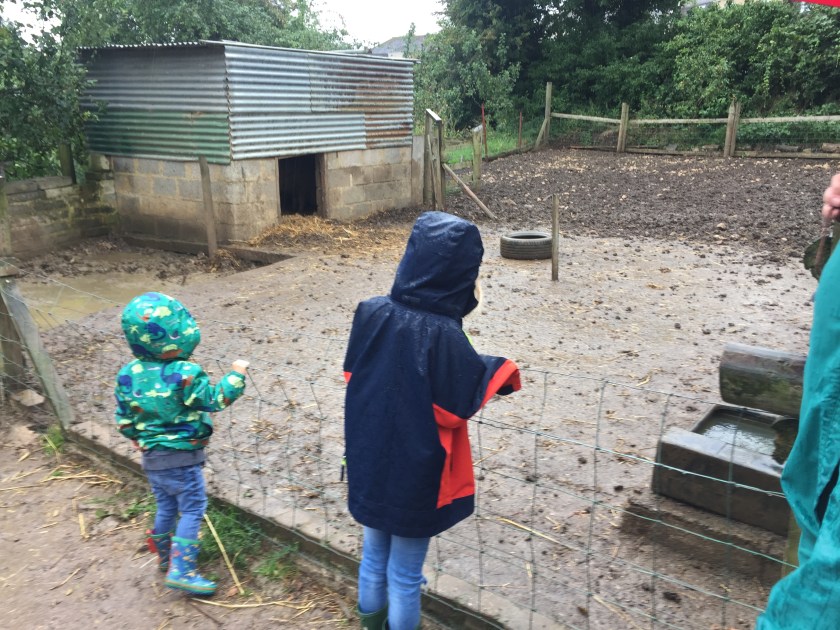
So in a make-do and mend sort of way, had a very rainy day visit to Bath City Farm yesterday with two of the grandchildren while the other one was in hospital having yet more tests.  Being a SWAN (syndrome without a name) requires a whole team of wonderful NHS consultants.  She’s phenomenally resilient and yesterday after having a general anaesthetic, an endoscope, and saline solution injected into her lungs she told her dad she’d had a ‘lovely day’.

We had a lovely day too, weaving the rain into the story so that the chldren could experience slides that are twice as fast when they’re wet.  The youngest thought it was hysterically funny to crash time after time into my legs after sliding down out of control. Later we went to McDonald’s as a special treat, and exactly as I did the last time, I managed to make a complete hash of the order and landed up with no chips and an extra cheeseburger. I know I’m supposed to be contemptuous of this kind of food, but it’s the exception rather than the rule for the children and we have many misgivings. However, and this isn’t a defence of junk food, if I were a hard pressed parent without much money, few cooking skills and no time, feeding a family of four for £15 must be a very tempting prospect. Haranguing people isn’t going to change the economics.

Back at the Potwell Inn, rainy days are a chance to get some preserving done, and we’ve been drying chillies, making half-sours with a huge crop of gherkins, and also making raspberry vinegar.  The leftover Seville oranges on the right of the picture were brined in January in exactly the same way you would pickle lemons. Just a quarter of peel with the pith scraped off and rinsed, adds a marvellous salty, orangy piquance to a sauce. This is (another) favourite season when we turn the surpluses into food for rainy days in the broader sense. Most years the concept of a rainy day doesn’t go much beyond an occasional treat, but this year there’s  greater sense of urgency as we start to contemplate the likelihood of food shortages and general upheaval. I wonder how we ever drifted into this perilous situation, and although I’m no believer in any ‘iron laws of history’ or of gods for that matter, I do think there’s a sense of inevitability about the collapse of an economic system that acts as a giant Ponzi fraud. When cultures begin to change no amount of longing for the good old days will bring them back, because to recall my first ever ethics lecture, as I frequently do,  – you can’t make an ‘ought’ into an ‘is’.