Potwell Inn afloat!

Ah bliss!! We’re back on the Kennet and Avon canal but this time we’re in a rented narrowboat for a few days after a brief handover session that didn’t quite convey the disconcerting slalom that such a long boat performs when the driver is a bit of a novice and oversteers. All the same, we settled down after the first 90 minutes and pulled over to moor up while the sun was still shining. The key to avoiding wild swerves seems to be to read the water resistance against the rudder through the tiller and not to overcompensate before the boat has had time to respond.

The internet signal, though not great, is good enough and the weather forecast is pretty awful so I can see some serious work on the database coming along. I’m slowly working through thousands of photographs of unidentified plants to see if any of them can be given reliable names and locations. Madame, after forty years of implacable resistance to the very idea of a narrow boat holiday has finally given in on the condition that she doesn’t have to do any work involving locks or swing bridges, so our youngest is our acting first mate and general muscle. The plan was originally to moor up at Dundas Aqueduct, but tea and home-made Dundee cake lured us to the bank and we feasted on some readymade paellas which burst into flames when we put them too close to the gas burner. We’re sandwiched here between the main road, a railway line and the river, so it’s all beguilingly muddled up because we can’t see anything except trees. Our first challenge of the morning is to get through a swing bridge that we gave an initial inspection before we closed the shutters on our first night. Our first lock is in Bradford on Avon and Madame is filled with dark forebodings but has kindly volunteered to make a video. I hope it will be very boring and won’t involve the Fire Brigade.

Everything is so slow on a narrow boat, you have to get your head into a different gear altogether. We are constantly overtaken by runners, swans, ducks, and even walkers, so our initial estimate of how far we’d get on this trip already looks wildly optimistic. We’re all looking forward to crossing the two aqueducts. There’s a decent pub next to Avoncliff if I remember correctly but Madame thinks it may be closed. The second, at Freshford is closed on Mondays and Tuesdays so the First Mate is relying on bottled cider. We spotted our first Kingfisher near the pub at Bathampton.

Canals are invariably marvellous. When we lived in Stoke on Trent for a while it wasn’t unusual to see dead dogs floating between the supermarket trollies. Here, though, there is botanical interest everywhere -not so much in the autumn – but in the early spring flush there are all sorts of plants that would have been harvested by the barge people as herbal medicines.

Anyway, more (and hopefully more photos tomorrow) I can feel an early night coming on.

Finding the Heffalump!

From the top left: The canal today; Gypsywort: next line are Gypsywort and Skullcap growing together on the water’s edge, then two photos of what I hope will be confirmed as * Flattened Meadow grass; then on the bottom line Snowberry and Soapwort.

*Sadly that one didn’t work out.

It’s been the strangest week. For a start it was overshadowed by the prospect of endoscopy – I’ve had some dodgy cells in my oesophagus for way over a decade and so they make sure every couple of years that they haven’t gone rogue. Most of the time I don’t think about it but as the day approaches I start to imagine the worst. Ironically (gimme the sedation and lots of it!) it’s pretty painless and certainly not frightening, everybody is very professional and kind and I even get a cup of tea and a biscuit after the local anaesthetic has worn off and I can swallow again; but until I see the photos and get the first draft of the report, I’m sleepless and I worry. Happily, once again I emerged under the blue skies of a good outcome – pending the pathology results, that is.

So – thus reprieved – next day we worked on the allotment in the heat until we were so exhausted we could hardly stand and generally overdid the celebration of our fitness. Apart from Madame’s dodgy knee we were no worse than walking wounded but painfully reminded that we’re no longer in our thirties. The good news continued with my walking trousers being mended free of charge when one of the pockets fell off – and even better, Osprey provided, free of charge, a replacement for the lost waist strap for my rucksack, and so we were set for a celebratory walk. Madame guessed I was suffering from a bit of Mendip fever and so she suggested we might make for the hills.

Come this morning, however, and we had one of those pointless circular discussions (familiar to anyone in a long relationship) about whether we really wanted to drive for an hour to Priddy Mineries to look for a single rare fern. After three or four turns around the circuit – “look if you really want to go we can go …”“But do you really want to go all that way ……?” – we both realized that neither of us wanted a long drive. Which left the “where” question wide open. Victoria Park? – No – Botanical gardens? – no – Henrietta Park? – no. Canal? hmmm, ummmm, why don’t we walk up to the George? DEAL!

There’s a real point in having some home territory. The Kennet and Avon Canal isn’t just a lovely place to walk, it’s the place where I almost always find at least one plant I’ve never seen before. Knowing most of the residents by name in – let’s say March or April, or perhaps December, if you like the perfume of Winter Heliotrope, doesn’t mean you’ll know them in May or – like today – in August. The towpath is constantly and astonishingly renewing itself month by month with fresh new growth pushing up through the senescent remains of the old. This miracle of renewal is happening just slowly enough to fool us that nothing much changes. In real life the canal banks put on a new set of colourful clothes throughout the year. Yes it slows down in the winter but even then, we find new growth in the rosettes of leaves that will flower later in the year. You’ve no idea how many shades of green there are in leaves alone, and when you add in texture and shape you can be lost in contemplation without a flower to be seen.

If we’d gone to Priddy as planned I would have yomped across the Mineries with my nose pressed into a GPS app and probably seen nothing. But on familiar territory that we’ve walked hundreds of times I found and photographed Gypsywort, Skullcap, and Soapwort as well as what I hope will be verified as * (wasn’t) Flattened Meadow grass growing on top of a rather famous Brunel wall. That’s three new personal records – and we found the Soapwort exactly where I remembered it from 2020 during the lockdown.

Back home I transferred all the photographs to the computer – the new camera does this wirelessly – and identified them all as best I could, calculated the National Grid references from the camera Lat and Long, using an OS app and turned to my old pal Mrs Grieve to see if her 1920’s herbal thought Gypsywort had any healing properties. She didn’t even mention it, and when I double-checked online, every single historical use for it has been deemed dangerous by science, so nothing to report there. Skullcap too passes under the radar but Soapwort root was once used to treat syphilis which neither Mrs Grieve or me have suffered from – all she can say in its favour is that it was thought to be “better than mercury“. Well thanks but no thanks – we’ll give that one a miss too. I often think the use of the word natural to bestow instant credibility is one of the quickest ways into A & E.

Wild swimming is about as natural as it gets, and yet – looking at the top left photo of the canal, taken today, the spring water trickling in from the hill was very pretty – but I’d say there are a few unsavoury additions to the cloudy waterway – so however hot the day I’ll be keeping my trousers on.

Anyway, as far as Heffalumps are concerned, I’m more and more convinced that there’s no real need to be searching across distant counties until I’ve looked more closely and found all the available ones nearer to home. I understand that in the wildflower meadows of Yorkshire and Cumbria they stand shoulder to shoulder, and maybe one day we’ll get there. I do love a good Heffalump specimen, but I don’t always need to wear my tropicals and a pith helmet.

Dundas aqueduct – July 2017

A moment of reflection in tunnel 2

I couldn’t resist photographing this lovely moment on the Kennet and Avon canal this afternoon, just a few yards from the iron bridge where we saw the heron which provided the opening paragraph for my post – “Hiding in Plain Sight” – a couple of days ago.

Tunnel 2 is just about the most unromantic name you could think of – perfect for a Soviet era love story involving two people and a shovel, possibly a broken shovel – come to think of it – but that’s one for another day. The reason for the existence of two tunnels and the deep cutting really is is profoundly unromantic. It came about because owner of the the Sidney Gardens – Regency pleasure gardens and knocking shop according to the historical accounts – refused to allow his patrons to be assailed by the nauseating smells and sounds of the same bargees who were day by day making many of them wealthier. The canal builders had to build two expensive tunnels to hide their work. Nowadays the biggest hazard on the canal is the lycra clad cyclists who race by looking intently at their instruments.

Our walk today was a long, almost eight mile loop through the allotment, past Royal Crescent, the Circus and the Assembly Rooms and past the top of Walcot Street down to Cleveland Bridge which is being repaired and is only open to walkers and cyclists, and therefore blissfully quiet aside from the raucous laughter of a gang of builders who were enjoying their lunch break by cracking jokes at each others’ expense; it sounded a lot of fun. Then we found a way through the housing estate bordering the river; rejoined the canal and the railway line next to the Cleveland Pool which is being restored and then on along the canal to Bathampton where we took the road towards the toll bridge and left it for the footpath back towards town and which runs alongside the river and continues under the monstrous concrete pillars of the bypass. It’s been a warm and occasionally sunny day – perfect for a walk and a catch up with the canal and riverside flora.

The changing seasons are a strong reminder that nothing hangs around for long in nature. The hedge parsley is long gone; replaced by the hogweed which is itself flowering and setting seed. The battered leaves are all that remains of the winter heliotropes that flowered in profusion during late winter. The spring flowers are gone and now the summer visitors are appearing and I could have clapped for sheer pleasure at finding a clump of white musk mallow on the towpath. It could be a garden escape, who knows? they’re more commonly purple like their cousins in the Malva family – but they were there and looking lovely – pristine even – a fleeting moment.

I had a few responses to my earlier post, an old school friend on Facebook, a helpful comment from Carolee a reader and virtual friend in the US and a phone call from another old friend to make sure I was still alive. My heart problem (Afib) seems to have got better on its own (I bet they all say that!) and with a couple of doses of filthy tasting valerian each day I’m feeling steadier; but the walk on the canal reminded me that the essence of the natural world is that its pleasures are both gifted and fugitive – not to be captured or pinned down – we simply have to accept – that’s the deal.

And if that sounds a bit glum it’s not meant to be. Life might be a helter skelter ride to oblivion but that’s no excuse for shutting my eyes and refusing to enjoy it while it lasts.

The birds come to us at Bath Deep Lock

It rained today at last, or at least enough to wet the ground and keep us indoors most of the day and so I redeemed the shining hour by making a Dundee cake; some – or rather a lot of smoked mackerel paté; and some mushroom soup which, today I thickened with stale bread in the way the French do it sometimes. When you bake all your own bread you agonise about throwing any of it away and so you become ever more inventive at using it up. Fresh; it needs no embellishment, and then toast speaks for itself. But there’s still bread and butter pudding, soup thickening and finally breadcrumbs just so you don’t waste a crumb. When we used to buy bread we seemed to throw away as much as we ate – it was all mouth and no trousers so to speak. Now we probably eat rather more than we should and never waste it. Keeping the bread supply going always reminds me of moving goods on the old canal network – it’s very slow, but as long as you think 24 hours ahead you’ve always got fresh bread, and sourdough keeps rather better than yeast bread.

I managed to lay my hands on 500g of dried bakers yeast today because I do still bake yeast bread and rolls – usually when I forget to start the sourdough in time. I try to leave the dough fermenting for as long as possible and so I’ve gradually cut the yeast down to one level half teaspoon for a two pound loaf. My completely unscientific feeling is that adding too much yeast makes the bread unappetising and stale much quicker. What you gain in rising time you lose in freshness.

Once the kitchen was clear and the cake on a rack, we went for our usual walk up the canal under grey and rainy skies. As we passed by Bath Deep Lock we saw Bath Nats President Prof David Goode intently watching the local heron as it walked purposefully alongside the lock and dropped down to fish from the bottom of the gate. We followed the bird up the canal, and I managed to get a couple of shots with my phone – not great quality I’m afraid, but I’ve never managed to catch a heron taking off before. It’s such an awesome sight to see this big, prehistoric bird winching his way into the sky.

The lock isn’t so named out of any local bragging rights – it really is very deep indeed, quite daunting to exit the canal into the river when it’s flowing fast, and all too easy to lose control of a narrow boat as it’s swept to the left by the current.

Next, as we passed the big pond at the head of the lock, a swan emerged from her nest in the reeds, bringing four cygnets across to see us. They’ve become very used to being fed and were quite tame, although they soon abandoned us when it became clear we had no food for them.

Not long afterwards the skies opened and we turned back towards home taking a shortcut that brought us out on to the river once more, facing St John’s RC church. There was David once again watching the tower intently. It’s an urban nest site for a pair of peregrine falcons who have fledged four young this spring. I had no binoculars so I couldn’t see very much, but we chatted with David for a while – he’s a notable pioneer and expert on urban ecology, and if you ever get a chance to look at bogs and mosses with him you’ll learn so much. But he has a terrible memory for faces and names and depite having been on a dozen meetings and field trips with him he asked us (for at least the twelth time) “what were your names again …?”.

As we were standing there the male (tiercel) flew back to the nest and there was a terrific noise from the hungry young birds because they’d fluttered down to a lower perch and the food had landed a short flight above them, on the official nest platform. Apparently this is a dangerous time for them because in high winds they’re liable to be blown off these insecure perches and into the river.

So all in all, not a bad crop of wildlife, bang in the centre of town. I had to laugh this morning when my Google phone informed me that we’d visited three cities last month. I scrolled down to see which cities we were supposed to have visited. They were Bath – no surprise there then; Severn Beach which used to be a bit of a joke for Bristolians hunting for an end of the world location and certainly not a city, but happens to be where we store the campervan. Finally Bitton came up as the third city. We like to think of it as a very pretty overgrown village.

The millpond of our lives is disturbed by ten burly policemen.

I had intended to write a post about the – shortly to be ended – peace and quiet of the city while the tourists have gone. I hardly need add to the thousands of words that have been written about nature and its beneficial effects and it’s mostly true, save for the reservations I mentioned a few days ago. We’ve had wonderfully quiet walks along the river and up the canal – undisturbed by hen parties on narrow boats or young men dressed as pirates.

There was a tremendously amusing moment a couple of days ago as we were sitting on the canalside enjoying the sunshine when we heard a very loud voice performing one half of a conversation, the other being in her earpiece. Why people find it necessary to hold the phone three feet from their face and shout at it is a bit of a mystery. Perhaps it’s so they can watch the other participant on the video screen- who knows? But anyway this young woman, dressed entirely in black slowed down when she saw us and taking a wide path around us hissed into the phone “I’m just passing two elderly people!”

The canal, and the river too, was like a millpond

  • and the inverted reflection of the trees, houses and the sky blessed the whole view with perfect symmetry. You felt you were looking beyond the surface of the water into an infinite depth. Cleveland House never looked more Georgian or more stately as it straddled the canal above a tunnel which was dug purely to protect the wealthy patrons of Sydney Gardens from having to see the bargees. It was built as a toll house above the canal and the tolls were collected by means of a basket lowered through the floor of the house.

Pellitory of the wall - Parietaria judaica
Pellitory of the wall

Alongside Cleveland House I spotted a patch of pellitory of the wall – Parietaria judaica growing as you might expect, on a wall. It’s not the kind of plant that you’d likely notice, with its inconspicuous flowers but it once had some fame as a useful medicinal herb for urinary problems. Culpeper really rated it and I dried a bunch last year but haven’t had occasion to try it out!

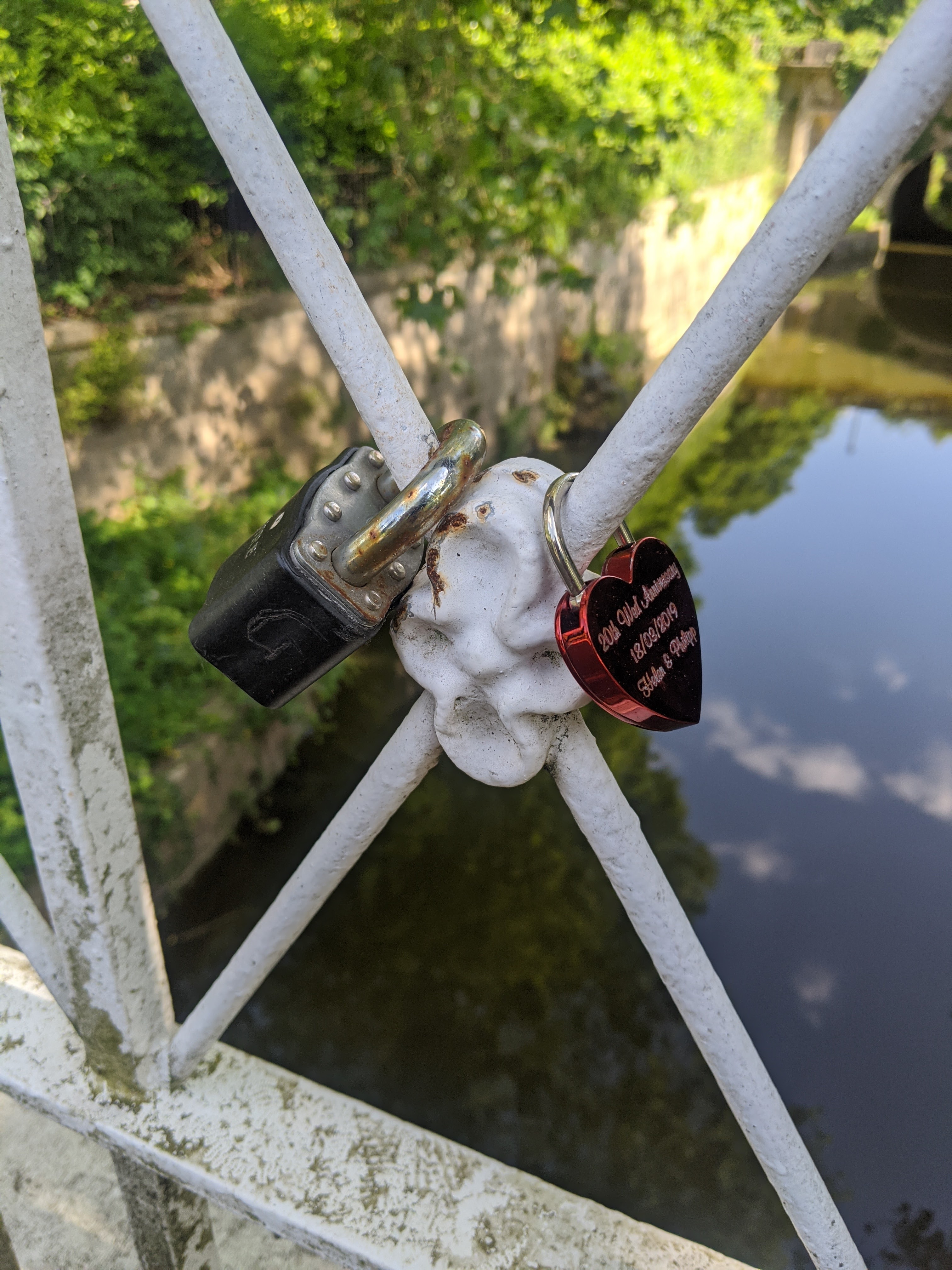
Crossing the canal by way of an iron bridge, we found a group of love token padlocks each one, no doubt, carrying a story that only the lovers will know. Sydney Gardens was full of sunbathers – it was lovely.

Bath felt really strange when the lockdown began but we’ve so enjoyed being able to cross the centre of town with all the shops closed and streets virtually empty. Sixty years ago, in Bristol, the shops in Whiteladies Road and the rest of Clifton all closed on Saturday afternoons and that was when Clifton village (where the Brunel suspension bridge is), was at its Georgian best. That’s what it was like here for a few weeks, but if the non-stop carnival on the green outside is anything to go by, most of our neighbours think it’s all over. I think to myself, it’s not over until people stop dying, but the shopkeepers and hoteliers are getting quite wet-lipped at the prospect of “putting it behind us”.

But back in the Potwell Inn, the work on the allotment has been relentless. This weather – very hot and dry for a couple of weeks now – means watering every day. The tender plants are fairly rattling out of the greenhouse, and the first wave of broad beans has almost all been harvested. The overwintering Aquadulce Claudia have given us about 30 lbs of beans in their pods, which translates into around five pounds of shelled beans.,and they freeze really well. Elsewhere the frost damaged runner beans and borlotti beans have all been replaced (we always grow spares) and are beginning to climb their poles at about six inches a day. The earliest asparagus is now being allowed to develop its leaves and we’re harvesting the middle and late varieties. Once again, the 12′ by 4′ bed provides all that we need. The first flowers are setting on the outdoor tomatoes and we’ve abundant pollinators arriving constantly on the allotment, attracted by all the nectar rich flowers we’ve scattered everywhere.

The view of the green from our front window.

These warm nights have made sure I was awake with the lark, and first thing in the morning the green is usually quiet aside from our regular martial arts couple, training and perhaps a dog walker or two. For the rest of the day it’s becoming busier. It’s used a lot for drug dealing because there are so many escape routes inaccessible to cars and some properly dodgy looking characters pass through every day. We also have (hardly a coincidence) a very large number of homeless people with multiple mental health and addiction issues who sit in noisy groups on the green. Many people find them intimidating, but moving them on isn’t helping to solve their problems and they leave us alone.

Yesterday we noticed two police cars parked up on the main road and right opposite where we live we saw a young woman hiding behind a tree clearly watching for someone. She didn’t look at all like the usual drug customer but we thought no more of it until this morning when all hell was let loose and ten police, three police cars and two ambulances converged on the green, pursued a young man into the woods, and brought him back out again protesting loudly. I’ve no idea what they were detaining him for, but they should, perhaps, have thought about bringing along a sniffer dog because this afternoon the same young man walked boldly into the woods at exactly the point he’d gone in earlier – presumably to retrieve his stash and jump over the fence, never to be seen until next time. I tell you there’s never a dull moment at the Potwell Inn – very edgy, you might say.

All work and no play make Jack a dull boy


It’s New Year’s Eve, and as you can see from the photos we’ve had a grand old time with family, friends and neighbours. There’s always a hint of the black dog sidling along somewhere close behind me at this time of the year but, as one of my spiritual directors said many years ago – “There’s nothing wrong with you that a bit of sunshine won’t put right”. I think the dominant mood has to be defiance – of the winter, of the politics and of all that tries to diminish us and keep us in shadow.  Fear and despair are the devil’s tools and it’s always possible to raise a finger against the tyranny of the machine.

Anyway, enough of that, we have bigger fish to fry at the Potwell Inn and in any case the sun broke through for a couple of hours yesterday. Plan A was to go over to Dyrham Park for a walk, but slow moving traffic on the A46 was a bit of a clue that plan B was a better bet.  In the end we drove into the park and straight out again, passing many hundreds of cars and crocodiles of walkers.  There was no peace to be had anywhere, and we wondered at what point the overwhelming popularity of the place would become a serious threat to the environment. I had the horrifying thought that the whole of  White Field might be turned into an overflow car park – all those stunning meadow plants mown off in pursuit of a few more visitors to fund the spoliation of yet more land.

IMG_20191228_141316And so we returned to a bit of unfinished business on the canal. I’ve written about the big patch of Winter Heliotrope we found – no great shakes, I know, but it was a cheerful sight.  However there was one thing I forgot to log, and the latin name Petasites fragrans is a bit of a clue, because apparently it has a perfume although experts seem unable to agree on what it is – some say vanilla, others cherry pie,liquorice or aniseed. A bit inconclusive, then! So there was nothing to do but go back and flare the nostrils a bit in search of the elusive fragrance. I thought it might help that the sun was shining and it’s true that there was a distinct fragrance but you could only get it by standing back from the individual flowers and embracing the whole bed. It was nice to confirm the name, but I couldn’t say that the perfume was any other than itself – the perfume of winter heliotrope.

IMG_20191230_135837

IMG_20191230_144103Here’s a photo above that just about sums up the time of year. I love the appearance of Clematis vitalba – old man’s beard, traveller’s joy – among other English names – when it reaches the final stage of its seasonal cycle. It’s winter in a picture, but almost at its feet we found new leaves of dandelion, tansy and yarrow in full spring growth. I’m always surprised at just how specific the habitats are. You’ll see loads of a particular plant in one small length of the towpath, and then it seems to be replaced by something entirely different. As I looked at the yarrow leaves I suddenly remembered another of our childhood names  – we called it ‘fish paste’ for no particular reason I can think of.

IMG_20200101_130145The canal itself was a beautiful sight in the winter sunshine, but even there we found a bit of human tragedy.  We’d noticed that one rather dishevelled looking boat was tilting dramatically the other day. Yesterday we found the distraught young couple whose home it had been, trying to rescue their belongings from the sunken hull. They’d obviously gone away for Christmas and returned to find their home underwater. There are so many people living within a whisker of destitution on these old boats. The wealthy owners of waterside homes are constantly agitating to have them removed, but the look etched on to their faces would have told you all you need to know about being poor and homeless in this, one of the richest countries in the world.

But the sun truly brings Bath stone to life, and as we took our usual walk, looping back through the town center I took a few photos of the canal and some of its buildings.  The water was flat calm, and I was fascinated by the appearance of what seemed an exactly parallel world in the reflection. Cleveland House – newly restored –  looked as if it was sitting on a giant’s cave, and the mature plane trees’ reflections were stunning. From Laura place, looking down Pulteney Street the sun – low in the sky – made the houses glow with a kind of inner light. Mercifully the river level is falling and narrow boats were at last able to join the Avon through Widcombe Deep Lock.  It’s a kind of secret Bath that draws us back again and again – and we’ll need to keep it up because I can see that within a week or two the wildflowers will move into a new gear altogether.


 –  

If only it were true!

Another walk along the canal today, and I was intrigued by the juxtaposition of the sign and a homeless person’s tent on the opposite side.  More often than not these temporary shelters are situated in places that are difficult for random thugs to reach because they are frequently targeted for abuse. This one tent is the tip of the iceberg and the canal is a favourite place.  There are probably dozens of rough sleepers along its edges – many of them with mental health and substance abuse issues, but it’s hard to tell.  Sleeping rough and living in fear of being beaten up or constantly moved on has its own corrosive effect. Then there are a large number of just-about floating narrow boats housing those who can afford the mooring fees but not much else.

Today the last half mile of the canal was rammed with boats unable to enter the river and head off towards Bristol.  The exit to the river through Bath Deep Lock is almost impossible in high water states because the long narrow boats have to enter the river broadside on, and the water was running like a train today.  Its deadliest state is always surprisingly quiet but always menacing.  Even Pulteney bridge gets quieter as the river rises and almost obliterates the weir in what looks more like a breaking wave. At this time of year when the Christmas parties get under way, the river has taken so many young lives it’s unusual to take a walk and not see a bunch of flowers tied to a fence.  Today was no exception. It’s cold at night, and the wet weather must have made life impossible for many homeless people.

Are we a humane society? We shall see in a couple of weeks, but I’m feeling despondent as our democracy is reduced to rubble by lies and deliberate lawbreaking.

IMG_20191128_121758

My favourite little patch of weeds is coming along nicely at the moment, and there was a hint of sunny weather to come as the birds practised a few bars of their spring songs. As we wandered back into the town centre we discovered that the Christmas Market had started hours earlier than we expected, and so we hunted down the Isle of Wight Garlic Farm stall and bought some more seed garlic and a few other bits and bobs from Rob Solari who gave the talk at the Allotment Society AGM. When we arrived home the monograph on garlic that I’d ordered had already arrived so we’re well set up now.  In honour of the occasion we baked some large mushrooms with a wholly improper amount of our own crop and shop butter and thoroughly enjoyed them.

Up at the allotment the Early Purple garlic has finally emerged in sympathy with our new-found commitment and so the world looks like a better place just now. The kitchen waste had piled up in the kitchen and so we took it all up to the site.  The compost heap is going well, but a winter heap is an entirely different proposition to a summer one.  It’s dense with peelings and vegetable leftovers and therefore more attractive to rats and prone to going anaerobic, so it needs a lot more brown waste like cardboard and it needs turning regularly to let some air in. But it’s nice and warm – around 25C – and the worms are still reducing it at a tremendous rate. However much we put on the heap it seems to shrink day by day.

Everything else is quiet on the plots, but the broad beans and overwintering peas are germinated and ready to go into the ground over the weekend when the weather looks much better. But it’s just as well the pace has fallen a bit because the constant shortening of the day length and the grey wet weather seem to lower our energy levels. The table is piled high with books to read but it was better to be out walking for much of the day. We shift into official winter on Sunday which is promising brilliant sunshine and cold conditions – proper winter then, and the garlic loves a cold spell. The photo was taken in Sydney Gardens where we walked past a large Ginkgo biloba – this one without stinking fruit surrounding it.  Someone must have swept it all up.

IMG_20191128_122202