
Every silver lining – it’s said – has an accompanying cloud, and one of the best things about allotmenteering is that there are always neighbours who will keep an eye on your plot while you’re away. But there are risks – your neighbour might treat the job as more of an aspiration than a commitment, although it’s usually our children who go down that route. On the other hand the risk to the Good Samaritan is that something horrible like blight might happen to the neighbour’s tomatoes and it’s them that will have to break the news. We have a friend whose daughter’s hamster died one Christmas Eve many years ago. He had to visit every pet shop in Bristol, with the deceased pet in his pocket, asking if they had another one “exactly like this.” Mission accomplished, and with the daughter in the dark about the ruse, they all celebrated Christmas without an accompanying cloud.
The reason for this visit to memory lane is that we arrived at the allotment this morning to find a Good Samaritan in a bit of a state – she’s always taken her responsibilities very seriously. Our neighbour’s tomatoes had suddenly developed some sort of disease while she was looking after them. We knelt and prodded and poked and examined the source of the problem which was not centred on the leaves but in the stems which had developed long brown lesions. When I cut one open and peeled it I could see decomposition beginning at the centre and it felt suspiciously soft. Later, at home, I checked with several books – the RHS book by Pippa Greenwood “Pests and Diseases” is especially approachable – and I decided it is probably Tomato Pith Necrosis, nasty but not completely fatal as long as you cut the infected stems off and burn/dispose of them. By the time we came on the scene she was already planning to dig them all up and burn them but we were certain it wasn’t blight (too early for a start) and she agreed to wait until the holder of the plot got back off holiday. She’d already texted him with the bad news and so I texted him later with the better news. The disease is soil borne and can be spread by splashing – for instance by watering with a rose from above – and also by handling. Tomatoes hate having their leaves handled. Needless to say we all solemnly washed our hands with gel and then we sped off to the Potwell Inn plot to make sure ours were alright.
 Happily all was well in the tomato department but while Madame was picking some peas she found that the Pea Moth was cranking into gear – that’s why getting them sown and picked as early as possible is always a good idea.
Elsewhere the young leeks are doing fairly well, but along with the autumn and winter crops already growing, they’re a reminder that nothing stands still for long on an allotment, and the seasons are always queuing one behind the other.
Meanwhile I’ve been revisiting some of the calculations I did before I posted on the subject of watering with stored rainwater. When I went back over the figures the combined water gathering area of the shed plus greenhouse is not 7 but only 5.5 square metres. So I had a look around, and if I roofed the compost bins that would give me an additional 4.5 square metres, and if, as well, I built a rain gathering roof between the shed and the greenhouse it would add yet another 2.5 square metres. That would give a water harvesting area of just under 12.5 square metres. Because there is always inefficiency in harvesting, let’s say that the effective harvesting area is 10 square metres. That means that for every mm of rain that falls we could harvest between 10 and 12.5 litres of rainwater. The average annual rainfall in Bath is 761 mm so that would potentially yield nine and a half thousand litres in a year. That’s about 5% – peanuts compared with the almost 200,000 litres that would fall each year on the whole plot in any case, but the thing is that it doesn’t rain every day and so the stored water is buffer against temporary shortages. Three thousand litres of stored water would provide 75 full watering cans a week for a month, or 25 a week if the drought went on for three months. The harvesting area could refill the tanks three times in an average year and, most importantly they could harvest during those short heavy thunderstorms and intense showers that would otherwise be wasted in run-off to the rivers. Another thing I ddn’t factor in yesterday was that 20% of the overall area of the plots comprises pathways that don’t need watering anyway – that’ll teach me to check my calculations more carefully before I post!
So all this, combined with the other measures I wrote about yesterday, (soil improvements, mulching etc.) could easily be part of the way forward. What really struck me was the sheer volume of rain that falls in a year, and how much of it is wasted in run-off. I haven’t even mentioned grey-water because on an allotment it’s not a factor – but you can see the huge impact of more widespread adoption of water storage.
But yesterday I also alluded to compost as part of the solution to global climate change, and again I checked the calculations I made when I built the 4 compost bins in February. I calculated that the absolute maximum compost we could make would be about 3 cubic metres – and that would be pushing it. All the organic gardening books suggest mulching with up to 15cm of compost. Calculated for our standard allotment that would mean making around 30 – yes thirty – cubic metres of finished compost a year, and I’d say that would be an absolutely impossible target. Some form of rationing will have to be done unless we/you are as rich as Croesus. There are other soil conditioners like leafmould that we can make, but they come (free) in the autumn and the heap spends a year shrinking to less than half its original size. So that makes about half a cubic metre. Apart from buying in manure, which I’ve no objection to except that it takes up so much space (27 cubic metres? – don’t be silly) – that’s a quarry lorry full. So that leaves us green manuring, and, because we’re not digging, the green manure would have to be composted – no problem there.
Sorry, that’s a lot of detail but it makes me wonder how realistic some of the gardening gurus actually are. TV gardening programmes are entertainment, and just as not everyone who watches Jamie Oliver actually cooks his recipes (which, incidentally are very good), so too with gardening shows. Whole new gardens without a blemish are planted up in five minutes and never a pest appears to darken the horizon, and ….. I begin to wonder if coffee table gardening isn’t the first cousin of the romcom – not much reality.
Finally, just to leaven the lump a bit, not all vegetables need a great deal of water. While I was researching this I discovered that watering does nothing for parsnips, and carrots do worse if they’re watered any more than occasionally. Our own experience with potatoes shows they need very little, so there’s some silver lining there. For me the take-home point from all this work with a tape measure and a calculator is a better understanding of the inputs that make for a sustainable and drought resistant allotment. Far from being minor issues they need to be brought into the long term planning of facilities and crops.

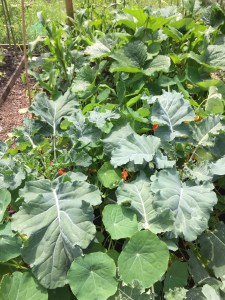 The only way to mitigate our water use is to increase the water capacity of the soil by increasing the amount of organic matter and making use of mulches to reduce surface evaporation. It’s clear from our experiments with mixed plantings, that covering the ground completely (courgettes, for instance under sweetcorn) lashings of leafmould and so-on really increase the moisture holding capacity. The Potwell Inn allotment needs most watering on the areas where the soil is exposed – it’s obvious really. Another approach – one which I’m sure the seed merchants will soon be all over – is to develop drought resistant varieties, but we could also start to develop extremely locally adapted plants through seed saving.


 Only one variety of chilli has done well in the greenhouse and the label claimed it was an Apachi F1, but we had real trouble with labels this year. We moved over to wooden labels and within weeks they were illegible. I think it was almost certainly a Romital. Anyway I took a ripe one off the plant today and tasted it and it was just lovely – full of flavour, pretty hot and perfect – I’d say – for a curry. Luckily there’s a good crop on the way. The Hungarian Hot Wax have had a splendid season so far. They’re mild and warm and again, full of flavour. The Apaches – the real ones – have done well, and the worst looking of the lot are the Habaneros which look terrible. I hope their new environment suits them better.


 Actually that’s not quite true because we’ve been eating new season garlic for quite a while as the main batch dried in the greenhouse. The picture shows about half the crop, and the results show that the variety Early Purple Wight was the most successful of the three varieties we tried. We’d thought that most of the alliums were a bit of a disappointment this year, and we dug up the onions when they appeared to be suffering from some kind of (unidentifiable) affliction. However, less fearful (diligent?) allotmenteers left their affected plants in and many of them have recovered and now look well, so maybe we were overcautious, but the combination of twisted and wilting foliage with softness in the sets suggested some kind of rot. We found no evidence of fly infestation at all. so that’s another one to put down to experience. There’s a lot of “no idea” in gardening if we’re honest, but plants are amazingly resilient and can come back from the brink. It’s been so dry this season, and it’s been difficult to give the plants enough water. When we planted the leeks out a couple of weeks ago they looked terribly sorry for themselves, but even the sickliest have pulled themselved into the ground and are looking more vigorous now. Our sage plants, particularly, respond to ruthless pruning with loads of new growth. Parsley seems to hate being watered from above with a rose, and most of our plants seem to prefer a good soaking straight from the can at ground level. There’s a mass of detailed experience that comes into play on the allotment, and so many things that can go wrong – but the rewards are immense, and we don’t beat ourselves up too much if we get it wrong. Life’s too short to waste with gloomy reflections on the inevitable failures.


 Being slightly obsessive I caught myself naming plants – with their Latin names if I knew them – as we walked down to the village today. Thank goodness no-one can hear the conversation in my head – if they could I’d have been locked up years ago!