Mint Moth joins the list of allotment visitors

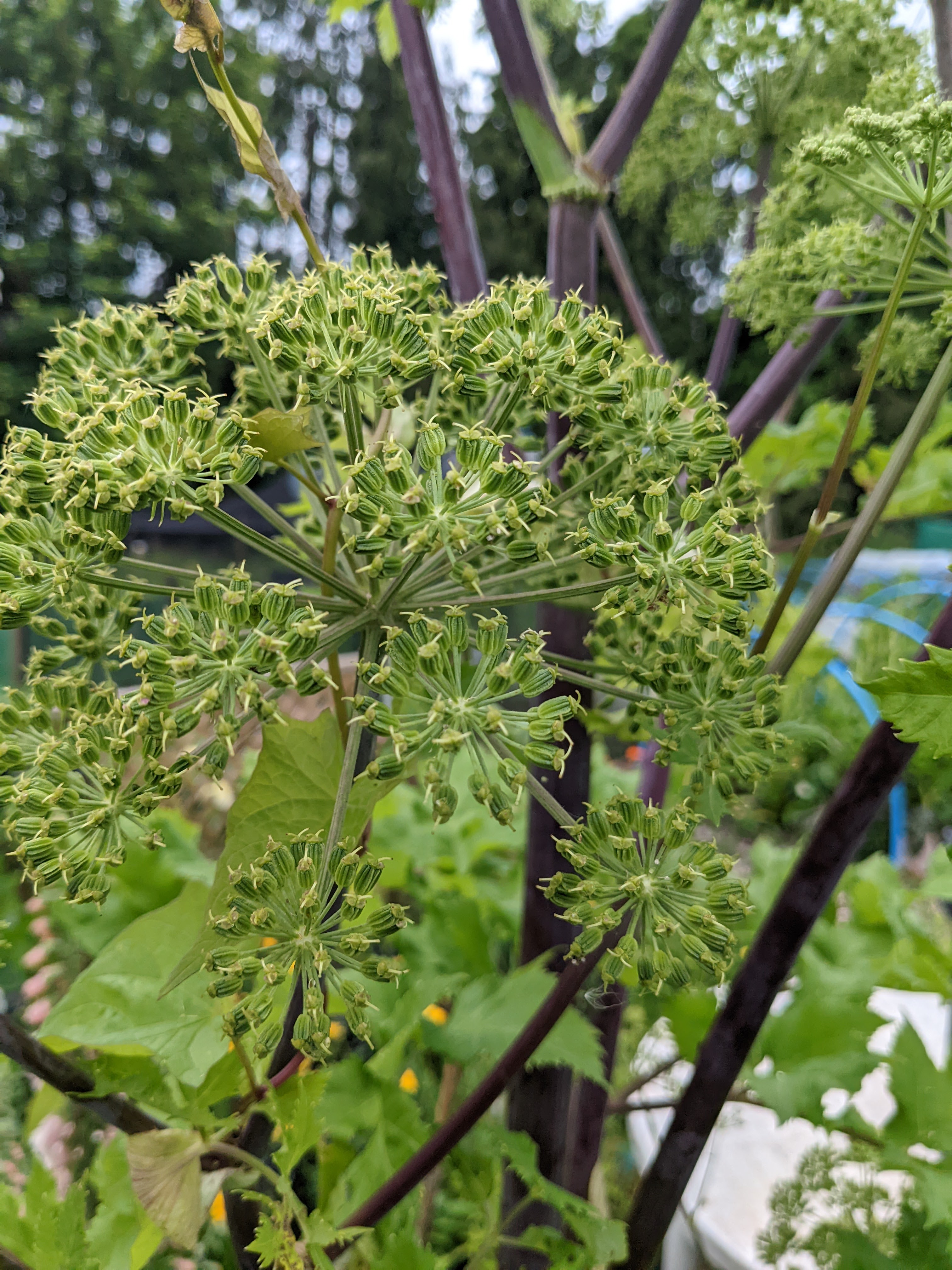
Mint Moth

Having posted about a proper regional rarity yesterday I should say the Potwell Inn is positively promiscuous in welcoming allcomers to feed on our allotment. Immediately next to this moth, the Iris Sawfly caterpillars were getting on with eating our pond iris leaves. I’m pretty sure there are predators that can grab a meal from them. Even slugs and snails are allowed on unless they make too much of a nuisance of themselves when Madame snips them in half with the gardening scissors – returning them to the pathways and beds for the birds. I’m wholly unqualified to identify all the many species that come to us but I can feel a list coming on with the help of the Bath Naturewatch group who usually get an insect ID back in minutes. It’s amazing what you can spot during a bit of close-up hand weeding. We’re not the Chelsea Flower Show here – it’s free admission to anyone apart from the two legged grazers who shamelessly nick our produce without noticing the trailcam. Our biggest visitors are the badgers and foxes and the smallest ….. well, we’ve never seen them.

The Blackbirds are almost on the permanent staff because they keep all the path edges clear of molluscs and their eggs, and who would begrudge the Robins a worm or three? Our philosophy is to discourage pests with nets of anything from 1mm mesh against carrot fly, up to larger netting to keep the pigeons and the white butterflies off the brassicas. It’s a live and let live philosophy that sees pests, diseases and weeds as an important part of the big picture because they often signal a problem that needs attending to.

Gardening this way is like a long seasonal conversation between equals. We greet one another, say thanks when thanks are required and please when we’re harvesting or we’re not sure we’re on the right track; and so the fruits of our labours aren’t just fruit and vegetables, but insights into the way the earth works – and if that sounds like hippy dippy nonsense – well don’t knock it if you haven’t tried it!

The colour comes from a dark form of Elder

This is the beginning of the season of plenty but it’s also very hard work. We overheard another allotmenteer a couple of days ago, lamenting the fact that her crops had all but disappeared under the weeds, and from predation. They’d obviously received a notice from the Council and she complained bitterly “It was fine when we left it” . That would be at the end of last year’s school holidays in September. But with fresh Basil on demand, strawberries and Asparagus almost over and potatoes just weeks away it feels good to be alive – even though our backs ache. A year’s supply of ruby coloured elderflower cordial is standing on the kitchen table, labeled and sealed.

Now the allotment is a nature reserve!

The garlic patch has been invaded by an extremely attractive but rather invasive plant. It’s been hanging around for years, and for years we’ve yanked it up by the handful and got rid of it – occasionally on the compost heap I suspect. Three years ago I had a go at identifying it because it definitely wasn’t anything I’d seen before. After a trawl through the books I got as far as a family name – Fumitory – but further investigation foundered when I discovered that it’s one of those so-called difficult plants for which you need specialist skills.

Oh no it’s not – oh yes it is!

I called on my friend Rob who has abundant specialist skills, and he gave me a very hesitant answer emphasising he wasn’t completely certain but it could be Fumaria muralis, the Common Ramping Fumitory – which isn’t at all common in these parts. Three years later my ID skills have improved a bit and after a bit of a thing with some Fumitories while on holiday in Cornwall last week I became fairly confident that I know what a Common Ramping Fumitory looks like, but when we got home I could that see that our allotment invader doesn’t quite fit the bill. So I took a lot more macro photographs, came up with a possible Fumaria capreolata, the White Ramping Fumitory which looked closer to mine, and sent them off to another local expert who thought that they were the (uncommon), common type after all; closing the circle and going back to square one. However she suggested that I might send off the photos to the National Referee and get his opinion.

Philosophy, like science, is as concerned with good questions as it is with good answers, but any half decent philosopher will tell you that questions can be troublesome or even dangerous at times. I emailed the photographs to the National Recorder and two hours later a very brief note came back saying it wasn’t either of the previous two ID’s, but is a Tall Ramping Fumitory – the appropriately named Fumaria Bastardii subsp hibernica. It was only when I searched on the distribution map for the plant that I realized it hasn’t been seen here in Bath for at least 40 years. I was so excited I couldn’t sleep and gave up trying after 5.00am. In my emails were congrats from the local recorder and the President of the Bath Natural History Society.

So that’s the good news for the day – although I have to say my only contribution to the find was a sharp eye and some persistent questioning. All the rest was done by a great team of experts, and thousands of volunteers who helped create the maps. But the next question is much trickier. What do we do with a rare plant in the middle of the garlic patch? – oh and another plant in the broad beans? I suppose the greatest reward for me is to have learned so much about a difficult family of plants. I can look a Fumaria in the eye now. That’s quite a feeling.

So aside from all the excitement we used the extra daytime to bake some bread and go up to the allotment early and get some watering done – the last three months have almost amounted to a drought – mercifully broken last week when we harvested around 500 litres of rainwater. After that we weeded and planted out the outdoor tomatoes, and fed the asparagus which needs to recover during the summer. We don’t spray for anything, so we have to pick the asparagus beetle grubs off by hand. We’ve had a great crop of strawberries from the new plants too. May is a tricky month and most of us take the risk of getting runner beans in as early as possible. Over the years we’ve learned to do two sowings a fortnight apart so that we can fill any gaps due to frost damage. The Potwell Inn allotment is sheltered from south-westerlies but very vulnerable to cold easterlies which can hammer even hardy early sowings. We had a few losses among the Borlotti beans but we were able to fill the gaps today. Our biggest enemy at the moment is Field Bindweed which spreads like wildfire and is almost impossible to eradicate.

Finally we’ve spotted Damselflies on the pond. It’s into its second year now and maturing nicely. The pond is in a small area no more than maybe 12′ X12′ and surrounded by narrow borders which are crammed with Foxgloves, Angelica, Lovage, Catnip and many smaller herbs and flowers. A proper miniature cottage garden.

I also put together a little collage of photographs of the polytunnel. In the autumn I sieved a big load of our home made compost and we spread a 3″ layer across the tunnel beds. LIke the rest of the allotment we don’t dig. Now we’ve planted out tomatoes, aubergines, basil, Minnesota Midget melons and marigolds which are doing really well. The photo at the top is where we’re at right now, and the others – left and right of the sieving (hard work), are where we got to last summer. The melons were absolutely stunning so we’re giving them lots of food, love and water in the hope of even greater glories later this year.

Then just to cap a busy day we picked a mixture of white and purple elderflowers and put them to soak in boiling water with lemon and orange zest. We’ll do two batches which will keep us self sufficient in Elderflower cordial – until next May. In fact I was so thirsty I was drinking the last of the old supply while I was grating the zests. And we’ll probably be in bed by 9.00pm.

Google Photos as a natural history resource.

Most of these photographs were taken on what turned out to be a life changing trip to Dartmoor in March 2016. The Potwell Inn didn’t exist; we’d been through retirement and a major family crisis when our second grandchild was born with a still undiagnosed genetic disorder; we’d moved from a large vicarage to a small flat in Bath and the allotment was yet to come. Christmas had been a write-off and we had taken ourselves off to St Ives in the campervan in search of some respite – in the dog days of the old year just as a major Atlantic storm reached the south west.

January 1st 2016 – a stupidly hubristic resolution

The key photograph here is the one of the (at the time) unidentified little seagull. We were leaning on the railings above the harbour just down from St Ives lifeboat station and watching the gulls when I realized that this gull was very different from some of the other gulls and I had no idea what species it was. I remember feeling faintly annoyed with myself and later that day we went into the bookshop and bought the first bird guide we’d ever owned. It was about then that quite the stupidest resolution I’ve ever made began to form in my head. I would not – I resolved – pass by any plant or animal, without naming it. The picture I took that day was completely hopeless in terms of identification, even with an 80mm lens there was no detail that had any significance so far as I could see. Just for the record I now know perfectly well that the dark smudge behind the bird’s ear is all that remains of the Black Headed Gulls’ distinctive summer plumage on December 29th.

Before we retired (i.e when we had a bit more money), I bought an iPhone and a Macbook. Madame had already settled into the Apple ecosystem because she was teaching photography at the time and it made sense for us to share resources. For the first time I owned a mobile that would add location data to the EXIF file. At roughly the same time I started keeping a private journal using Day One software and this integrated seamlessly between the iPhone, the Macbook and a big desktop. But it wasn’t so long before we came up against Apple’s policy of abandoning their products by making it impossible to upgrade the software. Day One suddenly stopped talking to my Macbook and when I complained I was told that it was my fault for not upgrading. We struggled on for several years, but applications like Photoshop and Lightroom were less and less easy to run on our aging machines and in any case their memory hogging features were far beyond my own needs. I was using Microsoft Windows for work and so we landed up in the worst of all worlds, moving photographs between incompatible software. Heaven knows how much data was lost; but in the end I began a long process of ditching Apple and moved as much data as I could find into Dropbox as a security for the future.

It was our oldest son who broke the impasse by giving me an old Pixel 3 phone after an upgrade and I started using Google Photos. To be honest there was nothing about the iPhone that I particularly missed, and when – a couple of years later – he gave me a basic HP Chromebook that he’d acquired during another upgrade, and after he helped me with a fast and pretty seamless setup and data transfer, I put my agonisingly slow Macbook on a shelf and started enjoying an entirely new and fast cloud-based ecosystem.

Anyway, to get back to the photographs at the top of this post, they represent something of a sea change. My ludicrous resolution to try to name things brought about a move towards much more purposeful photography. As my interest in plants moved up a step, I discovered that well composed photographs of plants I didn’t recognise, meant I didn’t have to dig them up and take them home which is at best inconsiderate and at worst illegal. It’s taken ever since to refine the technique so that I remember to photograph the sometimes apparently insignificant details that make the difference between a correct and a wrong identification.

None of this particularly mattered, of course, as long as I was the only person ever to see the record. But then, as I wrote in a post last week, I began sending them for verification by the local BSBI East Cornwall recorder – which is when it dawned on me that my photographs were more akin to archaeological compost than a filing system. Looking for old photos meant trawling through thousands of them in the hope of alighting upon the right one.

By now I’d got myself a powerful little Pixelbook and I was beginning to understand that the originally utilitarian Google Photos has a few new tricks up its sleeve. One of Google’s most useful – although much feared – attributes is its formidable artificial intelligence software. If you’ve ever used Google Lens on the phone you’ll know that. It can be a curse as well as a blessing – this morning I had an email from someone asking what was the launching fee at Percuil. We were on holiday for the last two weeks and I mentioned Percuil several times in the blog and the odd request must have flowed from a bit of AI that was too clever for its own good.

Google Photos uses AI to do a lot of basic sorting and indexing of photos behind the scenes; so I can search on months and years, faces and places. But last week I wanted to start indexing keywords like genera, species, English and Latin names and various other bits of searchable data. I’d contemplated using some third party software but after hours of searching I couldn’t find anything I liked better. Any records I’d submitted or had accepted would be somewhere in one of a number of vast external databases, but I wouldn’t be able to access them in a simple personal list.

So here’s the exciting thing. After a bit of experimentation it seems that contrary to what I read on the internet, I can do keyword searches on terms that I type into the “details” column at the head of all the EXIF data. The only downside is that the AI facilities remain in play, so a keyword search on primrose might yield a few lookalikes as well – not the end of the world in my view. My guess is that some of the AI used in Google Lens is already being built into Google Photos. The software connects seamlessly to WordPress, so I can use my photographs in this blog; and I can easily forward diagnostic photographs to the referees for acceptance.

When we go out plant hunting I take the phone with a macro lens so I can take the necessary photos. I’ve got stacks of useful apps on the phone as well, including OS mapping, accurate National Grid references, altitude, and shortcuts to the BSBI plant distribution database. I’ve also got iRecord, I Naturalist and a link to the local list of plants which I download as a PDF before leaving home. Google Lens is surprisingly helpful in steering me in the right direction but it’s not infallible. Of course I will take a book along with me but I always take photographs because I can use them with my library of plant books at leisure when I get home. It doesn’t always work, and I often have to go back, look more closely and take more photos in order to do a full ID.

The upshot is that the more of this kind of intense work I do, the more my plant ID skills improve. Typing details into the software drills the English and Latin names into my memory very effectively too. I think the take-home point is that while for some people, staggering across a bog with a large camera and tripod, an expensive GPS unit and a copy of Stace 4 weighing in at well over a kilogramme is the only way forward. But for my purposes I can get it all into a pocket without my trousers falling down. I take a 6″ ruler, I use my walking pole as a 1.5 metre measuring stick. I take a plastic zip bag, just in case; a Rite in the Rain waterproof notebook and a pen that writes on it underwater and upside down – who knows when that might be needed! a scalpel and a couple of hand lenses. Total weight around 500g.

Maybe I’ll be forced to eat my words one day, but this seems to me to be the simplest and cheapest way – it’s free – of creating a searchable, automatically backed up photographic database for plant recording. No good at all, of course for insects, mammals and birds because they all race around too far away for a phone camera. But my subjects stand still – unless it’s very windy – and best of all the photos escape the dangers of being lost forever in my fallible memory. What’s not to like?
A rainy day brings me face to face with my chaotic records.

Until quite recently I’ve been rather dismissive of record keeping. I’ve seen so many people sitting hunched in front of screens, entering data for hour after hour, and thinking to myself that such ant-like industry was a bit tame compared with having the wind in your face in some wild and remote corner of the countryside. However I had a sort of Damascus Road conversion this week when I realized how much I rely on my fallible memory.

So, for instance I recently came across a single Corn Marigold growing at the edge of the coast path. It’s one of those species that’s slowly disappearing because it contaminates grain crops and can make them go mouldy; and so farmers can get exemptions to spray them with weedkiller. OK I recognised it because I’d seen it before and took all the photos necessary to send it to the local Vice County Recorder for verification. All very laborious but the record was accepted and I was extremely pleased with myself.

Pleased, that is, until I tried to find the photos I’d taken of the same plant in Pembrokeshire, which was where the farmer explained to me the paradox of needing to spray off a vulnerable plant in order to make a living. I’m pleased I didn’t have to adjudicate in that case, but it was – he insisted – a very involved process. He was no cowboy; he played his farming by the book. This all took place in 2016, and in spite of a lengthy and time consuming search through thousands of photos I couldn’t find them. In fact, of the thousands of photos I’ve taken of plants, I’ve always relied on memory to find them again. There are no grid references, just dates – and no notes or I/D’s. So to verify a ten year old photo I just have to hope that the photo was good enough to convey the essential details, and with some plants that might mean a 3mm long seed. Usually they aren’t that good. I’ve tried using a very expensive Panasonic camera with an even more expensive Leica macro lens but it weighs a ton and slows down our walks to divorce speed. It’s been a steep learning curve to make the best of my Pixel 6 phone with an add-on macro lens.

Anyway, enough technical talk. The nub of the problem is that I don’t take the necessary notes on the spot, and I’ve never made my photos searchable by using keywords. Even worse, now I’ve started successfully submitting records to the BSBI I don’t have a personal copy of the plants I’ve recorded, along with all the other useful information. If it takes an optimistic one minute to make a record, it’ll take somewhere in the region of 200 hours to enter the data; and realistically it could take twice or three times that because many of the records would need identifying all over again. My respect for those industrious ants hunched over their laptops has soared.

Of course I’ve got handwritten notebooks going back fifty and more years; but they’re spasmodic, unsearchable and without photos. Worse still they contain stacks of shopping lists and phone numbers and references to books – you know the kind of thing. The only sensible option is digital and after a lot of searching through applications that monitor your mood, send you inspiring messages and increase your productivity I came back to the beginning and Google Photos where they’re all stored already with their EXIF data which in the case of the Pixel 5 stores location, although in an incomprehensible and difficult to convert form. Phew.

Hedge Woundwort

I think the heart of the problem is that I’m a bit of a Tigger; always on to the next thing, and because I’m a writer I use photographs as much to record feelings as for raw data. I love writing; I love writing this blog – but behind the scenes there are two almost conflicting aims. The writerly aim is to capture and hopefully convey the inspirational beauty of the earth. The scientific aim is to understand and to record the things I see in a way that can add to our knowledge and understanding of the earth. The conflict is expressed neatly in the names of flowers. Will it be the English names; imprecise and sometimes downright misleading, but often poetic and expressive of historical uses and ancient magic; or will it be the Latin? Will it be Hedge Woundwort or Stachys sylvatica? I would never want to choose because both English and Latin names are indispensable to me. The poetry and beauty of Eyebright, with its intimation of ancient usage carries so much metaphorical freight, we’d be all the poorer if it were shoved aside by the pedantic application of its scientific name – unless – that is, you’re trying to figure out whether it’s thriving or failing when getting the name exactly right for the species is a matter of real importance.

Absence of evidence is not evidence of absence

There are literally millions of records of British and Irish wildflowers, all searchable and nearly all down to the ant-like industry of thousands of volunteers recording and entering the data and the handful of poorly paid professionals who struggle to keep the whole show on the road. Why is it important? Mostly because the only weapon we have left to oppose the destruction of the earth or the gifting of our land to extractive industrial agriculture is strong and reliable evidence of the biological diversity of the land they covet. There’s no credible argument against this. The future is either green or it’s Goodnight Irene for all of us and our putative descendants. Governments will argue in bad faith that there is no evidence for X or Y, knowing full well that there is no evidence because they starved these essential scientific bodies of the funding they needed to gather the evidence.

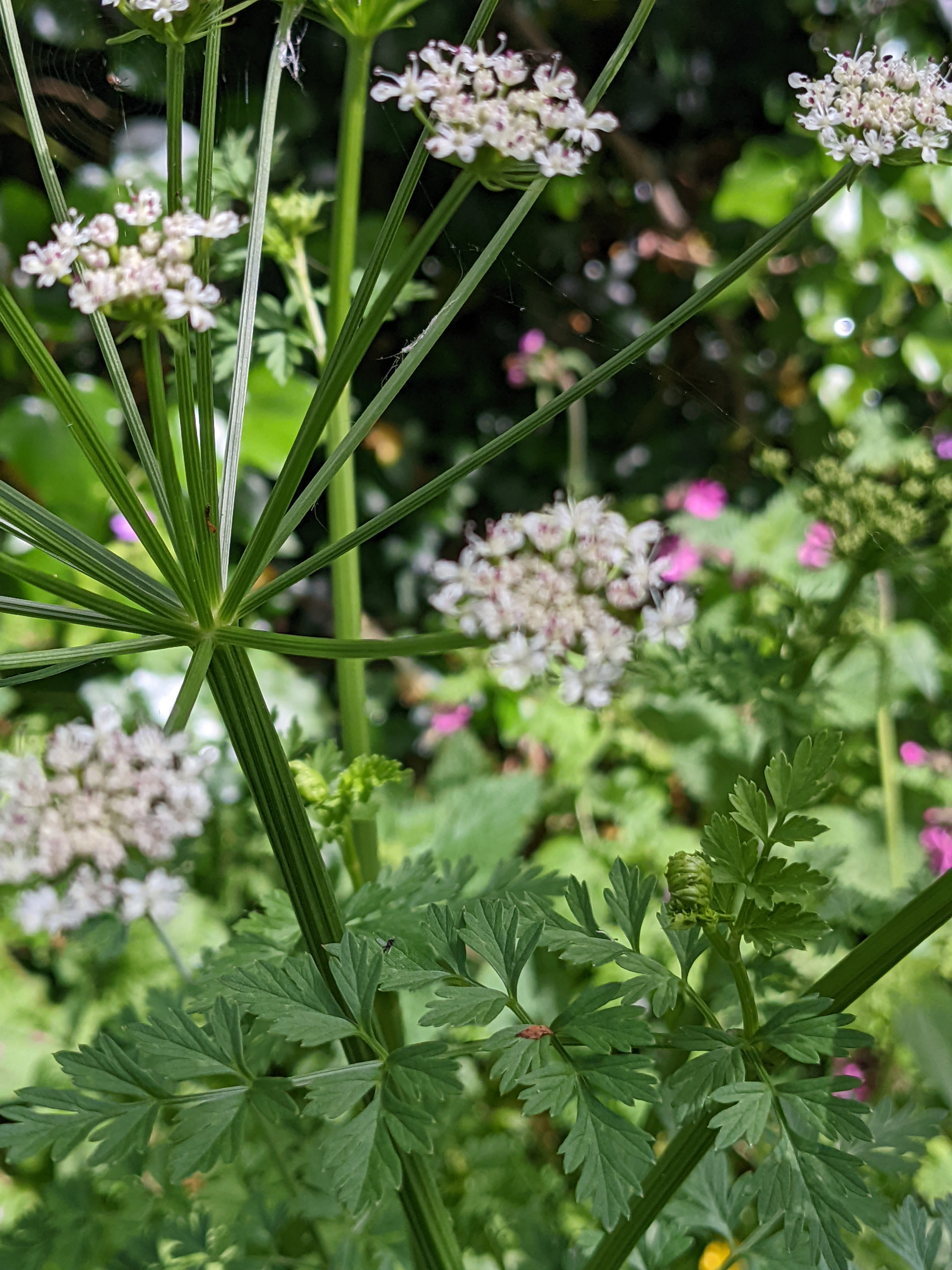
My chaotic records, I’m ashamed to say, are of no use at all in this threatened world unless I get them organised. I get it. This blog is just one thread of my fascination with what makes us human. It’s the visible conversation about the relationship between the Potwell Inn and being fully human; our lived experience in all its partiality and confusion. The other thread is the urge to identify, record and understand what is here in order that we can make a reliable inventory of what we have, what we are losing and what we have lost. Hard nosed and factual, industrious and perhaps a bit dull; except that I spent a couple of hours yesterday dissecting and photographing some Cow Parsley and comparing it with some Rough Chervil. I can’t begin to tell you how enjoyable it was!

“Good in parts – my Lord”

It only takes one blast of wind in a storm

The quotation, for the benefit of the under 70’s, comes from an Ealing Comedy film during which a poor curate feels obliged to eat a gone-off boiled egg prepared for him by his rather lordly bishop. When asked if it is tasty, he replies –“good in parts my Lord”. Like the tree in the photograph, blown down by one of our winter storms; yesterday was good, even very good in parts; but in one part a bit depressing.

We were doing a long amble through Bohortha, down to Place and then along the creek back to the campsite; seven or eight miles I should think, with a fair few hills to get across. Just after Place Ferry (the small ferry service over to St Mawes) we bumped into a couple walking in the opposite direction and began chatting. “You’re not from round here?” he asked. That’s the thing about local accents; (I mean local and not regional). The thought of banjos, verandahs and shotguns flashed through my mind but I knew that although we were complete strangers we shared a voice and a speech pattern that’s unique to one part of Gloucestershire. It was a good start. I don’t usually tell people about my parish priest days because somehow it’s enough to kill any conversation stone dead; but when it emerged that they had close friends in one of my old parishes I knew we were on the slippery slope. It was a friendly enough conversation with an amiable couple, but rather marred by him asking me “so are you the vicar that took out the pews?” “Yes I am” I said, and by then the conversation was holed in the side and sinking rapidly into the muddy estuary. 25 years of unremitting hard work reduced to an accusatory phrase. I still don’t know whether to laugh or to cry. “Where do you go to church now?” came next and I thought “stuff it” and said “nowhere”. His wife tried to ameliorate the situation by asking whether I was suffering from PTSD, and I could see that this was all turning into a proper farce; so we put the conversation out of its misery and wished each other a safe journey passing the most uncomfortable seat for one I’ve ever seen. Luckily we were too tired to talk much on the way back, and the simple routine of filling the water tank and emptying the toilet put it all into perspective. There’s no room for self importance in a chemical disposal point.

On, then, to the good bits which far outweighed the rest. Just for starters the weather was lovely for walking with a bit of wind and the temperature hovering between 16C and 18C. Cornwall does the most perfect spring days. I was desperate to know whether my find of a Smith’s Pepperwort would be accepted by the Vice County Recorder and find its way on to the national database. Vice Counties have nothing to do with misbehaviour, by the way, they’re an old established way of divvying up the country into workable areas that never (or at least rarely) change their boundaries at the behest of gerrymandering politicians.

Anyway, desperate as I was to hear from the East Cornwall referee, I left my smartphone in my pocket until it nearly drove me mad constantly pinging for fragments of meaningless celebrity drivel. In the end I turned it off. Smart though it may be, I don’t need to know that on this particular fifty metres of coast path there is no signal ……. and then there is …… and then there isn’t again.

Accepted!

So there was joy in excess of common sense when the email verifying my identification arrived. I felt I’d crossed a rubicon – getting a record accepted after only being a BSBI member for 2 days; but in truth the two are entirely unconnected. Later my son asked me if getting a record accepted makes me a professional botanist. I said I thought being professional involved getting paid in some way and at that moment I was ÂŁ35 down. In fact the vast majority of field botanists are probably true amateurs whose collective expertise is awesome and (for me) inspiring. Anyway he said he was going to open a savings account and put a small sum into it every time I got a new record accepted – in order that I might call myself a professional. What a kind gesture! Although not quite kind enough for me to come out of retirement. But that’s one down and another thousand (or probably two thousand) species to go.

Meanwhile – as an aside on chance meetings – I was on my hands and knees once on a footpath on St Brides bay, looking at this plant and trying to figure out what it was; when a woman stepped over me (I was blocking the path) and asked what I was looking at. “I’m trying to figure out what this is but I don’t know where to start”. “You need a decent field guide” she said. “I always recommend Rose to my students”. “Are you a teacher?” I asked. “I teach botany.” What are the chances of that? Just at the most opportune moment an angel comes along and tells you what you need to know – I mean bookwise not about being pregnant! The plant, by the way, is Hemlock Water Dropwort – and it’s as poisonous as plants get. Foragers would do especially well to memorise it.

Now, years on, I’ve got shelf loads of books and field guides and an entirely new life as an allotmenteer, amateur botanist and gossip – plus I’m in Cornwall and therefore very happy.

Once again, walking down to Percuil, our hearts are lifted.

Potwell Inn regulars will know that I get a bit grumpy when people take the therapeutic powers of nature as the fixed and immutable reward for stepping outside the door. Hand on heart I suspect I’m a victim of the protestant work ethic that guarantees there’s no gain without plenty of pain. I lay the blame for that disposition squarely on the Primitive Methodists who were rather keen on rewards but much more on punishments. Then, like today, we occasionally go for a gentle stroll with no particular quarry in mind, and we return almost breathless with joy.

Cornish lanes are never lovelier than they are in Spring and the footpath down to Percuil from Gerrans was as lovely as any lane ever has been.

We walked this way six weeks ago and the change has been astonishing. One of the most intriguing features of our walks is to see the successional drifts of flowers following one after another. You can no more hold back the emergence of the next wave of plants than you can hold an eel in your bare hands. I took this photograph because the combination of colours: the pink of the Campions, the white of the Stitchworts and the blue of the bluebells looked so beautiful in the sunshine against the green vegetation. You don’t even have to know the names of the plants to appreciate their beauty. Looking more closely you can spot Navelwort, Dock, Herb Robert and Hogweed. Further down the path we spotted a patch of Early Purple orchids – some with spotted leaves and others without; plants don’t read textbooks.

As we went down the path we could see the successions working out. Six weeks ago there was a mass of Winter Heliotrope, mostly finished flowering. with Alexanders emerging through them. Today the Alexanders were almost finished and the Cow Parsley has thrust through them, closely followed by Hogweed. Already the Cleavers (Goosegrass if you prefer) is threading up through the competition and even showing some tiny white flowers. There’s something wildly, needlessly extravagant about nature – like a Sufi dance – that can lead, (I say grudgingly), into direct awareness of the Power, the Spirit, the Tao; whatever you want to call it.

Percuil harbour

Down at the harbour we perched on the concrete wall of the chandlery come boatyard and laughed about the time we got beaten by the tide and the wind as we paddled back in our kayak and had to be towed in by the instructor. One of the boatyard workers drove past us on a tractor and as he walked back I asked if they were busy. “Yes,” he said, “The season always takes you by surprise”, and he graced us with a friendly smile. Behind the wall an invisible woman was having a loud conversation on a mobile and a hundred yards away the sound of a conversation on the verandah of a holiday let, skimmed across the hard sand towards us. We’d hoped for the sounds of Curlew or Cuckoo but today we were content to listen to a whole choir of other species. Upstream on the creek, a Heron and an Egret eyed each other cautiously over a patch of territory.

We walked back up the road with Madame’s rucksack stuffed with Corsican Pine cones for her to draw. I think she’d scaled the fence of a rather grand house to snaffle them under the gaze of a dog walker who she’d confused with me. That’s the joy of a meandering stroll with no particular purpose in mind.

On the other hand there’s serious work to be done and I’d spotted a couple of plants of what I think is Smith’s Pepperwort – Lepidium heterophyllum on a footpath. I checked on the BSBI database and although it’s been recorded all around us on the map, it’s not been seen here. Distribution maps can sometimes tell you more about the distribution of field botanists than they can about the private life of plants. Anyway, with the prospect of filling the last missing square in the jigsaw I was like a dog with a bone and sent a preliminary enquiry with a couple of poor photos to the local Vice County Recorder. That cost me ÂŁ35 because in all conscience I couldn’t continue relying on the BSBI, (Botanical Society of Britain and Ireland), for help without at least joining. And so I proudly present the evidence below with very little expectation that anyone else will be interested. Little things please little minds.

This little lot cost me four visits, one of which was to sniff a crushed leaf. The fact that it didn’t smell foetid or of garlic turned out to be important. So were the hairy leaves and the tough old perennial rhizome, not forgetting the purple stamens.

Culture war on the allotments

After an exhausting couple of busy weeks on the Potwell Inn allotment we’ve come down to Cornwall for a break. Luckily we were blessed with some decent rain as we left and although it made for unpleasant driving on the motorway it was a joy to think that the allotment was getting a thorough soak. Happily too, we’ve got brilliant neighbours who are always willing to lend a hand with watering the greenhouse and the polytunnel. Although the greenhouse has an automatic watering system, it’s very difficult to calibrate because the pressure goes down as the water level in the tank decreases, and occasionally a bit of gunk jams the inlet valve open so it floods the plants and does as much harm as drought does. There’s no doubt that personal attention is the least foolproof way of going on, but we all need a break occasionally and so we help each other out.

In fact, half the joy of allotmenteering is the community of interest that it builds. The gardeners on our site are a pretty fair representation of the hugely diverse and polyglot population of Bath. When we talk of culture we need to remember that the root of the concept comes from the uniqueness of our highly local ways of living, growing, talking and celebrating. You can either treat diversity as a threat, or (so far as I’m concerned) a marvellous melting pot in which everyone becomes both teacher and student. To use a slightly academic phrase, what diversity offers is the prospect of emergent properties; insights and techniques of the utmost importance in a time of huge threat.

So it came as something of a surprise when, after a hiatus of two years, the council announced that plot inspections would take place in early May and, rather than acknowledging that the site has never looked better with so many newcomers taking on empty and neglected plots; started to send out letters threatening eviction for quite trivial and, in one case, quite imaginary infringements of the rules. Sheds, one allotmenteer was informed, were not permitted to have windows. No trace of any such regulation can be seen in the 27 pages of mostly sensible rules but suddenly we are all in danger of being evicted as a result of rogue windows. The Potwell Inn allotment will probably get away with it because since the vandalism on Christmas Eve our shed hasn’t had one and the void has been covered with an empty manure bag, tacked on. We may, I suppose, still be turned off under a newly invented rule that advertising is not permitted. Another member was threatened because they were using an old cast iron fireplace as a firepit.

We were, however, warned that “non fruit bearing trees” with a trunk diameter of more than 3/4″ are not permitted. This is an (unwritten) extension of the sensible rule that standard fruit trees are prone to shading neighbours’ allotments. All of our trees are on highly dwarfing rootstocks, but Madame stuck a small piece of pruning from a bay tree in the ground in the hope it might preserve the leaves better than hanging it in the kitchen. We got an email detailing the ferocious and land grabbing propensities of bay and were “advised” to remove it. Our experience of bay trees is that they can get out of hand, but over pruning will often kill them.

So what on earth is going on? It seems to me that there’s an intriguing allotment culture war going on between an official with a very rigid historical view of what constitutes a proper allotment and a bunch of new gardeners who are entirely free of any preconceptions about double digging, National Growmore fertilizer and finely calibrated straight rows. On the one hand there is the stereotypical Mr Digwell with his trilby hat and pipe and on the other a new culture of recycling, upcycling and acute environmental awareness. The 25% of land on which we are allowed to grow flowers is more likely to be occupied by more recently sanctified “weeds” than cut flowers destined for the church porch.

I propose a test case with the lovely Echium pininana (photo above) which fails the regulations in every way being way more than three inches in girth, as much as ten feet tall, but which dies at the sniff of a frost and in summer is always alive with bees and other pollinating insects including armies of ants. And in any case, what on earth constitutes a non fruit-bearing tree. Without winter berries many of our overwintering birds would simply die and so – are cotoneaster bushes (in sensible numbers) friend or foe? Whose idea of fruit or food are we meant to be protecting?

Ironically the Council has announced a whole raft (I like that word because it implies imminent flooding, which is all too true), so a whole raft of green measures including green corridors which, truth to tell, is exactly what we need since Crest Nicholson were allowed to build houses for the wealthy on the southern riverbank which, before the construction of flats which resembled Russian bonded warehouses, was a post industrial urban wildlife haven. Of course we need houses, but not just for the wealthy!

So there we are – away in the wilds of Cornwall with the campervan; hunting for plants and – to be strictly accurate – guzzling wine and snoozing in the sunshine too. Will there be a menacing letter waiting for us when we get home? Time will tell I suppose, but this battle isn’t really about windows or trees it’s about dreams, it’s about saving the planet, it’s about listening to new ideas and new ways of doing things and it’s about widening the slit in the sentry post of petty regulations to see the wider picture.

Big day in the polytunnel

We’re flat out on the allotment at the moment and this is just a brief post to celebrate getting the tomatoes into the polytunnel. The Potwell Inn kitchen is very slowly being cleared of young plants as we keep an eye on the possibility of frost. After prepping the beds I emptied a whole 250 litre water butt over the dry beds, but I could probably have applied twice as much. It’s been another record breaking dry spring and so we were very glad to have 1700+ litres of stored water at our disposal.

Madame, working outside, spotted this spider – we think it was a Wolf spider – carrying her young around in a sac. These spiders are hunters rather than trappers, so they don’t weave webs.

There’s a huge difference between looking and beholding

My old music teacher AF Woodman had an assortment of names for me. Sometimes he would address me as “rod, pole or perch“, and on others he would extend my name by stressing every letter into a strangulated “poe-ill”. I didn’t care what he called me because he gave me a lifelong love of music. One of his pet phrases was – “I know you heard it Poe-ill; but were you listening?

Much later in life I was on a retreat at the La Retraite convent in Clifton, and we were invited to take the hands of a complete stranger but rather than something easy like telling them what we had for breakfast, we were instructed to behold one another. This turned out to be incredibly hard for me because it involved letting my guard down. It was, in its own small way, a life changing experience, because it uncovered a complexity and depth of possibility in an encounter with a stranger that eventually became the key to my pastoral work. Dangerous, messy and (in a very limited sense) erotic beholding, enabled a form of listening which involved all of the senses.

It took its toll, of course, and eventually I just ran out of steam. Too many bereavements; too much grief. I needed to get out before I burned out.

Anyway, that was then and as I’ve written here before, the key to surviving crises is a capacity to reinvent yourself using the strengths that are left after the broken bits have been laid up; all of which maunderings lead to a further look at the alleged healing powers of nature. The italicized “alleged” is not there to knock the idea but it’s just asserting that the healing powers of nature are a hypothesis not a natural law.

On Monday last we went back up to Velvet Bottom in a further search for Spring Sandwort – Minuartia verna. Our recovery from Covid – which we caught a month ago – has been very slow. The acute phase was pretty horrible, but that was followed by all sorts of symptoms that seemed more psychological than physical. Combined with a really busy time on the allotment it was as much as we could do to keep up with the routine work because any physical effort seemed to drain us both completely. So our trip to Mendip was compromised by my incapacity to focus, or draw any inspiration at all from what would normally excite and engage me. Madame was kind enough to keep her counsel, but I must have been a miserable companion. All I could think of was to lie down on the grass and sleep. Fortunately, a week on, we both feel almost normal again.

The urge to lie down on the warm grass, though, was inspired by an experience in my early teens when I lay on the grass on Rodway Hill and had what Romain Rolland described to Freud as the oceanic feeling. I’ve no idea how long it lasted but I seemed to be completely absorbed into the earth and her processes. From my point of view it was a completely passive experience and even though I was very young I just gave myself up to it. It was a completely unasked for healing that I’ve never forgotten. I lay there looking up at the blue sky, dappled with summer clouds and listened to the wind riffling through the drifts of grass. Now, with hindsight, I would include this in a description of the healing powers of nature only with the proviso that it can never be sought – it’s an experience of undeserved grace that can’t be guaranteed in any particular place, and which only fell to me a couple of times despite many attempts to force its hand.

But there’s another way of engaging with nature that’s quite different and is capable of and responsive to being sought; and it involves a kind of beholding, directed at natural rather than human subjects. Yes of course it’s possible to reduce field botany to a kind of trainspotting, and I’m certain that there are people out there who ask nothing more of nature than a new record. But when I go out on a field trip with some people, I sense that their engagement with the tiniest of nature’s gifts is far deeper; a two way engagement that both speaks and listens. To walk with such a person is – to quote a favourite heretic

To see a World in a Grain of Sand And a Heaven in a Wild Flower, Hold Infinity in the palm of your hand, And Eternity in an hour

From Auguries of Innocence – William Blake

For them a tiny rope of mycelium tracking across a dead tree; the elaborate hieroglyphic of Graphis scripta lichen a couple of inches in diameter on a tree trunk , the little Moschatel with its cubic flower head giving it the name Town Hall Clock; these are not ticks in a box but true encounters – beholdings, if you like – engagements with nature that have spiritual power and maybe even (if the seeing becomes a true beholding) an offer of healing. So in this sense too, it means something more than wishful thinking to speak of the healing powers of nature.

I hesitate to introduce terms like dangerous, messy and erotic to the pursuit of field botany, but if they have any use, it’s to move the heart of the enterprise away from the rational calculations of the identification key, spreadsheet and grid reference towards something more akin to wonder. Perhaps the healing powers of nature could be more easily embraced after her re-enchantment.