“Sumer is icumin in”

Even while we’re still battling with low temperatures and arctic winds, the earth’s changing track around the sun brings longer days and more sunshine. Now it’s not a question of ‘if?’ but ‘when?’. In the photo, the last days of the purple sprouting broccoli are almost here, while the beansticks are ready for summer. Setting up the bean sticks seems to be a form of benign displacement activity – it’ll be weeks until they’re needed but yesterday as I set them in, it felt like I was planting a flag in the diminishing skirmishes with winter. Yesterday too I set up a wigwam for the Alderman peas to climb and transplanted the autumn brassicas while Madame sowed seeds. We’re clearly in phase three of the sowing season. The first courgette shoot peeped out of its pot in the propagator, which is actually in use throughout the year. First to go in were the chillies and peppers in January, with successional waves until now when (aside from successional direct sowings) everything is sown except the autumn bulb fennel which goes in after the longest day. Then, during the rest of the year we grow basil for the kitchen.

The tomatoes are pretty much hardened off in their pots in the polytunnel now and we’re wondering when we should plant them into the soil. That will mean moving the container potatoes out into the wind and weather, so it’s a bit of a juggling act, but the forecast shows three more cold nights and then gradually rising night time temperatures. That’s a relief because the temperature in the polytunnel can go lower than the general air temperature – quite why I don’t know. Last night, for instance, the air temperature on the window ledge didn’t go below +6C but the polytunnel went down to +1C. The effect of moving the tomato plants from the flat to the tunnel has been to stop them growing altogether as they acclimatise to the bigger temperature range. For now they’re double wrapped in a fleece cloche inside the tunnel. The other most noticeable casualty of the cold nights has been the asparagus which is later this year by at least three weeks. It is producing, just about, but really it’s just ticking over even under a fleece cloche.

Needless to say, we sit light to the plans we drew up during the winter. Small plots are something of a nightmare when it it comes to rotations because some crops – potatoes especially take up a lot of space and some occupy their space for over a year. We just do the best we can, especially with the potato/tomatoes group but because the solanaceae comprise our largest rotation group we just improvise; sometimes rotating from one part of a bed to the opposite end; but even with all our best efforts the actual decision as to where each group goes is a last minute choice according to the space available. Yesterday we were lucky to have an empty bed about the right size, which had never seen any brassicas. The price was a second season of legumes on another bed further along which is the lesser evil (we hope!).

This year we’ve covered all the carrots and alliums (leeks, onions and garlic) with fine insect netting from the off, and grown them all in new soil and raised beds in the hope we’ll shake off the curse of allium leaf miner. This is nothing more brilliant than a bet. Anyone who imagines that we’re experts is mistaken. Mercifully, writers and bloggers don’t have to account for ourselves to our readers. My son was telling me today that a friend of his has written five quite successful books on a mind-bogglingly wide range of subjects from sourdough to gardening. All I can say is that if I ever need brain surgery I hope he doesn’t show up and supervise. It reminds me that when I was training to conduct interviews for the radio we were told that asking an actual expert a question on their chosen subject was always likely to result in a long and opaque dissertation accompanied by a power surge as people resorted to boiling the kettle. What you need is an amiable sounding bluffer …… hmmm – like me?

Chatting to our allotment neighbour today, he was lamenting that he’d followed exactly the instructions for growing shallots given by a massively famous TV expert – only to watch them sit in the ground sulking. That’ll teach him! Gardening is full of mysteries and turning a lucky coincidence into a canonical truth and then blogging about it doesn’t help anyone to be a better gardener. That’s why The Potwell Inn blog confines itself to the tricky business of being human, using examples that might include gardening and cooking but mostly avoids cruelty to animals! However today I was lugging a bag of compost across a narrow border and Madame upbraided me for snapping off one of the two Monarda plants we’d only set out two days ago. I bowed to the frosty storm but a few moments later I had a closer look and discovered that the slug which had sawn it off was still hiding under a leaf. Revenge was swift and terrible, but the Monarda is still dead.

It seems slightly odd that today I finished planting out the purple sprouting broccoli that we’ll be eating this time next year. I always find having to juggle the many sowing dates and times to maturity quite challenging. A quick taste of the polytunnel spinach was a revelation. Far from bitter even the largest outside leaves and stalks were good enough to eat raw in a salad. I do think the quality of our bewilderment is improving with time. Earlier our son and his partner came to visit us in the flat for the first time in over a year. Life creaks slowly back into the familiar patterns but going into a shop still feels odd – like a dangerous celebration. We bought some aubergines, peppers and courgettes from the veg stall in Kingsmead square and Madame is cooking ratatouille in the kitchen as I’m writing this . The smell is wonderful and – like putting up beansticks – it feels like a promissory note from the summer.

These are a bit close, I know, but we’re only growing for two so we don’t need huge vegetables – and it’s much nicer to eat them garden fresh.

Soil, sunshine, rain.

It’s difficult to overstate how beautiful this cauliflower is. I wondered for a moment whether I should add “beautiful to me” to that statement, but I think not. The beauty of grown things is not a whimsical fancy but one of the facets of nature that presents itself to us as a fait accompli. This exquisite formation of leaves and curds doesn’t demand my admiration – in fact, being a vegetable, it has no view on me or my opinions but comes as a gift.

I took the photograph yesterday when Madame unfurled the leaves which had mantled the head because she wanted to see whether this longstanding occupant of the allotment had finally come through. A full year after being sown, this cauliflower – one of four – was showing signs of its age; chewed by slugs with the outer leaves pecked by pigeons until we netted it, and the stalk turned to wood. These long standing biennials occupy a lot of ground for a very long time but, like the purple sprouting broccoli, they ripen at times of peak need – the hungry gap. The old growing year produces its Rembrandts just as the bright young things are putting on their first shows.

Most amazing of all is the fact that the food we grow and eat is made by turning sunshine, water and earth into vegetables. It’s a difficult balance because just a little too much or too little of any of the three can lead to disaster. For instance we’ve just emerged from one of the wettest winters since records began, followed by the driest spring and the coldest sequence of frosty April nights for sixty years. The plants are all at sixes and sevens and we allotmenteers are juggling seedlings, watering cans, propagators, south facing (UK) windows and fleece whilst obsessively consulting the weather apps on our phones. Sunshine, water and earth – the elemental gifts of nature – are outwith our area of dominion.

The watering can, the heated propagator, the polytunnel, fleece and greenhouse are our puny attempts to skew the odds in our favour. However, skewing the odds presupposes we’ve cracked the secret and what’s actually happened is that growers and farmers believed the bookies and started shovelling cash into the agrochemical fruit machine in the misplaced certainty that they were bound to win the jackpot eventually.

But slowly we’ve come to realize that rain, sunshine and earth are not strangers but the deeply related holy trinity of all growing things – ourselves included. Seawater and sun make clouds and clouds make rain. But when the clouds obscure the sun then the sun and the earth are estranged. When the earth is eroded no amount of sun can restore it. When it heats up, the weather becomes confused and extreme. The dark side of forcing the last drop of profit from the earth is drought, storm, flood, pestilence and famine – and if that sounds a bit Old Testament it’s maybe because this temptation to game the system isn’t something that got invented in the modern world.

But to get back to my cauliflower; when I look at it – rather perhaps when I behold it, I understand that all the while I thought I was the agent through whose efforts it could grow – I was, in fact its servant. Fussing over the seedlings, pricking them out and then in time planting them in a bed we’d already prepared; netting them last summer to keep the cabbage white butterflies out; hand picking slugs and snails out of the crown; spraying the white fly with soap and water and wrapping them against pigeons. We were in it together the whole while; with me in the expectation of the food it would provide and the cauliflower presumably committed to continuing its genetic inheritance to a future generation – all of which makes seed saving a kind of moral imperative!

We haven’t done a great deal of seed saving on the allotment except for the Calendulas and sunflowers (harvested one drunken night in Provence, with a full moon and fireflies!) – which seem to grow better from saved seed. This year we’re leaving a single parsnip in the ground to flower and we’ll save seed from that too; but the main motivation was to take advantage of its power as an attractor for insects. Is this some kind of religious attitude creeping in? It would hardly be surprising if there weren’t some traces of harvest festival, rogation days, Plough Monday and Wassailing at the White Hart jiggling around with the Old Testament stories in the back of the old lorry that constitutes my memory. But it’s not organised religion in any sense – not the kind that gives licence to so much mayhem and destruction.

What I love about allotmenteering is the chance to engage with nature much more practically. Going on a walk through the woods is like sitting there alone on the edge at the school prom. It’s much more engaging to grow a wallflower than to be one. When I approach a plant I often ask it (silently) what would be the right thing to do for you right now? Sometimes plants say ‘give me some space‘, or ‘give me some water‘. Sometimes they say – “I don’t like it here – can you put me over there in a bit more shade or sunshine?” The end result of the dialogue is a better plant. My cauliflower is the product of a long conversation between the seed, the earth, the sun and the rain and me. That’s the point of it. When we finally pick and harvest our produce we often say thank you out loud as we shall when I cut the first cauliflower at the weekend.

Of course there’s all the stuff about road miles, industrial food production and intensive farming with all its chemicals and heavy machinery; but ultimately we grow food at the Potwell Inn, because the only way to become fully human is to join the dance; to embrace feast and failure as a joyful participant rather than a passive consumer fuming at the absence of your favourite brand of tomato in the supermarket.

There is something splendid about a vegetable – even a cauliflower -wrought in this elemental process of earth, water and sun. The fact that generations of seed savers and plant breeders have selected for what we like to describe as desirable qualities might equally be seen as the resilient plant’s embrace of mutuality as the best way of getting along well. As Michael Pollan points out, corn and potatoes have done pretty well out of the deal.

So let’s not get too despondent about the way things are. Environmental degradation really is reversible. My phone – an ever reliable cause of pondering – came up with this photo of the Potwell Inn allotment exactly five years ago to the day. I rest my case.

It finally feels safe to welcome the apple blossom

For reasons that I doubt stand up to scientific scrutiny, May 12th is a red letter day in the Potwell Inn calendar, because it’s the day we feel safe to plant out runner beans. Should you be tempted to follow this piece of jumped up wisdom, I’d warn you that May 12th is no more significant than being two days after the latest date we’ve ever lost an entire crop to frost. Logically speaking, in this age of climatic catastrophe, it’s possible that we could see a severe frost a week later but we’ve got that covered because as usual we’ll sow a second lot a fortnight later. The allotment is a test bed for delusional theories about almost anything but we do need some kind of structured timetable, however unreliable – if we’re ever to grow anything. Folk wisdom takes us a little way; February fill dyke certainly lived up to its name; March came in like a lion but carried on prowling long after the lamb was meant to take over; and where are the April showers? – a bit of drizzle tomorrow and that could be that. The water butts are already nearly empty; and don’t even mention this relentless east wind!

However the two week weather forecast is showing a clear, frost free run through to May 10th which means (or perhaps may mean) that we can look at the apple blossom with fond hopes of a crop, rather than fearing that things can only get worse. Borrowing from the sinister language of covid, the allotment has been divided into areas. We have critical care for the tender plants outside that need constant covering and uncovering at night. Then there’s the polytunnel which speaks a high dependency language we’ve yet to master; and after that there are the overwintering brassicas; the cauliflower and purple sprouting, which seem to endure whatever nature throws at them.

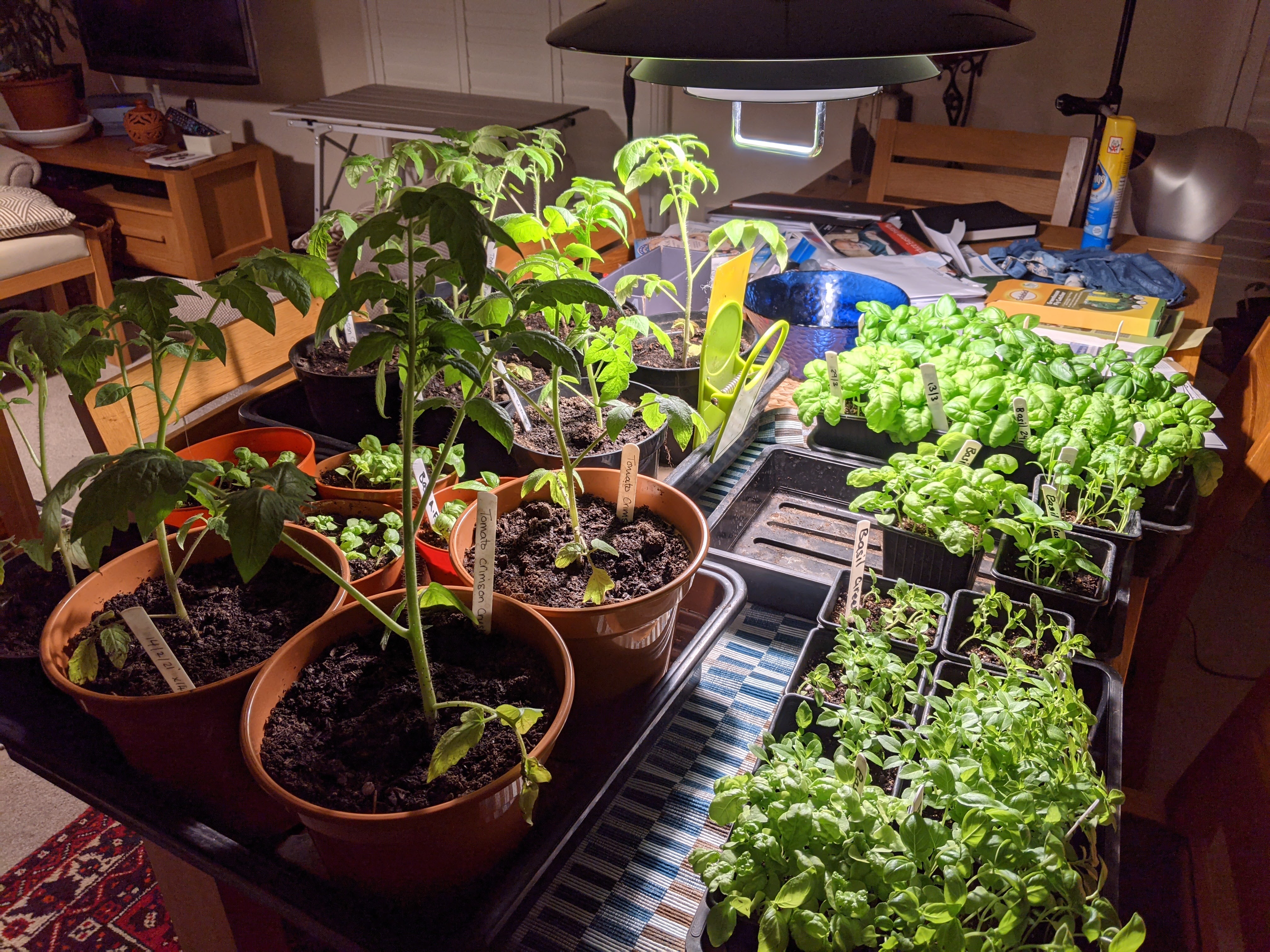
After a very shaky spell in the greenhouse, the tomatoes are now inside the tunnel and underneath a large hoop cloche. Every morning we roll back the fleece to let the sun to them and they’re looking well. We’re greatly indebted to Eliot Coleman’s “Winter Harvest Handbook” for this idea. However, with the end of the frosts we’re having to contemplate digging out some of the other polytunnel crops to make space for the summer vegetables. It’s been the most exciting revelation to see just how well crops like strawberries, spinach, chard, radishes, lettuces and early potatoes thrive under plastic. The container potatoes can be moved outside of course, as can the container carrots but whether we’ll be able to harvest the young turnips in the next ten days is doubtful. At home we’ve got chillies, peppers, aubergines in 5″ pots and trays of basil ready to go into the tunnel alongside the tomatoes, and while they all harden off we’ve got runner beans, borlotti and french beans going into root trainers to germinate; and melon (Minnesota Midget), winter and summer squashes, courgettes and cucumbers sitting in the heated propagators with corn to follow.

But this isn’t by any means all that’s been happening on the allotment because we’ve been setting out the rest of our list of insect friendly plants – so aside from the herbs, we’ve introduced four lavenders (Hidcote Giant), Bee balm (Monarda), Lemon Balm, Winter Jasmine, pot marigolds, Erysimum, catmint,Salvia, Hyssop, Echinops (globe thistle) and borage. They’ll join the fruit trees, soft fruit bushes and globe artichokes. The pond is planted up with iris, horsetail, water mint and other bits and bobs we’ve been given by other allotmenteers.

Surprisingly, perhaps, it’s been the kitchen herbs that have almost given us most pleasure. For more serendipitous reasons than cold logic we’ve collected six different mints and we’re growing four types of basil this season. We’ve thyme, marjoram, oregano, winter and summer savory; French sorrel, lovage, two types of parsley, rosemary, sweet cicely, coriander, chervil, French tarragon, chives and sage. There are probably more that I’ve overlooked. Ironically one of the healthiest marjoram plants we’ve ever grown is a self-seeded plant clinging to the foot of the compost bin on the edge of a path. Like so much in nature, plants are often best left to find their own favoured spot. We’ve lost so many thymes over the years but we still carry on hoping that one day they’ll find their own sweet spot.

Finally, it’s good to write that the latest cordons, (Victoria plum, damson, bramley and Conference pear) have all taken root. They’ll take three or four years to produce any fruit at all but they make me feel optimistic. And the asparagus bed is just beginning to produce useful quantities. When it was planted out we used a bulk offer to put in crowns of three different varieties but to be honest only one of the varieties ever did well. This year the bed has started throwing spears across the whole area at once. Our neighbour has has exactly the same experience and we wonder if the dominant variety hasn’t spread into the space once planted with other types. I’m no expert, so we’ll wait and see.

As I look down this posting I’m a little amazed that we’ve managed to stuff so much into 200 square metres and I wish I could claim it was all down to our expertise; but our guiding principle has more likely been greed, optimism and naivety. It hardly seems five minutes since the day when I’d never seen a green pepper, never smelt garlic and didn’t know any herbs apart from thyme, parsley and sage. Our very first herb gardens were fuelled by the need to furnish our cooking when you simply couldn’t buy herbs. The upside of a childhood lived through food rationing was that every new flavour was a genuine discovery. How could you not be blown away by the discovery that tarragon tasted even better with chicken than it sounded in the books. Even this year I discovered how good sorrel tastes – because we’ve grown it and now it’s free!

As we emerge from the lockdown more or less intact, my phone keeps reminding me of the things we were doing three four five and more years ago. Today this picture of Bardsey Island popped up and my heart sang with joy at the thought that this year – perhaps in September – we’ll be able to go back. Below Bardsey I’ve put in some other pictures taken yesterday on the allotment. Don’t ask whether the loss of the one is compensated by the gain of the other. Life doesn’t work like that.

2017. Bardsey Island from the mainland on Lleyn. It always reminds be of a leech!

Digging down

Priddy Pool

As it happens this post isn’t, strictly speaking, about allotmenteering or gardening, but about interrogating a landscape – to borrow a phrase from Alan Rayner of the Bath Natural History Society – “It’s about walking in nature rather than through nature.”

Dunnock egg

Our favourite way of exploring is to get to know a new landscape by walking all its byways and footpaths really intensively. In this case it’s revisiting a landscape after a gap of many years which has added an extra dimension altogether. I don’t think there’s anything particularly deep or spiritual about this way of walking; it’s just about intense attention to detail. The dunnock egg, for instance, was in the wrong place; many yards from any possible nest. It’s impossible to know why it was there, but probably it had been stolen and then abandoned.

What triggered this line of thought was using the idea of silence in my last posting. Today we were walking a linked series of old droves and as we made our way towards the starting point I realised that I could hear the sound of a dried and dead leaf scuttering across the road in the brisk wind. That’s silence. I could describe it as the matrix that holds all the sounds of a particular place together; an ocean in which sounds are made and scattered. Its a great sadness that such moments are so rare these days.

But there’s more. Coming back to this high country after many years, farming seems to have changed. Walking through the village everything looks much the same – the local authority have done their job in preserving its appearance – but from the inner landscape – the droves and footpaths, another picture appears. Old buildings that were once useful are now abandoned. Behind the unchanged roadside buildings massive new barns have sprung up as farmers have been forced to intensify or go out of business. The rich diversity of wildlife has become increasingly confined to reserves and after three days of walking we’ve yet to see an unimproved meadow. This isn’t an attack on farmers at all. They’ve somewhat heroically tried to do everything they were asked to do – not least to increase production at the expense of the soil and the environment in general. Every cottage that hasn’t been sold to second homers has been pressed into service for holiday lets and – in a situation I know only too well, a local mixed farming culture that developed over centuries has been homogenised and all but destroyed. I was only bleakly amused to meet an electrician installing CCTV cameras on a remote house to deter off-roaders in four wheel drives who, totally illegally, noisily tear the ancient drove road to shreds in rain and snow. The balance of power between locals and incomers has been destroyed and the parish council has, by all accounts, endured hostility as the entrenched pro and anti offroaders battle it out. The local school survives but we looked in vain for a shop. It occurred to me that the silence I was enjoying would have been punctuated by the sounds of dozens, if not hundreds of farm labourers and horses. Some silences are more malign than you might think. An absence of life is not what I was looking for.

And the earth in some places looked exhausted.

The landscape, it seems – and sorry about the long word – to be a palimpsest. The newest message inscribed upon the poorly erased messages of the past. Walking through nature you might never notice the difference, but walking in it forces us to embrace its mystery. The story told by the plants that survive in the most surprising corners where they escaped the predation of plough, fertiliser and pesticide.

And yet our hearts are still lifted by discovering new plants. Tonight – so long as the sky stays clear we might get a glimpse of the lyrid meteor shower – first described over two millennia ago, which adds up to a lot of wonder. God forbid I become just another grumpy old man. When it comes to landscapes I’m more Edward Thomas than RS Thomas.

Priddy again.

But then, you probably didn’t need me to tell you that if you’re from this part of the UK. It’s a stack of hurdles, used for the annual Priddy Fair and with its own thatched roof. After last week’s overnight stay here, we decided to come back for some more healing magic on the Mendips. A neighbouring allotmenteer has offered to keep an eye on the plot for a couple of days so we hope all will be well when we get back. The reason for being here is that the Potwell Inn bathroom is being refurbished and, since the flat is – shall we say – compact, we thought it was best to leave the builder to it. We shall return (we hope) to a proper walk-in shower which will be easier on the knees than the present daunting arrangements which involve a grade three scramble over the edge of the bath. Not that our need is imminent; today we did a 10K round trip over the fields to Ebbor Gorge and back again via the Queen Victoria where I had a pint – the first after eighteen months of abstinence. It was the first time we’d been to that pub in over fifty years. The last time was a memorable lock-in when the landlord offered us a room if we we wanted to stay. We didn’t.

An air of celebration has followed me around all day because I’d been to hospital for another echocardiogram yesterday morning and the results were good. Any leaking in the heart valves was, in the nurse’s words, ‘trivial’ and no worse than last time. I thanked her warmly and said I’d never been so pleased in my life to be described as trivial. To my great surprise she said she’d never been to Mendip, but she loved Dartmoor. So do I, I said, but Mendip is closer and less crowded.

So what with hospital, going to the supermarket for the first time in over a year (to stock the van), and driving to Priddy, I was tired but exhilarated. Books, hand lenses, camera and all the usual botanical paraphernalia are here with us and I slept for an amazing ten and a half hours. I have no idea why I can sleep so well in the van when I have trouble in getting beyond seven hours at home, and Madame is equally perplexed. But there’s something in the air here – quite literally because we’re camping next to a stable; but I think it’s the quiet. It’s not completely quiet of course, but all the sounds are embedded in a matrix of rare silence: a rookery just down the road, the horses in the nextdoor field, robins, chaffinches and sparrows singing, the wind in the beech trees. Then there’s the dangerously non-pc perfume of wood fires in the early evening. Campsites have their odd moments. When we arrived I left the electric hookup lead unwound on the grass. During the night, a silent and invisibly tidy minded (did I say tidy?) – camper had coiled it neatly. I know who it must have been because opposite us is a caravanner who has a strategically placed bucket painted red and marked “FIRE” behind his van. If I were really cruel I’d pile on the pressure and uncoil it again – or perhaps leave an empty wine bottle on the grass – but I’m so full of happiness at being out amongst the wildflowers again I’ll say hello to him tomorrow and compliment him on the way his socks and sandals match so beautifully.

Up here on high Mendip is probably not the best place for arable farming because the soil is rather thin. It’s better for grazing, but almost all the fields we saw have been “improved” and grazed mostly by sheep – which has had a baleful effect on the wildflowers and grasses. One footpath was speckled with wasted nitrate fertiliser granules which had been sprayed over it by a careless farmer. The soil up here, between 600 and 900 feet above sea level, overlays carboniferous limestone which drains freely into the many cave complexes. We’ve had a couple of field trips up here in the past, and we’ve visited some of the nature reserves that have escaped improvement and the wildflowers in those small protected areas are both marvellous and often rare.

All our sightings today were as common as muck, but not the least unwelcome for it. I had a go at identifying the crop in an arable field from the tillering leaves. It was a trick taught to me by a retired grain salesman called Richard Hiscock and it’s dead simple when you know what you’re looking for. You need to find out what ligules, auricles, sheaths and blades are and then have a proper look at the plant in question. In this case the fact that there were no auricles and it had short ligules so it was a crop of oats – easy peasy!

So here are a few of today’s everyday beauties. Nothing rare, in fact most of the flowers we saw today are ubiquitous, but after a year in lockdown it was like meeting long lost friends. The butterflies too were out and about- again nothing rare, but who could not like the sight of a Brimstone butterfly going about its busyness. At Ebbor Rocks we stood and watched a buzzard using the thermals above the escarpment over Wookey Hole to quarter the ground looking for prey. There were yellow archangel – Lamium galeobdolon; ground ivy – Glechoma hederacea; violet (don’t know which because I left the guide at home but probably sweet violet – Viola odorata; cuckoo flower or lady’s mantle – Cardamine pratensis; and finally the dandelion which – due to its propensity for interbreeding with its cousins, requires a PhD to identify fully and so it enjoys the latin name Taraxacum officinale agg. Dandelion peak season is around St Georges day – April 23rd and that being the case we’ll be keeping a close eye open for some St George’s mushrooms while we’re here. They used to grow in the (grievously unimproved) garden of our previous house.

You can keep your Chanel, wallflowers do it for me!

For reasons I’ve no intention of writing about, the perfume of wallflowers has the most powerful erotic overtones. This is probably the least written about aspect of gardening but it deserves at least a mention, not least since today one of our neighbours caught me on my hands and knees on her allotment, inhaling great draughts of the memory laden perfume. Madame knows all about this odd affliction so I’m not letting out any damaging secrets here, but if there are any enterprising perfumiers out there, you’ve definitely got one customer. However a lifetime of hearing confidences (and occasionally confessions), has taught me that erotic stimuli are as various as there are people. The oddest I ever heard was a female friend who fantasised about a mechanic with oily hands emerging from under a car and ravishing her. OK?

Anyway, to return to what passes for reality on the allotment, it won’t surprise you to know that the wallflowers (or Erysimum as they’re known by the RHS) are in flower. There’s a survey of the best bee attractors in Ken Thompson’s book “The Sceptical Gardener” which is an excellent read , and the plant Erysimum Bowles Mauve came at the top of the list. We always keep a few on the allotment and their reputation is absolutely deserved. The lavender variety Hidcote Giant also scores highest among the lavenders. Here’s the list in full.
Marjoram
Cardoon
Erisymum linifolium ’Bowles Mauve’ (Wallflower) – best for butterflies
Echinops – Globe Thistles
Catmint – ‘Six Hills Giant’
Borage
Agastache foeniculum – Giant Hyssop
Echium vulgare – Vipers Bugloss
Salvia verticillata – Lilac Sage,
Whorled Clarey

Ken Thompson “The Sceptical Gardener”

We have been gradually introducing all of these – and lots more – into the allotment. Today I planted out the lavenders and split the catmint into two while Madame interplanted herbs among the broad beans. Mainly, however, we were watering because it’s so very dry. Yesterday we moved the tomato plants into the greenhouse but a very cold morning knocked them about a bit so they’ve been moved into the polytunnel under a second set of hoops and fleece to recuperate.

During the winter I did a lot of thinking about the design of the plot – partly because we’d resolved to make insects and wildlife a priority, but also because parts of the design made it downright difficult to keep up with necessary work. There’s a whole permaculture philosophy centred on what are called “zones”. The general idea is that different parts of a permaculture setup are zoned according not just microclimates and suchlike, but also proximity. In a conventional house and garden, the house is zone 0 and the garden is zone 1. It would be easy to think that therefore permaculture principles don’t (or can’t) apply to allotments which are always some distance away. However, we noticed that our first row of cordon trees were always vaguely neglected because it was so difficult to get to them. They were inside and much too close to the edge of the fruit cage. So this winter we simply moved the side of the fruit cage inwards and left the cordons outside it. Six months on and they’ve never looked happier. They’re in full bud; properly pruned and mulched and generally better looked after because every time we walk past them we can take a close look and take any remedial action that’s necessary.

It’s worth bearing accessibility in mind when you’re designing a plot. We’ve moved the strawberries three times in five years for exactly the same reason. Now we’re growing them in the polytunnel in hanging baskets and they’re in flower and looking blissfully happy. Incidentally we were asked today by a visitor why we talked about our plants as if they were little people. Our answer was “because they are” – which she found almost as difficult to understand as she did when we talked about them being happy. All I can say is – just ask the Nepetas that I split and moved today, if they’re happier after six weeks in the sun, after a year on the north side of the shed.

One last point. It’s commonly thought that gardeners are all amiable, peace loving and non competitive beings. This is not true. We allotmenteers take a keen interest in everyone else’s allotment because we can’t bear to let them get one over on us. It’s a useful sort of competitiveness because it drives up standards across the whole site. A similar competitive spirit has fallen upon us since one of our neighbours started building a magnificent seat and shelter on a plot nearby. I had given up the idea of building a similar structure earlier in the year due to lack of time and funds, but now I’m dreaming of trellises, dog roses and festoons of clematis surrounding our own little shelter. Naturally we congratulated him on his magnificent work through gritted teeth, even while plotting pagoda revenge.

Every day closer to May 10th brings us nearer to removing the last of the fleece, planting the tomatoes into the ground and moving the container potatoes out into the allotment to embrace the sun and grow fat and slick and full of flavour. We’ve cut the first asparagus, but we always throw it on to the compost because it tends to be bitter – possibly through slow growth. By the end of next week it will be in full flush; and speaking of flushes, the two mushroom logs undercover behind the shed are at last showing signs of producing a crop of shitake and oyster mushrooms- if the little white excrescences on the logs are anything to go by.

Deja vu?

Looking down from the iron bridge above lock 3 of the Kennet and Avon canal

Walking down the canal a few days ago we reached exactly this point on the towpath when I found – in the sky, the clouds and the opening buds of the trees – a feeling; a sensation near to joy that was out of all proportion to its dimensions and properties as a view in the ordinary sense of the word.

Naturally it was a welcome change from lockdown ennui but it caused me to wonder how it can be that sense experiences (like Proust’s madeleine for instance), can carry such a huge metaphorical load. I could, if there was time, draw a mind-map with the scene at its centre, and which would embrace dozens if not hundreds of deeply personal associations, many of which could generate further mind-maps. Just to give this a bit of an anchor I could mention wild garlic which is just coming into its glory. My subsidiary mind-map would embrace childhood memories of walking by the river Frome and on from there.

I have no idea whether all this can be adequately explained by brain chemistry unless the scientists would concede that human memory simply stores and recovers these experiences through the workings of brain chemistry, like a biological hard drive – the means don’t matter to me very much but the experience lies at the root of all creative processes, including science. As an allotmenteer and as a rather incompetent amateur botanist I understand that the stimulus which drives us on; enables us to tolerate frost and wind and the loss of a whole crop or drives me to immerse myself in the minutest details of a plant’s structure for hours just so I can give it a name; that stimulus is wonder.

When we’re visiting new places – especially gardens – or walking in unfamiliar environments; meeting new people, the imagination is alive; fired up. Somewhere in the mind the sense impressions are finding places, associations, pre-existing memories, experiences and cultural thought-paths; and the inner workings of memory stores them – each in their right place like roosting hens finding their place on a perch at dusk; each discrete experience tagged and keyworded so that later, many years later perhaps, the precise configuration of a landscape, a flower, a gesture, a sound releases releases the whole stored, aggregated complex. If you were looking for a non-supernatural explanation of the déjà vu experience it’s right there.

A cowslip in our friends’ meadow yesterday

Why the sudden outbreak of philosophy? – Well, this week we’ve been partially released from lockdown. We’ve spent proper time with our children and grandchildren after a year of hermetic isolation and we hugged and clung to each other like shipwrecked sailors. We went to the campervan full of trepidation and replaced the dead battery and took ourselves off for our first night away from home in many months. We camped up at Priddy which is a place soaked in teenage memories of caving expeditions; watched rooks squabbling over nests and ate up the silence. Notwithstanding a terrible night’s sleep, as we were kept awake by a series of power cuts that had the heating unit cycling noisily on and off ; we came back to Bath feeling that we’d begun to emerge from emotional winter again.

Which brings me to our walk when (at my suggestion) we found the entrance to Swildons Hole which I’d not seen in fifty or more years but which is still full of memories. I’d spent so much time down there cold, wet, tired, fearful and occasionally completely panicked but always blown away by the powerful sensation of being underground and by the occasional bursts of sheer beauty hidden from human eyes for millennia.

A few years ago I met an outdoor pursuits instructor at the climbing wall in St Werburghs who offered to take me down again, but somehow we never got around to doing it. One glimpse of the entrance was enough to convince me that it would be a miserable and possibly dangerous experience for a septuagenarian! But that in itself was enough to remind me that however powerful the memories, not all experiences are repeatable however appealing the thought might be. The sense of our own mortality sharpens and intensifies these remembered experiences which linger in the mind like ghosts.

On the other hand, if you look closely at the third photo from the left, you’ll see something of a line of trees above the pill box entrance. I had no recollection of them from the past. In fifty years or so they’ve grown into a magnificent beech hanger and the sound of the wind rustling through the branches was unmistakable and worthy of a ten minute stop for a free symphony. You can see the leaf buds about to break as they turn from chestnut brown to green. At last a recoverable and re-liveable memory from my childhood trips to Stoke Row in the Chilterns. No I hadn’t really been here before, because on my last visit the trees were so much smaller and yet my memory was able to recover more from my grandparents smallholding to furnish and make sense of this new and powerful experience.

So what about the allotment? Well, we’re in suspended animation as the pampered indoor plants grow like cuckoos while we wait for the present icy spell to end. The earth is a dry as dust and we’re having to continually water in the polytunnel because daytime temperatures soar in the spring sunshine. Slowly, slowly, enough tough old stagers are emerging to break the illusion of winter and the apple blossom sits, clenched in bud waiting for the spring as a child waits for Father Christmas. It will come soon, but evidently not yet and not soon enough for some of the wind tormented broad beans. Inside the tunnel with an additional layer of fleece we’re just coming to terms with its capacity to advance the season. Every time we look at the spinach and lettuces or the young cabbage plants we have to pinch ourselves. The container grown potatoes are growing so vigorously I seem to be constantly mixing soil and compost to earth them up, and I think we’ll have a crop by early May.

Between the flat, the greenhouse, the tunnel, the hotbed, various cloches and the open ground we find ourselves managing half a dozen quite different seasonal microclimates. One little moment of joy came when Madame opened the crown of one of the cauliflowers and found the white curds just beginning to form – and that’s the first time we’ve grown them successfully. The asparagus is beginning to accelerate into life and the newly planted trees and soft fruit all seem to have taken. There are tadpoles in the pond and the Hidcote Giant lavender plants have arrived ready to be planted out and ready to attract insects and bees.

So it’s all good. Confusing, frustrating and good – as life usually turns out to be. Any prolonged silences over the next few weeks will probably be down to sheer busyness!

Ten top tips for bloggers

You know how it always takes a while to figure out what’s going on, but surely (at least in the UK) we can agree that it’s a cold spring – and I don’t mean that we’ve had some cold weather because that goes without saying, but after being lulled into a sense that winter is over by a couple of balmy days, we’ve gone backwards by what feels like six weeks; chilled by a seemingly immovable wind from the northeast which only occasionally swings around to the west to gather some more sleet. Over in France and Spain too they’ve experienced some very extensive damage to crops, including grape vines. It’s difficult to make a direct link to the climate emergency but these extreme events have every appearance of being the smoking gun. Something’s wrong when the average temperature is way below normal and yet we’re having to water because the earth is so dry. “That’s gardening” we say to ourselves hopefully – “… you win some and you lose some”; but are we just kidding ourselves? In Bath we’ve had to cope with illegal levels of atmospheric pollution for years because local politics has been torn between reducing traffic and increasing income from students, businesses and tourism. Now, to add to the evil mix, the SUV has become the vehicle of choice for city centre aspirationals. It seems we all agree that something must be done, but the proposals for reducing traffic have been so watered down by the tourism and transport lobbies that the politicians are running scared. Councillors elected on a green manifesto to reduce traffic have crumpled under the pressure and there are rumours of palace revolutions while local bloggers have poured out their bile on those of us who challenge their so-called ancient freedoms – like driving a three litre Range Rover 1/4 mile to collect Tarquin and Cressida from school.

Anyway, all this cold weather presents us with a storage problem at the Potwell Inn, because a traffic jam of tender plants has built up and is now occupying every conceivable space in the flat, leaving nowhere to germinate the next wave of cucurbits; the cucumbers, squashes and melons – not to mention the sweetcorn and the runner (pole) beans. We’ve hatched a plan to construct a third unheated propagator under our original daylight fluorescent lamps because they give out far more heat than the newer LED’s. Desperation inspires ingenuity and we can probably get by.

Not all ingenuity seems to work, though, and I have to report that my genius attempt to lure the rats into the traps with exceptionally smelly camembert cheese fell upon deaf nostrils, as it were, and the hoped for carnage did not come about. It was at least reassuring that the trailcam worked perfectly. Alas we’ve yet to find a reliable way of controlling their numbers.

If you look very closely you’ll see the rat emerging fit and healthy from the trap before exiting down the path.

Much of the week has been taken up by getting the campervan ready for a single night on the Mendips to make sure all the systems are working properly. Our last trip – over a year ago – saw the electrics collapse in domino fashion and we spent the week reading by torchlight and huddled in the sleeping bags to keep warm. When the electrics go in a campervan nothing works – water pump, stove ignition, lighting and heating all go into a sulk. All this was replaced and patched up a year ago but during lockdown we’ve never had a chance to test it out under normal conditions. I’m almost anxious about taking the van back on to the road but, on the other hand, it’s spring and I’ve got a year’s botanising to catch up with. I think I’ll get back to grasses and try to identify the early risers. Goodness why I find it so exciting to know the latin name of a clump of anonymous green stuff with almost invisible flowers – but I do, and yes, Madame finds it inexplicable as well. Glory be! a new book on UK grasses is on its way to me and I’ve already polished the hand lens (this is not a euphemism). It’s called “Grasses A Guide to Identification Using Vegetative Characters” published by the Field Studies Council – end of plug, except to mention that you can get it from the NHBS bookshop which carries an amazing collection of titles on every aspect of natural history, and not so much as a third cousin seven times removed has links to them.

Finally, I’m publicly registering my ferocious dislike for any newspaper or magazine article headed “Ten top ****” I remember one of the chief reporters on a local paper telling me once that most journalists are irredeemably lazy and the best way of getting your copy into print is to do the job for them. A whole industry has grown up around this character defect; it’s called lobbying – and/or – dare I say – influencing in which winsome young people earn money by making videos of themselves promoting various kinds of snake oil. These videos readily supply ten best anything stories about anything from parma ham to windscreen wipers. In this way I was provoked by a “ten best” on the subject of growing veg.

As a potter, way back, I was often penalized for my passionate interest in technique. Somehow a whole generation of art schools managed to make a distinction between “technique” – which you had technicians for; and “talent”. The outcome of this lamentable attitude was that many students completed their degree courses without the least idea of how the elements of their pieces were conceived of and built, and how they all fitted together to make a finished piece. I remember visiting a degree show where I spotted a glaze that I’d designed as a favour to the technician in that department. The student, not knowing me from Adam, was astounded when I gave her the outline of the recipe. The very best students had a firm grasp of technique as well as the creative competence to carry out their ideas.

This need for technique applies just as much to gardening or cooking as it does to ceramics, and one thing I’ve learned over the years by watching really inspirational potters, gardeners and chefs is that there are always more and different ways of achieving what they’re doing. Being trapped by any sort of ten best ideology is like handing over your brains to a stranger. I’m miles too old and ugly to be a persuader but I’ve been tempted. However I’m constrained by the terrifying thought that someone might have been so impressed by my fluent and articulate promotion of camembert cheese as a rat bait that they actually bought shares in in a cheese company and created an online rat bait outlet with its own logo.

I remind myself of Ernest Hemingway’s comment to his daughter that the purpose of education is to teach us to recognise bullshit. I would hate to think that my epitaph might read “Dave Pole – he couldn’t tell shit from pudding!” – so please pay no attention at all to anything I write. My life is a work in progress – until it’s not.

Ghostly presences

With the threat of (another) icy spell for the early part of this week we spent Easter day wrapping the apple trees, whose flowers are dangerously close to opening; and sorting all the young plants into degrees of tenderness so they could be appropriately covered. This left the allotment and the inside of the polytunnel looking like a hallowe’en display or a Christo sculpture but it’s worth the effort – plants cost time and money and having nurtured them this far it would be a tragedy to lose them. This morning we went up to see how the plants had fared and we’ve lost two half trays of tagetes (marigolds) which were at the end of a suspended shelf in the tunnel and from which the strong north-westerly winds had lifted their covering of fleece. For some reason this was more of a surprise than it ought to have been. Because we grow so many marigolds we tend to see them as indestructible workhorses but of course they’re tender little plants and did much worse than the lettuces and other salad crops – all fleeced too – and which were completely unscathed. The other casualties were the few autumn planted broad beans that survived an icy ten days early in the year, but were severely weakened in the process. Most of them have tillered so we haven’t lost them completely, but the few which staggered into spring more or less upright have now fallen. We’ll have to rethink our autumn sowings, perhaps keeping them under cover throughout the winter. It seems that it’s the dehydrating character of the arctic winds that almost does more damage than the temperature alone. Last week until Good Friday we were wearing T shirts and enjoying temperatures approaching 20C (70F). This afternoon as I write this, there is sleet and hail strafing the green in a fierce wind.

April being the cruellest month you can spend quite a bit of time rooting around in the stony rubbish to see what’s survived the winter. The nicest thing is finding that below ground, one of those congregations of dry and hollow remains is sprouting green shoots. Today it was the turn of the fennel. In the autumn during the great sort-out we moved angelica, fennel and lovage into a bed next to the new pond which eventually will be home to all our favourite tall herbs and insect attractors. The lovage is already a foot tall, the angelica seems not to have survived (but who knows?) and today we dug up the fennel only to discover it’s sprouting below the soil. Having read that herb fennel is a surly neighbour to most of the other plants we grow in that bed, we took the opportunity to relocate it in another perennial bed behind the shed. The pleasure that such little discoveries brings is beyond price; each opening bud and flower is a blow against the rule of winter. The little line of new bare root trees arrived rather small and in one instance frail; but I knew if I returned them the chance of replacement this season would be zero. Madame is marvellous at coaxing life out of no-hope bargains. I remember we once had a brief competition with another potential buyer of the most forlorn scrap of rhubarb in a pot I’ve ever seen a nursery attempt to sell. Madame won the contest (as she always does) and the plant has thrived so much we’ve had to split it twice – it cost £1.

I couldn’t countenance a year without angelica, it’s just so stately and beautiful, but it’s a biennial and so although the replacements we sowed in the greenhouse two months ago have germinated we won’t have a fresh supply until next year. For decades I’ve thought about candying some of the stems but I’ve never got around to it because cutting them off when they’re still tender seems sacrilegious. However, you can almost never find it in the shops (in the UK at least) and for me the sweet green and fragrant strips are an essential ingredient of the Christmas sherry trifle as taught to me by my old friend Gill Lough.

After my mention of Uncle Charles in the last posting, my sister reminded me that we had “learned” to milk a cow when staying there with the aid of the outside tap and a pair of rubber gloves. You may laugh, but that’s the exact method used by our teacher when Madame and me did a course on keeping goats. Charles – always known as Uncle Char also had a “garage” made from the empty packing case in which cars were once delivered. He could just squeeze his Austin A35 van into it, but it would collapse every time he reversed out, removing the only solid foundation for the trapezoid box to lean upon. My sister also reminded me that the door to the tiny dairy in which the cream was clotted was painted green. Our working lives may be logical and deductive but our most powerful memories are always sensual. These ghostly presences have a more powerful effect on us than we willingly acknowledge and I often wonder if the very specificity of our gardening tastes, down to the exact plants that we must have to constitute our ideal gardens, isn’t a forlorn attempt to recapture the moments when our memories were at their most plastic.

At the end of the new row of trees (it’s really tiny!) there’s a space for one last newcomer. I’ll probably dig deeper and get a container grown tree for this last one which absolutely must – without any doubt – be a greengage. Even if it never bears a single edible plum I want – no I need – it to be there for us to look at every day, next to the Victoria and the Shropshire damson and know that I have honoured this part, at least, of my grandfather’s gift. The greengage is a small miracle of perfume and sweetness and he grew them at The Crest, his smallholding in the Chilterns.

Life can be driven by all sorts of irrelevancies like expediency and ambition or plain self-interest. For me (for us) the allotment allows us to live life, in short moments at least, as an enacted poem because nothing that’s remembered can ever finally die.

Telling it like it is

This week I was reading a newspaper feature on the natural history writer Richard Mabey that revealed a certain tetchiness about the representation of nature as an entirely positive – not to say cosy -icon.

 “Bacteria and viruses and man-eating tigers and predatory Asian hornets are also all part of nature. At times we need to defend ourselves from ‘nature’ but also row back from the value judgments we make about certain parts of the natural world, because we need the whole thing kicking together if the biosphere, including us, is to survive.”

Richard Mabey in a Guardian interview with Patrick Barkham

Someone once said to me “you know your trouble is that you constantly set up a lovely scene in your writing and then you go and spoil it!” At the time I was a bit rattled by the remark but increasingly I think it was bang on the mark: – that’s exactly what I do; but not because I enjoy raging around my most elegiac visions but because that’s the way the world is. As I’ve said many times before, (sometimes even at a funeral service), love is impossible to imagine without loss – or at least the threat of loss. The greatest joys are too fugitive to hang a lifeline on and so you just have to throw yourself headlong into the torrent and hope for the best. The best writers can inscribe a single moment of the ebb and flow of life without for a moment implying that this is somehow the nature of it.

By way of an example I offer the blackthorn which, today, was in glorious flower outside our son’s allotment. You could never say the flowers were strongly perfumed but they were there in such profusion that the nearby air was infused with the richness of their nectar. Their fruit will appear in autumn, hard and bitter as aloes, and which are utterly unapproachable until they have seen a frost or two and are infused in gin and sugar. The picking of them is a genuinely Good Friday experience because their dreadful thorns will fight you for every berry and leave a septic puncture wound for which you will not forgive them until two years hence in November when you break open the mature bottle of sloe gin. Blessings come with their troubles – they’re contrary sides of the same currency.

So if I write about rats on the allotment I’m not breaking the code of omerta on the darker side of growing things; it’s a touch of duende, of the whole as against the partial. I’d love to be able to show a photo of me in a 1920’s wraparound apron and headscarf; all vermilion lipsticked and gathering sheaves of golden corn but I’d look silly in Madame’s clothes.

The control of rats on any allotment is a necessity mainly because any system of composting except doing it in a hermetically sealed retort, puts two features of rat heaven together – namely food and shelter. Consequently we often meet one another in the way that erstwhile enemies pass in the street; with grudging respect. Not using poisons for obvious reasons, means that the choice lies between chasing them with a garden fork which is likely to result in serious injury, though rarely to the rat; or trapping them as quickly and lethally as possible. Of course turning the heap regularly stops them from building nests and having babies, but they’ll always be there – close by. Today I woke with a possible solution to the challenge, because the problem with trapping is that rats are not stupid and once they’ve seen uncle Pentstemon meet his maker with peanut butter on his whiskers, they’ll avoid peanut butter as if it were made by Rentokil. But we have another problem apart from rodents – which is my fondness for Camembert cheese.

Camembert is surprisingly difficult to buy in prime condition. Supermarkets usually sell it refrigerated so hard it is beyond maturing and completely tasteless. However the local Co-op must be managed by a Frenchman because their Camembert is alway perfect straight out of the chiller. But after a couple of days the smell begins to leach out of our fridge and fills the kitchen. It smells as if there may be a dead sheep behind the washing machine and Madame has a hatred for dead sheep. Normally I would put up with the glorious ammoniac stink of a good one but it has all come to a head. Double wrapping will not do at all and I have been given an ultimatum. Either the cheese goes or she does. It’s an intolerable choice.

And so – this morning I thought suddenly that Camembert might make the most seductive ever bait for the rat traps! Imagine the potential slaughter of six traps baited with lumps of Camembert – I mean – at least twice in each one; twelve fat rats vanquished from the face of the allotments and universal praise from our neighbours who are far too polite to contemplate such a bold plan. I’ll feed the rats to the foxes and film them with the trailcam – which will look great on the allotment WhatsApp page. I shan’t charge a penny for the service – unlike the Pied Piper of Hamelin – because 1000 guilders seems a bit steep – and I’ll be allotment Rep by the end of the year as long as the vegans don’t gang up on me.

My uncle Charles was a rat catcher – seriously – and he would always leave the antidote to his cyanide at home so he’d know where to find it. He was a bit eccentric and would occasionally resort to the shotgun and cheerfully loose off half a dozen cartridges after a rat. He was also a terrible shot, so his chicken houses were always infested with them. My Aunty Dingles, his serially adulterous but glamorous wife, (don’t ask!) also made the best clotted cream in Berkshire which is a county not known for clotted cream so maybe it wasn’t that good.

And that – considered as a whole – is probably why I prefer to tell it as it is. It’s kind of comforting not to have to live up to impossible role models and I was at least spared that fate.

What’s your game sunshine?!!