By the rivers of Babylon. I need a word and only Welsh will do

The first basin on the K & A drained for maintenance today to the bewilderment of a heron.

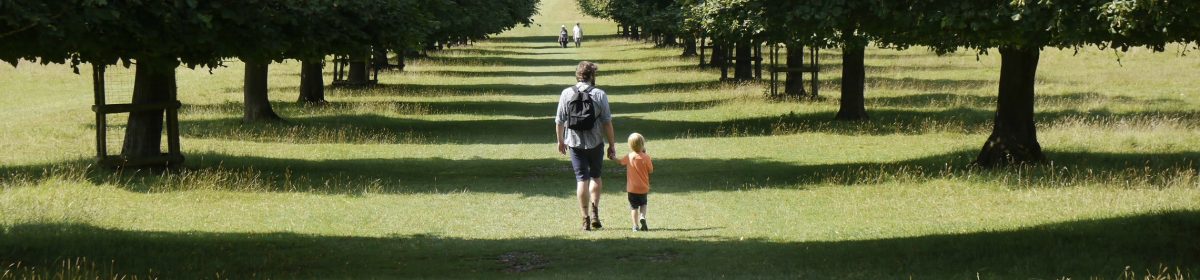
Looking for a photo to kick this post off I did a search and was astounded at the hundreds of pictures I’ve taken in Welsh landscapes over the years but this one fell into my lap, walking along the Kennet and Avon canal in central Bath. There’s a bigger frame of reference than English can express and it coalesces around a wonderful Welsh idea; the concept of “hiraeth”. I hesitate to call it a word because its reach extends far beyond its seven letters.

Derived from hir (long) and aeth (grief/sorrow), it combines nostalgia with a sense of grief or longing and it is considered a cornerstone of Welsh identity, reflecting a longing for lost traditions, language, or landscape.  It refers to a deep, often melancholy longing for a home or time that cannot be revisited. (Google Gemini search)

I must add at the outset that I have a very limited knowledge of the Welsh language, but I learned to pronounce Welsh place-names when I was helping to run some worker-writer’s workshops in the valley towns several decades ago. Neither Ian, my co-worker or I had a car and so we did all our travelling by train and bus and to avoid entertaining the other passengers I managed to learn how to learn to pronounce Welsh place-names properly. When confronted with a destination like Ystradgynlais it paid dividends to know how to pronounce it – even if the rest of the conversation was in English. I was once even congratulated on my pronunciation by a Welsh speaking farmers wife on Lleyn and I long for the day when I’ll be brave enough to wish the shopkeeper good morning in Welsh somewhere in North Wales without the paralysing fear of being replied to in the same language. My old Greek tutor Gerry Angel always said there were only two languages in the world worth learning – Greek and Welsh – and I’ve never had enough time to learn Welsh until (perhaps) now. I eventually passed the (New Testament) Greek exam.

A language is the matrix in which the culture of a country and its people is contained, and it follows that there are certain ideas, emotions and concepts that can’t be translated except by severing them from their context, history and memory. It also follows that there are things that can be said in Welsh that can’t be said in English. Learning Welsh, it seems to me, would entail embedding myself in the whole history and culture of the land rather than mastering the superficial meaning of even a few thousand words.

I’m familiar with this in my own experience because my native English tongue is from Gloucestershire where – as a child – we still used “thee, you and thou” – a habit that the teachers did their best to beat out of us. Anyway, they’re a most useful set of words because they convey degrees of familiarity Like the French vou and du leaving “you” with an association of hostility and suspicion. When I first went to work as a labourer in a steel erecting firm, I was always (young, dumb and hairy) addressed as “you”. We also had a version of what the linguists call a soft mutation which is very common in Welsh. For us, the tram roads carrying coal from Coalpit Heath were always known as “dram roads”. You don’t learn any of these informal grammar rules through books, you learn them from use. I’ve told this story before, but I buy all our rough sawn wood for the allotment from a timberyard near where I was born. Just talking to the counter staff there is to be transported back to my own history and sense of place, so – going back to the beginning of that long excursus, “hiraeth” is the perfect word to describe that sense of loss. The thousands of acres of farmland I walked over and played on as a child are all built over. My childhood territory is dissected by a ring road and a motorway and the brickworks and pitheads have all, bar a few crumbling walls, disappeared along with out unique dialect and the last few miners have died. The abundant methodist chapels are gone or converted into fashionable homes for incomers. The railway lines have become cyclepaths – a muggers’ paradise; predators on unwary cyclists and walkers. The Pines Express no longer thunders through the triangular junction. There’s no way back. Without land, language, culture or memories we are adrift without even our own word to describe the melancholy of it.

I’ve just started reading a marvellous book by Carwyn Graves (grovelling apologies for getting both his name and gender wrong yesterday) – entitled “Tir” – the Welsh word embodying the associated meanings of land types within Wales. I’ve got both of his previous two books, “Welsh Food Stories” and “Apples of Wales” and they both approach their subjects through the prism of Welsh history and culture. “Tir” casts a ray of light on all sorts of puzzling phenomena around landscapes – for instance – why are so many Welsh farmers deeply suspicious of the idea of rewilding? The answer is compelling and fascinating and would serve admirably as a push-back against rewilding as an abandonment of thousands of years of farming history. I’ve still got some way to go before finishing reading about all seven types of landscape – each expressed in a different word. It’s a marvellous book and I can’t recommend it too highly. It’s sent me back to the maps and dictionaries I’ve bought over the years but never fully understood and it’s also sent me back to seriously considering learning the language.

After ten years of complaining to our landlord about damp and black mould in our concrete building they’ve finally agreed to start doing the remedial work; installing ventilation extractor fans and mould proofing the walls as well as making good the botched plastering in a couple of rooms. The work is going to take a week so we’re moving out and we’ve rented a cottage high up in the Bannau Brycheiniog near the top of the next valley along from the photo. It looks like absolute paradise – the long road up leads past an abandoned asylum and a nature reserve and sits below the highest peak in the Eastern range. We’ve walked it before and it’s not in the least pretty – a big bog with a stone in the middle – but there’s a walk leading down from it to the main road that’s absolutely breathtaking. I’ve already got my plant lists ready and organised thanks to Notebook LM which happily did the work of processing a heap of data. When in despair, make a list, learn a language, read a book. It works for me!

A gentle reproach from Wales

October 2022. An absolute whopper from the Marcher Apple Network orchard in Cwmdu – no idea what it’s called.

I should open my Severnsider mailbox more often, I know, but mostly it’s full of technical stuff that I don’t understand – which is why I only found a polite note concerning the proper Welsh spelling of an author I’d written about – it ran – “Not a massive typo – you have Carwyn down as ‘Carwen’ on this post which is the female rendition of the name.” The post, from many months ago was titled “This is beginning to look like my mother’s siege larder” – and I’ve just amended the spelling by placing Carwyn in the correct gender.

Blog posts are ephemeral of course, but books last forever so I thought I’d give Carwyn Graves another plug for his two books; the first was (I think) published in both Welsh and English and it was called “The Apples of Wales”. If you’re at all interested in the innumerable local varieties of apple which result from its promiscuous cross pollinations, then this is a really interesting book offering marvellous insights into the local histories of some of these varieties. And if you’re really interested there’s a whole orchard of Welsh apple varieties behind Plan yn Rhiw on the Lleyn peninsula, and we were also able to visit an orchard at Cwmdu in the Brecon Beacons which was planted by the Marcher Apple Network – a society for reviving old varieties of apples and pears. We’ve planted a number of traditional varieties on the allotment, and our friends in the Beacons have planted many more.

Carwyn Graves’ excellent new book “Welsh Food Stories” is equally engaging and informative, so much so that I was tempted into following up on some of the books he mentions and I’ve managed to buy two or three of them secondhand. So I hope this mention makes up for my inadequate knowledge of the Welsh language; long may it prosper!

Anyway, while I’m in the mood I’ll also mention a piece I stumbled on yesterday called “Failing nature on Dartmoor – why its protected areas are in such poor condition and what needs to be done” by Tony Whitehead, analysing the heated debate on successes and failures in preserving Sites of Special Scientific Interest on farmed land on Dartmoor. It’s a subject that I’ve written about before and it’s been much clouded by misreporting and exaggerated accusations. I won’t attempt to paraphrase it but if you’re interested in getting a better grasp of what’s at stake it’s a really useful summary.

Back on the allotment an instinctive starting pistol was fired over the Easter holiday and the site was swarming with allotmenteers. For once it seemed sensible to be planting the potatoes on Good Friday, and the intoxicating smell of the wet but warming earth – known as petrichor – carried the subliminal message of the season. Is there some kind of spirituality here? – something to do with being held by an embracing framework? Nonetheless, not everyone is as engaged with nature as we are. We were expecting a delivery of plants which eventually turned up yesterday, three parts dead, after sitting in a courier’s warehouse for six days. The boxes were festooned with notices that warned they contained live material.

Now we’re sitting indoors waiting for Storm Noa to pass over while Madame sorts the wheat from the chaff in the seed box. This is such typical spring weather. Southwesterlies laden with moist air bring pulse after pulse of rain and sunshine to us in the west country, gifted by the Atlantic. The warmer the sea gets the more extreme the weather gets.

This is beginning to look like my Mother’s siege larder.

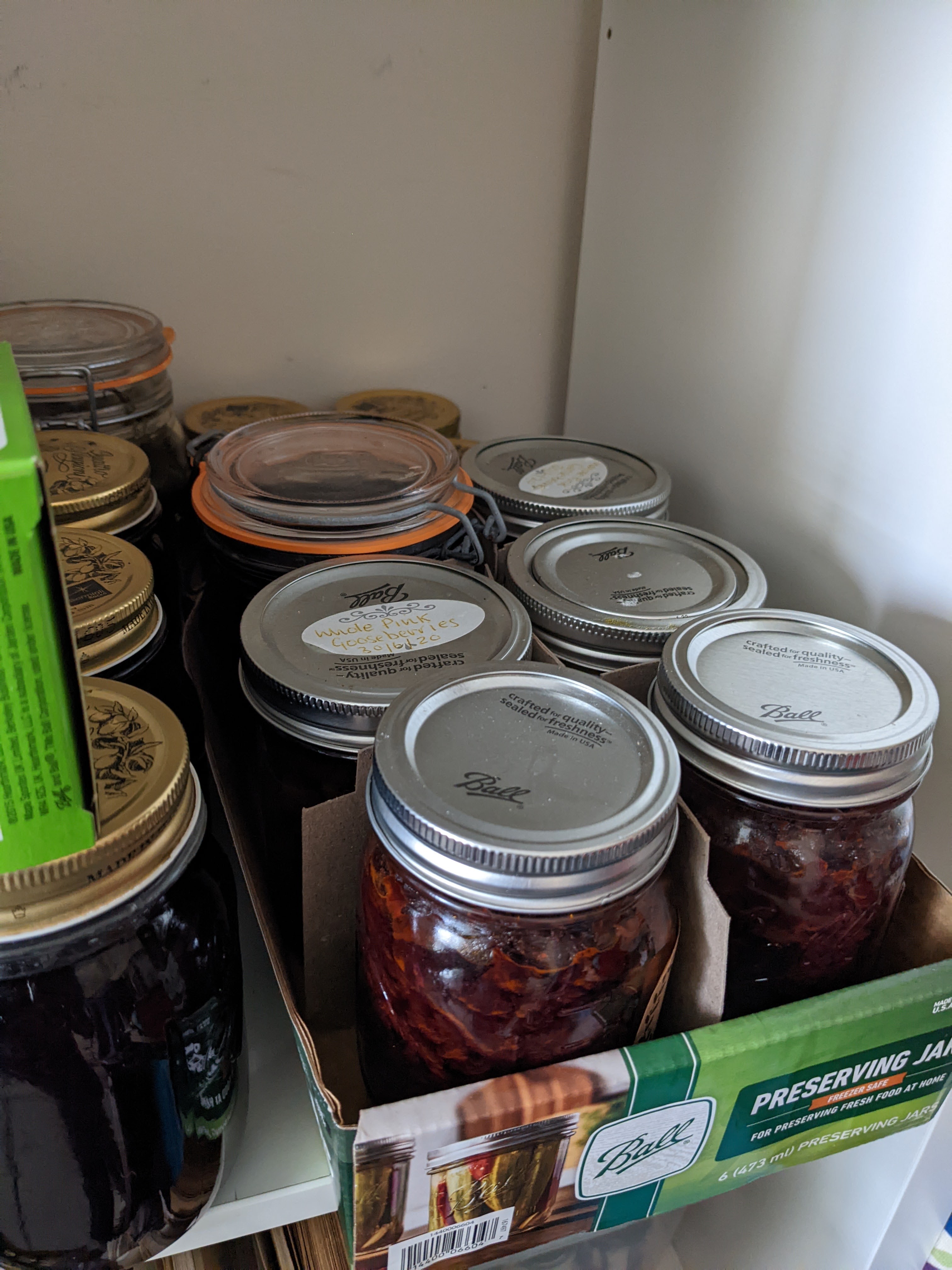
Another day on the stove, processing, stirring, sieving, tasting, bottling and so forth. Obviously not all of the stores in the photo were made this week – in fact some of them were made three years ago, but ignoring all advice from the recipe books we’ve found that chutneys, pickles and ketchups – provided they’re properly sealed and sterilized – will go on improving for years. The only proviso is that if you’re planning on keeping them that long you need to use Kilner type jars with rubber seals or acid resistant Ball types. Metal lidded pickles often evaporate or deteriorate and the lids will even rust through occasionally. The mugwort, collected in 2019, is said to provoke lucid dreams. My dreams are so surreal and occasionally scary that I’ve never thought greater lucidity would be much of an improvement.

The flat is full of spice and cider vinegar smells as I make 3 litres of tomato ketchup, and while I take a break to write this, Madame is cooking a batch of ratatouille. Against all the odds we seem to coexist peacefully enough in the kitchen as long as we don’t attempt to share the stove.

So why the urge to preserve? Well, part of it I’m sure is an atavistic re-enactment of childhood. My Mother and Grandmother had both lived through the hardship of two world wars and Madame’s Grandmother also was a gardener and a good cook. My grandparents’ smallholding in the Chilterns was as self sufficient as it was possible to be, and one of my earliest memories is of being with my sister, raking the hay into stooks on one of the fields. The rake was probably twice as tall as me!

But apart from that, after two years of lockdown shortages and in the midst of a massive cost of living crisis there’s every reason to do all we can to grow, prepare and store as much food as possible because it seems obvious that no help will ever come from the present government. Then again we also love cooking for ourselves, our family and friends too, and slow food, locally and organically produced isn’t some kind of middle class affectation, it’s the way we need to go. The present system of food production and distribution is simply unsustainable without further damaging the earth, her climate and biodiversity. Local and sustainable is a potential lifesaver and yes, we’ll need to embrace a rather different lifestyle but what’s to say it might not be better, richer and more fulfilling for a far greater proportion of our population.

That said, it’s pretty relentless hard work even being a part time peasant, but against all the odds we’ve had a good year on the allotment and we’ve harvested a bit more of most of our regular crops in spite of the drought. I took the photograph of these dying Harts Tongue ferns in a friend’s garden – I don’t think I’ve ever seen a sight like this before. It doesn’t take a genius to see that these extreme weather events will have a huge effect on food crops and therefore prices in general. Do we really want to live in a society where a few people live in utter luxury while many others are struggling to feed their children. I went to a supermarket earlier this week to get some eggs. We try to buy organic and free range eggs but when I looked at the price I saw that they were charging £6.00 a dozen for them. That’s frightening – so frightening I didn’t buy any.

The last 7 days have been truly odd. Last Thursday we went up to Birmingham to celebrate Madame’s birthday with our son and his partner; but first the car broke down and then there was a rail strike (which we completely support by the way. My father was a railwayman who spent his whole working life in fear of redundancy), and so we took the bus.

I love Birmingham but the bus station in Digbeth gives a pretty awful impression of the city. The whole area looks run down and ready for demolition in spite of a multitude of small businesses from car repairs to import export firms and money transfer shops. Exactly the kind of businesses you usually find occupying the lock-ups under railway arches, and in spite of the bleak surroundings they seemed to be getting by.

The buses were running late due to holiday traffic on the motorway and so we were able to see an entirely different side of the Second City away from the more glamorous centre. Fifteen years ago the centre of Birmingham had a very different feel; self confident, almost brash, with plenty of big-name stores. Now it’s different. There are all the usual signs of economic stress with empty shops in many of the principal shopping streets- even the John Lewis store has departed the Bullring. The Museum and Art Gallery, however, still has a radical agenda that makes it such a joy to visit. Where else in Britain would you see exhibitions devoted to Trades Union activism, Black Lives Matter, and even raves and club life in the 70’s. Industry is celebrated, not least by remembering the small workshops that sprang up everywhere- servicing larger industries like the now defunct car manufacturers. You get the feeling that by standing firm and facing down its undeniably racist episodes the city has begun to come to terms with the past. There’s an unapologetic multicultural community that doesn’t feel the need to tread carefully. The city centre gets rebuilt every decade – so there’s still money somewhere – and the Clean Air Zone along with decent public transport including trams to Wolverhampton, suggest that the spirit of Joseph Chamberlain has not quite been monetized and sold off to the asset managers. The biggest problems, though, are not in the past but in the present.

Standing and chatting to some of the other passengers in the queue for the National Express bus home, you could see the stress eating into their lives. Plato said that the city is a work of art, but he was wealthy and well educated and I doubt if he ever queued up amongst hoi polloi to see what was troubling them. For most people the city is less a work of art and more a ransom note. I chatted for ages to a young woman, looking fantastic, who was going for four days to a holiday camp near Brean in Somerset with her daughter who never once looked up from her iPad and her mother who never stopped talking on her mobile. In ten minutes I had the bare bones of her life as she talked about her dad, now dead but a hero to her – and her ex partner Dave, who’d cleared off – and as she spoke I felt that her holiday was an expensive lottery ticket to a more hopeful future. Later, after the weary queue for the late Weston Super Mare bus had departed I sat down and overheard a young woman behind me talking about her unexpected pregnancy at the age of 14 and how she’d been completely unaware of it until the ambulance crew spotted what was happening. I prayed silently and without much faith, that things would look up for them both.

Then, on Saturday I had my biennial (actually a year late) endoscope, to check that some rogue cells in my oesophagus hadn’t mutated into something really nasty and well, subject to an 8 week delay on the biopsies, it seems that everything is OK for now. However this regular brush with my own mortality through a very invasive procedure always has a profound effect on me. Luckily, after a day of being legally over the limit and confined to bed for most of it, on Sunday we went to see Carters Steam Fair which is always great fun. Being pretty ancient myself, it’s fascinating to reconnect with the fairground rides that I remember from childhood. Steam and grease and old rock and roll records have a fatal attraction for me as I remember the Rogers family and the Hills who took it in turns to visit Page Park and Rodway Hill. Sadly the Naughty Nineties girls with the free for all boxing booth will never reveal themselves to me because the girls are now in their nineties and the local ruffians who once fancied their chances in the ring will all be dead. The grandchildren shared none of these mournful thoughts as they embraced the fairground joyfully and ate candyfloss between the dizzying rides.

During all this to and fro, I finished reading Carwyn Graves’ excellent new book “Welsh Food Stories”. His previous book “Apples of Wales” is essential reading for anyone thinking of planting an orchard. The names of the varieties alone – Pig Snout and Goose Arse are just two – are a delight to the poet’s ear! I long for the day when you don’t need to be a food researcher to find fine local produce. At the moment, for many people, the future of food is like an unfinished building, because we know something about what the structure needs to be but hardly anything about what it will look and feel like. Books like “Welsh Food Stories” address the lack of a sustainable food culture by filling in some of the pictures.