
I just couldn’t leave Wales without a piece on our day trip on the Ffestiniog Railway on Tuesday. Last year we travelled the Welsh Highland Railway line from Porthmadog to Caernarfon which climbs through the mountains past Snowdon (or Yr Wyddfa, if you will) and down again to the sea – a magical five and a half hours there and back, with mugs of tea and Welsh rarebit to keep body and soul together. This year with Covid restrictions there are only half journeys available so we opted for the Ffestiniog Railway up to Tan y Bwlch.
anyone who’s ever lived in a commune will recognise the fact that there’s almost always one person whose revelatory vision everyone else is expected to serve
We’ve got history with the railway -well more of a one night stand actually – because when we lived in a self described commune in Bristol we spent a weekend working there as ‘volunteers’. The word volunteers is italicised because anyone who’s ever lived in a commune will recognise the fact that there’s almost always one person whose revelatory vision everyone else is expected to serve. That was John then, and probably still is. The pith helmet and khaki shorts of his childhood were invisible to most people but always rankled with me and so, with the certainty that winter follows spring we clashed. He was born to be a district agent in the great days of the Empire when Palmerston was Prime Minister and I could only aspire (in his mind) to be that insolent little chap – what was his name again? -who served the tea. Funnily enough he brought two of his admirers into a cafe I was in a few years ago and I recognised his booming voice immediately – I was so troubled by it I had to get up and leave.
Anyway this mountain adventure was an entirely ‘voluntary’ weekend event with the usual unspoken three line whip. Most of the commune members were doing office or teaching jobs, so a weekend breaking stones in Wales was probably more attractive to them, but we dutifully went along and even took two friends – Mike and Di – along with us. It was the weekend I first saw – rather heard – a Hydram (hydraulic ram pump) in action. I followed the camp water supply down the steep hillside towards the sound of the pump, each rifle shot crack sending a pulse of water up the pipe. Eventually I found the source in a walled off dam at the end of an old drift mine shaft, and I fell instantly in love with a machine that could raise water at least a hundred feet, free of charge and all day, every day. Sustainability in an elegant lump of cast iron with no more complex engineering than a pressure chamber and a couple of flap valves.
So that was it really. It snowed heavily and the bunkhouse felt like a scene from a Russian gulag. The occupants regarded us with suspicion; several of them were explosives experts who seemed to prefer to make a cutting through the mountain by reducing it to vapour. Others were living in the dream of the completed railway line so completely they were socially unavailable to the present moment and so like all bored twenty somethings we found our own fun and climbed the neighbouring mountain Moelwyn Bach in our wellies – cue major ticking off for irresponsibility, but the view was worth it! Then we rode a truck down the mountain from the end of the line and lost control of it completely, jumping off and watching it roll down the hill. After that no-one spoke to us, can’t blame them really, and mercifully we were never invited again. On our way back down the line on Tuesday we caught sight of the same kind of (refurbished by now) truck.

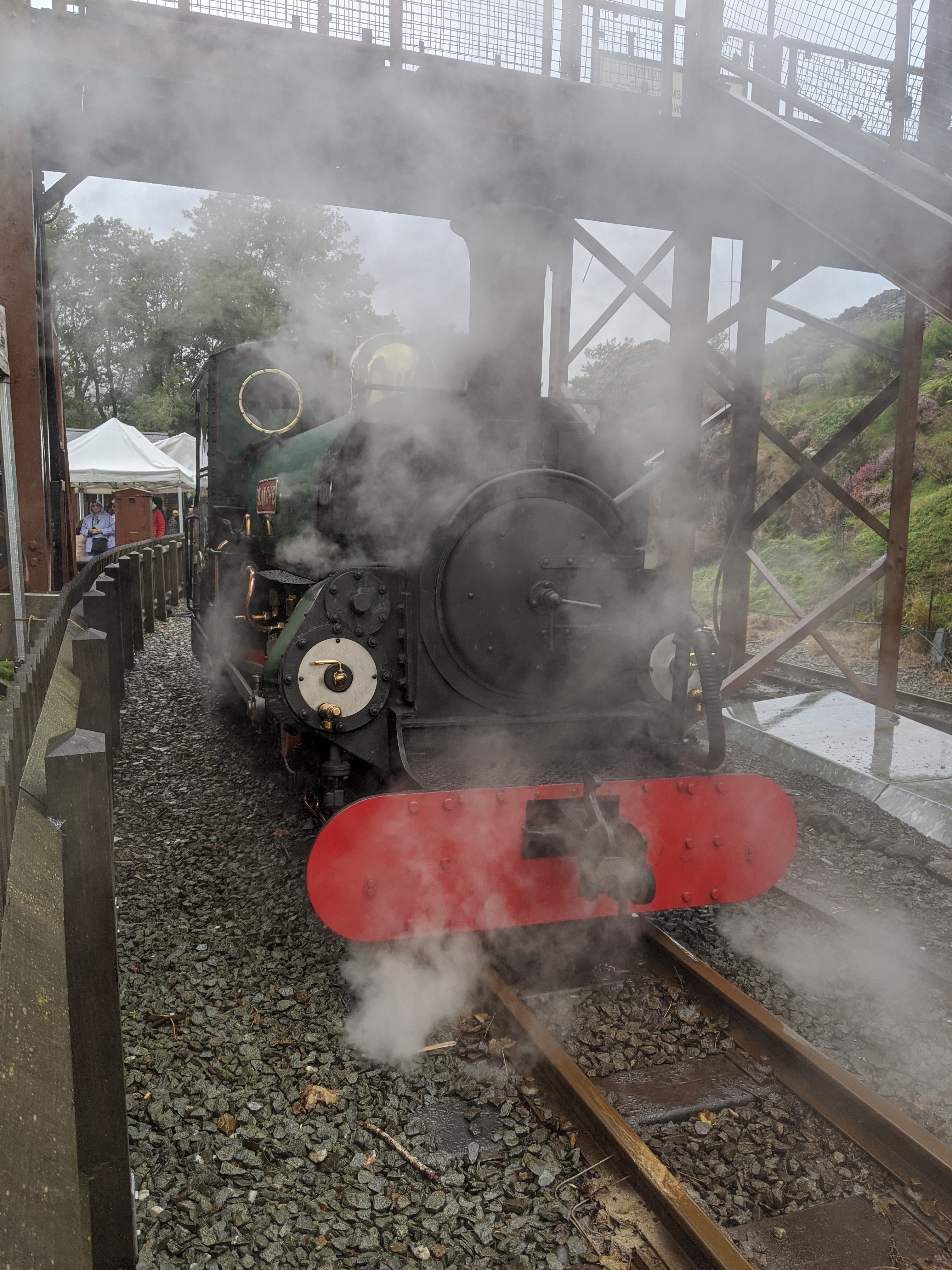
But that was then! On Tuesday we joined the socially distanced mini throng of travellers, and an elderly guard locked into our sealed compartments: third class with bench seats, to play with the leather window straps while we waited. Our engine – called Palmerston after the previously mentioned Prime Minister of the British Umpah era was steaming copiously at the front – possibly a tad too copiously as it turned out. The Ffestiniog railway was originally built to bring slate down from the quarries at Blaenau Ffestiniog. It’s a narrow gauge railway run almost entirely by volunteers and they run it well. The line climbs steeply uphill on its way to the mid point at Tan y Bwlch and the little engine was straining at every valve on the steeper bits. Then half a mile before the station the engine gave up the ghost altogether and we stopped in silence. For a while it was like Adlestrop, just the engine wrapped in a cocoon of steam, a few sheep and the sound of the drizzle. Welsh Mountain drizzle could fill a small lake in five minutes; it’s the only kind that you can actually hear drumming on the windows. Rebellious noises from passengers began to mount and the ancient guard trudged up and down the line trying to explain through the windows without having much of clue himself what was going on.
Eventually they sent a replacement engine to tow us up the last section of the line and Palmerston, humbled, was brought into Tan y Bwlch station three quarters of an hour late. At this point communications seemed to break down entirely with railway volunteers on their mobiles and engineers of all genders poking and pointing. A diesel (if I was making this up it would have been number 666 and called Harold Wilson – but that wouldn’t be true) so a diesel engine came along and shuffled two lots of abandoned carriages around the station until they were in the right order and yet another steam engine came and pulled the first train down the hill while we drank tea from paper cups and took lots of photographs under a temporary canvas canopy. Then they brought yet another engine and we set off back to Porthmadog.
I’m not a steam engine enthusiast in the usual sense. My dad was a railwayman and I was born next to the railway and so the sounds of trains been a part of my whole life – they still are, we can hear the engines passing through Bath Spa station quite clearly. Then there’s the coal to think about. How do you balance the desire to see the back of coal as a fuel with these hundred year old engines, restored and in regular use. I can’t see it attracting many visitors if they put electric motors in the engines and stuck red light bulbs in the fireboxes!
Steam trains have all the features needed to become a true addiction; a uniform, a private language (who knows what a top link man is these days?) and a proper set of exams to pass. Then there’s the sound. I once heard a recording of the foetal sounds that are the soundscape we all inhabited before we were born. You can’t tell me the similarity doesn’t trigger an aching sense of familiarity in the mind. But I remember my dad having to memorise miles of railway line when he went for his guard’s promotion. He would put a woollen blanket on the table and cover it with file cards filled with the esoteric language of the track. But he hated the railway, hated the shifts and the hours and the constant threat of redundancy during the Beeching era. So no, I’m not the least romantic about the railways. But I love Snowdonia and I love those trains – a beautiful paradox.



 And so to the allotment where we were delighted to see that last night’s rain had flowed obligingly into the first tank. This will be the one we direct to feed the greenhouse drip system. It will provide easily enough water to last a fortnight. The previous system, which was supplied by the far right hand barrel in the photo was too low and so stopped working after about the top third was gone.


