Wildflower meadows part II

_1080783

So today was our second day at RHS Rosemoor.  We always like to split a new garden into at least two days, the first to get the lay of the land and the second to go back in more detail.  In fact you’d need to go two days a week for a year to truly get the measure of the place. After my big worry yesterday I was able to relax and enjoy the gardens for what they are and, hardling surprisingly, we spent a lot of time revisiting the wild meadow areas. The first thing to say is that the RHS aren’t trying to pull the wool over anyone’s eyes. These meadows are as ‘artificial’ as any of the other (equally beautiful) gardens. It’s we visitors who like to put labels like “wild” and “cultivated” on what are basically different styles of garden: this kind of “wildflower meadow” style is developed by sowing and planting, using any means that works, for instance some of the plants are developed in modules and planted out. There’s no purism in the selection of species; no absolute rule that only native plants or archaeophytes are allowed in, and a scientific mowing regime is applied to  encourage self-seeding. Plants that don’t do well, or do too well and start choking the others out are dealt with by removal. This is a highly labour and resource intensive version of ‘natural’.

Imagine my sadness at reading in today’s Guardian that while many of us are working flat out to try to turn around this environmental and ecological catastrophy, our government are secretly eroding controls on harmful and cancer causing chemical insecticides that are absolutely banned in the EU but which may well be reintroduced by ministerial fiat if we leave. This is the greatest danger we’re facing today.  While I absolutely applaud the environmental efforts of bodies like English Heritage, the National Trust, The RHS and other non governmental authorities, we can’t save the world by building a few nature reserves like insect zoos.

Today I had a long conversation with a woman from Wolverhampton who is (pretty much singlehandedly) trying to build a wildflower meadow on a piece of land next to a housing estate. Last year was a terrible year for her and most of her spring sown seeds died during the hot summer, but she’s not daunted and today she was in Devon, at Rosemoor, trying to find out how she can give things a better chance and develop the plot. Her budget was about £250, and I think she might just pull it off, but all her work could be undermined in the stroke of a pen by a minister in thrall to the agrichemical industry lobby. I’m not very big on organised religion these days but sometimes I long for a bit of smiting from a higher power. Just a small plague of boils would do, as long as it was targeted at the right people.  Better avoid the flies and frogs, though, in case Bayer come up with some new and even more horrible chemical for dealing with plagues of  flies and frogs. The only (and more sensible) alternative is to make a stand with those who are trying to end this madness, and change the way we think about our relationship with (and complete dependance on) the earth.


The Pale Rider of the flower beds

_1080766

This is a white crab spider – I’ve never seen one before and neither had the gardener at Rosemoor who found it. I think it’s not so much rare as difficult to see, since it’s a bit of a pirate, ambushing its prey by sitting on a white flower and blending in until the unfortunate victim alights and gets more than it bargained for. If I’ve got the ID wrong blame me and not the gardener, I just googled “white UK spiders” and came up with this elegant assassin.

IMG_5498So our first day at Rosemoor was not nearly as wet as the forecast promised, although we kept our waterproofs on all day.  Last night’s rain was prolonged and heavy so we weren’t taking any chances. Our main interest was in the vegetable gardens because I wanted to find someone who could help us to understand what happened to our onions this year.  So I trailed around with the pictures on my mobile, accosting gardeners and largely discovering that they were no wiser than we were.  Aphids were mentioned, as were all the usual suspects – flies, fungi and eelworm, but none quite fitted the bill. In the end Madame suggested that it could have been that the sets, which arrived early and had to be stored for ages, had simply deteriorated before we planted them out.  The idea made sense to both of us, although it would mean that almost everyone else on the allotment site stored them badly as well. Anyway we’re getting an email address for a free ID service for members and I’ll send off the photos to see if there are any more suggestions.

As ever there were some wonderful things to look at – alliums were everywhere, as befits their recent ‘must have’ status; and as wide a range of plants as you could hope to see, but I’ll never be a gardener in the Gertrude Jekyll sense.  Notwithstanding the efforts to make borders and beds look “natural”, there couldn’t be anything less natural than this kind of English garden, absolutely stuffed with non natives and hybrids it reminded me of the way the Pitt Rivers Museum in Oxford used to be, apart from the fact that the labelling is a lot better. Two large tulip trees were still in flower, the photo on the right above is pretty much real size, and very spectacular they are.

I think the biggest question I came away with centred on the idea of nature. I have to confess right now that I’m a bit of a fundamentalist, and it’s not something I feel particularly happy about but my default position is that the less human intervention there has been, the better I like it. I can see a million reasons why that’s an unhelpful mindset because if anything is dynamic and ever-changing it’s the natural world and there’s no point in railing against Himalayan balsam, for instance because it’s here for good.

Much of the area occupied by Rosemoor is a relatively recent (1989) addition to the older gardens and involved digging out 13,000 tons of heavy clay and redistributing it around the gardens to achieve level beds.  That’s a lot of dirt being turned over and moved around, enough to keep a ‘no-digger’ awake for a week. So you just have to accept that this is a blank canvas garden of the kind beloved by hard landscape contractors, big flower shows and TV gardening programmes.

And I think I just have to accept that gardens like this are showcases where you can go and look at national collections of your favourite plants, and exquisite displays of plants from all over the world, and I’m sure that if I raised this with the RHS they would say ‘we’re not trying to recreate a natural landscape we’re creating a natural looking one’.

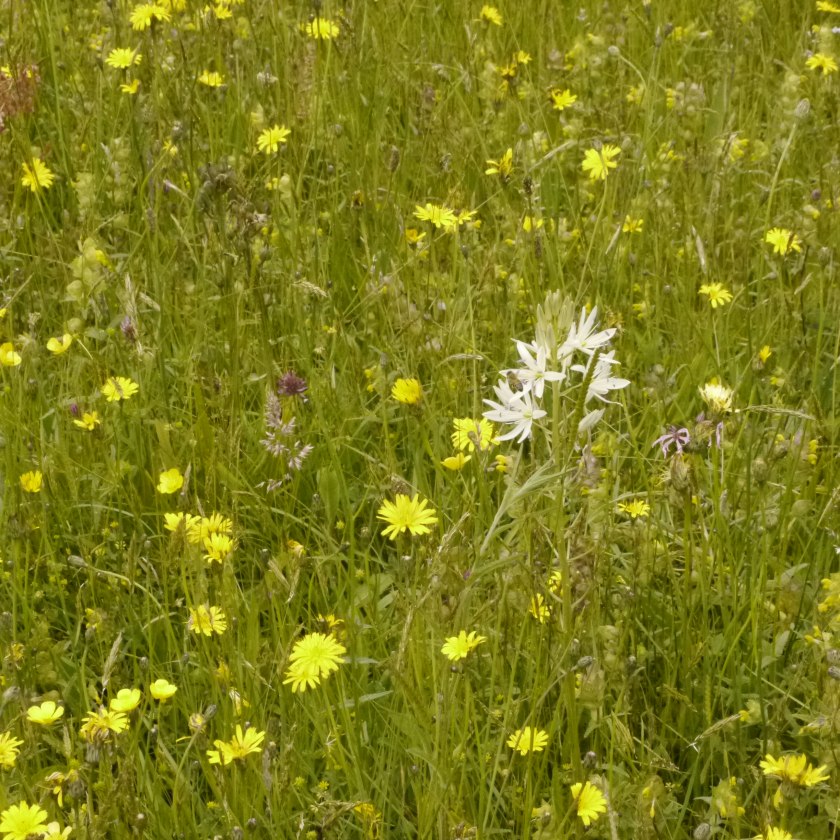
_1080773However, there came a moment when the dilemma became acute for me and that, ironically, was when the garden started to offer something I really wanted to see. There are now some quite large areas of wildflower meadow which I fell upon with joy. There were southern marsh orchids in flower, ragged robin, knapweed, oxeye daisies, umpteen grasses like crested dogs tail and so on, yellow rattle and an unexpected white flower that I don’t think I’ve noticed before which turned out to be Star of Bethlehem – Ornithogalum angustifolium . It was all too good to be true, surely? There, in a patch half the size of a football field, was a collection of plants I’d expect to find one at a time in a day’s search over a much wider range. All this in an area that had been turned over by earthmovers less than 30 years ago. It’s a wonder, a triumph of science and the gardener’s art.  A horticultural Las Vegas in the depths of a Devon valley.  I’ve never seen a better display of plants in a wildflower meadow; it exactly fits our current anxieties about biodiversity, and I don’t suppose the birds, the insects, moths and butterflies that flock to it will give a hoot whether it was there in 1930 . Compared with the usual miserable sowing of ‘wildflower mix’ that developers ususlly throw around their bleak gulags to persuade the planners that they really care about nature, this was xanadu. So why was I troubled? I think a large part of it was my stupid attachment to authenticity – whatever that means – and the truth is, starting from where we are (which is a pretty dreadful starting point) there’s no other show in town except the Las Vegas route, re-creating at great expense and with enormous skill, the flora and fauna of the environment we’ve allowed to decline to the point of no return. There’s no way back to the good old days before we lost nine tenths of our wildflower meadows, because simply abandoning a patch of ground to ‘nature’ can’t possibly succeed.

So my takeaway point is that there’s no cheap way of restoring these habitats.  If we’re serious about restoring them, throwing around a handful of imported and non-native wildflower seed is a dangerous distraction.  It will take time, skill and an abundance of resources.  Notwithstanding my reservations, I think the RHS have cracked it, bless them.

IMG_5512And just one more little joy – they’re developing a new orchard here and it’s dedicated to one of Madame’s old bosses – George Gilbert, a delightful man who probably knew more about apples than anyone else alive. We also saw a plaque in his memory at the Lost Gardens of Heligan, commemorating his contribution to the gardens there. He died in 2007, and took with him a lifetime of experience. His students are a big part of the future if we’re ever to rediscover and recreate the lost varieties of apples, pears and soft fruit, lost to careless agricultural policy, and that’s another star for the RHS who do so much to train the next generation of gardeners with apprenticeships, courses and such like.
 

Down in Devon in the rain

IMG_5507

We’re in Devon in Little Torrington for a couple of days at RHS Rosemoor, but after a sunny drive down, the promised weather closed in and we enjoyed a magnificent thunderstorm coming in from the north west. The last two days have been very exciting and challenging and I’ll probably write more about them tomorrow, but several days of gallery visits, and a wonderful afternoon at one of my old parishes plus some pretty ruthless gardening by Madame have precipitated a good crisis – the origin of the word is a Greek word ‘crino’ –  to choose.  And so yesterday I gave an old friend most of my church music and today I gave away my piano and all my other music. Then I think there are many other books that need to go to the Oxfam shop. I need space and (because I’m pretty ancient) I need to focus on the things I really want/need to do. Time to let go of some precious things so I can focus on even more precious things. Far from being sad about letting these things go, I’m quite exhilarated.

I once met a man on a tram in Lisbon.  In the course of a five minute conversation he told me how he had become very ill and he had given everything – and I mean everything away, and started to travel in faith that things would work out for him.  I’ll never forget the end of the ride when he entreated me to pay attention. He meant it, I remember his eyes and the way he held my hands.

So we’re here in the rain in Devon and I’ve brought the laptop, a camera, three pencils, a notebook and some good paper and we’ll see what happens. Instead of coming down all the way on motorways, we split off and came down the B roads.  Now we really understand the idea of the rolling hills of Devon, but the rivers we crossed were running red with soil, presumably being washed from fields – most likely fields growing maize. The whole soil-wealth of this place seems to be in the process of being washed into the sea.

At last, the right kind of rain.

IMG_5503

After weeks of near misses, with the rain slipping past us up the Bristol Channel and into South Wales, today the rain gods smiled on us.  Only 8.9 mm – less than half the forecast amount but nonetheless the best we’ve had for ages and when it dried up after lunch, we could almost hear the allotment gratefully guzzling it down.

However much you water by hand, it’s never as good as a natural soaking. I don’t know whether plants are affected by chlorinated water – it used to be the case that if you stood the water in a trough or even in a watering can overnight, the chlorine would evaporate leaving pretty much pure water (apart from the innumerable chemicals that couldn’t be filtered out). However I read recently that there are new ways of treating water with chlorine that persists for a longer period. I suspect that chlorine in any form has a deleterious effect on soil micro-organisms – the ones it’s used to kill in the pipes drrrr..

So rainwater is good and thunderstorm rainwater is even better as long as it’s not heavy enough to beat the plants flat. In fact, gardeners could probably furnish a whole vocabulary of rain types based on their usefulness. This occurred to me this morning as I looked out of the window at the Green and was faintly disappointed with the rain at first, until it increased a little and suddenly I could hear it falling on the leaves.

We instinctively judge rain and its qualities by sound and smell as much as by any other more scientific quality. Compare, for example the first few drops of rain falling in a summer storm – big fat, heavy drops, with – let’s say – the sound of misty rain drifting down on to a window, or driven rain coming in almost horizontally in a winter storm.  Any gardener would opt for a prolongued spell of the gentle but continuous rain that falls on a windless day, followd by warm sunshine – perfect growing weather.

And it was while I was imagining those big fat drops I remembered a pub we used to drink at, on a busy crossroads opposite a stand of very tall elms – before Dutch elm disease took its toll. There was a big rookery up in the trees, and if you were lucky enough to be sitting on the bench outside the pub on a hot summer day when the raindrops started to fall, whack, whack, whack on the leaves and then gathered in intensity as the sky turned to Paynes Grey straight from the tube, and the agitated birds called and chattered, and that unique smell of rain on hot tarmac and parched grass rose into the air, then you might have been transported to the Potwell Inn for a moment, until the rain drove you inside. The very thought of it left me pining for a lost age, and given half a chance I’d have got ino the car with (protesting) Madame and driven straight there.  But the pub has shut down, the elms have all gone and a housing estate covers the fields almost to the edge of the road. Nostalgia eh? rubbish emotion!

And so the allotments have been properly watered at last with the right kind of rain. The rain you don’t want is the stuff they get in North Wales where it rains sideways and each drop is encrusted with industrial diamonds that saw you in half; or in Cornwall where it rains every day, but only just enough to be annoying, or up the M5 along the ridge north from Bristol where it often doesn’t rain at all but just sits there in a cloud sulking in a fog. You don’t want the rain that comes with gusting winds, or anything that comes with hailstones, and especially not snow that breaks your nets and snaps off branches.

Moderation in all things is the name of the game, and the only way to do that is to protect the crops as best you can with nets and windbreaks and if you’re luckier than us, polytunnels, and save every drop of rainwater you can.  Oh and concentrate on drought resistant varieties species and varieties. There’s always a way: except there isn’t when things get past the tipping point, and then it all gets ugly. But unlike buses, you can save rain until you neeed it.


Gardeners of the imagination

IMG_5501

This is a pretty rubbish photo taken in a basement exhibition with my phone – the best way of getting an idea of this piece is to visit Fiona Hingstons website.

We spent yesterday with friends, eating, drinking wine, gossiping and then later trying to visit as many of the Fringe Arts Bath venues as we could. It turned out to be a more challenging and exhilerating day than I could have anticipated, and somehow this piece (there are two from the same series on display) really fired up my imagination. It’s a bit unfair to pick just one piece from four whole galleries worth of work, but it was the last exhibition we visited, so I think what finally clicked in me was an almost euphoric sense that something quite unexpected is happening.

First, a small confession.  Before I started to search online for some of the artists whose work I’d liked, I made the assumption that they were all young and post art-school at the beginnings of their journeys.  It’s true there were quite a few in that category and I’ll say a bit more about that in a moment, but one of the ‘gallery minders’ gave me the answer in the first exhibition and it took 24 hours to mean anything to me.  We’d been in the first gallery in Walcot Street and I’d been excited by the work I’d seen.  Grasping for an explanation I said to her that it was good to see that some of the idealistic ethos of the seventies hadn’t been crushed by the grim apparatus of austerity, and she said ‘oh no, the hippy ethos is still alive and well!’

After decades of the dead hand of the Arts Council, now shrunk to the skeletal remains of a sponsorship agency for big business, we’re beginning to see the re-emergence of the ‘underground’, the ‘counterculture’ – both utterly tainted and compromised in the way they were co-opted to shift product,  but regaining something of their old strength.  All of which is a rather long way of saying that there were artists of all ages and dispositions being shown.

That’s absolutely not to say that the exhibitions were living in a world wholly detached from the way we ‘do things round here’. These artists didn’t seem to be in any sense separatists, dreaming of a better place somewhere unreachably beyond where we are now.  In fact I kept thinking of Anne Frank, Charlotte Salomon, Louise Bourgeois and for some reason Francesca Woodman.  Madame made a hugely perceptive remark when I mentioned this on our way around.  She said that some of the exhibits reminded her of Francesca Woodman in the way that it seemed the artist had passed through the room and left a ghostly trace of herself. For instance there was one group of works gathered together under the title “Enshrine”. Many of the objects were very small, the kind of thing you might make when there’s not much space to work in, no grand studios for rent – maybe living with parents.  So they were being shaped  by the brutal economics of the artistic life, but also there was something poignant in the background.  The tiniest hint that these precious objects, filled with recovered memories and imagined worlds , could be hidden at short notice, stuffed into a bag when the knock on the door came.

There was a pervasive sense of threat to the environment which was being challenged by intense engagement. I found Fiona Hingston’s website I laughed out loud to see the title of one of her postings – “Making = Remembering”. Making, in this case, means making by hand using wire and masking tape.  Obsessive reflective, meditative and faintly disturbing, remembering becomes a subversive act when it points out what’s been lost.

I think I’d fallen into the sad conclusion that all the dreams, prophecies and visions of the past had dried up and that we are condemned to live (and in our case probably die) in the frozen steppes of corporate greed. “Not so soon” was the reply. The pervasive feeling was that these artists’ work was a challenge to the ‘way we do things round here’. A challenge with force, with heft.

It’s a shame so few politicians ever visit a gallery except to rub shoulders with the wealthy and powerful. Culture is a far bigger force than a gallery with some free wine, and if I were in public office right now, I’d be nervous.  These gardeners of the imagination have been working away, against the odds, and they’re not going away any time soon.


Why the delight? Part II

IMG_5500

So here’s the 2019 onion crop in a bag and waiting to go to the bin. Generally we recycle everything we grow on the allotment except where plants appear to be diseased – which the onions certainly did. In fact all the alliums this year, autumn and spring planted alike, semed to keel over to the same problem.  Possibly eelworm, white rot who knows.  My theory is that either the sets were the result of a very stressed growing season last summer, or that after planting they suffered more stress in the ground on the allotment.  Who can tell? But it’s infuriating that this so-called “easy crop” has failed twice in two years. Which leads me to the Part II title.

Yesterday I went big on the pleasures of gardening and its effect on our sense of wellbeing, but there’s another side to gardening that we simply can’t ignore. Crops fail, pests invade and consume them, and monster micro-organisms like blight can destroy a crop in days. Gardening/allotmentering isn’t a primrose path – even at the Potwell Inn.

So is this just the counterbalance to too much ‘delight’? Is every ointment obliged to have a fly in it? Can failure and disease ever make a contribution to our wellbeing?

The clue, I think, lies in the very last words from yesterday’s posting – the quote from Neitzsche – what doesn’t kill you makes you stronger. Suffering can never be good for you, and aside from some fairly specialised preferences will hardly lead to delight – but – when things go wrong on the allotment they’re rarely if ever going to do you any huge damage.  It can make you sad, uncomfortable or even ashamed if, like us, you prune a grape vine too late and it starts to bleed sap, pints of the stuff!

But I’ll put my money on gardening increasing our resilience and therefore able to help us ride the more serious stuff that happens to us. On the allotment, often I think we’re practicing a set of emotional skills that we can apply elsewhere.  Add to that time to think, time to meditate if you like and the argument that gardening increases our wellbeing becomes overwhelming. Somewhere within it there’s a spirituality that I’m content to leave unnamed.

I’ve always tried to keep this blog real. I can’t stand the style maazines and seed catalogues that suggest it’s all a breeze use uses the word ‘fantastic’ in every sentence.  For me ‘fantastic’ is first cousin to ‘fantasy’, and what we create in a garden is real, not fantasy.

To finish, though, on a brighter note, when the vegetables start to ripen and we get to taste them the question inevitably comes up – do they taste better? By the time we got back from the allotment yesterday we were too tired to cook, but earlier – in the morning I’d made a big batch of pesto and so I cooked some linguini and that was supper. Whenever food scientists try to answer the flavour question I’m pretty sure they grab a bag of organic whatever, and a bag of its non-organic equivalent and test them against one another. Both will have travelled hundreds if not a thousand miles in a refrigerated lorry and sat around in a supermarket distribution warehouse and, surprise surprise, you can’t tell the difference.

They should do the comparison with today’s pesto, or fresh peas straight off the vine.  There’s the delight!

Why the delight?

IMG_5492

It’s good to be in contact with the natural world ….. isn’t it? Everywhere I look I’m being told it’s good, even I bang on endlessly about the pleasures of the allotment, and (they say) it’s not just good – it’s a miracle cure for just about any affliction you could name – and if you put that particular claim on a herbal remedy you’d be in real trouble with the law.

What’s interesting to me is not that it’s good to be outside, but to wonder why it’s so good. Why do people with mental health issues feel so much better when they walk or garden? Why so, people with life-changing illnessses or those who are going through bereavements?  I think we can discount any sort of natural ‘miasma’, some undiscovered radiation that affects our dopamine levels, but in my unscientific way I do believe that our moods are linked to quite tiny physical changes.  Without making it sound as if this is a pitch for PhD funding, the question is – what’s the link between experiencing the natural world, in gardening for instance, and mood – and the subtle changes in our brain chemistry. If I were an academic – I haven’t got the patience in real life – but if I were, I’d quickly move on after I’d listed fresh air, sunshine and excercise … because they’re all very good and we know it.

But while I’m building a raised bed, weeding, planting out and watering there’s always a dialogue going on in my head.   Talking to the plants doesn’t make me certifiably crazy, it makes me more human. Having a chat to the robin that sits waiting for titbits to emerge from the soil when I’m digging feels like the most normal thing in the world. Examining the rows and clumps and trying to figure out if all’s well or whether I should look for a troublesome pest – that’s about relationship.  And so the first area I’d look for the answer to my question “why?”  would be in the relational. Of course allotmeteers are (by and large) a friendly lot but actually quite a few of us find relationships with other humans far more tricky than relationships with robins and runner beans. There are people on our site that I’ve never spoken to because they clearly don’t want to complicate their day by talking to me – far too risky – and I don’t hold it against them, they’re completely free to be themselves.

And that leads to the second promising avenue for research. We’ve looked at relational factors but what about the sense of agency that comes with allotmenteering? Being ill, being sad, being under-appreciated or jobless can send you into a vortex where you feel absolutely helpless.  Tending the allotment, or even a walk through the woods, can give you back a sense of purpose. There’s a link between what you you do and what you get back and so you begin to regain the sense of agency that’s so important to our wellbeing.

Yesterday we took some beetroots from the hotbed and while Madame planted out leeks for the winter, I finished planting the outdoor tomatoes and I put a screen around them to protect them from the expected winds on Saturday.  One of the problems with propagating plants indoors is that they can be quite leggy and soft and so they can be easily damaged by wind or rough handling or even sudden changes in temperature. That’s why we harden things off, gradually introducing them to ‘real’ life on the allotment. Of the sixteen plants, fifteen survived their first night in the rough and tumble and they’ll quickly develop more strength as the roots go down and the stems toughen up.

It’s the sheer generosity of the earth that heads my list of the healing properties of gardening. There is no explanation for the variety, the vitality, the colourfulness, the exquisite shapes and patterns, the medicinal uses, the food they provide.  Time without number I come away from the allotment with a trug full of food and a sense of thanksgiving. Even on the winter days when the bird nets are collapsing under the weight of snow and I drag myself up there to clear them, I get back exhilerated by the cold and the sense of adventure but perhaps more than anything esle by the sense that I matter, that my existence makes a difference, if only to a patch of purple sprouting broccoli!

That’s why the delight.

IMG_5491


The noble globe artichoke

IMG_5489Is it really worth the bother?

Was it really two years ago I bought those tiny globe artichoke plants? We’ve nurtured them and moved them to a better spot and watch them grow into a spectacular border.  But today Madame fancied eating one and I/we dutifully braved the fearful thistle spines and brought them to the kitchen.

As the landlord of the entirely fictional Potwell Inn, I’d have to say that artichokes would never appear in a real pub menu because the prep time and the wastage is enormous.  This is serious luxury food for people who have a big compost heap,  There are two ways to eat the beast. The French way is to peel off the tough outer leaves and cut the spines off; poach it, bring it to the table with some hollandaise sauce, pull off the succulent leaves one at a time dip them in the sauce and suck the fleshy bit out.  That’s a bit too much like tantric sex for me.  The other way is to remove all the leaves, cut the top off and the bottom off and then spoon the bit that would become the seeds out, all the time protecting it with dribbles of lemon juice lest it should go brown.  Then, finally you have a fleshy white disc which you poach in acidulated water for ten minutes or so, until it’s tender.  Then you can eat it with butter or hollandaise, although you’d want at least four to make a decent starter – which means a surprise treat for your beloved is going to cost you a large and rather beautiful border. You may, therefore, be expecting me to give the magisterial thumbs down to the globe artichoke on the grounds of prodgality  and excessive faff, but here’s the thing…

…. There’s no way we could afford to eat fresh globe artichokes in a restaurant, even if we could find a place that would serve them,  but cut on the allotment and served twenty minutes later they are completely, absolutely and mind blowingly delicious – even eaten quite plain. They taste marginally better than home grown asparagus.  So long live the globe artichoke, they take up a lot of space and they make a lot of compost but they look beautiful, they’re good to draw and they’re delicious to eat – what could possibly be wrong with that.

Back on earth, however, we supplemented the end of the hungry gap with our first digging of spuds, the first (douce Provence) peas and more broad beans after a day planting out tomatoes and leeks.  We grow an f1 hybrid called Crimson Crush outside because it’s large, vigorous and almost completely blight resistant. We’ve also put some red peppers and aubergines in a sunny spot outside.  Last year they did quite well so, although we certainly don’t wish for another drought, we hope they’ll enjoy the global heating that’s driving our weather crazy.

A to B – missing out the glyphosate

Yesterday I posted a picture of the allotment looking eastwards across some vacant plots. If you take a look at that picture you’ll see that the weeds are now waist height, the bindweed is about to come into flower, along with willow herb, and the grasses are ripening their seed. Couch, bindweed and all the other suspects thrive here because the soil is good and bindweed in particular has more than one way of preserving itself, not least by roots growing over a metre down into the soil. Seeds can bide their time for years until favourable conditions come along.

But the next door allotment was in use until two seasons ago, when it was doused with glyphosate and lay there looking sick and yellow for the rest of the season. You can’t blame anyone taking on a new and overgrown plot for seeking out the easiest way of eradicating the weeds so they can start growing food. Those with plenty of patience might cover the ground with black plastic held down by stones or pallets and wait for a season for the weeds to die. The trouble is that this method is good for killing annual weeds, but the real baddies seem to laugh at it. The rotavator is a terrible idea because it just chops the couch and bindweed into little pieces, and every one becomes a new plant.

At this point, just as the desperate realization that this is going to be hard sinks in, along comes the bottle of glyphosate promising to do the job with not much more effort than pumping up the spray and taking a stroll through the weeds.  Spray it on, they say,  the weeds will die and the weedkiller will be inactive within a day of touching the soil. The trouble is, everything about that statement is wrong. Without venturing into the scientific evidence that long exposure can give you cancer, the watercourses and rivers are becoming polluted and it lasts for years not days –

Glyphosate doesn’t work very well

Trust me I’ve used it in the past, and although it kills annual weeds it doesn’t render their seeds infertile, and it doesn’t kill couch and bindweed either.  Of course it looks as if it’s worked as the leaves dessicate and turn yellow, but deep down where the rhizomes and roots live, they’re just taking a break until next season. It’s a con trick because you can’t use it once and enter for the best kept allotment award the next year, since next year the weeds will be back but they’ll be growing through your courgettes and lettuces which you won’t want to sacrifice by spraying again.

Tough though it may seem, the only way to deal with these weeds is to clear the site and then dig it, dig it again and again and then give it the treatment under the plastic and finally cover it with compost, cardboard, mulch or whatever.  Even no-diggers need to get the ground as clear as possible before they put the spades on ebay. It’s hard work but by the end of it you’ll know more about your soil than you ever thought possible, you’ll know how it’s affected by rain and drought, the names of the annual weeds and when the sun rises and sets on your patch from season to season. The worms will multiply and improve the soil, consuming organic material and turning it back into plant food. You’ll be able to grow things right from the outset as long as you remove every speck of root you find and dispose of it – not in the compost heap because it seems to survive there as well. Remember the old saying –

The farmer’s boot is the best fertilizer

  • and as Nietzsche said, whatever doesn’t kill you makes you stronger!

This is what a cold front looks like

IMG_5484Just when we thought the rain had passed us by altogether and we’d gone up to the allotment to fix the straining wires for the cordon tomatoes, the sky turned threateningly black and we had to scarper for shelter in the shed.  The signs were all there as the cold front bore down on us. The temperature dropped by 10C since yesterday and the southerly winds moved south west bringing moisture laden clouds into cold air.  There was only one way to go, and it poured down.  We took our jackets and tops off – it’s easier to dry a T shirt – and we quickly finished and packed up.

I don’t usually show such unflattering pictures, but this one, looking east from the boundary of our allotments, shows the sky more clearly.  As you can see, our neighbouring allotments are unoccupied and a bit like weed factories. When the rosebay willow herb starts sharing its seeds I’ll go over it with a strimmer, but really we’re at the mercy of whatever comes our way.  And there’s the paradox and the dilemma of so-called “rewilding”. We can all see the point of it, but when push comes to shove we’d like all our weeds downwind of the prevailing SW wind; and continually weeding out rosebay and dandelion is a pain. On the other hand I was blessed with a beautiful sighting of a fox.  We looked at each other but so far as I could see there was no cuddly mutual recognition, our worlds were so utterly different, nd so we went our separate ways.

Ironically it felt as if the ‘hungry gap’ finished today with the rain.

We came home and I cooked spaghetti puttanesca using our own new season garlic, chillies and basil along with our own passata prepared in the autumn. We’ve been eating our own green salads for ages but somehow today, chopping a fat bulb of green garlic, it seemed different.  Praise be!