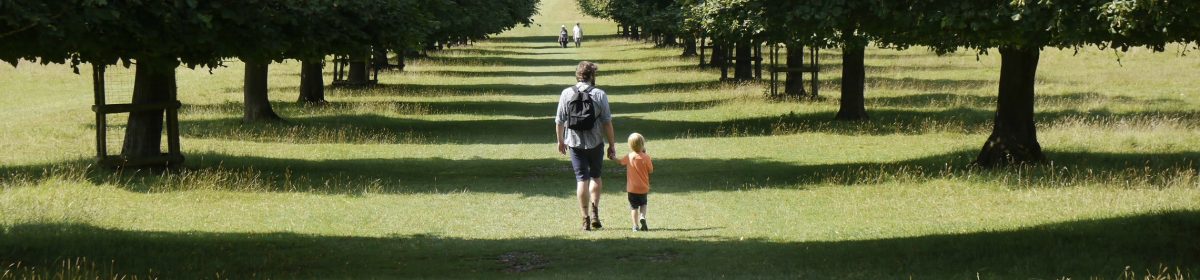

This photograph embraces the landscape I’ve spent much of my life working in, walking in, cycling around and variously exploring. It looks looks across to the Forest of Dean and in the flesh, as it were, you can just see the pillars of the old Severn bridge so all my old parishes are there. To the left is the place where I was born, and the whole of East Bristol towards Clifton where we also lived and all our children were born. The depression on the horizon contains the Avon Gorge through which the River Avon (which flows past our flat in Bath) enters the River Severn and the Bristol Channel. Our flat lies on the cycle path that traces the abandoned railway line between Bristol and Bath and if I follow it I can pass the house I was born in. I first went into Dyrham Park when I was about 11 years old and was allowed to go cycling on my own. I explored all of this landscape and often climbed over the wall of Dyrham Park and rested there. In fact I still feel as if I’m trespassing although the house was virtually derelict at the time.
Whenever we go to Dyrham Park we ignore the bypass and the motorway, which I loathe for having gutted and broken up the landscape of my childhood. There is, or rather was a powerful sense of place that came from the style of buildings and the stone many of them were made from. There were old connecting routes like the dram road – even the name “dram” is, I think a soft mutation of “tram” which is very characteristic of the dialect of my childhood. The road which has almost disappeared now, was the tramway that brought coal from the South Gloucestershire Coalfield – Parkfield Colliery, Coalpit Heath and so on, to the river Avon for onward transportation. I think I’ve written about the sense of rootedness I had from just talking to an assistant at Bendrey’s Sawmill who spoke with exactly my own dialect and which placed us both within a few square miles. The dialect is gradually ebbing away and the explosion of housing estates and their infrastructure of roads and services has eroded what sense of belonging once existed except for a few eccentrics and die-hards who, like me, are apt to be taken for idiots because we refuse to jettison our accents. As I’ve often had to remind people ‘the fact that I speak with an accent doesn’t mean I’m stupid’, but such is the power of the stereotype. To get back to the point, though, we sometimes take the route I might well have cycled as a child; through Keynsham and then past Fry’s old factory now renamed “The Chocolate Quarter” and converted into attractive flats too expensive for the people who lost their jobs at Frys to buy. Progress my ass! North Common, Bridgeyate, Siston Common , Wick, and Dyrham were, I suppose, just about the catchment area for Rodway School. One of my first girl friends used to catch the train from Yate to Mangotsfield along with maybe twenty others. It was a human sized patch of territory within which many remained and I’ve returned from living only twenty miles but a whole civilisation away. I remember saying when I retired from parish ministry – I think it was my last service at Elberton – that I was afraid I had become hefted in Severnside. Well, if it was ever true, the territory of my childhood has proved the stronger force. Each place is embedded and enchanted by memories. The brickworks at Shortwood where Eddy and I would play in the old flues, crawling through the underground passages to gaze up at the sky through the chimneys. The capped mineshaft at Parkfield where you could still peer down the mineshaft and see the harts tongue fern marking the boundary between the known and the terrifying depth of the shaft. All this in a landscape.
And so today we took a break from the allotment and went for a walk in Dyrham Park and by the strangest coincidence we met a couple of Rangers one of whom was the daughter of the Deputy Head of my primary school, so we’re talking sixty years ago. It’s always the voice, you see. Between us we remembered not only all the teachers, but their idiosyncracies and the colour of their hair. A whole cast of characters came back to life. Then as we zig-zagged down the Terrace to the formal gardens we were admiring this pruning on the espalier pears in front of the main house, when one of the gardeners came along and he then called over the full-timer who had actually pruned them so beautifully. As soon as he knew that Madame had once worked at Long Ashton Research Station they were away, talking about growing virus-free budwood and grafting and, of course, pruning. So then we had a marvellous impromptu seminar on the Modified Lorette pruning system, and he’d actually visited the gardens at Versailles to see the method being used. Apparently they are quite happy to allow nine years for the lower branches to reach full length before they allowed any rising shoots to establish a second tier. So back home and a glass of perry from the orchard while we reflected on the day. As we were checking out at the shop I had a jokey exchange with the woman on the till. I asked her if I’d live longer if I collected enough of their ‘bags for life’ she instantly swtitched into metaphysical mode and asked me intently “would you really like to live for ever?” “No, absolutely not” I said – but I thought to myself “can I have a few more more days like this first?”
 No prizes for guessing that this was our local Sainsbury’s the day after the snow fell. To be fair it was a combination of equipment failure and panic buying but the same thing happens every time we get a period of severe weather. The system collapses, people get angry and we realize that there is no slack, no resilience in it at all. I had a quick look on Google and I could see that there were people complaining everywhere – broken by the fact that they’d been forced to buy brown bread instead of white! This kind of event is almost designed into the system. Some time in the 20th century the notion of public good was set aside by the food industry in favour of profit. One kilo of asparagus is flown from Peru at the cost of 8 kilos of carbon released into the atmosphere Our passion for fresh, out of season vegetables and fruits may not (like meat production) be releasing methane into the atmosphere but it’s making up for that with all the other greenhouse gases involved in transporting it a thousand miles overland, and even if you buy local produce, when the infrastructure collapses because it’s not properly maintained, the milk, the fresh seasonal veg and everything else that needs to be brought to market stays put and sometimes even rots in the ground.


 This is the season where the weather can be all over the place, and today as we walked down to the allotment we noticed the automatic greenhouse vents were open. It was no more than 5C with a cold north westerly wind blowing and the ground was still frosted, but the sun was intense and a very little 6’X4′ greenhouse can soon heat up even in the winter. If we were on a mission it was mainly to get the three recently finished beds under cover before the snow. They need to warm up ready for the early plantings, but in addition I wanted to clear the way to build the hotbed, the wormery and the last two raised beds, as well as get rid of a few of the really nasty weeds – like bindweed and couch.
 If we do get a substantial fall I’ll need to go up and clear the nets of snow. In the past we’ve seen very strong steel frames bend under the weight. I received another photo this morning of the rapidly growing pile of very fresh and hopefully very hot horse manure that my friend Annie is saving for us and so I sorted out a dozen empty compost bags so we can transport the manure back in our little car. Really I’d love a pickup – we had one many years ago and I loved it – but Madame very properly reminds me that you can’t take grandchildren out for the day in the back of a pickup. Warm clothes? No probably not.
 For the first couple of minutes it kicks off but very quickly it settles down to not much more than a whisp of smoke and steam. It’s rather like burning charcoal – after a hot start you restrict the access of oxygen and then, with a bit of judicious topping up and maybe some wood chips sprinkled in now and again, it will burn immensely slowly for a week and reduce the weeds to ash that then goes straight on to the compost heap. I know that some people swear by stacking it up and wrapping it in black plastic, or – even worse – just chucking it on the compost heap and rendering the whole heap a nursery bed for weeds. Sometimes you just have to do the least worst thing you can think of.


 Some people might find even a slightly out of focus photo of a pile of poo a bit – well, rich first thing in the morning, but we at the Potwell Inn are made of sterner stuff and find it extremely cheering. Most people send pictures of their winsome children or latest culinary triumph. Not so for people like us. This little pile is the beginnings of the new hotbed, nestling in the corner of my good friend Annie’s barn. She’s dotty about horses. I’m less dotty about the animals themselves – (I once had a bad experience with a nasty natured beast called “Copper” who thought it would be amusing to scrape me off his back by galloping at a low branch), – I am however very attached to their by-products which are going to be converted this year to a wheelbarrow full of early salads, followed by the best crop of squashes ever seen anywhere. Annie is/was one of my parishioners back in the day – I took her wedding service, and she was reminiscing yesterday about the rehearsal when a policeman burst into the church, which was very remote and pretty much in the middle of a field, because he had spotted the cars outside and suspected a burglary was taking place. Now, of course, we live 20 miles away but we still keep in occasional contact. Especially when there’s manure involved! This little pile is just one day’s output from her extremely well cared for horses so I’m expecting great things. How exactly I’m going to get it to the allotment in our tiny car is another matter. Hot, wet and richly smelly, oh my word – it puts a spring in my step.

 I can answer that question for us at the Potwell Inn because one of our children suffered from his earliest months from what was thought to be lactose intolerance. It turned out to be something else and he’s now approaching forty and in good health, but that’s not the point. For us that possibility – in the era before smartphones – meant that shopping became a nightmare in which small print was obsessively pored over and during which we carried a long printed list of safe foods which had to be updated every few weeks because manufacturers would change recipes and what was ‘safe’ one week would contain lactose a month later. Lactose was a cheap and easy recipe component that found its way into the most unexpected places. What that experience did – and this is the takeaway point – was to pathologise food for us. We were in an unusual and rare position and eventually, after several years of hospital admissions, it became clear that lactose wasn’t the underlying problem and things kind of settled down again.
 I think I might be a bit of a perfectionist. I had three hours on the allotment this morning while Madame cultured the cold I was good enough to share with her last week, and so I took this photo of the bed I dug today so I could show her when I got back to the flat. But what do I see when I put it on the screen? Any sensible person might have paid attention to the neat bed and its readiness for planting up in the spring. All I could see was the tiny bit of couch root at the bottom left hand corner that I’d managed to overlook. Pefectionism is a blight and it’s often accompanied by being unable to choose between several almost identical course of action. Should I drive the pegs for the boards into the paths or the beds? There’s much to be said for either course of action and I’ve wasted hours wondering about it.
 In fact our shed has turned out to be a bit of a disappointment. Since it got so full of – things – it’s impossible even to step into it, but I made a flask of tea and resolved that I would take a break now and again just to contemplate the fruits of our labours and dream of next season. Three hours later Madame rang me on the mobile and asked if I’d enjoyed the flask. Well actually I’d completely forgotten about it and then I felt embarassed at being so lame about taking a break so I put the tools away, since I’d finished all I wanted to do, and perched on a kneeler drinking the tea in a penetrating wind and feeling that I ought to be experiencing a lot more pleasure than I was actually having. I seem to lack the zen like gift of contemplation that seizes nearly everyone else on the site. So then I picked leeks, parsley and Brussels sprouts for supper tonight and came back to the flat.