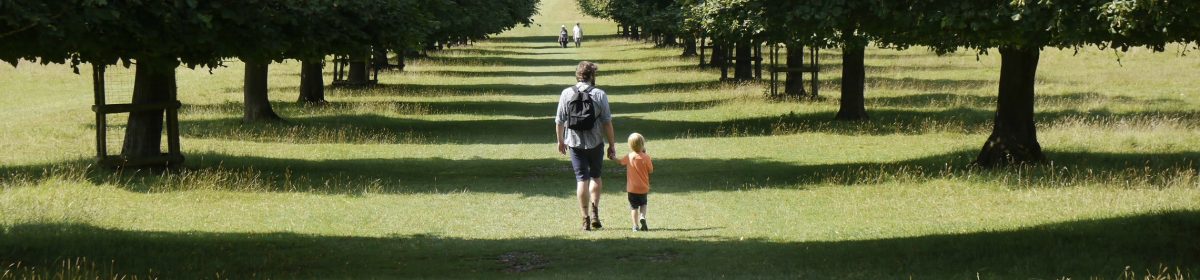
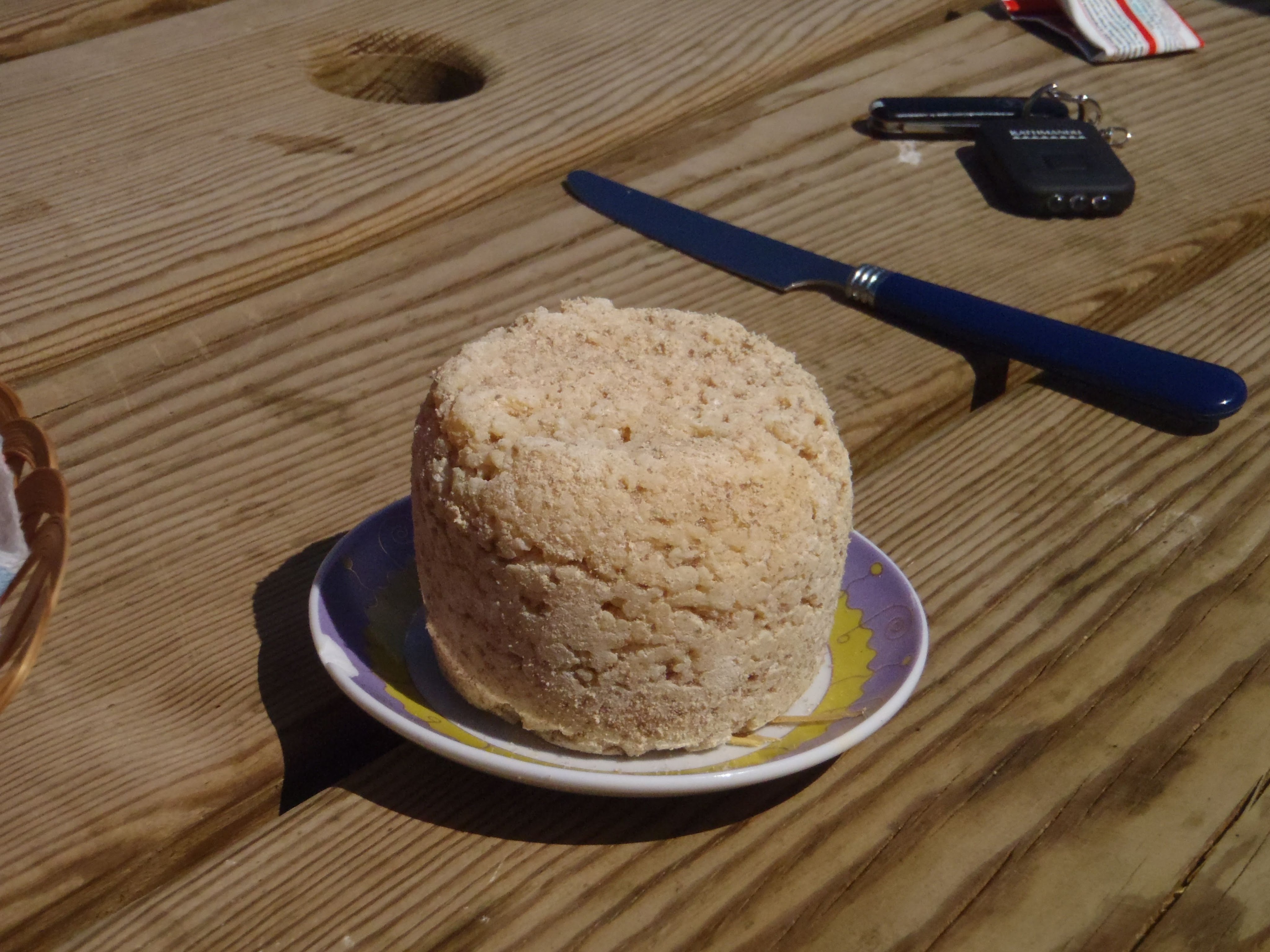
No energy today. Every step (all uphill) a struggle. Jacqueline caught up with us and gossiped us over the first huge pass. Stopped at a farm and had café au lait + fresh bread and a small cheese made on the farm. Wonderful!
Ctd next day:- No room at Les Sauvages so we decided to press on to St Alban sur Limagnoles – 35K and nearly killed us. Arrived at the church at St Roch and unexpectedly burst into tears. On and on – it seemed even walking downhill was hard. Arrived at campsite exhausted and on the verge of quarreling. Mercifully the campsite manager cooked us a toasted sandwich and some chips. Slept 10 hours and breakfasted on two bowls each of hot strong and sweet black coffee. Left at 11.00am thinking we had an easy (17K) walk but it was 25°C and uphill (2 big hills and their corresponding valleys. [M] had to help carry my stuff as I was about to collapse. Arrived at Aumont Aubrac to find the campsite closed. Broke in and picnicked on sardines and apricot tart + UHT milk. Still tasted heavenly. We were both feeling demoralized as all the campsites we hoped to stay in were closed for the next three days. Discussed sending some stuff home to save weight. Bed at 7.30pm as we want to leave between 5.00 and 6.00am to miss some of the heat. 25K tomorrow. Can’t get fuel for our cooker anywhere in France. Sharing our vagrant experience with Alain and his wife – he’s made a cooker from the end of a beer can! Crazy as a coot!
Journal
Well we didn’t exactly break in but we did clamber over a locked gate. It was a weird experience because the facilities were all locked up with the entrances full of leaves – a sight we were beginning to be all too used to. We’d met Alain and his wife a little while earlier. They were sitting at a table outside a cafe and being mercilessly teased by some of the locals. The village was heaving with visitors partly there for the Pentecost holiday – which we’d failed to factor in; and also because the annual transhumance was beginning and locally it’s a big deal as the cattle, decorated with flags and garlands, are driven up to the plateau to graze the wildflower rich meadows. The French are among the most secular of people, but they don’t appear to have given up on the holy days, and there’s a deep sense of tradition surrounding the transhumance. I found it very moving to watch the cattle being driven up the drove roads, but the downside was a good deal of drinking which left us feeling a bit unsafe at times. That was the evening when Alain – a retired tax inspector – showed us the tiny spirit stove he’d made from the bottom of a lager can. Later on in the walk by which time we’d all got blisters, we found him walking in pink plastic sandals with plastic bags on his feet.
The church of St Roche was almost the only church I actually entered on the walk. Inside was the obligatory elderly woman in black and with rheumatic chesterfield legs hobbling around and completely ignoring me. My mother had died two months previously, but as she’d died with Alzheimer’s and hadn’t recognized either me or my sister for several years, any acute sense of mourning had been dissipated over a long period of what we called pre-mourning– or so I thought. So in a rather blokeish way I went into the church, saw the old lady, came out and completely fell apart; howling all the tears I’d had locked away for a very long time. M looked at me and said – “that was a bit unexpected” and the subject was never mentioned again. I didn’t need a therapist to help me see what was going on there, but a long time later exactly the same thing happened in a psychoanalytic psychotherapy therapy session. I was trying to describe how moved I was by the way that Odysseus’ nurse had recognized him by the scar on his thigh and once again I exploded with what felt like a volcano of grief. Grief seems always to be a work in progress.
The way down to St Alban was steep, narrow and rocky, and with our heavy rucksacks much more of a struggle than grinding uphill. It would have made our journey easier if we’d realized how wonderful it would be crossing the Aubrac plateau the next day, but that’s the way of pilgrimage – everyday is a surprise.
According to the Cicerone guide there’s a campsite where we stayed next to the river but I can’t remember anything about it.
Journal
Well the reason I can’t remember anything about camping in Monistrol d’Allier is because after looking more carefully at the journal, we didn’t stop there but pressed on to Saugues. The photo was taken on the endless hill coming out of Monistrol where we were passed by quite an elderly man who was admittedly travelling light but making rapid progress. I said something about it being steep, and he replied- “no,Mont Blanc – that’s steep!” So here’s the day in full from the journal. It includes a stretch I’ve already written about.
20th May 2010
Monster monster day. Crossed over a big ridge to Monistrol d’Allier where we found an unlikely Englishman called Peter running a restaurant. Couldn’t stop him chatting. Had a coffee and a triangular toasted sandwich – the machine for which he hopes to sell in Korea (!) –filling was made from last night’s leftovers gratin dauphinoise, bits of dry cured ham and cheese sealed in a kind of crêpe.
After that the going got more and more tough. We laboured up the side of a gorge and climbed upwards and upwards into a new landscape. Dairy cattle, sheep for milking (with bells) and goats too. Very like high Mendip. Pastures completely untouched and covered with spring flowers. Dandelions seem to be at their peak here – a month later than at home. Lady’s’ Mantle and all sorts of stunning wildflowers. We fell in with three women from Nice who were totally shocked at the appearance f a peasant farmer’s wife. One of them said to me with a horrified look – “This is DEEP DEEP France!”
Eventually we reached the top and down into Saugues. Found a good campsite next to the river and in the middle of a sports ground. Walked back into town and found a brilliant restaurant – 4 courses 12€. Met up with Serbian woman called Jacqueline and two Germans. Miss Serbia spoke about 5 languages and just loved organizing us.. Cold night. Slept well and woke up at 6.30. Bananas and orange juice for breakfast.
This part of the journey – aside from being very arduous, as the Cicerone Guide warned – gave us a first glimpse of some of the most lovely countryside I’d ever visited as we approached the Aubrac Plateau. The weather was fine and clear and – being pretty high at approaching 1,100 metres – it was cool enough to enjoy the walk once we’d levelled out. The campsite at Saugues held one further surprise because when we stretched out for a rest alongside the river, M’s bivvy mat was punctured by a sharp stone and we had a frantic time hunting for the repair kit. We had a bit of a barney about the fact that I had a long gossip with Jacqueline which evidently touched a raw nerve with M in the shadow of his ex wife’s infidelity. Anger was constantly simmering not far under the surface and was always inclined to break out without warning.
I wrote earlier about some of the kit we assembled to take on the Camino and you’ll know – if you’ve been following this thread so far – that it was far too much and far too heavy. No complaints, though, about the little Hilleberg tent which was super light, stormproof and very comfortable; nor the Thermarest inflatable bivvy mats which were brilliant too, and the Mountain Hardware down filled sleeping bag. There’s nothing more cheering in the world than feeling safe, dry and warm when you’ve finally found somewhere to pitch up and you’re cold, tired and hungry. I love the sleeping bag so much that when I was driven back sedated from an endoscope exam I preferred to sleep it off in the sleeping bag. As I looked at the kit just now I thought to myself – why on earth didn’t we do the South West Coast Path? or the Coast to Coast?
With a little time for reflection, that turns out to be a pretty serviceable question. What, if anything, is the difference between a pilgrimage and a long walk? I’ve already said that before we left I felt I’d lost my way and that any sense of vocation that I once enjoyed was worn down by conflict and self doubt. I think that, at the time, I just hoped that I might find some kind of illumination by walking the Camino.
But there’s absolutely nothing about going for a long walk that prevents anyone, religious or not, from experiencing numinous moments that could fairly be categorised as spiritual without buying into the whole supernatural apparatus. The sense of the spiritual could derive from the emergent quality of a random conjunction of material factors – the sound of cowbells on a distant pasture, the smell of the spring air, the wild profusion of spring flowers experienced in a strange place that makes us feel how beautiful the earth is, or how small and vulnerable we are; or it could also be explained as a reassuring hug from an immaterial universal force. Does Gaia do hugs? Maybe it’s our attitude to those experiences that frames alternative answers, and perhaps on reflection a walk can turn into a pilgrimage or a pilgrimage into a walk. In the end; does it even matter?
There’s another possible answer to the question what’s the difference between a walk and a pilgrimage? when we look at it through the lens of some sort of virtue ethic. Going for a long and possibly arduous walk might call into play some or all of – let’s say – the Buddhist virtues; generosity; proper conduct; renunciation; wisdom; energy; patience; honesty; determination; goodwill and finally equanimity – but that wouldn’t be the objective of the walk. However reflecting on those virtues as the walk unfolds and deliberately putting them to use, frames the walking differently, allowing us to reflect on bigger questions such as what does it mean to be fully human? how do I distinguish between flourishing and just getting by? Maybe the objective of the walk is not so much simply to arrive at some kind of holy place – although that certainly adds a layer of meaning – and it should never be an opportunity for suffering for the sake of it because that would be a display of ego and self importance, but perhaps it’s the manner of the journey that matters. Perhaps it would be better to keep quiet about it. The one thing I am quite sure about is that pilgrimage in order to gain posthumous benefits – a get out of jail free card to be traded in against today’s willfulness, is just wrong! A pilgrimage, then, pays more attention to inner change and that’s why it’s hard to do well and easy to get wrong.
My first and finest lesson in equanimity came while we were at art school; Madame studying sculpture and I was studying ceramics. Quite in alignment with my personality I took up two ceramic disciplines that demanded spontaneity and risk – raku and salt glaze. I had made a kiln load of pots to fire in a self built salt glaze kiln, and spent 36 hours firing them in the corner of the sports field. When the kiln was opened it was dramatically overfired and everything had sintered together in a lump that could only be removed with a crowbar. I knew, as I stood in front of a month’s ruined work. that this was a critical moment. I could walk away and try something less risky or embrace the failure as a profoundly important life lesson. I chose the second option and ate it up -and it’s fed me well.
But back on the Camino, did we really need the lean-back chairs? No, of course we didn’t and they – along with most of the redundant or unusable kit – were sent later on to a friend in Bordeaux where we hoped to pick them up later. The improvised clothes pegs are free and available underneath most conifers. The giant scallop shell is the symbol of the pilgrimage for complicated reasons accompanied by pretty far-fetched yarns but it serves as a badge of sorts. Oh and the cheese comes later in the walk but it’s a reminder that if you’re actually taking part in a pilgrimage rather than a mobile supper club, you have to eat when you can, and put up with being hungry when you can’t: it’s all part of the process. Our worst ever meal was a shared tin of cold (we had no stove) cassoulet complete with the layer of fat on the top, but if you look at the top left photo you’ll see the two trees above us in which a Nightjar sang (or rather churred) gently all that night. I had never heard it before or since. When it all boils down, the biggest load you carry on a pilgrimage in any case, is the mental baggage.
Monster monster day. Crossed over a big ridge to Monistrol d’Allier where we found an unlikely Englishman called Peter running a restaurant. Couldn’t stop him chatting. Had a coffee and a triangular toasted sandwich – the machine for which he hopes to sell in Korea (!) –filling was made from last night’s leftovers gratin dauphinoise, bits of dry cured ham and cheese sealed in a kind of crêpe.
Journal
This is becoming quite a chastening exercise because every bit of the journey I read back in the contemporary notes comes to me with extras I didn’t recall at the time – like the fact that Peter the proprietor of the hotel and restaurant brought out a wooden board with a lump of local sausage, olives and a large hunting knife for us to help ourselves as he (mostly he) talked. I got the impression he was quite isolated and rather lonely since his wife and, I think, daughter were away somewhere. I couldn’t resist this photo – “Poseur,” apart from the English loanword meaning, meant something like installer, and I wonder if it referred to houses built for the workers building the SNCR railway track from Paris down to Nice. If you drive rather than walk out of Monistrol d’Allier, you follow the railway line which looks incredibly scenic. The trains were still running infrequently a few years ago and there was a ticket that allowed passengers to get on and off as frequently as they liked. It’s a journey I’d still love to make. According to the Cicerone guide there’s a campsite where we stayed next to the river but I can’t remember anything about it.
Some years later, Madame and I retraced as much of the route as we could in our little Hyundai i10 and we stopped off at Monistrol to spend a night at the same hotel. Peter the owner was still there and at supper he walked through to the kitchen with a big tray of freshly picked bright yellow girolles. They would have cost £50 at the market. Our room was spartan – like student accommodation – but on checking it just now it seems to have gone a bit more upmarket these days, although I don’t think the Korean toasties had taken off. There’s really nothing much to see in Monistrol; Madame vowed never to return, and I didn’t argue.
You get some idea of the terrain we were getting ourselves into from the photos below. The warning below them , which we hadn’t properly embraced, was in the indispensable Cicerone guide “The way of St James”. More on that tomorrow with a bit of luck.
I haven’t been spending all my time on writing up the Camino; we’ve also been incredibly busy on the allotment and tomorrow we’re back off to the Bannau (Brecon Beacons) to spend a couple of days with our friends. Hopefully we’ll have time to put out the moth trap and see some of the spectacular moths you can find there, even at 1000 feet – and the fungus season is cranking up nicely although a large box of girolles is probably not going to happen. Looking at the Camino photos the Aubrac hills, although they’re closer to 4000 feet, aren’t dissimilar.
This was only the second day of our walk but even by then we were beginning to realize the scale of the effort we’d be needing to make. Our rucksacks were back breakingly heavy and none of the training walks had been anywhere near the level of difficulty we were now attempting. Somewhere on one of my dead laptops there’s a spreadsheet with the weight of every single item we were taking – all neatly added up. On the night we actually packed them we weighed them on the bathroom scales and the rucksacks were around 5 kilos heavier – a powerful incentive to send some of the kit back to the UK. Individually the kit was as close to state of the art as we could afford; all of it – from bivvy mats, sleeping bags to quick drying clothes, overtrousers and raincoats, super lightweight – it rains a lot up there in the spring. Looking back, was it really necessary to take a spare pair of shoes? Two cameras rather than one? – the list of errors went on. But there’s a reason for it all that hid under the radar as I was planning, because I’m a bit of a hobbit – I believe I need my familiar objects around me.
I suppose most people would say – off the top of their heads – that the object of a pilgrimage is to get to the destination; the holy place at the end of the rainbow. But for me the essence of the enterprise is to embrace vulnerability. For me, not knowing where I’m going to sleep or eat each night is extremely challenging. Not knowing what the next day will involve or where I’ll finish up; not speaking the language very well; not knowing what we would do if ( as happened several times) when we arrived at the campsite, it was closed and locked, or all the shops shut. I could never come out of a period of vulnerability feeling smug or spiritual; just exhausted, wary and fearful but strangely exhilarated and open, with all my senses on steroids. There’s a clarity of thinking that comes alongside vulnerability. The dead hand of my scripted future is swept aside. One of the notes I found in the notebook today that didn’t find its way into the typed transcript was this –
My worst fear would be that my life would turn out to be a quotation from somebody else’s
I had a stroke of luck today when I found my original notebooks among a box of old files. I still use the boots on the allotment so they’ve lasted around 14 years of hard work. Still waterproof too!
Three questions, then – but not all questions have the same dangerous forensic quality or indeed the same capacity to disturb a night’s sleep. When I formulated them it seemed likely that – at this distance in time – they’d be easy to answer but – well, it seems not. You’d think, wouldn’t you, why then? would be simple; I was due a sabbatical, so who wouldn’t?
Why then?
The Church can be the devil, and when it thinks it can’t be it is!
Canon Francis Palmer in an ordination sermon.
On the one hand, I was an enthusiastic walker and I’d become fascinated by the idea of pilgrimages. I’d even invented and done a two day, forty mile walk from Malmesbury Abbey to Littleton on Severn, following the most likely route to be taken by monks travelling to one of my churches. An old legend told the story of one of my predecessors being murdered on the way to take a communion service, and having the chalice he was carrying stolen by robbers. It was said that a nearby spring turned red every year to commemorate his death. An alternative legend claimed it was the Saxon anchorite St Arilda who was murdered by a Roman officer called Nuncius when she refused to submit to him. I designed the walk to pass both churches dedicated to her as well as my own, and also the spring named after her – which involved a bit of mild off-route trespass. It is thought that the occasional red colouration of the water is due to a micro-organism.
Much earlier in my life I’d managed to include St Ann’s well in Syston into a cross country run which I invented to keep a sadistic PE teacher off my back. It’s difficult for much younger people to understand that we boomers – apart from all the good things like education – also had to put up with a significant percentage of our teachers suffering from PTSD after war service.
Anyway, aside from my interest in pilgrimage and the availability of the sabbatical there was something else. As Francis Palmer warned on the day I was ordained, the church is a dangerous institution. Bullying is endemic. Both congregations and senior clergy are all too willing to destroy, or encourage the destruction – physically, psychologically and spiritually – of anyone who challenges their authority or orthodoxies. I had to cope with a group inside the church who constantly belittled and challenged me; but also a local head teacher who attempted to destroy my career by making false accusations against me. The accusations were easily disproved but the church legal authorities refused to intervene on the grounds that he was clearly mad. We had church members on the doorstep shouting abuse at me or whoever answered the door. We were about to begin a major refurbishment of the church which was overwhelmingly supported by all but a handful of vocal diehards. Yet I was very close to burning out after approaching twenty years of constant headwind in spite of which we increased the congregation, built up a vibrant music group and extended our outreach into the village. Francis Palmer was right, and so was Dom Edmund Wheat who once said to me “always remember that availability is an ascetic discipline”. I no longer knew what, if anything, I believed in any more – apart from believing in the congregation who had stuck with me. I may have thought, without ever articulating it to anyone, that I might, just possibly, find God again out there in the wilderness.
So I filled in an airily optimistic proposal for some funding without mentioning any of what I’ve just written, and it was approved. I was awarded a few hundred pounds most of which I spent on an amazing Hilleberg two person lightweight tent because I thought that was how everybody else conducted long pilgrimages. Then came the maps, the guidebooks and spreadsheets and time ticked on as I bought essential boots and equipment and carried out long training walks.
Why now?
So why am I writing this after so many years? I can think of two possible answers. Firstly, and without any provocation from me, the thought that I might try and walk to St David’s Cathedral popped into my head last time we were in Pembrokeshire. To be clear, I would walk to St Non’s Well not the Cathedral which is 3/4 hour walk further on but far too noisy and full of tourists – and I would do it in short sections, over a period of time and preferably with Madame somewhere close.
The other reason is because I’ve been worrying that the wheels are increasingly wobbly and may fall off before I’ve accomplished a couple of goals. Nothing immediately life threatening is happening but I seem to be taking a lot of medication and visiting the hospital more and more. Bless them, they’ve done wonders, but it seems to me that it’s time – and this is a lovely euphemism – to get things straight; and the Camino is one of those life events that I need to straighten out while I can still put one foot reliably in front of the other. I don’t want to spoil the plot, but I’m still post-Christian and I’m still hoping, still looking for an answer.
The second goal – and this is pure hubris – is to finish writing a million words in this blog, about being human, or being virtuous I’m 80% there now.
Why me?
Well why not? However most of my life has felt as if I was being called to do or be something but I never found out what it was! Vocation is exactly that kind of thing which happens when you go for a job interview and protest that you haven’t seen a job description. At the risk of sounding psychotic, words sometimes land in my heart that are incapable of doubt. There’s a form of utterance in grammar that’s called performative. So these performative statements land without warning and because of their nature, what is spoken just happens. Mercifully they’re vanishingly rare in my experience, but it’s odd when the words “It’s alright” plop into your heart and immediately everything is alright and all melancholy and doubt fly away. There was another one – a bit cryptic but I knew instantly what “clear the decks” meant for me.
So moving on we’ll come to day one of the actual walk:
20th May 2010 Yesterday – bit of a slog (that’s an understatement). We seemed to be climbing all day – could only get a coffee in St Christophe because the (food) service was finished. Got to Montbonnet and decided to push on to St Privat d’Allier – which turned out to be all uphill. Arrived at the Camping Municipal (very good) at 6.30pm. Feasted on the weirdest and thinnest cheese omelette ever + chips and lettuce leaves. Bed at 8.30pm. Up at 6.00 and faffed about until 8.00 so we could stock up on pain au chocolat at the boulangerie.
This is a detail of the tympanum of the abbey in Conques – much further down the path
19th May 2010 Leaving Le Puy now. Cleaner at the cathedral asked me if my water bottle was a respirator!
Journal
The preparations for the Camino took months. I was overdue a sabbatical in any case – I’d missed the previous opportunity because I could foresee that any progress we’d made in moving forward would be utterly undermined by a small conservative faction in the congregation who still thought my job was to chaplain the status quo.
Looking back, I was preparing for a pilgrimage that never was, never would be on offer. Pilgrimages were the package tours of the middle ages. They were fuelled by the fear of hell and the sheer difficulty of forgiveness; and the USP was the odd idea that kissing or touching a gold reliquary containing a dubiously authentic body part – let’s say the foreskin of the martyred St Superfluous – would confer bankable spiritual benefits. The early church must have been populated with a great number of genetically strange saints with a dozen hearts, twenty five fingers and innumerable other dangly and easily removed bits for sale on the open relic market. I’ll come back to what my motivation was further down the road; but rest assured that relic reverencing wasn’t part of the plan.
Anyway, moving on rapidly, the 21st century pilgrim can call upon a well resourced network of comfortable overnight stops and small cafes, not to mention the Transit vans which – for a tidy sum – will carry your luggage; transport you over the hard bits and even meet you with a picnic lunch.
Our budget, on the other hand, was 30 euros a day to cover everything – and as the journey unfolded we quickly realized that this wasn’t remotely enough. We had planned to carry everything we needed; tent, sleeping bags, bivvy mats, clothes, cooker – kitchen sink etc. Being completely self contained would mean we could wild camp with occasional nights in a campsite to grab a shower. Having spent the night at the youth hostel in Le Puy en Velay we set out to buy gas for our hideously expensive skeletal titanium cooker. I’d been assured by the good folk at Snow and Rock that suitable gas canisters were universally available across Europe. It seemed, after a fruitless trudge around Le Puy, that this was not the case. Before we had taken a single step along the Camino we had to accept that there would be no cooker; no warmed-up tins of soup or early morning brew ups. That was the first disappointment.
At the cathedral, where we needed to get our pilgrim records stamped, a friendly nun asked my companion if he was my carer and the cleaner expressed interest in my respirator (drinking water bladder). With that cursory medical out of the way, we staggered down the long flight of steps with much heavier rucksacks than were sustainable for some of the days we had planned. If that was a portent we ignored it, fiddled about with the straps – as if that made any difference – and set off, followed with quizzical regard by the locals who obviously thought we were rather odd. Within a couple of hundred yards we were slogging up a steep hill having learned our first pilgrim lessons. France is not wild; you shouldn’t believe everything they tell you in camping shops; and this was going to be painfully hard. Our first glimpse of La France Profonde was a small industrial estate where one of the units made paté. It smelt like Brain’s pie factory from my childhood.
Tomorrow I’ll perhaps write a bit more about the kit as we tackle our first really hard day.
It’s two weeks since we got back from France. At first I was just confused, feeling terribly guilty and carrying a huge sense of failure. Of course everybody made the right kind of noises, being very affirming and saying they’d have done the same thing under the circumstances but it’s been very hard to shake off the feeling that I somehow wimped out. Since then I’ve been suffering from elective agoraphobia – not wanting to meet or talk to people, and skulking in and out of the village taking the quick way out onto the A38. I kept myself busy at home, installing a mobile phone repeater amp and helping the boys to decorate a bedroom, but I knew I was avoiding the issue. The fact is, my sabbatical project has gone down in an ignominious defeat, I’ve been sponsored for something I couldn’t finish, and I’ve got two months off with zero sense of what to do with it. On the other hand I can’t sit around forever feeling sorry for myself – and I did learn a lot even from the shorter walk. On the plus side we walked 350K and across the 4000 foot high Aubrac Plateau in really tough conditions and carrying everything we needed – so we walked further than Offa’s Dyke Path (283K) The Coast to Coast (307K) and the vast majority of other UK trails. The problems we encountered were mostly our own fault – not least a hubristic view of our capabilities and a failure to look carefully enough at the facilities we needed. This led us into some mammoth 35K walks carrying far too much weight. We also failed to realize that many French campsites only open during the school holidays – and many of the ones we stayed in that were open had not finished their winter refits – restricting facilities greatly. The one factor we couldn’t have foreseen was the exponential growth of assisted and guided walks along the route. We were constantly surprised at the number of people who seemed to be carrying next to nothing. It took several weeks to realize that their belongings were being shipped from place to place by transit van. Sometimes we would find a large group sitting in the middle of nowhere eating a picnic that had been driven out to them. On one occasion one such group took over the only restaurant in a small village in its entirety. Naturally the infrastructure has followed the money, and so the facilities (which are expanding rapidly) are not for solo walkers and campers but for paying groups. Consequently many of the gîtes d’etape were being swamped by large groups – a problem which could only get bigger as we approached Spain. If I was ever to attempt such an ambitious project again, I’d calculate the ratio between load and distance more carefully. To do the whole Camino carrying the loads we had – i.e. carrying tent etc. would ideally break down into daily walks of 20K maximum – 17K would be better. That would not be possible due to the uneven distribution of suitable campsites. Wild camping gets less and less possible as you move into more populated areas and it’s illegal in Spain. That inescapable limitation means that the only way to do it in less than 4 months (allowing one day off a week) is to ditch the tent and stay in gîtes d’Etap or B&B. This would increase the daily budget dramatically – from 30€ to as much as 100€. Even taking into account the shorter time it would still be twice as expensive and wildly more than I could afford. Looking back on my notes now they seem unbelievably brief, often missing out great chunks of stuff that seem far more important on reflection. I’ll be adding to them and matching them with photos over the coming weeks. Watch this space.
From my notebook
Well that was then – 13 years ago, since when the photographs were gradually dispersed over three incompatible laptops, the original notebooks (which fortunately I transcribed soon afterwards) are somewhere buried in the strata that constitute my filing system and I’ve done everything I can to forget the whole thing. The sense of failure never left me and cast a long shadow over the following years. But gradually – and then suddenly in the last few weeks – I began to see a way to reconnect the threads.
Of course writing history, even the memoir of an event in which I was a participant, is a dangerous game. The temptation to gloss the hard parts; fill in the missing bits with fiction; to inflate or deflate those aspects of the narrative that suit purposes which I don’t even fully understand myself; or just to self-justify; blame someone else and whinge on about the blood, sweat, tears and blisters; all of which happened but all of which were mitigated by unexpected moments of grace.
So having spent a week organising all the written material I could find and united the photographs into a single and accessible library I’ve also got an idea (untested until today) of how to proceed. I’ll use the contemporary and unedited written notes and photographs to evoke some sense of our failed 1000 mile walk; then I’ll add some reflections on how we got to where we found ourselves; what we learned from it, how it’s played out in subsequent years; and to start at the beginning, the very first note which absolutely nails our unpreparedness :
18th May 2010 Couldn’t sleep so up at 4.00am. Stella drove us to Parkway. Saying goodbye was unbearable – I was praying she wouldn’t cry but she did anyway! Then it was just endless trains all day. We only just got to Paris Gâre de Lyon in time because I misread the tickets and forgot to advance my watch by an hour so we had to run up the stairs with our rucksacks on. People must have thought we were mad. Two hours wait and a grotty pizza at Lyon then the most beautiful train journey up the Loire valley: (I only worked out it was the Loire Valley when the conductor gave us a map). The first conductor out of Lyon was a beautiful black guy with a lovely smile. SNCF staff seem to wear whatever they like with one badge of office – often a cap. Spent night at a youth hostel in Le Puy after arriving at 9.30.
WTF did I think I was doing? Subsequently Madame has wasted no opportunity to tell me how completely out of character it was for me to just clear off for three months, and she’s right. I don’t think I gave a moment to imagine how lonely and distressed she would be. I was just obsessed with this batshit crazy plan to walk across France and Spain to Finisterre – the end of the earth. My companion (Modestine? – he often carried part of my load) was someone very close to us whose marriage had just broken down and who was compensating by drinking far, far too much. I asked him along because I wanted (needed) to stay close and look after him. It certainly added another layer of madness to the adventure.
Much more to follow, including a reflection on this whole pilgrimage business – what it’s about and whether some sort of immaterial and supernatural God has any part in it at all. I’ve never felt so nervous about pushing the publish button before!