You have to eat your peck of dirt

But not eating it won’t help you live longer

IMG_5937

It was my turn to prep the veg tonight.  We’d brought back a red cabbage, the last of the summer broccoli, carrots, beans – the usual suspects at this time of year – and they all went into the sink for a swill.  Generally we give the leaf veg a quick soak in salted water so any beasties float to the top – a couple of well fed slugs surfaced tonight. The carrots had got a mild attack of carrot fly and rather than reject them all I cut the iffy bits out – you probably know the score.  We cut any green bits off the potatoes but unless they’re green right through we eat the rest. Blackfly, whitefly, caterpillars we see them all and we try not to cook them, but if one or two slip through the net we don’t worry.  It’s an organic allotment and we don’t inundate our crops with chemicals, we just take the pests off. We don’t peel if we can help it and we don’t even scrub them with abrasive pads because ……

everybody needs to eat their *peck of dirt before they die –

Some are so fearful of dirt and bugs that I’ve even heard of people spraying lettuce with antibacterial spray but sadly the converse of the proverb isn’t true at all.  Not eating your peck of dirt might impoverish your immune system of challenges and make you less resistant to infections – I remember our GP saying years ago that we all washed far too much and then got skin problems. If the evidence of the Potwell Inn kitchen is anything to go by, we’re wading through an invisible soup of micro-organisms every day.  We use them to make bread and pickles and to preserve food for the winter. Our kefir helps to keep our gut healthy and it’s everywhere apparent that our immersion in the creatures with which we’ve evolved is, by and large an essential part of remaining well. I was reading this week that even the somewhat messy events of our birth can give our immune sytem a head start.

By way of a caveat I should say that there ae some micro-organisms that should be avoided.  My particular bitter experience has given me a useful aversion to campylobacter, which I’ve had three times – probably making me a candidate for the Darwin award. In every case I’d eaten processed chicken which I’d barbecued badly — that’s to say on the outside of the grill and in a strong wind. Yet another reason for thinking carefully about cheap meat! But a bit of ordinary dirt, or the occasional accidentally boiled caterpillar doesn’t pose an existential threat nearly as great as a kitchen full of chemicals and a careless chef.

And just to add an amusing postscript to my solemn pronouncements on sourdough loaves, I mentioned at the weekend that I’d started a loaf to cheer myself up after the theft of our coldframes. In my haste I forgot to put the usual 20% of soft plain flour into the mix, and so I was hoping that the resulting loaf would prove my theory that what’s needed is to lower the protein content of the flour a bit in order to get that sought-after open texture, and provide me with a ‘with’ and ‘without’ side by side photo so I could brag about my scientific method. However nature stepped in and I seem to have created two almost identical loaves. Ah well, I’m not as clever as I thought – as if I didn’t know that already!

*And if you were wondering, a peck is 1/4 bushel – but we all knew that didn’t we?  In American dry measure it’s 8 quarts, which is a lot to eat all at once so it’s probaby best to spread the load over a long healthy lifetime.


When in doubt – cook!

Well it took a bit of time to get going, but we spent the day with our family – sons, partners and grandchildren to celebrate a seventh birthday with Sunday lunch, birthday cake and presents; junior membership of the RSPB, inexpensive binoculars, a microscope; you get the picture – no pressure whatever.  Our son (not the proud dad one), who’s a bit of a prankster in these matters, had to be persuaded to drop the idea of a (pregnant) rabbit or a mixed pair of African snails, but there’s always another year!  No one ever quite captures the quiet joy of getting along together or the dubious pleasures of  “here comes the farmer” accompanied by screams of pleasure and “again Grandad”. Families don’t always work, and ours has had its share of ups and downs, but when fair family weather comes along it’s worth celebrating.

Home again in the relative silence of the flat, I weighed out the tomatoes we picked yesterday ready for another big batch – probably 10 litres of what we call “Hazan number one” – a sauce so good you could eat it without the pasta. Just now that might be a relief because we’ve had pasta for supper three nights on the trot, testing out freezable recipes for rainy days. I’d love to increase our repertoire to a dozen sauces because they can be used to beef up vegetarian recipes without the beef.  Pru Leith does an excellent vegetable stock in her “Vegetable Bible”, and I’m slowly being convinced that the move towards eating less meat doesn’t in any way mean sacrificing rich flavours.

Then, the nuclear option for cheering myself up – I started a sourdough loaf that will be ready to bake in just over 24 hours. The sight and smell of a newly baked loaf is one of the most cheering sights in the world – simple but life enhancing. If they knew how good this feels they’d tax it or make it illegal.

Do feel free to pass on the message!


Sourdough? – bring it on!

I overheard a young bloke in the supermarket the other day explaining to his girlfriend that one particular brand of something or other was better ‘because it was higher in protein’.  Most of us who have struggled to bake a sourdough loaf that looks and tastes like the ones that go for £3.50 at the local ‘artisan’ bakery, have turned instinctively to higher protein flours.  Protein is the ingredient that turns into gluten and gluten is the stringy substance that gives the loaf texture; holds it all together.  If you’ve ever tried to make bread with ‘soft’ (low protein) cake flour you’ll have seen the result is far from satisfactory – it tastes like cake – drrr.

Industrial bakers like high protein flours because, as someone in the industry once said, ‘it’s the cheapest way of making water stand up’. But most industrial bread is densely textured and fine grained.  The enviable artisan sourdough of our dreams has a much more open texture whilst still maintaining strength and texture.  The answer is so simple it’s almost unbelievable. The best way to get a loaf like the ones at the bakery is to substitute about 20% of the total high protein flour with soft ‘cake’ flour. I can’t give exact figures because it will depend on the particular bread flour you have, but trust me I’ve experimented for years and this does the trick.  When you see sourdough loaves advertised as containing ‘three flours’  it’s probably nothing more secret or complicated than the mixture of high and low protein flour in the main mix with the small amount of rye flour in the starter. What the soft flour does is to weaken the gluten to the exact point where it will allow the big bubbles to develop.

I’ve totally given up on the idea of 100% wholemeal sourdough.  Maybe I’m thick, but every time I’ve tried it, (dozens), it’s come out like a doorstop. If you believe that eating nice food is a foody distraction, and if you can afford to get your snapped off teeth crowned regularly that won’t be a problem. I remember the ‘Grant Loaf’ from the 60’s and 70’s.  It was certainly a bit of a statement then, although modern bakers seem to be claiming to have invented it. They’re not trying to do it with soft wholemeal flour, though.

This loaf takes about 24 hours from start to finish and the best advice is to leave it alone as much as possible. Of all those hours, I don’t suppose the actual amount of kitchen time amounts to more than an hour, and that includes baking. It’s made with organic flour, tap water, seasalt and a tablespoon of olive oil and the levain was started years ago with a little bit of rye flour and whatever it was that blew in through the window.  The biggest downside is that it tastes so good we eat a lot more of it than we should.  There is a slight glimmer of hope, though.  It seems that white sourdough bread has a similar GI (glycaemic index) to wholemeal, i.e. it doesn’t make your blood sugar skyrocket.  Naturally the homemade jam on it does but hey! …


Welcome back, old friend

IMG_5274The oven, having been pretty much out of action for a month has been repaired and this was the first sourdough loaf I’ve been able to bake during that time. Judging by the amount of spring and the look of the crust, it hasn’t been heating properly for ages and consequently the steam function wasn’t working either. Terry, the repair man, hadn’t tackled one like this before but with a combination of laptop, owners manual and persistence he dismantled the door and replaced the broken part. And so the household routine and the proving/kneading regime harmonised once more so that with very little effort the loaf was started early yesterday morning and the loaf came out of the oven around mid-morning today in time for us to go up to the allotment until 5.00pm.

This is an absolute mongrel of a recipe involving rye flour, bread flour and soft cake flour along with a little sea salt, a tiny bit of olive oil and a starter that I made years ago and just keeps going. After experimenting for years this, finally, is a loaf that Madame really likes and so we don’t waste any and it’s never around long enough to go stale. Coincidentally it also makes the best panzanella ever during the summer when we have plenty of basil and tomatoes.

This principal, of growing and cooking things we really like seems to me to be one of the best justifications for the Potwell Inn kitchen. Bearing in mind that I was five when post-war rationing finally ended, I simply didn’t have any exposure to any imported vegetables and fruits.  I was 21 before I tasted garlic and so my life in food has been one revelation after another. Our children take food diversity for granted and their generation (two of them are chefs) has evolved ever more baroque affectations to tickle the palate.  But for me Escoffier was always right – “Faites Simple” should be a battle cry against ornamentation, and so I’ve always preferred the simplest ways of preparing the best quality ingredients, and if we can grow them ourselves that’s even better. Fortunately I’m a cook not a chef and so the Potwell Inn kitchen has an exclusive clientele of two most of the time and occasional guests now and then.  And if anyone turns up their nose because there isn’t a cold smoked quail’s egg balanced on top of three game chips and trio of sausages, they don’t get asked back!

So with bread under the belt, as it were, we were off to the allotment where the pea netting was put up, the potatoes were ridged up and a good deal of potting up and transplanting was done. It’s been an exceptionally dry year so far and although we’ve had a couple of soakings, I was surprised when I was planting out young lettuces at just how dry the soil is.  It’s lovely that we can enjoy the warm sunshine but it’s odd to be needing to water quite as much as we do.

Meanwhile the coldframes and greenhouse are full of young plants looking for a permanent space to grow in and the asparagus is throwing up more and more fronds. We shan’t take any more this year but feed it up and mollycoddle the bed in the hope of even greater rewards next season.

Thinking space at the Potwell Inn

IMG_4384After a lifetime of being up at 5.30am we’re now a lot gentler on ourselves, and I generally get up at 7.00.  When we were both working full-time, Madame would leave the house at 7.00am and then I would have a couple of hours to think, read and write before the random demands of the day commanded my attention. But now those precious couple of hours have settled into a new routine where I get up and make tea for us both, and then I head for the kitchen or my ‘study’. As long as I supply occasional coffee and stick my head around the door now and again Madame is happy to read while I get on with my thing which is noodling around.

IMG_4272It’s surprising how much time it takes to feed the sourdough starter, check all the seedlings and make sure they’re happy, strain and feed the kefir and, on bread days, knead dough.  Then there’s reading and planning and working out what’s needed on the allotment and what we need to eat most urgently.

Allotmenteers live by a rather different set of food rules because – if we’re not going to waste the things we’ve grown – we need to even out supply and demand either by eating more of the vegetable in surplus, or by preserving it in some way against the day when there’s none of it to be had. In late summer we look at the enormous purple sprouting broccoli plants that have occupied their inordinately large patch of ground for an eternity, and wonder why we bother.  We’re inundated with all the good things the autumn can give us and we find it hard to fast forward to a day like today when we’re longing to have the first taste.

Although we’ve still got kale, savoy cabbages and red cabbage in the ground they represent last season and the broccoli is a foretaste of new, tender growth.  But that leaves the problem of what to do with the laggards of the last season. The answer today is to cut one of the larger savoy cabbages and make sauerkraut. IMG_4828Yes, as Madame pointed out, you normally make it with gigantic summer cabbages that weigh 25lbs and need a whole barrel to themselves; but I don’t see why you shouldn’t make a couple of pounds with a Savoy and see what happens. After all, theoretically, you can ferment anything with enough carbohydrate in it to get the process going. So I’m off to the allotment this morning to check whether the drip watering system in the greenhouse worked earlier on, to take the temperature of the hot bed (they’re like children, you know), and to cut the cabbage and bring it back to the kitchen.
My wonderful cistern watering device needed a tweak first thing because I’d attached the supply strip to the wrong side of the cork and there was too much of it submerged.  This hi-tech gadgetry is very demanding! The weather here at the Potwell Inn in beautiful, but difficult for us gardeners because it combines growth inducing warm days with frost at night – a potentially dangerous combination, but yesterday we had our first picnic of the year on the plot.  Being at the bottom of the slope we get less direct sun than our neighbours at the top but on the other hand we’re protected from high winds by the same trees that take our sun.  The worst problem is that we’re in a frost pocket which demands attention to our earliest crops – we use a lot of fleece. As we left we noticed that the site was busy with allotmenteers but there wasn’t a lot of work going on.  It was catchup time – another of the hidden benefits of growing things.

Sulking sourdough and marmalade

IMG_3535It’s inevitable when you make bread regularly that just now and again you’ll get a batch that refuses to play. This isn’t just a problem with home baking – I can remember many occasions when we lived in a large village that still had its own bakery, and occasionally there would be a queue outside the door because Brian (the baker) was having problems with an overnight batch. You could hardly blame lack of experience in his case because he’d been baking in the family business since the days when he delivered the bread to the outlying hamlets in a horse and cart. A dud batch can affect anyone.

In my instance yesterday it was entirely my own fault because I didn’t feed the starter as I usually do, 24 hours before mixing the sponge. Cue for a sluggish fermentation that really never caught up and a dense loaf that just felt wrong at every stage from kneading onwards. It still tasted alright but fell short in every other respect.

In the past I’ve lost a batch through using out-of-date yeast and even well out of date flour. Sometimes being thrifty just lands up wasting time and money. The weather and the temperature can have a huge impact and the smaller the batch the bigger and more rapid the effect can be.  A large batch can withstand sitting in a cold draught for ten minutes where a small, one loaf batch will plummet in temperature.  Too much salt will slow a fermentation right down and spoil the flavour anyway and then, keeping a benevolent but not fussy eye on the way things are going can prevent a loaf from blowing.  Sourdough, being a slower method, won’t be hurried whereas adding extra yeast to a yeast bread can speed things up at the expense of keeping quality. The same goes for sugar which is quite unnecessary in sourdough anyway. I’m sure any of these variables could be eliminated with a pile of measuring instruments but I’d never bother. Mistakes are a great teacher.

IMG_4830The season for cod roe seems to have come and gone without me spotting any at all  but as for marmalade I had an email from Potwell Inn friend Mags who had read my piece a couple of weeks ago.  She tells me she boils the fruit whole for 2 hours before removing the pulp into a muslin bag and slicing the peel.  She says it’s less time consuming and in any case makes better flavoured marmalade with less sugar – so tomorrow I’ll give it a go and report back on the results. The new batch demands another dozen new jars – I really thought we’d never have to buy another jar or lid but somehow all this preserving and pickling has used them all.

Daily bread!

IMG_4819Here at the Potwell Inn I bake sourdough bread about three times a week during the winter when the timetable of starting the sponge first thing in the morning fits best of all with our timetable, although we might have to slow the final rise down a bit (24 hours later) if we need to be at the allotment early. That’s more of a problem in the summer when it’s warm all night, and so I bake a little less often. Regularly baking bread  soaks into the warp and weft of kitchen life and becomes much more than the sum of its parts.

Although dough thrives on a bit of neglect, it also demands attention to detail.  My recipe has evolved over the years since I first tried it, but it’s unforgiving of mistakes. On Christmas Eve I was in a rush and added a bit too much salt, for instance. Salt really inhibits the dough, and although the loaf was OK there was an undertone in the flavour that diminished its appeal. Getting the right hydration can cause problems too if you don’t pay attention.  Different flours take up different amounts of water and so you can only know if it’s right by the texture of the dough. All the books say the dough should be as soft as you can manage but if you try to make bread with a dough that’s just that bit too soft, when it comes out of the banneton it will flatten out like a cowpat. I try to adjust it so it’s just – but only just – sticking to the table but pulls off easily with the aid of a scraper. If it’s too easy to knead – ie too stiff – it will be easier to handle but it won’t be able to rise to its full glory. There are other tricks I play but that’s not really what I want to write about today.

Because there’s always something else going on. Ten minutes kneading can become a meditation, with the everyday mind quietened by the purposeful movements of the arms, hands and body.  I remember reading once that religiously inclined French people would make the sign of the cross over the new loaf before cutting it. For all the visits we’ve made to France – which is a determinedly atheist country for the most part – I’ve never once seen that action, but it stuck in my mind because it suggested that, religious or not, the new loaf should be treated with special respect because it provides so much of what we need. It feeds us in the process of baking and it feeds all equally in the eating. Flour, water, salt, and a little oil along with the ferment which is a kind of gift because you can’t make it, only accept it as a gift. If I can shamelessly steal a religious concept, baking bread is a sacramental activity because the loaf becomes:

The ‘outward and visible sign of the inward and invisible grace”.

Which, if you think about it could equally apply to any number of activities like growing an allotment, cooking, brewing beer, writing to a friend or even darning a torn sweater!  Did you know that the familiar phrase “daily bread” is the best that all the scholars have managed in 2000 years when they attempted to translate the little Greek word ‘epiousios’?  I like to drag it out of retirement in our weary culture and translate it as relating to the things we really need in order to flourish, bread being among them but also the almost spiritual practice of making it and sharing it with friends and loved ones. It’s being fully human, there on a plate in front of you.


Ah! but what do you yearn for secretly?

IMG_4779Some years ago we were in Uzès where – as is almost universal in France – you could buy brilliant bread. There was every shape, size, flour, yeast, baking method and texture you could imagine so it was a good place to think about what constituted a good loaf, and I don’t mean a Good Loaf in the sense that there might be some hierarchy of goodness only known to the connoisseur.  I just mean the bread I like best, and it was in Uzès that I began to realize that the eyes could seduce you into buying something that was nowhere near as good as it appeared. There were loaves a metre long and weighing 3 or 4 kilos that the baker would cut you a piece from. There were loaves with crust like razor wire and there were tooth snappers, and the bread you most lusted after was often pretty indigestible or stale by teatime.  Afficionados and people who write books on this subject will purse their lips and inspect what they like to call the crust and the crumb for its adherence to their particular prejudice. They may comment learnedly (and loudly) on the merits of the true San Francisco sourdough and you may well feel that there must exist, somewhere in Paris, a standard perfect loaf in a glass case alongside the standard kilogramme. This elevation of an ordinary domestic skill to the level of high art not only inflates the price but sets up as a standard a highly specific style that stifles all alternatives.

So we need to ask ourselves what kind of bread we yearn for secretly and then try to make it. Sometimes I want nothing more than the cheapest and most refined and steam baked white loaf in the shop so I can toast it until it burns black at the edges and then I can eat it slathered with salted butter. Actually that turns out to be suprisingly difficut to make without a small factory adapted to the Chorleywood procees – “the cheapest way to make water stand up” as one wag put it.

But one thing has become canonical for no reason than I can work out. I suppose most people will know that ciabatta was only invented in 1982 in Verona, and that it was only invented in response to the popularity of the baguette. The open texture of the baguette and the even more open (ie full of holes) texture of ciabatta have taken the bread world by storm and so they have become something all home bakers must force themselves to reproduce in every loaf unless they are to live in shame and the fear of a visit from the  bread police. But ……

It doesn’t have to be like this.  The crust and the crumb are variables you can control if you choose to do so.  I feel a certain sense of pride when I knock out a sourdough loaf that looks exactly like the ones in the £35 coffee table book, but then all too often the crust is razor sharp and toothbreakingly hard, and the huge open textured crumb dries out rubbery and then hard as rock in 24 hours.  The only way to satisfy the exacting customers (if there were any) of the Potwell Inn (if it existed) would be to bake every day and frankly I don’t have the time – even though I do, in fact, exist!

And so after a good deal of thought and several expensive retreats I wish to announce that I will no longer be a slave to fashion even if my friends stop talking to me.  I formally eschew the temptations and allurements of the gospels of Bertinet and Tartine and I loathe and abominate the works of Hollywood and the colour supplements.  And if anyone dares to ask me what’s on the menu I shall reply “bread” with a curl of the lip and a toss of the head and I’ll enjoy what I bake with the butter running down my chin and the strawberries coasting across the limpid surface of the toast like schooners  in full sail. I know how to live, I do!

The Tao of sourdough?

IMG_4760I will never make any kind of claim for understanding sourdough because I don’t; and neither would I write any kind of definitive guide to it for two reasons”

  • I never seem to reach a point where I feel there’s nothing left to learn, and –
  • I hate the way books so often intimidate and make our efforts feel pointless.

On the other hand I well remember leaving art school with a degree in ceramics and remarking to one of the lecturers that it would have been helpful if they had taken the time to teach me some techniques and not left it all to me to find out. So in that spirit I feel it’s OK to share some of the facts I wish someone had told me about years ago. So herewith the Potwell Inn bakery shortcourse, completely free of charge.

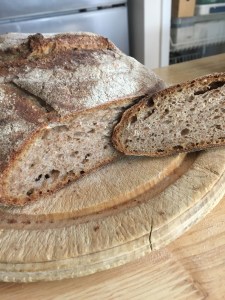
  1. Bread flour  – For too long I thought that the stronger the flour (ie. the higher the  protein level) the better the bread would be. Not true! The loaf in the photo is made with a third soft wheat flour and only two thirds strong bread flour. Obviously there’s a crossover point where you get a cakey texure but 1/3 to 2/3 seems to work with the flours I use. Should I say what they are?  Well no, because anyone can bake beautiful bread using whatever ingredients are to hand, as long as they’re prepared to experiment a bit – which leads me to –
  2. Complete failure is very rare – Sometimes they’ll slump, and sometimes they’ll stick to the banneton and sometimes they just sulk.  But the resulting bread is almost always better than anything you could buy.
  3. Rice flour I wish I had a pound for every mixture I’ve tried to dust the dough and help it to release. Of all the things I’ve tried, rice flour works best.
  4. Getting a hot base –  feel free to buy a lump of granite or a hi-tech widget made from recycled space shuttle nose-cone tiles, but I use a cast iron griddle for Welsh Cakes that was incredibly cheap and holds a tremendous amount of heat. I never clean it.
  5. Kneading –You can use a machine but you’ll learn more about the quality of a dough in ten minutes of hand kneading than you will in a year of tiny changes to the recipe. Flour is a natural product and even branded flours can vary from batch to batch.  Wholemeal flour takes more water than white, but beyond that, the exact proportions can vary from week to week. It’s easy to add a bit more flour if a dough feels too sticky but it’s horrible trying to add water to a too-stiff dough, so start wet and stop as soon as you can.
  6. Sourdough takes up too much time –  first make the batter, say ten minutes maximum, and then go and do something else for the rest of the day or night – whichever suits you best. Second, add the final amount of flour, the salt and some olive oil bearing in mind point 5 above and knead it for ten minutes or until it just ‘feels’ right. Let’s say that takes you another 15 minutes. Then go away again for a another 12 hours or so. Third, fold the dough over on itself gently a few times and form it into a ball and put that in a banneton which you’ve copiously dusted with rice flour. That takes another 5 minutes. Leave it for another three or four or however many hours it takes to look perky.  Finally turn it out, slash the top and bake it as hot as you can get the oven for ten to fifteen minutes and with steam if you have it.  Then turn the oven down a bit and bake for another 30 – 35 minutes. Elizabeth David suggested in her book “Bread and Yeast Cookery” that you’re trying to imitate the falling temperature of a wood fired oven. You have to be there for some of that bit – so let’s say another twenty minutes of your undivided attention. So that adds up to not a lot more than an hour of actual work. If you’re away at work, bake at the weekend or maybe kick the batter off before work on Friday morning and finish baking before lunch on Saturday.
  7.  Have you got a posh steam oven? Yes but for the first 47 years I didn’t and I still made bread. I’ve got a very small and cheap car – priorities I suppose.
  8. You need to buy a starter – No you don’t.  If it smells nice it’s probably OK – no faff, just dark rye flour and water and lots of time.
  9. Is it a spiritual experience? Only in the sense that you have to be ‘in the moment’. In that respect it’s just like every other craft skill, you have to have a dialogue with the material.  It’s not MDF board!
  10. Why bother? Because £4.00 for a large loaf is ludicrous however big the baker’s beard is, and very soon your bread will taste better than theirs, I promise.

Controlled rotting resumed in the kitchen

2018-02-12 08.38.17

Here we are, back home and that means two posts today with a bit of luck and some time. First off, ‘though, there is the revival of the sourdough starter and the kefir to think about. The Potwell Inn is a plain sort of a place – or it would be if it existed –  and here we try to avoid mystification, and when it comes to sourdough starters and their care, there’s enough ordure written about it to keep our allotment fertile for the next ten years. So here’s the key principle: wild yeasts are are ubiquitous – they’re everywhere and they’ll still be there centuries after the last lobbyist declares that chemical X will save the world, thereby ending the world. I’ve only killed a sourdough starter once and that was a deliberate experiment to see how long I could neglect it before it died.  The answer was that I couldn’t kill it at all, but under the anaerobic conditions of its container it turned into another life-form so powerfully smelly that I had to throw the container away.  Second point is that getting a starter going is so easy you wonder how the hipster artisan bakers have got the nerve to sell the knowledge for £150 a morning. Get some dark rye flour and stir it into some tap water and leave it in a warm place until it starts to bubble (could be days – don’t wory).  Then throw half of that away and add more flour and more tap water, give it a stir and keep going like that until it’s ready to use.

So getting back from North Wales means the neglected starter needs a feed because it’s been neglected for a fortnight and it’s sulking. I do use organic flour; my favourite is Bacheldre Mill, but I don’t fuss about water.  By all means waste your money on organic single malt virgin water brought over from the Isle of Sky in a coracle but it won’t taste any better.  I do not employ holiday starter sitters to stir the infant broth daily, even on minimum wages. I have not scoured the antiques markets for authenic barm pots and neither do I subject the infant starter to any ceremonial prayers or position it on a lay line. Most particularly I would never dream of shelling any money out for someone else’s starter, but if you happened to know where the Potwell Inn is (which for reasons already described would be difficult because it doesn’t exist), but if you should happen to pop by at the back door of the pub I’ll gladly give you a bit.  It’s lovely and it smells like apples.

As for the second exercise in controlled rotting, the kefir was in an even more perilous situation because I’d forgotton about it for weeks.  You know how it goes with kefir – drinking it every single day for ever would bore you stiff. So it’s been languishing at the back of the fridge waiting patiently for someone to show it some love.  Today I showed it some love and I strained it and washed the grains off (with tap water) and and put it in a clean container with more full cream milk. Once again it’s organic milk because that’s what we use. Because I’ve washed it and possibly because the chlorine in the water is a bit of an inhibitor, it will be slow to recover, but it will recover.

The pantry is full of various other vegetable bits and bobs undergoing their own lacto-fermentation and they too will cope with whatever life throws at them. I don’t sell this food so any public health inspectors reading this need not trouble themselves to Google up the Potwell Inn and attempt to pay me a visit, and if I do suddenly expire one day from some unexplained cause it’s vanishingly unlikely that the wild yeast will have done it!