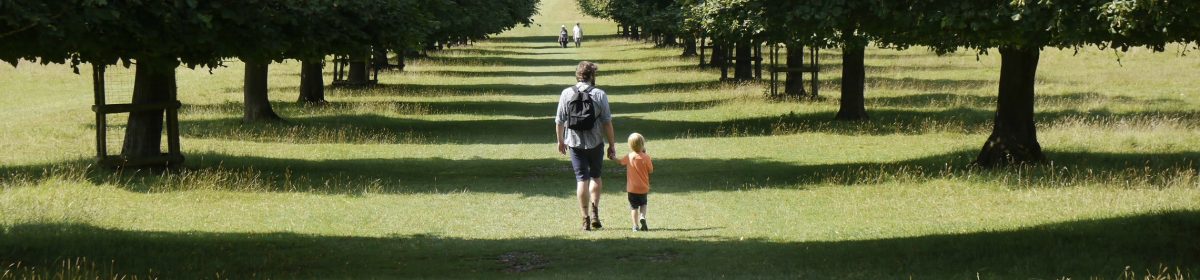

OK so – if you examine that statement from every angle it might look smarter than I intend. I do know my place, after all I’ve lived in it for most of 73 years, my speech is inflected with its dialect and there’s not much of it I haven’t walked, cycled, driven or tried to grow things in at some time or another. I recognise a respectable amount of its wildlife in a thoroughly non-professional way, and I know most of its history. So I know my place; I’m hefted to the area around two rivers, the Avon and the Severn, and to the land west of the Cotswolds and north of the Mendips.
And so by extension I know a lot less about many other areas that I love just as passionately, especially the far western parts of England and Wales, but they’ve been holiday romances rather than family. I make lists of plants, watch birds and animals and always come back refreshed and inspired. I’m an amateur, a bit of a peasant, an autodidact, living an inch from the edge of a howler, an intruder into the VIP lounge of proper (whatever that’s supposed to mean!) experts. And so reading George Monbiot’s book “Feral” has been a big struggle because I know, even with my street wisdom, that there’s something wrong with his argument – I just don’t quite know what it is. There’s porridge in the radiator, gear oil in the sump and quite a bit of well disguised filler in the bodywork and notwithstanding the good looks on the forecourt I know it’s a wrong ‘un.
I’ve been reading it restlessly, on and off. I shout at it, slam it shut, double check the data. I managed to struggle through the first couple of chapters, although I found some of the tales of superhuman derring do – paddling six miles out to sea in a kayak – running twenty miles before breakfast with a young Masai man, dodging bullets in a Brazilian mining settlement – well, a bit desperate. The beatific visions and revelations of true nature were a touch too Ignatian for me, and I was just waiting for the wrestling with bears bit so I could just accept it as a fictional ‘coming of middle age’ narrative . The picture of Vladimir Putin on a horse kept floating into my mind.
But when he kicked off on the so-called Cambrian desert I had to race to the laptop. Where is this scene of dereliction and abandonment overrun by malignant sheep and even more malignant Welsh hill farmers? A quick check on the BSBI website turned out to be difficult because reorganised boundaries have rendered the vice county list a bit impenetrable. Powys, for instance, includes bits of Montgomeryshire *(VC47), Radnorshire (VC43), Brecknockshire – Breconshire if you’re English – (VC42) and a bit of Denbighshire (VC50) and the Cambrian Mountains also embrace some of Ceredigion(VC46) and Carmarthenshire(VC44). That’s a lot of lists, but checking them all I couldn’t see even one of them with a significantly lower number of plant species; but I could see that there were quite a few rarities in amongst them. Even from my own scant knowledge I know that there are irreplaceable habitats there, bogs, mires and wetland areas. The road between Tregaron and Abergwesyn seemed to me, when I first drove it, a paradise. And what on earth is he suggesting when he writes in the same chapter that there were no birds? He seems to have set out with a self imposed vision of a despoiled land, and exercised iron discipline on himself to exclude any evidence to the contrary. The red kite, thank goodness, is now as common as medieval hill towns in Provence – who’d have thought it? I stopped reading when the book started to make me feel fearful.
But I know my place, and I can’t offer anything approaching a sensible review of the book from a more experienced perspective. I know it’s a contested area of thought and I’m slowly trying to catch up after decades of the more (dare I say) piles and varicose veins side of spirituality that is the life of an almost extinct species of country parson. So I searched through the original reviews, found some hiding behind paywalls, but some more that shared at least a few of my misgivings and then I stumbled on this blog by Miles King which has a review written with far more authority and expertise than I’ll ever have, and which I’ve found invaluable. I realize I’ve been rather harsh, but we’re in a crisis and what we need, more than anything else, is to follow the facts on the ground even if they contradict (especially if they contradict) our presuppositions and prejudices. Making up ‘facts’ to advance an opinion is morally wrong and – at the moment – dangerous because it hands ammunition to the enemy who will use exactly the sort of logical contradictions that abound in “Feral” to attack the whole project.
So I’m going to put the book back on the shelf now because I’ve just got hold of “Meadows” by George Peterken whose lecture we went to a while ago at Bath Nats. In the midst of a crisis there’s no time for a canonical literature to emerge, no place yet for the final word or the revealed truth, but there are enough half-baked ideas out there to furnish a lifetime of village flower and produce shows. “Meadows” looks to me to be a better bet if I want to find out what’s really going on and what we might have to do about it. There are plenty of elephants in the room already without parachuting them into Powys.
- these are all vice-county lists of plants found in the designated areas and maintained by the Botanical Society of Britain and Ireland

 One of the greatest advantages of living in the centre of Bath is the proximity of the Bath Royal Literary and Scientific Institution which is only 5 minutes walk away and accommodates most of the Bath Nats indoor meetings. The view through the first floor window was lovely this afternoon. January is the quietest month in Bath, with far fewer visitors and space to walk around the city unhampered.


 We know the whole environmental culture has to change, and so let’s take the example of tree planting. Should we plant a million trees, say? Well yes, but where should we plant them? – and what trees should we plant? whose land shall we plant them on? who will pay for them, maintain them and keep them healthy? Can we tackle the climate crisis and the extinction crisis at the same time with the same plan – or will the two sides of the larger crisis require a plan modulated to meet both? This is where I part company with some of Monbiot’s comments because one obvious solution is to use the presently indefensible agricultural subsidy system to change the farming culture. To say to farmers “you can do what you like (within the law) with your own land, but we won’t pay you to do it if it doesn’t bring about any public good.” I’m pretty sure that most farmers would be only too pleased to stop damaging their land so long as it didn’t bankrupt them in the process. Most hill-farms get 80% of their income from subsidies. Monbiot is quite right to say that the hill-country landscape has been turned into a wildlife desert by overgrazing sheep, but whose fault is that when, until recent years, farmers were paid according to the size of their flocks so, of course, they overstocked the sheep. Millions, if not hundreds of millions of trees could be planted on some of that unproductive land but the best possible workforce and custodians of the new forests would be the farmers who presently farm sheep. They’re in place already and they know their land as only farmers do. Calling for an end to sheep farming only makes a dangerous situation worse. Do we even know what numbers of sheep might constitute a sustainable national flock? Aren’t there economic and ecological benefits to maintainin a much smaller national flock thereby retaining the best of the hill farming culture and reducing overproduction to the point where the market for sheep and wool improves. Would a revival in woollen cloth be a sustainable alternative to more plastics? I don’t see the point in alienating and threatening farmers with the expropriation of their livelihoods when we know we’re going to need them onside. The grouse moors are much harder to defend, especially when the cost of shooting is so great that only the wealthy can participate, and amid the costs to wildlife by heather burning are the sinister statistics around the shooting and poisoning of birds of prey by gamekeepers who know when to keep their mouths shut.


 At the start of our walk, looking down at the spring that constitutes St Anne’s well, you could see the ancient remains of a settlement that would have given access to fertile south facing soil, security and a good view of the sea and its potential harvest. The landscape has become a palimpsest whose history can be both sensed and actively read through its overlapping scars, whilst still being a rich ecosystem for wildlife, plants and birds.


 So our first day at Rosemoor was not nearly as wet as the forecast promised, although we kept our waterproofs on all day. Last night’s rain was prolonged and heavy so we weren’t taking any chances. Our main interest was in the vegetable gardens because I wanted to find someone who could help us to understand what happened to our onions this year. So I trailed around with the pictures on my mobile, accosting gardeners and largely discovering that they were no wiser than we were. Aphids were mentioned, as were all the usual suspects – flies, fungi and eelworm, but none quite fitted the bill. In the end Madame suggested that it could have been that the sets, which arrived early and had to be stored for ages, had simply deteriorated before we planted them out. The idea made sense to both of us, although it would mean that almost everyone else on the allotment site stored them badly as well. Anyway we’re getting an email address for a free ID service for members and I’ll send off the photos to see if there are any more suggestions.

 However, there came a moment when the dilemma became acute for me and that, ironically, was when the garden started to offer something I really wanted to see. There are now some quite large areas of wildflower meadow which I fell upon with joy. There were southern marsh orchids in flower, ragged robin, knapweed, oxeye daisies, umpteen grasses like crested dogs tail and so on, yellow rattle and an unexpected white flower that I don’t think I’ve noticed before which turned out to be Star of Bethlehem – Ornithogalum angustifolium . It was all too good to be true, surely? There, in a patch half the size of a football field, was a collection of plants I’d expect to find one at a time in a day’s search over a much wider range. All this in an area that had been turned over by earthmovers less than 30 years ago. It’s a wonder, a triumph of science and the gardener’s art. A horticultural Las Vegas in the depths of a Devon valley. I’ve never seen a better display of plants in a wildflower meadow; it exactly fits our current anxieties about biodiversity, and I don’t suppose the birds, the insects, moths and butterflies that flock to it will give a hoot whether it was there in 1930 . Compared with the usual miserable sowing of ‘wildflower mix’ that developers ususlly throw around their bleak gulags to persuade the planners that they really care about nature, this was xanadu. So why was I troubled? I think a large part of it was my stupid attachment to authenticity – whatever that means – and the truth is, starting from where we are (which is a pretty dreadful starting point) there’s no other show in town except the Las Vegas route, re-creating at great expense and with enormous skill, the flora and fauna of the environment we’ve allowed to decline to the point of no return. There’s no way back to the good old days before we lost nine tenths of our wildflower meadows, because simply abandoning a patch of ground to ‘nature’ can’t possibly succeed.


 And just one more little joy – they’re developing a new orchard here and it’s dedicated to one of Madame’s old bosses – George Gilbert, a delightful man who probably knew more about apples than anyone else alive. We also saw a plaque in his memory at the Lost Gardens of Heligan, commemorating his contribution to the gardens there. He died in 2007, and took with him a lifetime of experience. His students are a big part of the future if we’re ever to rediscover and recreate the lost varieties of apples, pears and soft fruit, lost to careless agricultural policy, and that’s another star for the RHS who do so much to train the next generation of gardeners with apprenticeships, courses and such like.


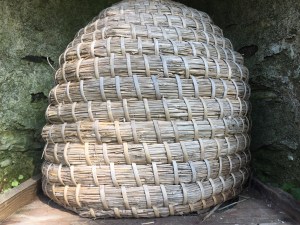 And that, I’m sure, is why honey is now gathered from conventional hives at Heligan while the skeps are treated as an historical record for the benefit of the tourists. Our visit to Heligan has provoked a lot of thought. It’s a brave idea to recreate a garden that last existed in its full glory over a century ago, and we love being there. But there’s no way that modern gardeners could justify using the old chemical treatments in the name of authenticity. On the other hand, some of the potato varieties being grown are so vulnerable to extinction that they simply have to be protected by modern chemical sprays for fear of them being lost forever. There are no easy ways of doing real gardening and sticking to the high moral ground all the time.
 Anyway, on the Potwell Inn allotment some new ideas are unfolding. At the border of the allotment site we have a long row of Leylandii – ugly sun-stealing brutes they are, and apart from providing a perch for wood pigeons they’re hardly a wildlife hotspot. It would mean moving a bureaucratic mountain, but why not cut them down and replant with mixed smaller trees like birch, field maple and hazel interspersed with a thick undergrowth to create a boundary hedge attractive to wildlife? Why couldn’t we link up with a goatkeeper and provide them with moveable fencing to graze off abandoned and out-of control allotments. We used to keep a goat and believe me she would eat anything. There used to be a wildlife corridor on the southern side of the river which took in a long derelict site before the Local Council awarded a contract to Crest Nicholson to build ludicrously expensive flats that effectively concreted over the whole area. By way of honouring their agreement they planted some sick looking sallows and laid a park with some kind of turf with a dozen species trees. It’s exactly the same mindset as the old skeppers had. “Nature is infinitely abundant and all those bats and birds and insects will soon find somewhere else to go”. And under the skep goes the sulphur – except this time the skep is the same size as the earth and there’s nowhere else for the wildlife to go, and now we’re the wildlife being choked to death by the sulphur.