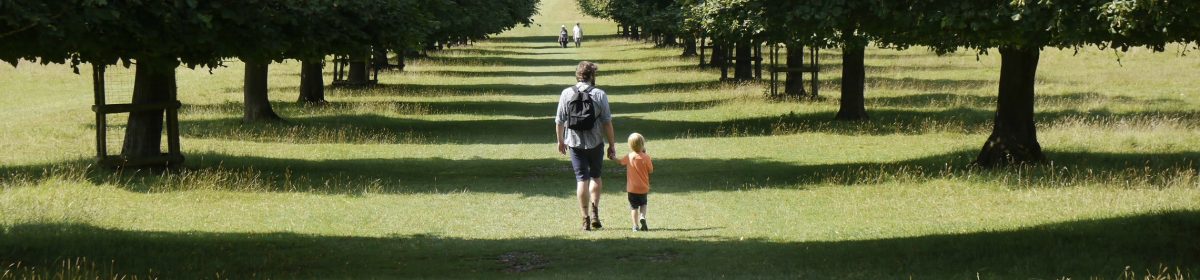


I think it starts here, in the photo on the left. If you walked to the narrow road and turned right, there’s a corner to the left and a drop down a small hill. The road was surfaced with small flint pebbles set in tar. Just at the bottom was a gate from which a track led past a field that, in summer, was decorated with stooks of hay – I remember that as children we were allowed to draw the cut hay into piles with big wooden rakes before it was stacked in a hayrick. On the left was a prefabricated building where a small engineering business went on. At the end of the track was The Crest, my grandparents’ house. My Grandfather was a carpenter from a line of carpenters that I’ve traced back to the eighteenth century and who lived in the same place for so long, a row of cottages is named after them. Only just over five feet tall with a roll-up dangling (usually unlit) from his mouth all day, he was a carpenter in the family business and a smallholder of just a few acres. He uttered curses like the resurgence at Vaucluse, mostly against God who, being a militant atheist, he didn’t believe in. The curses were broadcast in order to annoy passing sunday school teachers. He was entirely self-taught; a lifelong Marxist and member of the Labour Party, and he was the best read person I ever met as a child and, even better, he would lend me his books to read. He taught me to use a slide rule and logarithms, and in his desk (utterly forbidden territory) he had a rotary slide rule. He could make rainbows with a stirrup pump and had a greenhouse with a toad in it called Charlie, and a collection of pianolas in his shed that we were allowed to play with. He kept pigs and cows and hens and grew vegetables and he was unquestionably the most influential person in my life – half of which I’ve spent trying not to be like him and the other half doing the opposite.
So today I prepared the propagator and pots ready for the chillies I wrote about yesterday, to be sown, and you now know that the first two paragraphs of this posting are connected in a very deep way. When I get my thumbs into the dirt I almost always think of him and today I would have loved to have shown him what I was up to. He was always experimenting with growing new things. He grew and dried his own tobacco, I can remember it hung to dry under the eaves of his shed, and it smelt so filthy he was banned from smoking it in the pub. But he would have understood why all this trouble to grow chillies is worthwhile, just as an experiment, just because you might discover something interesting.
And so the new season is poised to begin, a couple of weeks ahead of the game, and I’m already thinking that when all these tender plants germinate there will rapidly come a time when they need repotting and then what? However, all gardeners will also recognise that there are times when you need to rise above the facts, and this is one of them. We’ve thrown a line aboard the season and now we’re (almost) tied to it wherever it takes us, rain, shine, frost, wind snow and drought. Words will be spoken as the tide of pots spreads across the flat in front of every South facing window and the thought of a polytunnel will fill my lustful thoughts – ‘when did that happen?’, I wonder, ‘when did polytunnels replace the desires of (what Dylan Thomas called) ‘my green age’.
“24 degrees centigrade”, I command the thermostat – “Aye aye, skipper” comes the reply -and the great game is on. We’ll win some, lose some and learn some too.
 So here are this season’s hopefuls in order of their capacity to create fear, or (looking on the bright side) to cure minor infestations of intestinal worms. As I mentioned the other day, we’ve dropped Pearls and Jalapenos off the list because even in last year’s sunshine they didn’t get all that hot.
 Some people might find even a slightly out of focus photo of a pile of poo a bit – well, rich first thing in the morning, but we at the Potwell Inn are made of sterner stuff and find it extremely cheering. Most people send pictures of their winsome children or latest culinary triumph. Not so for people like us. This little pile is the beginnings of the new hotbed, nestling in the corner of my good friend Annie’s barn. She’s dotty about horses. I’m less dotty about the animals themselves – (I once had a bad experience with a nasty natured beast called “Copper” who thought it would be amusing to scrape me off his back by galloping at a low branch), – I am however very attached to their by-products which are going to be converted this year to a wheelbarrow full of early salads, followed by the best crop of squashes ever seen anywhere. Annie is/was one of my parishioners back in the day – I took her wedding service, and she was reminiscing yesterday about the rehearsal when a policeman burst into the church, which was very remote and pretty much in the middle of a field, because he had spotted the cars outside and suspected a burglary was taking place. Now, of course, we live 20 miles away but we still keep in occasional contact. Especially when there’s manure involved! This little pile is just one day’s output from her extremely well cared for horses so I’m expecting great things. How exactly I’m going to get it to the allotment in our tiny car is another matter. Hot, wet and richly smelly, oh my word – it puts a spring in my step.
 I’m amazed that two Potwell Inn regulars have suggested their favourite marmalade recipes already, although the difference is more in the preparation than the ingredients. Mags emailed with her favourite approach and then today Rose suggested hers. The common factor was that they both involved cooking the fruit whole and then removing the pips and pulp. In Rose’s recipe – or rather Mrs Beeton’s – the pulp is returned to the pan without the chopped peel after cooking whole for 2 hours. The two hour cooking period is common to almost all the recipes I’ve seen. In Mag’s it’s returned in a muslin bag which makes it easier to remove than the Beeton recipe which needs straining. Again all recipes require the removal of the pips.

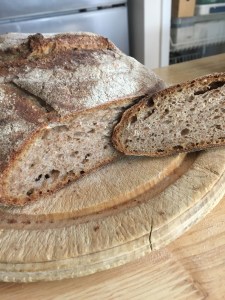 It’s inevitable when you make bread regularly that just now and again you’ll get a batch that refuses to play. This isn’t just a problem with home baking – I can remember many occasions when we lived in a large village that still had its own bakery, and occasionally there would be a queue outside the door because Brian (the baker) was having problems with an overnight batch. You could hardly blame lack of experience in his case because he’d been baking in the family business since the days when he delivered the bread to the outlying hamlets in a horse and cart. A dud batch can affect anyone.
 The season for cod roe seems to have come and gone without me spotting any at all but as for marmalade I had an email from Potwell Inn friend Mags who had read my piece a couple of weeks ago. She tells me she boils the fruit whole for 2 hours before removing the pulp into a muslin bag and slicing the peel. She says it’s less time consuming and in any case makes better flavoured marmalade with less sugar – so tomorrow I’ll give it a go and report back on the results. The new batch demands another dozen new jars – I really thought we’d never have to buy another jar or lid but somehow all this preserving and pickling has used them all.

 I can answer that question for us at the Potwell Inn because one of our children suffered from his earliest months from what was thought to be lactose intolerance. It turned out to be something else and he’s now approaching forty and in good health, but that’s not the point. For us that possibility – in the era before smartphones – meant that shopping became a nightmare in which small print was obsessively pored over and during which we carried a long printed list of safe foods which had to be updated every few weeks because manufacturers would change recipes and what was ‘safe’ one week would contain lactose a month later. Lactose was a cheap and easy recipe component that found its way into the most unexpected places. What that experience did – and this is the takeaway point – was to pathologise food for us. We were in an unusual and rare position and eventually, after several years of hospital admissions, it became clear that lactose wasn’t the underlying problem and things kind of settled down again.


 I never for a single moment thought I would be writing this, but last summer, on the basis of no more than a mention in a biography, we salted some runner beans just to see what would happen. Here at the Potwell Inn we read a lot of books – I mean a lot of them – and among them was the new biography of Patience Gray entitled Fasting and Feasting written by Adan Federman – and so when, in a passing remark, her son Philip said he actually preferred the taste of salted beans to their fresh counterparts, we were unable to resist.