
Even a concrete blockhouse constructed in brutalist neo-Georgian can benefit from a few window boxes and the Potwell Inn fits that description pretty well. This line of thought was prompted when we dropped off at a country pub yesterday, after a bruising encounter with the till at a garden centre. It happened that we’d just spent (as always) more than we intended on filling our window boxes for the summer. They always look as lovely from the inside as they do from the road, and it’s our little gift to the neighbours, so window boxes join the other protected budgets like books, art materials and the campervan. Oh and wine too, I suppose.
However, the pub was clearly in trouble since their hanging baskets were pretty much dead and there was an advert on the door appealing for bar staff, a chef, in fact anyone prepared to throw themselves under the oncoming train of HMRC and all the other creditors. Best bitter – flat; crisps – not available (“we had a busy weekend”). Negotiations with an agency chef were being conducted in the empty bar but we were far too polite actually to crane our necks in order to listen in. Sad, isn’t it, to see a fellow licensee going under even when your own pub is virtual? We could have planted up their window boxes in an hour and the place would have looked like a going concern.
 Back at the Potwell Inn we too have deceased window boxes, hence the trip to the garden centre, and the generally decrepit look outside the Gulag. Dead daffodils don’t have the same attraction as their younger selves. Inside, on the other hand, is a different matter. It looks like the morning after a student party but the mess comprises hundreds of plants in different stages of development, and unsteady piles of garden reference books – far too many of both. The kitchen is all but unuseable except for picking the supply of basil and brewing tea.
 The simplest meal involves a tremendous amount of moving – gravel trays, root trainers and any receptacle that can be pressed into service cover the table and much of the floor. This period is always a great boon to the freezer which needs emptying in the next couple of months ready to store fresh produce. Truth to tell however, there’s only so much chard, broccoli and frozen borlotti beans a person can cheerfully consume – even in a good cause – and I found myself looking lustfully at a ready meal in the supermarket today.
Meanwhile back at the ranch
Yesterday while I was adding some kitchen waste – tea leaves, peelings and discarded leaves – nothing cooked – to the compost heap. I pulled off the layer of cardboard on top, and there was a scurrying of little feet followed by a dirty great rat that leapt upwards and away in one athletic bound. I don’t know which of us was more scared. It’s almost impossible to eradicate them entirely but the danger of leptospirosis is very real and so strong measures have been taken to discourage them. Vegetarians please look away now, although I doub’t anyone would eat a rat except from dire necessity!
 So today at the allotment I extracted the first victim from a trap with a tinge of sadness mitigated by the knowledge that this one at least wouldn’t be peeing on our lettuces. Elsewhere, with the help of a decent amount of rain, the potatoes have roared ahead. It is a true conundrum, the way that however hard we water, a couple of hours of rain brings on the allotment far better. What is the magic ingredient in rainwater that trumps the expensively processed stuff that comes out of the tap? Or is it precisely the expensive chlorine enriched processing that holds tapwater back from giving our plants what they really need? Yesterday I planted some companionable nasturiums amongst the apples. They’d been languishing in a half tray in the cold frame but had never thrived. I transplanted them with no great hope of success but the alternative was to throw them away. This afternoon we took another look and an unbelievable transformation had taken place. In fact everything in the fruit cage looked as if it had been given a dose of steroids during the night. The strawberries had drawn up to their full height and were seeming to invite me to ‘step outside’ if I even mentioned the possibility of straw to hold their fruit above the ground. The nasturtiums had picked up so much I wondered whether we’d be spending the rest of the summer getting them under control. Plants have this way of talking to us – if only we’d listen. Perhaps that’s all that ‘green fingers’ amounts to, the capacity to listen to what they’re saying.
And so the summer window boxes are all planted up. The logistical problems of taking the spent ones down two floors to the garage and carrying the new ones up the same way are a tiny bit intimidating when your knees are shot, but the rewards are immense. When those trailing plants get underway they can go right down the wall and past the lintels of our downstairs neighbour’s windows too. All good, then.


 The oven, having been pretty much out of action for a month has been repaired and this was the first sourdough loaf I’ve been able to bake during that time. Judging by the amount of spring and the look of the crust, it hasn’t been heating properly for ages and consequently the steam function wasn’t working either. Terry, the repair man, hadn’t tackled one like this before but with a combination of laptop, owners manual and persistence he dismantled the door and replaced the broken part. And so the household routine and the proving/kneading regime harmonised once more so that with very little effort the loaf was started early yesterday morning and the loaf came out of the oven around mid-morning today in time for us to go up to the allotment until 5.00pm.


 There aren’t many occasions when we eat out when I don’t come home with an idea to try out. I must confess I’d never even thought of eating rhubarb raw before we were offered it in a mixed salad at the Lost Gardens of Heligan. To be fair it was just one ingredient but it tasted pretty good – I just had no idea whether it had been prepared in some way. My first thought was that it could have been fridge pickled, but it’s already pretty sour and so I experimented this morning by chopping the rhubarb into chunks and pouring over it a boiling mixture of water, raspberry vinegar (home made) and a little salt – and then allowing it to cool completely. I tasted it and it still seemed to need a little sweetness, so I stirred in a tablespoon of undiluted rasperry vinegar. It tasted very good and would add a tart component to any mixed salad. My guess is that it would be even better using early season forced rhubarb but this year we relocated all our plants on the allotment and so forcing was out of the question.
 Back in the flat, the chillies, peppers and aubergines have all left the propagators and are sitting in the south facing windows waiting for the temperature outside to allow them into the cold greenhouse. They’ve been replaced by the whole second wave of tender seedlings and so this begins the period when we can’t close any of the shutters and every available inch of floor space is in use.


 Sometimes, when it’s snowing and you have to go up to the allotment to clear the nets, or when it’s pouring with rain, or so hot that even walking up there makes you sweat, it’s easy to ask that question and the answer is in the photo. If you’ve ever seen better true spinach, fat, fresh and bursting with life – in a supermarket – I’ll eat my new and beloved hat. This is the season for true spinach in the UK at least, and it’s also the season when the garden centres are rammed with people wanting to grow something, anything to make contact with that strange and powerful urge that must be encoded into our DNA. We went today to buy more seed trays and compost and I was happy to queue up ten deep at the checkout because every single customer was on to the same thing as me. As I often used to say at live music events, if the authorities knew how much fun this was they’d tax it or close it down. If I have one criticism of garden centres it’s their eagerness to get tender plants out sooner than they really should, which must lead to many disappointments and losses for inexperienced gardeners.
 In the flat the chillies are actually in flower and need repotting into their final sized pots. This is always the conundrum. If you sow too early you land up with a lot of tender plants that need to be indoors for a couple of weeks at least before you dare move them into the unheated greenhouse. So just as the M5 was utterly congested yesterday as we drove back from Heligan, so too is our plant supply. Every spare surface within a yard of a window is pressed into service. We were so busy today I didn’t have time to ID the flowering wild plants I photographed, so that list – plus the list of potato varieties they’re growing at Heligan will have to wait.


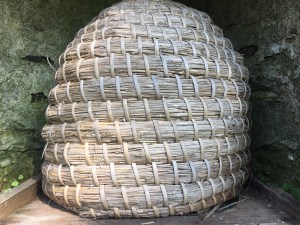 And that, I’m sure, is why honey is now gathered from conventional hives at Heligan while the skeps are treated as an historical record for the benefit of the tourists. Our visit to Heligan has provoked a lot of thought. It’s a brave idea to recreate a garden that last existed in its full glory over a century ago, and we love being there. But there’s no way that modern gardeners could justify using the old chemical treatments in the name of authenticity. On the other hand, some of the potato varieties being grown are so vulnerable to extinction that they simply have to be protected by modern chemical sprays for fear of them being lost forever. There are no easy ways of doing real gardening and sticking to the high moral ground all the time.
 Anyway, on the Potwell Inn allotment some new ideas are unfolding. At the border of the allotment site we have a long row of Leylandii – ugly sun-stealing brutes they are, and apart from providing a perch for wood pigeons they’re hardly a wildlife hotspot. It would mean moving a bureaucratic mountain, but why not cut them down and replant with mixed smaller trees like birch, field maple and hazel interspersed with a thick undergrowth to create a boundary hedge attractive to wildlife? Why couldn’t we link up with a goatkeeper and provide them with moveable fencing to graze off abandoned and out-of control allotments. We used to keep a goat and believe me she would eat anything. There used to be a wildlife corridor on the southern side of the river which took in a long derelict site before the Local Council awarded a contract to Crest Nicholson to build ludicrously expensive flats that effectively concreted over the whole area. By way of honouring their agreement they planted some sick looking sallows and laid a park with some kind of turf with a dozen species trees. It’s exactly the same mindset as the old skeppers had. “Nature is infinitely abundant and all those bats and birds and insects will soon find somewhere else to go”. And under the skep goes the sulphur – except this time the skep is the same size as the earth and there’s nowhere else for the wildlife to go, and now we’re the wildlife being choked to death by the sulphur.


 Yesterday I forgot to take the camera and so I couldn’t photograph the navelwort – or pennywort as it’s also known; its Latin name is Umbilicus rupestris, and there were several noteworthy facts we found out. Firstly I’ve always seen it on walls and never looked for it anywhere else, but here it’s quite common at the bottom of tree trunks. Secondly its succulent leaves are apparently good to eat and thirdly if you scrape the back of the leaf off it exudes a sap that has healing, coagulant properties and will – if you care to try – adhere to your skin like a natural elastoplast. Isn’t that fascinating?
 Back at the veg garden we made a list of the 23 varieties of potato they’re growing this year. Yesterday’s tour leader talked a little about these heritage potatoes and said that although they all tasted good, they were tricky to cook correctly and if overcooked they would become waterlogged and collapse. Many of these varieties, regardless of their quality, are not on the EU permitted list and so cannot be sold. We’re growing three of their varieties this year on the allotment, along with two more modern cultivars. But we really envied the space they have here to experiment. After we’d finished the list we sat enviously in front of their rhubarb patch. Again, so much space – and yesterday we tasted rhubarb in a way I’ve never even thought of – in a salad. I suspect it was very lightly ‘fridge pickled’ and we both thought it was delicious – time for an experiment in the Potwell Inn kitchen. I think the starting point for us will be a poaching liquid with raspberry vinegar, water and a little salt, brought to the boil and simply poured over the sliced rhubarb. I’ll report back later.
 Then we moved on to the apples where we had a good look at the pruning method they’re using here. It looked very like the Modified Lorette ststem that we last saw in the National Trust gardens at Dyrham Park. It involves cutting back very hard in the winter and then again in the summer. It’s not a system either of us knows but it looks very productive. The gardener at Dyrham Park said it was very slow to establish but, on the other hand it seems capable of sustaining excellent crops. So much to learn! So many lists!


