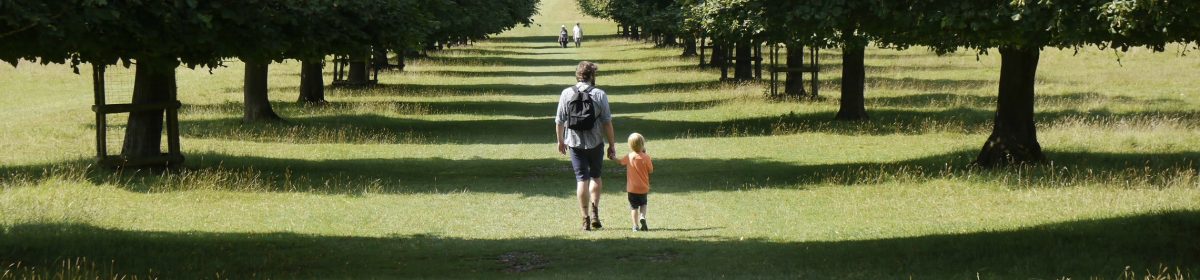

Starting from the all-time best bits of our break in the Brecon Beacons, there was the blues night in Brecon, of course, but I’m bound to say that listening to a cuckoo for the first time in several years comes near to the top of my list. Ordinary pleasures have become exceptions these days and so cuckoos are peak moments. So too was watching a bird feeder with great tits, blue tits, nuthatch and yellowhammers all feeding at the same time. Meanwhile a mouse had created a great home for himself in a drystone wall under the feeder, only having to pop his head out through a crack in the wall to catch the falling seeds. He’s in danger of getting so fat he won’t be able to escape his five star accommodation. Half a dozen hens were browsing around the cottage all day and providing the best eggs we’ve tasted since we gave up keeping them ourselves.
But let no-one say we, at the Potwell Inn, shirk the less arcadian bits of life – there’s always time to learn a new skill, and sheep dagging just happened to come up yesterday. I was at the clean end of the crush, while Nick and Kate were the – let’s say – “coal face” with the hand clippers, so all I could do was help wrestle the sheep in and operate the bit of the crush that dealt with the front end. Sorry about all the technical farming language. Actually that’s not all I was doing, because I was also eyeing up the rich daggings as they fell to the floor, thinking how well they’d look on our compost heap. This indignity – for the sheep – was to help clean them up ready for lambing and make it easier to see whether they were ‘uddered up’ without a wrestling match. Sheep, I discovered are both heavy and likely to kick you in the face if you’re not very careful. As it was, it was the brim of my hat that caught at least one haymaker of a blow. Daggings – the mucky bits of wool around the rear end – also make fantastically good mulch because they aren’t strong enough to burn the roots of young plants. Having never seen any kind of shearing close up before, it obviously needs real skill not to nick the sheep. The wool is thick with lanolin and cutting through the clumps of wool looked like hard work.
 Madame took a look at a pond that Nick had dug out years ago, and it was full of newts. Newts were once so common you could go to pretty well any pond and catch a jam jar full, but nowadays it becomes a notable treat to see them. Isn’t there a picture beginning to form here? This constellation of wildlife that we were finding is no accident. It’s a great sadness that we no longer think it’s weird to have to go to a nature reserve in order to see creatures that were once everywhere, but here on this 24 acres of unprofitable mixed hill farm is a sign of what we’ve lost. So many species clinging to life in ‘improved’ farmland are thriving here without even knowing how rare they’ve become.
 You see the term “hobby farming” used disparagingly by those who ought to know better, but here in these pockets of unimproved land are populations of wildlife that would rapidly spread back into the surrounding land if their environment was restored. These so-called hobby farmers are acting as unpaid guardians of many thousands of acres of unofficial and unmarked “biodiversity banks” without, in many cases, claiming a penny of government subsidy, while the money goes to destructive intensive farming.
There is, perhaps, one thing you might notice on the farm, and that would be things like this Victorian potato plough which Nick still uses. Is it efficient? Well no, but that really isn’t the point. The fact is that for all our obsession with progress, there are still many things that work perfectly well – if a lot more slowly. A bit like the landlord of the Potwell Inn and his wife!


NB Rose – Some good food plants around too!
 When you cross over the Brecon Beacons via the Beaufort road you suddenly cross a line between the open moorland and the post-industrial landscape, marked by a line of electricity pylons. I’m not sure which side of the line I prefer. Surprisingly, perhaps, I admire and even like the post industrial landscape inhabited by the ghosts of miners, steelworkers and the lost fortunes of entrepreneurs and the dreamers who made porcelain in works like Nantgarw where beauty and purity emerged from the smoke and filth of the potbanks. I like it and yet I loathe what’s become of it in the industrial estates and business parks that replaced it.
 The David Nash exhibition was something else. It was everything that the city has turned its back on. Here is an artist who has made it his business to look at the natural world not as a resource to be extracted and sold off, but as the object of a prolongued meditation. They’re almost religious in their intensity. It’s an exhibition of fifty years of work since he bought an old chapel in Blaenau Festiniog for £200 in which to work and presumably do a lot of thinking. What did I admire most? – well he can draw, I mean he can really draw. There’s a playful element (in the very best sense of the word), that reminds me of the intensity of children’s play. There’s a sense of the re-enchantment of the world through a profound attentiveness. It smells good when you walk into the gallery – is this a normal term of art criticism? It was just so good! We’d seen another film about the large lump of carved tree trunk that was cast into a stream and followed in its passage to the sea at Barmouth some years later, but watching a slightly fuller version on a large screen encouraged us to sit down and watch it right through. It sounds a little like conceptual art but it was much fuller, richer, and much more meditative than most work in that mode. There’s a lot of work in the exhibition and I came away thinking that there’s a very close kinship between the kind of attentiveness that artists like David Nash exhibit, and the attentiveness of the scientist. All that nonsense put about by CP Snow about two quite different forms of consciousness has entered into the bloodstream and it was wrong. My old music teacher, AF Woodman, used to shout at us – “I know you can hear it but have you been listening?” Call it close attention, call it meditation or mindfulness – it really doesn’t matter much, but we’ve spent so much time quantifying, describing and judging the output of artists so we can make lists in order of importance, that we’ve missed the really important bit. Once again I’ll apply my entirely subjective way of judging an exhibition – does it make me want to work? – yes. Does it change the way I look at things? – yes.
 The water flowing into this old wash boiler comes straight out of the hill and serves as the water supply for the house. It’s clear, pure and tastes a lot better than the stuff that comes out of most taps. It also happens that the spring makes the most wonderfully relaxing sound; I could sit and listen to it all day. I’ve strip washed in it in the past, when the possibility of being surprised by a passer by was almost infinitesimally small. As a precaution, 30 odd years ago, we used to boil the water before drinking it. Over the years it’s proved completely safe and so nowadays no-one bothers.
  We were first brought to this place all those years ago, when it was a holiday cottage and painting studio – it’s pretty inaccessible, although the faciliies are much improved from the days when the stream, when it was in spate, would flow into the cottage under the living room wall and out again under the door. Now it’s in full occupation as a smallholding. Hill farming doesn’t pay any more and so its full-time flock of sheep and hens, and a part time herd of fattening pigs are subsidised by two incomes from work outside the holding – this is not a place for the faint-hearted. More than 250 metres higher than our allotment, the spring sowings need to be best part of a month later, and the winters are much fiercer.


 bafflingly confusing and often invisible creatures and sends reports in to the County Recorder because knowing what you’ve got is the essential first step in knowing whether you’re in the process of losing it. These photos, taken last year show Madame and Kate unpacking the trap and sorting the moths into jars so they could be identified and released again. We were absolutely amazed at the diversity and sheer beauty of some creatures we’d never seen before. Where there are only relatively few (between 50 and 70 including migrant) butterfly species, the moths make up for it with over 2500 species including a whole set of micromoths which are tiny and brown and need expertise way beyond my paygrade. As always, the world gets more complicated the closer and more carefully you look.


 – is the same sort of unanswerable question as “when is the date of the last frost?” And like all unanswerable questions, the only possible answer is – “it depends”. This picture shows what happened last season when we made the wrong guess.
  We were up in Snowdonia enjoying the view of the snow capped mountains and wearing every thread of warm clothing we possessed and it hardly entered our minds that the “Beast from the East” was – at that moment – doing for our runner beans. However we had anticipated that a late frost might happen and so we had a duplicate set in the greenhouse. Our neighbour, struggling not to let too much schadenfreude show, was slightly foxed by the fact that our beans seemed to regenerate within 24 hours. Yes it’s National Gardens Week and every other programme on the telly is advocating gardening as a panacaea for all the ills that beset us, but in the interests of factual accuracy I need to say that allotments can also be intensely competitive places. Generosity and animosity exist in exactly the same proportions on an allotment site as they do anywhere else within the human race. By and large, gardeners occupy a nicer than average place on the bell-curve of human wickedness but don’t count on it! Elections for site reps can involve chicanery on a parliamentary scale.
 Anyway, that’s enough bubble popping for one day. To continue on the date of the last frost, I should also say that the buds on the grape vine were also badly affected, but once again the vine regrouped and a new crop appeared within a couple of weeks. There was no big effect on the harvest either, it seems. All these weather events took place between the last week in April and the first in May and so it was our intention this season to delay planting out the tender plants until around 5th May. All our sowing was based around that date and now the Potwell Inn is full of plants that desperately need to go out. A couple of courgettes in the propagator seem to think they’re outside already and are traling all over the place. Moving them without snapping them off is going to be quite a challenge.
 Absolutely no certainty about this 2mm critter on our broad beans, but we discovered there were quite a large number of them when Madame added another tier of twine to support the beans during Storm Hannah which is forecast to pass by tonight. I decided to take it home to photograph and while I was setting up the macro lens and focusing, a flea beetle jumped on to my hand. We’d already seen their work elsewhere on the allotment, cutting neat scallops in the leaves; so neat, in fact, that you might imagine scalloped leaves were part of the design. So bug-hunting is beginning in earnest and this one is a puzzle since I have a great deal to be modest about in the entymology department. Is it a cluster of eggs? we wondered. Now I really need that dissecting microscope! If you look closely at the east, northeast side of the photo you’ll see a stumpy brown protuberence and so the next guess was that it’s the hatching of the pupal stage of …… something. We’ve scoured the horticultural pest books and searched the internet too, but nothing quite fitted. We hazarded a guess at a big hatch of ladybird eggs, encouraged by the recent warm weather. There were also a number of ants on the plants, and ants have a remarkable relationship with blackfly (bean aphids) so best case scenario is that when the population of aphids explodes fairly soon there will be hordes of ravenous ladybird larvae waiting to take advantage of them. However when I attempted to dissect it with a scalpel and my 15X magnifier I could just about make out a number of apparently empty, hollow chambers. I finished up not being convinced that it wasn’t some sort of multi-celled seed head. So I’ll just wait to see if there are any proper naturalists out there who’ll put me right – just for interest’s sake – we won’t be drenching the plants with neonicotinoids. Ever.
 The environmental movement didn’t start last week – I just thought it was worth mentioning it because Rachel Carson’s book “Silent Spring” was published in 1962, that’s 57 years ago, and ever since then, we’ve been pushing back at the problem with very little apparent success. Was it Thomas Kuhn that wrote that science advances as scientists die? He wasn’t being harsh, but simply pointing out that vested interests rarely go away because a better explanation has been found. Billions of pounds/dollars have been spent on defending the indefensible as the evidence of environmental damage has mounted up year by year and decade by decade.


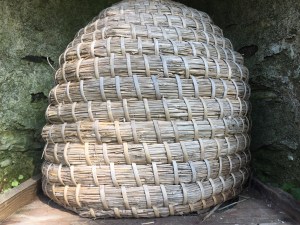 And that, I’m sure, is why honey is now gathered from conventional hives at Heligan while the skeps are treated as an historical record for the benefit of the tourists. Our visit to Heligan has provoked a lot of thought. It’s a brave idea to recreate a garden that last existed in its full glory over a century ago, and we love being there. But there’s no way that modern gardeners could justify using the old chemical treatments in the name of authenticity. On the other hand, some of the potato varieties being grown are so vulnerable to extinction that they simply have to be protected by modern chemical sprays for fear of them being lost forever. There are no easy ways of doing real gardening and sticking to the high moral ground all the time.
 Anyway, on the Potwell Inn allotment some new ideas are unfolding. At the border of the allotment site we have a long row of Leylandii – ugly sun-stealing brutes they are, and apart from providing a perch for wood pigeons they’re hardly a wildlife hotspot. It would mean moving a bureaucratic mountain, but why not cut them down and replant with mixed smaller trees like birch, field maple and hazel interspersed with a thick undergrowth to create a boundary hedge attractive to wildlife? Why couldn’t we link up with a goatkeeper and provide them with moveable fencing to graze off abandoned and out-of control allotments. We used to keep a goat and believe me she would eat anything. There used to be a wildlife corridor on the southern side of the river which took in a long derelict site before the Local Council awarded a contract to Crest Nicholson to build ludicrously expensive flats that effectively concreted over the whole area. By way of honouring their agreement they planted some sick looking sallows and laid a park with some kind of turf with a dozen species trees. It’s exactly the same mindset as the old skeppers had. “Nature is infinitely abundant and all those bats and birds and insects will soon find somewhere else to go”. And under the skep goes the sulphur – except this time the skep is the same size as the earth and there’s nowhere else for the wildlife to go, and now we’re the wildlife being choked to death by the sulphur.