Natural, organic but bad!

Following on in much the same vein as  “Frugal, thrifty, tight?” which I posted on December 18th last year, I was reflecting today on the perils of regarding everything organic as necessarily good to eat.  I remember (possibly 40 years ago) eating a bean pie from Cranks Restaurant in London which was, at the time, something of a flagship for organic food.  Even then, back in the day, an organic wholemeal loaf could be more character forming than fun to eat, and the bean pie-crust tasted like an early experiment in military armour.  But they were selling like hot cakes in Ladbroke Grove and appeared to confer some kind of ethical glow on the consumers. Decades later, I’ve learned by practicing that it’s entirely possible to make lovely wholemeal pastry as long as you don’t overwork it and I’ve occasionally made an effort to create my own beanie pie – without much success so far.  Maybe this years borlotti beans will break my run of bad luck.

But now, with the allotment, we can guarantee the organic provenance of all our vegetables, but not necessarily their wholesomeness. You get used to washing and soaking to remove the beasties but having done that it’s all too easy to assume that if it’s come off the allotment it will be good for us.

Most mornings I make a kefir based smoothie and if there’s any available I always put some spinach in the mix.  But just now we’re between crops, and the only spinach available when I looked was rather old and had bolted.  It really needed to go on the compost heap but being frugal and thrifty I laboriously picked all the leaves off the mighty stem, gave them a good wash and – for two consecutive days – whizzed them up raw in the kefir.

In the bathroom this morning I was, as I said, reflecting – as one does – and as I read one of the stack of books I keep there for reflecting purposes, it became clear that ancient raw spinach contains uncomfortable amounts of oxalic acid – like old rhubarb does. “Bingo” I thought as my synapses added two and two together and revealed the secret of our suffering.  The acid is broken down by cooking, but we’d eaten it raw and in considerable quantity.  A little bit more recearch later I discovered that raw salad vegetables are superb vectors of several other disorders you don’t want to experience.

Normally I’m careful about adjectives like natural, fresh and organic …… “So”, I always say, “are foxglove and deadly nightshade, and they won’t do you any good at all!” But I’d never expected that staple foods like spinach need to be treated carefully – in future I’ll think twice.

On the allotment we continued clearing up for winter and composing all the empty beds. As Madame wanted to wash down the greenhouse, I picked the last of the chillies whatever their state of ripeness and we gathered up the shallots from the drying shelf. Now we’re ready to sow the overwintering legumes and green manure. No-dig has relieved us of one heavy task, but the turning and humping around of quantities of compost will soon put on a sweat. After several weeks of rain and gloom there’s a prospect of some drier weather for a few days and that’s all we need to carry on growing.


Borlotti beanfeast

IMG_6251

Not a huge crop, admittedly, but satisfying all the same and if you taste the beans in this semi-dry state you’ll soon know why it’s worth growing them yourself.  Last year we froze some so they could be dropped into soup without pre-soaking, but this year they’ll need soaking first simply because we waited for them to reach maximum size before picking them.

IMG_6250But it was Madame who picked these, because I was over in Bristol with two of the boys putting the glass into A’s recycled and free greenhouse. The careful preparation as we dismantled it from its original site in Bath really paid off. Every nut, bolt and clip was stored separately in boxes and we wrapped the panes of glass in fours in 50 metres of bubblewrap (which will be re-used as insulation).  The three of us made an amiable crew,  light work of the job and managed to complete the greenhouse with only one cracked pane – easily replacable.   It ought to  go without saying that there is real family life beyond the wild storms and mutual incomprehension of adolescence but I don’t see it much mentioned these days since we were instructed by our jailers to regard generation X as a bunch of snowflakes while they were told that we had stolen their inheritance. Well the truth is in our family at least we still love and respect one another, and the inheritance (such as it ever was) is in some offshore bank account, stolen in yet another distraction robbery by those who presume to lecture us on our morals. End of harrumph.

So as A contemplated the first sowings on his family’s new allotment, the Potwell Inn crew went up to ours and while Madame planted out spinach and weeded, I sorted out the compost heap.  One of the advantages of living in a block of flats is that the communal waste area provides an endless supply of cardboard, not to mention occasional window boxes and plant pots. The bonanza days are when a flat is re-let and then we get big corrugated carboard boxes – the worms’ favourite honeymoon hotel. All compost heaps need carbon and carboard is a great source. We’ve put hundreds of egg boxes in ours over the years, and I’ve never seen a single one in the resulting compost, they simply disappear.  So yesterday I took up a couple of huge thick boxes and sawed them up (much quicker and safer than a knife or by tearing them). At present the fragments are lying in an insulating heap on the top, to encourage the heap to heat up a bit, and then next time the heap is turned in a week or so, they’ll be a bit softer and easier to incorporatate into the green material.

IMG_6252

Meanwhile, back at the Potwell Inn, the winter supply of basil is coming along nicely in the propagator.  It’s right next to a window, casting a daylight glow into the street for twelve hours, and I’ve been expecting a visit from the community police  – but I guess they see the window boxes and conclude that we’re more lkely to be septuagenarian garden freaks than threats to the Queen’s peace – whatever that might be!


Moody old Severn day

IMG_6246

The title of this blog isn’t some kind of random conceit; the River Severn is a kind of spiritual home to me.  For all its ugly brown tides, and industrial development it rules majestically over the ephemeral, human landscape, putting us in our place.  It’s the liminal and contested space between England and Wales, with a border that loops so much you’re likely to find yourself entering and leaving one kingdom for another without any apparent rhyme or reason.  East of the river runs my home county of Gloucestershire, and the western edge swerves in and out between Gwent and the western part of Gloucestershire.  I served here as a Parish priest for 25  years and I could stand in the churchyard at Littleton on Severn, just a little bit north of here and look across the river to see the sun setting over the Welsh hills. I hope that my remains will rest within sight of the river when the time comes – not too soon I hope.

Thirty years ago you could still see salmon putchers and nets stretched across the river in places.  There was a regular but dwindling supply of salmon running the river. Higher up there were an abundance of elvers, now sadly overexploited and endangered by their extraordinary popularity in Japan. They’re worth a lot of money and so they’re almost fished out, but I knew the man who caught the last salmon in a putcher on our side of the river, and I knew several others who had eaten elver omelettes not so many years ago. Doughnut (the nickname given to him when he wore a white T shirt with a red horizontal stripe, to primary school; it was a name that stayed with him for the rest of his life), Doughnut who also made cider like his father, told me once that the salmon had started to develop ulcers and lesions on their flanks as a result of the chemicals being pumped into the river further downstream.

IMG_6245When I was 17 I worked with some of the men who built the first Severn Bridge.  They were as hard as hell, and quite fearless on the steel. Almost exactly on the spot where the photo was taken today, there used to be an amusement arcade run by a traveller family who I got to know well many years later.  There was also a bathing lake called the Blue Lagoon which (incredibly) was a massively popular place. A little further downstream again there was a line of brightly painted beach huts on the promenade where fortunate Bristolians could come on their half-days and holidays.  I used to take communion to an elderly lady in Knowle who had a picture of her family bathing hut on the mantlepiece – she always spoke very warmly of it.  The Second Severn Crossing was built during the time I was working in the area.

We had two nuclear power stations – now decommissioned but still “hot”, and more cider orchards than you could shake a stick at. But – and here’s the thing – it’s a hotspot for migrating birds, once again dwindling, but the sound of a skein of geese flying upriver at dusk would make your blood run backwards. I first went there, to the amusement arcade, as a young teenager – driven there on the pillion of a motorbike driven by a man who turned out to be well dodgy, and that’s enough on that subject! I did my only burial at sea at a point just above the first Severn crossing where the Balmoral, an old paddle steamer paused a mile upstream of their usual turning point and allowed me to scatter the ashes of a man called Peter, a Severn Pilot who knew the river as well as anyone alive. As we laid him to rest the skipper gave three long moaning blasts on the steam whistle to send him off. In his younger days during the war, he would walk the banks on his days off in order to navigate what’s always been a treacherous river in the darkness of the blackout. You’d have to have the heart of a bishop not to be moved by it.

And so these wild, semi industrial places seared their way into my heart and although I love the mountains and the more conventionally romantic views, for me there’s no greater joy than finding a couple of common scrubby plants eking out a living on the sea-wall battered by salt and wind.

We were there today because we needed to charge the batteries on the campervan.  While we were waiting for the gennie to do its work, we went for a stroll along the prom and then for what was supposed to be a short drive acros the bridge into Wales.  As we crossed into Wales we noticed that there was no oncoming traffic because they were resurfacing and so we were obliged to take a thirty six mile drive up the Welsh Side to Gloucester and back down the English side to where the campervan is stored. But it was a lovely day and we enjoyed the unexpected trip.

Where we live now, next to the river Avon, is still connected to the Severn Estuary which it joins about twenty miles downstream at Avonmouth.  We’re also on a track that leads directly in fifteen miles to the back garden of the house I was born in. I’ve spent most of my life within the  landscape that can be seen from the top of Dyrham Park. Hefted, I suppose, and tied by my dialect into an instantly familiar culture. It’s home.

Home on the range

IMG_5988

Well, sort of – although this isn’t home, rather a borrowed kitchen in the summer where we cooked some great food for all the family. However, the range – or the stove is a wonderful place of retreat when everything is going to hell in a handcart, and that certainly seems to be the case in the UK where we, or the government, have managed to create an extra crisis as if environmental extinctions and global heating weren’t bad enough. We’re poised on the edge of withdrawing from the EU in pursuit of some bizarre dream that we can relocate in another age.  Even a member of our family (fortunately not one we have to see very much of) opined yesterday that it would be lovely to go back to the 60’s.  ‘Be careful what you wish for’, I thought, as I tried not to bite the end off my tongue.

It all adds up to a terribly depressing and stressful time as we are being lured into a distraction robbery by a bunch of people I would gladly introduce to some of the unregulated dark and satanic mills I’ve had the misfortune to work in. BUT – it is what it is, and we may yet escape from the gimlet eyed brexit evangelicals.  Tomorrow will tell.

So today was supposed to be a bit of R & R after a very busy week and my first thought was to do some drawing, but that idea soon wilted like a warm lettuce as he “what’s the point” feeling swept over me.  There were jobs lining up on the list so in the end we went to the garden centre and bought the first seeds for the 2020 season, and ordered some more on the internet.  Preparing for the spring does, at least, inject a bit of joy into the procedings and thereafter I tied myself to the cooker and cooked as if my life depended on it. I quite enjoy batch cooking and so I did 6Kg of ragu to be portioned up for the freezer, I roasted a chicken, flaked the meat off and made stock, I made tomato soup with yet another batch of fruit, drank copious expressos and forgot that we have virtually no freezer space – that’s the problem with displacement activity, it always seems to displace the most important bit of the brain.

One aspect of the difficulty with getting on with drawing is the fact that we’ve just been to an exhibition of the Bath Society of Botanical Artists. In fact we’ve been twice and I’ll probably find an excuse to go again.  My teacher has a piece in, and she’s also recently published a book which I bought. She (Julia Trickey – “Botanical Artistry”, Two Rivers Press) is inspiring and daunting, and she’s a great teacher.  When I look at my work after having seen some of the work on display, I know I’ve got a million miles to go.  My last big project ended in hundreds of preparatory drawings and photos but collapsed in the face of the challenge.  Being the kind of person I am, (I hate failing), one of the purchases in the garden centre was a single hyacinth bulb which, when it flowers, will enable me to complete the project and move on. You can’t wait for inspiration to call, it has to be willpower plus technique, I’m not Michelangelo!

Panzanella – Oh Glory!

IMG_6233

As I’d promised myself when I woke up this morning, it could only be panzanella – Anna Del Conte’s recipe – for supper. It’s a trumpet voluntary, a salad in D Major, the whole brass section of flavours, the very food to make you joyful! Tomato, garlic, onion, basil, capers, good olive oil and red wine vinegar. It’s summer in a bowl, a last shout of sunshine and the kind of dish that I always make for four even though there will only be two of us at the table. It’s the salad that can transform a bad day into a good one – I’m going too far now, but you get the picture. We had the possibility of some pasta in hand, a frozen roll of pesto that would only have taken ten minutes to prepare, but the sourdough component of the salad is filling enough and apart from a pear we were done and smiling.

After supper we sat together reading through cookbooks – we are very greedy after all. Who’d have thought exploring a new vegetarian cuisine could be so much fun?

A change of gear and mood on the allotment

This is the time of year when there’s a definite change of pace on the allotment. There’s a change of crops too as we harvest the last of the summer vegetables like courgettes and (still) a few tomatoes and French beans, and start clearing those which have ‘done their bit’. We had a rogue volunteer squash that grew from last year’s compost and after we’d cleared and sheeted the potato patch we allowed it to range freely over about 20 square metres.  But as the temperature dropped over the past couple of nights we could see the plant wilting and so today it went into the compost, along with the asparagus. The trug we brought home was more typical of autumn with its muted colours, and the parsnips are doing well in their no-dig bed –  the latest sowing of spinach is growing nicely under its cloche, and we staked the purple sprouting broccoli ready for the expected winds.  There’s stil basil to pick and tonight that’s going into what’s bound to be one of the last panzanellas of the year.  We need to pick the borlotti beans in the next couple of days, but gradually, one at a time, the beds are moving into their winter modes.  The decision to convert both allotments into beds was quite costly, but it’s paid off handsomely because we can work them all in any state of the ground. Without digging the whole task of preparation is much quicker and there’s no evidence that crops have been affected adversely at all. We’re hoping for a spell of dryer weather to sow the overwintering broad beans and peas, but we’re not bothering to overwinter any of the alliums because the results have been very patchy.

Without doubt one of the less welcome aspects of the autumn has always been, for me, a debilitating spell of low mood, but although it’s been lurking there like the black dog for a couple of weeks, I’ve found the allotment an enormous help. It’s impossible not to be uplifted outside in the fresh air, and a couple of hours quiet weeding is a cure for any sort of melancholy. Obviously once the remains of the dying season have been composted, pickled, cooked or – in extremis – burned, the new season always feels that much closer.  Our soil in in great form – three full seasons of TLC and tons of compost have turned it from a sticky clay-loam, full of couch grass and bindweed, into a rich soil that runs through the fingers and makes weeding so much easier.  Even an attempted invasion of creeping buttercup into the asparagus bed was easy to deal with.  The individual plantlets could be gently lifted and the soil shaken of, leaving no bits of root to sprout next spring.

A little extra time away from gardening has allowed us to do a few more experiments in vegetarian cooking in the Potwell Inn kitchen. There’s no doubt it’s a challenge, but we’re enjoying the new styles, and vegetables that have gone straight from the soil into the pan, taste so much better – plus the fact that we’ve laboured over them makes wasting them unthinkable. As I was writing this, Madame called me into the kitchen to taste a new recipe for braised red cabbage and it was fabulous, much more restrained than our go-to recipe has always been. It’s like being let loose in a sweet shop, so many new flavours and textures to play with. Prepping the panzanella this afternoon, I was using our own tomatoes, chillies and garlic and my own sourdough bread – it transforms the way you regard the raw materials when they haven’t come double wrapped in plastic, doused in chemicals and a fortnight old already.

The compost bin is almost full to the brim for the third time since I built it in the spring.  It’s been inclined to run a bit wet and cold because of the rain we’ve had so I’m going to put a roof over the whole group of four bays so I can control the moisture and gather rain from another nearly 50 square feet of roof, it seems all wrong to water with tap water when there’s the possibility of harvesting several thousand litres a year on site.

Below, the compost bins when they were first built with our cold frames – now stolen – in front, and beyond them, the hot-bed experiment which was so successful we’re going to build two more where the coldframes used to be.

IMG_5003


Go on – sneeze!

IMG_6028

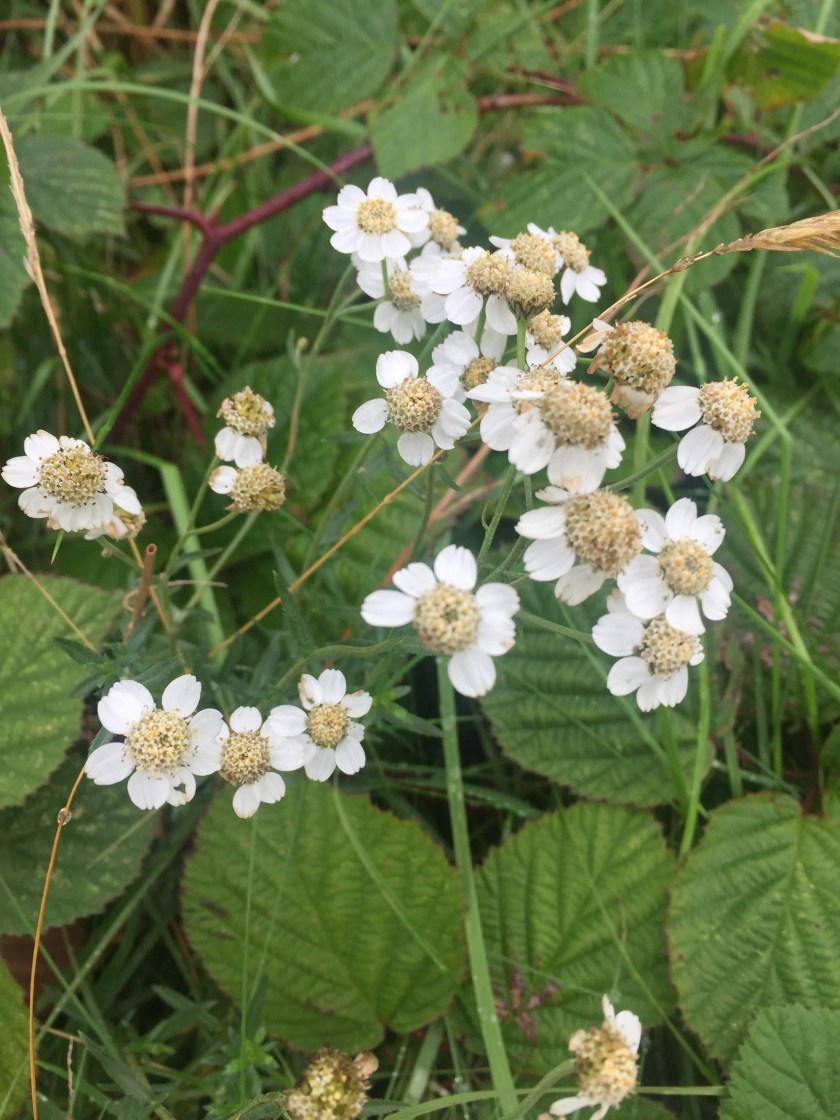
Well, Mr Wordsworth, you were right about emotion recollected in tranquility. Our trip to Cornwall was entirely unexpected, and so, with no more travel plans in place, this is the beginning of the rest of the Potwell Inn autumn and today we sat down and reviewed all our summer photographs on a big screen. I was taken aback at quite how intense an experience it was, and this picture of a Sneezewort plant just about had it all for me. As we went through all the new plants, I remembered the exact spot we found this one.  It’s not particularly rare and no-one apart, perhaps, the painter Giorgio Morandi, would write poems to its beauty.  He’d love it for its restrained colours and I can just see the buff and white flowers somewhere in the background of one of his still-life paintings.

It was the colours that first caught my eye, and then the fact that I’d never seen it before. The identifications you have to work hard for are by far the most memorable and as time goes on I can usually place a plant somewhere in the right family. But once I knew its name I realized I knew a little bit about its medicinal uses in the past and instead of being a stranger it was a friend at the first meeting.

There were lots of meetings like that during the summer and I took hundreds of photographs in which I could instantly recall where they were taken and then refer back to my waterproof notebook to find the name. Sometimes it was easy and sometimes there are a sequence of letters or numbers that mean I had to key it out by answering a series of questions exactly correctly to take me to the right place in the book.

But there was more, because many of the plants had features that just cried out to be painted; the brilliant hues of blackberry leaves, the exact texture of the skins of sloes, the sealing wax red of hawthorn berries and rose-hips. Some of them also stood astride more than one field of interest – illustration, medicine, abstract structure and form, folk names. The natural world suddenly becomes a far richer, more precious place. As I’ve written often before, it populates it with friends whom the prospect of losing fills me with sadness and the resolve to stop that from happening.

I saw at once what I need to get done during the winter months when the allotment takes up less time and I can set up my tiny cramped drawing space once more. I feel blessed and inspired to be back at the Potwell Inn.


Buying fish in Newlyn

IMG_6222

Bit of a rave from the grave, this one and I published it here a year ago when I could count my followers on the fingers of one hand   – but since we’re in Newlyn again I thought the amateur cooks like me  might enjoy it.

Buying Fish in Newlyn (1st November 2008)

The first time we tasted scallops was at Corsham where we were at Art School. There was a party and Chubby came back from Kirkcudbright with a salmon and some scallops. As always the cooking was accompanied by fierce debates as to the correct way to deal with them. I imagine, although I can’t remember for sure, that Tim was at the heart of the arguments. He always was. Cooking and eating were, for him, explorations of the extreme. The question was always – “how raw could you eat beef fillet?” We were different. We were working class and we liked our food cooked.

There were other experiences. Barney once said he could understand how people could live in little houses like mine. I don’t think he was being patronising, not deliberately. He just hadn’t ever considered that a family could live an entire life in an end-of-terrace 1930’s house. My mother always said it was semi-detached but I thought that was pushing it. It was joined on to a row of houses  but only on one side.

It was Barney’s mother that would start cooking supper, a new new kind of meal I’d never heard of before,  at around six. Out would come the sherry and cooking would take place. We only ate there a couple of times. On one occasion he said “don’t break the glasses they’re Jacobean” They felt wonderful in my hand. There was a Hiroshige print in the toilet – the place they called the lavatory; a Tang dynasty horse upstairs and paintings by Paul Feiler just like the one in Bristol Museum. You can get seriously seduced by that kind of stuff.

So, forty years later we went to Newlyn to buy fish. Over the years, since that time in Corsham I’ve bought and cooked scallops all over the place, always, though, so far as I can remember, prepared or frozen ones. Actually I know that’s the case – for reasons I‘m about to explain.

An amateur cook, like me, has to find everything out the hard way. In fact it was Barney who gave us our first cookbook. He must have seen the way I was looking at his mother. She was very sweet but probably thought I was a bit exotic, being properly working class as I thought then. Cookbooks in the sixties were not like cookbooks now. For a start there were virtually no useable illustrations. There were plenty of charming John Minton style illustrations, line drawings most of which involved Chianti bottles. Nothing, ‘though, to tell you how to skin a rabbit or draw a chicken. So a couple of dozen scallops seemed straightforward enough.

Actually it’s more complicated than that because there is significance to numbers. How many is too many and how few are too few?  Five sounds a bit cheapskate, as if you’re just trying them out. What if a dozen turned out to be beautiful but just too few? We’re talking about a forty mile round-trip here. But two dozen puts you in a good light; a man who knows his scallops. You might think this is all a bit silly but I’m very intimidated by experts.

And why Newlyn? Well, that’s where the fish come in: are landed. Romantic Newlyn, Cornish Newlyn; home to the Newlyn painters whose luminaries – Stanhope Forbes, for example, loved the romance of the fishing life. Take almost any municipal art gallery on a wet Saturday afternoon and look in the gloomiest corner and you’ll probably find a Newlyn painting. Largely ignored, beyond the indifferent gaze of the children out for a funless afternoon of access with their estranged fathers, there will be a painting with a story. A narrative involving impossibly handsome young fishermen leaning against glistening granite walls, as their winsome young ladies gut mackerel with happy smiles against the backdrop of a gathering storm in which you know SOMEONE IS GOING TO DROWN.

Actually Newlyn, these days, is no great shakes. One local fishing fleet owner was in the midst of being prosecuted for faking fishing quotas. There was nowhere much to park. The local heritage Pilchard Experience had closed down and there were one or two faintly dangerous looking men leaning against the wall of the Fishermens’ Institute. Stanhope Forbes it wasn’t. But the sea was as blue as only the sea in Cornwall is capable of being. It’s a breathtaking mixture of turquoise and ultramarine, shining and glinting in the light. We tried the newly refurbished Newlyn Gallery but it seemed to be closed. The Guardian What’s On? Said there was meant to be an exhibition called Social Systems which was dispersed over several sites in Newlyn and Penzance. It was “responding to the potential of everyday life practices”. We could see a couple of women talking, and downstairs there was a table with decorator’s equipment on it so we went away. Later in Tate St Ives they told us that actually  was the exhibition, so maybe we missed something awesomely subtle.

Still, there were the scallops to buy, so we walked hand in hand along the road past the ice works, the trawlers, the sheds where they auction the catch. What I’m saying here is that there was a load of emotional freight attached to buying these shellfish. This was not fish fingers we were after here, it was a piece of conspicuous consumption. I didn’t need bloody Tim, or bloody Barney’s mother or anyone else to tell me how good this was, or how I was supposed  to cook them. I’d got a bottle of Muscadet in the fridge. Ten years previously I wouldn’t have dared to admit that, but on the telly I saw Rick Stein saying there’s nothing better than a nice bottle of Muscadet with shellfish. “Fair do’s, I’ll buy that one Rick” I thought,, and in any case there was only the two of us so no need to be even secretly embarrassed.

So we got to the fish shop. It was like arriving at Canterbury after an arduous pilgrimage as we peered through the door, a little nervous about going in. There was a family in there already gathered around a young, dark haired man who seemed to be explaining something to them over the slab. They all looked so intimidatingly absorbed that we left the shop and walked up the road a bit to another fish shop. But the display there wasn’t that great. In fact I’ve seen a bigger variety of fish on display at Tesco. So we went back again to shop number one. The family appeared to be leaving empty handed; perhaps they’d ordered something for later?

The dark haired young man was still bent over the slab. He was filleting a piece of fish very very slowly, and as he cut into the fish his head was gyring and bobbing almost imperceptibly. I’d seen a similar affliction in the pottery workers who operated the  jigger machines in Stoke on Trent. “Look here” he said, motioning for us to come closer. “Ringworm” he said as he teased one of the parasites out of the rapidly shrinking fillet. And then, just in case we weren’t really sure we’d seen the whole horror of the infestation he pulled out several more tiny worms, slightly bluish against the white of the fish flesh. I remembered reading in Michael Bourdin’s book Kitchen Confidential about infestations in swordfish, but when I mentioned it to the young man he said he’d never seen it in a swordfish.

I could see a big basket of scallops on the floor covered in ice, but I didn’t want to buy them immediately so I said “Have you got any fresh haddock?” “How fresh do you want it?” he asked, archly pulling a very small haddock from the display. Was it a haddock? How did I know it wasn’t a cod? Could I safely identify half a dozen white fish varieties? Probably not, I was on the back-foot again.

“Do you want me to fillet it for you?”

He took the knife, the same knife he’d used to prod out the worms. He didn’t sharpen it. He hacked away inconclusively at the wretched fish until it yielded a couple of absolutely tiny ragged fillets. The plump remains looked almost capable of swimming away. I’ve seen dead fish look all sorts of ways but never complacent before.
Madame, meanwhile, was inspecting the freezer. “They’ve got whitebait!” She knows how much I love whitebait, but I can rarely find them. I think it offends the sensibilities of most people to eat the whole tiny fish, bones, scales and guts as well. So we bought a bag of whitebait.

I was losing confidence fast. The pilgrimage was going a bit awry at that point, but I would have my scallops. Two dozen live scallops in their shells. He counted them out and we negotiated some extra ice and a polystyrene box and drove back to our rented cottage in Cadgwith.

I’ve been ill on shellfish. I once truly thought I was going to die after a desperately greedy meal of live shellfish in France. It wasn’t so much food poisoning as toxic shock I think. So here are the rules for shellfish. If they’re open and won’t close don’t eat them. If they’re closed and won’t open in water don’t eat them either. You want your mussels, your clams and your scallops to function like Olympic opening and closing athletes. You want them to slam shut at the tiniest tap.

These scallops turned out to be a bit sluggish in the opening and closing department. Those that weren’t already dead were suffering. But worse still was the smell. Rule three is this – if fish stinks don’t eat it. But there were still a few, maybe thirteen scallops that passed tests one and two. I thought if I removed the obviously deceased the smell might go away.

Then there was the experience. I’m sure I can remember Rick Stein opening freshly caught scallops with a penknife and downing them whole and live. It was one of those paeans to the ‘stiff fresh’ and natural that they do on the television; more lifestyle and spirituality than straightforward eating. But that must be a false memory because when I prised open the first scallop it was – well – full of the mildly unpleasant stuff that living things always have inside. Stuff you don’t want to think about let alone eat! It turned out that scallops are more complicated than you’d imagine. You have to clean them, removing frills and black bits and sand and membrane and oh-God stuff. By the time you finish you’ve got the muscular bit that joins the part you’ve just thrown away to the shell and, if you’re lucky, a fragment of coral that you didn’t manage to burst while you were peeling the rest off. And from two dozen shells four inches across I got less than half that number of very small scallops.

I put them in the fridge but by that time I’d suffered a crisis of faith. I kept getting them out and sniffing them but somehow the smell wouldn’t go. It was the smell of the fish trains at Temple Meads railway station when I was a child. So forty miles of driving, half an hour of fiddling about and any sense of the lyrical possibilities of holiday food lost forever I threw the scallops in the bin, tipped half a bottle of oil into a pan and deep fried the whitebait. Bottle of muscadet, slice of brown bread, salt, black pepper and a squeeze of lemon; sunshine and the sound of the sea in our ears. It was good.
Working landscape

IMG_6220

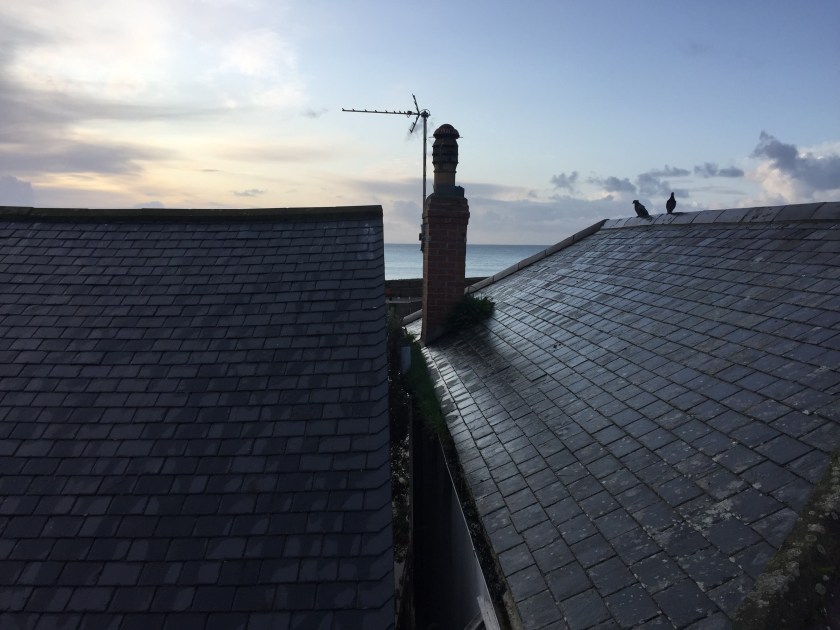
I woke up this morning listening to horses passing.  Their hooves were sounding  on the cobbles outside, except they weren’t because it didn’t take long to realize that these horses were big clots of rain falling from the blocked gutter into the yard below.  We’re staying in an old net-loft, once used as an artist’s studio, and the gutters in the building opposite (so close you could reach out and touch it) are completely clogged with a wonderful array of grass and ferns – very Cornish! I’d  been having one of those dreams that you can chase down to an event during the previous day. My dream concerned a pair of wellington boots – black and very ordinary looking – but which I knew were known as “recording boots” – and which I desperately wanted to own.  They were (needless to say) very expensive. At this point, amateur Freudians, Jungians and my properly professional therapist would be saying – “What were you supposed to be recording?”  I’d gone to bed after reading from John Wright’s new book on foraging, so the obvious (but wrong) answer would have been that I wanted to record plants.

As I often do, when Madame and I sit in bed with a cup of early morning tea, I mentioned the dream to her in the knowledge that it would be hard for her to find any sinister interpretation in my harmless desires. We chatted for a bit and then there was one of those therapeutic silences and it occurred to me that I had spent an amount of time on the bus stop outside the old fishermen’s institute in Newlyn yesterday, regarding a young man – or more precisely – regarding his wellingtons.  I promise that this is not some homoerotic/rubber confession, at least not mine.

And so, with a bit of clarity beginning to dawn, I explained the origin of the dream and Madame launched into one of her revelatory discourses.  Our conversations often seem to possess unexpected emergent qualities.  Suddenly we were back on the quayside in a Newlyn harbour some time between 1880 and 1900.  The young man I observed yesterday, the one with the slightly too large, green, steel toecapped safety boots was obviously a fisherman returning from a spell at sea.  He looked tired out.  On his back was a rucksack that contained very little – I could see a bottle of shower gel, so probably his work had taken him away for several days.

“It hasn’t changed very much”, Madame said. “Not from the Stanhope Ford paintings.”  And it was true. With a different set of clothes he could have been one of the eponymous “Jack” models from the paintings, which were revolutionary at the time, with their focus on a rather romanticised view of working lives. The fishermen, smokng their pipes as they mended their nets and their wives, sometimes grieving wives, gutting fish or hauling them off in huge baskets to sell.  The beautiful young girls not yet eroded by the weather of a harsh life – all there then, and all still here now.  Stanhope Forbes, Walter Langley and the others had found their recording boots.  The herring and pilchard have gone, long since but the young men still put to sea.  In the pub a group of older men came in – down fishing, but not local men – among them one from the Shetlands, one from Ireland.  We eavesdropped on their conversation. They were talking about boats and about the cost of gear.  One remained silent, keeping his counsel and sipping his single pint where two of the others were downing them.

Out on the street there was a lot of ordinary life going on. Young mothers out with their children in pushchairs, a couple of men outside another of the pubs, one saying to another – “She’s not speaking to me so I might as well ….”. There’s work, but it’s often poorly paid and seasonal just like it always was.  Nowadays the catch goes off in lorries while the remaining boats play cat and mouse games with the Spanish and Dutch factory ships out there hoovering up everything including the sea-bed. The fishwives have morphed into an army of cleaners who look after the holiday cottages whose owners live elsewhere. Not much of the money comes into Cornwall.

The Newlyn School painters, if they were able to come back, would find plenty of familiar scenes to paint.  The grandchildren and great-grandchildren of their original models are probably still here somewhere. They’d be able to buy their favourite French cheeses in the upmarket shops  and get some sourdough bread too – that would have pleased them, no doubt. They never lost their London ways. But here, life’s a gamble – only the bookmakers get rich, and hardly anyone can afford a pair of recording boots.

Anyone for angelica?

IMG_6215

IMG_6212Sometimes the success or failure of a day out hinges on something essentially random – like finding a shop that sells crystallised angelica.  We last bought it in Penzance at least three years ago, and so as we set off up Causeway Head I had little hope of finding the shop, which even then had the air of a pop-up, still in business. But there it was, very much in business and pleased to sell me enough for three Christmas sherry trifles at least.  I’d despaired of ever finding it again but somewhere there’s a person with the energy to simmer angelica stalks in increasingly strong sugar solution for days, until the tender stalks are preserved ready to add a touch of green to contrast with the morello cherries floating on whipped cream atop the trifle.  The Potwell Inn always produces Christmas puddings as well, but we rarely eat them until well into the year because sherry trifle made according to a recipe given to us by an old friend has become a Christmas fixture.  As you can see my thoughts have turned instinctively to Christmas for no better reason that the preserving and pickling are all but finished.  Once upon a time, Gill made us the trifle as a gift every year, but when she became too old I took on the task as a tribute.  No Christmas could be complete without it, and because she always aded angelica it never looks right without it.
When I think about it, most of the canonical tasks of Christmas involve quite inexplicable feats of endurance. We know perfectly well that the puddings, cakes and treats are ridiculously rich and life-threateningly full of fat and sugar but a good life deserves a bit of occasional feasting as well as fasting. We are far from the mindset of a couple known to Madame whose idea of the perfect Christmas lunch was to warm up an Iceland frozen turkey dinner and eat it on their laps. Somehow the angelica is even worth a trip to Cornwall, and  always tastes better as a happy accident.  IMG_5459

We grow it on the allotment – it’s a magnificent sight in the summer as it grows to six feet tall – each plant producing enough of the leaf stems to decorate a hundred trifles – but once again this year, we didn’t find time to create our own store in the kitchen. The little shop is, in itself, a model. There is virtually no packaging to be found in it, you could bring your own containers and buy a huge range of ingredients from bulk.  How strange that even in cosmopolitan foodie Bath there isn’t an equivalent shop – I’m sure it would do well.

We walked up and down the pedestrianised street and found an excellent bookshop (Barton Books) the contents of whose bookshelves closely resembled our own at home.  I think I’d read about a third of the stock, and would happily have read the rest.  I joshed the owner a little and asked him if he’d only stocked his favourite books and he responded that good booksops always reflected their owners’ tastes. I couldn’t agree more, and I came out with John Wright’s latest book on foraging which I’ve already started reading.

Penzance is a place of contrasts  – three years ago I’d have been glad never to visit again after we watched an unhinged young woman pouring abuse and beating her dog in the street.  Today we were in Newlyn buying some fresh fish and the fishmonger said he lived in Penzance but it had become “a hole” over the years. Exactly as if we were at home, we watched a couple selling drugs on the street – both obviously addicts themselves, both hollowed out by drugs and life in general and with no provision for any help out of their mess.

Mousehole, where we’re staying, is stuffed with ludicrously pretty cottages which are all that remains of a once thriving fishing community.  Next door in Newlyn there is still a big fishing fleet but Moushole, with its tiny harbour, confines itself to selling souvenirs and doing a bit of occasional crabbing. The purpose has gone out of the place. In Newlyn the fishmonger said he’d voted for Brexit.  I sincerely hope for the town’s sake that he doesn’t get his wish. Virtually all the fish we eat as a nation we buy in, and virtually all that’s caught here is sold abroad, overwhelmingly in Europe. If tariffs were applied to the catch, the fishing would become as unprofitable as the tin mining and that would leave tourism – which only really pays for a third of the year – as the principle industry, bringing even more poorly paid jobs, homelessness and unemployment, helplessness, anger, drugs and alcohol abuse.

But the incomers seem to be taking up at least some of the slack by driving up house prices and providing work for an army of builders, painters and plumbers. The landscape and its wonderful light are largely untouched by change and the granite landscape of West Penwith is as magical as ever it was.  Am I too hard on this place?  We lived in Falmouth for a year as students and were both captivated by it whilst, at the same time, being wary.  You’re always an ’emmet’ here, one of the teeming hordes of ant-like tourists who come, as if to a left-luggage office, looking for something you’ve lost but can’t quite describe. The little battery lit serpentine lighthouse you used to be able to buy from the turners’ shacks on the Lizard has come to stand as a lament for that loss.

We walked to Newlyn today and passed the memorial on the original site of the Penlee Lifeboat station from which the Solomon Browne set out in 1981 in a hurricane force storm to try to rescue the crew of the Union Star coaster. Both crews were lost in the 60 foot waves, and the tradition of Christmas lights here must surely reflect and bring to mind that terrible tragedy as the lights shine out across the sea as if to welcome back the men who will never come.

IMG_6206There’s nowhere to park here: the village was fully formed before the car was invented and the old fishermen’s cottages form a maze of narrow alleyways but there’s an excellent bus service back and forth to Penzance and from there onwards to anywhere in the county. On the roadside facing the sea there are allotment gardens, with some sculptural and whimsical scarecrows.

So, as always we celebrate a few days in Cornwall with mixed feelings. Loss and tragedy are never far below the surface and yet there are few places quite so likely to get the creative sap rising. The railway line to Penzance brought with it not just the tourists, but the painters of the Newlyn School, and later the St Ives artists who, for a while, changed the course of art history.  It’s a culture that’s never quite at ease with itself, often feeling isolated and angry with the ‘upcountry’ politicians who have served it so badly.  If ever a place needed strong regional government this is it. There’s an uncanny resemblance to Wales where the mineral wealth was extracted by a semi colonial economics leaving the place sucked dry.  Love it?  Hate it? It’ll still be here long after we’re all dead!