
This is a white crab spider – I’ve never seen one before and neither had the gardener at Rosemoor who found it. I think it’s not so much rare as difficult to see, since it’s a bit of a pirate, ambushing its prey by sitting on a white flower and blending in until the unfortunate victim alights and gets more than it bargained for. If I’ve got the ID wrong blame me and not the gardener, I just googled “white UK spiders” and came up with this elegant assassin.
 So our first day at Rosemoor was not nearly as wet as the forecast promised, although we kept our waterproofs on all day. Last night’s rain was prolonged and heavy so we weren’t taking any chances. Our main interest was in the vegetable gardens because I wanted to find someone who could help us to understand what happened to our onions this year. So I trailed around with the pictures on my mobile, accosting gardeners and largely discovering that they were no wiser than we were. Aphids were mentioned, as were all the usual suspects – flies, fungi and eelworm, but none quite fitted the bill. In the end Madame suggested that it could have been that the sets, which arrived early and had to be stored for ages, had simply deteriorated before we planted them out. The idea made sense to both of us, although it would mean that almost everyone else on the allotment site stored them badly as well. Anyway we’re getting an email address for a free ID service for members and I’ll send off the photos to see if there are any more suggestions.
As ever there were some wonderful things to look at – alliums were everywhere, as befits their recent ‘must have’ status; and as wide a range of plants as you could hope to see, but I’ll never be a gardener in the Gertrude Jekyll sense. Notwithstanding the efforts to make borders and beds look “natural”, there couldn’t be anything less natural than this kind of English garden, absolutely stuffed with non natives and hybrids it reminded me of the way the Pitt Rivers Museum in Oxford used to be, apart from the fact that the labelling is a lot better. Two large tulip trees were still in flower, the photo on the right above is pretty much real size, and very spectacular they are.
I think the biggest question I came away with centred on the idea of nature. I have to confess right now that I’m a bit of a fundamentalist, and it’s not something I feel particularly happy about but my default position is that the less human intervention there has been, the better I like it. I can see a million reasons why that’s an unhelpful mindset because if anything is dynamic and ever-changing it’s the natural world and there’s no point in railing against Himalayan balsam, for instance because it’s here for good.
Much of the area occupied by Rosemoor is a relatively recent (1989) addition to the older gardens and involved digging out 13,000 tons of heavy clay and redistributing it around the gardens to achieve level beds. That’s a lot of dirt being turned over and moved around, enough to keep a ‘no-digger’ awake for a week. So you just have to accept that this is a blank canvas garden of the kind beloved by hard landscape contractors, big flower shows and TV gardening programmes.
And I think I just have to accept that gardens like this are showcases where you can go and look at national collections of your favourite plants, and exquisite displays of plants from all over the world, and I’m sure that if I raised this with the RHS they would say ‘we’re not trying to recreate a natural landscape we’re creating a natural looking one’.
 However, there came a moment when the dilemma became acute for me and that, ironically, was when the garden started to offer something I really wanted to see. There are now some quite large areas of wildflower meadow which I fell upon with joy. There were southern marsh orchids in flower, ragged robin, knapweed, oxeye daisies, umpteen grasses like crested dogs tail and so on, yellow rattle and an unexpected white flower that I don’t think I’ve noticed before which turned out to be Star of Bethlehem – Ornithogalum angustifolium . It was all too good to be true, surely? There, in a patch half the size of a football field, was a collection of plants I’d expect to find one at a time in a day’s search over a much wider range. All this in an area that had been turned over by earthmovers less than 30 years ago. It’s a wonder, a triumph of science and the gardener’s art. A horticultural Las Vegas in the depths of a Devon valley. I’ve never seen a better display of plants in a wildflower meadow; it exactly fits our current anxieties about biodiversity, and I don’t suppose the birds, the insects, moths and butterflies that flock to it will give a hoot whether it was there in 1930 . Compared with the usual miserable sowing of ‘wildflower mix’ that developers ususlly throw around their bleak gulags to persuade the planners that they really care about nature, this was xanadu. So why was I troubled? I think a large part of it was my stupid attachment to authenticity – whatever that means – and the truth is, starting from where we are (which is a pretty dreadful starting point) there’s no other show in town except the Las Vegas route, re-creating at great expense and with enormous skill, the flora and fauna of the environment we’ve allowed to decline to the point of no return. There’s no way back to the good old days before we lost nine tenths of our wildflower meadows, because simply abandoning a patch of ground to ‘nature’ can’t possibly succeed.
So my takeaway point is that there’s no cheap way of restoring these habitats. If we’re serious about restoring them, throwing around a handful of imported and non-native wildflower seed is a dangerous distraction. It will take time, skill and an abundance of resources. Notwithstanding my reservations, I think the RHS have cracked it, bless them.
 And just one more little joy – they’re developing a new orchard here and it’s dedicated to one of Madame’s old bosses – George Gilbert, a delightful man who probably knew more about apples than anyone else alive. We also saw a plaque in his memory at the Lost Gardens of Heligan, commemorating his contribution to the gardens there. He died in 2007, and took with him a lifetime of experience. His students are a big part of the future if we’re ever to rediscover and recreate the lost varieties of apples, pears and soft fruit, lost to careless agricultural policy, and that’s another star for the RHS who do so much to train the next generation of gardeners with apprenticeships, courses and such like.


 Being slightly obsessive I caught myself naming plants – with their Latin names if I knew them – as we walked down to the village today. Thank goodness no-one can hear the conversation in my head – if they could I’d have been locked up years ago!
 It was much shorter than I had imagined, but the upper leaves were unmistakable. But was it the real deal? – there’s a hybrid but without Stace (the bible) I can’t be sure. Then, just to cap a lovely walk we spotted pellitory of the wall hiding behind a gatepost. That’s another two medicinal biggies and then at the last moment a Silver Y moth on the roadside.


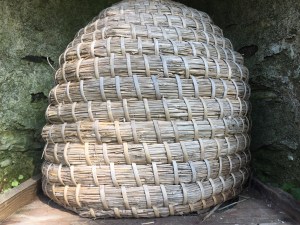 And that, I’m sure, is why honey is now gathered from conventional hives at Heligan while the skeps are treated as an historical record for the benefit of the tourists. Our visit to Heligan has provoked a lot of thought. It’s a brave idea to recreate a garden that last existed in its full glory over a century ago, and we love being there. But there’s no way that modern gardeners could justify using the old chemical treatments in the name of authenticity. On the other hand, some of the potato varieties being grown are so vulnerable to extinction that they simply have to be protected by modern chemical sprays for fear of them being lost forever. There are no easy ways of doing real gardening and sticking to the high moral ground all the time.
 Anyway, on the Potwell Inn allotment some new ideas are unfolding. At the border of the allotment site we have a long row of Leylandii – ugly sun-stealing brutes they are, and apart from providing a perch for wood pigeons they’re hardly a wildlife hotspot. It would mean moving a bureaucratic mountain, but why not cut them down and replant with mixed smaller trees like birch, field maple and hazel interspersed with a thick undergrowth to create a boundary hedge attractive to wildlife? Why couldn’t we link up with a goatkeeper and provide them with moveable fencing to graze off abandoned and out-of control allotments. We used to keep a goat and believe me she would eat anything. There used to be a wildlife corridor on the southern side of the river which took in a long derelict site before the Local Council awarded a contract to Crest Nicholson to build ludicrously expensive flats that effectively concreted over the whole area. By way of honouring their agreement they planted some sick looking sallows and laid a park with some kind of turf with a dozen species trees. It’s exactly the same mindset as the old skeppers had. “Nature is infinitely abundant and all those bats and birds and insects will soon find somewhere else to go”. And under the skep goes the sulphur – except this time the skep is the same size as the earth and there’s nowhere else for the wildlife to go, and now we’re the wildlife being choked to death by the sulphur.
 This photo is pretty out of date because, in the intervening period since it was taken, the chillies have been removed from the heated propagator and the basil put back in for a bit of a holiday in the sun which resulted in them growing rapidly. There are a number of different varieties of basil and this is the first year we’ve grown anything except the normal “Classico” type we’re used to buying in the shops. Franci seeds have a pretty wide selection for the UK market but I’m sure there are many other suppliers, and this year we added their ‘Basil bolloso napoletano’ to our list. It’s impossible to compare the performance of the two types because we treated them rather differently. The fact is, any basil seems to love heat and light.