I’m not quiet I’m thinking!

IMG_5928

Actually that’s not totally true because like many grandparents find, school holidays offer lots more opportunities to be with grandchildren and this last couple of weeks we’ve also got together with all our grown up children. However that’s not where most of my energy has been going, because I’m in the process of changing my mind. This isn’t a small matter of believing X rather than Y, but a fundamental problem with the way X and Y have been understood. LIke the vast majority of people who are interested in natural history I’ve gone along with the prevailing view that the preservation of threatened species of all kinds hinges on re-creating the precise ecological communities – if necessary behind high fences –  that once allowed them to flourish. The vocabulary of conservation is spattered with words like ‘virgin’ and ‘pristine’ that imply that nature was OK until we messed it up and so we need to rewind the programme to the point where it went wrong and then press the freeze button for the rest of time. It implies that there is some kind of evolutionary plan that resulted in everything being the way it used to be before we spoiled it, and, even worse, that these ecological relationships were somehow ‘right’ and any deviation from them – for instance when so-called ‘alien’ species (the very word gives the game away), move in, they need to be removed, or perhaps ‘cleansed’ in order to return to the pre-lapsarian state of grace. Forgive the religious language but it’s actually a religious thought wearing a white lab coat, but it’s all wrong, and that’s where I’ve been stranded, reading furiously (in every sense of the word) and trying to catch up with a field I know very little about.

At the very moment I was finally getting settled into my botanical studies, I started to get interested in weeds because there are a lot more of them nearby to study; one thing led to another and now I’m in limbo trying to figure out what it’s all for.  What’s the direction we need to travel in in order to repair the ecological damage we’ve done, without  reducing the natural world to a desert with a few gated reserves dotted around to remind us what we’ve lost? What does a healthy and productive earth look like? – feel like? How can we live our lives fruitfully without making things worse? How did we get to the point where we defined the best interests of a tiny part of the human race with the interests of the whole earth? … and I don’t have any answers at all yet. Doubtless they’ll come along eventually but in the meanwhile I’m prowling around the Potwell Inn in a mist of self doubt needing to examine a large part of my experience and memory, paying special attention to the presuppositions that have been pit props and retaining walls to my inner world for decades.

Of course there’s a wider context for all this.  The political chaos that hangs over us like a black cloud is an inescapable source of anxiety, but personally too, things have happened that threw me off kilter.  A farmer I’d known well in one of my parishes fell down the stairs at the weekend, broke his neck and died the next day. It’s a heartbreaking event for his own family, but it leaves us all feeling that life is fragile, fugitive. What with the morons in charge and accidents and illness threatening, what’s the context in which we can  understand the earth, its tides and weather in the broadest sense.

It feels like grief.  Cooking and gardening feel like going through the motions, displacement activities. Yesterday I went to the local stationers and to my great surprise I was able to buy a card index – the beginnings of the Flora of Muckyannydinny Lane.  It’s a card index because you can’t design a database until you are able to define it detailed purposes and I’ve no idea yet what that purpose might be so it’s back to the technology of the quill pen.

But now I’m off to try to mend the fridge on the campervan before we take a break driving as far North and West as we can in England. Yet again we were drawn to the West, and we’re going further North too – right to the Scottish borders, completing the last link from Cornwall in the South and catching up with friends on the way.  There’s nothing systematic in this, just happenstance and curiosity and a big pile of books of which the latest is Fred Pearce’s “The New Wild”. Read it – it’ll explode your mind!


High Summer overtakes the kitchen

IMG_5878There’s a smell  – or perhaps more mellifluously a perfume – for each season, and often it’s the perfume that gets you into the one that’s coming without your becoming aware of it.  Suddenly the kitchen is full of glugging and bubbling ferments, you’re scratching around on the top shelves looking for preserving jars and that packet of rubber seals you were sure you bought last year, or was it the year before that? Dill, garlic, basil above all, and the apple smell of the sourdough starter fill the air and the feeling of hunkering down becomes dominant. Six weeks after the solstice it becomes impossible to ignore the fact that the evenings are drawing in.  Apart from weeding there’s not a lot to do on the allotment other than bringing home the vegetables but it’s still too hot to embark on the civil engineering projects that you’ve got lined up for the autumn and winter. After a prolonged dry period it’s raining on and off here and so the urgent need to water has gone.

I’m always astonished at the capacity of ferments to survive.  The kefir which we secreted at the coldest part of the fridge months ago came out yesterday smelling as fresh as it went in.  A quick swill under the tap to wash off the painfully sharp ferment from the grains and then some fresh milk and within hours it had warmed up and thickened as if it was last topped up yesterday. The sourdough starter needs a bit more attention but provided it’s fed weekly it will wait patiently until the urge to make bread overtakes me tonight and I start a new batter. The second batch of half sours is awaiting a clean jar and perhaps some fresh dill and a touch more sugar, but they’re crisp and still taste of gherkin. Madame is mass producing pesto for the winter and rolling it into long sausages which, after a couple of hours in the freezer, can be sliced into portions and returned to the freezer for later. Real instant food.

The Potwell Inn allotment is capable of throwing up all sorts of surprises, and this season the tender fruits and vegetables have done better outside than they did in the greenhouse.  The exception is the habanero chillies which really do need the heat, but the other chillies, the basil and the aubergines have all done better outside.  After decades of loathing I’ve finally made peace with ratatouille (as long as Madame cooks it) just in time for the usual surplus of courgettes. In France, or at least in the South East which we know better, the whole of August seems to be occupied by fêtes but here the rhythms of sowing, harvesting and feasting seem to have very largely disappeared, choked out by the vacuous plenty of ‘food as entertainment’  and flowing into the eutrophic ponds of our impoverished lives.

Today a new garden tool arrived in the post.  I’ve wanted a hori hori – a narrow Japanese combination of trowel and knife  – for ages, but it’s been a struggle to find one that wasn’t a foot long and looking like a lethal weapon of some sort. This one looks innocuous enough to carry in my bag without attracting attention to itself.  It’s really for digging bits of root, dandelion, burdock, horseradish – nothing rare – without digging out the whole plant. It was only a fraction of the price of some of the loftier artisanal products that boasted carbon or stainless steel forged blades and leather holsters, but I thought I could test the principle before lashing out on one to impress the neighbours.

I absolutely love the changing seasons apart from a couple of weeks between September and October when the declining daylight and the empty ground combine to make me feel listless and sad.  All my charges have been harvested and I get a bit rootless, but it’s never long, then, until my birthday and after that the sun rises a little earlier each day until the winter solstice.


Unravelling a bit

img_5233

There I am, nose firmly stuck in Richard Mabey’s book “Nature Cure” to which I turned the moment I finished his “Weeds – the story of outlaw plants”, when Madame says to me – “I wish I could find more books like that for you” – the subtext reading something like -‘then you’d sit quietly occasionally’.

The books that have been most important in my life have all shared a number of characteristics in that they set me off on a binge reading spree of the author’s other books; I always read them twice or more; I also read the footnotes; I read the bibliographies and finally I then continue the reading binge by reading the sources.  In this instance many of Richard Mabey’s other books were already on the bookshelf, bought years ago and for reasons only peripherally connected to my present interests.  “Flora Britannica” was bought to supplement the books on botanical art, for instance. First time round the books were interesting and, if you like, out there in the sense that they didn’t get under my skin like they are now; all of which is a rather long introduction to the fact that I woke up this morning feeling cross and after reading in bed for half an hour I felt even crosser – mostly with myself. The phrase, a quotation, really crystallised a sense of unease I’d been failing to unravel or confront for weeks. I realized that I was feeling slightly miffed by the fact that Richard Mabey had perfectly articulated in 2005 a difficulty that I had steered around using a very sophisticated evasion.

But first I need to introduce a new term that I’ve not used before because I’ve tried to avoid using challenging language on this blog.  However this term (which I’ll explain once and then use the less provoking acronym PFTP) was a piece of advice regularly given to his students by Canon David Isitt who was Canon Theologian at Bristol Cathedral and one of my best ever teachers.  PFTP stands for “pissing from the pulpit”and it’s what you do when you explain how harrowing and difficult your sermon has been to prepare and preach. ‘Nobody wants or needs to know about your suffering!’ He would rage when some hapless student had broken his rule.

I have the gretest affection for everything David Isitt taught me, but in the particular instance I’m writing about now, I think a dash of PFTP is allowed. The process by which you unravel a difficulty is of interest if it might be of any help to someone else confronting the same problem. So was Richard Mabey indulging in PFTP when he quoted this phrase from Jonathan Bate, concerning the Romantic movement? :-

The price of this intoxication with with the spirit of things is a definite break with the human community. Pantheism displaces philanthropy, communion with nature stands in for social awareness.

He (Mabey) goes on to write – (see chapter 3 – Commonplaces) – to write brilliantly about the dangerous defects of almost all natural history television and books, their cutie cutie anthropomorphism and fabricated narratives. The question I couldn’t avoid asking myself, crystallised as a challenge.  “Isn’t your blog in danger of adding to that selfsame false consciousness that creates an entirely bogus world in which runner beans cavort in an organic paradise, and rare wildflowers (accompanied by lofty thoughts) spring up in your path as they did for the great saints.  Or to put it another way, is it ever OK to write when you’re angry or will that put off the readers, the people you’ve gulled along with your lovely word pictures and photos?

I can almost guarantee before I press the ‘publish’ button that this will receive less views and less likes than a piece of the same length about sourdough bread or interplanting Nasturtiums, and it concerns me that I’m so worried I self-censor, but it concerns me more that I could end up publishing stuff that implies “I’m quite the cleverest and happiest person in the entire world – just look at how beautiful my world is!”

So when I’ve written about the drug dealers, the machete attacks, the homelessness and the problems associated with living even in a small city –  problems like air pollution, unenforced planning regulations and such like, it’s not because I want to hint what an edgy existence we lead here at the Potwell Inn so readers can admire our tenacity, it’s because that’s the way life is around here, and the orchids have to set up shop in the midst of all this, just as we do. If I’m drawn to talk about the weeds it’s because the urban environment is – in its own way – just as fascinating as the pristine meadow. Can I escape from anything by creating the perfect allotment and going off to explore the western coasts in the campervan ? – of course not, and neither can anyone else.

This is a sceptic’s guide to being human and, to quote Jonathan Swift in his 1732 poem “the Lady’s Dressing Room” – “Oh! Celia, Celia, Celia shits!”. (Sorry that extra vulgarity slipped in, but it expresses in a line what I’d struggle to write in a paragraph). Being fully human is – to quote Francis Schaffer, to be “a glorious ruin”, and more than anything else I think the greatness of human life lies in being able to live fully in the midst of the bigotry and stupidity of moronic politicians and their poisonous effluvia.  I don’t want to use (Wordsworth’s) daffodils as a distaction from my moral and ethical obligations to my neighbours and I’d be heartbroken if anything I ever write became a substitute for real action.

Life is a work in progress – until it isn’t any more – and there’s a lot more I’m trying to get my head around (sorry, more PFTP), but what’s shouting at me is that I can’t be an objective and detached observer of the natural world, however rhapsodic that might make me sound, because the best I can manage is to notice it from the inside. There’s no part of me, not a single cell or thought that’s not embedded, hefted in this mess – and, to quote Dylan Thomas – ” – I am dumb to tell the crooked rose / My youth is bent by the same wintry fever”.

Near where we used to live there’s a difficult place to find, called Damery Lake.  It’s hardly a lake any more but a small trout stream runs through it and it’s crossed by a narrow lane that winds for four or five miles between a farm shop I knew well, and a canoe showroom – so naturally I often found an excuse to take the long way home and go from one to the other. I stopped once on the small pack-bridge crossing the stream and I was struck by the most painful waking dream, that one day a century ago, a young officer, fighting in the midst of one of the terrible First World War battles came back to the lake in his imagination and escaped the horror for just a moment as he remembered his childhood nearby, and that some part of his consciousness had become attached to the place like a ghostly presence, filling my mind too, and so the scene ever since has been engraved in my imagination.  Two very small, very expendable human lives separated by a century and united by a place of great natural beauty.  I wonder if he ever found his way back to the lake, or even fished there? Writing the natural world has to embrace all these dimensions of life if it’s not to become escapist and dangerous, and I salute Richard Mabey for encouraging me to take the risk.


Antics in the long grass

The City Council have gone green – well that’s one explanation, and another might well be that they’ve seen a way of saving money that they can dress up as a green policy. Either way round it’s still a good idea except  we’ll have to see what kind of reception it gets from the local residents in the longer term.

Essentially the policy is to stop mowing a strip of grass around the southern edge of the green and also under the trees outside our flat, . The idea was circulated and the response was very positive and so it’s being implemented. The text of the announcement uses the words “leave a strip uncut” but doesn’t specify how wide the strip should be, which has led to a variety of interpretations by the tractor drivers – some of whom have left a couple of metres and others who’ve mowed right back to the edge as usual. You can’t blame them, they’re grounds workers whose job has always been to keep things looking tidy and suddenly they’re being asked to go against all their instincts and leave a whacking great area of weeds.  It must feel completely wrong, and this has resulted in a piece of wide stubble instead of allowing any plants to grow up and set seed.

But there’s another problem looming. The responses made great play of the reappearance of ‘wildflowers’ on the green, and I fear that when residents don’t see the poppies and scabious they’re expecting but the thriving nettles deter them from retrieving lost footballs there may be a reaction. Butterflies, moths and pollinating insects – the kind we’re trying to preserve – feed on, and lay their eggs on all manner of wild plants including (but by no means exclusively) the pretty ones, and a proper mini-reserve wouldn’t necessarily look pretty at all, quite apart from removing some favourite shady areas.

Yesterday we were having a picnic with the grandchildren on the green, and my oldest grandson brought back a burdock leaf to ask me what it was. Later on I had a scout around the tree and found a whole collection of Lesser Burdocks of various ages, some obviously in their first year when they’re just a rosette on the ground.  There were also a couple of magnificent Welted Thistles, lots of Broad Leaved Plantain, some Chickweed, lots of Wall Barley and – mysteriously – a tomato in flower. The tomato must have come from a picnic like ours, but it begs the question (given our locality) how long it will be before we see the first seedlings of Cannabis. The area under the tree has long been a favourite place for a quiet smoke while waiting for the dealer to show up.  Now these are (nearly) all nice and useful plants, but apart from the tomato they can barely boast a ‘decent’ flower between them. I was most pleased about the Burdock because it’s a useful medicinal plant, but I’ll harvest the seeds rather than the plant because there are far too many dogs on the green to make consuming them a pleasant thought, and I can try growing some in drainpipes on the allotment. That’s OK they think we’re bonkers already.

If this kind of ‘wilding’ is going to work we’ll need to communicate much more effectively what the outcome will be. Most people can’t tell a wasp from a hoverfly and are afraid of almost every insect except ladybirds.  Some signage would help, as would an opportunity to meet a naturalist who could explain things and answer questions, otherwise there’s a danger that local residents will react against the scheme and demand their tidy lawn back again. Primary schools are already doing great things with the under-elevens who are far more ecologically sophisticated than most parents.  Our oldest grandson is only six but he’s fierce about the natural world.

So it’s a great idea, but if the City Council see it as a money saver then it’s sunk before it starts.

A very genteel affair!

IMG_5903

Yesterday afternoon, after a long fish and chip lunch (working class dinner) with friends, we both needed a walk so we wandered up to the Botanical Gardens with no particular quarry in mind except the vague hope that there might be some traces of a physic garden in amongst the plantings. No such luck, though – the garden has its seasonal moments, but apart from a couple of very nice borders the trees are the main survivors of the relentless pressures of austerity.  The garden is just far enough from the tourist hotspots to allow the City Council to neglect it without much fear of being called out. Any protesters can be labelled as ‘minority activists’ citing the pressing and greater needs of social care and claiming that these sorts of things are expensive fripperies  – like libraries and galleries …… and – the list goes on, the cuts get deeper and the fabric of society begins to disintegrate. The Garden is only a short walk from Royal Crescent which is constantly crowded with visitors who photograph the lovely architecture without giving a thought to where the money came from.  William Beckford whose folly overlooks Bath from a commanding position on Lansdown was one such landowner.  His Wikipedia entry gushes on about his achievements as an art collector, novelist and politician but remains silent on the slave plantations that provided his inherited wealth.

So it was a relief to find Carters Steam Fair setting up next door.  Carters is unlike any other funfair you might have been to – for a start you’re safer at the fair than you would be crossing the A4 to get to it.  When I was a child, travelling fairs were thought of as being a bit rough and risky.  On the hot evenings fights would break out like summer showers and I can recall the boxing booths where the local lads would get up and have a go.  There were still a few freak shows and I even remember the name of one burlesque act, called “The Naughty Nineties Girls”.  These all added to the erotic undertones of the funfair.  During the afternoons it was mainly attended by families and children, but as a teenager when I was first allowed to go at night, it took on an altogether darker and more exotic life.  As you approached, you could hear the raucous music and see the lights. What was so wonderful about it?  Well, it was edgy, liminal – you had to cross the penumbra of scattered light to enter – it was everything that life at home wasn’t – joyful, noisy, disorderly, open-ended.  They played rock and roll music and there were girls. The young men running the rides were like young predators stalking their supper. It was Weimar Berlin, bathed in diesel fumes and the smell of the summer night.  There were huge noisy generators run by men who’d seen it all, there was mud and straw and the greatest thing of all was that it would disappear after a week leaving just tyre tracks and yellowed grass. A truly proletarian event.

IMG_5904

Carters has all the old rides, the paper roll steam organs and the rock and roll music. There are generators and candyfloss and hotdogs but it’s resolutely respectable and run by a family who spend their winters restoring the unloved relics of the dangerous days. They even run courses on funfair lettering and painting.

Re-live Grandma’s Yesterday

That’s the slogan on one of the lorries and we’ll be there on Saturday afternoon when it opens, listening (I hope) to the Everly Brothers and photographing the spectacular machinery. All very low-tech, 1950’s and hauntingly beautiful.

Meet the new parishioners


Two new neighbours, thanks to Richard Mabey’s book on weeds which has reminded me how we don’t know these plants because, through some cultural trick of the mind, calling a plant a ‘weed’ means we often don’t even see it. These two plants are growing on the pavement outside the flat and one of them at least is rather pretty. I don’t think the one on the right – Conyza canadensis, or Canadian Fleabane is ever going to win a prize for its looks, but the other, Erigeron karvinskianus – Mexican Fleabane is very pretty.  We’ve been here almost 4 years now an in that time it’s extended its precarious life in pavement cracks almost the whole length of the street.

There’s a direct parallel with the human population in our ward.  On a short walk into the centre of town it wouldn’t be unusual to pass people of half a dozen nationalities from right around the world. Among our visitors here, Chinese and Japanese are almost as common as the French and Spanish speakers.  Some residents have been here for generations, some stay for years and there’s a whole other mixed age group of students and others who are far more ephemeral. Mexican Fleabane and Canadian Fleabane are just two more visitors who came and stayed.

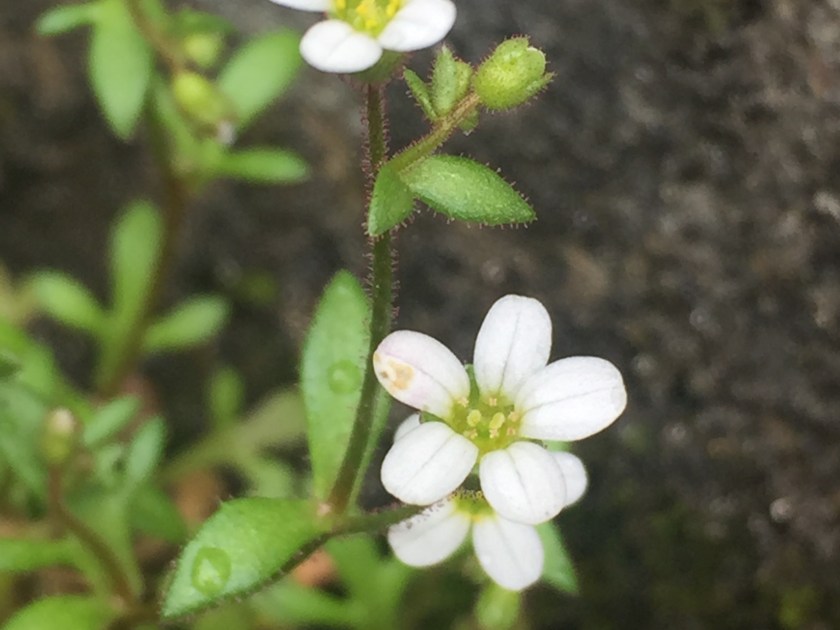
IMG_3768There are others too – this one is Saxifraga tridactylites – the Three Fingered or Rue Leaved Saxifrage that turned up on our fire escape steps in 2018 and promptly disappeared.  It was replaced by a fine crop of slime mould the following winter. I had no idea that slime moulds were mobile but this one slowly worked its way down the steps and on to the yard where it too promptly disappeared.

I love it – the constantly changing plants seem to fit the constantly changing population. There are beautiful plants of course, but there are loads of imposters, spivs and generally indestructable plants like Hedge Mustard and Wall Barley.  I’m not calling them weeds any more because if we’re going to bring the earth back from the brink we’ve got to start calling these plants by a different name.  I’m calling them parishioners because because like it or loathe it we’re sharing both our space and our fate with them. They’ve all got names,  parents and a history, just like the drunks and spiceheads who also spend their days immobile outside on the grass.

I hope I shall be Parson Woodforde to all my new parishioners of whatever life-form; speaking of which, the dog belonging to our neighbour Nutter is barking furiously (fruitlessly) at a hot air balloon passing overhead. His owner is sitting in the sun drinking beers – he hasn’t even gone out busking today – which is a great mercy to all our visitors.