


Up very early, woken by our neighbour who seems to be commuting to work from his campervan. But he wasn’t the only early riser because after owls during the night (who could resist listening?) a cockerel kicked off on the farm and I was wide awake and very much looking forward to finishing reading Isabella Tree’s book “Wilding”. I won’t try to sumarise the book but I would urge anyone to get hold of it and read it – it’s a brilliant introduction to some ideas that are going to dominate the next twenty years if we’re going to survive the anthropocine period. Campervans are like submarines, there’s not a lot of space, so I read sitting in bed, with the aid of a spotlight while Madame slept on.
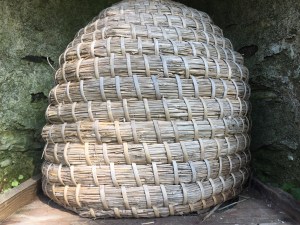
Really good books change the way we think, and I’ve already mentioned some paradoxes that we allotmenteers need to address, such as being over-tidy, making space for insect favouring plants, making space for some species we’ve historically shunned, and worrying about the chemicals that might be hiding in the manure we apply to our plots. As I was reading all sorts of ideas were popping into my mind (which I’ll come back to later) but first I want to explain why when I took these photos of the bee wall at the Lost Gardens of Heligan, I knew – without knowing why – that this was what I was going to base my next post on. Yesterday, technology got in the way and I was frustrated by my inability to get myself online at the campsite. But now I’m glad because it’s taken more than 24 hours to figure it out.
The official line – the one being suggested by our excellent guide – was that the straw skeps were no longer being used to keep bees because an over-curious visitor had gone behind the barrier and shoved their finger into the skep. Cue very cross bees! But I’m perfectly sure that the real reason is more complicated, because for all their visual appeal, skeps and their use in beekeeping are the sign of an attitude towards wild creatures that we’re still battling with in the 21st century. In fact the photos at the top of the page could easily stand as a visual representation of the content of Isabella Tree’s book. Harvesting honey from skeps has a history that probably stretches back many centuries if not millennia. But there’s a problem with it because the honey could only be harvested by killing all the bees first. In the days of Heligan’s bee wall they would probably have been killed by burning sulphur. To deliberately kill a colony of bees today is unthinkable to most of us, but until the early 19th century it was the only show in town. But that didn’t matter because honeybees were so plentiful that every year a new queen and colony would set up home or perhaps a swarm would be given a home by an astute beekeeper. The history of the removable frame hive, where the honey could be removed without killing the bees could go back to the 17th century, but things started to move in 1814 the when a Ukranian beekeper called Petro Prokopovych took the first steps. In 1848, Jan Dzierzon cut slots in the sides of his hives to take removable frames, and in America in 1851 Langstroth invented the first modern hive after calculating what’s known as the ‘bee space’ the smallest gap between the frames that the bees won’t bridge.
But what really matters here is the underlying psychology of the beekeepers of the past who saw no reason why a natural resource like honey should not be treated as essentially free, to be harvested without responsibility.
In 2019 the idea of harvesting without regard to the cost and the impact on the natural world suddenly seems utterly wrong.


Do I sound a bit cross? Well I am cross. But as sure as eggs is eggs, retreating to an idealized past is not an option. Which bit of the past should we aim for? The nineteenth century? the eighteenth? the sixteenth or the tenth? The question is – “how much change in my life am I prepared to embrace in order to create a future for my grandchildren and their heirs?’ And the answer is – a great deal!
Sadly, you may think, there’s yet another list of wildflowers brewing at the back of my mind. If we don’t know what we’ve got we’ll never notice that we’ve lost it.

